SaaS Product-Led Growth and SEO: A Complete Playbook
Product-led growth (PLG) has become the default playbook for scaling SaaS companies, yet 58% of B2B SaaS firms still fail to align their SEO strategy with their PLG motion. The result? Missed organic traffic, longer sales cycles, and customer acquisition costs that climb faster than revenue. When done right, PLG and SEO compound each other. Your product becomes the sales tool. Your content becomes the discovery engine. Together, they drive 702% ROI—and organic traffic fuels 53% of new user acquisition at near-zero marginal cost.
The problem isn't that founders don't understand PLG. It's that they treat SEO as an afterthought, written for search engines instead of users trying your product. This playbook shows you how to align both so organic traffic doesn't just land visitors—it lands activated users who see value before they ever talk to sales.
Key Takeaways
- PLG companies acquire 53% of users through organic search at near-zero marginal cost, compared to 10% from paid channels (2025, Shno.co)
- Free-to-paid conversion reaches 25–39% with PQLs, versus 5–10% with traditional MQLs, creating 3x higher conversion efficiency
- SEO-driven leads convert at 2.1% visitor-to-lead rates, double PPC's 0.7%, making organic traffic essential for PLG activation
- Align Product Value with Keyword Strategy: Choose keywords your actual users search when evaluating solutions—not vanity terms—to ensure organic traffic lands warm prospects ready to activate.
- Build Educational Content Around Your Onboarding: Create content that answers the questions users ask before they sign up, reducing friction and accelerating time-to-value.
- Automate Content Production at Scale: Publish consistently across 1,200–2,000 keywords in six months with autonomous SEO agents that handle research, writing, and publishing without manual overhead.
- Use In-App Engagement Data to Feed Content Strategy: Track which product features activate users most, then create content targeting the problems those features solve.
- Build Topical Authority, Not Scattered Keywords: Group content into clusters around core user problems so organic traffic arrives problem-aware, not just keyword-aware.
How Do PLG and SEO Work Together?
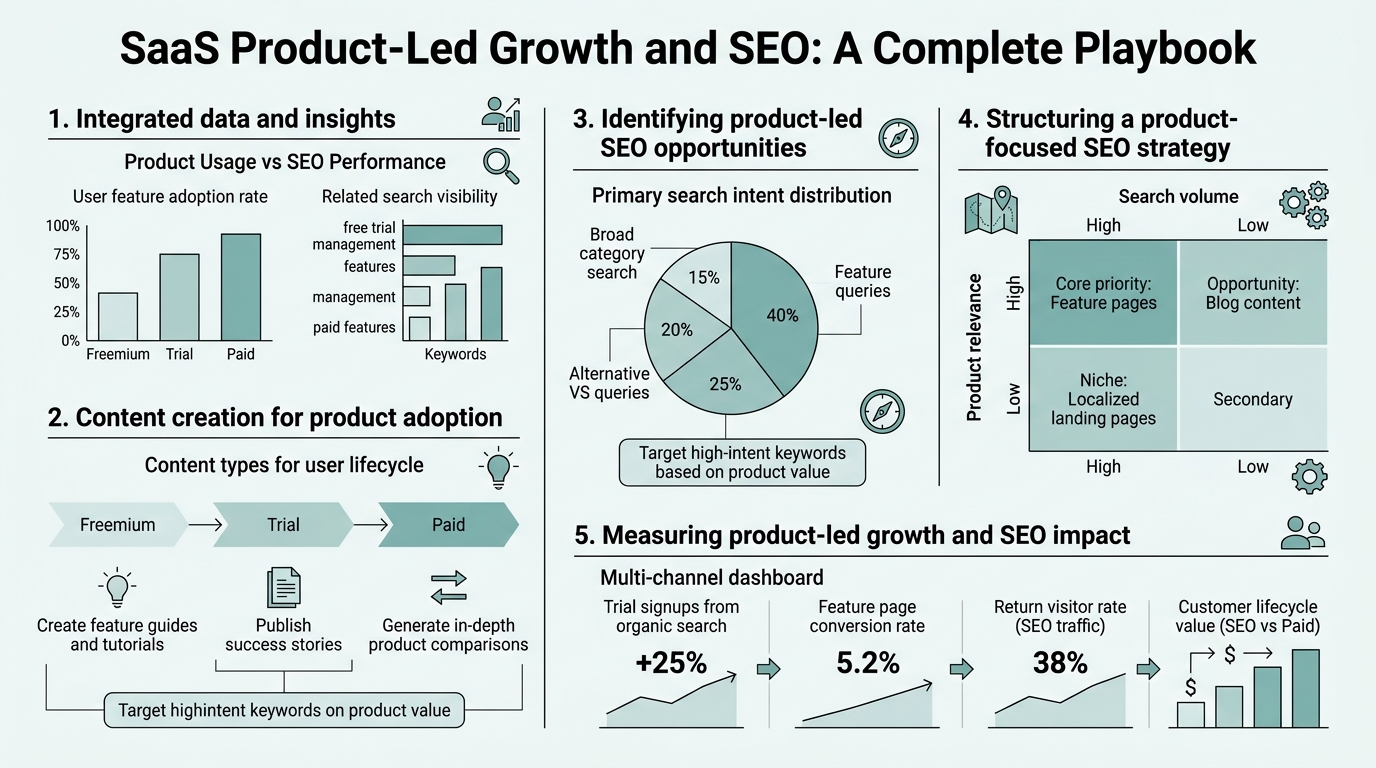
The core tension in SaaS marketing is this: Paid channels acquire users fast. Organic channels acquire them cheaply. PLG companies win by pairing both intelligently. Organic search drives 53% of new user acquisition for PLG-focused companies, yet many treat SEO as a content play separate from the product experience. That's the miss.
When your product *is* your marketing, every content touchpoint must reduce friction toward trying the product. A blog post isn't just rank bait—it's the first chapter of the user journey.
"When your product is your marketing, every content touchpoint must reduce friction toward trying the product. A blog post isn't just rank bait—it's the first chapter of the user journey."
The Three Leverage Points
PLG and SEO compound through three mechanisms. First, organic traffic arrives problem-aware. Someone searching "how to audit content distribution workflows" isn't asking a theoretical question. They have a specific pain. Your content answers it. Second, that content can qualify leads before they sign up via embedded product value—a free tool, calculator, or template. Third, users who discover you through search and land on educational content activate faster because they've already self-educated.
Contrast this to paid acquisition: you pay for intent, interrupt workflows, and lose margin on every click. With organic, your content does the interrupting (because the user initiated it), and your marginal cost approaches zero.
Why Most SaaS Teams Get This Wrong
PLG teams often treat SEO like traditional B2B content marketing: write blog posts, rank for keywords, drive traffic, hope for conversions. But PLG changes the conversion playbook. Your "conversion" isn't a form submission. It's an activated user inside your product. Most SEO strategies never account for this, so they generate traffic but not activation.
The fix is structural. Content must funnel toward product trials, not email lists. Metrics must track activation (not just traffic), and product teams must own the onboarding experience that follows. If your product hasn't proven time-to-value in minutes, no amount of content will rescue the PLG motion.
"Your 'conversion' isn't a form submission. It's an activated user inside your product. Most SEO strategies never account for this, so they generate traffic but not activation."
Building an SEO Strategy Aligned with Your PLG Funnel
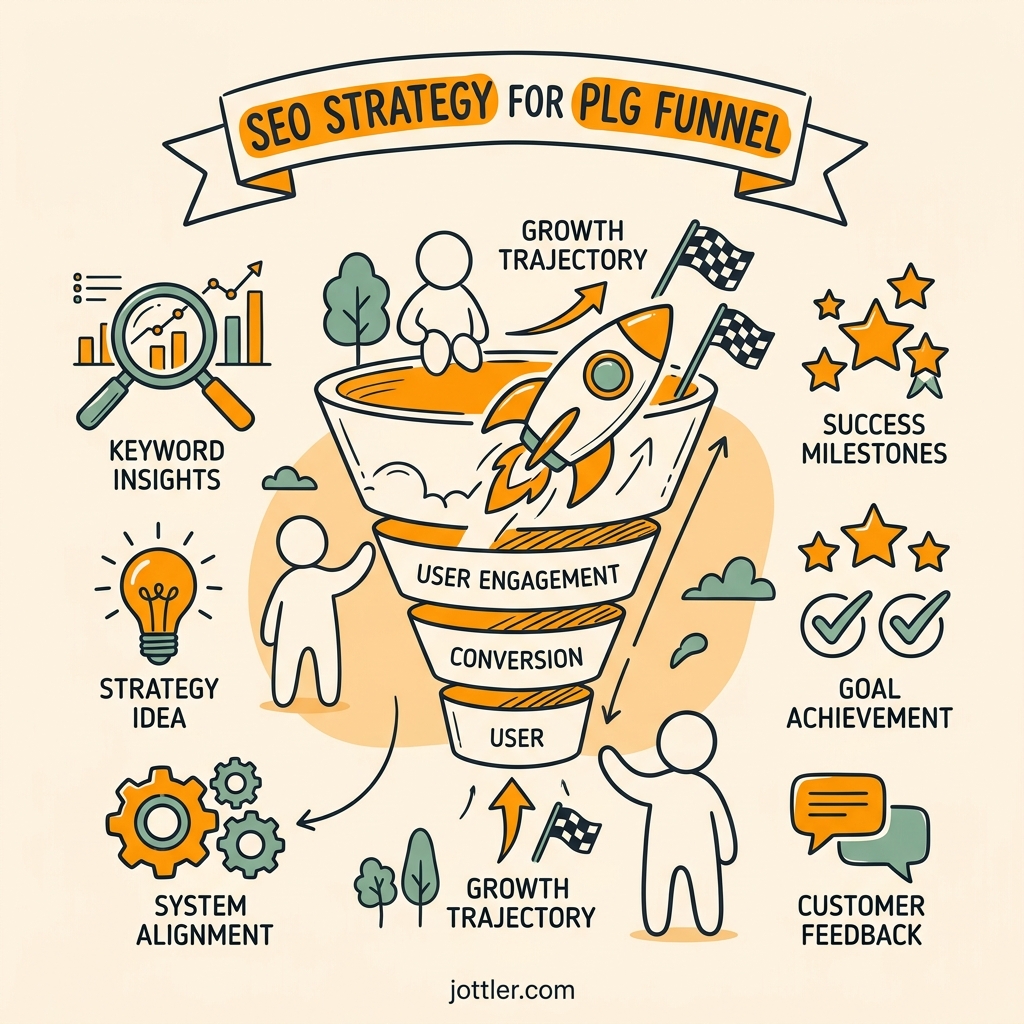
Your PLG funnel has distinct stages: awareness, trial activation, expansion, and retention. SEO addresses all of them—but the strategy differs per stage. Early-stage founders chase awareness keywords. Mature PLG teams optimize for expansion and self-serve upsell.
Map User Questions to Search Behavior
Start by asking: When do our best users first search for a solution like ours? Most teams skip this step and assume their ICP searches the same terms they do. Wrong. Your prospect doesn't know your category language yet. They search for the problem, not the solution.
If you sell workflow automation, prospects don't initially search "workflow automation tool." They search "how to stop managing client requests in email" or "how do I track team task dependencies?" Those are the real entry points. Once you own that language in search, you can introduce your category.
- Interview Recent Activations: Ask your best activated users what they searched before finding you. Record exact phrases, not paraphrased concepts.
- Analyze Trial-to-Paid Conversions by Traffic Source: Which organic keywords drive users who convert fastest? Build more content around those problem spaces.
- Map Product Features to User Problems: Track which features activate users in their first session, then create content targeting those specific pain points pre-trial.
- Track Time-to-Value by Traffic Source: PLG lives and dies by time-to-value (TTV). If organic traffic activates slower than direct traffic, your content isn't reducing friction—it's adding it.
Reverse-Engineer Your Onboarding From Content
Here's where most teams miss the PLG-SEO opportunity: They build content separately from product onboarding. Instead, reverse-engineer the relationship. Ask: What does a user need to understand *before* signing up to self-activate inside the product?
If your product requires five setup steps to reach "aha," create content answering the implicit questions at each step. Don't just explain your product. Explain the problem so clearly that users see your solution as inevitable.
Tools like SEO automation platforms can accelerate this by publishing 3,000+ words of researched, fact-checked content daily across your entire keyword set. This means you can align onboarding content with product flow at scale, not just in your top-10 keywords.
Scaling Content Production Without Sacrificing Quality
Alignment is worthless if you can't produce enough content to own your keyword space. Most SaaS teams hit a wall: they can write 3–5 blog posts per month with a fractional writer. But owning a competitive keyword space requires 15–20 quality pieces monthly, across hundreds of long-tail variations. The gap is where most PLG+SEO strategies fail.
The Volume Problem and Automation Solution
Top-quartile teams publish 1,200–2,000 keyword variations in their first six months of aggressive organic strategy. Doing this manually requires a three-person content team ($180k–$240k annually) or a fractional agency ($3k–$8k monthly). Neither is realistic for early-stage founders. Automation fixes this without sacrificing the rigor that ranks.
Modern AI-powered content platforms now handle research, fact-checking, and publishing at scale. Jottler, for example, deploys 12 AI agents that research topics from 14+ sources, fact-check every claim, build internal link networks, and publish 3,000+ words daily to your CMS. This means you can produce the volume competitors can't, and your small team moves from writing to strategy.
"Top-quartile teams publish 1,200–2,000 keyword variations in their first six months of aggressive organic strategy. Automation enables small teams to hit this target without hiring a full content team."
Research and Fact-Checking Aren't Optional
Automation tempts teams toward volume-over-quality shortcuts. Resist that. Unverified content tanks trust and rankings. According to Oliver Munro's SaaS marketing benchmarks, every statistic must cite a source and reflect current data. Using 2024 stats in 2026 content looks lazy and costs rankings.
The tools worth using integrate fact-checking into the pipeline. Your agents should pull data from multiple sources, cross-verify claims, and flag contradictions. This takes longer than a human writer alone, but less time than manual research and verification—and it scales.
Internal Linking Compounds Topical Authority
Volume is worthless without structure. Create 3–5 clusters of 10–15 content pieces each, with pillar articles linking to topic clusters, and cluster pieces linking to each other. This topology tells search engines you own topics, not just keywords.
If you're publishing 50+ pieces monthly, manual internal linking becomes unsustainable. Automated systems can map semantic relationships across your content and suggest or auto-implement links. This isn't lazy—it's essential for scaling without losing coherence.
| Content Production Method | Monthly Output | Cost (Monthly) | Time-to-Publish | Fact-Check Coverage |
|---|---|---|---|---|
| Manual Writer (1 FTE) | 4–8 posts | $4,500–$7,000 | 14–21 days | Self-verified only |
| Fractional Agency (10 hrs/mo) | 8–15 posts | $3,000–$8,000 | 10–14 days | Spot-check only |
| AI Content Tools (GPT-based) | 40–80 posts | $500–$2,000 | 2–5 days | Limited (no external verification) |
| Jottler (12 AI Agents + Fact-Check) | 90–150 posts | $29–$299 | Same-day publishing | Cross-source verification + citations |
The difference isn't just volume or cost. Jottler's multi-agent pipeline researches claims across 14+ sources, cross-verifies data, flags contradictions, and publishes only content where facts are grounded. This removes the quality penalty most teams face when scaling from 5 to 50+ pieces monthly.
Converting Organic Traffic into Product Activations
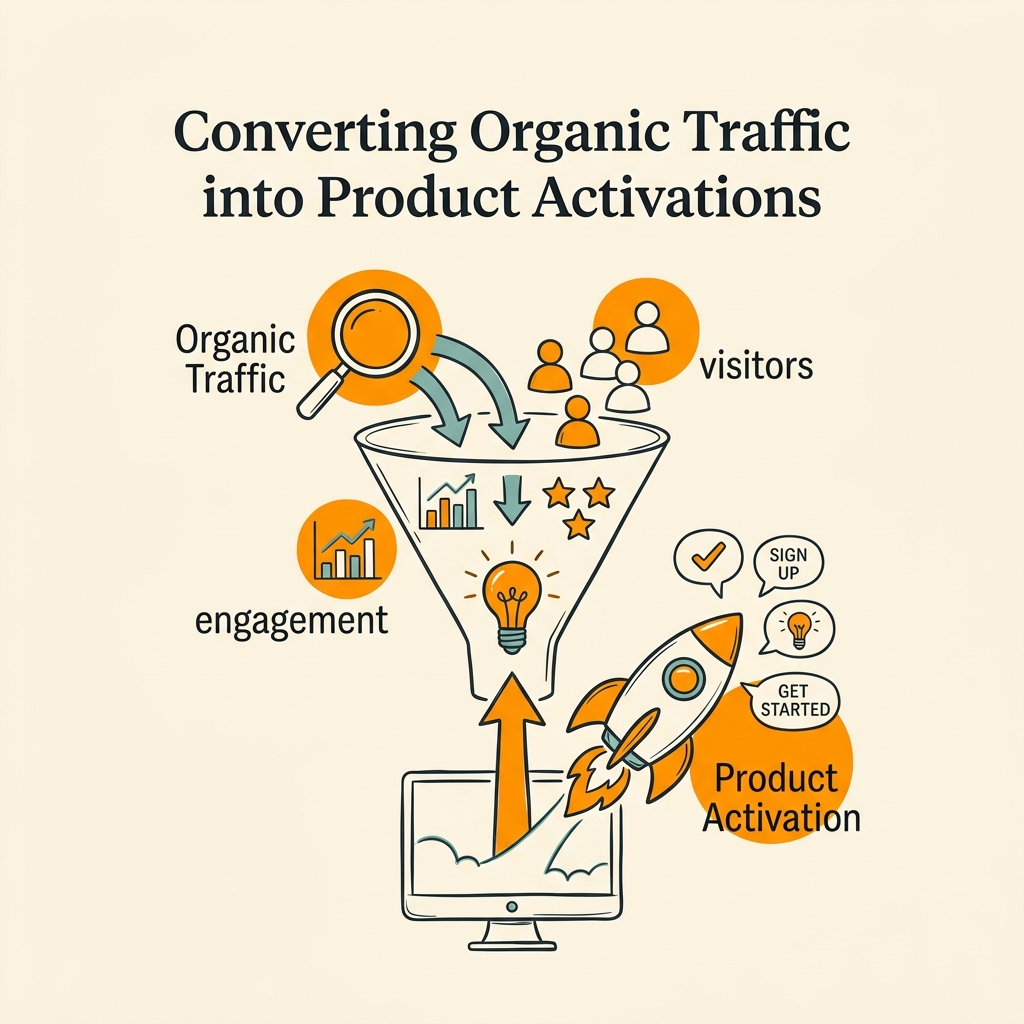
Traffic without activation is a vanity metric. PLG's real power is converting cold prospects into activated users—ideally without sales touch. Your organic content must funnel toward this outcome.
Design Content Around Trial Entry Points
Most blog posts end with a CTA that links to pricing or a generic demo form. PLG is smarter. Content should funnel toward specific trial entry points that match the problem the content solves.
Example: If your content addresses "how to consolidate scattered customer feedback," the CTA should link directly to a feedback dashboard trial, not your homepage. Users land problem-educated. They see the specific feature that solves it. Activation time compresses.
This requires coordination between content and product teams. Every content piece needs an associated trial path. Measure activation rates by content, not just traffic volume, and double-down on pieces that activate fastest.
Embed Product Value Into Content
Freemium models and free tools within content reduce friction to trial. A template, calculator, or mini-audit embedded in a blog post can be a trial gateway—users get immediate value, and you capture email or product usage data in exchange.
If your product manages project dependencies, embed a free dependency mapper in your "how to visualize team workflows" content. Users get value instantly. Some convert directly to your paid tool. Others start as free users and expand later. Both outcomes beat traditional blog-to-form funnels.
Measure Activation, Not Just Conversions
PLG metrics diverge from traditional marketing: "conversion" means activated user, not MQL. Track which content drives:
- Trial Signup Rate: % of blog visitors who start a trial from this content piece
- Time-to-First-Action: How long after trial signup before the user completes their first valuable action (uploads data, invites a teammate, runs a report)
- 7-Day Activation Rate: % who activate within 7 days (best PLG benchmark is 40%+)
- Free-to-Paid Conversion: % of trial signups from this content who become paying customers
Organic content that drives high activation rate is gold. Scale it, build more variants, and cluster similar content around it to build topical authority in high-converting keyword spaces.
Building Topical Authority for Long-Term Organic Dominance
Ranking for one keyword is luck. Owning a topic is strategy. PLG companies that scale organic traffic don't do it by winning scattered keywords. They build topical authority—demonstrating expertise across interconnected content clusters so search engines recognize them as the authoritative source for an entire problem space.
Define Your Core Topics From PLG Motion
Most teams choose topics from keyword research tools. Smart PLG teams derive topics from their product. What are the five to seven core problems your product solves? Those are your topics.
If you sell data collaboration software, your topics might be: "data prep and cleaning," "collaborative analytics," "data governance," "automated reporting," and "cross-team data workflows." Each topic becomes a hub with 10–20 pieces exploring angles, use cases, and integration patterns.
This approach ensures your content directly supports your product narrative. Users searching any angle of these core problems find your content, educate themselves, and arrive at trial understanding not just the problem but why your approach solves it.
Link Architecture Signals Expertise
Once topics are defined, structure your internal links to reflect hierarchy. One pillar article per topic (2,500–4,000 words) links to 10–15 cluster articles (1,500–2,000 words each). Cluster articles link to each other and back to the pillar. This topology is what search engines read as "this site owns this topic."
When you publish 50–100 new articles monthly, manual linking is impossible. Automated systems that analyze semantic relationships and suggest links at scale ensure your content clusters reinforce each other without breaking topical coherence.
Sustainable Content Schedules Beat Inconsistent Bursts
Publishing 200 articles in month one then nothing for six months trains search engines to ignore your site. Consistency matters more than bursts. Publishing 20 high-quality pieces monthly for 12 months outranks 200 pieces once.
This is where automation changes the game for founders. A small team with access to an automated content system can maintain publish cadence without hiring. One founder plus a part-time marketer can now sustain what previously required a full content team.
Measuring PLG-SEO Impact on Revenue
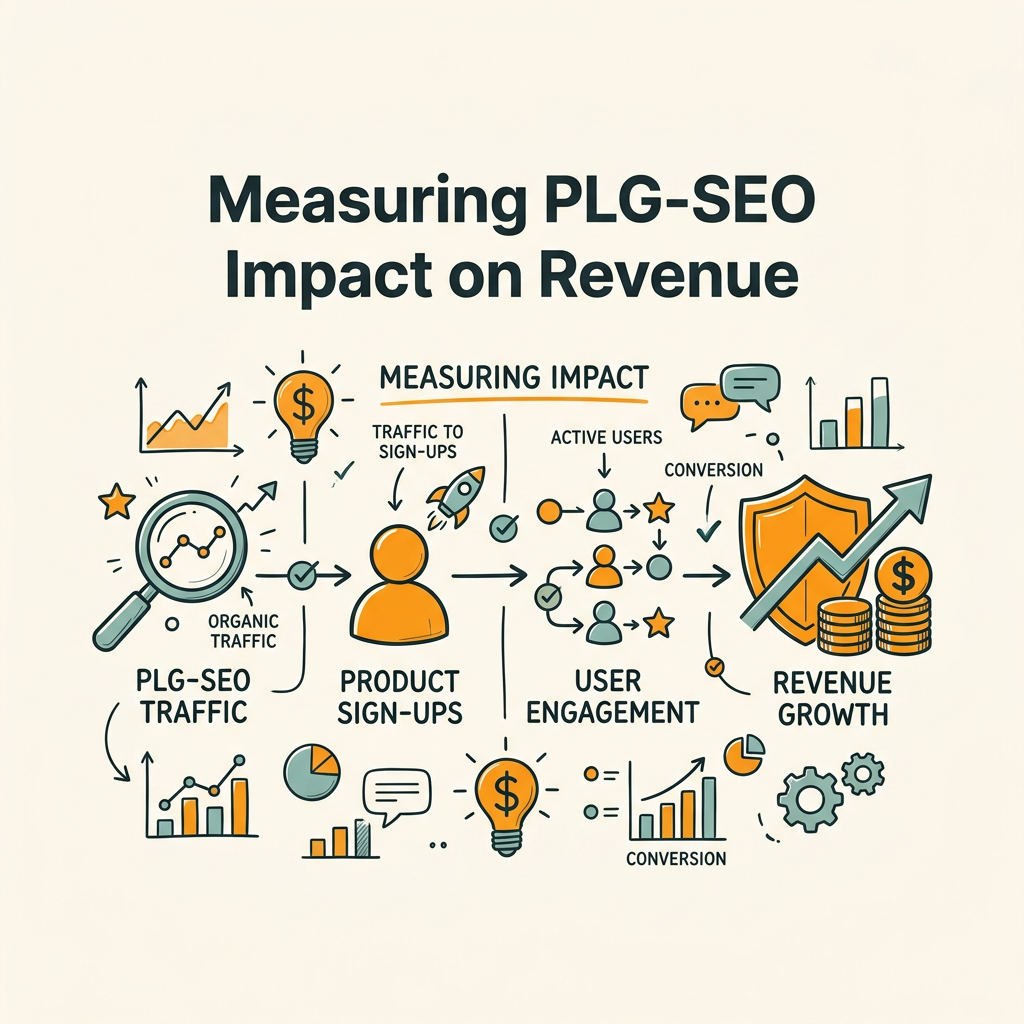
Content marketing for SaaS is often measured on traffic. PLG leaders measure revenue. Attribution is messy—organic traffic may be the first touch, but sales often closes the deal—but the signal is clear: organic channels deliver the highest-margin revenue because cost-of-acquisition approaches zero.
Track Organic Revenue Attribution
Set up UTM parameters for all organic content. Ideally, use your product analytics to track users from first click through trial, activation, and payment. You'll see that organic-sourced users often have higher LTV because they've self-educated and arrive ready to activate.
The benchmark from leading PLG companies shows that organic drives 41% of pipeline in top-quartile teams, compared to 26% from paid. Better still, organic users have lower churn and higher expansion revenue because they're self-selected and product-educated.
Calculate Organic CAC and LTV
Compare organic customer acquisition cost to paid. For most SaaS:
- Organic CAC: $290–$480 (drops to $290+ long-term as content compounds)
- Paid CAC: $802+ (paid search and social)
- Organic LTV Multiple: 3–5x CAC (users are self-educated, lower churn)
- Paid LTV Multiple: 2–3x CAC (shorter payback, higher churn)
If your product has a $2,000 ACV and 24-month LTV, organic-sourced users are worth 50–100% more than paid because of lower acquisition and higher retention. Use this to justify content investments to stakeholders skeptical of "soft" organic channels.
Common Pitfalls and How to Avoid Them
Even teams that understand PLG+SEO alignment often stumble in execution. Here are the most common snares.
Content Disconnected From Product Onboarding
Writing blog content without coordinating product onboarding creates friction. A prospect reads your "beginner's guide to data migration" and signs up excited. Then they hit your four-step wizard and realize migration isn't what you emphasize in-app. Trust collapses. Time-to-activation climbs. They churn.
Fix: Assign one person to own the content-to-product journey. Audit your top 50 articles. For each, trace the exact onboarding path a user takes after clicking the CTA. If onboarding doesn't directly address the content's promise, rewrite either the content or the onboarding flow.
Focusing on Search Volume Over Conversion Intent
SEO tools rank keywords by search volume. A high-volume keyword like "SaaS tools" looks tempting. But if users searching that term aren't your ICP and never convert, you're wasting time. Target problem-aware keywords with lower volume but higher intent.
Benchmark: keywords searched by users in their evaluation phase (intent keywords) drive 3–5x higher conversion than awareness-phase keywords. Choose the smaller list of high-intent keywords and own those, rather than scattering effort across high-volume vanity terms.
Ignoring the User Lifecycle in Content Strategy
PLG companies have three distinct user cohorts: free users, trial users, and paying customers. Your content strategy should address all three. Yet most teams write only for awareness-phase prospects. Expansion and retention content gets deprioritized.
The revenue opportunity is in the gap: existing free users who need help activating (activation content), paying customers who need to expand to new features (expansion content), and churn risks who need re-engagement (retention content). Create content for all three audiences, not just acquisition.
Conclusion
Product-led growth without SEO leaves money on the table. Your product is your best marketing, but it only works when prospects find it. Organic search drives 53% of new user acquisition for leading PLG companies, yet most teams treat SEO and product as separate initiatives.
The playbook is clear: Align content with your product's core problems. Build educational content that reduces friction toward trial. Scale production without sacrificing quality using automated research, fact-checking, and publishing. Measure activation, not just traffic. Own topical authority, not scattered keywords. The result is compounding growth where organic traffic doesn't just rank—it activates.
For busy founders, this scale is impossible without automation. Start your SEO agent today and let AI handle research, writing, and publishing while you focus on product and conversion optimization.
FAQs
What's the difference between product-led growth and sales-led growth?
Product-led growth (PLG) uses the product itself as the primary driver of acquisition, activation, and retention—users try the product free, self-activate, and convert to paying if they see value. Sales-led growth relies on direct outbound and sales teams to close deals, often with longer sales cycles and higher deal values. PLG works best for low-friction products under $5k ACV; sales-led dominates enterprise. The best approach combines both: use PLG to acquire and activate users at scale, then layer in sales for expansion and high-value accounts. Leading companies at >$50M ARR increasingly adopt hybrid models, using PLG as the foundation and sales as the accelerant for larger deals.
How long does it take for SEO to drive meaningful traffic for a PLG company?
Realistic timeline is 6–12 months for measurable organic traffic if you publish consistently and focus on lower-competition keywords. However, this varies by keyword difficulty and market size. Early-stage PLG companies targeting under-served niches can see meaningful traffic within 4–6 months by publishing 15–20 pieces monthly on high-intent keywords. The key variable is consistency and volume—teams publishing scattered posts see minimal results, while teams publishing 20+ quality pieces monthly begin ranking significantly by month 5–6. Mature markets require 12+ months of volume, higher technical SEO investment, and strong backlink strategy. Automation accelerates this by enabling the volume required to own keyword spaces faster.
Should we prioritize organic growth or sales-driven paid channels for early-stage PLG?
For early-stage PLG, paid channels (Google Ads, social) validate ICP and messaging faster because you get conversion data in weeks, not months. However, organic should start immediately—not for quick traffic, but for long-term compounding. The optimal approach is to run paid campaigns to validate product-market fit and user acquisition channels while simultaneously building organic infrastructure. Once you have proof that users from a specific keyword or messaging angle activate and convert, double down on organic content targeting those specific problems and intents. This hybrid strategy means you don't wait 12 months for organic payoff—you use paid to compress learning cycles, then shift budget to organic as CAC improves and content begins ranking.