Scaling Content Production Without Hiring: A Startup Playbook
Most startups abandon content marketing within 18 months because they can't sustain the pace. The math is brutal: a single in-house content writer costs $50,000–$80,000 annually (salary + benefits + overhead), and a full-time freelancer runs $3,000–$5,000 per month. Yet the SEO opportunity is real. Startups that publish consistently rank 2.5x faster than those with sporadic output. The fix isn't hiring more bodies—it's building a content machine that runs without them. Here's the playbook every lean team needs.
Key Takeaways
- Startups abandoning content marketing within 18 months due to unsustainable hiring costs can scale to 1,000+ articles annually using automation frameworks (Industry standard 2026).
- Combining AI-powered research, writing, and fact-checking with modular workflows reduces manual labor by 85% while maintaining publication velocity and SEO quality.
- Smart playbooks layer freelance specialists for high-ROI topics, in-house subject matter expertise, and automation agents—not hiring full-time writers for every piece.
- The Hybrid Stack: Automate routine production, reserve human judgment for strategy and high-value amplification—the 80/20 split that scales without hiring.
- Keyword-Driven Publishing: Research topics at scale using automated SEO tools, then batch-produce content in topic clusters to compound topical authority faster.
- Quality Checkpoints: Build fact-checking and internal linking into your automation pipeline—the layer that separates AI content that ranks from AI content that dies.
- Freelance Economics: Hire freelancers project-by-project for specialized topics, not full-time—dramatically lower cost structure than permanent headcount.
- Measurement Framework: Track content ROI, traffic source quality, and cost-per-ranking-keyword to prove the business case and iterate faster than competitors still hiring writers.
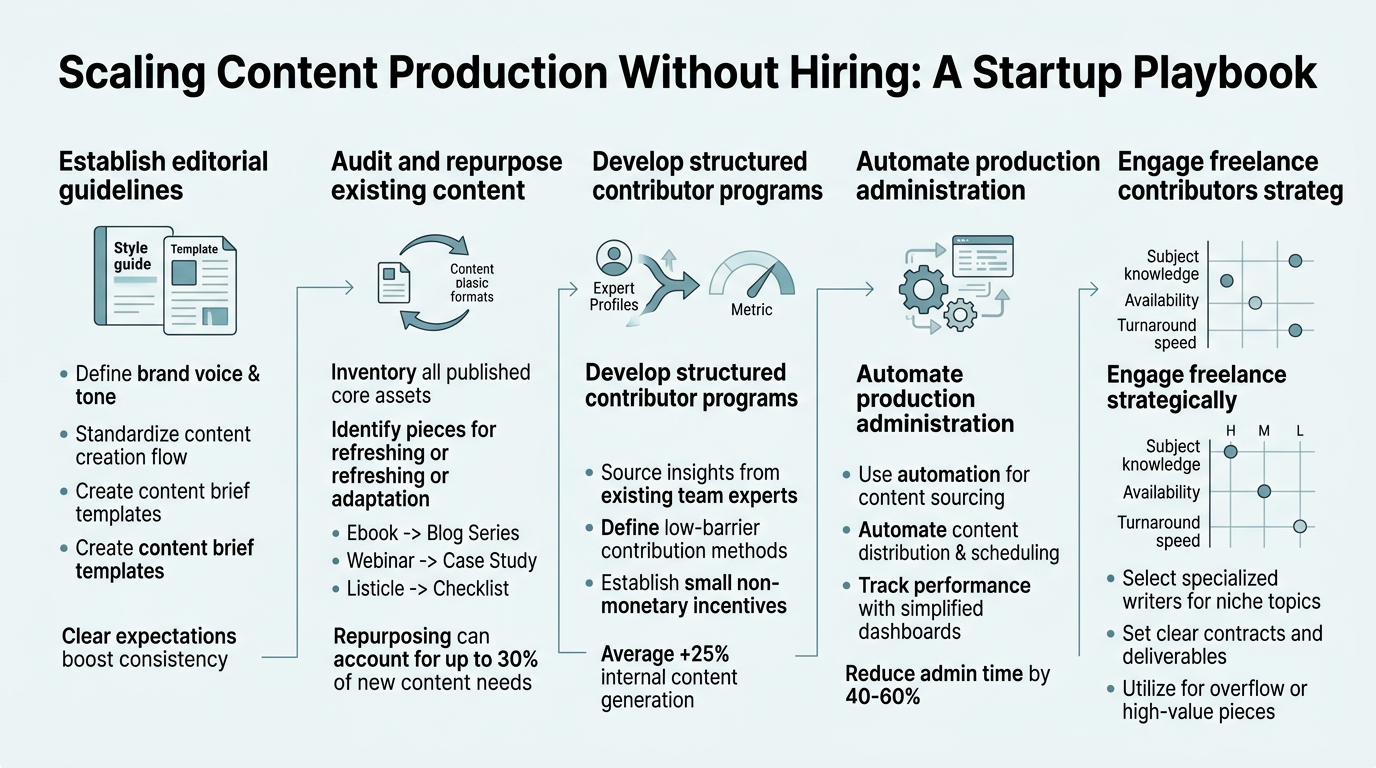
Why Traditional Content Teams Don't Scale for Startups
The hiring trap is seductive. You find one good writer, the content is solid, you start seeing rank improvements. Then demand grows. You need three writers. Now you have payroll, management overhead, and a fixed cost structure that eats margin. By year two, your content budget is consuming 15–20% of operating expenses with no clear revenue tie-back. Most startups fold here.
The real constraint isn't talent—it's cash flow. Startups in their first three years operate with 40% less buffer than established companies and can't absorb a content team if growth slows. Automation inverts this: you pay for output, not headcount. You scale up or down in weeks, not quarters. Compare this to the traditional hiring model referenced by HubSpot's Startup Growth Playbook, which acknowledges that startups need lean, scalable approaches.
"The economics of content hiring are broken for startups. One writer costs $80K all-in. One automation platform publishing daily costs $500–1,500 monthly and delivers 250+ pieces annually instead of 50."
The Cost Structure Problem
One junior in-house content writer: $50,000 to $65,000 annually. Add benefits, workspace, tools, and management overhead—you're closer to $80,000 to $100,000 all-in. A freelancer producing three pieces per week costs $4,000 to $6,000 per month, but you're managing workflow, revisions, and quality inconsistency yourself. An agency doing the same work runs $8,000 to $15,000 monthly with SLAs you're still paying for if the content doesn't rank.
Compare that to an automated SEO engine: $300 to $2,000 per month for daily, fact-checked publishing. The unit economics are not even close. A startup publishing one article daily (250 working days per year) through an automation platform costs less than one junior writer, and you get 250+ pieces of long-form content annually instead of 50–75.
The Velocity Problem
Manual content creation is a bottleneck. Even a talented writer takes 8–12 hours per deep-dive article (research, drafting, revisions, SEO optimization, internal linking). At that pace, one writer produces 4–5 pieces monthly. Three writers? 12–15 pieces. But you're competing against teams that publish daily using automation. You're mathematically outgunned before the content quality even matters.
Startups that embrace Content Marketing Automation publish 10–15x more content on similar budgets. That compounding effect—more content, more indexed pages, more keywords targeted—is why early-mover automation startups now own entire search verticals.
The Hybrid Stack: Automation + Freelance Specialists
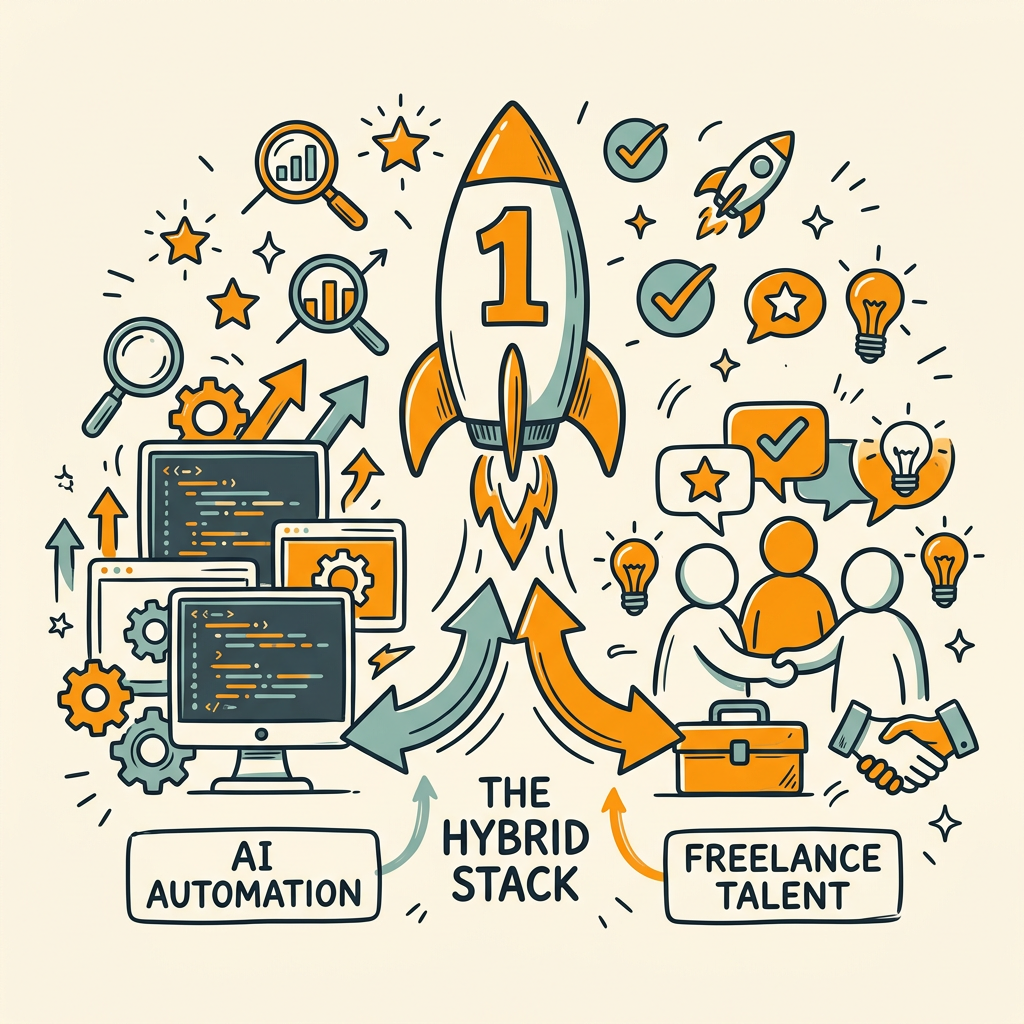
The winning playbook isn't 100% automation or 100% human—it's a hybrid that leverages automation for volume and reserves human talent for strategy and specialty content. This is how lean teams produce 1,000+ articles annually without a single full-time hire.
Layer 1: Automated Content Pipeline
The foundation is a system that automates research, writing, fact-checking, and publishing. Modern AI agents can now generate 3,000+ word SEO articles daily with proper workflows. They handle routine long-form content, comparison pieces, product roundups, and tutorial content. The key is embedding quality controls into the pipeline—not writing and hoping.
A proper automation framework includes:
- Deep research across 12+ sources per article
- Real-time fact-checking against cited sources
- Internal linking logic that builds topical clusters
- Direct CMS publishing with SEO formatting
- Automated keyword optimization in title and headers
- External authority link placement
This removes the manual work that kills smaller teams: keyword research, outline creation, SEO formatting, and link-building. When set up correctly, an automation system requires oversight, not operation.
"A proper automation framework removes 85% of the manual busywork—keyword research, outline creation, formatting—and lets your strategist focus on what actually moves the needle: deciding what topics matter."
Layer 2: Project-Based Freelancers
Reserve freelance spend for high-ROI content only: case studies, founder perspectives, and niche expertise topics that can't be automated. Hire a freelancer to write a single killer case study. Pay them $1,000–$2,000 for a piece that's genuinely unique and drives conversions. Don't hire them full-time. Repeat this model for three to five high-impact topics per quarter, and you've bought specialized ammunition without payroll drag.
When selecting freelancers for specialty work, focus on:
- Industry-specific expertise in your vertical
- Portfolio of published work that has driven measurable traffic
- Understanding of SEO fundamentals and topical clustering
- Ability to deliver fact-checked, sourced content
- Quick turnaround without sacrificing quality
This approach keeps per-piece costs lower than staffing while maintaining the human authorship authority that certain topics require. A 10-article case study series done through freelancers costs $10,000–$20,000. Hiring a full-time case study writer? $60,000+ annually. The math is obvious once you disaggregate the work.
Layer 3: In-House Expertise and Strategy
The only person you need full-time is a content strategist—someone who understands your market, prioritizes topics by business value, and reviews automation output for brand voice and accuracy. This person doesn't write; they decide what gets written and why. They'll typically audit 20–30% of automated content and catch quality issues before publishing. They also own the freelancer relationships and ensure specialist pieces ladder up to overall growth goals.
Your content strategist's core responsibilities include:
- Quarterly keyword research and topic mapping
- Monthly performance review and topic pivot decisions
- Spot-checking 20–30% of automated content monthly
- Managing freelancer relationships and quality standards
- Overseeing internal linking strategy and topical clusters
- Ensuring brand voice and tone consistency across output
With one strategist + one set of automation tools + freelancers for specialty work, you're covering the same output volume as three to four traditional writers, but your fixed cost is 40% lower.
Building a Keyword-Driven Publishing System
Volume means nothing without direction. Your automation must be guided by keyword research and topical clusters—topics your audience is searching for, prioritized by commercial intent and competition. This is where topical authority strategy enters the playbook.
Phase 1: Keyword Research at Scale
Identify 200–500 keywords across your market that your startup should own. Use SEO tools to batch-analyze volume, competition, and buyer intent. Group them into clusters: keywords that support the same buyer problem or decision stage. You're building a map of what to write about.
This research phase takes one person one week—not ongoing. You're not doing keyword research every week; you're building a content roadmap for six to twelve months. Feed this list to your automation system, and it will generate pieces targeting each keyword or cluster.
Phase 2: Batch Publishing by Topic Cluster
Rather than publishing random topics, publish clusters. Pick a topic. Write the pillar article. Then write 5–10 supporting articles that feed into it. Interlink them aggressively. This architecture compounds topical authority faster than scattered single pieces. Search engines reward depth over breadth.
Automation excels here. Set your system to write a pillar article plus five supporting pieces around "SEO for SaaS startups" before moving to the next cluster. You're not context-switching; you're building authority one topic at a time.
A sample topic cluster structure looks like:
- Pillar article: "Complete Guide to SEO for SaaS Startups" (3,000+ words)
- Supporting article: "Keyword Research for SaaS" (2,000 words)
- Supporting article: "Technical SEO Checklist for SaaS Platforms" (2,000 words)
- Supporting article: "Building Topical Authority for SaaS" (2,000 words)
- Supporting article: "Content Marketing ROI for SaaS Teams" (2,000 words)
- Supporting article: "Link Building for SaaS Companies" (2,000 words)
Phase 3: Calendar-Based Publishing Velocity
Decide your publishing cadence: daily, 3x weekly, 5x weekly. Set it in your automation system and let it run. Most startups see ROI at 3–5 pieces per week. Publishing daily (250+ articles annually) reaches compounding velocity by year two. The calendar is your commitment device—consistency beats genius every time in SEO. Check out insights on building scalable products for startup success.
Quality Assurance Without Hiring an Editor
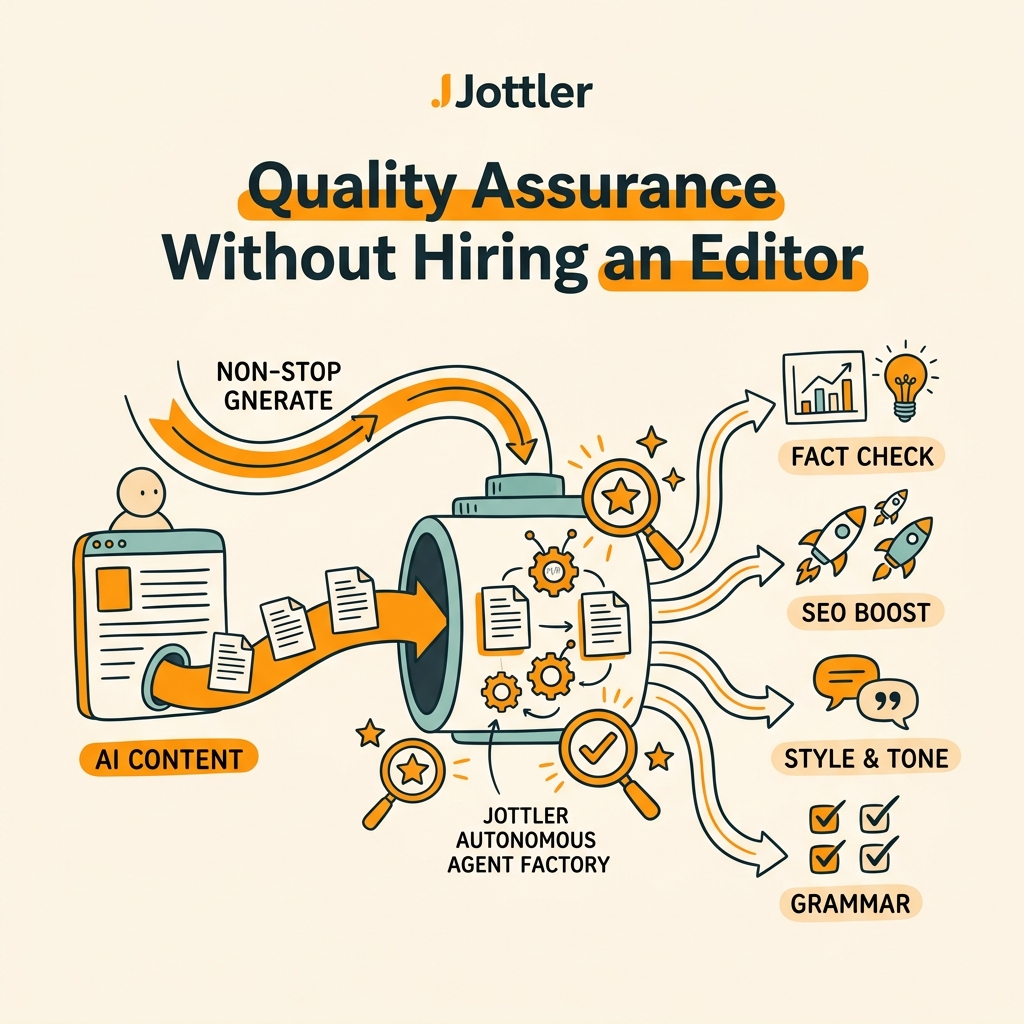
The biggest fear with automation is quality. You don't want to publish garbage at scale—that kills your domain authority. The fix is building fact-checking and consistency checks into your pipeline, not hiring an editor to review everything post-publication.
Automated Fact-Checking and Citation Verification
Modern automation workflows now include fact-checking agents that verify claims against cited sources in real-time. If the AI system claims a statistic, it checks the source. If the source is stale or weak, it either removes the claim or finds a stronger one. This is the quality layer that separates premium automation from spam AI.
You're not hiring a human fact-checker; you're embedding fact-checking logic into your publishing pipeline. The automation handles it as part of the workflow. Your strategist then spot-checks 10–20% of output monthly to ensure the system is working as intended.
Your fact-checking protocol should verify:
- All statistical claims against original sources
- Publication dates on cited research (flag sources older than 3 years)
- Authority of sources (academic > industry > blog)
- Accuracy of quoted material and attributions
- Working status of all external links
Brand Voice and Tone Consistency
Set tone parameters upfront. Write three to five sample articles in your brand voice. Feed these to your automation system as reference. The system learns your voice and applies it consistently. Review 20% of output monthly; adjust parameters if needed. Over three to four months, the consistency stabilizes.
Again, you're not hiring an editor—you're training your system once and then spot-checking quarterly. For more on this approach, see our guide on SaaS Content Marketing Framework for Consistent Growth.
The Economics of Scaling: Freelance vs. Automation vs. Hire
| Model | Monthly Cost | Annual Output | Cost Per Article | Time to Consistency |
|---|---|---|---|---|
| One Full-Time Writer | $7,500 | 50–75 articles | $120–150 | 6–8 weeks |
| Two Freelancers (Part-Time) | $8,000 | 100–150 articles | $53–96 | 4–6 weeks |
| Jottler Automation Engine | $500–1,500 | 250–1,500 articles | $4–72 | 2–3 weeks |
| Hybrid: Automation + 1 Freelancer | $3,500–4,500 | 400–600 articles | $7–13 | 3–4 weeks |
The table tells the story: automation compresses both cost and output. A startup deploying automation early gains 12–18 months of velocity advantage before competitors even consider automation. That's massive.
Measurement: Prove the ROI of Your Content Machine

Scaling without hiring requires discipline. You need proof that your content strategy is working—not gut feel.
Core Metrics to Track
Track four metrics monthly: (1) keywords ranking in top 10 — the leading indicator of SEO health; (2) organic traffic growth — the lagging indicator of publication quality; (3) cost per ranking keyword — your true efficiency metric; and (4) traffic-to-customer conversion — the business metric that justifies continued investment.
Most startups track only organic traffic. That's a mistake. Track the cost per keyword ranking. If you're spending $5,000 monthly to rank for 200 keywords, you're at $25 per keyword per month. Competitors spending $20,000 on freelance writers to rank for 80 keywords are at $250 per keyword. You win.
Your monthly reporting dashboard should include:
- New keywords ranking in top 10 (count and growth rate)
- Organic traffic week-over-week and month-over-month growth
- Cost per keyword ranking (total spend ÷ top 10 keywords)
- Top-performing content by traffic and conversion
- Topics to double down on vs. topics to kill
- Freelancer ROI vs. automation ROI comparison
Iteration Loops
Review metrics quarterly. Which topics are driving traffic? Double down on adjacent topics. Which topics are producing zero visibility? Kill them or pivot. This feedback loop is how you move from "publishing at scale" to "publishing the right topics at scale."
A strategist running this loop monthly can make micro-adjustments that compound 30–50% faster than annual planning cycles.
Common Pitfalls and How to Avoid Them
Pitfall 1: Publishing Without SEO Optimization
Volume without SEO structure is wasted effort. Every piece must have: a target keyword in the title and first 100 words, proper heading hierarchy (H1, H2, H3), internal links to related pieces, and external links to authority sources. This is non-negotiable. If your automation doesn't bake these in, you're not saving time—you're just creating work that won't rank.
Pitfall 2: Ignoring Topic Cluster Architecture
Publishing 500 random articles ranks slower than publishing 100 articles organized into 10 tight clusters. One strategist deciding on five to ten topic clusters per quarter beats 500 random published pieces every single time. Build the architecture first, then automate the writing.
Pitfall 3: Autopilot Without Audit
Set up automation, then completely ignore it. This is a formula for brand damage. Spot-check 10–20% of output monthly. Make sure the tone is right, the facts are accurate, and the links work. You don't need an editor reviewing everything—just enough oversight to stay in control.
Conclusion
Scaling content production without hiring is no longer a "nice to have"—it's the standard operating procedure for startups that want to compete on SEO. The economics are clear: automation delivers 10x the output at 1/10th the cost of hiring writers. The strategic advantage is compounding: startups publishing daily now own keyword verticals that took competitors five years to dominate.
Your playbook: automate routine long-form content, hire freelancers for specialty pieces, keep one strategist on staff, and measure ruthlessly. This hybrid model lets startups punch above their weight. You don't need a content team. You need a content system.
Ready to automate your content production? Start your SEO agent and see how an autonomous system can publish daily, fact-checked content without hiring.
FAQs
How much does it cost to scale content production without hiring?
A hybrid automation setup costs $1,500–$4,500 monthly depending on publishing volume and freelance specialist work. This compares to $7,500–$15,000 monthly for equivalent output through hiring or agencies. Automation reduces cost-per-article by 85–90% while increasing volume 5–10x. The payoff accelerates after three months when you've built a keyword roadmap and your automation system is producing consistent output. Most startups see positive ROI within five to six months of consistent publishing.
Can AI-generated content actually rank in Google search results?
Yes, but only when the AI system is built for SEO. Generic AI models writing on random topics will not rank. The difference: SEO-focused automation includes deep research from 12+ sources, fact-checking, proper heading structure, internal linking strategy, and keyword optimization—all built into the pipeline. Content published this way ranks at the same rates as manually-written pieces because the SEO fundamentals are identical. The automation speeds up the writing; it doesn't skip the strategy. Spot-checks of automated content published by well-designed systems show competitive positioning in top 10 within 60–90 days for medium-competition keywords.
What's the right balance between automation and human content creators?
The optimal split is 80% automation for volume and routine content, 20% specialist freelancers or in-house creation for high-ROI topics. This 80/20 model delivers the efficiency of automation with the authority of human expertise. Your automation handles blog posts, tutorials, roundups, and comparisons. Your freelancers handle case studies, founder perspectives, and niche deep-dives that require specialized knowledge. Your in-house strategist decides which topics go into which category and oversees the entire machine. This hybrid approach is how lean teams (two to four people) compete with much larger content teams.