Semrush vs Ahrefs: Link Building Features
Link building accounts for 28–36% of total SEO spend, yet 56% of SEO professionals outsource at least part of the process (2026, Linkbuildinghq). For busy founders and growing marketing teams, choosing between Semrush and Ahrefs for link building isn't just about database size—it's about workflow efficiency, data freshness, and whether the tool helps you close the gap between competitors' backlinks and yours. This guide breaks down the critical differences between these two platforms to help you pick the right fit for your team's actual process.
Key Takeaways
- Semrush has a 43T+ backlink index and stronger outreach workflows; Ahrefs has 500M+ referring domains and faster link discovery (2026)
- Ahrefs wins for pure backlink analysis; Semrush wins for integrated campaign execution and reporting
- 93.8% of link builders prioritize quality and relevance over volume, making workflow features matter more than raw data size (2026, Linkbuildinghq)
- Backlink Index Size: Semrush leads with 43T+ backlinks; Ahrefs excels with 500M+ referring domains and faster discovery cycles for fresh links.
- Link Prospecting Workflow: Ahrefs is optimized for competitor analysis and surgical link opportunity identification; Semrush integrates outreach, reporting, and broader SEO context.
- Comparison Tools: Ahrefs Link Intersect allows up to 10 URLs; Semrush Backlink Gap handles up to 4 but ties into full content and outreach workflows.
- Authority Metrics & Trust: 68.1% of SEO professionals rate Ahrefs as the most accurate backlink provider; Semrush is strong but secondary in link analysis circles (2026, Shno).
- Best For Busy Teams: Semrush's integrated tooling is faster for reporting and campaign coordination; Ahrefs requires more manual workflow assembly but offers deeper analysis.
How Do Their Backlink Indexes Compare?
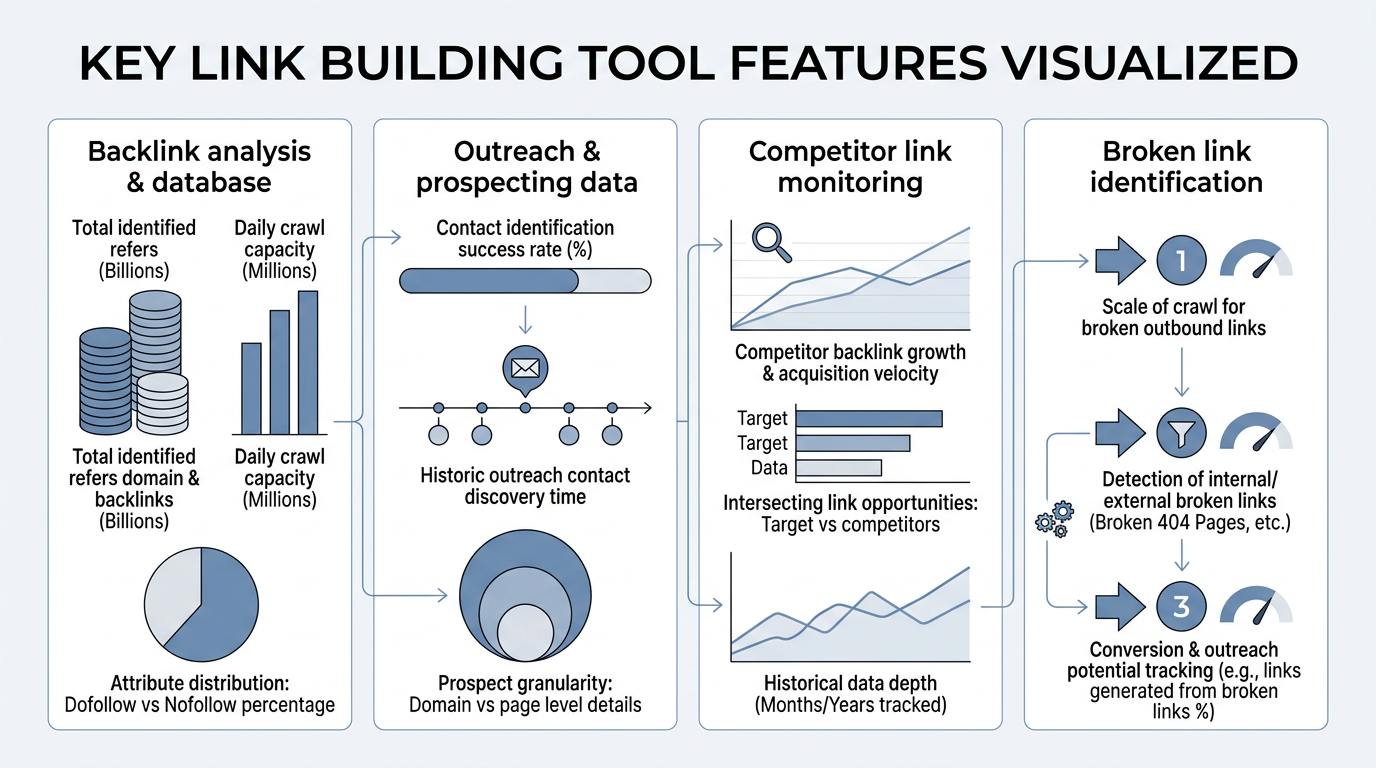
The first question most teams ask: which tool has better link data? The answer is nuanced. Semrush reports a larger raw backlink index at 43 trillion links, while Ahrefs tracks 500 million+ referring domains and 35 trillion live backlinks (2026, Style Factory). According to Onelittleweb's 2026 comparison, the difference matters less than how fresh the data is and how well each tool surfaces the links you actually care about.
"The biggest gap between Semrush and Ahrefs isn't database size—it's freshness. A smaller, more recently crawled backlink index beats a larger, stale one every single time."
— Backlinkgrid, 2026
Database Size vs. Data Freshness
Semrush's larger index is useful if you're hunting for every possible mention of a competitor. Ahrefs' smaller but more frequently updated index is better if you're racing to claim fresh link opportunities before competitors do. Ahrefs' crawler is described as updating backlinks every 15–30 minutes in multiple 2026 sources, while Semrush's refresh cycle is slower. For teams managing digital PR or chasing new mentions from journalists and publications, Ahrefs' speed matters. For content planning and competitor gap analysis over weeks or months, Semrush's larger volume is more valuable. This is where the actual job matters: speed favors Ahrefs; comprehensiveness favors Semrush.
Authority Metrics: DR, UR, and Trust Flow
Both tools use authority scores, but Ahrefs' Domain Rating (DR) and URL Rating (UR) dominate practitioner preference. 64.1% of SEO professionals use Ahrefs DR/UR as their primary authority metric when evaluating link opportunities (2026, Shno). Semrush's Authority Score exists but is less deeply entrenched in industry workflows. When a team standardizes on "only accept links from DR 40+ sites," they're using Ahrefs' language. This matters for team consistency and reduces friction when communicating backlink quality across hiring managers, content teams, and agencies. If your team already speaks Ahrefs, switching to Semrush for link building alone creates friction. If you're starting fresh, Ahrefs' metric standardization gives you a head start.
Which Platform Has the Better Link Building Workflow?
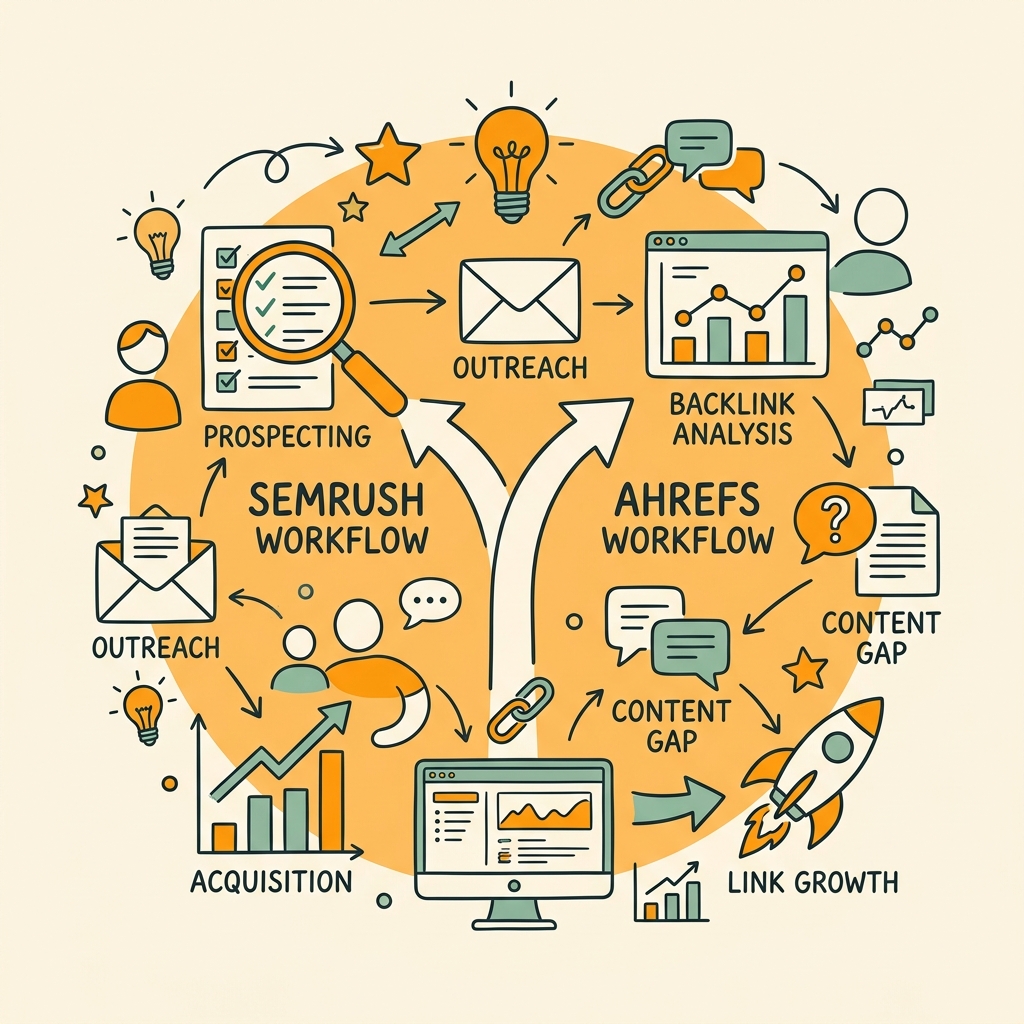
Database size is table stakes. The real difference is in how each platform guides you from "who links to my competitor?" to "which of those should I contact?" and finally to "I closed the link." Semrush and Ahrefs take opposite approaches. Ahrefs is built for link analysts who want granular control; Semrush is built for marketing teams who want integrated workflows (2026, Backlinkgrid). Understanding proven link building strategies for B2B companies will help you evaluate which platform fits your execution model best.
Ahrefs: Surgical Competitor Backlink Analysis
Ahrefs shines when your job is to dig deep into competitor backlinks and identify the highest-quality opportunities. The interface prioritizes backlink detail: you see the referring domain, anchor text, link type (dofollow/nofollow), and can instantly apply filters for link quality, traffic, relevance, and freshness. The "Best Links" filter is particularly powerful—it lets you configure precisely which links matter for your analysis across all reports and charts. Ahrefs also allows you to compare up to 10 URLs in Link Intersect, letting you see which sites link to multiple competitors but not to you. This is where Ahrefs earns its reputation among link specialists: it gives you the tools to be surgical.
"When you need to identify which 100 link prospects matter most out of 10,000 possibilities, Ahrefs' filtering and DR/UR metrics cut analysis time in half. For specialists, this is non-negotiable."
— Shno Research, 2026
The trade-off is workflow fragmentation. Once you've identified a link opportunity in Ahrefs, you export the list, switch to your outreach tool (typically BuzzStream, Mailshake, or manual email), and manage follow-ups separately. If you want to track which Ahrefs-discovered links actually closed, you're managing two systems.
Semrush: Integrated Outreach and Campaign Coordination
Semrush takes a different route. Its Backlink Gap tool shows you sites that link to competitors but not to you—just like Ahrefs' Link Intersect—but with a key difference: it's tied to broader SEO context. You can see not just which sites link to your competitors but why (what topic clusters they publish on, what their audience is, whether they're likely to be receptive to your content). Semrush also allows you to build link-building campaigns within the platform, log outreach efforts, and track response rates directly. For a team juggling multiple SEO initiatives—content, keywords, rank tracking, PPC—Semrush keeps link building in the same ecosystem.
The downside is that Semrush's link analysis is less detailed than Ahrefs' at the row level. You get less granular filtering and fewer link-quality indicators. If your team's core skill is hyperspecialized link analysis, Ahrefs' depth will feel more natural.
Comparison: Link Discovery Tools Head-to-Head
| Feature | Ahrefs | Semrush | Best For |
|---|---|---|---|
| Multi-URL comparison | Link Intersect (up to 10 URLs) | Backlink Gap (up to 4 URLs) | Ahrefs for larger competitor networks |
| Link filtering | Best Links, traffic, relevance, freshness, DR | Link type, traffic, engagement, topical fit | Ahrefs for precise filtering |
| Outreach integration | Export only; use third-party tools | Built-in campaign tracking and logging | Semrush for end-to-end tracking |
| Context beyond backlinks | Backlink-focused; minimal SEO context | Tied to content, keywords, rank tracking | Semrush for holistic SEO planning |
| Reporting | Manual export or limited dashboard | Automated campaign reports; white-label options | Semrush for agencies and teams |
Which Tool Is Best For Your Actual Team?
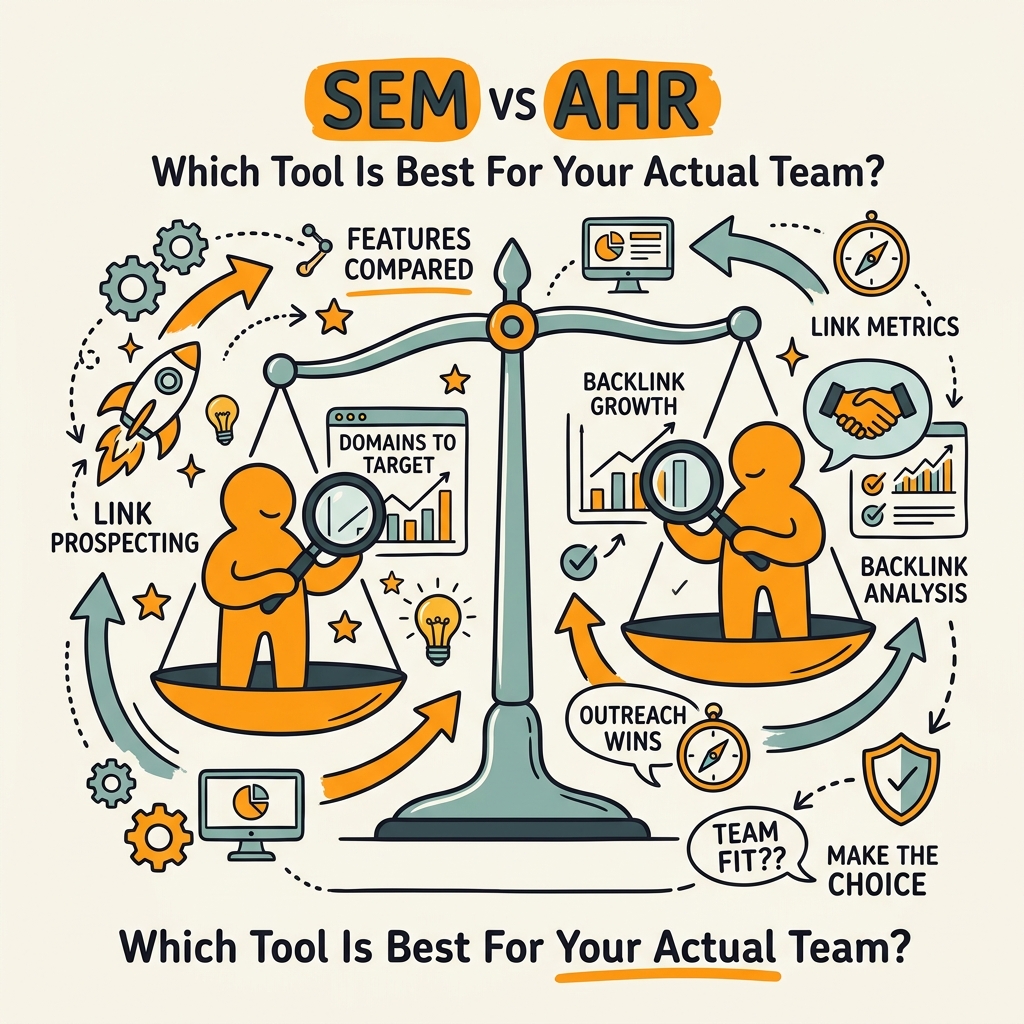
Choosing between Semrush and Ahrefs for link building ultimately depends on your team's size, specialization, and existing workflows. For busy founders and growing marketing teams, the answer is neither—or rather, both, but with a catch. Both Semrush and Ahrefs are designed around manual workflows: you find links, you contact sites, you track results. Neither platform automates the highest-leverage part of link building: consistent, data-driven content creation and publishing that earns links without outreach.
When Ahrefs Wins
Choose Ahrefs if your team meets these criteria:
- Your team's primary job is competitor backlink analysis and link opportunity identification
- You have a dedicated link specialist or agency partner managing outreach separately
- You prioritize data granularity and filter flexibility over workflow speed
- Your team is already fluent in DR/UR metrics and wants consistency
Ahrefs is the analyst's tool. It's faster at link discovery, trusted more widely for authority assessment, and offers the most surgical filtering options. For a lean team with deep SEO expertise, Ahrefs is the logical pick. Per Backlinkgrid's analysis, Ahrefs remains preferred for pure link prospecting and competitor research workflows.
When Semrush Wins
Choose Semrush if your team needs:
- Coordination of link building with broader SEO initiatives—keyword research, content planning, rank tracking
- Non-specialist marketers or business operators who benefit from integrated workflows
- Reporting automation and campaign tracking without switching tools
- White-label reporting for multiple clients if you're an agency
Semrush is the generalist's platform. It's slower at pure link analysis but faster at closing the loop from opportunity to logged result. For a growing team wearing multiple SEO hats, Semrush reduces tool sprawl.
The Missing Piece: Automated Content for Link Earning
Neither Semrush nor Ahrefs solves the real constraint for busy founders: time. Both tools excel at link *discovery* and *analysis*. But 89% of marketers create content specifically to earn links (2026, Linkbuildinghq), meaning your biggest opportunity is not finding more link prospects—it's publishing content so good that outreach becomes optional. This is where automated content systems like autonomous SEO agents shine. Instead of spending hours analyzing competitor backlinks and crafting outreach emails, you can focus on publishing linkable assets—research, data, tools, educational content—that earn links and compound your organic traffic on autopilot. Many founders use Ahrefs or Semrush to analyze *where* links are coming from, then use an automated content platform like Jottler to ensure they have a steady stream of link-worthy content to promote. This hybrid approach—Ahrefs/Semrush for opportunity identification, automated content for asset creation—is increasingly the winning playbook for fast-growing teams.
Pricing, Integration, and Long-Term ROI

Both tools use similar subscription models, but the pricing structures differ in ways that affect link builders. Ahrefs pricing starts higher but includes all features on every tier. Semrush pricing starts lower but withholds advanced link features to higher tiers. For a small team running link building, Semrush's entry point is cheaper. For a mature link-building operation, Ahrefs' predictable, all-inclusive pricing may be clearer.
Integrations and Tool Ecosystem
Semrush integrates natively with Google Ads, Google Analytics, and common CMS platforms, which matters if your link building is tied to broader marketing workflows. Ahrefs has fewer native integrations but excels at exporting data for use in specialized outreach tools like BuzzStream, Mailshake, and Hunter.io. If you're already in the Semrush ecosystem (using it for keyword research and content), adding link building there is one-click easy. If you're a pure link-building specialist, Ahrefs' export flexibility and deep integrations with outreach tools are preferable.
ROI: Which Actually Closes More Links?
Both tools report similar outcomes when used correctly. Consider these proven tactics for link earning:
- Digital PR is rated as the #1 most effective link-building tactic at 48.6% effectiveness (2026, Shno)
- Guest posting follows at 16% effectiveness for quality link placement
- Resource pages and tool mentions account for consistent, passive link acquisition over time
- Skyscraper content and data-driven research pieces drive 20–30% of earned links for high-authority sites
Neither Semrush nor Ahrefs directly executes digital PR or guest posting—they support the decision-making that leads to successful outreach. The real ROI difference emerges when you factor in team time. If Semrush's integrated workflows save your team 5 hours per week on campaign coordination and reporting, that's compounding value. If Ahrefs' fresher data helps you identify breaking link opportunities before competitors do, that's compounding value too. The decision should be: which platform reduces friction *for your specific workflow*?
Conclusion
Semrush leads in integrated workflows, reporting automation, and holistic SEO coordination. Ahrefs leads in data freshness, analytical depth, and link discovery speed. 68.1% of SEO professionals trust Ahrefs as the more accurate backlink provider (2026, Shno), but Semrush's 43 trillion backlinks and outreach integration make it superior for teams that need to *act* on link opportunities quickly, not just analyze them. For busy founders and growing teams, the real leverage isn't better link analysis—it's better link *earning*. The companies that win at link building aren't those with the best analysis tools; they're the ones with the most consistent, high-quality content. If you want to scale link building without burning out your team, consider combining tool analysis with SEO automation that compounds your efforts. Then pick either Semrush or Ahrefs based on your team's existing workflow. Better yet, combine link analysis with an AI content generator for SEO to ensure you have a pipeline of linkable assets ready to promote. Link building tools analyze opportunities; great content creates them. Ready to compound your link-building efforts? Start your SEO agent and focus your time on strategy instead of execution.
FAQs
Which is better for finding new backlink opportunities, Semrush or Ahrefs?
Ahrefs is faster at discovering fresh backlinks because its crawler updates every 15–30 minutes, while Semrush's refresh cycle is slower. However, Semrush's larger backlink index (43T+ vs. 35T+) means it may surface older or more obscure link opportunities that Ahrefs hasn't indexed yet. If you need to catch breaking mentions or new digital PR placements within hours, Ahrefs wins. If you're doing comprehensive competitor backlink analysis over weeks, Semrush's volume advantage matters more. Many teams use both: Ahrefs for speed, Semrush for breadth.
Does Semrush or Ahrefs have better link quality filtering?
Ahrefs offers more granular filtering options through its Best Links feature and DR/UR metrics, which 64.1% of SEO professionals rely on as their primary authority benchmark. Semrush's filtering is less detailed but still effective for identifying topically relevant, high-traffic link prospects. If your team is highly specialized in link analysis and needs surgical precision, Ahrefs' filtering depth gives you more control. If you want simplicity and just need effective filtering tied to broader content and keyword context, Semrush's simpler approach is faster to learn and execute.
What's the easiest way to manage link building for a busy team?
Use Semrush if you want end-to-end link management in one platform, since its built-in campaign tracking and integration with broader SEO tools reduce tool switching. However, the highest-leverage move for busy founders is to shift focus from link analysis to link earning: publish content so valuable that links come without aggressive outreach. Automated content systems that research, write, and publish 3,000+ word articles consistently generate more link-worthy assets than any manual link-hunting process ever will. Combined with either Semrush or Ahrefs for identifying where competitors' links originate, this approach compounds your results without requiring more hours in a day.