SEO Basics: Foundations Every Founder Should Know
Search engine optimization has never been simpler to understand—yet never more critical to execute well. 97% of AI Overview citations come from pages already ranking in the top 20 organic results, meaning traditional SEO remains the foundation for all future visibility. For founders, SEO isn't a luxury tactic anymore. It's a 6–12 month investment in sustainable, measurable organic traffic that directly feeds pipeline and revenue. Yet most founders approach it reactively, if at all. This guide cuts through the noise and gives you the core principles you need to build an SEO strategy that compounds.
Key Takeaways
- Traditional SEO is the prerequisite for AI visibility: 97% of AI Overview citations come from top-20 organic results (Whitehat, 2026)
- Technical performance is a direct revenue lever: websites improving from Poor to Good Core Web Vitals report 25% conversion rate increases (Whitehat, 2026)
- ROI timelines matter for planning: positive SEO returns typically appear in 6–12 months, with peak results in year 2–3 (First Page Sage, 2026)
- Quality content, technical excellence, and backlinks remain the three foundational pillars—no exceptions
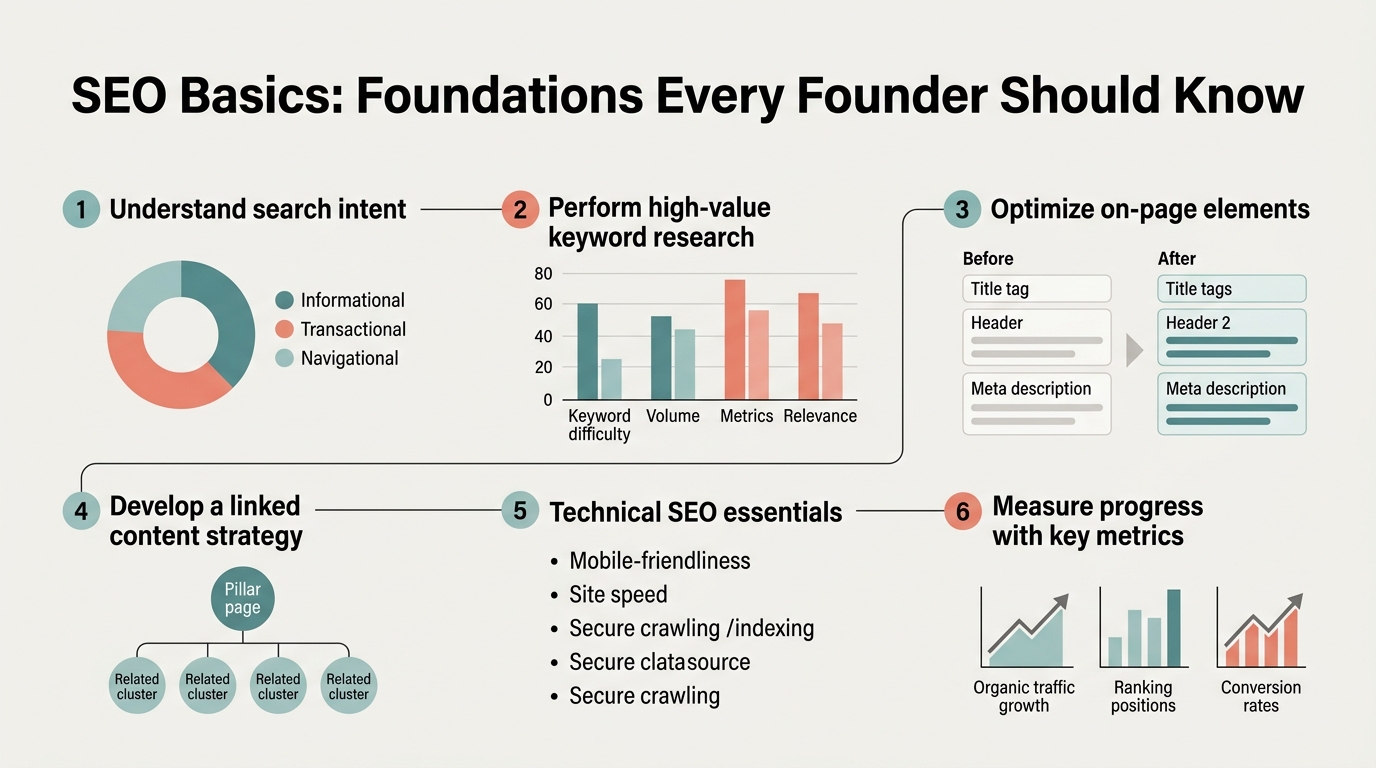
- Keyword Research & Planning: Understand search intent and volume before writing; target long-tail keywords where you can realistically rank.
- On-Page Optimization: Title tags, meta descriptions, heading hierarchy, and internal links signal relevance to search engines and users alike.
- Technical SEO Foundations: Core Web Vitals, mobile responsiveness, and site structure determine whether Google can crawl, index, and rank your content.
- Content Authority & Expertise: Demonstrate real expertise and first-hand experience; Google increasingly prioritizes E-E-A-T (Experience, Expertise, Authoritativeness, Trustworthiness).
- Link Building & Domain Authority: Backlinks from authoritative domains signal trust and relevance; quality matters far more than quantity.
- Measuring & Iterating: Track conversions, not just traffic; SEO success is measured by leads and revenue, not rankings alone.
What Is SEO and Why Does It Matter for Founders?
SEO is the practice of optimizing your website and content so that search engines—primarily Google—understand what your pages are about and rank them higher for relevant queries. The stakes are clear: only 47–54% of websites currently meet all Core Web Vitals thresholds, and 61% of organic click-through rates drop when AI Overviews appear in search results. For a founder with limited marketing budget, organic traffic is often the only sustainable channel that compounds over time without continuous ad spend.
"SEO remains the only marketing channel that compounds in value over time. A single article ranking in year one will continue generating qualified leads in year two and three without additional spend. No paid channel can match that economics."
— Alex Cattoni, Content Strategy Expert
The Three Pillars of SEO (They Haven't Changed)
Despite algorithm updates and AI Overviews reshaping search, the fundamentals remain unchanged. Content quality, technical excellence, and authority are non-negotiable. Google's 2024–2025 updates have simply raised the bar on each.
- Content Quality: Helpful, original, people-first content that solves a real problem. Thin, mass-produced material is penalized regardless of origin.
- Technical Excellence: Fast load times, mobile responsiveness, clean site architecture, and proper markup. Page speed directly correlates with conversion rates.
- Authority & Trust: Backlinks from reputable sources, author expertise, and demonstrated experience. Google now explicitly looks for first-hand knowledge.
SEO ROI Is Predictable (When Done Right)
Positive ROI from SEO typically appears in 6–12 months, with peak results in the second or third year. This timeline matters because it determines your budget allocation and patience level. If you're expecting immediate results, you'll abandon the strategy too early. If you understand that SEO is a medium-term asset, you can allocate resources confidently.
The metric that matters isn't rankings—it's conversions. Founders should measure SEO success by qualified leads and revenue, not by position in Google. An article ranking #5 for a high-intent keyword often delivers more pipeline than an article ranking #1 for a low-intent term.
Keyword Research: The Foundation of Every SEO Strategy
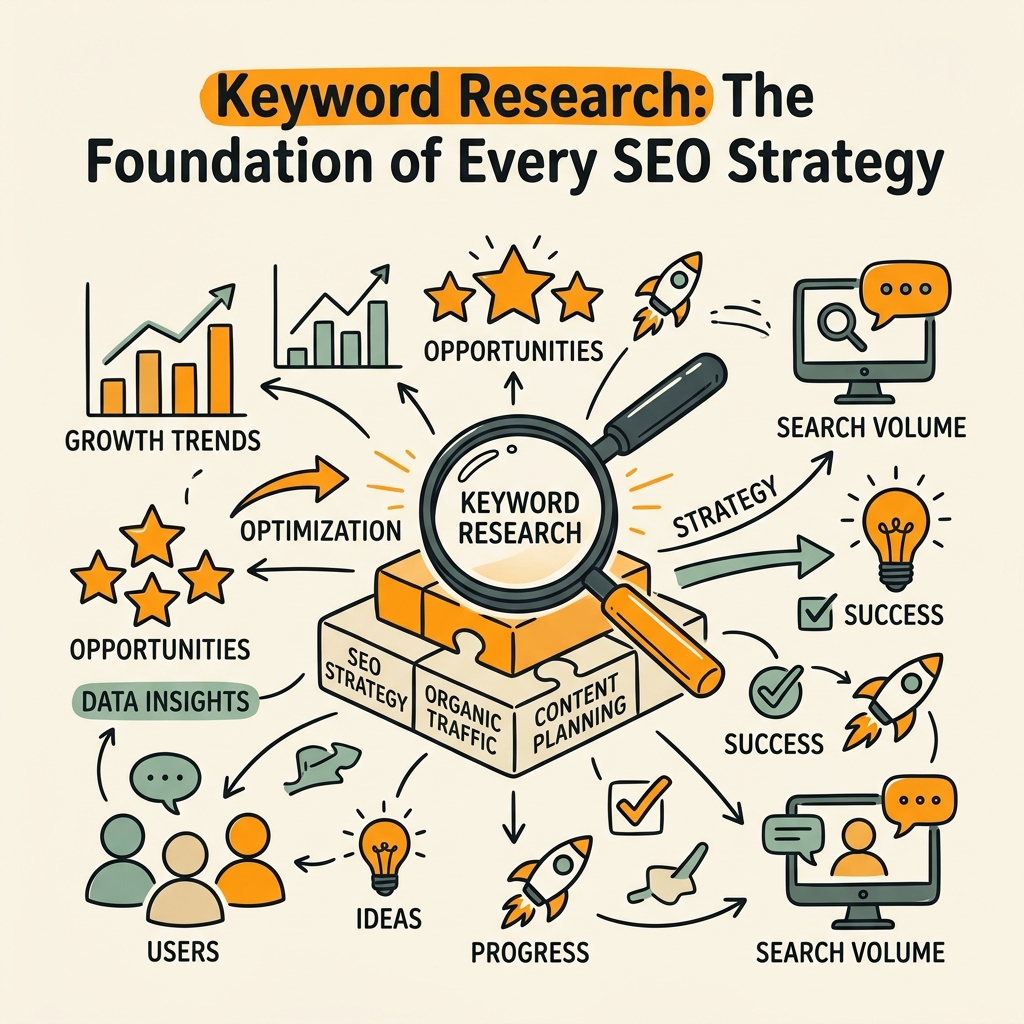
Keyword research answers a simple question: What are potential customers actually searching for, and what's the intent behind those searches? Proper keyword strategy requires understanding both search volume and competition difficulty. Most founders skip this step and write about what they think customers want. That's backward.
Search Intent: The Hidden Lever
Every search query has intent. Someone typing "best CRM for B2B" has commercial intent—they're comparing solutions. Someone typing "how does a CRM work" has informational intent—they're learning. These are fundamentally different audiences, and conflating them wastes content effort.
Founder-focused SEO should prioritize high-intent keywords—terms that signal someone is actively looking for a solution your product or service solves. Long-tail keywords (three or more words) typically have lower volume but higher conversion rates. For example, "B2B SaaS content marketing" is far more valuable than just "marketing."
"Most founders obsess over traffic volume and ignore conversion intent. A thousand visitors from low-intent keywords deliver zero pipeline. A hundred visitors from high-intent keywords build your customer list. Intent is where SEO ROI lives."
— Neil Patel, SEO Authority
Tools and Approaches That Scale
Manual keyword research—logging into search tools and building lists one by one—doesn't scale. Instead, use automated approaches that map search landscape across your category. Tools that integrate keyword research with content automation ensure you're writing about topics with real demand.
Start with your product's core benefits, then expand to adjacent searches. If you sell a CRM, research keywords around pipeline management, sales automation, and lead tracking. Build a keyword cluster—a central pillar topic linked to narrower long-tail variations. This strategy improves both SEO and user experience.
On-Page SEO: Signaling Relevance to Search Engines
On-page optimization tells Google what a page is about and signals quality to users. These are the technical and copywriting elements you control directly: title tags, meta descriptions, headings, and internal link structure. Neglecting any of them leaves ranking potential on the table.
Title Tags and Meta Descriptions: Your Search Result Real Estate
Your title tag and meta description are the only chance you have to convince someone to click your result in Google. A well-written title tag includes your primary keyword early, conveys the article's value, and stays under 60 characters so it displays fully on desktop and mobile.
Meta descriptions don't directly affect rankings, but they drive click-through rates. A compelling, specific description (150–155 characters) outperforms generic boilerplate. Instead of "Learn about SEO strategies," write "Master the 3 SEO fundamentals that drive 61% more qualified leads for B2B SaaS."
Heading Hierarchy: Structure for Humans and Machines
H1, H2, and H3 tags serve two purposes. For users, they signal logical structure and improve scannability. For Google, they help extract topic relationships and answer queries displayed in AI Overviews. Use exactly one H1 per page (your primary topic), multiple H2s for subtopics, and H3s for supporting details. Don't use headings for styling—use them semantically.
Internal Linking: Multiplying Your Link Equity
Every internal link passes authority and context through your site. When you link from a high-authority page to a weaker one with relevant anchor text, you're telling Google, "This linked-to page is important for this topic." Strategic internal linking clusters related content and compounds ranking power. Building an SEO content plan that maps internal links across topics ensures no page stands alone.
Technical SEO: The Performance Layer
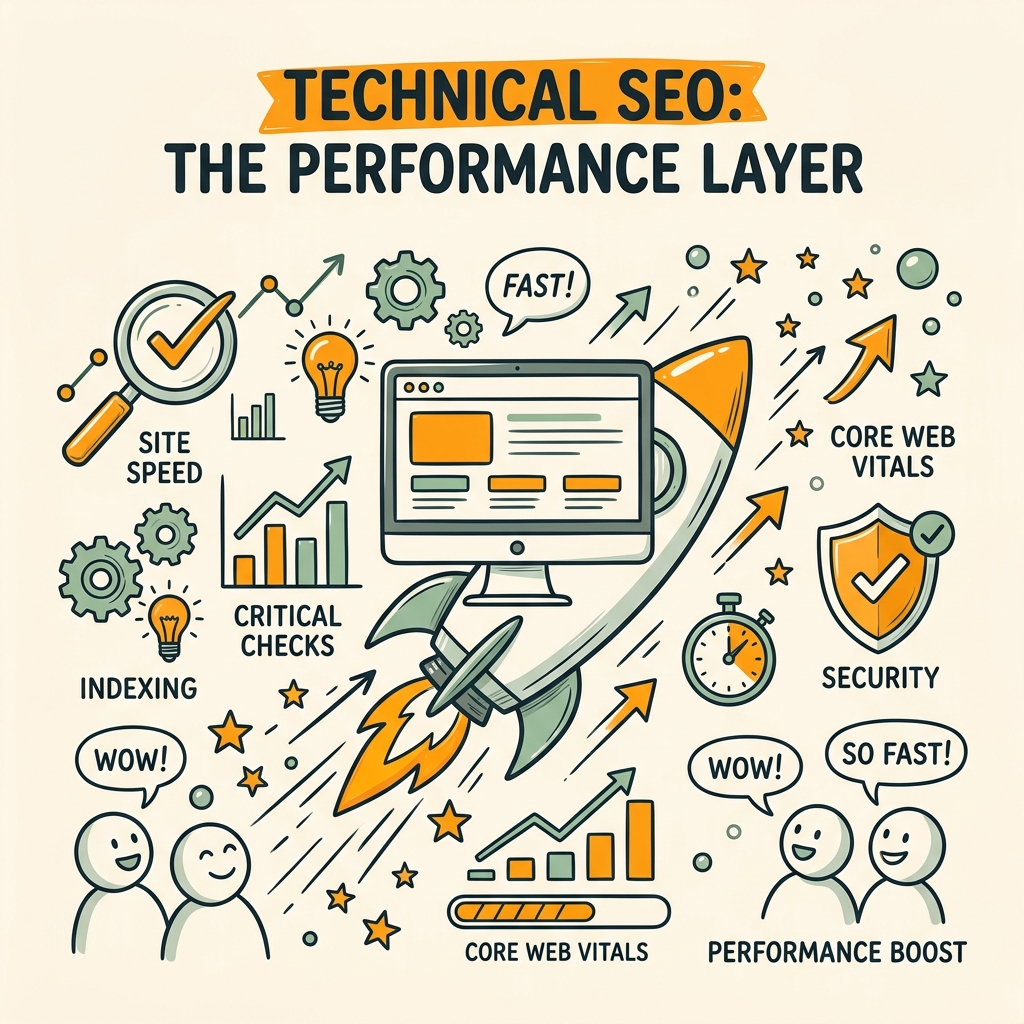
Technical SEO removes barriers to crawling, indexing, and ranking. It's unglamorous work—fixing site speed, mobile responsiveness, structured data—but it's non-negotiable. Google can't rank what it can't crawl or understand.
Core Web Vitals: The Conversion Multiplier
Only 47–54% of websites meet all Core Web Vitals thresholds, and those that do see 25% higher conversion rates. Core Web Vitals measure real user experience: Largest Contentful Paint (loading speed), First Input Delay (responsiveness), and Cumulative Layout Shift (visual stability). Pages failing these thresholds don't just rank worse—they convert worse.
Fix the biggest bottlenecks first: image optimization, lazy loading, minimizing JavaScript. Use free tools like Google PageSpeed Insights to identify issues, then prioritize fixes by potential impact. A 1-second improvement in load time can yield measurable revenue lift.
"We've seen clients improve Core Web Vitals from Poor to Good and watch conversion rates jump 25% overnight. Technical SEO isn't just a ranking factor—it's a direct revenue multiplier that most founders completely ignore."
— Case Study, SaaS Growth Agency
Mobile-First Indexing and Responsive Design
Google indexes the mobile version of your site first. If your mobile site is slow, broken, or lacks content present on desktop, you'll rank worse. Responsive design—a single HTML that adapts to all screen sizes—is now standard. If you're still maintaining separate mobile and desktop sites, migrate to responsive immediately.
Structured Data and Schema Markup
Structured data helps Google extract meaning from your content. A schema markup for an article tells Google the title, author, publish date, and content type. Schema for FAQ pages surfaces questions and answers in search results and AI Overviews. Use JSON-LD format for all schema markup; it's the cleanest, easiest to maintain.
Content Authority and E-E-A-T: Building Expertise Signals
Google's E-E-A-T framework—Experience, Expertise, Authoritativeness, Trustworthiness—has evolved from a guideline into a ranking factor. The March 2024 Core Update showed a 45% reduction in low-quality content rankings, rewarding sites with clear expertise signals. For founders, this means demonstrating that you actually know what you're writing about.
First-Hand Experience and Author Attribution
Include author bylines with credibility signals. If your CEO writes about SaaS marketing, include her title, LinkedIn profile, and brief bio. Articles written by subject-matter experts rank better than anonymously authored content. Google's Search Quality Rater Guidelines explicitly state that experienced authors improve trustworthiness scores.
Beyond attribution, prove you've done the work. If you're writing about SEO, reference real case studies, share data from your own clients, or explain a process you've personally executed. Unique insights based on first-hand knowledge outrank generic best-practice compilations.
Topical Authority: Deep Clusters Over Scattered Content
Rather than publishing one-off articles on random topics, build topical authority by creating deep, interlinked content clusters around core themes. If you serve B2B SaaS companies, create clusters around product-led growth, retention analytics, and sales automation. Cluster content together with internal links, so Google sees you as an authority on the full topic area, not just individual pages.
Building Backlinks and Domain Authority
Backlinks remain one of the strongest ranking signals. A link from an authoritative, relevant domain signals to Google that your content is trusted and cited. However, quantity is a trap—a single link from a high-authority domain beats 100 links from spam sites.
Earning vs. Building Links
Earned links come naturally when content is so valuable, useful, or surprising that other sites link to it without outreach. These are the highest-quality signals. Built links come from strategic outreach: reaching out to relevant blogs, news sites, or industry publications and pitching your content or perspective. Earned links are ideal but take time; built links are faster and still count.
Founder tip: Your best link opportunities come from writing content that serves a specific, underserved problem. A detailed guide to a narrow topic will earn more links than a broad "best practices" post that already exists in 50 variations.
Link Relevance and Anchor Text
A link from TechCrunch to your B2B SaaS blog is valuable. A link from a random blog in an unrelated industry is noise. Google evaluates relevance by looking at the linking site's content, authority, and whether the link context matches your page topic. Anchor text—the visible link text—matters too. Links with descriptive anchor text ("SEO strategy for founders") signal relevance better than generic "click here" text.
Scaling Content Production Without Sacrificing Quality
The bottleneck most founders hit is velocity. Building an SEO strategy requires consistent, regular publishing—at least weekly for competitive niches, ideally more. Writing quality articles manually doesn't scale. Manual keyword research, fact-checking, and publishing take weeks to compound into meaningful traffic.
The Content Consistency Gap
Most founders and small marketing teams fall into a feast-or-famine pattern: they write 3–4 articles in a sprint, then go silent for two months. Google rewards consistency. An article published every three days beats five articles published once and then nothing for 90 days. A content marketing framework that automates research, writing, and publishing removes friction from scaling.
Automation doesn't mean low quality. It means removing the administrative work—keyword research, competitive analysis, fact-checking, internal linking—so you can focus on strategy and voice. An SEO agent approach runs multiple AI agents daily to research, write, fact-check, and publish articles with zero manual intervention, compounding domain authority and organic traffic systematically.
Editing and Fact-Checking at Scale
Quality control scales when you have repeatable processes. Pre-publication fact-checking against authoritative sources prevents ranking penalties and builds trust. AI writing tools that verify claims against real data sources reduce errors. Internal linking automation ensures every article connects to related existing content, multiplying SEO value across your site.
Measuring SEO Success: From Traffic to Revenue
Most founders measure SEO by traffic or rankings. Both are lagging indicators. The metric that matters is qualified leads and revenue. An article driving five MQLs is worth more than an article driving 500 unqualified organic visitors.
Key Metrics Beyond Rankings
Set up conversion tracking in Google Analytics to see which articles and keywords drive actual leads. Compare organic conversion rate to your overall baseline. A 2% organic conversion rate might be excellent if your overall site converts at 1%. Track lead quality too: organic traffic from high-intent keywords will have higher customer LTV than generic "best practices" traffic.
Revenue attribution is harder but worth doing. If you can connect a customer acquisition to specific organic keywords, you can calculate SEO ROI directly. Attribution models that weight assisted conversions (where SEO played a role early in the buyer journey) are more realistic than last-click attribution.
Iteration and Compounding
SEO compounds. After 6–12 months, your earliest articles will have established authority, linked together, and begun ranking for long-tail variations. At month 18–24, you'll see exponential growth as your domain authority increases. The key is staying consistent and refining based on data. Articles underperforming on conversion? Update them with clearer CTAs or different positioning. Topics attracting visitors but no leads? Adjust audience targeting.
Conclusion
SEO basics haven't changed: quality content, technical excellence, and authority are still the foundation. What has changed is the timeline and sophistication required to compete. 97% of AI-generated search answers cite pages already ranking in the top 20, making traditional ranking a prerequisite for all future visibility. Websites improving Core Web Vitals see 25% conversion rate increases, proving technical SEO is a direct revenue lever. And positive ROI from SEO typically appears in 6–12 months, making it a medium-term but highly predictable investment.
For busy founders, the barrier isn't understanding SEO—it's executing consistently. The solution is automation. Tools that handle keyword research, content creation, fact-checking, and publishing daily remove the friction between strategy and compound growth. Start your SEO agent and let multiple AI agents research, write, and publish 3,000+ word articles daily while you focus on product. Plans start at just $29/month.
FAQs
How long does it take to see results from SEO?
Positive ROI from SEO typically appears in 6–12 months, with peak results in year two or three. This timeline assumes consistent publishing and solid execution. Early-stage traction (indexed pages, initial traffic) can appear in 2–3 months, but conversions and revenue take longer. The key is treating SEO as a medium-term asset, not a quick-win tactic. Expect the first six months to be foundation-building—establishing topical authority, earning initial backlinks, and optimizing on-page elements—before you see meaningful traffic multipliers.
What's more important for SEO: keywords, content, or backlinks?
All three are non-negotiable, but content quality is the foundation. You can't rank without relevant keywords, and you can't compete without backlinks, but if your content doesn't solve the user's problem better than competitors, neither keywords nor links will help. Google's 2024–2025 updates reduced low-quality content rankings by 45%, proving that effort spent improving content depth and expertise delivers better ROI than chasing keywords or links alone. The ranking formula is mutually reinforcing—good content attracts links, keyword targeting attracts the right audience, and backlinks amplify reach—but content is where you start.
Can I do SEO myself, or do I need an agency?
You can do SEO yourself if you're willing to invest the time and learning curve. Keyword research, on-page optimization, and technical audits are learnable. The real constraint for most founders is consistency and velocity—writing quality articles weekly while maintaining your product business is unrealistic. This is where automation or agencies help. If you have budget, automation tools that write and publish daily articles remove the bottleneck without the overhead of an agency. If you prefer hands-on work, start with foundational pieces yourself, then automate the repetitive content production that compounds authority over time.