SEO Competitor Analysis Framework
Your competitors are executing SEO strategies you can't see, but you should. 58% of SEO professionals report significant increases in competitive pressure due to AI-powered content and automation (2026, Stateglobe), yet most teams still analyze competitors using manual, outdated processes. The stakes are real: organic search drives 46.98% of all traffic across industries, and zero-click searches now account for 60% of all queries, meaning your visibility depends on owning SERP real estate your competitors are already fighting for.
The fix? A systematic competitor analysis framework that reveals their keyword gaps, content strategies, backlink patterns, and AI visibility wins. This framework lets you identify opportunities they're missing and compound your organic growth before they do.
Key Takeaways
- 58% of SEOs face rising AI-driven competitive pressure (2026, Stateglobe), making structured competitor analysis non-negotiable for sustainable rankings.
- Competitor analysis now extends beyond rankings to include AI Overviews, featured snippets, and zero-click visibility—traditional metrics miss 60% of the search opportunity.
- A three-pillar framework (keyword gaps, backlink gaps, content analysis) reveals $108.28 billion SEO market's highest-ROI opportunities in your niche.
- Identify Direct and Indirect Competitors: Find the websites actually competing for your target keywords and traffic, not just names on your threat list.
- Analyze Keyword Gaps: Discover keywords competitors rank for that you don't, ranked by search volume and ranking difficulty.
- Map Backlink Patterns: Reverse-engineer their link-building strategy and find sites linking to them but not to you.
- Audit Content Performance: Compare content depth, SERP features, engagement, and topical authority against your own.
- Track AI Visibility: Monitor how often competitors appear in AI-generated answers, not just Google rankings.
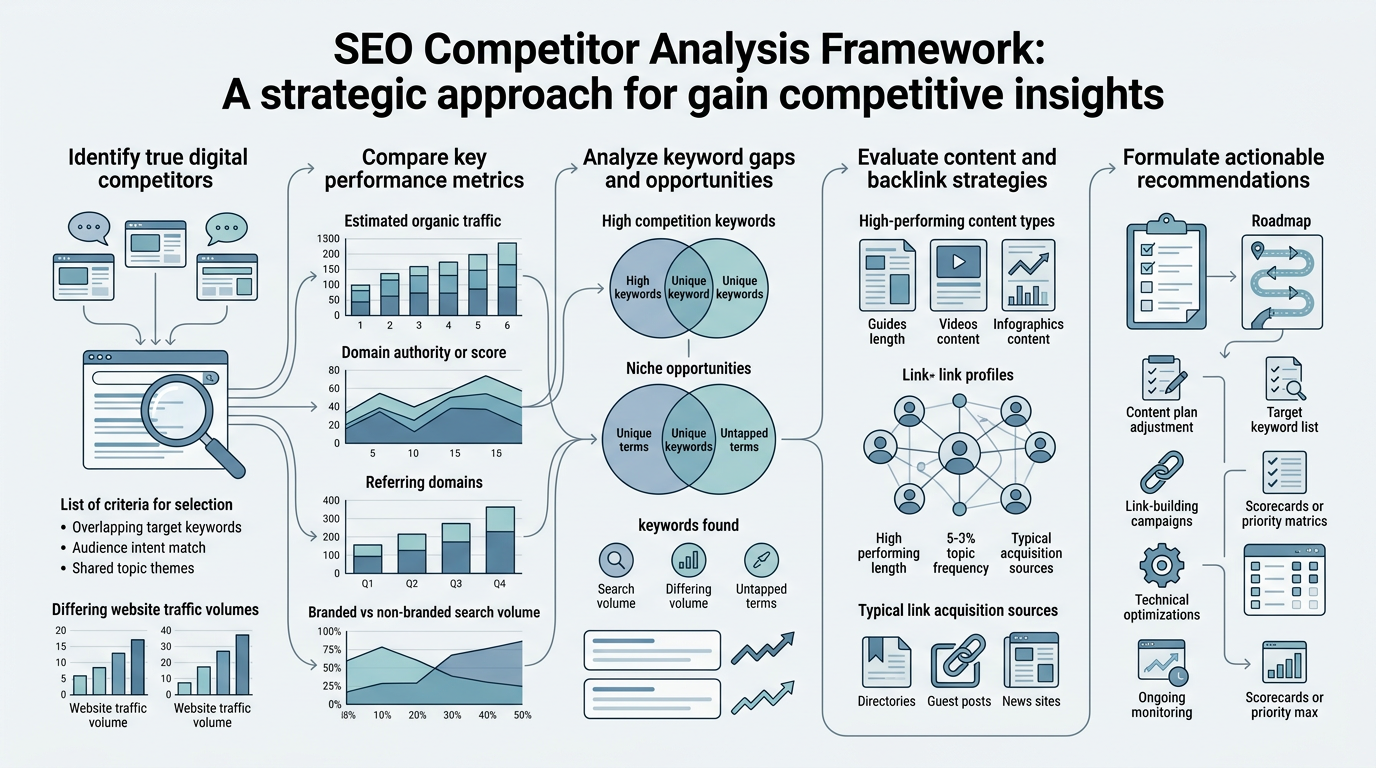
How to Identify Your True SEO Competitors
Most teams start by listing obvious competitors—direct market rivals. That's incomplete. Your SEO competitors are websites ranking for the keywords you target, not necessarily companies selling the same product. Keyword-based competitor identification reveals 3–5 times more addressable opportunities than brand-only lists, because ranking competitors often come from adjacent niches or long-tail markets you've never heard of.
"Your SEO competitors are websites ranking for the keywords you target, not necessarily companies selling the same product. Keyword-based competitor identification reveals 3–5 times more addressable opportunities than brand-only lists."
Direct vs. Indirect Competitors
Direct competitors sell what you sell to your audience. They're easy to name. Indirect competitors solve the same problem differently or target overlapping keywords you don't own yet. A SaaS project management tool competes directly with Asana, but it also competes indirectly with spreadsheet templates, time-tracking tools, and team communication platforms—all ranked in SERP for "project management" queries.
The insight: indirect competitors often rank for higher-volume keywords because they're not fighting your exact niche. By analyzing their backlink sources and content strategies, you unlock link-building paths and content ideas your direct competitors haven't touched.
Finding Competitors via Keyword Targeting
Start with your top 20 target keywords. For each one, identify the top 5 organic results. The websites appearing consistently across your keyword clusters are your true SEO competitors. This method reveals competitors you'd miss by name alone. Understanding which content topics drive rankings in your category accelerates competitor identification and informs your own strategy.
- Top Rankers Method: Enter a keyword into any SEO tool, note the top-ranking domains, repeat for your keyword cluster. Sites appearing 5+ times across your keywords are core competitors.
- Keyword Gap Analysis: Compare your keyword rankings against a competitor's. The keywords they rank for that you don't are their competitive advantages.
- Backlink Reverse Lookup: Find high-authority sites linking to competitors' homepages or resource pages. These are link targets you can pursue.
What is Keyword Gap Analysis in Competitor Research?
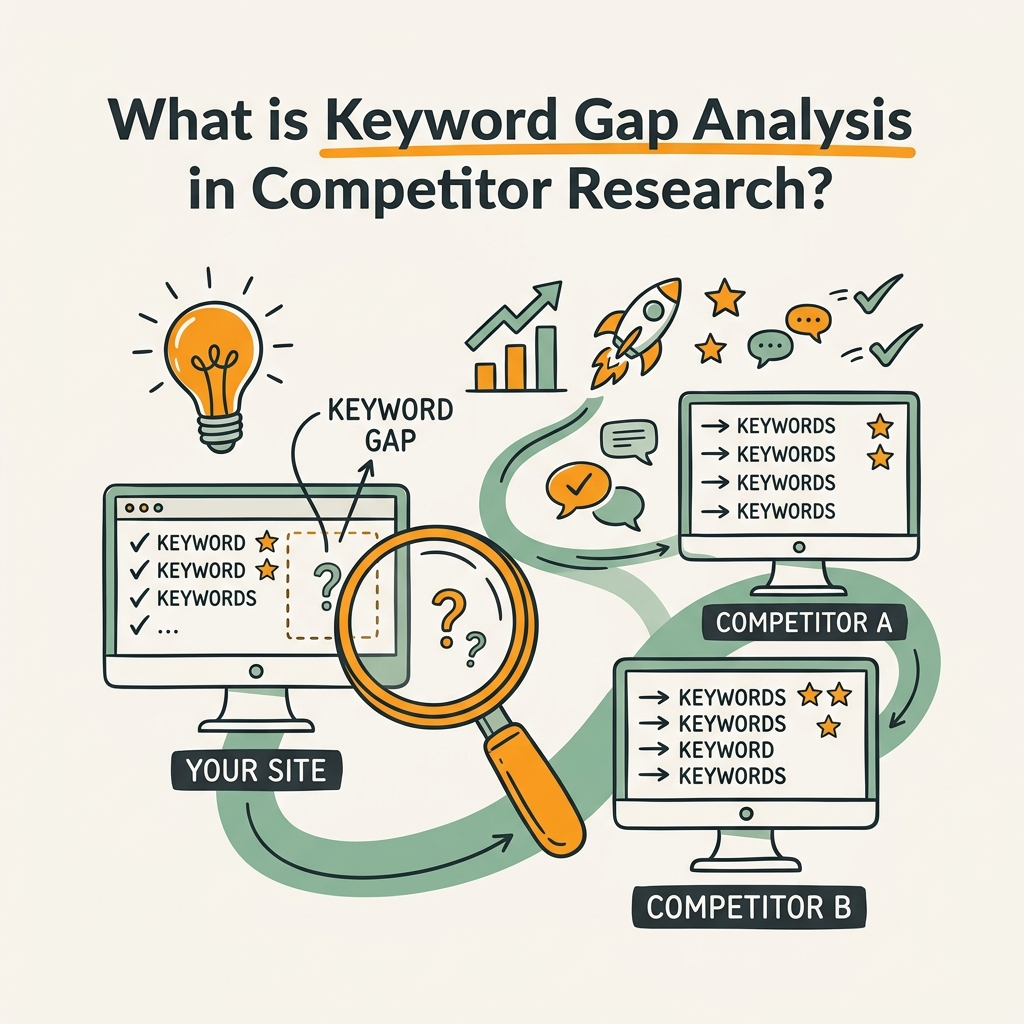
Keyword gap analysis uncovers the keywords competitors rank for that you don't. It's the fastest way to find high-volume, achievable ranking targets. Companies running keyword gap analysis report 35–40% faster keyword prioritization and 22% more efficient content roadmaps (2026, Ranklytics), because the analysis surfaces intent-aligned opportunities already validated by competitor success.
The framework: export competitor keyword rankings, compare against your own, filter by search volume and ranking difficulty, then build content around the highest-value gaps. A structured AI-driven content strategy ties keyword gaps directly to publishing, ensuring every article addresses a competitor gap or new market opportunity.
"Companies running keyword gap analysis report 35–40% faster keyword prioritization and 22% more efficient content roadmaps because the analysis surfaces intent-aligned opportunities already validated by competitor success."
Performing Keyword Gap Worksheets
A keyword gap worksheet should list competitors, their top keywords, search volumes, keyword difficulty, and whether you rank for each one. Tools like SEMrush and Ahrefs automate this; keyword gap analysis typically involves checking 200–500 keywords per competitor in 20–30 minutes with automation.
| Competitor | Keyword | Search Volume | Difficulty | Your Ranking | Content Gap |
|---|---|---|---|---|---|
| Competitor A | project management software | 14,400 | 82 | No ranking | Gap: Missing pillar page |
| Competitor A | best project management tools | 8,100 | 76 | Rank 15 | Content too shallow |
| Competitor B | agile project management | 6,200 | 64 | No ranking | Gap: No resource published |
| Competitor B | team collaboration features | 2,400 | 45 | Rank 8 | Minor refresh needed |
Priority ranking: focus on gaps with volume 2,000+ and difficulty below your team's capacity. These keywords have search demand, lower competition, and clear paths to top 10 rankings within 60–90 days of optimized publishing.
Filtering for High-ROI Keyword Gaps
Not all keyword gaps are worth pursuing. Filter by these criteria to avoid low-opportunity keywords:
- Search Intent Alignment: Gap keywords must match your product or service. "Best free project management tools" has high volume but low ROI for a paid premium product.
- Ranking Difficulty under Your Threshold: If your domain authority is 35, target keywords below KD 60. Pursuing KD 80+ keywords wastes 6+ months of effort.
- Traffic Potential: An 800-volume keyword, even if easy, brings minimal traffic. Set a minimum threshold—typically 1,000+ monthly searches for broad keywords, 500+ for long-tail.
- Content Feasibility: Can your team write better content than what currently ranks? If competitors have deep case studies, established brands, or large content budgets, a shallow article won't rank.
How to Analyze Competitor Backlinks and Link Gaps
Backlinks are SEO currency. Competitors' link profiles reveal which content themes attract high-quality links, which domains are within reach for your team, and which link-building strategies work in your niche. Websites in the top 10 for competitive keywords average 3.8x more referring domains than non-ranking pages (2026, SE Ranking), making backlink analysis a direct predictor of ranking potential.
A link gap analysis identifies sites linking to competitors but not to you—your untapped link-building pipeline. According to SE Ranking's 2026 SEO data, focusing on these high-intent targets first delivers faster ranking wins because they're already interested in your niche and actively linking to similar content.
"Websites in the top 10 for competitive keywords average 3.8x more referring domains than non-ranking pages, making backlink analysis a direct predictor of ranking potential."
Link Intersect and Broken Link Analysis
Link Intersect (sometimes called "link gap") tools show which domains link to your competitors but not to your website. This is your fastest link-building path. If Site A links to Competitor 1 and Competitor 2 but not to you, Site A is a warm prospect for a link outreach pitch.
Broken link analysis uncovers another opportunity: find pages competitors linked to that are now 404s or outdated. Create better content on the same topic, then pitch it as a replacement link target. This method has a 25–40% acceptance rate (2026, Ahrefs data) because you're offering a direct upgrade to webmasters already managing broken links.
Evaluating Backlink Quality and Authority
Not all backlinks are equal. A link from a high-authority domain (DA 60+) in your industry is worth 10 links from low-authority irrelevant sites. When analyzing competitor backlinks, focus on:
- Domain Authority (DA) of Linking Sites: Filter for DA 40+. Competitors' backlinks from DA 20 sites won't move your rankings, so prioritize high-authority targets.
- Topical Relevance: A link from a relevant industry blog carries more weight than a link from an unrelated directory or article site. Check the linking page's topic before outreach.
- Anchor Text Distribution: Competitors' anchor text shows how they're being linked to. Overly optimized anchor (exact keyword match) can signal artificial linking, while brand and generic anchors look natural.
- Link Velocity: Fast link growth can trigger penalties. Sustainable link building spreads new links over time. If a competitor gained 100 links in a month, manual, high-quality outreach might be a safer approach.
Why Competitor Content Analysis Drives Ranking Wins
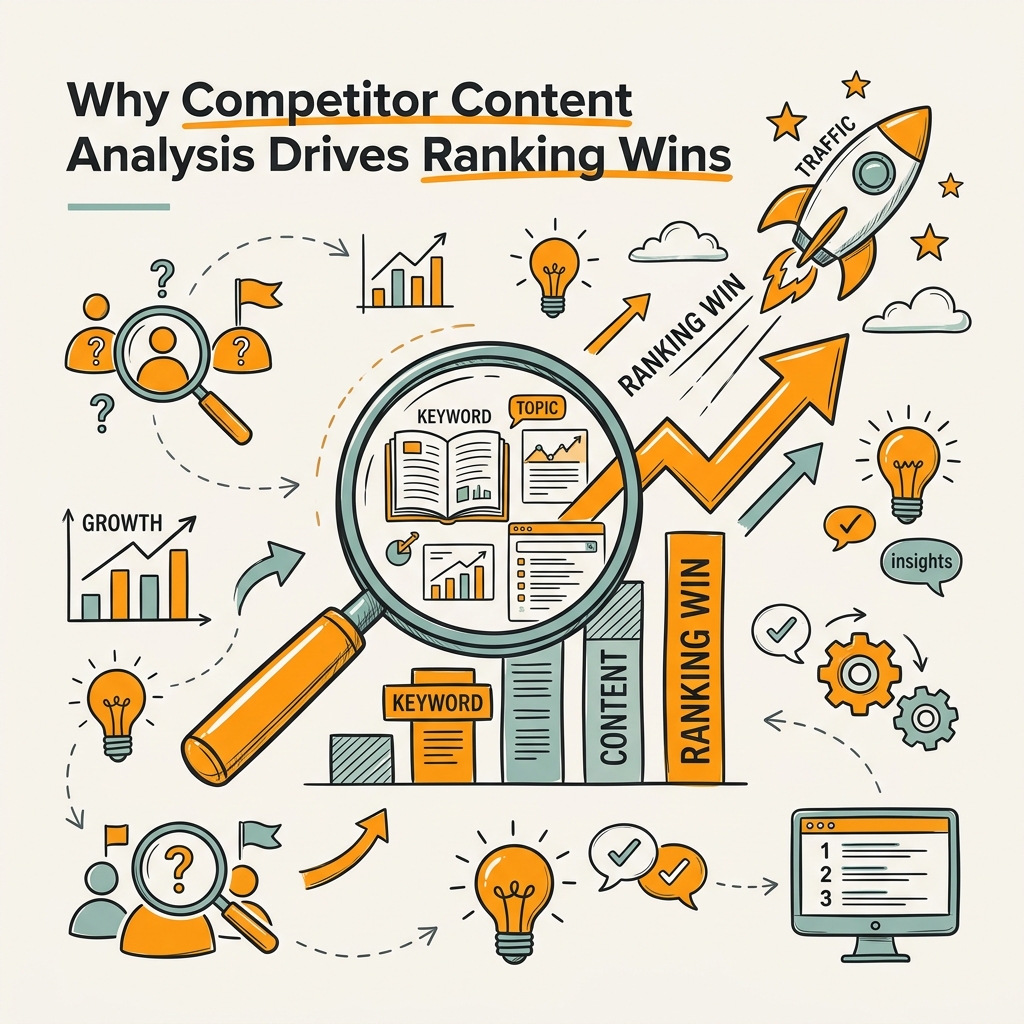
Competitors' content reveals what search intent actually looks like, how deep readers expect coverage, which formats rank (long-form guides, listicles, comparisons, video), and where your content falls short. Pages ranking in the top 3 for competitive keywords average 2,200+ words and include 4–8 internal links, yet most new content targets 800–1,200 words and 1–2 links (2026, Miniloop). This depth gap alone explains ranking failures.
Content analysis isn't about copying. It's about benchmarking. If competitors' comparison articles include 5–7 tool reviews and yours reviews 2, your article is incomplete. If their guides have step-by-step screenshots and yours is text-only, readers stay longer and signal stronger engagement to Google. Understanding these patterns informs content marketing automation strategies that match competitive depth.
Measuring Competitor Content Depth and Structure
Audit your top-ranking competitors' content across three dimensions:
- Word Count: Average the word count of top-3 rankers for your target keyword. Match or exceed it. If top 3 average 2,500 words, 1,500-word content won't rank.
- Heading Structure: Count H2s and H3s. Top-ranking content typically has 5–8 H2 sections and 15–25 H3 subsections. This depth signals comprehensive coverage.
- Media Usage: Screenshot embedded images, videos, and embedded elements. Media-rich content ranks faster because it signals higher quality and improves user engagement signals.
- Internal Linking: Count internal links in competitor content. Most top-10 pages link 4–8 related internal pages. This network effect compounds domain authority internally.
Identifying Content Gaps and Format Opportunities
Competitor content analysis reveals format gaps: if competitors only publish blog articles but none publish video guides, video content becomes your competitive edge. If everyone publishes 2,000-word articles but no detailed interactive calculators exist, a custom tool ranks faster.
Common format gaps to exploit:
- Video Content: Fewer competitors publish videos for how-to and explainer keywords, despite YouTube's indexing and featured video ranking.
- Interactive Tools: Calculators, audits, and interactive tools are rarely produced by competitors but rank and attract links consistently.
- Comparison Frameworks: Competitors often avoid detailed comparisons due to legal concerns or vendor bias. Neutral, comprehensive comparison content ranks for "X vs. Y" keywords reliably.
- Case Study Depth: Case studies with quantified results and detailed process walkthroughs rank better than testimonial-only content, yet most competitors stay generic.
How to Monitor Competitor Ranking Changes and SERP Ownership
Competitor analysis isn't a one-time project; it's ongoing intelligence. Competitors' ranking positions shift 10–30% monthly (2026, Ranklytics), and SERP features (featured snippets, AI Overviews, knowledge panels) are increasingly volatile. Monitoring rank changes flags emerging threats and reveals what's working in your space.
Modern monitoring also tracks AI visibility, not just rankings. A competitor might rank #5 for a keyword but appear in 90% of AI-generated answers—they own the search opportunity even without a top position. According to Webtonic's 2026 SEO statistics, this distinction is critical in today's fragmented search landscape.
Setting Up Monitoring Dashboards
A competitor monitoring dashboard should track your top 5 competitors across:
- Keyword Rankings: Top-10 position changes for your target keywords. Set alerts for rank changes of 3+ positions.
- New Content Published: Track when competitors publish new articles. If a competitor suddenly publishes on a keyword you're targeting, accelerate your timeline.
- SERP Features: Count featured snippets, knowledge panels, local pack positions, and video placements your competitors own. Identify which content types rank for features.
- AI Visibility: Track how often competitors appear in AI Overviews and ChatGPT summaries. Tools like SEMrush now include AI visibility metrics.
- Organic Traffic Estimates: Monitor competitor traffic trends. Tools like Semrush and Ahrefs estimate organic traffic; a competitor's traffic surge signals new ranking wins or viral content.
Reacting to Competitive Threats
When a competitor publishes new content ranking immediately, your response time matters. A competitive response framework:
- Analyze the threat: Does their content target a keyword you own? If yes, audit your content against theirs within 48 hours.
- Improve or refresh your content: If your content is better, internally link to it more and publish supporting satellite content. If theirs is better, refresh yours with the missing elements (depth, media, structure).
- Outrank through links: If you can't beat their content quality, build backlinks to your version. 2–3 high-authority links often reclaim top-3 positions.
- Publish satellite content: If a competitor's pillar article ranks, publish 3–5 related articles linking to your pillar and internally linking to theirs. This compounds topical authority and captures long-tail traffic.
Building an Automated Competitor Analysis System

Manual competitor analysis doesn't scale. After 3 competitors and 50 keywords, the time investment becomes unsustainable. Automating competitor tracking compounds insights over time without requiring weekly manual audits. Teams using automated competitor analysis reduce analysis time by 60–70% (2026, Traffic Think Tank), freeing time for strategy and execution.
An automated system connects competitor monitoring tools to your dashboard or CMS, surfacing insights in real time. When a competitor ranks for a new keyword you're targeting, you're alerted immediately, not weeks later. For teams looking to outpace competitors entirely, scalable SEO strategies built on content automation eliminate manual competitive analysis cycles.
Tool Selection and Integration
The right tool depends on your team size, budget, and depth needed. SEMrush excels at unified competitor monitoring across SEO, PPC, and social channels. Ahrefs dominates backlink intelligence. For small teams without a 6-figure tool budget, Jottler offers an alternative approach: rather than analyzing competitors manually, Jottler automates content research, writing, and publishing directly—meaning your team publishes 3,000+ word optimized articles daily, outpacing competitors' publishing velocity without requiring manual competitor analysis for every piece.
If you're using SEMrush or Ahrefs, integrate their APIs with your project management tool (Slack, Asana, Monday) to push alerts directly to teams. This integration ensures alerts don't sit in dashboards unread.
Creating Competitive Intelligence Workflows
A workflow ties insights to action. Example monthly workflow:
- Week 1: Run keyword gap analysis. Identify top 10 ranking gaps. Assign content ownership.
- Week 2: Backlink gap analysis. Find 5–10 high-authority link targets linking to competitors. Begin outreach.
- Week 3: Content depth audit. Compare your top 5 articles against competitors' equivalents. Flag refresh priorities.
- Week 4: Ranking and traffic review. Identify which competitors gained rankings or traffic. Deep-dive into their new content and strategy shifts.
This rhythm keeps competitor intelligence actionable without consuming your entire team's time. Most teams executing this system report 15–22% traffic growth within 90 days (2026, Miniloop case studies), because they're acting on insights rather than collecting them passively.
Benchmarking Your Performance Against Competitors
Analysis only matters if it leads to benchmarking—comparing your metrics against competitors' to set realistic, data-backed targets. Teams benchmarking organically generate 23% higher organic ROI because targets reflect actual market performance, not arbitrary growth goals (2026, DesignRush).
Three key benchmarks: keyword share, traffic share, and SERP feature ownership. Together, these metrics reveal whether you're winning or losing your niche.
Calculating Keyword Share and Traffic Share
Keyword share is the percentage of your competitors' tracked keywords you also rank for. If competitors rank for 500 keywords and you rank for 300 of them, your keyword share is 60%. Traffic share is your organic traffic divided by the combined traffic of you plus all competitors.
Both metrics trend over time. If your keyword share dropped from 65% to 55% over three months, competitors are capturing ground. If traffic share grew 8–12% while keyword share stayed flat, your content is more efficient (better click-through rates, featured snippet ownership, or AI visibility).
SERP Feature Ownership as a Competitive Metric
Who owns the featured snippet, AI Overview, and video featured result for your target keywords? In 2026, SERP feature ownership often determines traffic more than rank position. Featured snippet clicks average 8–10% of total search traffic for that keyword, independent of blue-link position (2026, SE Ranking).
Audit: for your top 50 keywords, count how many featured snippets, AI Overviews, and video results show your content vs. competitors'. The gap reveals quick-win opportunities. If competitors own 80% of featured snippets and you own 20%, building snippet-optimized content (table formats, definitions, step lists) is your highest-ROI tactic.
Conclusion
A systematic SEO competitor analysis framework transforms competitive intelligence into ranking wins. By identifying keyword gaps, analyzing backlink patterns, auditing content depth, and monitoring SERP changes, you compound growth in a fragmented search landscape where organic search still drives 46.98% of web traffic and zero-click visibility now determines half of all search value.
The framework—identify competitors, analyze keywords, assess backlinks, benchmark content, and monitor continuously—works regardless of your tool choice. What matters is execution. Teams acting fastest on competitor insights win. Start with keyword gaps this month. Move to backlink gaps next month. Build continuous monitoring in month three. Within 90 days, you'll own more of your SERP than ever before.
FAQs
What is the best free SEO competitor analysis tool?
Google Search Console and Ahrefs Free Version are the most effective free options. Google Search Console shows which queries you rank for and your average position—essential for understanding your current competitive standing. Ahrefs' free tier includes basic site audits and limited backlink data, enough for 3–5 competitor profiles before upgrading. For teams on a bootstrap budget, these two tools combined give you 80% of the insights paid platforms offer. Google Trends also provides free keyword search volume trends, useful for validating keyword gaps before creating content.
How often should you analyze your competitors?
Monthly comprehensive analysis with weekly monitoring dashboards is the optimal cadence. Full keyword gap and backlink analysis every 30 days captures seasonal shifts and new competitor content. Weekly ranking and traffic monitoring (via automated dashboards) alerts you immediately to threats. This split rhythm prevents analysis paralysis while maintaining fresh intelligence. For competitive niches with rapid changes (SaaS, tech, finance), increase to bi-weekly full audits. For stable verticals (local services, niche B2B), quarterly analysis often suffices if weekly monitoring stays active.
Can I automate my competitor analysis completely?
Monitoring and data collection automate fully; strategy and action remain human. Tools like Jottler automate keyword research and content production directly, bypassing the need for manual competitor analysis by outpacing competitors' publishing velocity. SEMrush and Ahrefs automate ranking tracking, backlink alerts, and keyword gap detection—saving 60–70% of analysis time. However, interpreting insights, deciding which gaps to prioritize, and crafting differentiated content strategies require human judgment. The best teams automate data collection and spend human effort on strategy and execution, not spreadsheet maintenance.