SEO Fundamentals Every Founder Should Know
Organic search accounts for 53% of all website traffic, yet 58%+ of Google searches are zero-click, meaning users get answers without leaving the results page. For founders juggling product, hiring, and fundraising, the shift from ranking-for-traffic to ranking-for-conversions feels invisible—until your traffic plateaus despite ranking position #1. The solution? Understanding what SEO actually does for founders: it compounds. Unlike paid ads, organic growth builds on itself. But only if you get the fundamentals right. Here's what you need to know to build SEO that actually moves the needle.
Key Takeaways
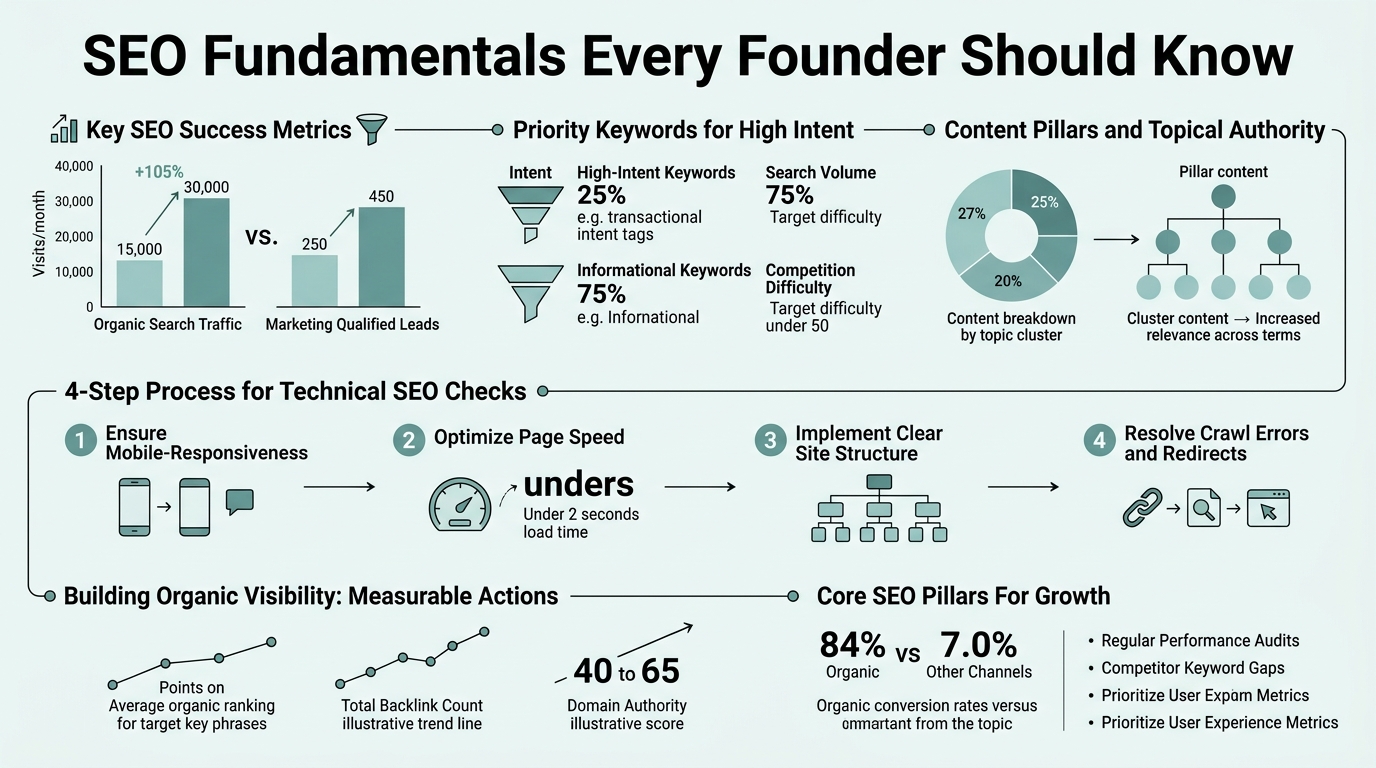
- Organic search generates 53% of website traffic and offers $147 CPL in B2B, versus $280 for paid (Ahrefs, 2025)
- Zero-click searches now dominate, requiring content optimized for SERP features, snippets, and AI answers
- Topical authority and conversion optimization matter more than raw rankings; measurable business outcomes trump pageviews
Quick-Scan Overview
- Organic Traffic Economics: B2B SEO delivers lower acquisition cost ($147 CPL) than paid search, with 53% of website traffic originating from organic search in 2025.
- The Ranking-to-Conversion Gap: Zero-click searches and AI Overviews mean ranking #1 doesn't guarantee clicks; CTR has dropped below 30% for many industries.
- Topical Authority Strategy: Building clusters of related content around core business themes drives better rankings than chasing isolated keywords.
- Content Automation for Founders: SEO automation platforms handle research, writing, and publishing daily, letting you scale organic traffic without hiring.
- Technical SEO Essentials: Site structure, mobile speed, and schema markup are foundational; poor implementation kills even good content.
Why Organic Traffic Economics Matter for Your Bottom Line
SEO's true value for founders lies not in rankings but in acquisition cost. Organic search generates a 5.0% conversion rate for B2B companies, and the cost per lead of $147 in SaaS is less than half paid search's $280 CPL according to Ahrefs. This compounding effect is powerful: a single well-optimized page can drive thousands of qualified leads over months with zero incremental spend. But that only happens if you focus on conversion, not vanity metrics.
The True North: Business Outcomes, Not Rankings
Founders often obsess over ranking position. Position #1 feels like a win. Then traffic lands, but conversions don't follow. The issue? Organic search is no longer a traffic channel alone. It's a discovery and trust channel. Users searching for solutions are already evaluating competitors. Your rank determines visibility, but your content and conversion funnel determine whether they buy. Measure SEO by assisted revenue, pipeline contribution, and cost per lead—not sessions or keyword rankings. This shifts how you build content: fewer pages, more depth, stronger topical authority, better conversion optimization. When you approach SEO from this revenue-first angle, everything changes. You stop publishing generic content and start building authority that converts.
Compounding Organic Growth vs. the Paid Ad Treadmill
Paid ads work until you stop paying. SEO compounds. A blog post ranking for a 500-volume keyword generates 150–200 clicks per month, month after month. Over a year, that's 1,800–2,400 qualified visits. Paid search burns budget to hit the same volume. The trade-off? SEO takes time—typically 3–6 months for new content to rank. Founders impatient for growth often overspend on ads instead of investing in durable organic foundations. The winners build both: paid for immediate demand, organic for compounding assets. But the portfolio should reflect SEO's long-term efficiency. This is especially critical for founders running lean budgets.
Understanding the Zero-Click Search Reality
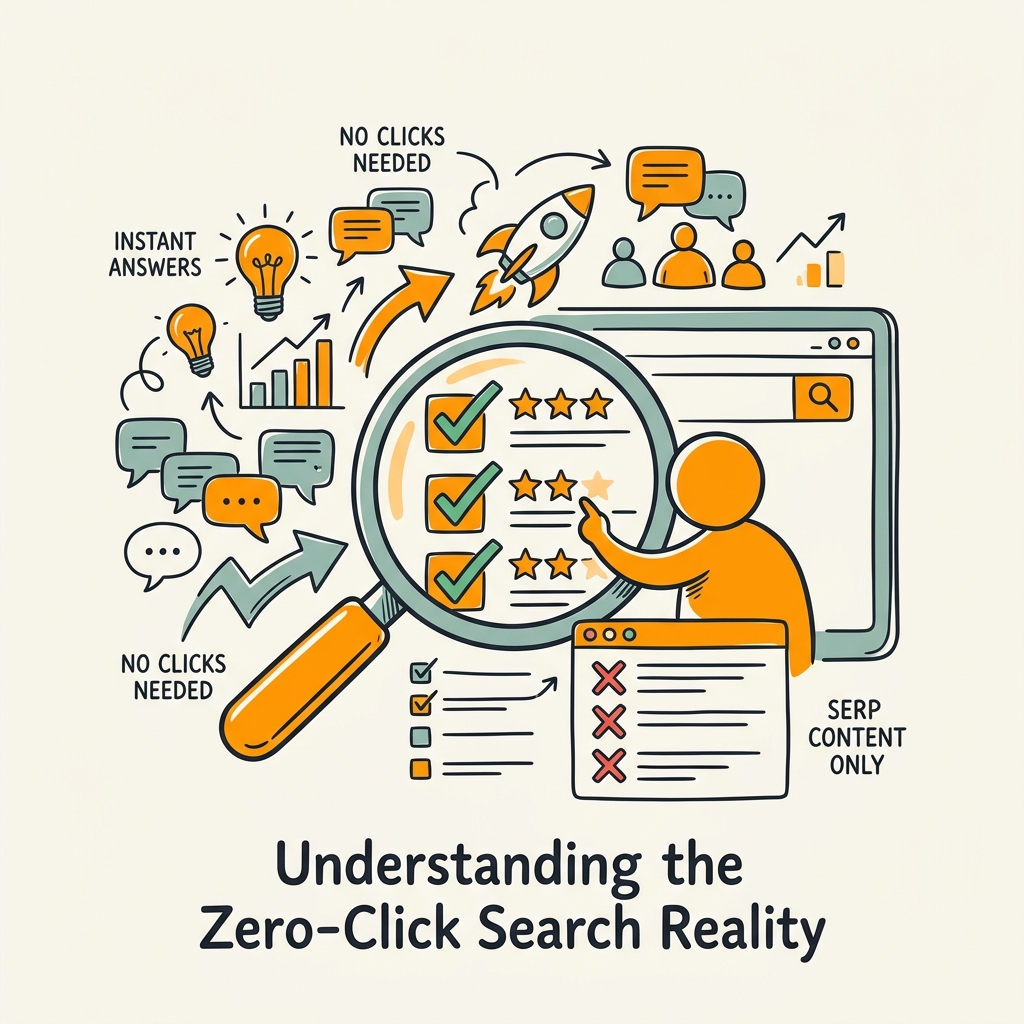
Your target customer is Googling your solution keywords. You rank #1. Your CTR is 20%, not the 40% you expected. Why? 58% of Google searches now end without a click. Users get answers from featured snippets, People Also Ask boxes, AI Overviews, or the knowledge panel. Your rank is worthless if the answer appears in a box above your link. Founders must optimize for zero-click visibility—capturing mind-share and authority even when users don't visit your site. The smart approach: see zero-click SERP features as additional opportunities, not threats.
Zero-Click SERP Features and What They Mean for Your Content
Zero-click answers come in several forms. Featured snippets extract a 40–60 word summary from your content and display it at the top of search results. People Also Ask surfaces related questions and short answers. Google Shopping shows product cards. AI Overviews (Google's AI-generated answers) pull information from multiple sources and display a synthesis without a clickthrough. Each format requires different content: snippets demand concise, direct answers; People Also Ask wants Q&A structure; AI Overviews benefit from authoritative, cited content. According to Uprankd's 2025 SEO data, tools can show you which pages currently capture snippets and PAA placements, so you can optimize systematically. The goal: earn visibility in every format, not just the blue link. This expanded view of ranking—beyond traditional SERP position—is essential for 2026 SEO success.
"Zero-click optimization isn't about losing traffic—it's about winning authority. When your snippet appears in the SERP, users see your brand as the answer before they even click. That brand recall drives conversions downstream."
— SEO Best Practice, 2026
Building Content That Wins in AI-Driven Search
AI Overviews are reshaping SERP layouts. They appear in 7.6% of Google searches currently, but industry analysts expect that to grow. AI systems don't link directly to every source; they synthesize. Your edge is specificity, originality, and trust signals. Pages with author bylines, expert quotes, primary research, and case studies rank higher in AI answers than generic, synthesized content. For founders, this means: invest in proprietary insights, user interviews, and original data. A case study showing how your product solved a specific customer problem outranks thin blog posts. AI systems can detect depth and authority. Use it to your advantage. This is where approaches like automated content marketing automation excel—they can factor in these authority signals when publishing at scale.
Topical Authority: The Foundation of Durable Rankings
Topical authority means owning a topic. Instead of writing scattered posts about "SEO," "keyword research," and "link building," you build a cluster: one authoritative pillar page covering SEO comprehensively, then 10–20 detailed child pages diving into subtopics, all internally linked. Google recognizes this as expertise. Rankings follow. This approach also reduces content bloat. Many founders publish volume without strategy—50 shallow articles instead of 10 comprehensive ones. Topical authority flips this. You publish fewer, deeper pages and win broader keyword coverage with each. The result: faster growth with less effort.
Keyword Clustering and Topic Mapping
Manual keyword lists are outdated. Modern SEO starts with keyword clustering: grouping 100+ related search terms into 5–10 distinct topics, each representing one content opportunity. Platforms that automate keyword clustering analyze SERP intent and automatically group terms by semantic similarity and search intent. This eliminates the trap of writing two articles that rank for the same audience, diluting your authority. One strong page beats two weak ones. For a SaaS founder building an SEO content plan, start by mapping your top 10 business-critical topics. Then cluster keywords under each. Assign one pillar page and 3–5 child pages per topic. This gives you a roadmap: 50–70 pages total, all focused on demonstrable expertise. This structured approach compounds faster than scattered publishing.
Internal Linking as the Connective Tissue
Internal links are SEO's most underused lever. They pass authority from high-ranking pages to newer pages, they distribute crawl budget, and they guide users deeper into your site. But most founders link randomly—or not at all. Strategic internal linking follows topical clusters. Your pillar page links to all child pages. Child pages link to the pillar and related children. This structure signals to Google: these pages form a cohesive topic. Rankings compound. For automation, tools now exist that build internal link networks automatically based on keyword relevance and topical clusters, so you don't manually create 50 links per page. If you're using a content platform, prioritize those with smart internal linking built in. This single feature can accelerate authority growth by months.
Technical SEO: The Invisible Foundation
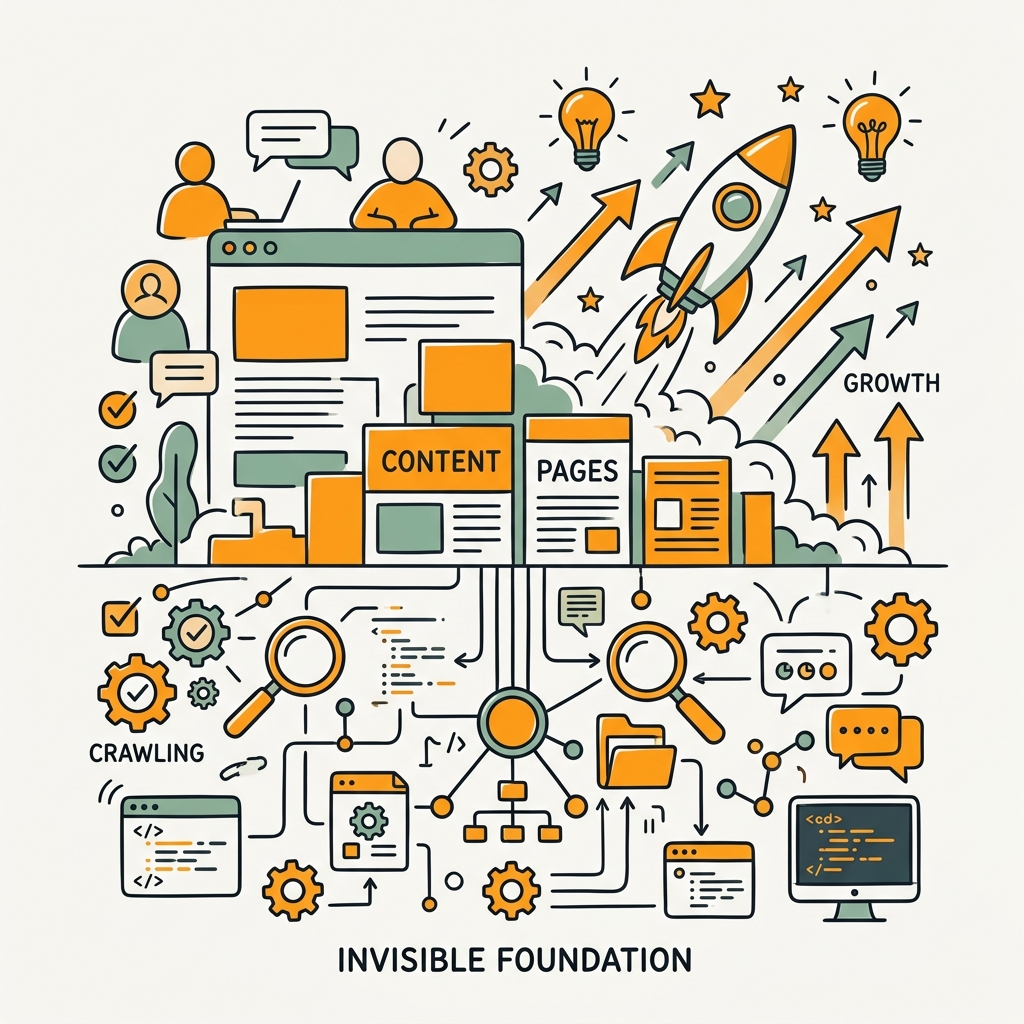
Great content fails without solid technical SEO. Crawlability, mobile performance, site speed, and structured data are not optional. Google's Core Web Vitals—page speed, visual stability, interactivity—are ranking factors. A slow site ranks worse than a faster competitor with mediocre content. For founders on a budget, this is good news: technical SEO is a one-time investment. Fix your site structure, optimize images, enable caching, and add schema markup. The benefits compound forever. Many founders skip this because it's not "creative" work—but it's the foundation everything else rests on.
Mobile-First Indexing and User Experience
Google now indexes and ranks primarily off mobile versions of pages. If your mobile site is slow, has poor readability, or crashes, desktop performance doesn't matter. Mobile zero-click rates are higher than desktop, meaning mobile users are even more likely to get answers without clicking. Your mobile site must be fast (under 3 seconds to first contentful paint), readable without scrolling sideways, and touch-friendly. Test on Google's PageSpeed Insights and prioritize fixing red flags. For SaaS, this often means: lightweight checkout flows, readable mobile layouts, and fast API responses. Use a CDN, compress images aggressively, and defer non-critical JavaScript. The speed investment pays for itself in conversion uplift alone.
Schema Markup and Rich Results
Schema markup tells Google what your content is: an article, a product, a review, an FAQ. With schema, your SERP listing can include star ratings, prices, author names, or a FAQ accordion. These rich results dramatically boost CTR. They also improve visibility in AI answers. Structured data is no longer optional. Your CMS should auto-generate schema for every page: Article schema for blog posts, FAQPage schema for FAQs, BreadcrumbList for navigation. Don't manually code schema; use plugins (Rank Math, Yoast) or platform-native tools. This scales. When schema is automated, you compound CTR gains across hundreds of pages without extra effort.
Content Strategy That Converts: From Search Intent to Revenue
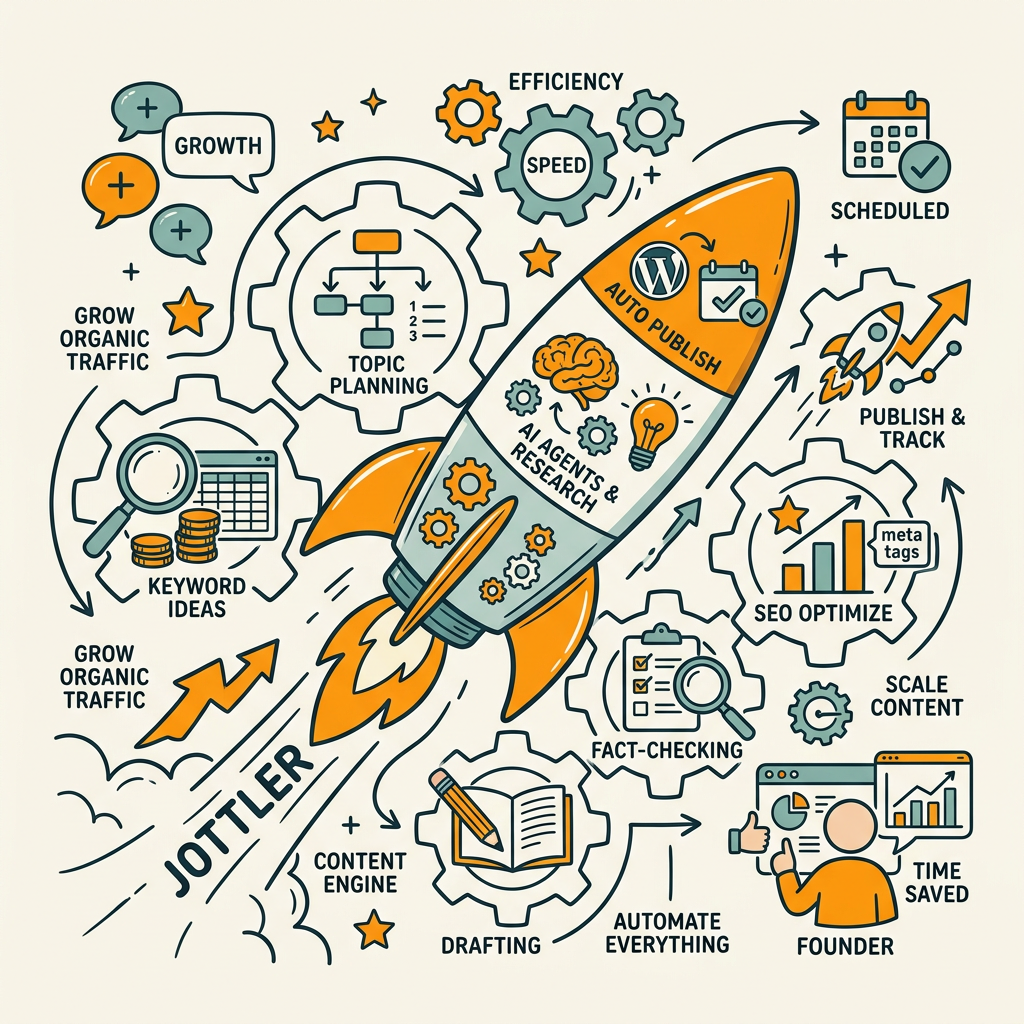
SEO content falls into four intent buckets: informational (learning), commercial (researching vendors), navigational (looking for your brand), and transactional (buying). Each requires different content, placement in the funnel, and success metrics. Founders often mix these, creating confusion. An informational post ("What is SEO?") shouldn't convert like a comparison ("Jottler vs Competitor"). Each serves a different stage. Map your funnel. Then assign content intent. This clarity drives better results. The approach used by the best SEO automation systems is to pre-cluster content by intent and funnel stage, ensuring every piece lands in the right place.
Targeting High-Intent Keywords and Bottom-of-Funnel Content
Informational keywords are cheap traffic. But they convert at 1–3%. Commercial and transactional keywords convert at 8–15%. Founders should invest in both, but weight bottom-of-funnel content higher. If your product is project management software, "what is project management" gets traffic but doesn't sell. "Asana vs Monday.com" converts 5x better. Build a mix: 40% top-of-funnel (awareness), 40% mid-funnel (evaluation), 20% bottom-funnel (conversion). Each page should map to a clear customer journey. Then measure each funnel stage: top-of-funnel by branded search growth, mid-funnel by engagement and time-on-page, bottom-funnel by conversion rate and revenue. SEO that doesn't move the needle financially is expensive traffic. Don't let vanity metrics fool you.
The Role of Original Research and Proprietary Insights
The internet is saturated with regurgitated "top 10" lists and generic guides. Original research stands out. Surveys, studies, data compilations, and case studies are Google-preferred content. They attract links (authority signals), earn media coverage, and rank for branded terms. For a founder, commissioning one original research study—a customer survey, a competitive analysis, a trend report—yields 20+ content opportunities and positions your brand as an expert, not just a tool. This is especially powerful for B2B SaaS. A study showing "78% of marketing teams struggle with X" becomes a centerpiece. You cite it in sales decks, social, and ads. Organic traffic amplifies it. One study: 6–12 months of content ROI. This is one of the core differentiators driving AI content strategy success—proprietary insights can't be automated away.
"Original research is the only moat that matters in SEO today. Generic content ranks nowhere. But data from your customers, your product, your market—that's defensible. It attracts links, earns trust, and compounds in value year after year."
— Content Strategy Principle, 2026
Building Your SEO Stack: Automation for Busy Founders
SEO is operationally complex. Keyword research, content planning, writing, optimization, publishing, linking, and reporting require multiple tools and workflows. For founders without a dedicated SEO team, this is overwhelming. The modern solution: SEO automation platforms that handle the entire pipeline. These systems research topics, write articles, optimize for on-page factors, build internal links, check facts, and publish to your CMS daily—with zero manual oversight. This shifts the founder's role from executor to strategist.
What to Automate First: Research, Briefing, and Publishing
Don't automate writing before automating research and publication. Start with the most painful tasks. For most founders, that's keyword clustering, content briefs, and scheduling. Tools that auto-generate content roadmaps, cluster keywords by intent, and schedule posts free enormous time. Next, automate publishing: connect your CMS and let the system publish directly, eliminating manual CMS entry. Once those workflows are locked, then add content generation. Jottler, for example, runs the full cycle—research, writing, fact-checking, CMS publishing, and internal linking—with 12 AI agents daily, generating 3,000+ word articles without founder input. This compounds. 365 published articles per year, each with internal links and optimized structure, builds topical authority that no competitor with 10 writers can match. The compounding effect is extraordinary.
Integrating SEO Tools Into Your Marketing Stack
Your tech stack should flow: keyword research tool → content planning tool → writing/optimization tool → CMS → analytics. Silos kill efficiency. If your keyword tool, writer, and CMS don't talk, you spend hours manually transferring data. Modern platforms integrate this. Tools like Ahrefs for research, Jasper for drafting, Rank Math for schema and optimization, and Google Search Console for analytics work together. But if your platform does all of it natively (research, writing, optimization, publishing), you save weeks per year. For a founder running lean, integrated platforms beat best-of-breed tooling. The time savings alone justify the investment.
| Automation Task | Manual Approach | Automated Approach | Time Saved/Year |
|---|---|---|---|
| Keyword Research & Clustering | Spreadsheet analysis, manual grouping (40 hours/year) | AI-driven clustering by intent (2 hours/year) | 38 hours |
| Content Brief Generation | Manual SERP analysis, brief writing per page (100 hours/year) | Auto-generated briefs from competitor pages (5 hours/year) | 95 hours |
| Article Writing & Optimization | Hire freelancer or in-house writer (300+ hours/year) | AI writing with fact-checking & schema (10 hours/year review) | 290 hours |
| Internal Linking | Manual link placement per article (60 hours/year) | AI-driven relevance matching and auto-linking (0 hours) | 60 hours |
| CMS Publishing & Scheduling | Manual upload, formatting, scheduling (80 hours/year) | Direct CMS integration with auto-publish (0 hours) | 80 hours |
| Performance Reporting | Manual dashboard assembly from 3+ tools (50 hours/year) | Unified analytics dashboard (5 hours/year) | 45 hours |
Common SEO Mistakes That Derail Founder Success
Even with great strategy, execution gaps kill SEO. Most founders make avoidable mistakes that stall growth for months. Understanding these pitfalls saves time and budget. The good news: all are fixable once you're aware of them.
Chasing Volume Over Intent
Publishing 100 low-intent articles beats publishing 10 high-intent ones in some metrics. But not in revenue. Founders often chase volume because it feels productive. "We published 50 blog posts this month!" Reality: 45 generated zero leads. High-intent pages are smaller in volume but convert 5–10x better. Invest in fewer, stronger pages aligned to actual customer problems. Quality beats quantity. Always. This principle underpins the most successful AI article generators that rank—they prioritize depth and relevance over pure output.
Ignoring Competitive Gaps and SERP Intent
Writing a blog post without studying the top 10 results is malpractice. If the top 10 are all comparison pages, a beginner's guide won't rank. If they're all technical deep dives, a shallow overview fails. Spend 30 minutes analyzing competitor pages: what structure do they use? What data? What subheadings? Then match or exceed. This isn't copying; it's respecting intent. AI tools like Surfer SEO and Clearscope automate this analysis, showing you the exact headings, word count, and semantic keywords top pages use. Use them. The edge comes from going deeper, adding more original research, and making a better page—not from ignoring what already ranks.
Publishing Without Internal Linking
A new page with zero internal links is essentially invisible to Google. It has no authority path. New pages need 3–5 contextual internal links from relevant, existing pages to gain traction. This requires planning. If you publish 100 unlinked articles, you've wasted effort. Systems that automate internal linking—either through manual tagging or AI-driven relevance matching—compound growth. Every new page links backward to established pages and forward to future ones. This interlinking is a moat. Competitors starting fresh lack it. Over a year, internal linking strategies compound into significantly faster rankings.
Measuring SEO Success: Metrics That Matter
Vanity metrics hide failure. Ranking #1 for a keyword nobody searches is worthless. Driving 10,000 sessions from low-intent traffic that converts at 0.1% is expensive. Founders need clarity on what to measure and why. The right metrics change how you prioritize everything.
Revenue-Aligned Metrics: From Impression to Conversion
Track the full funnel. Impressions (how often your page appears in search results) → CTR (how often users click) → Engagement (time-on-page, scroll depth) → Leads or Sales. Each metric tells a story. Low impressions? You're not ranking for enough volume or the topic isn't searched. Low CTR? Your title tag or meta description isn't compelling. High impressions and low CTR? Your landing page experience is poor. Low engagement? Content doesn't match intent. Conversions dropping? Your conversion funnel or CTA is weak. Use Google Search Console for impressions and CTR, GA4 for engagement and conversions. Build a dashboard that tracks all four. Optimize backward: if conversions are low, trace the issue through engagement → CTR → impressions. This reveals the real problem. This systematic approach prevents wasted effort on irrelevant optimizations.
Organic Contribution to Revenue
The ultimate metric: how much revenue came from organic? Use UTM parameters or GA4's assisted conversions feature to track organic's contribution to multi-touch customer journeys. A 3-person startup might attribute 30% of revenue to organic. A larger company with established brand might show 15%. Know your number. It informs your SEO budget. If organic drives 25% of revenue, your SEO investment should reflect that importance. This backward-looking view of revenue ensures SEO gets the resources it deserves.
Key Metrics to Track Monthly
- Organic Impressions: Total times your pages appear in search results. Target: 10% monthly growth after month 3.
- Click-Through Rate (CTR): Percentage of impressions that result in clicks. Target: 25%+ for mid-funnel, 15%+ for top-funnel.
- Organic Traffic Volume: Sessions from organic search. Target: 20–30% monthly growth in year 1.
- Pages Per Session & Time on Page: Engagement signals. Target: 2+ pages per session, 2+ minutes average time.
- Conversion Rate by Landing Page: Leads or sales divided by organic sessions. Target: 5%+ for bottom-funnel, 0.5–2% for mid-funnel.
- Cost Per Lead (CPL): SEO investment divided by organic leads. Target: $50–$150 depending on industry.
- Revenue Attribution: Total revenue influenced or attributed to organic. Target: Track assisted conversions and last-click.
Conclusion
SEO fundamentals haven't changed: optimize for search intent, build topical authority, create content that earns links and shares, and measure business outcomes. But the execution has. Zero-click searches, AI Overviews, and mobile-first indexing mean ranking alone is insufficient. Content must convert. Topical authority compounds faster than scattered articles. And automation lets founders scale without hiring. The founders winning in 2026 aren't waiting months to see results. They're publishing daily with automated systems, building topical authority at scale, and measuring by revenue—not rankings. Start with your biggest business opportunity: the customer problem your product solves. Build a topical cluster around it: a pillar page covering the full solution, 5–10 deep child pages addressing sub-problems, and strong internal linking. Then automate. Connect your SEO platform to your CMS, publish daily, measure conversions, and iterate. Let topical authority compound. In 12 months, you'll own that category.
FAQs
How long does it take to see SEO results as a founder?
SEO typically compounds over 3–6 months. New content usually takes 2–3 months to rank in the top 50, and another 1–3 months to reach top 10 positions. However, topical authority accelerates results. Once you've published 10+ deep articles around a core theme with strong internal linking, each new article ranks faster because Google recognizes your domain's expertise. The first cluster takes 6 months; the second takes 3. This compounding is why SEO beats paid ads long-term. Initial patience yields disproportionate returns.
Do I need to hire an SEO specialist or can I do this myself?
You can start yourself, but complexity scales. Keyword clustering, competitive analysis, and on-page optimization are learnable. Publishing and measuring are straightforward. What's hard: doing this consistently every week without burning out. SEO automation platforms solve this. Instead of hiring an $80K/year specialist, invest in a platform that automates research, writing, and publishing daily. You stay strategically involved—reviewing page topics, setting topical clusters, checking conversions—without doing the mechanical work. This works especially well for busy founders.
What's more important: rankings or conversions?
Conversions, completely. Ranking #1 for 100 keywords that generate zero leads is expensive. Ranking #5 for one keyword that converts 20 leads per month is gold. Always measure ROI: cost per lead, conversion rate, and revenue attribution. This is your north star. If a page ranks #3 but converts at 15%, it's worth more than a #1 ranking converting at 0.5%. Structure your entire SEO strategy around conversion funnel alignment, not vanity rankings.