SEO Fundamentals Every Founder Should Understand
Most founders treat SEO as a nice-to-have, delegated to an overworked marketer or ignored entirely. That's a costly mistake. 46.98% of all website traffic still comes from organic search, and 94% of webpages receive zero traffic from Google—meaning the competition for visibility is brutal. Yet the fundamentals haven't changed. What has changed is the execution: in 2026, you're not just competing for clicks anymore. You're competing for visibility in AI summaries, search rankings, and the discovery that actually moves your business forward. Here's a quick summary of how to build organic traffic that compounds:
Key Takeaways
- Position #1 in Google captures 39.8% of clicks (2025, FirstPageSage), making ranking the single highest-leverage SEO outcome—but only if you target the right keywords with search intent matching your offer.
- Long-form content (3,000+ words) drives 3x more traffic, 4x more shares, and 3.5x more backlinks than average-length articles, making depth a core ranking factor.
- 58% of Google searches now end without a click due to AI Overviews, so founders must optimize for answer visibility and brand authority—not just click-through rates.
- Search Intent and Keyword Selection: Rank for keywords that match what your audience actually searches for, not just high-volume terms with no commercial intent.
- Technical Foundation: Core Web Vitals, mobile optimization, and crawlability are non-negotiable prerequisites before any content strategy works.
- High-Quality, First-Hand Content: Google now rewards E-E-A-T (Expertise, Experience, Authoritativeness, Trustworthiness), meaning your content must demonstrate real knowledge and original insight.
- Authority Through Backlinks: External websites linking to yours remain the strongest third-party vote of confidence search engines recognize.
- Consistency and Content Frequency: Compounding organic traffic requires regular publishing—but quality and relevance matter more than volume alone.
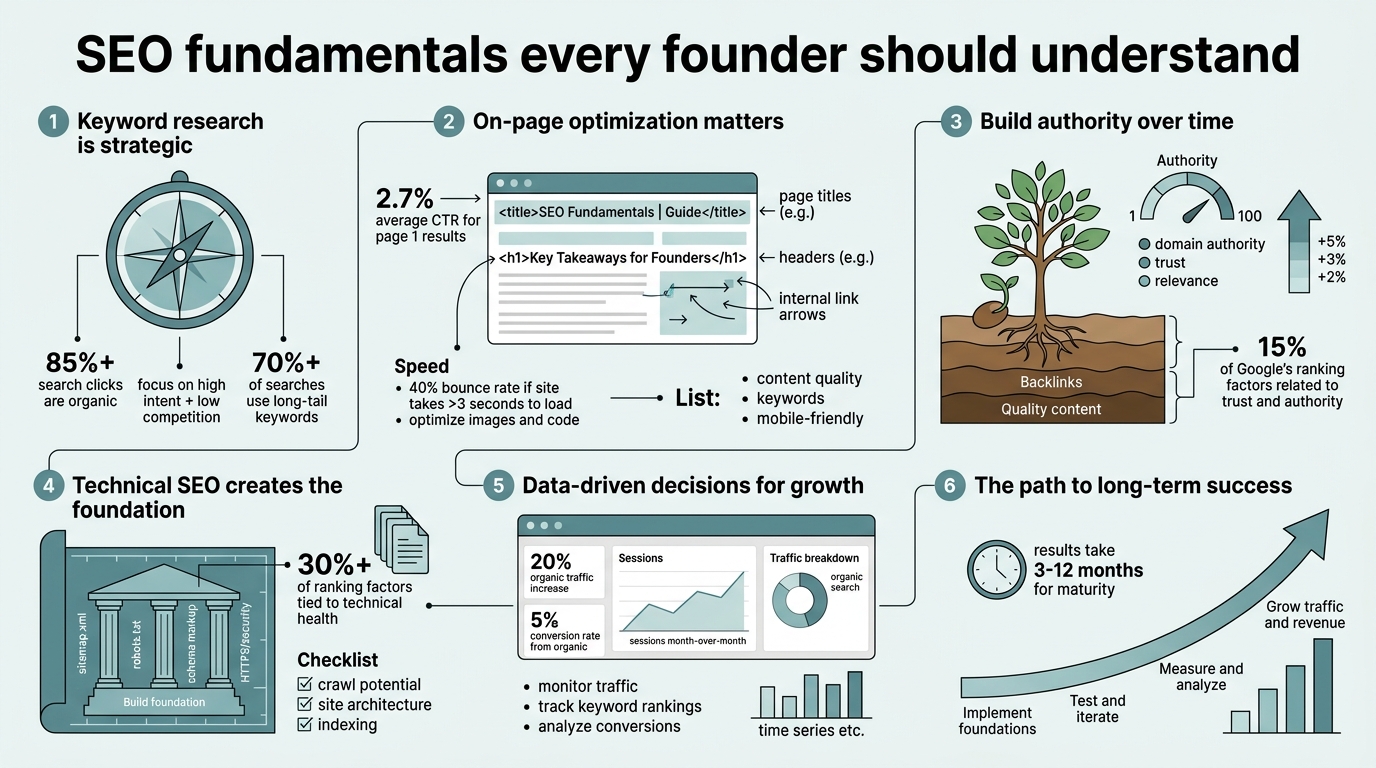
What Is Search Intent and Why It Drives Everything
The first rule of SEO is not "get traffic"—it's "get the right traffic." Search intent is the reason someone typed a query into Google. Are they looking to buy, learn, compare, or navigate? This distinction determines whether your content ranks, converts, or wastes your time. 70% of all Google searches are informational in nature, but if you're selling software and optimize only for informational keywords, you'll get traffic that never becomes customers.
Three search intents matter most:
- Informational Intent: "How do I X?" "What is X?" Audience is learning; these keywords have high volume but low conversion. Ideal for building topical authority and attracting newsletter subscribers.
- Transactional Intent: "Buy X," "X pricing," "X vs Y." Audience is ready to decide or purchase. High commercial value but lower volume and higher difficulty.
- Navigational Intent: "X login," "X reviews," "X pricing." Audience knows your brand or category; these are easiest to rank for but often irrelevant for founders just building awareness.
"Intent alignment compounds traffic because every click is higher-quality, reducing wasted impressions and accelerating your path to product-qualified leads. If you're a financial planning SaaS, ranking for 'financial planning software cost' (transactional) matters more than 'what is financial planning' (informational)."
Founders often fumble this because they optimize for what they think is important (brand keywords, feature-heavy terms) instead of what prospects actually search. This misalignment wastes months of effort and budget on traffic that never converts. The correction is simple but requires discipline: map every piece of content to a specific search intent and buyer stage, then prioritize transactional keywords that align with revenue.
How Technical SEO Becomes Your Silent Advantage
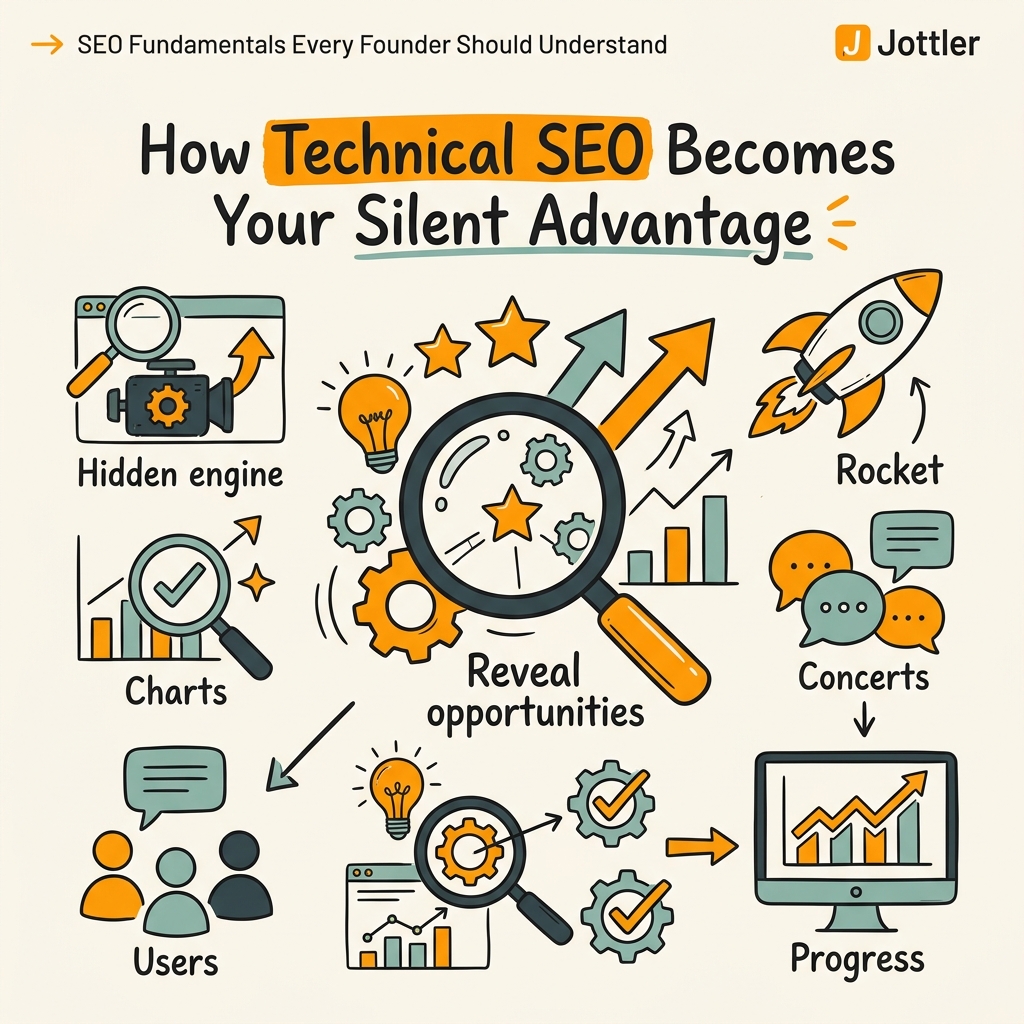
Technical SEO is invisible when it works and catastrophic when it doesn't. It's the foundation every ranking strategy stands on. A poorly optimized website can rank nowhere despite great content and strong backlinks. Technical SEO campaigns deliver an average 117% ROI, yet most founders treat it as a one-time audit item instead of an ongoing discipline.
Three technical pillars matter most to Google in 2026:
- Core Web Vitals: Page speed (LCP), interactivity (INP), and visual stability (CLS) are confirmed ranking factors. Mobile users especially notice—92.3% of all internet users browse on mobile devices.
- Mobile-First Indexing: Google indexes and ranks your mobile version first. If your mobile experience is slow, broken, or poorly structured, your rankings suffer before your desktop version ever matters.
- Crawlability and Structure: Search engines must be able to discover, crawl, and understand your content. Broken internal links, XML sitemap errors, and pages blocked by robots.txt silently kill visibility.
"Rather than managing technical audits separately from content publishing, integrate keyword research, fact-checking, and CMS publishing into a single pipeline that compounds organic growth without manual intervention or delayed technical fixes."
Jottler's autonomous SEO engine handles this by ensuring every article published is optimized for technical performance from the start. The system eliminates the lag between content creation and technical optimization, compressing what would take weeks into a seamless, automated workflow.
Why Content Depth and E-E-A-T Are Non-Negotiable Now
In 2024, keyword density and keyword placement still moved rankings. In 2026, Google cares far less about those surface-level signals and far more about whether your content actually answers questions better than the thousands of other pages targeting the same keyword. Content exceeding 3,000 words generates 3x more traffic than 1,400-word articles, but length is a proxy for something deeper: comprehensiveness, authority, and demonstrated expertise.
E-E-A-T—Google's framework for evaluating content quality—now dominates ranking decisions. Here's what each pillar means for founders:
- Experience: Have you (or your team) actually done the thing you're writing about? Case studies, client results, and personal anecdotes outrank generic aggregations.
- Expertise: Are you the right person to teach this? Credibility signals include published interviews, speaking engagements, credentials, or years in the field.
- Authoritativeness: Does the broader web recognize you as a leader? Backlinks, citations, and mentions from reputable sources vote on authority.
- Trustworthiness: Can readers trust your advice? Transparency about conflicts of interest, clear sourcing, and accurate citations matter.
This shift has real consequences. AI-generated content without human oversight now ranks lower than human-written content with original research, even when AI content is technically competent. Tools like AIOSEO report that the largest ranking shifts in 2026 favor content with demonstrated first-hand experience. Founders who write from real experience—launching products, closing deals, building teams—have a structural advantage over agencies or content mills churning generic answers.
How Keyword Research Creates Your SEO Roadmap
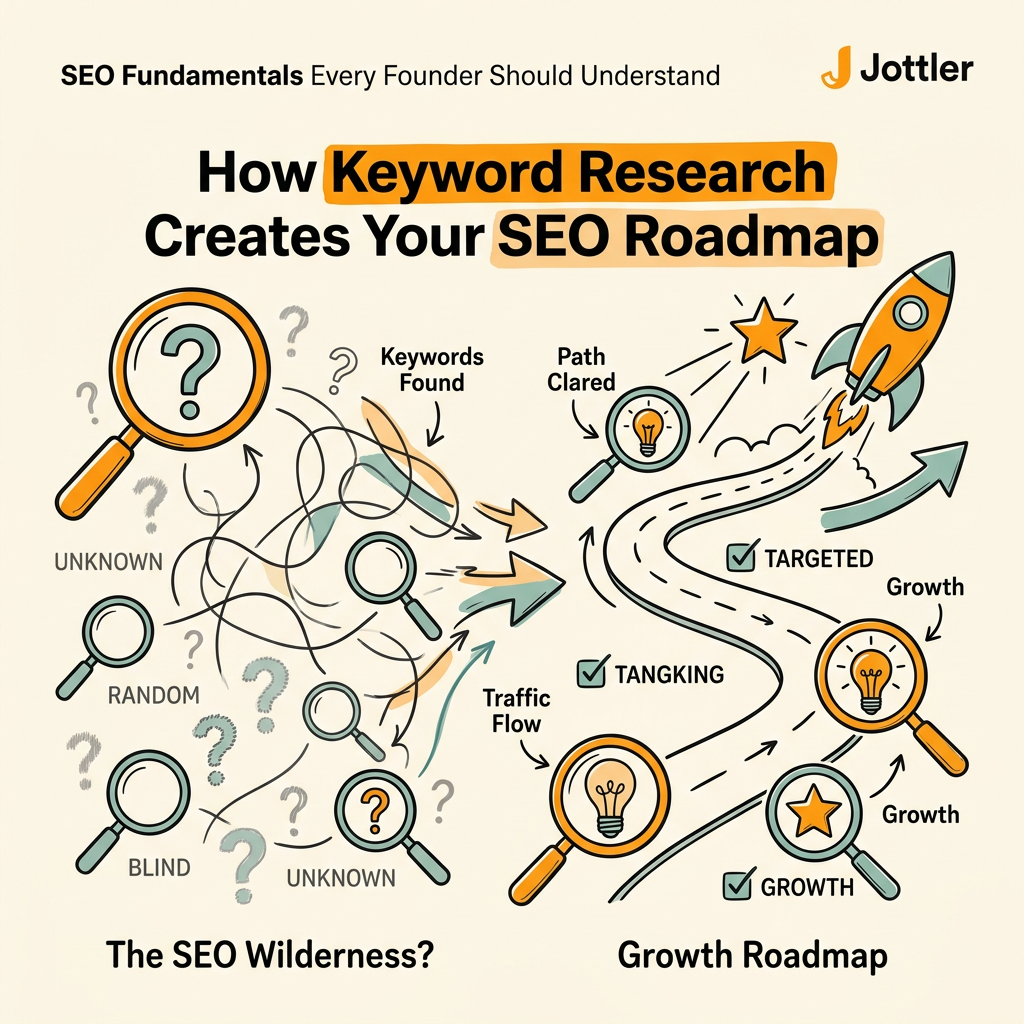
Keyword research is the compass of SEO strategy. Without it, you're publishing content blindly—hoping Google notices instead of deliberately building visibility for terms your audience actually searches. Keyword research basics reveal that URLs with keywords similar to page content see a 45% higher click-through rate, but the real value is in the roadmap: understanding what your market needs, what your competitors are fighting for, and where the gaps are.
Five steps make keyword research actionable:
- Seed with your business: Start with 3-5 keywords tied directly to your product, service, or mission. A financial planning SaaS might seed "financial planning software," "wealth management," "portfolio tracking."
- Expand with long-tail variations: Tools reveal that "financial planning software for freelancers" may have lower volume (100/month) but much higher intent alignment than the broad seed (5,000/month).
- Layer in search volume and difficulty: Prioritize keywords with KD under 50 if you're new; they're achievable. Volume matters less than relevance—a keyword with 300 monthly searches that converts is worth more than 10,000 searches that don't.
- Map to buyer stage: Informational keywords ("how to plan finances") target awareness; transactional keywords ("financial planning software pricing") target decision. Balance both, but weight transactional based on revenue.
- Track and iterate: Keyword research isn't a one-time event. Your roadmap evolves as competitors enter, as new products launch, and as search behavior shifts. Quarterly reviews keep strategy sharp.
Most founders skip this and publish on topics they think matter. Keyword research forces intellectual honesty: "Do people actually search for this? Who are they, and what are they looking for?" That rigor becomes your competitive edge.
Building Authority Through Strategic Backlinks
Backlinks are votes of confidence from the outside world. A link from TechCrunch carries more weight than a link from a random blog because Google trusts TechCrunch's editorial standards. High-quality content, backlinks, and search intent remain the top three ranking factors in 2026, but most founders treat backlinks as a secondary tactic instead of a primary strategy. That's where momentum dies.
Three types of backlinks matter:
- Editorial Links: A journalist or blogger links to your research, product, or insight because they found it genuinely useful. These are the hardest to get but the most valuable. They require either newsworthy content, original research, or genuine visibility in your industry.
- Resource Links: Your website appears in a "best tools" list, resource guide, or directory. Less valuable than editorial links but more achievable. They require actively reaching out to curators and list maintainers.
- Partnership and Sponsor Links: You partner with other companies, sponsors, or communities that link to you in return. These are transactional but reliable.
"When your content is published daily at scale, internal linking creates a network effect—each new article links to relevant previous content, building authority clusters that rank better together than individually."
Jottler's autonomous SEO engine includes smart internal linking, which compounds your backlink strategy by ensuring every published article strengthens topical authority across your domain. This systematic approach to linking accelerates how quickly your domain accumulates authority signals.
How Content Consistency Compounds Organic Growth
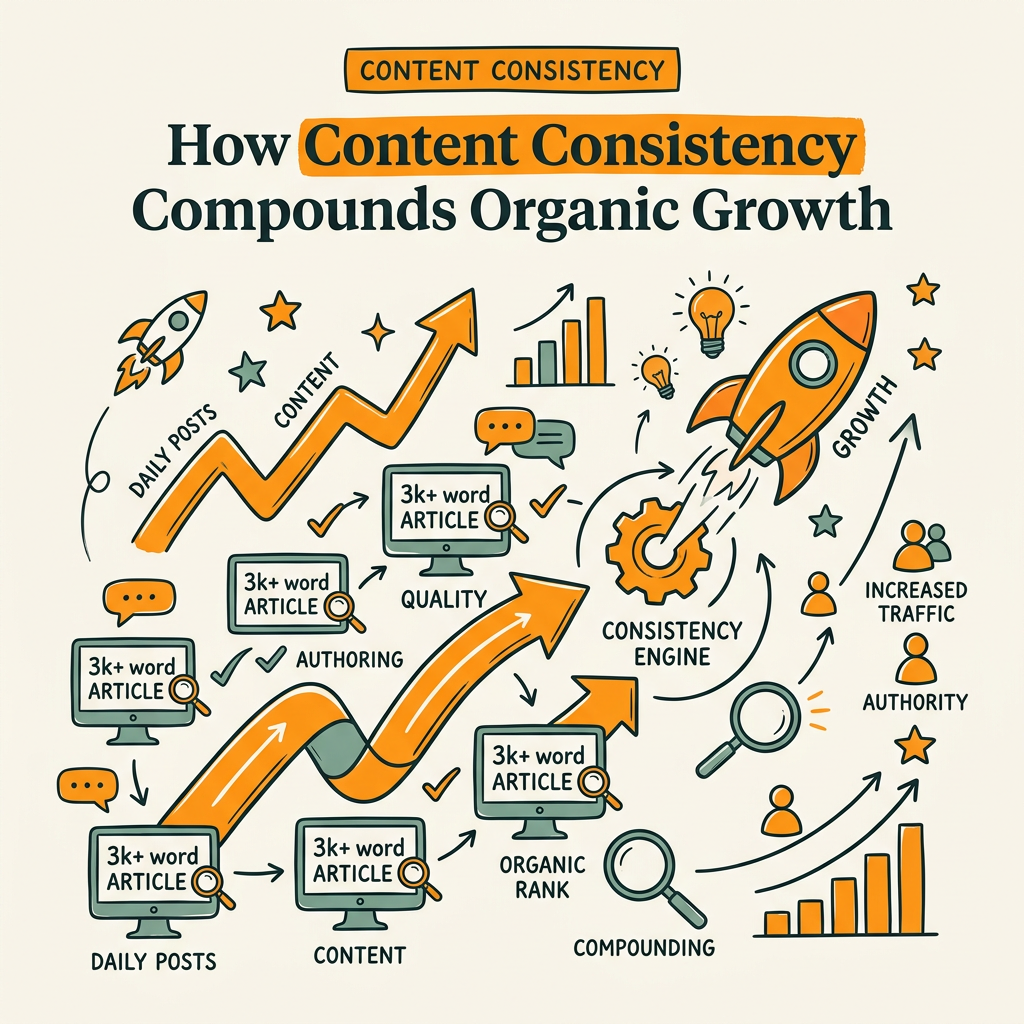
SEO is not a one-time project. It's a compounding system. One article ranks; ten articles compounds growth; one hundred articles builds a moat. Yet most marketing teams struggle to publish consistently because content creation takes time, keyword research requires upfront work, and publishing workflows feel manual. Founders abandon SEO because they expect it to work like PPC (immediate results) when it actually works like compounding interest (slow, then exponential).
Two metrics reveal why consistency matters:
- Domain Authority Growth: Google's algorithms reward domains with regular, high-quality publishing. A domain publishing weekly outranks a domain that published once then stopped, even if individual article quality is identical.
- Topic Cluster Effect: Publishing on related topics within a category builds "topical authority"—Google recognizes you as an expert on the broader field, not just individual keywords. Five articles on "financial planning" together rank higher than one comprehensive article alone.
The bottleneck for most teams is not strategy—it's execution. Content research takes 4–6 hours per article. Writing takes another 3–4. Fact-checking and internal linking add 2–3 more. Publishing workflows drain another hour. That's 10–14 hours per article, which means a team publishing 4 articles per week would need dedicated full-time staff. Most founders can't afford that, so they publish sporadically and watch their competitors pull ahead.
This is where automation changes the game. Tools that automate research, writing, fact-checking, and publishing can compress that 10–14 hour cycle into hours or minutes, enabling daily publishing at professional quality. Consistency becomes achievable not because you're working harder, but because the system is working for you. Start your SEO agent and research, write, fact-check, and publish 3,000+ word articles daily, automatically building internal link networks and compounding organic growth without requiring content teams to manually oversee every step.
The Rise of Zero-Click and Answer Engine Optimization
In 2025, Google's AI Overviews changed the game. 58% of searches now end without a click to any website because Google provides the answer directly on the search results page. This terrifies publishers, but it also reveals a strategic opportunity: if your content appears in Google's AI Overview, you're still winning—you're just measuring success differently.
Two shifts follow this reality:
- Answer Engine Optimization (AEO): You're no longer optimizing just for ranking #1. You're optimizing for inclusion in AI summaries. That requires clear headers, direct answers to common questions, and structured content that LLMs can extract and cite.
- Brand Visibility Over Clicks: Appearing in an AI Overview, even without a click, exposes your brand to tens of thousands of searchers monthly. That builds brand awareness and authority, which eventually drives direct traffic, referrals, and inbound links.
The mechanics matter: 52% of sources cited in Google AI Overviews rank in the top 10 results. Being top-ranked is still critical—but now you're fighting for two outcomes: clicks and citations. Content structured with FAQ-style answers, numbered lists, and direct claims performs better in both worlds because it's easier for both human readers and AI algorithms to extract the key insight.
Building Your SEO Foundation Without Burning Out
Most founders burn out on SEO because they treat it like a sprint instead of a system. They hire an SEO consultant, publish a few articles, see no results after three months, and shift budget to paid ads. That's how every founder fails at SEO: impatience plus complexity.
Three principles prevent burnout:
- Clarity on Timeline: SEO compounds over 6–12 months minimum. Expect no significant traffic for 3 months. Expect 10–30% increases monthly from month 4 onward. If you can't commit to that timeline, use paid ads instead.
- Automation Over Hustle: Don't hire three content writers and pay them to research, write, edit, and publish manually every week. Automate the research, writing, and publishing pipeline. Use human judgment for strategy and quality control, but remove the repetitive work.
- Metrics That Matter: Track organic traffic and conversions, not rankings. Rankings correlate with success, but they're not the goal—sustainable growth is. A keyword that ranks #3 with 1,000 monthly clicks matters more than a keyword ranking #1 with 10 clicks.
The cleanest way to build SEO as a founder is to let automation handle the work that scales and focus your human time on strategy: Which audience problems should we solve? Which keywords best reach that audience? What original insight do we have that competitors don't? Automation answers "How do we publish at scale?" Strategy answers "What should we publish?" Both matter. Neither should be done manually.
| SEO Foundation | Manual Approach (Hours/Week) | Automated Approach (Hours/Week) | Monthly Articles Published |
|---|---|---|---|
| Keyword Research + Writing + Fact-Checking + Publishing | 40–56 hours | 5–8 hours (strategy oversight only) | 4–5 |
| Keyword Research + Writing + Fact-Checking + Publishing (with Jottler) | 40–56 hours | 3–4 hours (strategy only) | 100–150 |
| Organic Traffic Growth (6-month timeline) | +15–25% monthly | +15–25% monthly | Compounding advantage |
Conclusion
SEO fundamentals haven't changed in spirit—create high-quality content, build authority through backlinks, and optimize for search intent. But the execution has shifted in 2026. You're competing for visibility in AI summaries, not just clicks. You're rewarded for first-hand experience and original research, not keyword optimization. You're successful only if you publish consistently and compound your efforts over months, not weeks. Most founders skip SEO because they expect shortcuts or because the manual work feels overwhelming. The founders who win treat SEO as a system, automate the repetitive parts, and stay disciplined long enough to see compounding returns. Organic traffic still drives 46.98% of all website traffic, and position #1 captures 39.8% of clicks—making SEO the highest-leverage investment available. The cost of ignoring it is the cost of every potential customer finding your competitor instead. Start your SEO agent today and automate the work that compounds.
FAQs
What are the 5 core SEO fundamentals?
Search intent alignment, technical optimization, content quality, backlink authority, and publishing consistency are the five pillars. Search intent means your content answers the actual question searchers type. Technical optimization ensures Google can crawl, index, and rank your pages (Core Web Vitals, mobile usability, site structure). Content quality means demonstrating first-hand expertise and experience. Backlinks signal that other authoritative websites trust your content. Consistency compounds growth—one article barely moves traffic, but ten articles creates momentum. You don't need fancy tactics; you need these five foundations strong and working together.
How long does it take to see results from SEO?
Expect 3 months before you see meaningful traffic growth, with exponential increases accelerating from month 4 onward. Most SEO strategies operate on a 6–12 month timeline to show clear ROI. New domains and competitive keywords take longer; niche keywords with lower difficulty can rank in 4–8 weeks. The mistake founders make is giving up after 2–3 months. SEO is a compounding system—your first five articles may drive minimal traffic, but your 50th article reaches audiences that trust your domain and amplifies traffic to your entire site. Patience is a feature, not a bug.
Do I need a full marketing team to execute SEO?
No—but you need systems that automate the repetitive work so your team can focus on strategy and quality. A founder with an autonomous SEO platform can outpace a three-person content team publishing manually every week. The bottleneck is not creativity or strategy; it's the manual work of research, writing, fact-checking, and publishing. Automation compresses that work from 10–14 hours per article to hours, enabling daily publishing without hiring staff. One founder with the right tools publishing 5 articles per day will beat a team publishing one article per week manually, because consistency and scale compound faster than individual article quality.