SEO Keyword Strategy: From Research to Ranking
Most marketers treat keyword research and ranking strategy as two separate activities. They're not. The top-ranking pages don't just target the right keywords—they structure their entire content plan around search intent, competitive difficulty, and revenue potential. Yet 58.5% of searches now result in zero clicks, making traditional volume-first keyword selection increasingly risky. The winning approach in 2026 is to combine rigorous keyword research with a strategic ranking framework that accounts for competition, intent alignment, and long-tail dominance. Here's how to build a keyword strategy that delivers compounding organic traffic and conversions.
Key Takeaways
- 91.8% of all searches are long-tail keywords, but 70% of clicks concentrate on the top 5 results, making keyword selection and ranking difficulty assessment equally critical (2026, Whitehat SEO).
- Intent-driven keyword targeting outperforms pure volume strategies; revenue-generating keywords should be prioritized over traffic-generating ones.
- A complete keyword strategy clusters keywords into topical themes, maps them to search intent, and builds content around competitive ranking potential.
- Define Your Research Foundation: Identify high-intent, revenue-relevant keywords using volume, difficulty, and intent analysis.
- Analyze Competitive Ranking Patterns: Study what's ranking for your target queries and identify content gaps your team can exploit.
- Score Business and Ranking Potential: Prioritize keywords that combine achievable difficulty, conversion alignment, and search volume.
- Map Intent and Content Types: Match keywords to buyer journey stages and content formats to maximize ranking and click-through rates.
- Build Topic Clusters: Group semantically related keywords to build topical authority and strengthen internal linking architecture.
- Publish and Monitor Compounding Growth: Execute your content plan systematically while tracking ranking progress and adjusting strategy quarterly.
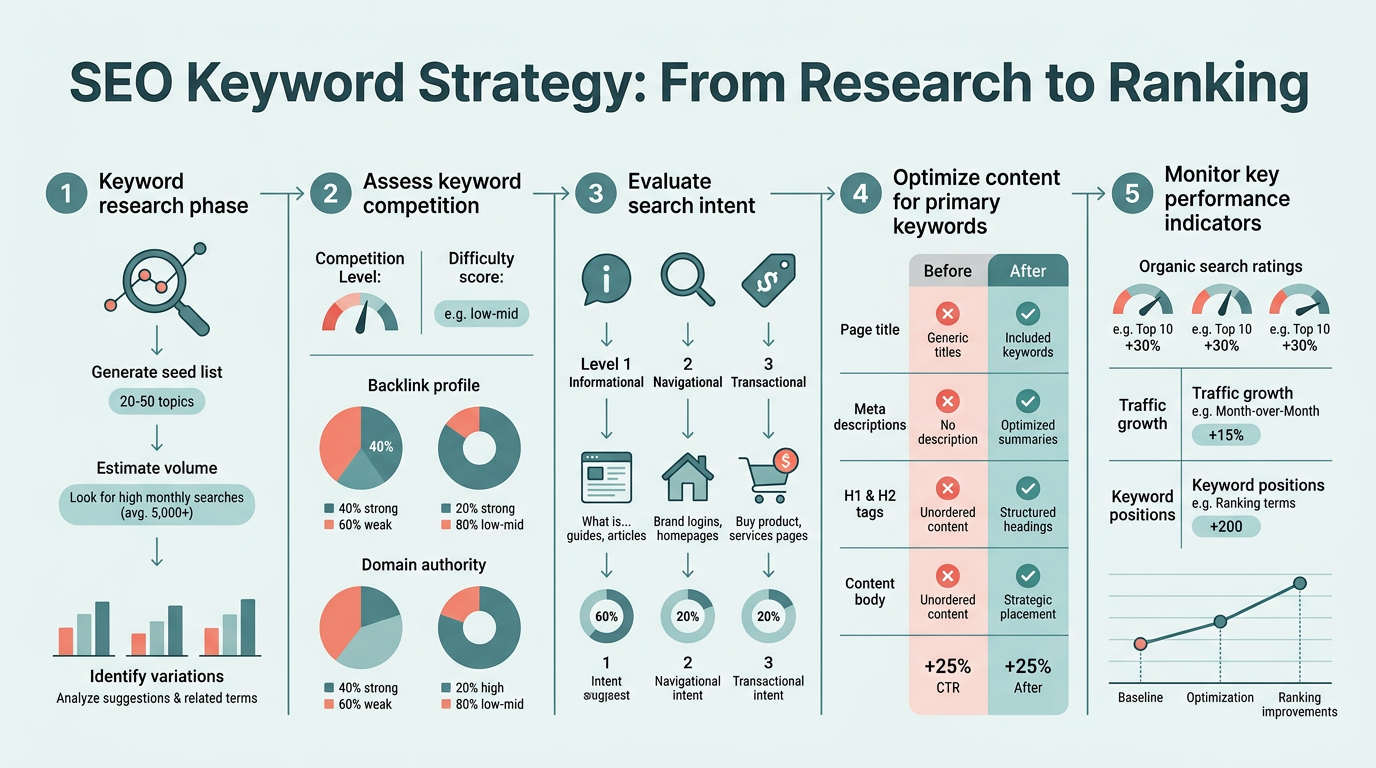
How to Define Your Research Foundation
Your keyword strategy starts with data. The average website ranks for 1,000+ keywords, but most of that ranking happens by accident. A deliberate foundation means identifying which keywords are worth targeting before you write a single piece of content. According to AIOSEO, 94.74% of keywords have monthly search volume of 10 or less, which underscores why strategic selection matters—most keyword opportunities are low-volume but high-intent.
"The average website ranks for 1,000+ keywords, but most of that ranking happens by accident. A deliberate foundation means identifying which keywords are worth targeting before you write a single piece of content." — AIOSEO Research, 2026
Separate Volume from Viability
Most keyword research tools show search volume and keyword difficulty (KD) side by side, suggesting they're equally important. They're not. A keyword with 1,000 monthly searches and KD 85 is almost certainly a waste of your ranking budget. Start by filtering for keywords that meet three criteria:
- Search volume: Minimum 10–50 monthly searches (for B2B) or 100–500 (for B2C). Below that threshold, the compounding return barely justifies the content investment.
- Keyword difficulty: Target KD under 50 for rapid ranking potential. KD 50–70 is competitive but rankable with strong content and backlinks. Avoid KD >75 unless you're building topical authority over 12+ months.
- Intent alignment: Does the keyword match your product, service, or audience intent? A keyword with 500 searches means nothing if the searchers don't want what you sell.
This filtering step alone eliminates 70% of the noise and focuses your team on keywords worth ranking for.
Prioritize Long-Tail Keywords Strategically
Over 80% of search traffic comes from long-tail keywords, yet most teams obsess over high-volume head terms. Long-tail keywords—phrases with 3–5 words targeting a specific intent—are easier to rank for, convert better, and align more closely with what your buyers actually search. A keyword like "how to implement lead scoring" (100 searches, KD 35) often outperforms "lead scoring" (500 searches, KD 75) in both ranking speed and conversion rate. Build your keyword research around clusters of 30–50 long-tail variations rather than 5–10 broad head terms. An SEO content plan that ships combines volume with intent to identify exactly these high-ROI long-tail opportunities systematically.
Extract Keywords from Your Competitor's Traffic
Competitor keyword analysis reveals which terms are already working in your niche. Use tools to identify the top-ranking keywords for your 3–5 closest competitors, then filter for keywords your site doesn't yet rank for. Focus on keywords where competitors rank in positions 4–10—these are winnable opportunities with medium difficulty. Avoid chasing keywords where competitors dominate positions 1–3 unless you have a unique angle or superior content depth.
How to Analyze Competitive Ranking Patterns
Once you've identified candidate keywords, study the current SERP landscape. This determines whether your content strategy should be "rank fast with quick-win content" or "build authority over time with pillar pages." Research from TheeDigital highlights that the #1 organic result gets 39.8% of all clicks, emphasizing why ranking position in your target keywords is as critical as keyword selection itself.
"The #1 organic result gets 39.8% of all clicks. Ranking position in your target keywords is as critical as keyword selection itself." — TheeDigital Research
Assess What's Ranking and Why
Look at the top 5 results for your target keyword. Note the content type (blog post, product page, FAQ, comparison), depth (word count, heading count), and format (text, video, interactive). The top-ranking pages reveal the SERP's expectation. If the top results are all long-form guides, a 500-word blog post won't rank. If they're all short how-to's, a 3,000-word pillar page might be overengineered. Your content needs to match format expectations while exceeding quality. Tools like an autonomous SEO agent can analyze SERP patterns across hundreds of keywords simultaneously, surfacing the exact format and depth benchmarks your content needs to meet.
Identify Content Gaps in the Ranking Landscape
The second-place opportunity is always in the gaps. If all top 5 results are how-to guides, consider ranking with a comparison or case study. If all results are product-focused, rank with educational content. If the SERP has no video, adding one can differentiate your result in click-through rate. Scan the "People Also Ask" section—Google's implicit keyword suggestions reveal sub-questions the audience has but the ranking pages don't fully address. Build your content around answering those micro-questions comprehensively.
Evaluate Backlink Profiles of Top Competitors
The keywords that rank have backlinks behind them. For your target keyword, check the backlink profiles of the top 3 results. How many referring domains? What's the domain authority? If the winner has 200+ referring domains from high-authority sources, you'll need a robust link-building plan. If they have 15–30 links, your content quality and internal linking might be sufficient. This assessment shapes your entire go-to-market strategy—whether you're competing on content alone or need a parallel link-building campaign.
How to Score Business and Ranking Potential
Not all keywords are created equal. A scoring framework ensures your team invests in keywords that align with business goals and ranking potential simultaneously.
Build a Keyword Scoring Matrix
Create a simple spreadsheet with the following scoring columns. Grade each keyword on a scale of 1–5 (or percentage 0–100) for each dimension:
| Scoring Dimension | Weight | Ranking Difficulty Impact | Business Value Impact |
|---|---|---|---|
| Search Volume | 20% | Higher volume = more potential clicks | Direct traffic upside |
| Keyword Difficulty | 25% | Lower KD = faster ranking (higher score) | Resource efficiency |
| Intent Alignment | 25% | High alignment = better ranking signals | Higher conversion potential |
| Conversion/Revenue Potential | 30% | Revenue keywords rank better with niche focus | Direct business impact |
Apply this matrix to your keyword list. Keywords scoring 80+ become tier-1 priorities. 60–80 are tier-2 (pursue after tier-1). Below 60, either revise or deprioritize. This single step forces ruthless prioritization and prevents your team from chasing vanity metrics like volume.
Identify Your Quick Wins
Quick wins are keywords where you already have some ranking traction (positions 6–15) and strong content can push you to page one. These keywords have proven search demand, and the SERP has already validated the topic. Update the content, improve depth, add better formatting, and build a few internal links—your ranking can improve within 4–8 weeks. Quick wins are psychologically and strategically important. They prove your keyword strategy works and compound momentum early.
Define Your Long-Term Authority Keywords
Authority keywords are high-value terms (high volume + high business fit) that require 6–12 months of topical authority building. These are often broad head terms or highly competitive niches. Instead of targeting them directly with single pages, build a cluster of 20–50 supporting pages that progressively deepen your topical expertise. As your cluster grows and your domain authority increases, these authority keywords become rankable. This is the long-game strategy most founders ignore—but it compounds significantly.
How to Map Intent and Content Types
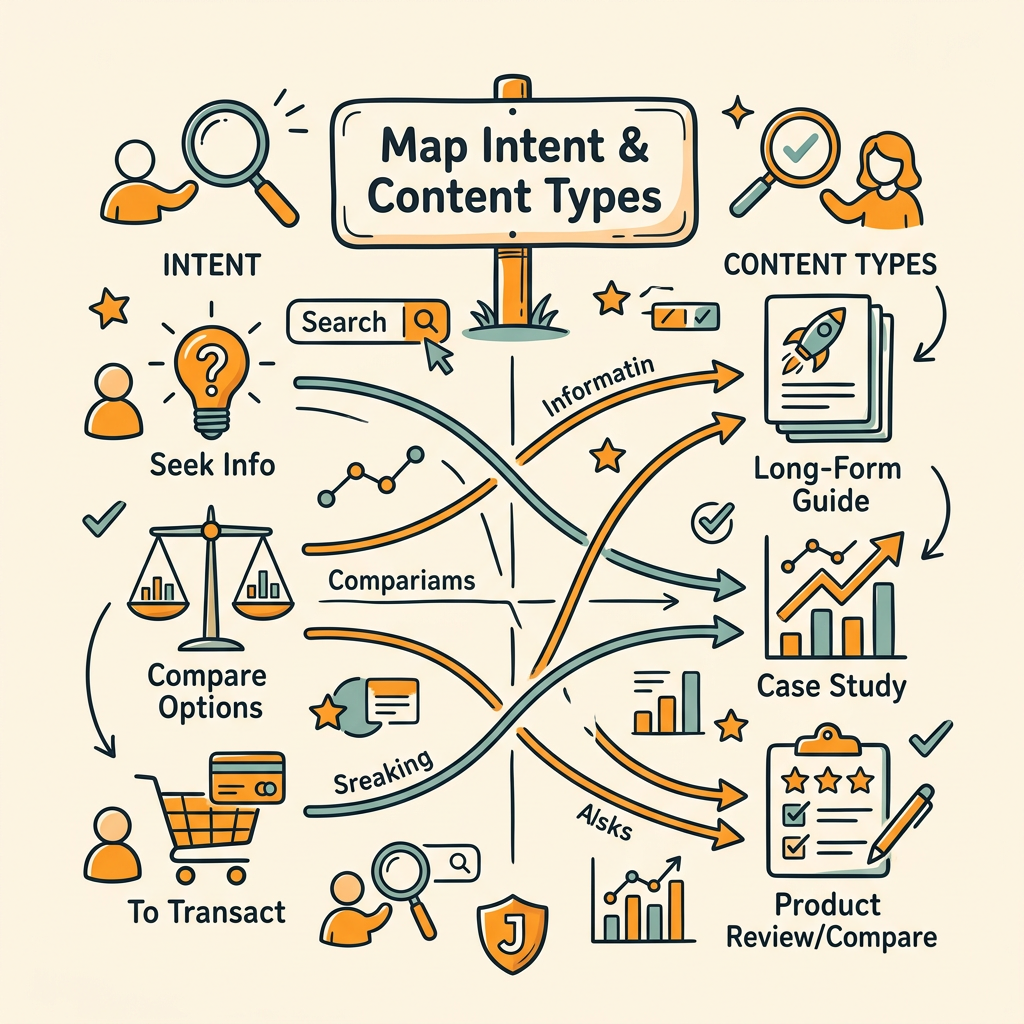
A keyword has no meaning without intent. The same word can mean different things depending on search context.
Classify Keywords by Search Intent and Buyer Journey Stage
Search intent falls into four categories, each requiring different content:
- Informational: "How does X work?" "What is X?" Content: guides, definitions, explainers. Goal: attract awareness, build topical authority.
- Commercial Investigation: "X vs Y", "Best X for Z", "X comparison". Content: comparison guides, reviews, case studies. Goal: educate buyers, establish credibility.
- Transactional: "Buy X", "X pricing", "X free trial". Content: product pages, pricing pages, landing pages. Goal: capture high-intent demand.
- Navigational: "X login", "X support", "X features". Content: thin pages, internal navigators, FAQ. Goal: serve existing users and drive internal engagement.
Map each keyword to one category. This ensures you're not writing a comparison guide for a transactional keyword (misalignment) or a product page for informational demand (waste of conversion potential). A strategic AI content approach ensures every piece maps to the right intent and stage before being written.
Build Content Clusters Around Intent
Cluster keywords by intent stage. For example, your product is "Sales Automation." Your keyword research might reveal:
- Informational cluster: "what is lead scoring", "how to qualify leads", "sales process steps" → 10 guides/explainers
- Commercial investigation cluster: "sales automation software comparison", "best CRM for SMBs" → 5 comparison/review pages
- Transactional cluster: "sales automation software pricing", "CRM free trial" → product pages + landing pages
This clustering structure becomes your content roadmap. You're not writing random blog posts—you're building a coherent asset that guides searchers through their buying journey.
How to Build Topic Clusters and Internal Linking
A topic cluster is a group of semantically related keywords organized around a pillar page (the main authority piece) and supporting cluster pages (detailed sub-topics). This structure signals topical authority to Google and creates a powerful internal linking architecture.
Design Your Pillar Page and Cluster Content
Choose one broad keyword as your pillar. For example: "Sales Automation" (high volume, authority keyword). Write a 2,500–4,000 word guide covering the topic at 30,000 feet. Don't go deep into specific tactics—stay strategic and comprehensive. Link to 8–12 cluster pages from the pillar. Each cluster page dives deep into one sub-topic, like "How to Implement Lead Scoring" or "Sales Automation Best Practices." This hierarchy tells Google that your domain owns the sales automation space.
"Topic clusters signal topical authority to Google and create a powerful internal linking architecture. A pillar page covering the broad topic links to 8–12 cluster pages that dive deep into sub-topics, telling Google your domain owns the space." — SEO Best Practice, 2026
Strategic Internal Linking Creates Ranking Multipliers
Internal links do three things: they distribute authority, guide user navigation, and tell Google how you organize topics. Link from cluster pages back to the pillar with consistent anchor text like "[Pillar keyword]" or "Sales automation guide." Link between cluster pages where topics overlap. If your "lead scoring" page mentions "qualification criteria," link that phrase to your "sales qualification" page. This web of topically relevant links is increasingly important as Google rewards semantic depth and E-E-A-T signals. Manual internal linking is tedious and often missed. Content automation tools that include smart internal linking can identify and build these connections automatically, ensuring no topical opportunity is missed.
Update and Expand Clusters Systematically
A cluster isn't static. As you publish new content, add it to existing clusters and relink. If your pillar page ranks for 30 keywords, your cluster should grow toward 15–20 supporting pages within 12 months. Each supporting page should be indexable, link-rich, and optimized for a specific long-tail keyword. Over time, this cluster becomes a defensible ranking asset—it's so deep and interconnected that competitors can't easily replicate it.
How to Execute and Monitor Your Strategy
A keyword strategy on paper is just a spreadsheet. Execution is where ranking happens.
Prioritize Content by Scoring and Timeline
Tier-1 quick-win keywords should be published within 30 days. Tier-1 authority keywords should have pillar pages published within 60 days, with cluster content rolling out over 3–6 months. Tier-2 keywords come after tier-1 is well underway. Create a rolling 90-day content calendar that balances quick wins (psychological wins) with long-term authority building (compounding wins). Most teams fail here—they treat keyword research as a one-time exercise rather than a continuous input into their content machine.
Track Ranking Progress and Intent Conversion
Two metrics matter: ranking position and conversions. Set up a rank tracking tool to monitor your tier-1 keywords weekly. You should see movement within 2–4 weeks and first-page ranking within 6–12 weeks (depending on KD and your domain authority). But don't optimize for rankings alone. Measure conversions by keyword. A keyword ranking #5 that converts 0% is worse than a keyword ranking #7 that converts 5%. This forces honesty about which keywords actually matter to your business.
Adjust Strategy Based on Data
Every quarter, review your content performance. Which keywords ranked faster than expected? Which didn't rank? Which drove the most revenue? Use this data to refine your scoring model and future keyword selection. If long-tail informational content consistently underperforms, shift more resources to commercial investigation and transactional keywords. If your domain authority isn't moving despite volume, invest in link building. A keyword strategy is a living document—it evolves as you learn what works for your audience and market.
Conclusion
A complete SEO keyword strategy combines rigorous research with ranking reality. You define your foundation by identifying keywords with genuine traffic and business potential, analyze the competitive landscape to find rankable opportunities, score keywords by both difficulty and revenue fit, and map them to content types that match search intent. Then you cluster keywords into topical themes, build internal linking architecture, and execute systematically while tracking both rankings and conversions. The teams that win in 2026 won't be chasing volume—they'll be compounding authority one keyword, one page, one internal link at a time.
The difference between a keyword list and a keyword strategy is execution. Start with your research foundation this week, publish your first 5 quick-win pieces within 30 days, and build toward a 20-page cluster within 6 months. The earlier you begin, the more ranking compounding works in your favor. Start your SEO agent to automate your keyword research, content creation, and internal linking so your team can focus on strategic execution rather than manual busywork.
FAQs
What is the best keyword strategy for SEO in 2026?
The best keyword strategy prioritizes intent-driven, long-tail keywords over high-volume head terms. Focus on keywords that align with revenue and conversion potential, build topical authority through keyword clusters rather than isolated pages, and map keywords to specific content types based on search intent. This approach accounts for the shift toward zero-click results and AI-generated answers by ensuring your content answers questions comprehensively and gets cited by AI systems. Track both ranking position and conversions—a keyword ranking position 5 with 0% conversion is worse than position 8 with 5% conversion.
How do I know if a keyword is worth targeting?
A keyword is worth targeting if it meets three criteria: achievable keyword difficulty (KD under 50 for quick wins, under 70 for medium-term growth), meaningful search volume (minimum 10–50 monthly searches for B2B, 100+ for B2C), and business alignment (the keyword matches your product, audience, or revenue model). Additionally, assess competitive ranking difficulty—can your content realistically outrank top 5 competitors, or do you need to build topical authority first? Keywords that score 80+ on a combined difficulty-intent-volume-business-fit matrix deserve investment. Keywords below 60 are usually distractions.
How long does it take to rank for a targeted keyword?
Ranking timeline depends on keyword difficulty and your domain authority. Quick-win keywords (KD under 30) typically rank within 4–8 weeks if your content is stronger than existing page-1 results. Medium-difficulty keywords (KD 30–50) rank within 3–6 months. Competitive keywords (KD 50+) require 6–12 months and often depend on topical authority and backlinks. New domains always rank slower than established ones. Rather than chase fast rankings, build consistent publishing momentum—one new optimized page per week compounds into 50 pages per year, each capturing long-tail traffic and internal linking equity.