SEO-Optimized Copy: AI Tool Features Explained
AI-powered SEO copywriting has become essential for scaling content production. 97% of content marketers plan to use AI to support content marketing efforts in 2026, yet most teams struggle to navigate which features actually move the needle on rankings and traffic. The challenge isn't generating copy anymore—it's generating copy that ranks. SEO-optimized AI tools must balance keyword targeting, content quality, and on-page structure to deliver results. Here's how the best tools achieve this balance and which features separate the winners from the rest.
Key Takeaways
- AI-assisted SEO content produces a 35% increase in organic traffic compared to manual content, while reducing time-to-publish by 57% (2026, Siege Media)
- Top SEO-optimized copy tools include real-time SERP analysis, content scoring, and semantic keyword expansion as core features
- Jottler automates the entire research-to-publish pipeline with daily 3,000+ word articles, fact-checking, and smart internal linking built in
- Real-Time SERP Analysis: Matches your copy to what's already ranking on page one, including content type and title structure for better relevance alignment.
- Content Scoring and Optimization: AI rates your draft against keyword density, readability, and length benchmarks before you publish.
- Semantic Keyword Expansion: Automatically identifies related keywords and topical clusters to improve coverage without keyword stuffing.
- Automated Internal Linking: Connects new content to related posts across your site, building topical authority without manual effort.
- Fact-Checking and Verification: Validates claims and data before publishing to reduce errors and protect your domain authority.
- CMS Integration and Publishing: Moves copy directly from generation to your WordPress, HubSpot, or other CMS with zero manual steps.
What Makes AI Copywriting Tools SEO-Optimized?
Not all AI writing tools are built for search engine visibility. SEO-optimized copy tools share a critical foundation: they understand that ranking copy requires more than good grammar. 61% of marketers use AI to improve SEO strategies, and those who win are using tools that embed search intent, SERP alignment, and keyword logic into the writing engine itself. The difference between a generic AI writer and an SEO-focused tool comes down to how early in the generation process these signals are applied.
The SERP-First Approach to Copy Generation
The strongest SEO-optimized tools start by analyzing what's currently on page one of Google for your target keyword. Rather than generating copy blind, they extract the dominant content format, title patterns, word counts, and even semantic signals from top-ranking articles. This means your AI-generated copy already knows whether your keyword favors long-form guides, listicles, or comparison posts.
"Analyzing what already ranks before writing is essential—including reviewing top-ranking content type and title structure. This SERP-first foundation ensures every article you publish compounds your topical authority." — Search Industry Best Practice, 2025
Search engine experts in 2025 recommend analyzing what already ranks before writing, including reviewing top-ranking content type and title structure. Tools like Surfer SEO pioneered this approach, but it's now table stakes for any tool competing in the premium SEO-copywriting space. When you're building a comprehensive AI content strategy, this SERP-first foundation becomes even more critical—it ensures every article you publish compounds your topical authority.
Keyword Intelligence Built Into Generation
SEO-optimized copy tools must go beyond keyword insertion. Modern AI copywriting platforms use semantic keyword expansion to identify related search terms, long-tail variations, and topical clusters. This approach avoids the keyword-stuffing traps of older SEO writing methods while ensuring natural coverage of the keyword concept.
"Semantic keyword expansion is now the competitive differentiator. The best tools let you identify not just your primary keyword, but the semantic field around it, enabling natural placements without forcing keywords into sentences." — SEO Industry Analysis, 2026
52% of SEO experts use AI for competitive keyword analysis, which means keyword intelligence is now a core differentiator in the market. The best tools let you see not just your primary keyword, but the semantic field around it. Rather than forcing your keyword into sentences, the tool suggests natural placements and even alternative phrasings that signal the same intent to search engines.
On-Page Optimization Built Into the Workflow
SEO-optimized AI tools don't treat optimization as a post-writing step. Instead, they score your draft in real time. Content scoring typically evaluates keyword density (not too high, not too low), readability metrics like Flesch Kincaid, word count benchmarks against competitors, and structure alignment (proper use of headings, bullet points, and lists). Some tools even analyze engagement signals like internal link density or image usage.
The advantage of this integrated approach is speed. Rather than writing a draft, running it through Surfer SEO separately, then editing back and forth, SEO-optimized AI tools allow you to draft and optimize in one workflow. When you integrate this into a broader content marketing automation strategy, you eliminate dozens of manual approval steps.
Core Features of Leading SEO-Optimized Copy Tools
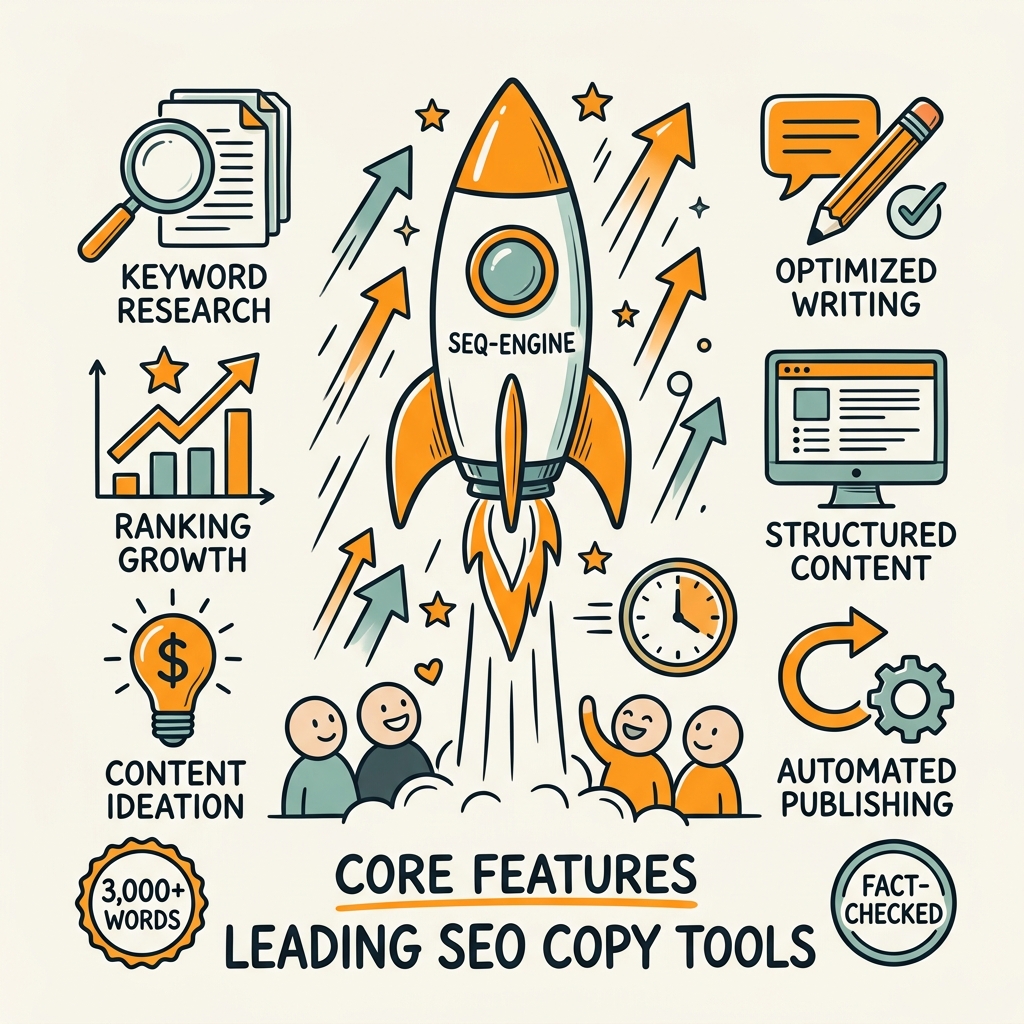
The competitive landscape for AI copywriting tools has crystallized around a set of features that actually impact search rankings. 74% of content marketers use AI for ideation, 61% for outlining, and 44% for drafting, which reveals where AI creates the most value in the content lifecycle. The tools that dominate the market excel at one or more of these stages while integrating SEO signals throughout.
Real-Time Competitor and SERP Analysis
The fastest way to write search-winning copy is to study what's already winning. Top SEO-optimized tools pull the top 10 results for your keyword and extract: content structure (how many headings, what types), word count benchmarks, keyword placement patterns, and even semantic keywords competitors are ranking for. This data becomes the foundation for your copy outline and first draft.
Jasper, one of the premium players in this space, integrates with Surfer SEO to provide this SERP analysis. Writesonic includes built-in SERP analysis without requiring a separate subscription. The key difference is accuracy and depth. Tools that analyze only title and meta description miss opportunities to match content type and structural patterns that influence rankings.
Content Scoring and Readability Metrics
A score is only useful if it reflects what Google actually ranks. The best SEO-optimized tools evaluate your draft against multiple dimensions:
- Keyword coverage: Does the primary keyword appear in the H1, first paragraph, and at least two H2s? Are related keywords naturally distributed?
- Readability: What's the Flesch Kincaid score? Is the average sentence length in the 15–20 word range (optimal for SEO and user experience)?
- Content length and structure: How does your word count and heading count compare to top-ranking results for the same keyword?
- Entity and semantic coverage: Are you covering important concepts and entities related to your main topic?
- Engagement signals: Do you have lists, tables, blockquotes, or other structural elements that improve user engagement?
Surfer SEO remains the specialist tool for content scoring, offering a 1–100 score that correlates strongly with ranking ability. But Jasper, Writesonic, and Jottler all offer integrated scoring that lets you optimize before publishing.
Semantic and Long-Tail Keyword Expansion
Gone are the days when a single keyword was enough. Modern SEO-optimized copy tools expand your keyword into semantic clusters. This means identifying: synonyms, related questions (from People Also Ask), long-tail variations, and subtopic keywords your audience searches for. The tool then guides you to naturally weave these keywords into your outline and draft.
The benefit is topical depth. Rather than writing a shallow article that ranks only for your primary keyword, semantic expansion helps you rank for dozens of related terms. Tools built for this approach—like those featured in reviews of best AI writing tools for content marketing teams—automatically expand keywords into topical clusters and help you build content clusters across your site, so one article strengthens your authority across an entire topic area.
Automated Internal Linking and Topical Authority Building
Internal linking is one of the highest-impact SEO signals, yet most teams build links manually. SEO-optimized AI tools are beginning to automate this. The best tools scan your existing content library and automatically suggest (or directly insert) internal links to contextually relevant articles. This serves two purposes: it distributes link equity across your site and it signals topical authority to Google by clustering related content.
SEO automation platforms take this to the next level by building an internal link network across all generated content. Every article is automatically linked to related content across your site, creating a living topical cluster that compounds your domain authority over time. This is the difference between publishing isolated articles and publishing a coordinated content system.
How to Evaluate an SEO-Optimized Copy Tool for Your Team
Choosing the right tool depends on your workflow maturity, budget, and content velocity goals. The market has segmented into three tiers: all-in-one platforms, optimization specialists, and fully automated systems. Each tier serves different teams at different growth stages.
All-in-One Platforms: Jasper and Writesonic
Jasper and Writesonic both bundle copywriting, templates, and SEO features into one platform. Jasper starts at $49/month and Writesonic at $16–19/month, which reflects different positioning. Jasper focuses on brand voice consistency and team collaboration, making it the stronger choice for agencies and enterprise teams. Writesonic bundles SEO features directly into the generation engine, making it the better value for SMBs and solo creators who want everything in one place.
The tradeoff: all-in-one tools are jacks-of-all-trades. Jasper pairs well with Surfer SEO for serious optimization work, but this adds cost. Writesonic's built-in SEO guidance is good, but not as granular as Surfer's scoring system. For teams optimizing their first 10–20 articles, both tools are efficient. For teams publishing 50+ articles per month, you'll outgrow their optimization depth.
SEO Optimization Specialists: Surfer SEO
Surfer SEO is the category leader for pure optimization. At $99/month, it's a premium investment, but it's not a full writing tool. Instead, Surfer excels at taking your draft (whether from ChatGPT, Jasper, or any AI writer) and scoring it against top-ranking content. It provides the deepest SERP analysis, content structure recommendations, and keyword clustering in the market.
Best practice: use Surfer as the optimization layer. Write with Jasper or Writesonic, then run your draft through Surfer to score and refine it before publishing. This workflow keeps your writing velocity high while maintaining top-tier optimization standards.
Fully Autonomous Content Systems: Jottler
Jottler represents a new category: the autonomous SEO engine. Rather than being a tool you add to your workflow, Jottler automates the entire content pipeline. It researches, writes, optimizes, fact-checks, and publishes 3,000+ word articles directly to your CMS daily. Plans start at $29/month, making it the lowest-cost option for high-volume content production.
The core advantage for busy founders and scaling teams is elimination of manual steps. You don't choose keywords, write outlines, generate drafts, or manually insert internal links. Jottler's 12 AI agents handle all of this, from keyword research through publishing. Each article includes deep research from 14+ sources, fact-checking to prevent false claims, and smart internal linking that builds topical authority across your site. When you compare this to AI SEO optimization tools that require manual oversight, the productivity gap becomes obvious.
For teams stuck in the "we need more content but don't have time" trap, Jottler solves the structural problem. Traditional tools still require you to decide what to write, oversee the writing, and manage publishing. Jottler removes that decision-making burden entirely, compounding your content output without compounding your workload.
Feature Comparison: What Separates Winners from Middlefields
| Feature | Jasper | Writesonic | Surfer SEO | Jottler |
|---|---|---|---|---|
| Starting Price | $49/month | $16–19/month | $99/month | $29/month |
| SERP Analysis | Via Surfer integration | Built-in | Deep, specialized | Built-in (14+ sources) |
| Content Generation | Full copywriting suite | Full copywriting suite | Optimization only | Full articles (3,000+ words) |
| Content Scoring | Basic | Built-in | Advanced (1–100) | Advanced + optimization |
| Semantic Expansion | Via templates | Built-in | Yes | Automatic |
| Internal Linking | Manual | Manual | Manual | Automatic |
| Fact-Checking | Manual | Manual | Manual | Automated verification |
| CMS Publishing | Integrations available | Integrations available | Export only | Direct publishing |
| Automation Level | Manual workflow | Manual workflow | Optimization layer | Fully autonomous |
| Best For | Agencies, brand voice | SMBs, budget SEO | Deep optimization | Busy founders, scaling |
SEO-Optimized Copy Features That Actually Move Rankings
Not every feature matters equally. Some features correlate strongly with higher rankings, while others are nice-to-have. Here's what the data shows actually works.
Keyword Positioning and Density Management
Your primary keyword needs to appear in the H1, first paragraph, and at least two H2 headings. This is no longer about keyword density (a 2% target is outdated). Instead, it's about semantic placement: your keyword and related terms should appear naturally throughout the article, with stronger emphasis in foundational elements like the title and opening.
SEO-optimized tools automate this by analyzing your competitor's articles and showing you the keyword placement patterns that rank. Rather than manually placing your keyword, the tool suggests locations and even rewrites sentences to incorporate keywords naturally. Jottler's AI agents build this into every article during generation, ensuring correct placement without requiring manual adjustments.
Content Structure and Heading Hierarchy
Google's algorithm now pays attention to content structure. Articles with clear H2–H3 hierarchies, short paragraphs (40–80 words), and varied formatting (lists, tables, blockquotes) rank higher than walls of text. SEO-optimized tools guide you to structure content correctly from the start.
The best tools provide outline templates based on what's ranking for your keyword. If your keyword favors 6–8 H2 sections with 2–3 H3s each, the tool builds that structure automatically. This is much faster than writing a draft and restructuring it later.
Entity and Semantic Relevance
62% of content marketers report higher SERP rankings for AI-generated content that covers entity-related keywords and semantic concepts. Modern search engines understand concepts, not just keywords. A tool that identifies related entities (people, companies, concepts) and guides you to cover them naturally will produce copy that ranks better.
Writesonic and Jottler both expand keywords into semantic clusters automatically. This prevents your article from ranking only for your primary keyword—it helps you rank for dozens of related long-tail terms from a single article.
Avoiding SEO-Optimized Copy Pitfalls
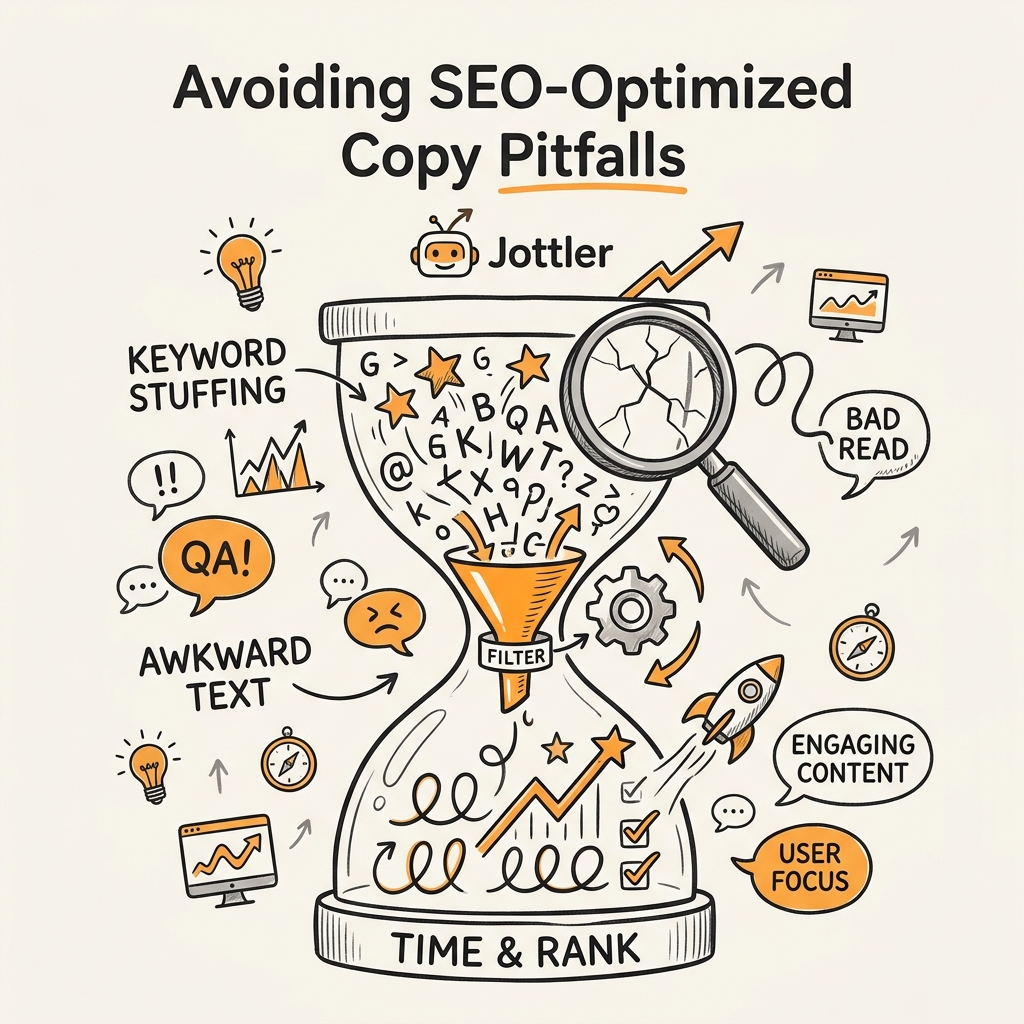
Even the best tools can produce ranking-resistant copy if misused. Here are the most common mistakes teams make when using AI copywriting tools for SEO.
Skipping SERP Analysis Before Writing
Some teams jump straight to generation without analyzing what's ranking. This creates a mismatch between your content intent and what Google expects. If a keyword favors listicles but your AI generates a long-form guide, your ranking potential drops immediately.
"The fastest way to rank is to understand the dominant content type, word count, and structure before your AI writes a single word. Tools like Surfer and Jottler make this automatic, but analysis is critical." — Content Strategy Best Practice
Fix: Always start with SERP analysis. Understand the dominant content type, word count, and structure before your AI writes a single word. Tools like Surfer and Jottler make this automatic, but even with Jasper or Writesonic, spend 5 minutes reviewing top-ranking results.
Ignoring Content Scoring and Optimization
An AI-generated draft is rarely optimized for ranking. It needs review against your keyword, competitor benchmarks, and on-page factors. Teams that skip the scoring step publish content that underperforms.
Fix: Integrate content scoring into your publishing checklist. Before publishing, your article should pass: keyword coverage check, readability score, word count alignment with competitors, and structure validation. Jottler automates this entire step, but if you're using Jasper or Writesonic, layer in Surfer SEO to ensure every article is optimized before it goes live.
Forgetting About Internal Linking and Topical Authority
Publishing articles in isolation wastes ranking potential. Each new article should link to existing content, and existing content should link back. This builds topical authority and distributes link equity across your site.
Fix: Develop an internal linking strategy from the start. When writing about a new keyword, search your existing content for related topics and link to them. Then update those older articles to link forward to your new piece. Jottler automates this entire process, building internal link networks across all generated content without manual work.
Real Results from SEO-Optimized Copy Tools
The data on AI-generated SEO content is increasingly positive. AI-assisted SEO content delivers a 35% increase in organic traffic compared to manually-written copy, while cutting time-to-publish by 57%. But these results only materialize if the tool includes SEO optimization from the start.
Recent Siege Media data shows that 97% of content marketers plan to use AI in 2026, with the majority citing productivity gains and SEO improvements as their primary drivers. Teams using fully optimized tools like Jottler report compounding organic traffic growth, since every article feeds into a larger topical authority system.
The best practice emerging in 2026 is to treat SEO copywriting as a system, not a task. Rather than generating individual articles, use an SEO-optimized AI tool to build interconnected content clusters. Each article strengthens the others, and internal linking compounds your authority. This is why fully autonomous systems like Jottler increasingly outperform manual workflows—they optimize for the system, not the individual article.
Conclusion
SEO-optimized copy tools have evolved from simple AI writers to sophisticated systems that embed search intent, SERP alignment, and on-page optimization directly into content generation. The core features that matter—real-time SERP analysis, content scoring, semantic keyword expansion, automated internal linking, and fact-checking—have moved from optional to table stakes.
For busy founders and scaling marketing teams, the ROI is clear: AI-assisted SEO content delivers 35% higher organic traffic while cutting production time by 57%. The teams winning in 2026 aren't those using AI as a simple writing assistant. They're using AI as a content system that handles research, optimization, linking, and publishing autonomously.
Jottler represents the frontier of this evolution. By automating the entire research-to-publish pipeline with daily 3,000+ word articles, built-in fact-checking, and smart internal linking, it solves the core problem busy founders face: you understand content marketing's importance, but you lack the bandwidth to scale it consistently. Jottler makes that inconsistency disappear.
Start your SEO agent today and watch your organic traffic compound without adding headcount or hours to your team's calendar.
FAQs
What are the core features of SEO-optimized copy tools?
Real-time SERP analysis, content scoring, semantic keyword expansion, automated internal linking, and fact-checking verification are the five pillars of modern SEO-optimized tools. SERP analysis ensures your content matches the format and intent of what already ranks. Content scoring measures keyword coverage, readability, and structural alignment against competitors. Semantic expansion identifies related keywords and topical clusters to improve coverage naturally. Automated internal linking builds topical authority across your site. And fact-checking prevents claims from damaging your domain authority. Tools like Jottler integrate all five into a single autonomous system, while others require combining multiple platforms.
How much does a good SEO-optimized copy tool cost?
Prices range from $16–99/month depending on the tool and feature set. Writesonic starts at $16–19/month and includes built-in SEO features, making it the best value for SMBs. Jasper costs $49/month and focuses on brand voice and team collaboration. Surfer SEO is $99/month but specializes in post-draft optimization. Jottler starts at $29/month and automates your entire content pipeline, including research, writing, optimization, and publishing. The key is matching the tool to your workflow maturity and content velocity goals.
Can AI-generated SEO copy actually rank in Google?
Yes. AI-generated SEO content produces a 35% increase in organic traffic compared to manual content, but only when the tool embeds SERP analysis, keyword optimization, and content structure into the generation process. Generic AI writing tools produce copy that doesn't rank well because they miss search intent. SEO-optimized tools analyze what's already ranking and guide your AI to match that pattern. The critical difference is whether the tool starts with SERP analysis or content quality alone.