SEO Strategy Fundamentals for Business Growth
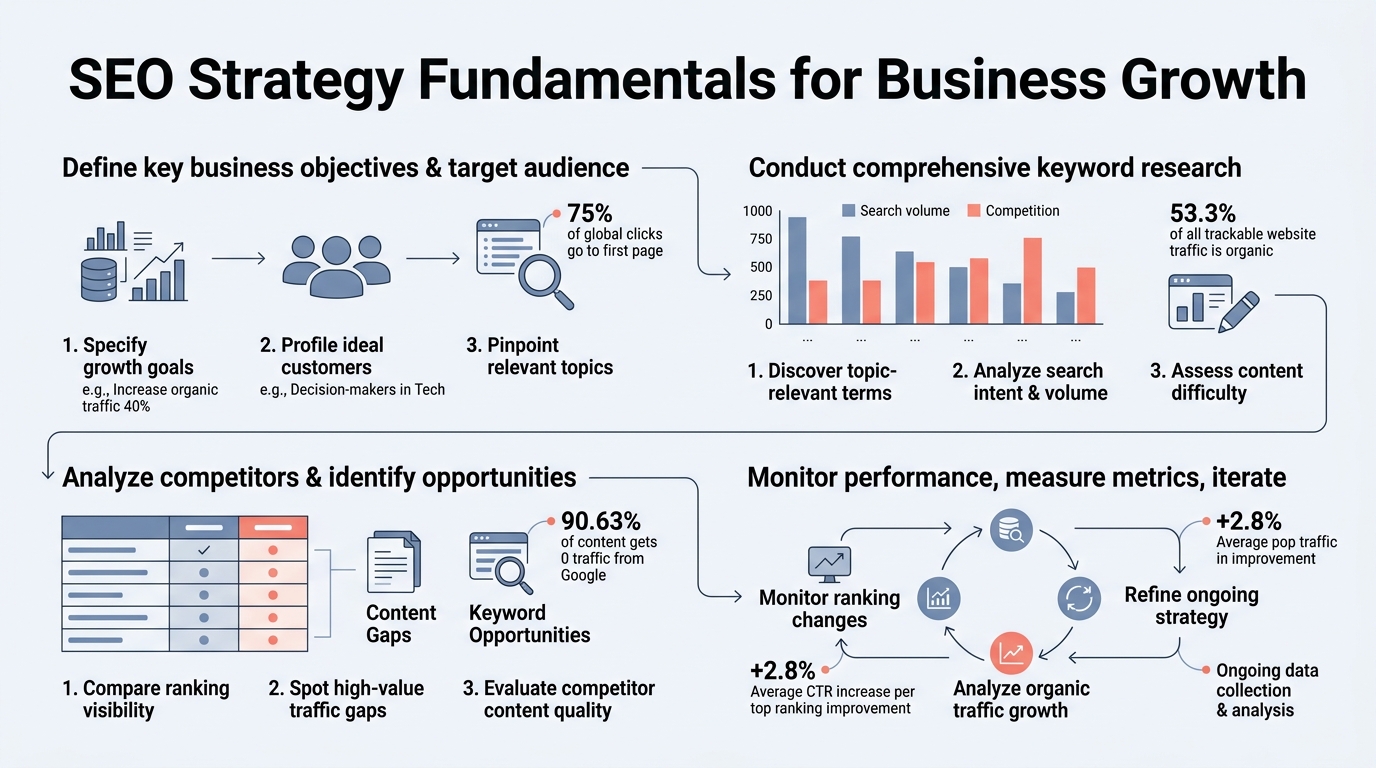
Most businesses leave organic traffic on the table. 53.3% of all website traffic comes from organic search, yet only 12% of companies systematically invest in SEO strategy. The cost? Ceding market share to competitors who capture page-one rankings and the 39.8% click-through rate that comes with the #1 position. Without a framework, marketing teams spin their wheels on tactical taskspublishing content that ranks nowhere, chasing vanity metrics, missing the revenue impact SEO can deliver. The fix is a structured SEO strategy: one that starts with what your customers actually search for, builds authority systematically, and compounds over time. Here's how to build one that drives real business growth.
Key Takeaways
- 748% median ROI from SEO ($22 returned per $1 invested), with B2B SaaS averaging 702% over 3 years (First Page Sage, 2026)
- B2B companies generate 2x more revenue from organic search than any other channel, including paid ads
- Organic leads cost $31 per conversion vs. $198 for paid alternatives, making SEO the most efficient long-term growth lever
- 88% of marketers increase or maintain SEO budgets year-over-year despite broader marketing cuts
- Keyword Research Strategy: Map search intent to buyer journey; prioritize high-intent queries where your ICP actually searches.
- Content Authority: Build topical clusters that establish expertise across related topics, compounding your domain authority.
- Technical Foundation: Ensure crawlability, indexability, and Core Web Vitals so search engines can actually rank your content.
- Internal Linking Structure: Connect content strategically to guide users and distribute page authority across key pillar pages.
- Measurement & Iteration: Track organic traffic, conversion rates, and revenue from SEOnot just rankingsto prove ROI.
What Is SEO Strategy (and Why It's Different from Tactics)
SEO strategy is the multi-quarter plan for how you'll win organic search. Tacticskeyword optimization, link building, content publishingare how you execute it. The difference matters because busy founders often confuse activity with strategy. Publishing weekly blog posts without a keyword roadmap isn't a strategy. Optimizing title tags without understanding your competitive landscape isn't a strategy. Strategy answers: Which search terms will drive the most qualified traffic? What does your audience actually need to see to move down the funnel? How do we become the trusted authority in our category?
A real SEO strategy starts with competitive positioning. If you're a SaaS startup competing in a saturated space, you don't beat incumbents by writing generic "how-to" content. You win by targeting high-intent buyer keywords, building authority in adjacent topics competitors ignore, and creating content so useful it becomes the reference competitors cite. A structured SaaS SEO strategy compounds over timemonth three looks like month one's work, but by month nine you've built enough authority that new content ranks faster and older content pulls more traffic.
How to Research Keywords That Actually Drive Revenue

Keyword research is the foundation of everything. Without it, you're guessing which topics matter to your audience. High-intent keywordsthose that signal buying intentconvert 3-7x better than informational keywords, yet most teams waste cycles on content nobody's searching for. The goal is to map what your ideal customer profile (ICP) searches for at each buying stage, then build content around those queries.
Segment Keywords by Buyer Intent and Stage
Not all keywords are created equal. Intent varies wildly: "what is SEO" gets millions of searches but almost no conversions. "SEO platform for SaaS companies" gets fewer searches but far higher intent. Build your keyword strategy in three tiers:
- Informational (awareness stage): "How does SEO work?", "SEO basics for startups"high volume, low conversion. These build awareness and drive top-funnel traffic.
- Navigational/Comparison (consideration): "Best SEO tools", "Jottler vs Semrush"mid volume, mid-high intent. Audience is evaluating options.
- Transactional (decision stage): "SEO tool pricing", "Start free SEO automation"low volume, very high intent. This is where conversions happen.
Prioritize transactional and high-intent comparison keywords first. You'll get fewer impressions, but conversion rates justify the focus. Once you rank for 10-15 buyer keywords, add supporting informational content to feed the top of funnel and build overall domain authority.
Use Search Volume + Competition Data to Identify Gaps
Keyword tools (Ahrefs, SEMrush, Moz) show you search volume and keyword difficulty (KD)the competitiveness of ranking. The sweet spot for growth is keywords with 200+ monthly searches and KD under 40. Below 200 searches, the traffic payoff is tiny. Above KD 40, you'll spend six months fighting incumbents for visibility. Early in your SEO lifecycle, prioritize lower-KD keywords to build momentum and prove ROI. As authority grows, tackle higher-difficulty terms.
Look also for keyword gapsterms your competitors rank for that you don't. If your top three competitors all rank for "SEO ROI calculator" but you don't, that's a signal you're missing revenue. Reverse-engineer their content and build a version that's more useful, more recent, and better optimized.
How to Build Content That Ranks and Converts
Content is the vehicle for SEO. Without high-quality content, no optimization technique works. The best content strategy balances search demand (what people search for), business value (what drives revenue), and author expertise (what you're uniquely positioned to teach). This alignment is where most teams fail: they write what they think is important instead of what their audience actually needs.
Create Topical Clusters to Build Authority
A topical cluster is a group of interlinked content pieces organized around a central pillar topic. Example: pillar = "SEO Strategy", subtopics = "Keyword Research", "Content Optimization", "Link Building", "Technical SEO". Each subtopic ranks for its own keywords but links back to the pillar and to related subtopics. This structure signals to Google that you own the topic, boosting the entire cluster's authority.
Start with three to four core clusters aligned to your main ICP pain points. For Jottler's audience (busy founders), core clusters would be "Organic Growth for SaaS", "Content Marketing Automation", and "SEO Fundamentals". Then build 4-6 subtopic articles per cluster. Over six months, you'll have 15-20 interlocked pieces that collectively rank for 50+ keywords and drive 3-5x more traffic than the same articles would independently.
Optimize for Search and User Intent
Modern SEO optimization has two audiences: search engines and humans. Overoptimize for keywords (keyword stuffing, forced mentions) and your content reads like spam. Ignore optimization entirely and it doesn't rank. The balance is to write useful content first, then optimize for clarity:
- Title tag: Include primary keyword, stay under 60 characters, make it click-worthy ("How SEO Drives $100K+ in Revenue for SaaS Startups" beats "SEO Strategy").
- Meta description: First 150 characters; include keyword naturally and include a number or value prop to boost CTR.
- H1 and H2 tags: Use semantic variations of your keyword in headings; make them descriptive enough that someone could scan headers and understand the article.
- Body content: Front-load your answer (first 60 words should directly answer the query), break up long paragraphs, use lists for scannability, and bold key statistics.
- Internal links: Link to related articles using descriptive anchor text; aim for 3-5 per article. This distributes authority and keeps readers in your content.
An SEO content plan should align keyword targets with publishing frequency and internal linking strategy. Many teams miss this: they publish great articles but fail to link them to one another, leaving authority dispersed instead of concentrated.
How to Build Technical SEO as a Competitive Moat
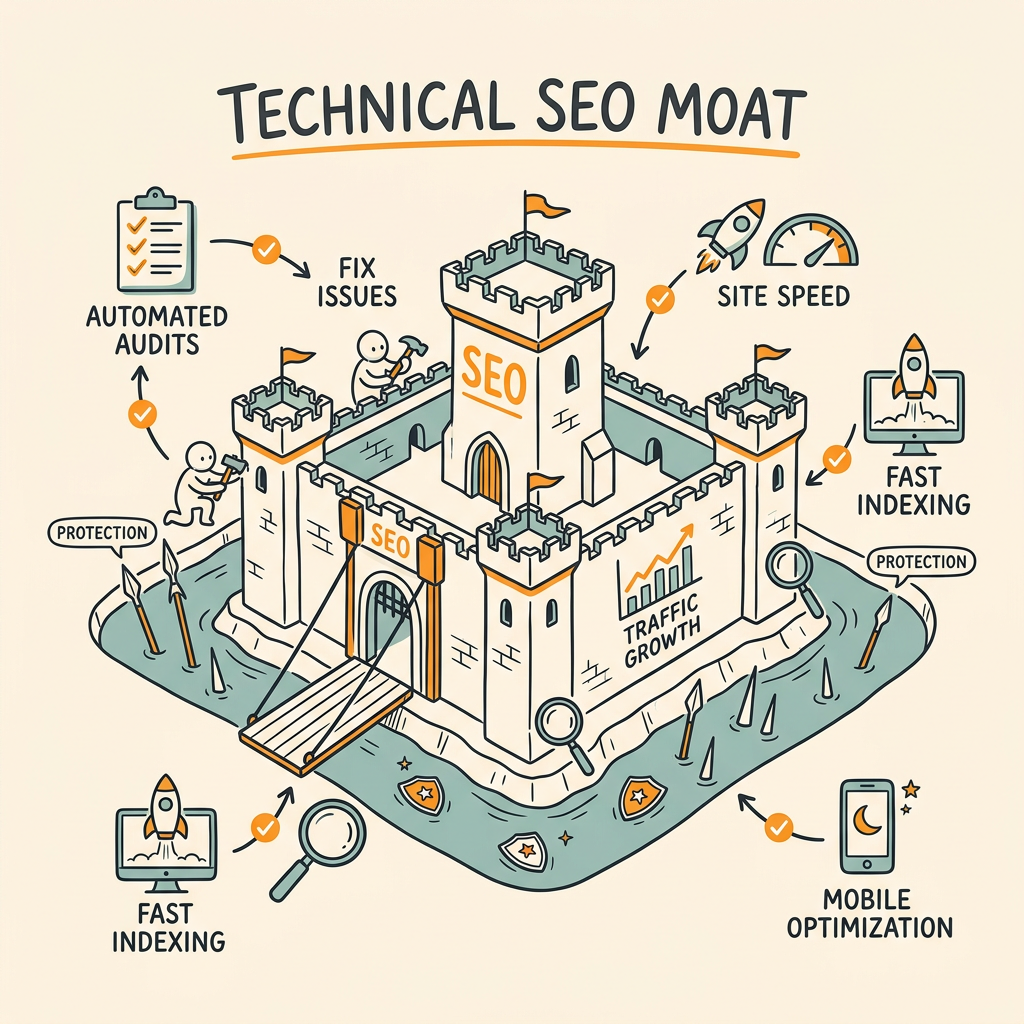
Technical SEO is the plumbing of your website. Poor technical SEO kills ranking potential regardless of how good your content is. The fundamentalssite speed, mobile responsiveness, indexabilityare table stakes. But your competitors are handling those too. The competitive advantage comes from going deeper: Core Web Vitals, schema markup, crawlability optimization, and internal link structure are what separate rank-one pages from rank-five pages.
Prioritize Core Web Vitals and Page Experience
Google's Core Web Vitals measure user experience: loading performance (LCP), interactivity (INP), and visual stability (CLS). Pages with poor Core Web Vitals struggle to rank, especially in competitive niches. If your competitors all have green Core Web Vitals scores and you don't, they'll outrank you even with comparable content. Audit your site using Google PageSpeed Insights. A score of 75+ is competitive; 90+ is excellent. Common quick wins: image optimization (compress and use modern formats), lazy-load below-the-fold content, minimize JavaScript, and use a CDN.
Structure Data with Schema Markup
Schema markup tells Google what your content is about in machine-readable format. FAQ schema can get your content into Google's People Also Ask. Product schema can display star ratings and pricing. Organization schema adds your logo and contact info to knowledge panels. Most teams skip this, but schema is increasingly important for visibility in AI Overviews and generative search. Use schema.org and Google's Rich Results Test to audit your implementation.
How to Build Sustainable Link Authority
Links are votes of confidence. A page with 10 high-quality links will outrank a better-written page with no links. But link building intimidates teams because it sounds like "cold outreach" and "relationship-building", which is truebut it doesn't have to be chaotic. A sustainable link strategy starts with content so useful people link to it naturally, then strategically builds authority where it matters most.
Create Linkable Assets First
You can't pitch a link to mediocre content. Build assets people actually want to link to: original research, data studies, interactive tools, comprehensive guides that cite and credit other experts. Content cited in other articles gets 3x more organic traffic because both the original content and citing content drive referral traffic. Example: if you publish "The 2026 State of SaaS Marketing" with original survey data, dozens of industry blogs will link to it when discussing SaaS trends. That's sustainable link equity without asking.
Build Authority Where Your ICP Looks
A link from a tier-one publication in your industry is worth 100 links from random blogs. If you're a B2B SaaS company, a single link from TechCrunch, ProductHunt, or your industry's leading blog creates more ranking power than a year of generic link building. Reverse-engineer which publications your ICP reads. Build relationships with their editors. Contribute thought leadership content, offer exclusive insights, and pitch story ideas tied to industry trends. One high-quality link per quarter beats a hundred low-quality links.
| Link Source Type | Authority Impact | Effort to Earn | Recommended Frequency |
|---|---|---|---|
| Tier-1 Industry Publication (TechCrunch, ProductHunt, SaaS-specific media) | Very High (10-50 DR impact) | Very High (months of outreach) | 2-4 per year |
| Your Own Content Assets (guides, research, tools on your site) | High (improves domain authority) | Low (internal linking only) | 3-5 per article |
| Customer/Partner Pages (portfolio links, integrations, partnerships) | Medium (10-20 DR impact) | Medium (relationship + setup) | 2-3 per quarter |
| Industry Directory or SaaS Lists (G2, Capterra, niche directories) | Medium (5-15 DR impact) | Low (sign up, profile completion) | Monthly (evergreen) |
| Guest Posts in Competitor/Adjacent Blogs | Medium (5-20 DR impact) | High (pitch + write + revise) | 1-2 per quarter |
How to Measure SEO ROI and Iterate
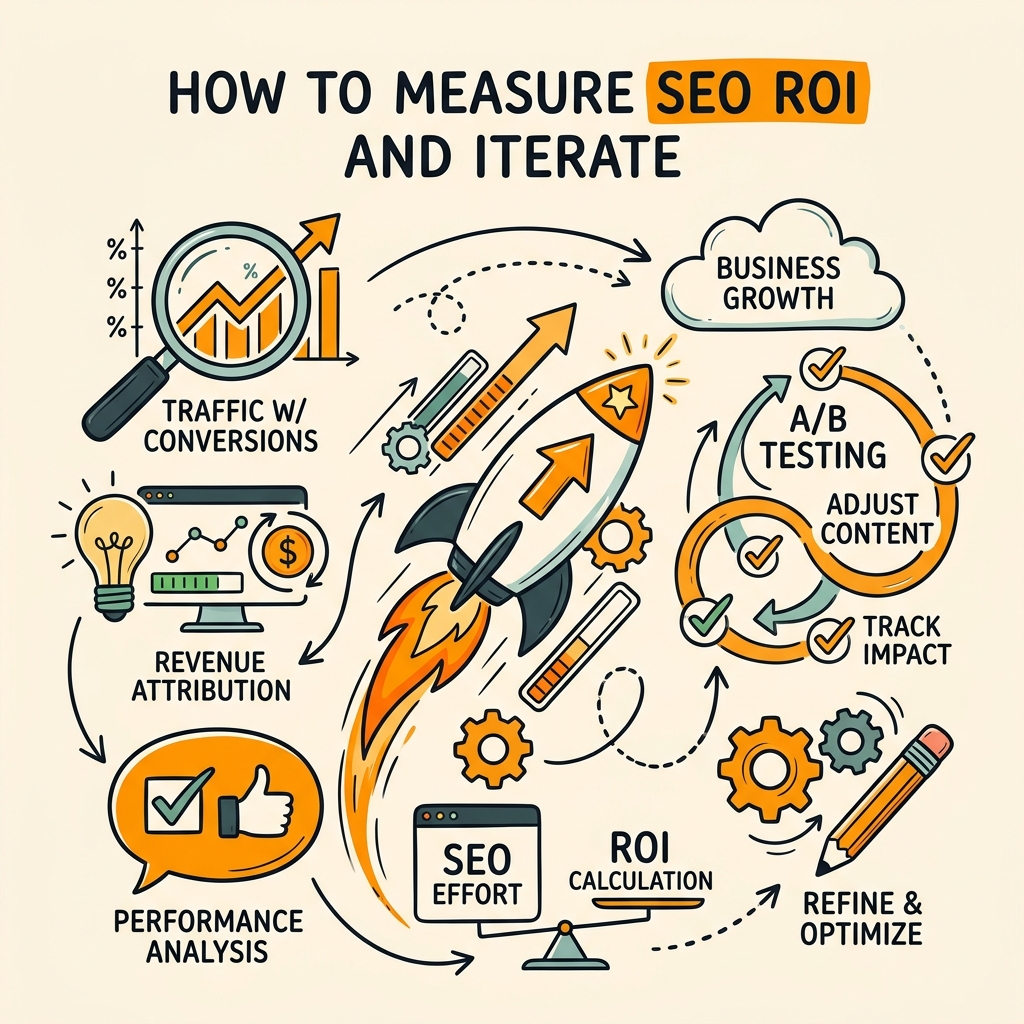
What gets measured gets managed. Too many teams track vanity metricsrankings and trafficwhile ignoring revenue. Ranking #1 for a keyword with 10 monthly searches? That's 5 clicks per month, probably zero conversions. You need a measurement framework that ties organic traffic to business outcomes: leads, customers, revenue. B2B SaaS companies that track revenue from SEO report 702% ROI and break even on SEO investment in 7 months, but only if they measure it accurately.
Set Up Conversion Tracking and Attribution
Connect your website analytics (GA4) to your CRM. Tag organic traffic in your CRM as "organic" source. Track which organic visitors become leads, which leads become customers, and how much revenue each cohort generates. This takes two hours to set up but gives you visibility most competitors lack. You'll see exactly which topics drive qualified traffic, which keywords fuel growth, and where to double down. Without this, you're flying blindand you'll optimize for the wrong metrics.
Build a Monthly SEO Dashboard
Track four KPIs: organic traffic volume (month-over-month growth %), conversion rate from organic (target 1.5-4%), cost per acquisition from organic (divide total SEO spend by new customers), and lifetime value of organic customers. If organic traffic grew 20% but conversion rate dropped 50%, that's a red flagyou're ranking for lower-intent keywords. If cost per acquisition from organic is $100 and customer LTV is $5,000, that's a profitability signal worth scaling investment.
"Website, blog, and SEO is the #1 ROI-driving channel for B2B brands. Despite AI and algorithm changes, the channel that consistently drives returns hasn't changed."
Taylor Scher, SEO Strategist, Taylorscherseo, 2026
Why SEO Compounds (and Why Consistency Matters More Than Perfection)
The biggest mistake teams make is stopping SEO too early. Content marketing is a compound investment. Month one of publishing looks like month onesmall traffic gains, zero ranking movement. Month three still feels slow. But by month six, older content starts ranking better, new content ranks faster, and domain authority creates a flywheel. By month twelve, you're getting 10x more organic traffic than you were willing to invest initially.
This is where most founders quit. The pressure to show ROI in 90 days kills consistency. But 88% of marketers who sustain or increase SEO budgets year-over-year report significantly higher ROI than those who cut spend. The teams winning in organic search are the ones who committed to the strategy for 12+ months straight, published consistently, and compounded their results. This is non-negotiable for busy teams: you need a system that publishes high-quality content without eating your bandwidth.
"The median SEO ROI stands at 748%positioning it among the highest-performing marketing channels available. Yet the majority of this value comes from cumulative content and authority built over six to twelve months."
Analysis via Upgrowth, 2026, citing First Page Sage benchmarks
Autonomous SEO agents are built specifically to solve the consistency problemthey research keywords, write long-form content, fact-check, and publish daily, compounding your domain authority without requiring your team to manually produce articles. For busy founders who understand SEO matters but can't staff a full content team, this automation removes the biggest barrier to winning organically.
Conclusion
SEO strategy fundamentals come down to three things: understanding what your audience searches for (keyword research), becoming the most useful answer to those searches (content authority), and proving that organic traffic drives revenue (measurement). When these three pillars align, SEO becomes your most efficient revenue driver. B2B companies generate 2x more revenue from organic search than any other channel, at just $31 per lead conversiona 748% ROI that compounds month after month.
The journey starts with a keyword roadmap, progresses through topical authority and technical optimization, and matures into a predictable, measurable revenue stream. Consistency is the unfair advantage. Most competitors quit after three months; the teams winning organically committed to 12+ months of sustained effort. The good news: you don't need a massive SEO team to pull this off. You need clarity on strategy and a system that automates the execution. Start your SEO agent today and let autonomous content research, writing, and publishing compound your organic growth without the manual burden. Visit https://jottler.co/auth/signup to begin building your SEO advantage.
FAQs
How long does it take to see SEO results?
Most teams see measurable organic traffic within 3-4 months of consistent publishing and optimization, though real compounding results typically show up around month 6-9. B2B SaaS companies report break-even on SEO investment in approximately 7 months if they're publishing consistently and tracking revenue attribution correctly. The timeline depends on niche competitiveness (easier niches see results faster), publishing frequency (daily beats weekly), and content quality. Patience matters: the teams that sustain investment for 12+ months see 10x better results than those who quit after quarter two.
What's the difference between SEO strategy and SEO tactics?
Strategy is your multi-quarter roadmap; tactics are the individual actions you take to execute it. Strategy answers: Which keywords will drive the most qualified traffic? What topics should we own? How do we build authority faster than competitors? Tactics are: optimizing title tags, publishing blog posts, building links, improving Core Web Vitals. Many teams confuse activity with strategythey publish content randomly, optimize pages without a keyword plan, and call it an SEO program. Real strategy aligns all tactics toward a coherent goal: dominating your market's most valuable keywords and generating qualified revenue.
How do I know if my SEO investment is working?
Track organic revenue, not just rankings. Set up GA4 to CRM conversion tracking, then measure: total organic traffic (month-over-month %), conversion rate from organic visitors, cost per customer acquisition, and lifetime value of organic customers. If cost per acquisition from organic is less than 20% of customer lifetime value, your SEO is working. If organic traffic is up but conversions are flat, you're ranking for low-intent keywords and need to shift your content strategy. Most teams declare SEO a failure after three months because they measure rankings instead of revenue. Give it twelve months, measure revenue attribution, and you'll see why 88% of marketers sustain or increase SEO budgets.