Setting Up HARO Workflow Automation for PR
HARO (Help A Reporter Out, now rebranded as Connectively) is one of the fastest ways to earn quality backlinks and press mentions. But speed requires vigilance. Pitches submitted within 6 hours of a query posting see 20% higher conversion rates, yet most teams respond manually and miss the window entirely. When you're running a growing company, spending hours daily checking digests and crafting responses eats time that should go to strategy. The fix? Automation. By setting up a workflow that routes queries to AI drafting, prioritization, and notification systems, you can respond to 20-40 pitches per month consistently and achieve the 5-15% placement rate that separates successful digital PR from noise.
Key Takeaways
- Pitches submitted within 6 hours see 20% higher conversion rates; automation compresses response time from hours to minutes (2026, The Stacc)
- Workflow automation reduces error rates by 40-75% and saves PR teams 6.2 hours per week on routine tasks (2026, PR Lab)
- 89% of organizations have adopted or plan to adopt workflow automation by 2026; teams automating over 50% of repetitive workflows report 74% efficiency gains (2026, Gitnux)
Quick Scan: Core Automation Components
- Instant Query Routing: Catch HARO queries in the first 2-4 hours through email forwarding and Slack integrations.
- AI-Powered Draft Generation: Use AI agents to draft personalized pitches from HARO query details in under 2 minutes.
- Relevance Filtering & Scoring: Automatically classify queries by niche fit and flag only the highest-match opportunities.
- Template-Based Personalization: Maintain a library of data points, case studies, and credentials that merge into drafts automatically.
- CRM Integration & Tracking: Log every pitch, response, and placement in a centralized database to measure ROI and identify what works.
- Editorial Calendar Sync: Connect HARO placements to your content strategy so wins feed your SEO roadmap.
How Does HARO Workflow Automation Save Time?
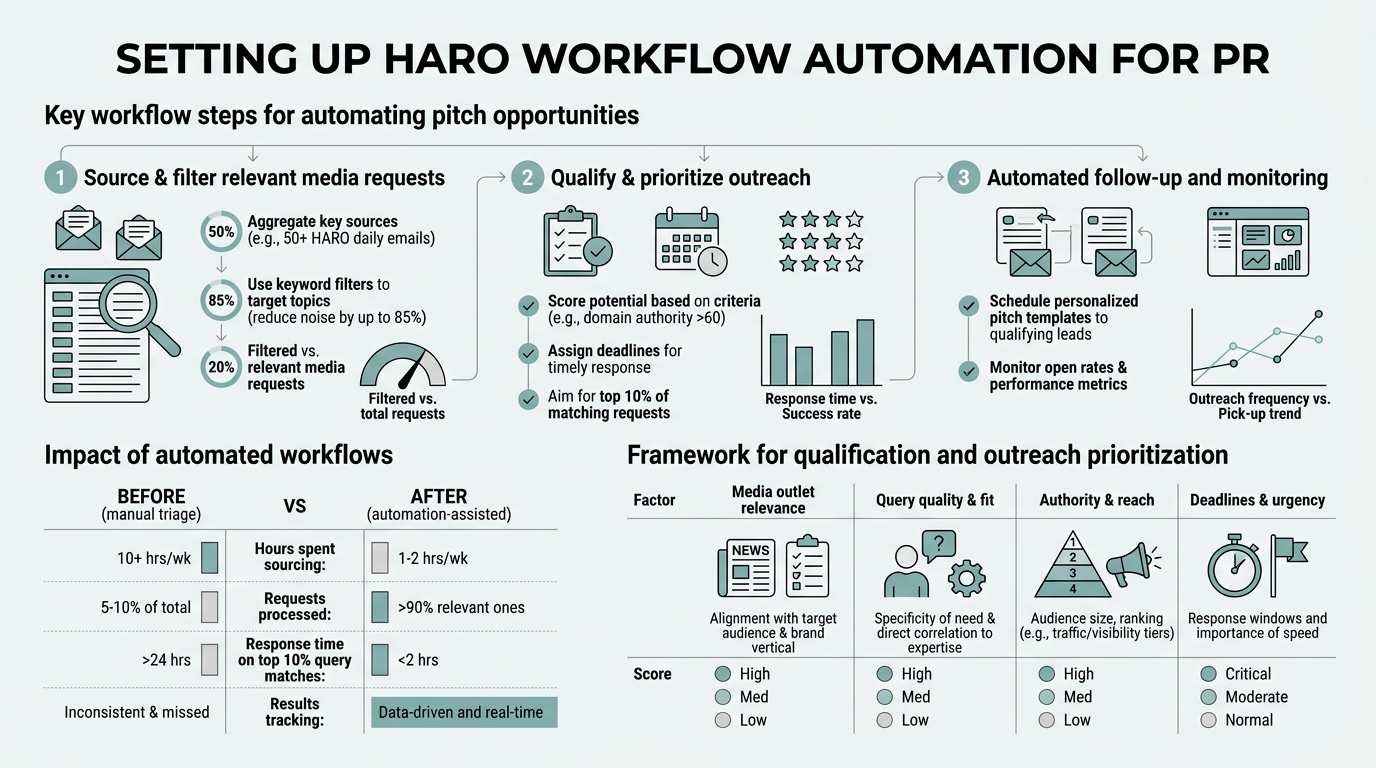
Manual HARO outreach is a game of attrition. 89% of organizations are adopting workflow automation by 2026, and the ones ignoring it are falling behind. A typical team without automation spends 45-60 minutes per day scanning digests, manually evaluating fit, writing responses, and tracking replies. Automated workflows compress that to 5-10 minutes of human review and approval. The math is straightforward: reclaim 30-50 minutes daily, multiply by 20 working days per month, and you've freed 10-16 hours of productive time monthly. For a founder or lean marketing team, that's the difference between running organic PR and abandoning it entirely.
"Speed is not a nice-to-have in HARO. It's the primary lever that determines success. Journalists reviewing pitches often make decisions within hours of posting queries, making early response the competitive advantage that separates placements from rejections."
The Speed Advantage in Response Time
Response speed is not a nice-to-have in HARO. It's the primary lever that determines success. Journalists reviewing pitches often make decisions within hours of posting queries. A pitch that arrives within the first 2-4 hours after posting has dramatically higher odds of placement than one sent six hours later. Manually managing this requires someone to constantly monitor email or dashboards, which is unrealistic for distributed teams. An automated workflow sets up instant notifications (email, Slack, webhook) that alert relevant team members the moment a matching query arrives, enabling response within minutes rather than hours. Teams using automated HARO routing report 20% higher conversion rates simply from speed.
Error Reduction and Consistency
Manual outreach introduces human error at every step: missed queries, typos in pitches, duplicate submissions, forgotten follow-ups. Automation reduces error rates by 40-75% compared to manual processing. A well-configured workflow removes these friction points through structured processes:
- Every pitch uses the same quality template and proven structure
- Subject lines follow formula-based approaches that work
- Follow-up reminders trigger automatically on schedules you define
- Duplicate submission detection flags redundant pitches before sending
- Data validation catches missing fields or incomplete information
Consistency compounds over time. A team seeing 1-3 placements per month from manual work might triple that rate simply by eliminating the errors that sink pitches.
What Are the Core Components of a HARO Automation Workflow?
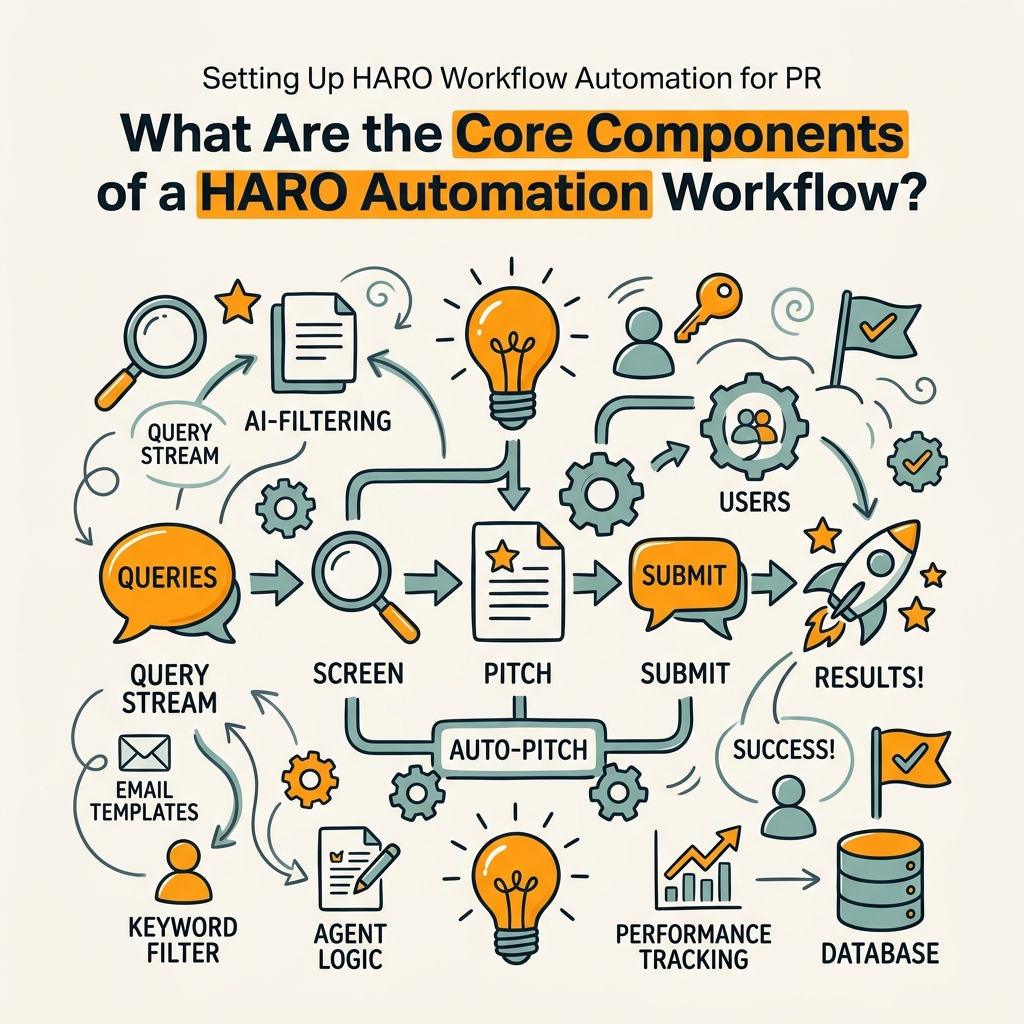
A functional HARO automation system has five essential parts working in concert: query ingestion, relevance filtering, draft generation, human review, and tracking. None of these alone drives results. Together, they create a feedback loop where every pitch informs the next one. Setting them up requires planning, but the architecture is straightforward and replicable across any PR team size.
Email Parsing and Instant Query Routing
HARO sends digest emails to subscribers containing 10-30 queries daily. A manual workflow means reading these emails, copying relevant queries into a document, and manually alerting team members. An automated system parses the HARO email directly using tools like Zapier, Make, or custom webhook handlers. These platforms extract query details (topic, deadline, journalist contact, publication) and forward them to a centralized queue—often an Airtable base, Slack channel, or custom CRM. This eliminates the copy-paste step entirely. The moment a query matches your defined niche, your team is notified. Early adopters using automated parsing see response times drop from 30+ minutes (manual email scanning) to under 5 minutes (instant alert).
AI-Powered Relevance Classification
Not every HARO query deserves a response. Successful teams target only queries that match their precise expertise, achieving 5-15% placement rates instead of sub-1% rates from spray-and-pray approaches. An automated system classifies each query using AI agents that score relevance based on your niche keywords, industry vertical, and past successful placements. A query about retail technology gets a high score if your expertise is SaaS for retail; a query about healthcare policy gets a low score if you're a B2B tech company. This scoring gate saves time by filtering out 70-80% of queries your team would waste time evaluating manually. The result: your team reviews only truly relevant opportunities, which improves placement rates and focuses effort where it matters most.
"A poor relevance filter that responds to 80% of incoming queries will tank your reputation with journalists. Selectivity is not optional—it's the foundation of sustainable HARO success. Fewer pitches, better fit, higher placement rates."
Intelligent Draft Generation Using AI Agents
This is where automation shifts from organizational to transformational. Traditional AI writing tools generate generic pitches. Purpose-built HARO automation uses multiple AI agents to handle different aspects of pitch generation. One agent analyzes the journalist's query and identifies what angle they're likely to favor. Another agent pulls relevant company data, case studies, or statistics from your knowledge base. A third agent structures these elements into a personalized, concise pitch that feels human-written. Most automation systems produce draft pitches in 60-120 seconds, saving a PR professional 10-15 minutes of writing per response. Over a month of 20-30 responses, that's 3-7 hours recovered. More importantly, AI-generated drafts that incorporate your specific credentials and data points yield higher placement rates than hastily written manual responses.
Human Approval and Final Customization
Automation that removes human judgment entirely is dangerous. The best HARO workflows insert a deliberate human review step. A team member receives the AI draft, reads it in 2-3 minutes, and either approves, edits, or rejects it. This catches tonal mismatches, ensures accuracy, and prevents embarrassing mistakes like pitching the wrong service. This approval loop adds only 2-3 minutes per pitch while preserving quality control. Teams that skip the review step often see lower placement rates because AI-generated pitches, while faster, lack the personal voice that journalists value. The human review stage should include these verification steps:
- Check that the pitch directly addresses the journalist's stated angle or question
- Verify all data points, statistics, and credentials are current and accurate
- Ensure the tone matches your brand voice and the publication's style
- Add one personal detail or recent example to humanize the response
- Confirm the call-to-action is clear and specific
CRM Tracking and ROI Measurement
A pitch sent is data lost if you don't track it. A centralized CRM (Airtable, HubSpot, or a custom database) records every query responded to, the draft sent, the reviewer who approved it, the journalist's response, and whether a placement occurred. This creates a feedback loop. Over time, you learn which types of queries convert, which angles work best, and which industries pull more coverage. Teams logging this data systematically report ROI achievement within 12 months of implementing workflow automation. You also capture metrics like placement rate (pitches sent ÷ placements earned), average publication DR of your placements, and backlink authority gained per quarter. Founders using this data can measure whether HARO is worth the effort for their specific business.
What Tools and Platforms Enable HARO Automation?
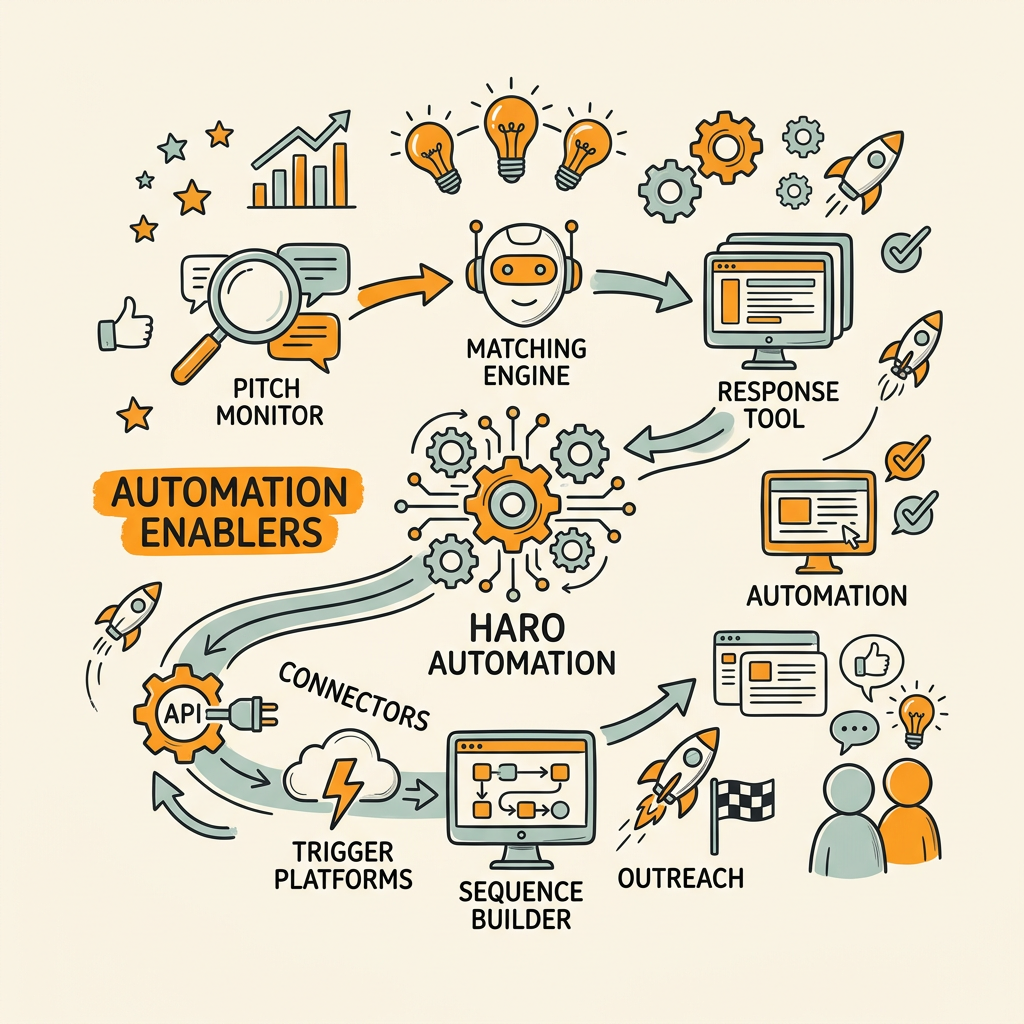
You don't need to build a custom solution from scratch. Several tool combinations work well, ranging from no-code to light development. The right choice depends on your team's technical comfort, volume of queries, and desired level of customization. Most growing companies land in the mid-range: using existing platforms like Airtable + Zapier + AI APIs rather than building bespoke systems.
| Automation Layer | Popular Tools | Best For | Effort |
|---|---|---|---|
| Query Ingestion | Zapier, Make, email forwarding rules | Parsing HARO digests and routing to Slack/Airtable | Low |
| Relevance Filtering | Airtable forms, custom scripts, OpenAI API | Scoring queries and flagging matches | Medium |
| Draft Generation | ChatGPT, Claude API, content automation platforms | Producing personalized pitch copy in seconds | Low-Medium |
| Human Review | Slack, Airtable comments, email | Approval workflows and quality gates | Low |
| Tracking & Analytics | Airtable, Notion, HubSpot, custom database | Recording pitches, responses, placements, ROI | Low |
Most teams start simple: HARO email → Zapier → Airtable + Slack notifications → ChatGPT drafting → Google Sheets ROI tracking. This combo costs under $200/month and requires no coding. As volume grows and patterns emerge, teams add sophistication: custom scoring rules, automated follow-up sequences, and integration with editorial calendars.
Building vs. Buying: When to Use All-in-One Platforms
Smaller teams often prefer all-in-one platforms designed specifically for PR and outreach. Tools like Prowly offer native HARO integrations combined with email tracking, contact databases, and reporting. The advantage is simplicity: one login, integrated workflows, pre-built templates. The trade-off is cost (typically $300-1,000+/month) and less customization. A three-person PR team might find Prowly saves time compared to stitching together five different tools. A founder running PR solo might find the same workflow through Airtable + Zapier + ChatGPT more cost-effective. The key is matching tool complexity to team size and volume.
How Do You Set Up an Automated HARO Workflow Step-by-Step?
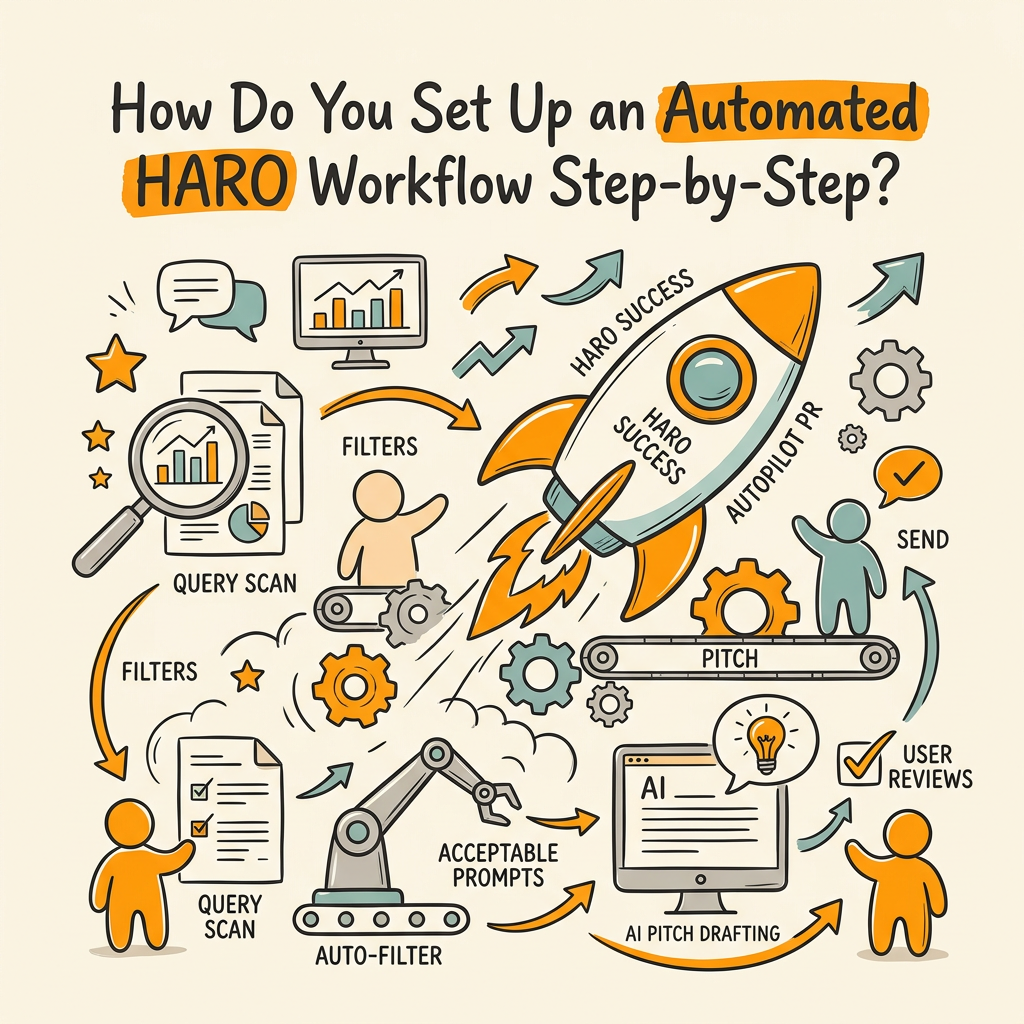
The setup process is straightforward enough for a non-technical founder to execute. It typically takes 2-4 hours for initial configuration, then runs on autopilot with minimal maintenance. Here's the practical path.
Define Your Niche Keywords and Relevance Criteria
Before any tool touches HARO data, clarify what "relevant" means for your business. Write down 15-20 keywords and phrases that describe your expertise. If you're a SaaS for project management, relevant topics include "project management software," "asynchronous work," "team collaboration," "remote work productivity." Irrelevant topics include "construction management," "healthcare compliance," or "manufacturing." This list becomes the basis for your filtering rules. Every automation system will lean on these definitions to score incoming queries. The more precise your list, the better your automation performs.
Set Up Email Forwarding and Initial Query Capture
Forward your HARO digest email to a Zapier-monitored email address or use Make (formerly Integromat) to parse the raw email. Configure the tool to extract: query title, journalist name, publication, deadline, and full query text. Route this extracted data to an Airtable base with fields for each piece of metadata, plus fields for relevance score, draft status, approval, and response date. This is your query hub. Every HARO query lands here automatically, eliminating manual copying.
Integrate AI Drafting with Prompt Templates
Create a master prompt template in ChatGPT or Claude that accepts variables: journalist name, publication, query title, query text, and your company credentials. The template instructs the AI to generate a concise, personalized pitch that addresses the journalist's exact angle. Example: "Draft a 2-3 sentence pitch responding to [journalist] who is writing about [topic] for [publication]. Mention [your credential] and offer [specific insight or data point]." Use Zapier's "Code by Zapier" action or a Make webhook to fire this prompt automatically for every high-relevance query. The AI response lands back in Airtable as a draft column that your team reviews.
Create a Slack Approval Channel and Notification Rules
Route every high-relevance query to a Slack channel dedicated to HARO approvals. The message includes the query summary, AI draft, and two buttons: "Approve & Send" and "Edit & Review." When someone clicks "Approve & Send," the workflow captures the approval timestamp, marks the query as sent, and logs the draft for tracking. This single-click approval keeps friction minimal. Low-relevance queries get a separate digest email so they're not noise, but they're available if someone wants to dig deeper.
Build a Simple ROI Dashboard
In Airtable or Google Sheets, create a summary view that tracks: queries responded to, responses sent, journalist replies received, placements earned, domains of publications, and backlink authority (using Ahrefs or SEMrush API data). Update this dashboard monthly. Over three months, you'll see patterns. You'll notice which industries pull fastest responses, which angles journalists favor, and which topics in your niche generate the most coverage. This data guides your future focus.
What Are Common Pitfalls and How Do You Avoid Them?
HARO automation is forgiving compared to other marketing automation systems—you can't accidentally spam thousands of people or breach data rules. But there are real mistakes that undermine results.
Over-Automating the Pitch and Losing Voice
The biggest trap is letting AI draft a pitch and sending it with zero review. Generic AI-generated text reads like generic AI-generated text. Journalists spot it immediately. The fix is non-negotiable human review, even if it's just 2 minutes of tweaking. Add one personal detail, change a phrase to match your actual voice, or swap the example for one more timely. That small step keeps the pitch human and dramatically improves placement odds.
Blasting All Queries Without Selectivity
Some teams think automation means "respond to everything." It doesn't. Targeting only relevant queries that match your precise expertise is what separates 5-15% placement rates from sub-1% rates. A poor relevance filter that responds to 80% of queries will tank your reputation with journalists and lower your average placement quality. Be ruthless with your niche definition. Respond to fewer, better-fit queries and your metrics improve.
Neglecting Follow-Up
A significant percentage of HARO journalists miss initial pitches or make final decisions days after posting. An automated workflow should include a follow-up rule: if no response within 48 hours, send a brief follow-up. A single follow-up email doubles placement rates in many niches. Most teams manually track this and forget, which costs placements.
Not Measuring or Iterating on Success
Automation without data is just busywork at scale. The teams seeing real ROI log everything and adjust their filters, templates, and angles monthly based on results. If queries about "customer retention" convert at 12% but queries about "pricing strategy" convert at 3%, you shift your filter weight toward retention topics. This iterative approach turns HARO from a vanity metric into a predictable lead and authority source.
How Does Workflow Automation Fit Into Broader Content Strategy?
HARO placements are not an isolated tactic. They're most valuable when integrated into your larger content and SEO strategy. Every placement is backlink + brand mention + audience validation. The smartest teams use HARO placements to inform their SEO content plan. If you're getting consistent placement requests on "remote work culture," you build a pillar page on that topic. If journalists consistently quote your team on "AI adoption in SMBs," you create topical authority in that area. Scaling content marketing systematically means using earned media wins to guide organic content strategy, not letting them exist in isolation. Tools designed for content marketing automation can pull HARO placement data to inform topic clusters and internal linking, multiplying the ROI of every pitch that lands.
Combining HARO workflow automation with broader SEO automation creates a compounding effect. Your team executes HARO faster, captures the backlinks and mentions, then feeds that data into an automated content engine that builds topical authority around those themes. The result: organic traffic compounds, brand authority accelerates, and HARO becomes not a one-off tactic but a strategic input to a larger machine.
Conclusion
HARO workflow automation eliminates the speed friction that kills most digital PR campaigns. When your team can respond to qualifying queries within minutes instead of hours, and can process 20-40 pitches per month without burnout, your placement rate climbs from 1-2% to 5-15%. Organizations automating over 50% of repetitive workflows report 74% efficiency gains and 200-300% ROI within 12 months. The investment—usually 2-4 hours of setup and $100-300/month in tools—pays for itself in recovered time and earned backlinks within weeks.
Start with simple email parsing and Slack routing. Add AI drafting once your process stabilizes. Build your CRM tracking so you can measure what works. Iterate monthly based on placement data. Over time, you'll develop an automated PR engine that generates consistent coverage without consuming your entire week. For busy founders who understand that organic authority compounds, this is not optional work—it's foundational infrastructure.
Ready to reclaim the hours HARO is eating? Start your SEO agent and let automated systems handle the research, writing, and publication workflows while you focus on strategy.
FAQs
How long does it take to set up HARO workflow automation?
Most teams complete initial setup in 2-4 hours. This includes defining your niche keywords, setting up email forwarding to Zapier, creating an Airtable base, connecting a ChatGPT API, and configuring Slack notifications. The heaviest lift is clarifying your relevance criteria—the niche definition that determines which queries your team pursues. Once this runs, maintenance is minimal: reviewing and approving AI drafts (2-3 minutes per query) and updating your tracking database monthly.
What percentage of HARO pitches typically convert into placements?
Placement rates range from 1-2% for teams using spray-and-pray approaches to 5-15% for teams with selective niche targeting and fast response times. The difference comes down to two factors: sending only high-relevance pitches and responding within the critical 2-6 hour window after a query posts. Automated workflow systems directly improve both. A team using automation might see 20-40 pitches per month yield 1-3 placements, compared to 50+ pitches manually yielding only 1-2. Precision beats volume.
Can you automate HARO pitch writing without it sounding like AI?
Yes, but it requires one non-negotiable step: human review. Fully automated pitches with zero human touch often sound generic and convert poorly. The winning approach is AI draft generation plus 2-3 minute human customization. A team member reads the AI draft, tweaks the angle, swaps in a fresher data point or example, and personalizes the closing. This hybrid approach preserves speed (avoiding the 10-15 minute manual write) while maintaining the voice that journalists respond to. Most teams find this balance delivers both efficiency and quality.