The Compound Effect: Building Traffic That Scales Over Time
Most content teams quit after three months. They publish consistently, see minimal traction, and conclude that content marketing doesn't work. The truth is bleaker: they're abandoning their strategy right before the compound effect kicks in. Blogs with 30+ posts see 3.5× more marginal traffic per new article than blogs with fewer than 10. Yet organic search still drives 53% of all global website traffic, making it the only marketing channel that actually compounds. Unlike paid ads that evaporate the moment you stop spending, a blog post published today can generate traffic for three to five years. The difference between stagnation and exponential growth isn't brilliance—it's the willingness to build systems that make every future article work harder than the last.
Key Takeaways
- Organic traffic compounds over time while paid ads stop immediately—blogs with 30+ posts generate 3.5× more traffic per new article (Ahrefs, 2026)
- Average SEO ROI is 22:1 over 24 months with consistent investment, and organic traffic costs 61% less per lead than paid advertising (2026)
- The "quit zone" hits at month 4–6; teams that push through this plateau enter the compounding zone where each new article amplifies existing ones
- Why Organic Traffic Compounds Over Other Channels: Only organic search creates lasting, self-sustaining growth where past content multiplies the impact of new content.
- The Growth Timeline and the Quit Zone: Most teams underestimate how long the compounding phase takes—here's when to expect traction and how to survive the plateau.
- Four Levers That Accelerate Scaling: Publishing cadence, content depth, internal link networks, and distribution strategy each compound the others' effectiveness.
- The Structural Automation Layer: Manual content workflows block scaling; automation handles research, fact-checking, and linking so teams can focus on strategic depth.
- Building Topic Authority in the AI Era: The new search landscape demands deeper, more interconnected content—the compound effect has never been more critical.
Why Organic Traffic Is the Only Channel That Actually Compounds
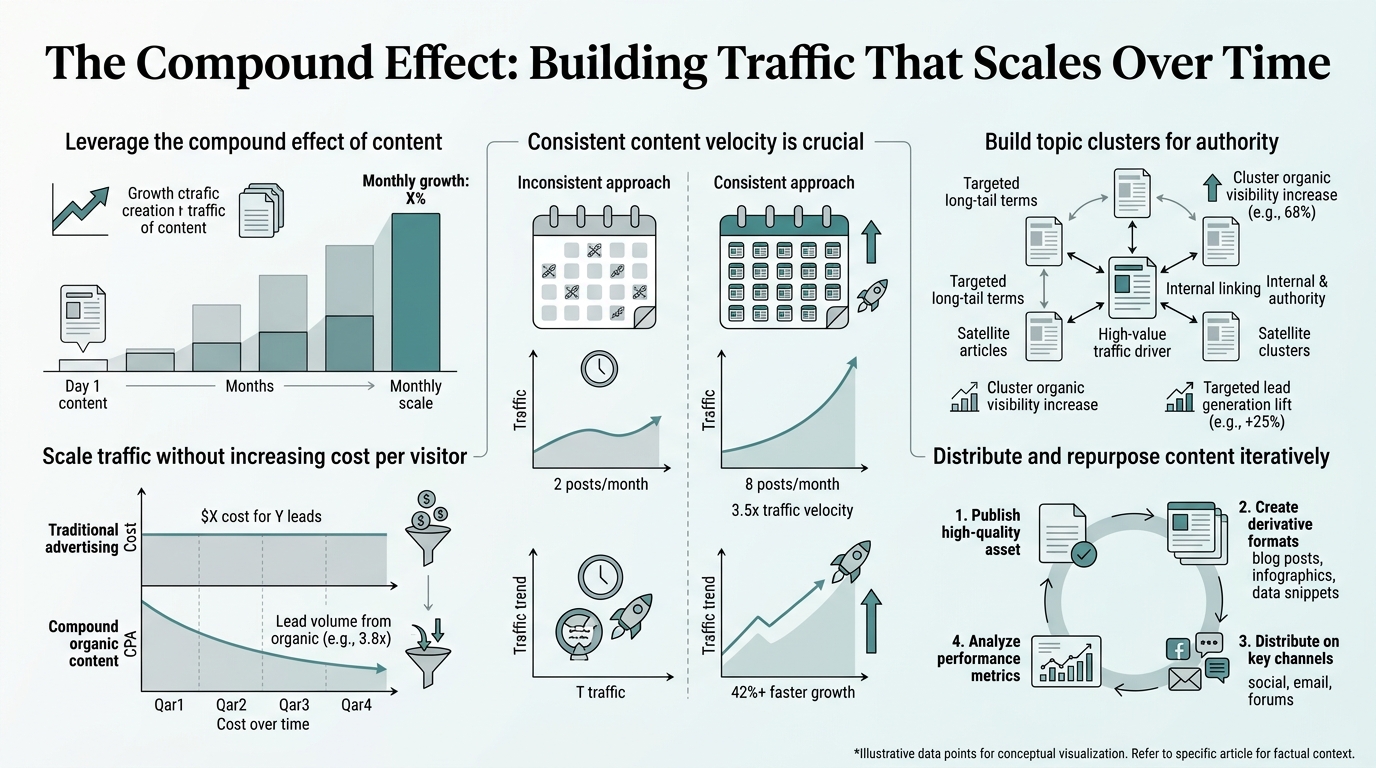
The compound effect in organic traffic works like interest on a savings account. You publish an article today. It ranks for one keyword, generates a handful of clicks. Unremarkable. But that article is also an asset. It attracts backlinks. It appears in internal link networks. It sends authority to related content. Two years from now, it's ranking for 50 keywords. A competitor paid $5,000 for a month of Google Ads and got temporary visibility. Your article cost a fraction of that and keeps working. Organic traffic costs 61% less per lead than paid advertising, and unlike paid channels, the ROI actually accelerates as your content library grows.
"Organic content is different—it's a compounding asset class. Unlike paid advertising that delivers immediate results but no residual value, a single article can generate traffic for three to five years while continuously improving its ranking potential."
This is why the average SEO ROI is 22:1 over a 24-month period with consistent investment. Paid advertising delivers immediate results but no residual value. Social media posts decay within 48 hours. Email lists require constant maintenance. Organic content is different—it's a compounding asset class.
The Mechanics of Compounding Traffic
Compounding happens through three reinforcing loops. First, topic authority—as you publish more articles on a topic, Google recognizes you as an expert. Your articles rank higher, faster. Internal linking connects your articles, creating what SEO professionals call a "topic cluster." Each new article in that cluster inherits authority from the others. Second, content network effects—when you publish your 20th article, the first 19 are still generating traffic. That new article links to three existing pieces, sending them fresh internal link juice. Those 19 articles now have compounding authority they didn't have before. Third, AI citation amplification—AI search engines like ChatGPT and Claude pull from your deepest, most comprehensive content. A single article that answers multiple questions in a niche can be cited by AI systems hundreds of times, sending referral traffic and brand mentions back to your site.
Jottler automates the structural layer—keyword research, internal linking suggestions, fact-checking—so teams can publish consistently without burning out. The result is predictable compounding on autopilot.
Why Most Teams Never See the Compound Effect
The compound effect has a hidden tax: patience. Growth isn't linear. In months one through three, you'll see roughly 18% of your eventual peak traffic. By month six, you're at 42%. Month nine, 70%. The jump from month four to month six—the "quit zone"—kills most strategies. Teams that see minimal results after three months conclude content marketing doesn't work. They shift budget. The strategy dies at precisely the moment when momentum would have kicked in.
"The quit zone at months 4–6 is where most content strategies fail, not because they're broken, but because teams underestimate the patience required for compounding to become visible. This is precisely when you should be doubling down, not pivoting away."
The average blog post takes 4+ hours to produce manually. At that pace, a two-person team manages two posts per week and burns out by month three. The gap between "consistent publishing" and "sustainable publishing" is automation. You can't outwork the compound effect, but you can automate the work that's keeping you from consistent publishing.
The Growth Timeline: When to Expect Results and How to Survive the Plateau
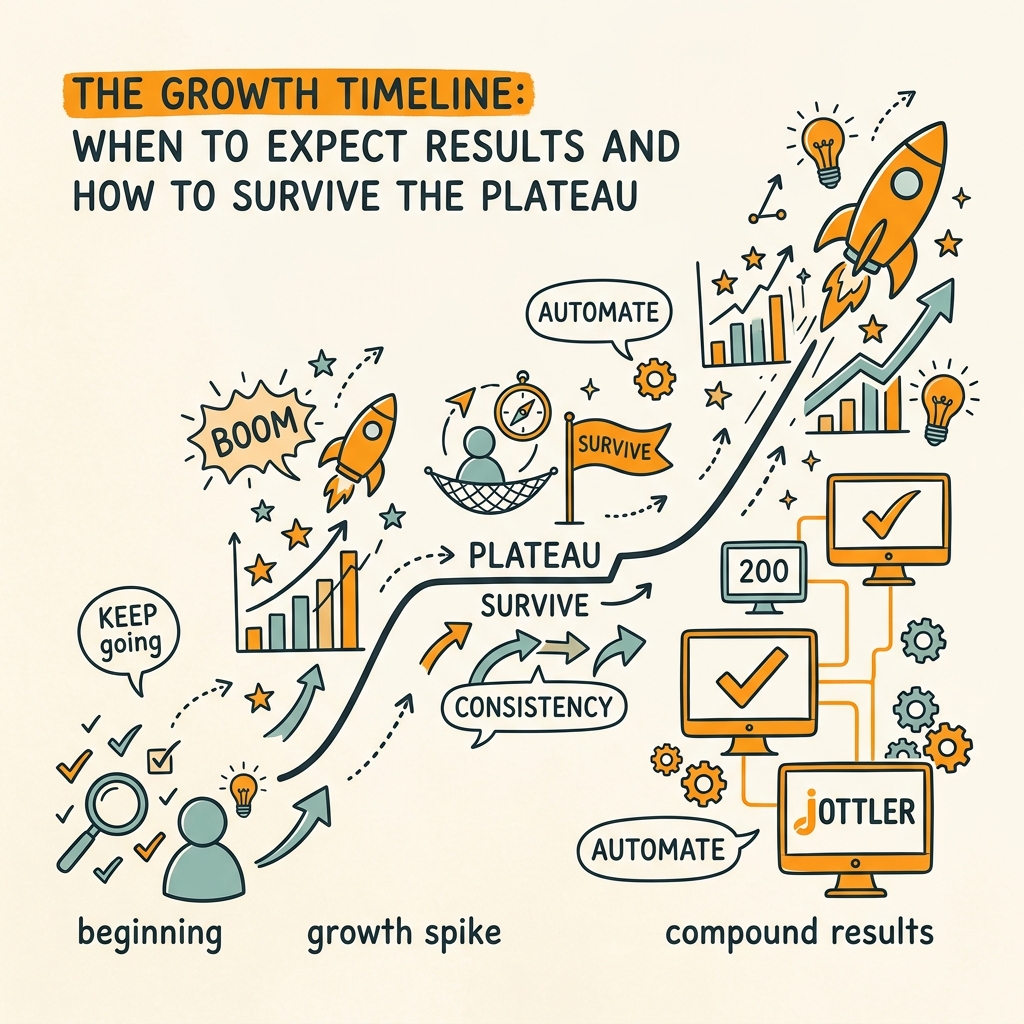
Understanding the organic growth curve prevents the most expensive mistake: quitting too early. The timeline below is based on aggregated industry data from studies tracking blogs that publish consistently, maintain 2,500+ word articles, and build internal link networks. This isn't best-case scenario—it's realistic trajectory for disciplined teams.
| Growth Phase | Timeline | Traffic as % of Peak | Key Milestone |
|---|---|---|---|
| Foundation / Doubt Zone | Months 1–3 | ~18% of peak | Content is indexed; keywords start appearing in search results |
| Compounding Begins / The Quit Zone | Months 4–6 | ~42% of peak | Second and third articles start ranking; internal links build authority |
| Accelerating Momentum | Months 7–9 | ~70% of peak | Topic authority kicks in; new articles rank faster; backlink velocity increases |
| Compounding Returns | Month 12+ | 100% baseline (and growing) | Organic becomes predictable; ROI compounds; cost per lead drops month over month |
The critical insight: the quit zone (months 4–6) is where the compounding effect transitions from psychological payoff to mathematical reality. Your growth curve isn't broken—it's just accelerating. The teams that push through this zone enter a state where each new article generates more traffic than the last, where past content amplifies future content, and where organic becomes your most cost-efficient channel.
Why Month 3 Looks Like Failure (But Isn't)
At month three, metrics are discouraging. You've published 12–16 articles. Your organic traffic might be half a percent of total traffic. Your cost per article—divided by traffic generated—looks terrible. This is the design of organic growth, not a sign of failure. You're building a foundation that won't generate exponential returns until the compound effect accelerates.
Articles published in month three won't hit their ranking potential until month seven or eight. They need time to accumulate backlinks, be cited by other sites, gain internal link authority. Impatience at this stage is what kills most content strategies. The teams that publish through the plateau—month three through six—are the ones who see the compound effect materialize.
The Turning Point: Month 7 When Compounding Becomes Visible
By month seven, the plateau breaks. Your earliest articles are hitting full ranking potential. They're compounding authority to your newer articles. New articles rank faster because they inherit topical authority from the growing content library. This is when sustainable content strategies separate from the failed ones. The math reverses. What looked like diminishing returns actually becomes exponential growth.
Four Levers That Accelerate the Compound Effect
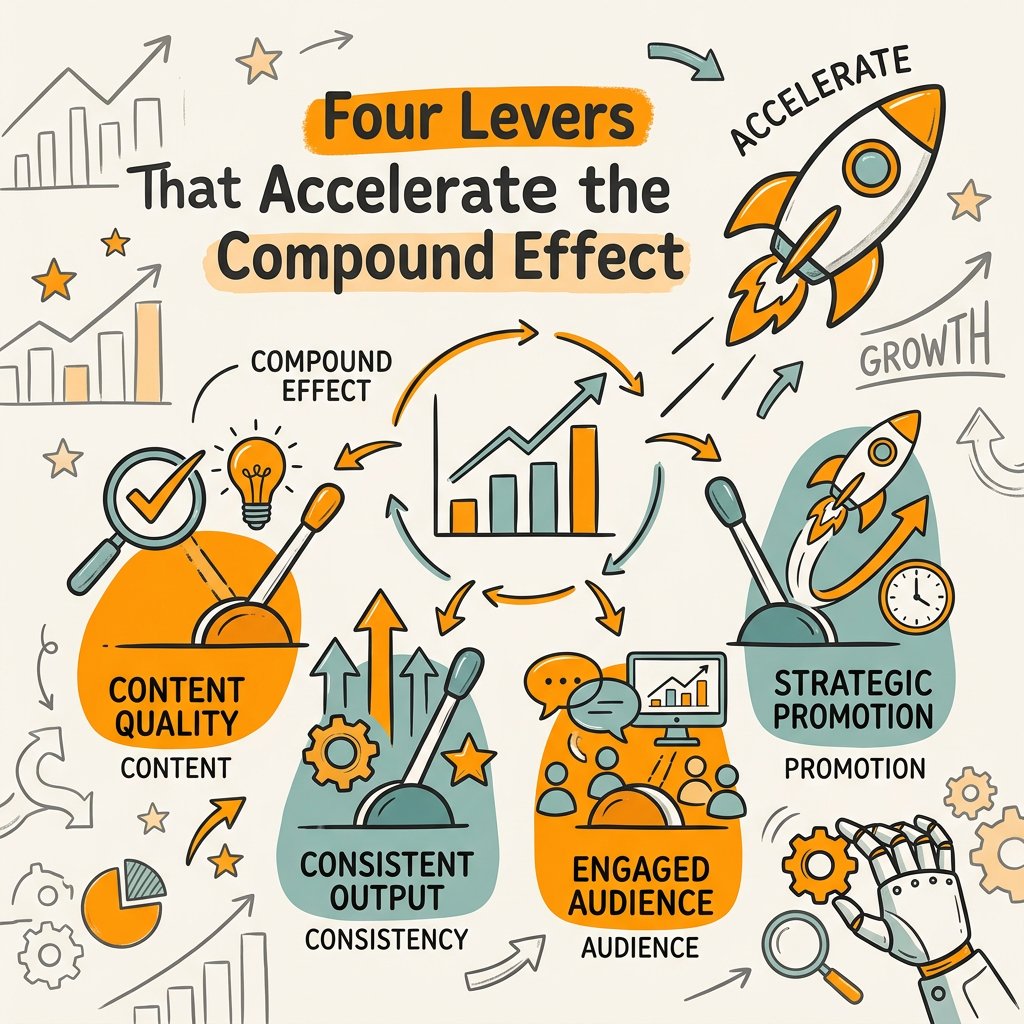
The compound effect isn't magic—it's engineered through four specific levers that reinforce each other. Pull all four, and growth accelerates. Miss one, and scaling plateaus. The most successful teams don't try to optimize all four equally. They start with one, add a second when the first is dialed in, and stack them for exponential returns.
Lever One: Publishing Cadence and Consistency
Consistency beats intensity. Publishing four articles per month for 12 months outperforms publishing 20 articles in one month followed by silence. Google rewards fresh, regularly updated content. More importantly, AI search engines weight recency heavily. Content updated within 30 days has an 82% AI citation rate, meaning it gets cited by ChatGPT, Claude, and similar systems far more often than stale content.
The consistency challenge isn't novelty—it's sustainability. Most teams can write one brilliant article. Sustaining that quality monthly, for 12 months straight, requires system-level support. Manual workflows collapse under that pressure. Automated content systems handle topic research, keyword clustering, and structural optimization so writers can focus on depth and insight without burning out.
Lever Two: Content Depth and Schema Markup
Long-form content (2,500+ words) receives 77% more backlinks than shorter pieces. But length alone doesn't drive compounding—structure does. Adding Article Schema, FAQPage Schema, and HowTo Schema tells search engines exactly what your content covers. FAQPage Schema alone boosts rich media display by approximately 90%, meaning your article appears in AI Overviews, featured snippets, and knowledge panels more frequently.
Schema markup is structural. It's not about writing differently—it's about annotating what you've already written so search systems understand it. Most teams skip this because it's invisible. But for compounding growth, schema is the difference between an article that ranks and an article that dominates.
Lever Three: Internal Link Architecture and Topic Authority
Each new article should link to two to three existing articles. More importantly, update those existing articles to link back. This builds what SEO professionals call "topical density"—the signal that tells Google you're not just writing about a topic, you're an authority. Content clusters with 10+ interconnected articles see AI citations increase by 161% compared to standalone pieces.
Internal linking is compounding in its purest form. It costs nothing. It takes five minutes per article. But it exponentially increases the value of your entire content library. Jottler automates internal link suggestions, identifying where past articles should link to new ones and vice versa, building these networks without manual overhead.
Lever Four: Multi-Platform Distribution
Publishing to one platform limits reach and backlink sources. Publishing the same article across WordPress, Medium, Substack, and LinkedIn creates four independent discovery channels. Each platform attracts different audiences. Each creates an independent backlink source pointing to your canonical version. Each generates brand mentions and social signals that compound your authority.
This isn't duplicate content penalization—it's strategic distribution with clear canonical tags. Search engines understand multi-platform publishing. What they reward is consistent, authoritative presence across multiple channels. The ROI multiplier is significant. One article, five platforms, five discovery vectors.
How to Automate Content Production Without Sacrificing Quality
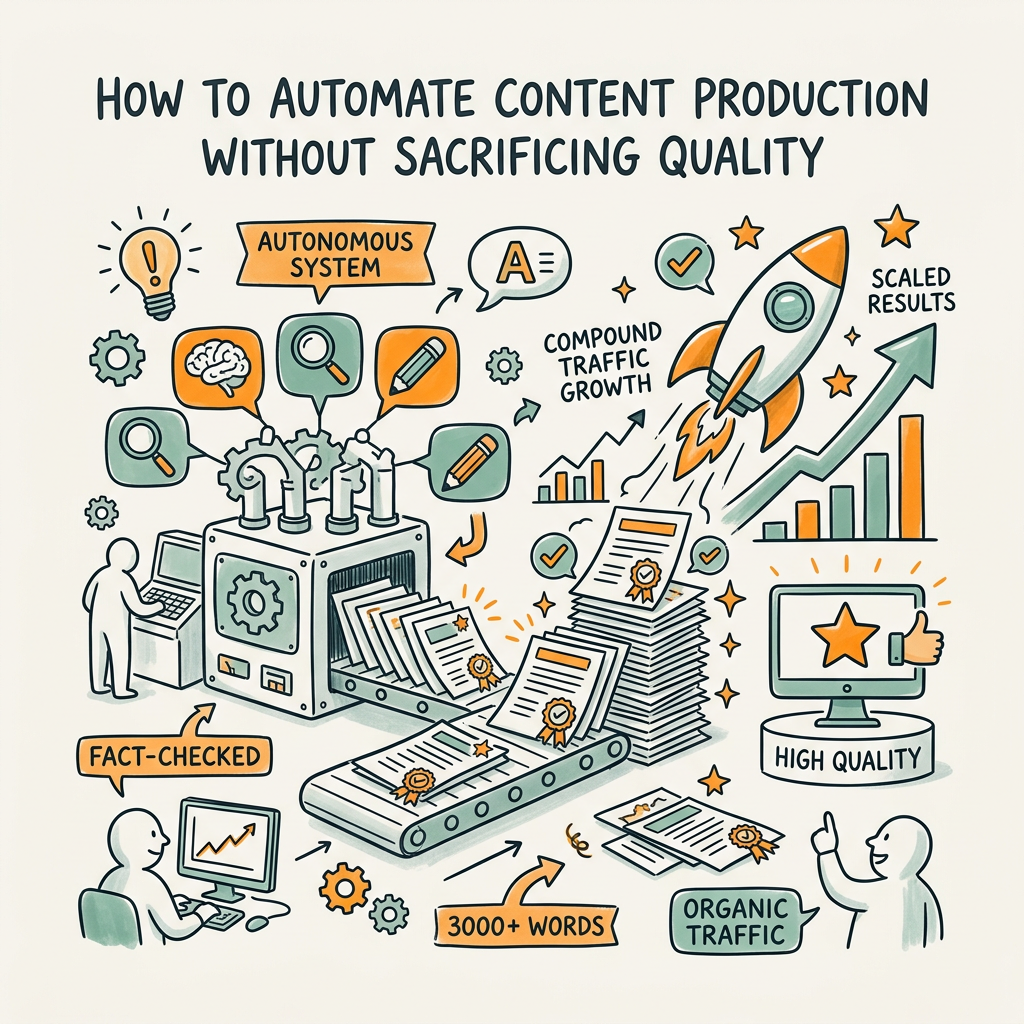
Scaling organic traffic requires volume. Teams attempting to capture 100+ keywords across multiple niches need 50–100+ articles. Manual production (4+ hours per article) is impossible. This is where most scaling attempts fail—not due to quality concerns, but because the team can't sustain the publishing cadence required for compounding.
The solution isn't hiring more writers. It's automating the structural layer—keyword research, topic clustering, internal linking recommendations, fact-checking, and CMS publishing—so existing writers spend 80% of their time on substance and 20% on process.
The Structural Layer: What Can Be Automated
Content production has two layers: structural and creative. The structural layer includes keyword research, topic outlining, internal link identification, meta tags, schema markup, fact-checking, and publishing. These are deterministic—given the same inputs, the output is predictable and verifiable. The creative layer—voice, insight, original perspective, narrative flow—requires human judgment.
Most teams automate the creative layer (using AI copywriting tools) and handle structure manually. This is backwards. Automating structure while protecting creative depth is how sustainable content scaling actually works. Jottler does exactly this. It researches keywords, builds topic clusters, suggests internal links, fact-checks claims, and publishes to your CMS. Writers focus on writing. The system handles everything else.
The Automation Pipeline: Keyword Research to Publishing
A disciplined automation pipeline removes friction at each stage. Here's the workflow:
- Keyword Research: Identify high-volume, low-difficulty keywords in your niche. Group them into topic clusters. This takes hours manually. Automated tools return clusters in minutes.
- Content Brief Generation: For each keyword, generate a brief including target audience, angle, competitor gaps, and internal link opportunities. Structured briefs ensure every article serves a strategic purpose.
- Fact-Checking Protocol: Before publishing, verify every stat against original sources. Cite studies by year and source name. Remove unattributed claims. This is non-negotiable for compounding—one false stat tanks your credibility.
- Internal Link Insertion: Identify where past articles should be linked in new pieces. Update those past articles to link forward. Build the network, not just individual pieces.
- CMS Publishing and Distribution: Publish to your primary domain. Syndicate to additional platforms with canonical tags. One workflow, multiple channels.
Why Most Teams Fail at Scaling (And How to Avoid It)
The failure point isn't usually quality. It's consistency. Teams publish at 100% quality for three months, hit the quit zone, and either stop publishing or drop quality to sustain volume. Both are fatal. Compounding demands consistent, high-quality publishing for 12+ months. This is only possible with automation. The alternative is hiring significantly more staff, which most scaling companies can't afford.
Building Topic Authority in the AI-Driven Search Era
The search landscape shifted dramatically in 2025–2026. AI Overviews, zero-click searches, and generative search engines changed what ranking means. But they didn't change what wins—topic authority compounds exactly as it did before. AI systems pull from the deepest, most comprehensive content in a niche. Sites with strong topical authority—10+ interconnected articles on a subject—get cited far more frequently by AI.
Content updated within 30 days has an 82% AI citation rate, versus stale content that barely gets mentioned. This favors teams that publish consistently and keep content fresh. But recency alone won't save weak content. Topic authority is still the primary ranking factor. It's just that topic authority now extends beyond Google's index—it determines whether AI systems cite your content.
The New Citation Economy
Citations from AI systems (ChatGPT, Claude, Perplexity) are becoming as valuable as backlinks. When ChatGPT cites your article, users click through. When users click through, they might convert, sign up, or share. The sites that win in 2026 are the ones that treat topic authority as a multi-channel asset—ranking for Google, being cited by AI, and driving traffic across all channels simultaneously.
This reinforces the compound effect. The sites with 50+ articles in a niche don't just rank better—they get cited by AI systems more frequently. Each citation brings traffic. The traffic increases brand authority. The increased authority improves ranking. The improved ranking increases citations. It's compounding at scale.
Conclusion
The compound effect in organic traffic is mathematical, not motivational. You don't need perfect articles—you need consistent ones. You don't need viral content—you need content that ranks and compounds. You don't need to outwork the system—you need to systematize the work so it doesn't require constant manual effort.
Teams that push through the quit zone at month 4–6 see 3.5× more traffic per new article by month 12, compared to early-stage blogs. The ROI of that patience is 22:1 over 24 months, making organic your most cost-efficient channel by a significant margin. But reaching that outcome requires consistency, and consistency requires automation.
The compound effect isn't a shortcut. It's a commitment to building assets that work for years, not months. If that timeline aligns with your business goals, start publishing today. Every article you delay is a year of compounding returns you'll never get back. Start your SEO agent and remove the friction between strategy and execution.
FAQs
How long does it take for the compound effect to kick in?
The compound effect starts immediately, but becomes visible between months 4–6. In months 1–3, you're building the foundation—content is being indexed, keywords begin appearing in search results, but traffic is roughly 18% of peak. The "quit zone" happens here because progress feels invisible. By month 6, you're at 42% of peak traffic as internal links and topic authority accumulate. Month 9 typically brings 70% of peak, and by month 12, you're seeing full compounding returns where each new article generates more traffic than the one before it. The key is consistency through months 1–6—that's when most strategies fail, not because they're broken, but because compounding takes time to become visible.
What's the minimum publishing frequency needed to see compounding results?
Aim for 4+ articles per month with 2,500+ words each. This isn't arbitrary—it's the threshold where internal link networks become dense enough to create topical authority. Publishing fewer than 4 per month works, but your timeline extends proportionally. Publishing 2 per month might take 18 months to reach peak traffic instead of 12. The consistency matters more than the exact number, but frequency also signals to Google that your site is actively updated. Content updated within 30 days has an 82% AI citation rate, so regular publishing affects both search ranking and AI discoverability. Consistency for 12+ months beats sporadic publishing at any frequency.
Can you compound organic traffic without publishing hundreds of articles?
Yes, if you focus on depth over breadth. A cluster of 10–15 exceptionally comprehensive, interconnected articles on a niche topic can generate significant compounding returns. The key is internal linking density and topic authority. Content clusters with 10+ interconnected articles see AI citations increase 161% compared to standalone pieces. You don't need 500 articles—you need enough articles to establish authority in your target niche, then leverage internal linking to amplify the network. Quality, depth, and strategic interconnection outperform quantity every time. Deep, clustered content compounds faster than scattered, shallow content regardless of volume.