The Compound Effect: How SEO Momentum Builds Over Time
Most founders treat SEO like a sprint. You publish a few articles, check traffic quarterly, hope for the best. Then real work piles up, publishing stops, and organic traffic flatlines. What you're missing is that SEO doesn't work like paid ads—it's compounding interest for your website. According to onwardSEO's analysis, year-three organic revenue returns eclipse year-one by 12x on the same budget. The catch? You have to stay consistent. A 2025 NP Digital study of 20 companies showed that firms pausing SEO experienced a 39.7% drop in organic traffic and 10.4% revenue decline, while continuous publishers gained 85.8% LLM traffic and 9.1% revenue growth. This is why the compound effect of SEO is real, and why it demands a different approach than most teams expect.
Key Takeaways
- Year-three SEO ROI compounds to 12x year-one on flat budgets, driven by authority and crawl efficiency flywheels (onwardSEO, 2025)
- Pausing SEO incurs a "catch-up tax": companies that stop publishing see 39.7% traffic drops vs. 18.2% for continuous publishers
- 70% of websites see measurable organic growth within 6+ months of consistent optimization, with full potential unlocked by month 12+
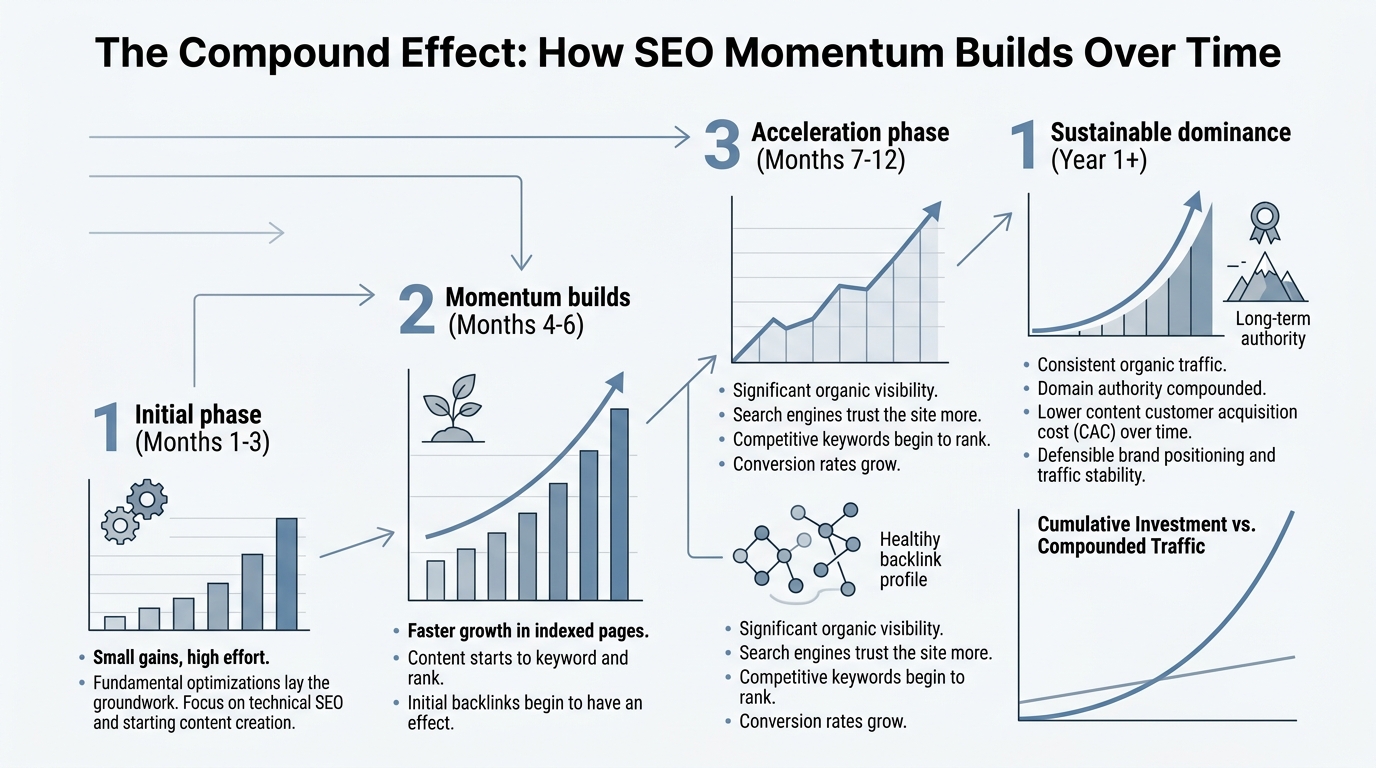
- The Three Phases of SEO Momentum: Technical fixes (0–9 months), content scaling (9–18 months), and dominance (18–36 months)—each phase accelerates the next.
- Authority Compounding: Each ranking gains you backlinks, citations, and brand mentions that feed into future rankings, creating a self-reinforcing flywheel.
- The Consistency Cost: New sites face a "valley of death" with –49.6% ROI in year one, but profitability arrives at month 30 when compound gains kick in.
- Traffic Acceleration: Each blog post generates 60% more traffic after 12 months due to accrued SEO authority and the snowball effect of organic visibility.
- The Consistency Multiplier: Continuous publishing produces 8.5x higher conversion rates per SEO lead than paid traffic, and those leads compound as your site's authority grows.
Why SEO Compounds While Other Channels Don't
Paid advertising is a rental. You pay, you get traffic, you stop paying, traffic evaporates. SEO is ownership. Each article, every internal link, all domain authority you build appreciate over time instead of depreciating. According to The King of Search, SEO leads are 8.5x more likely to convert to paying customers, and traffic grows exponentially—2x to 10x+ over years—without proportional reinvestment. This is the flywheel effect. Your site doesn't just generate traffic; it generates authority, which generates more traffic, which generates more authority.
"SEO is ownership. Each article, every internal link, and all domain authority you build appreciate over time instead of depreciating. Traffic grows exponentially—2x to 10x+ over years—without proportional reinvestment."
The Authority Multiplication Flywheel
When your first article ranks and gets backlinks, Google sees that site-wide authority bump. Your next articles rank faster. When three articles rank for competitive keywords, journalists and industry figures start citing you. Citations become backlinks. Backlinks feed ranking signals. Suddenly, articles that would've taken six months to rank in year one rank in six weeks in year two. This isn't luck—it's the compounding mathematics of domain authority. The more you publish, the faster each new piece gains traction because the foundation beneath it strengthens exponentially.
The Content Snowball Effect
A single article published today generates traffic today, more traffic in six months, and peak traffic after 12+ months. Digidop's research shows each blog post generates 60% more traffic after 12 months than during its first six months. Multiply this by 50 articles over a year, and your traffic doesn't grow linearly—it accelerates. Older content gains authority signals. Newer content benefits from that authority. The entire corpus compounds. This is why established sites see exponentially faster growth than newcomers. They have a base of compounding assets.
"Multiply this by 50 articles over a year, and your traffic doesn't grow linearly—it accelerates. Older content gains authority signals. Newer content benefits from that authority. This is the compounding asset base that separates market leaders from laggards."
Why Consistency Is the Hidden Multiplier
The fatal mistake most founders make is treating SEO publishing as optional. The NP Digital study was damning: companies that paused blogging saw 39.7% SEO traffic drops and 10.4% revenue decline within 12 months. Meanwhile, continuous publishers gained 9.1% revenue growth and 85.8% visibility in LLM engines. That's the gap between compound growth and compound decline. The moment you stop feeding the machine, the machine stops working. But here's the kicker: restarting is harder than maintaining. You've lost momentum. Competitors have gained it. You're fighting to recapture what you surrendered, not to expand from where you left off. This is why consistency compounds and inconsistency bankrupts your organic channel.
The Three Timelines That Define Compounding
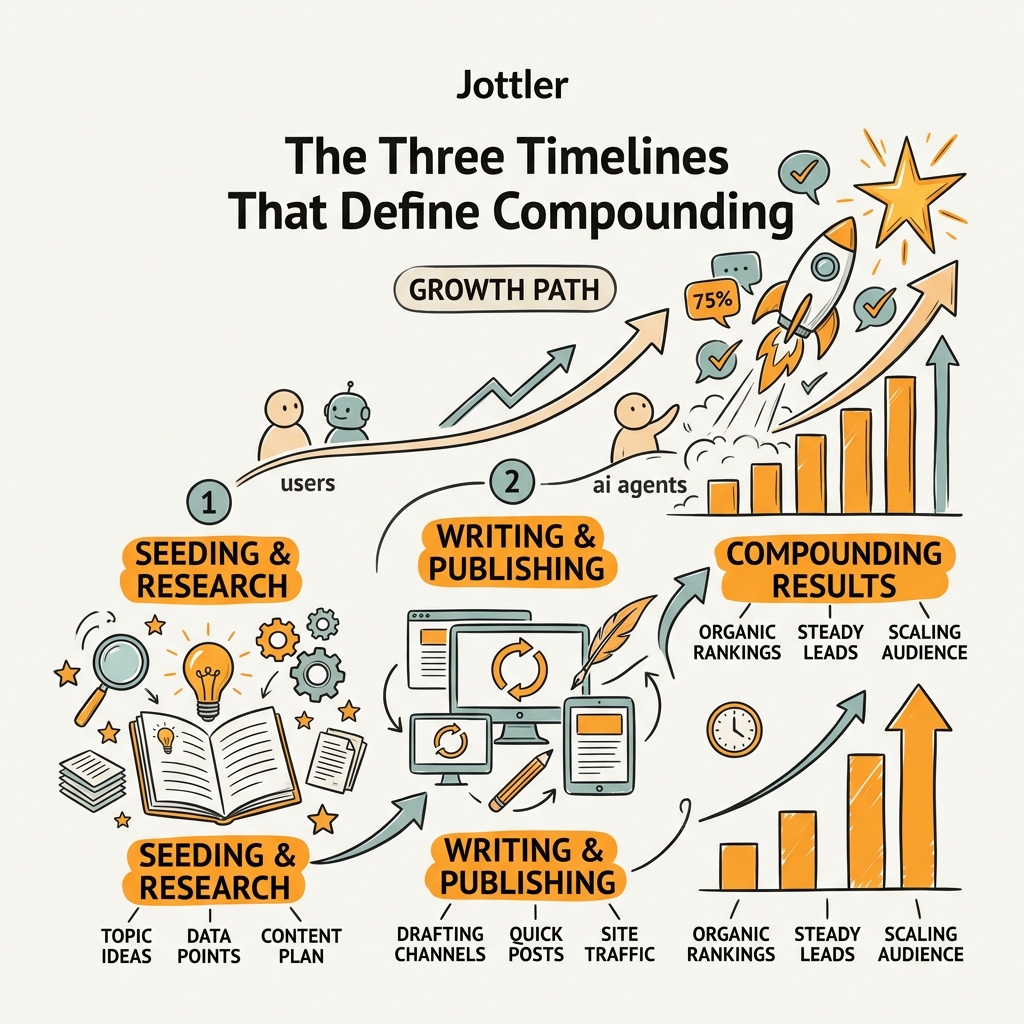
SEO doesn't grow overnight, but it does grow predictably if you understand the timeline. Most founders fail because they expect results in three months, get frustrated at month four, and kill the program at month six—right before the compounding kicks in. The research reveals three distinct phases, each with a different ROI curve and outcome pattern.
Phase 1: The Valley of Death (Months 0–9)
New sites enter what onwardSEO calls "the valley of death." In year one, new sites face –49.6% ROI as you invest in technical SEO, content foundation, and authority building with minimal inbound traffic. Established sites, by contrast, achieve 198.5% ROI by year five because their foundation is solid. The valley isn't failure—it's the foundation pour. You're not supposed to see profitability yet. According to ConnectWithBest's analysis of WebFX and SE Ranking studies, 70% of websites see measurable organic visibility rise after 6+ months of consistent optimization. That's months 7–9. The first six months are mostly invisible. This is where most founders lose faith and quit.
During the valley of death, your work focuses on:
- Technical SEO foundation—site speed, mobile optimization, core web vitals, XML sitemaps
- Content foundation—publishing 20–40 pillar articles that establish topical relevance
- Crawl efficiency—ensuring Google can efficiently index and understand your site structure
- Authority signals—building initial backlinks and domain credibility
Phase 2: Steady Acceleration (Months 9–18)
At month 9, something shifts. Technical SEO foundation is solid. You have 20–40 articles. Google has crawled them multiple times. Early-ranking articles start earning backlinks. Internal linking patterns are established. Traffic begins compounding. This phase lasts until month 18. Growth is visible, but still measured. You're seeing 2–3x month-over-month growth, not 10x. This is the "patience phase"—where founders who survived the valley see real validation. Traffic is growing, but profitability is still months away. This is also where the consistency multiplier becomes obvious. If you've published 30+ articles, traffic accelerates faster than a competitor with only 15.
During acceleration, expect to see:
- First articles ranking on page 2–3 for target keywords
- Natural backlinks from industry publications and resource pages
- Brand mentions and citations appearing in relevant discussions
- 2–3x traffic growth month-over-month as the topical foundation strengthens
- Increased crawl efficiency as Google revisits and re-evaluates content
Phase 3: Dominance (Months 18–36)
After month 18, compounding accelerates dramatically. Year-three SEO ROI eclipses year-one by roughly 12x on the same budget. You hit profitability around month 30. Traffic doesn't just grow—it accelerates. Your site now has 60+ articles, strong domain authority, established topical clusters, and dense internal linking. New articles rank faster because the entire ecosystem is stronger. Competitors who quit in month 6 or 12 watch from the sidelines as you dominate first-page results. This phase rewards consistency and punishes the inconsistent. If you paused between months 12 and 18, you've forfeited three months of acceleration. You're now competing against sites that didn't pause and have 9+ months of additional compound growth on you.
"Year-three SEO ROI eclipses year-one by roughly 12x on the same budget. You hit profitability around month 30. New articles rank faster because the entire ecosystem is stronger. Competitors who quit in month 6 or 12 watch from the sidelines."
By month 18+, your competitive advantage compounds through:
- First-page rankings for 50+ keywords across your topical authority cluster
- High-quality backlinks from established publications and industry leaders
- Dense internal linking networks that amplify authority across topic areas
- Exponential traffic growth as new articles benefit from accumulated domain strength
- Revenue profitability and ROI that exceeds paid channels by 8.5x or more
- Acquisition cost advantage as SEO leads convert 8.5x better than paid leads
How Consistency Automation Sustains the Compound Effect
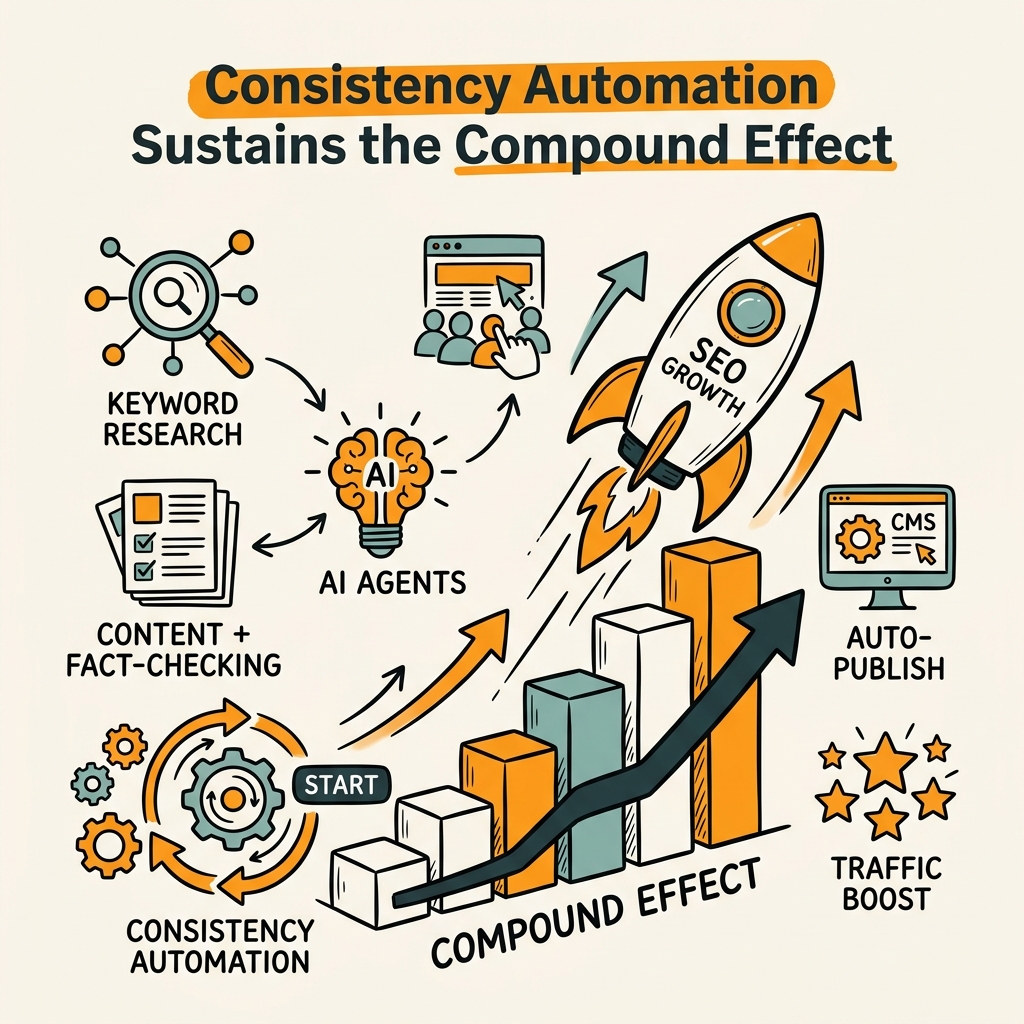
Here's the brutal truth: sustaining the compound effect demands publishing consistency most founders can't maintain manually. The timelines above assume regular, high-quality content production week after week, month after month, for years. For a solo founder juggling product, sales, customer success, and fundraising, this is practically impossible. Missing weeks breaks momentum. Missing months kills the compound effect entirely. This is where automation becomes not optional—it becomes essential for founders who want to compete.
Why Manual Content Creation Breaks Compounding
Manual content creation is intermittent by design. You write when you have time. Months of consistency are interrupted by product launches, fundraising rounds, or customer crises. Each interruption costs momentum. The Digidop study found that even two-week publishing gaps result in noticeable traffic stalls. Projects like building a consistent SaaS content framework demand more discipline than most teams can sustain manually. You need a system that publishes whether you're busy or not, whether you're inspired or not, whether you're stressed or not. That system is content automation.
The breakdown of manual content work includes:
- Keyword research: 30–60 minutes of competitive analysis and search volume validation
- Deep research: 1–2 hours gathering data, statistics, and credible sources
- Drafting: 2–4 hours of writing, structuring, and editorial review
- Optimization: 1–2 hours of SEO refinement, internal linking, and metadata
- Publishing: 30–60 minutes of CMS formatting, scheduling, and promotion
Total time per article: 5–9 hours. For three articles weekly (the minimum for compounding), that's 15–27 hours—nearly a full-time job for founders with no other responsibilities.
The Automation Advantage: Publishing Without Friction
Tools that automate research, writing, optimization, and publishing remove the friction points where founders fail. Instead of spending four hours per article researching keywords, writing, fact-checking, and formatting, automation handles the entire pipeline. You set a publishing schedule—say, three articles per week—and the system publishes them automatically. No decision-making required. No motivational peaks and valleys. Just consistent output that feeds the compound machine.
Automation removes friction at each stage:
- Research automation: Pulls relevant keywords, search volume, and ranking difficulty instantly
- Source aggregation: Gathers credible statistics, studies, and expert quotes from 14+ sources
- Writing automation: Generates optimized drafts based on top-ranking competitors and target structure
- Fact-checking: Cross-references claims against sources and flags unverified statements
- Publishing automation: Formats, optimizes metadata, and publishes directly to your CMS on schedule
Why Jottler Solves the Consistency Problem
Jottler is built exactly for this problem. The platform automates keyword research, deep research from 14+ sources, AI-assisted writing, fact-checking, and CMS publishing. Founders connect their website once, set a desired publishing frequency (1–5 articles daily), and Jottler's 12 AI agents handle the rest. No weekly decisions. No research paralysis. No publishing delays. The result is predictable, consistent output that compounds over months and years without requiring constant founder oversight. For busy founders at scaling companies, this is the difference between building a compound SEO asset and struggling to maintain momentum with manual processes.
The Math of Skipping Consistency: What Pausing Actually Costs
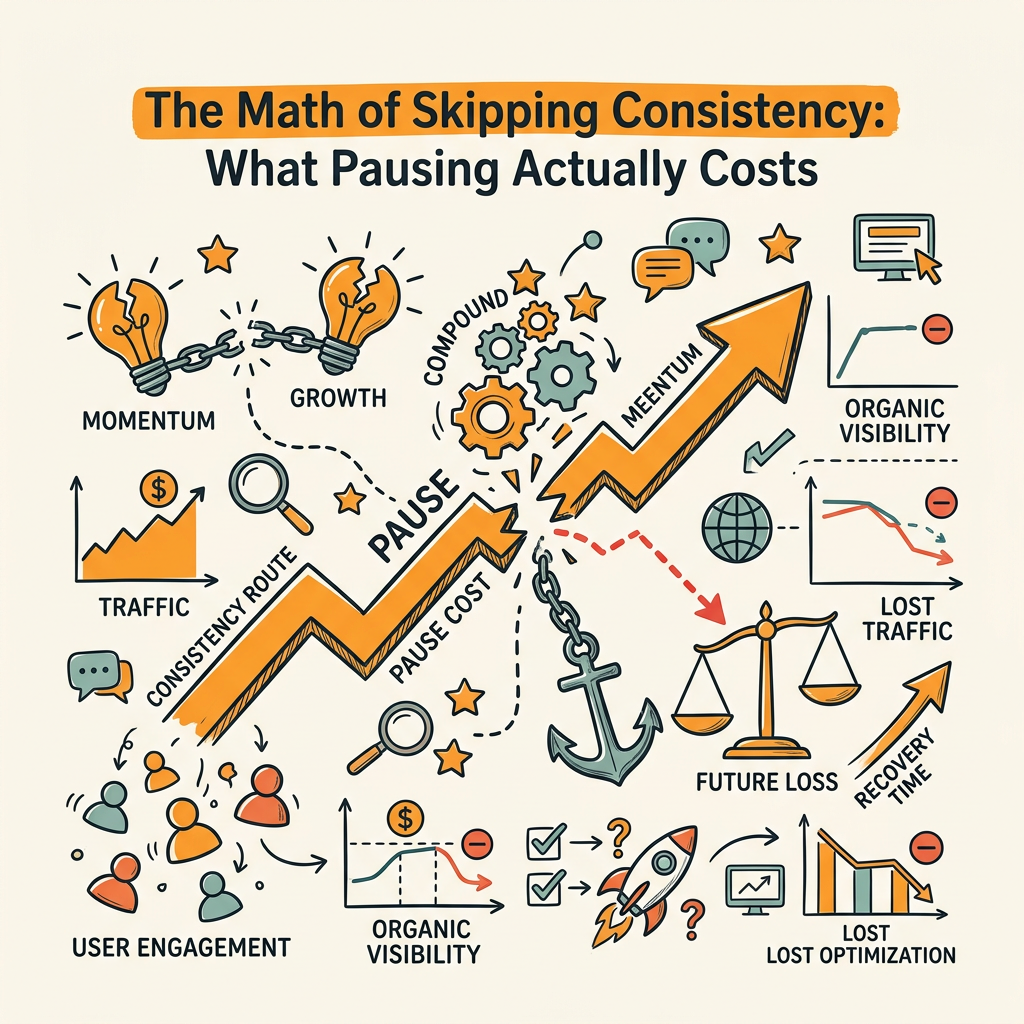
The 2025 NP Digital study quantified something every founder needs to see. Pausing SEO doesn't pause your competitors. It accelerates them. Here's the cost breakdown.
| Metric | Continuous Publishing | Paused After 12 Months | Differential Impact |
|---|---|---|---|
| SEO Traffic Change (Year 2) | +18.2% growth maintained | –39.7% decline | 58% swing against paused |
| LLM/AI Visibility | +85.8% traffic from AI engines | +6.5% AI traffic | 79.3% gap |
| Revenue Impact | +9.1% growth | –10.4% decline | 19.5% swing |
| Cumulative Compounding | 12x by year 3 | Reversed gains, restart required | Complete compounding collapse |
That 39.7% traffic drop isn't a temporary dip. That's the decay rate. You're not just losing new traffic—you're losing the compounding leverage you built. When you restart, you're fighting against competitors who kept momentum. They've now built on months of additional growth. You're competing from behind, not from where you left off. Recovery is harder than maintenance. This is why consistency is non-negotiable for compound SEO.
The Recovery Tax: Why Restarting Costs More Than Continuing
When you pause, your site doesn't just lose traffic—it loses ranking signals. Links decay in relevance. Content ages. Competitors advance. When you restart, you're not starting from where you paused. You're starting from where your competitors have advanced to. If your competitor continued publishing while you paused, they've built months of additional authority. You're now chasing. And chasing is expensive. You need more content, better links, faster optimization just to recapture your old position. Maintenance costs less than recovery.
The recovery cost breakdown shows why pausing is expensive:
- Lost ground: Competitors gained 9+ additional months of authority while you paused
- Link decay: Backlinks lose relevance when content stops updating and site authority stalls
- Fresh content penalty: Older content without updates loses freshness signals and ranking positions
- Competitive catch-up: You need 2–3x more new content than competitors gained to recapture rankings
- Timeline extension: Recovery takes 6–12 months longer than if you'd maintained consistency
The Founder Dilemma: Consistency Without Burnout
Here's the trap most founders face: you know consistency is required, but you're already burnt out. Hiring an in-house content team costs $80–150K annually. Hiring an agency costs $5–20K monthly for inconsistent output. Neither is affordable for early-stage founders. This is where automation becomes the leverage play. Tools like Jottler cost $29+ per month and deliver daily publishable articles with research, fact-checking, and optimization built-in. The compounding doesn't stop because the founder is exhausted. The machine keeps running.
How to Accelerate Compound Growth Deliberately
Consistency is table stakes. But knowing how to structure content for maximum compounding unlocks the exponential curve faster. The research reveals three compounding accelerators that sophisticated teams use to compress timelines and multiply velocity.
Internal Linking Architecture That Compounds Authority
Every internal link is a vote of authority from one page to another within your domain. Most teams treat internal linking as an afterthought. Strategic teams treat it as the connective tissue that multiplies compounding. When article A links to article B, and article B links to articles C and D, you're creating a topical network that amplifies authority across the cluster. Google sees this architecture and treats the entire cluster as an authority node. New articles in that cluster rank faster because the cluster itself is strong. This is the internal linking flywheel. Tools like AI-powered SEO tools that handle smart internal linking automate this architecture, ensuring every new article strengthens the topical clusters and compounds the entire site's authority.
Topical Authority Clusters Over Random Content
Publishing 100 random articles compounds slower than publishing 30 articles organized into three deep topical clusters. When your content is organized by topic—say, "Python tutorials," "JavaScript frameworks," "Full-stack development"—Google recognizes your site's expertise in that area. New articles in high-authority clusters rank faster. Existing articles gain relevance boosts. The entire cluster accelerates. Random content doesn't compound. Organized content does. This is why the most advanced SEO teams structure their content around topical pillars and clusters before publishing, not after.
A topical authority strategy includes:
- Pillar pages: Comprehensive guides covering broad topics (e.g., "Complete Guide to Python Programming")
- Cluster articles: Deep dives into subtopics linking back to the pillar (e.g., "Python Decorators Explained," "Async Programming in Python")
- Internal linking density: 3–5 internal links per article pointing within the cluster
- Semantic relevance: All articles share vocabulary, intent, and topical overlap
- Authority consolidation: Backlinks and citations target the pillar, elevating the entire cluster
Continuous Optimization and Updating
Older content compounds too. Article published in January should be updated in July with new data, new links, new examples. Google notices. The article gains a freshness signal. Rankings improve. Traffic spikes. This multiplication happens multiple times per article per year if you're disciplined. But continuous updating requires systematic oversight most teams lack. Automation handles this too—tools that flag underperforming articles and suggest optimization strategies remove the decision overhead. You update systematically, not randomly.
Conclusion
The compound effect of SEO is real. Year-three returns eclipse year-one by 12x on the same budget. Continuous publishers gain 9.1% revenue growth while those pausing lose 10.4%. Each article compounds to 60% more traffic after 12 months. But compounding isn't automatic—it requires consistency that most founders can't sustain manually. The question isn't whether to invest in SEO. The question is how to structure your SEO investment so it compounds predictably for years without burning you out.
For busy founders, the answer is automation. Start your SEO agent to automate keyword research, deep research, writing, fact-checking, and publishing. Set your publishing frequency once, and watch the compound machine work while you focus on product and customers. The founders who understand that consistency compounds are the ones building 12x returns. The ones still publishing manually are the ones falling behind.
FAQs
How long does SEO compound growth actually take?
SEO compounds in three distinct phases: foundational work (0–9 months) with minimal traffic gains, acceleration (9–18 months) with visible 2–3x monthly growth, and dominance (18–36 months) where year-three returns hit 12x year-one levels. Most websites see measurable organic visibility after 6+ months and hit profitability around month 30. The timeline is predictable, but requires consistent publishing throughout. Skip even two weeks and you reset the compounding clock.
What happens to organic traffic if I pause SEO for a few months?
Pausing SEO triggers a 39.7% organic traffic drop within 12 months. Restarting isn't recovering—you're recompeting against sites that maintained momentum. Recovery takes longer than the pause because you've lost ranking signals, authority relevance, and competitive positioning. Even two-week publishing gaps cause noticeable traffic stalls. Consistency is the multiplier. Inconsistency is the killer. One paused quarter can cost you six months of compounding growth.
What's the most practical way to maintain SEO consistency as a busy founder?
Automation is the only practical path for busy founders. Manual content creation is intermittent by design and breaks compounding. Tools that automate keyword research, deep research, writing, fact-checking, and publishing remove the friction points where consistency fails. Set a publishing frequency once, and the system publishes whether you're busy, stressed, or focused on other priorities. This removes the motivational burden and makes consistency automatic rather than dependent on founder willpower.