Top AI SEO Tools for B2B Growth
86% of SEO professionals have integrated AI into their strategy, yet most teams still juggle multiple tools and waste hours on manual optimization. For busy B2B founders and marketers, the challenge isn't whether to use AI—it's choosing the right tools that actually deliver compounding organic traffic without constant oversight. The good news: a new generation of AI-powered SEO tools can automate research, content creation, optimization, and publishing into a single workflow that scales your organic visibility week after week. According to SeoProfy, teams using integrated AI SEO tools see 45% more organic traffic within six months.
Key Takeaways
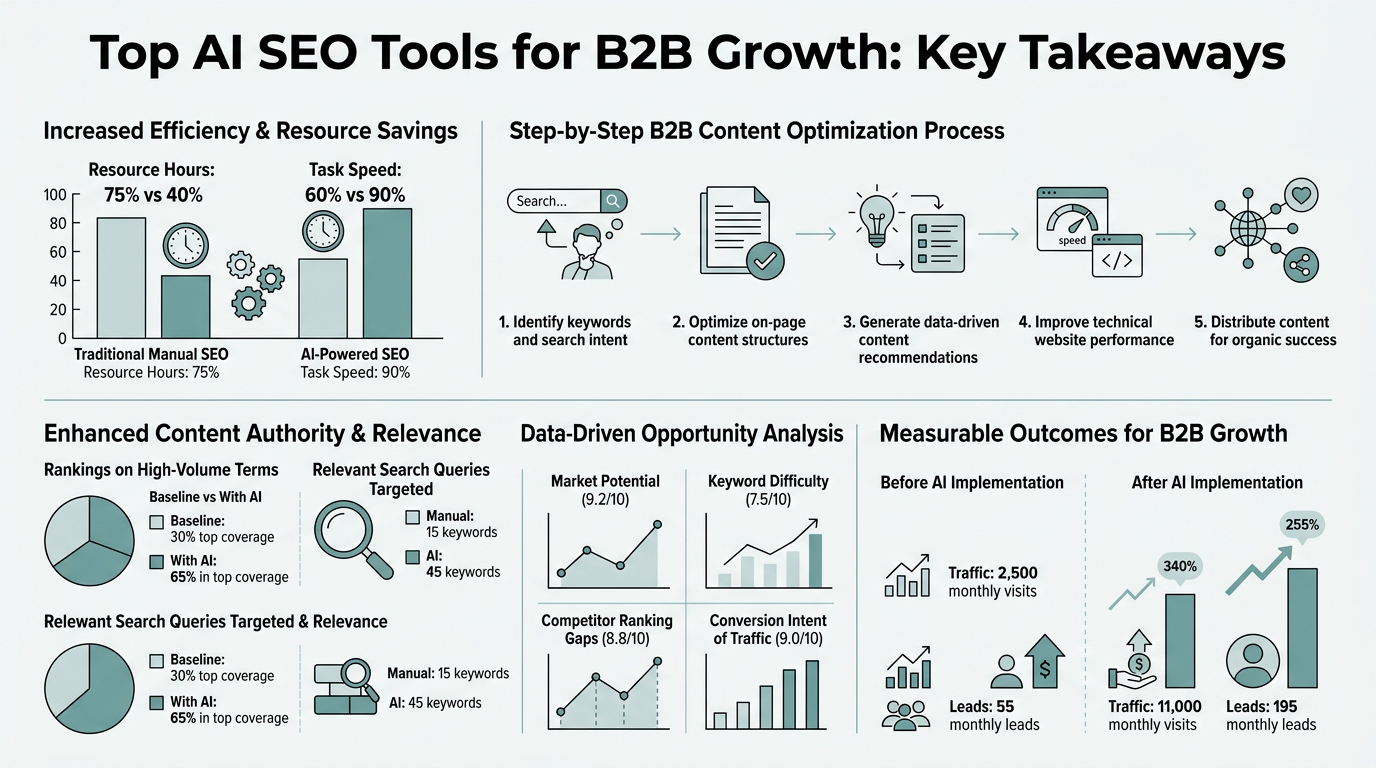
- 86% of SEO professionals use AI to boost efficiency; those combining research, writing, and optimization tools see 45% more organic traffic within six months (2026, SeoProfy).
- B2B teams that automate content workflows achieve 68% higher ROI from SEO spend compared to manual approaches (2026, Semrush).
- Autonomous tools that handle topic selection, fact-checking, and CMS publishing eliminate the need for multiple subscriptions and free up 15+ hours per week.
- Autonomous Content Platforms: Single tools that research, write, optimize, and publish at scale—ideal for founders who can't hire a content team.
- On-Page Optimization Tools: Real-time SERP analysis and automated suggestions that improve rankings without guesswork.
- AI Keyword Research Platforms: Deep intent analysis and topic clustering that identify overlooked B2B opportunities.
- Integrated Workflows: Tools combining multiple functions save setup time and eliminate data silos across your SEO stack.
- Fact-Checking and Quality Control: Automated verification ensures content credibility and brand trust before publishing.
What Makes an AI SEO Tool Essential for B2B Growth
The right AI SEO tool does more than generate content—it compounds your organic visibility. AI traffic from search engines grew 527% year-over-year in early 2026, and B2B companies capturing this traffic see conversion rates 6 to 27 times higher than traditional search. The challenge: most tools only solve one piece of the puzzle (keyword research, writing, or optimization), forcing you to patch together five or six different platforms.
"The days of waiting weeks for content to rank are ending. Search engines now crawl and index content faster, especially from established domains. Tools that reduce publishing friction—from topic selection to live article—dramatically reduce time-to-first-ranking."
The Scalability Problem Every B2B Founder Faces
Consistent, high-quality content is the engine of B2B SEO. But producing 2–3 research-backed articles per week requires either a large team or an enormous time commitment. A single 2,000-word SEO article demands keyword research, source gathering, fact-checking, on-page optimization, internal linking strategy, and CMS publishing. Most founders do this manually or with scattered AI tools, burning through 15–20 hours per week on tasks AI can automate completely. That's why autonomous platforms that handle the full workflow—from topic research to live publishing—have become indispensable for scaling.
Why Traditional SEO Tools Fall Short for B2B
Legacy SEO platforms like Ahrefs and SEMrush excel at competitor analysis and traffic tracking, but they require human writers to act on their data. They also cost $200+ per month per tool, and you still need separate solutions for writing, optimization, and publishing. For a B2B team juggling limited resources, this fragmented approach means slow content cycles, missed keyword opportunities, and inconsistent optimization. Modern AI SEO tools eliminate these friction points by automating the entire content operation in one platform.
Autonomous AI Content Platforms: The Full-Workflow Solution
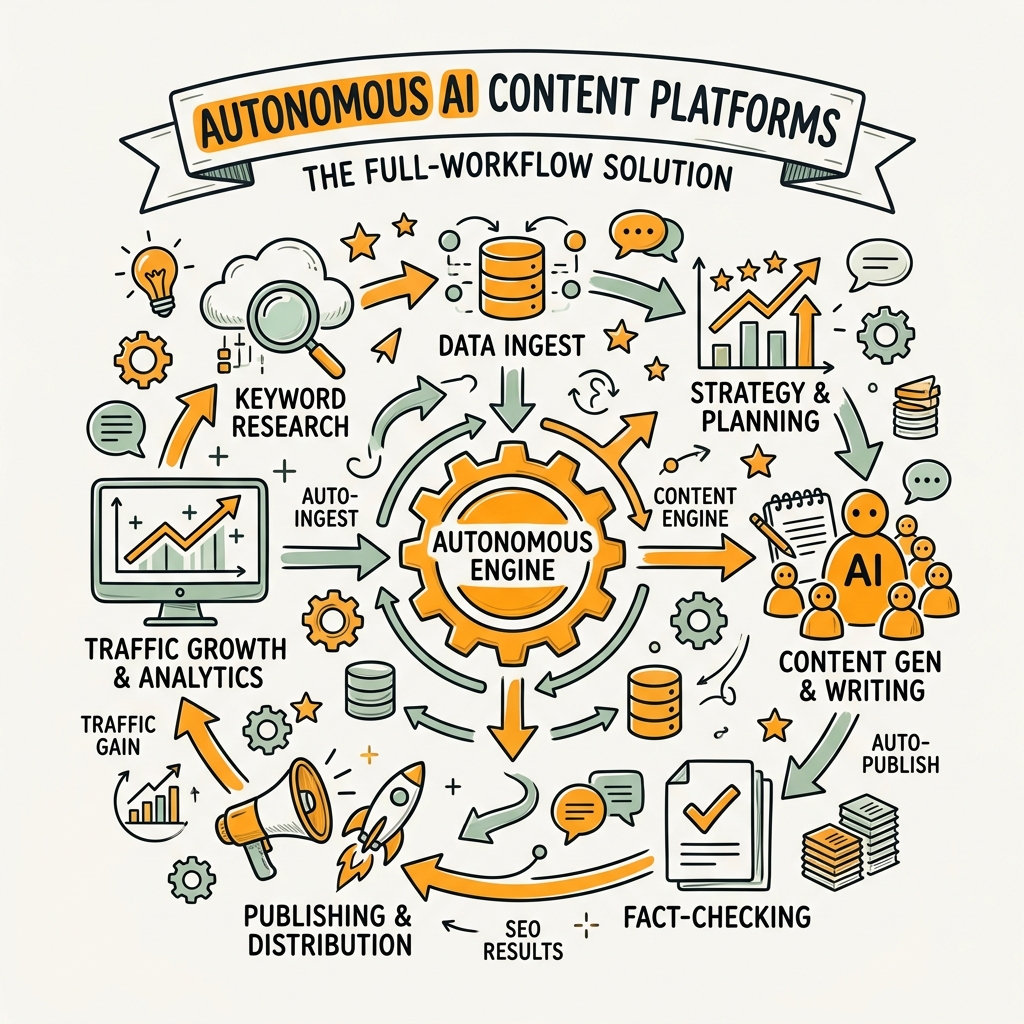
Autonomous content platforms are purpose-built for founders who understand that consistent publishing compounds organic growth—but don't have time to manage it manually. These tools combine 12+ AI agents (keyword research, fact-checking, writing, optimization, publishing) into a single daily operation that runs without you. For B2B founders, this is the closest thing to hiring a content team without the payroll.
Jottler: Daily Long-Form Content at Autonomous Scale
Jottler stands out as the autonomous SEO engine purpose-built for busy founders. It researches, writes, and publishes 3,000+ word SEO articles daily using 12 AI agents that handle keyword research, deep fact-checking from 14+ sources, on-page optimization, and smart internal linking. The founder sets desired publishing frequency (1–5 articles daily), connects their CMS, and Jottler's agents automatically build topical authority and internal link networks without manual intervention. Most critically, it combines content production with strategic keyword research and fact verification—eliminating the constant context-switching that kills productivity. Pricing starts at just $29/month, making it accessible for bootstrapped teams that need enterprise-scale output.
The autonomous model solves the coordination problem: instead of managing five tools and ensuring data flows between them, founders get one unified system. Jottler's agents research trending topics in your niche, identify keyword gaps, write comprehensive articles, fact-check every claim against primary sources, optimize for on-page factors, and push live articles directly to WordPress, Ghost, or custom CMS platforms. This reduces the manual overhead of content marketing from weeks to minutes of setup.
"Instead of managing five tools and ensuring data flows between them, founders get one unified system that automates research, writing, fact-checking, optimization, and publishing in a single workflow. This reduces overhead from weeks to minutes of setup."
Sight AI: Generative Engine Optimization with Real-Time GEO Tracking
Sight AI takes a dual approach: traditional SEO combined with Generative Engine Optimization (GEO), which optimizes content for AI search engines like ChatGPT, Claude, and Perplexity. The platform features 13+ AI agents, an AI Visibility Score that tracks brand mentions across 6+ AI models, and Autopilot Mode that automates topic-to-publishing workflows. For B2B companies watching their competitive positioning in AI search results—which now account for significant referral traffic—this real-time visibility tracking is valuable. The Semrush integration also pulls competitive data without switching tools.
Sight AI's edge lies in its forward-looking focus. As AI search matures and Google's AI Overviews capture 61% of clicks that would normally go to organic listings, optimizing for these AI-mediated results becomes critical. According to Semrush research, the shift to AI-mediated search requires rethinking SEO strategy entirely.
When to Choose Autonomous vs. Point Solutions
Autonomous platforms excel when your goal is consistent publishing volume with minimal overhead. They're ideal for:
- Bootstrapped founders with limited time or budget for multiple tool subscriptions.
- B2B teams scaling from 2–3 articles monthly to daily publishing without hiring writers.
- Companies prioritizing content automation and topical authority over manual control.
They're less ideal if you need deeply customized content voices, highly specialized domain knowledge, or hands-on optimization per article. In those cases, a hybrid approach (autonomous platform for volume + point solutions for refinement) works better.
On-Page Optimization and Content Intelligence Tools
Once you've published content, AI optimization tools ensure it ranks. Real-time SERP analysis paired with automated optimization suggestions can improve rankings by 30% within months. These platforms analyze top-ranking content, identify semantic gaps, and suggest specific edits that boost relevance without sacrificing readability.
"Real-time SERP analysis paired with automated optimization suggestions can improve rankings by 30% within months by identifying semantic gaps and suggesting specific edits that boost relevance without sacrificing readability."
Surfer SEO: SERP-Driven Content Editing
Surfer SEO analyzes 500+ ranking factors from live SERP data and provides real-time recommendations for word count, NLP terms, semantic entities, and heading structure. Its Content Editor integrates directly into your writing workflow, flagging optimization opportunities as you draft. For content teams without dedicated SEO specialists, Surfer's actionable recommendations eliminate guesswork. The tool also includes auto-optimize features that insert ranked terms naturally, preserving voice while boosting relevance.
Surfer works especially well for B2B teams focused on maximizing ranking potential for each piece of content. It's less about generating volume and more about surgical optimization—ideal as a complement to autonomous platforms like Jottler.
Semrush AI Article Generator with SEO Integration
Semrush combines AI article generation with its massive SEO database, creating briefs from keyword research that guide writers toward relevant topics. The AI Article Generator produces first drafts optimized for Semrush's ranking factors, and the Content Optimizer module refines published content in real time. For mid-market B2B companies with existing Semrush seats, the integrated workflow saves tool-switching overhead.
Semrush's advantage is its all-in-one approach: traffic analytics, competitive intelligence, and AI writing live in one platform. The downside is cost and complexity—it's built for larger teams with dedicated SEO specialists.
Clearscope and MarketMuse: Semantic Depth and Quality Grading
Clearscope grades content semantic depth with an A++ scoring system trusted by enterprise teams at HubSpot and Shopify. MarketMuse (now part of Content Stack) emphasizes topical coverage, identifying gaps in your content cluster strategy. Both tools excel at quality differentiation when competitive content is abundant.
For B2B companies in saturated verticals (enterprise software, SaaS, professional services), these tools help stand out by ensuring your content doesn't just rank—it dominates through depth and topical authority.
AI Keyword Research and Intent Classification
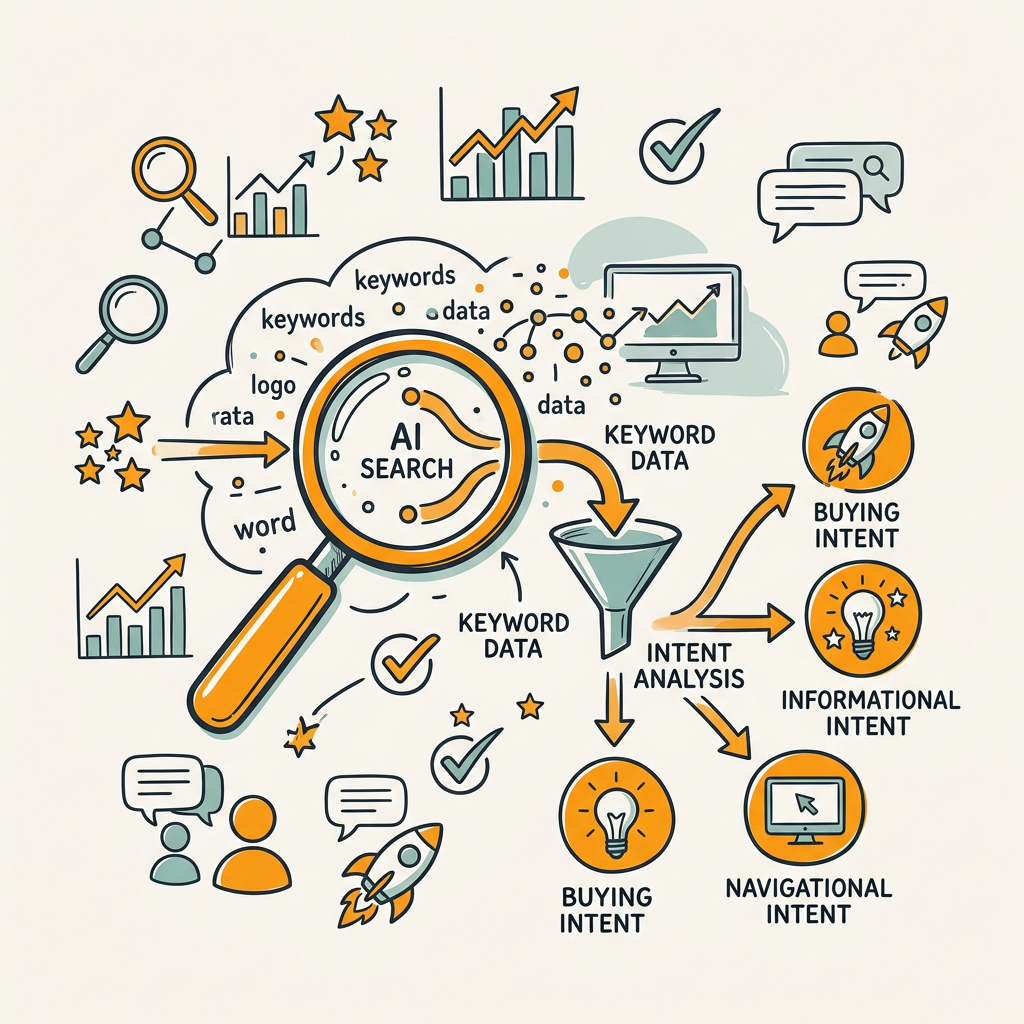
Strong B2B SEO starts with identifying high-intent keywords your audience actually searches. AI keyword research tools now combine volume, difficulty, and intent signals to highlight overlooked opportunities that traditional tools miss.
Intent-Based Keyword Clustering for Topic Authority
Modern AI keyword tools group related searches by user intent: awareness, consideration, decision, and post-purchase. For B2B companies building topical authority, this clustering is critical. A founder in the project management space might discover that "best project management tools for remote teams," "asynchronous collaboration software," and "low-code workflow automation" all map to the same buyer journey stage—allowing them to create a content cluster addressing a complete buying motion rather than isolated articles.
Automated SEO platforms like Jottler include native keyword research that performs this clustering automatically, identifying the topic clusters worth pursuing and the sequence in which to publish them for maximum topical authority.
Competitive Gap Analysis
AI keyword tools now perform competitive gap analysis: identifying keywords your competitors rank for but you don't. This reveals immediate high-ROI content opportunities. Instead of guessing which topics to cover, you see exactly which searches your competitors are capturing and why their content ranks. The tool then suggests your content strategy to recapture that traffic.
Building an Integrated AI SEO Tech Stack
Rather than choosing a single tool, most successful B2B teams layer complementary solutions. Here's how to structure it:
| Function | Best Tool(s) | Purpose for B2B | Approx. Cost/Month |
|---|---|---|---|
| Content Production & Publishing | Jottler (autonomous); Jasper (templated writing) | Daily long-form articles at scale; topical authority | $29–$99 |
| On-Page Optimization | Surfer SEO; Semrush Content Optimizer | Real-time SERP analysis; ranking factor recommendations | $89–$300 |
| Keyword Research & Intent | Jottler (built-in); Ahrefs; SEMrush | Topic clusters; competitive gaps; buyer intent | $99–$400 |
| Quality & Semantic Depth | Clearscope; MarketMuse | Content grading; topical completeness; differentiation | $170–$500 |
| AI Search (GEO) Tracking | Sight AI; programmatic SEO platforms | Monitor brand mentions in ChatGPT, Claude, Perplexity | Enterprise pricing |
| Analytics & ROI | Google Analytics; Looker Studio | Traffic attribution; content-to-revenue mapping | Free–$1,200 |
The minimum viable stack for B2B founders: Jottler (autonomous production) + Surfer SEO (optimization) + Google Analytics (measurement). This covers research, writing, publishing, optimization, and ROI tracking for under $150/month. Add Sight AI if AI search visibility is competitive in your niche.
The enterprise stack for larger teams: Start with Jottler for baseline production, layer in Semrush or Ahrefs for competitive intelligence, add Surfer or Clearscope for optimization, and monitor AI search with Sight AI. This integrated approach ensures no gaps in coverage and enables collaboration across writers, SEO specialists, and content strategists.
How AI SEO Tools Translate to B2B Growth
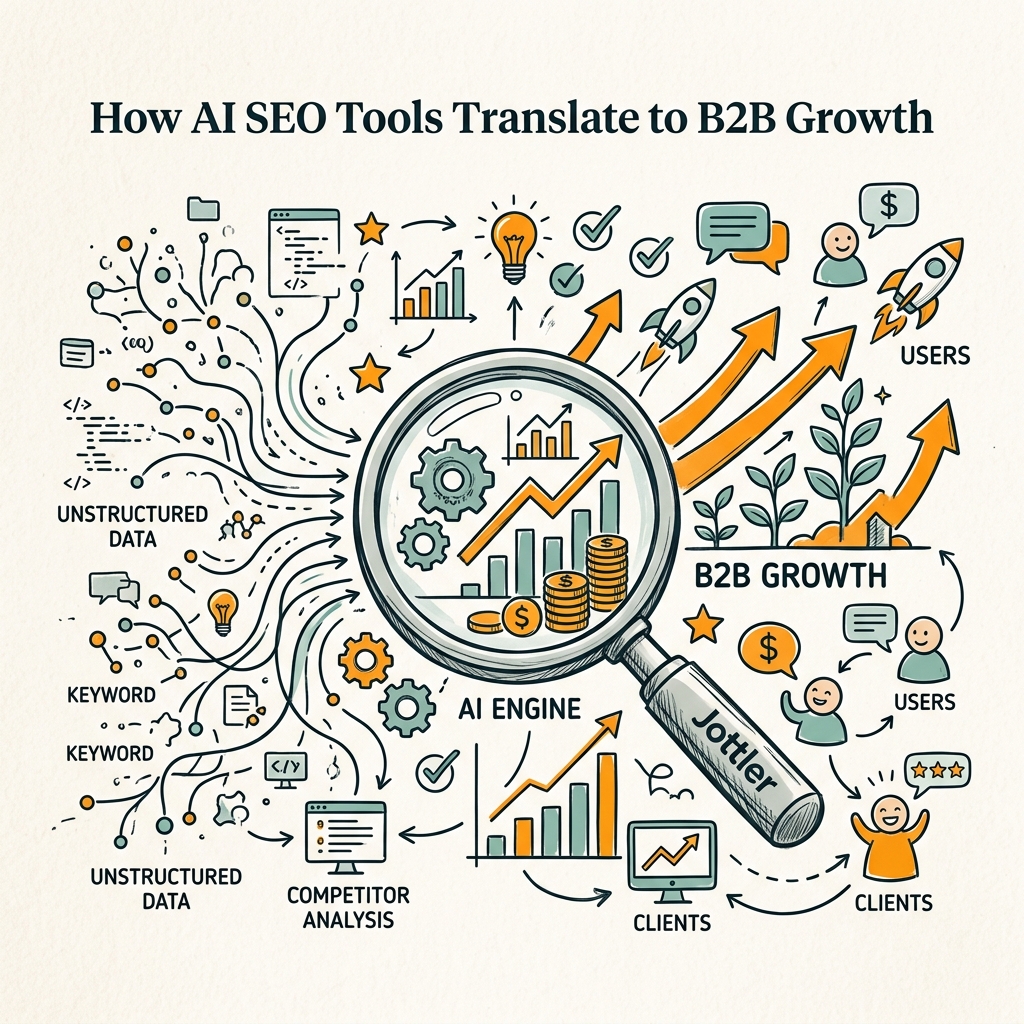
The real ROI of AI SEO tools shows up in compounding organic growth. B2B companies using AI-driven content strategies report 68% higher ROI from SEO compared to traditional approaches. Here's why.
Consistency Drives Topical Authority
Google's algorithm increasingly rewards topical authority—how thoroughly your site covers a subject from multiple angles. Autonomous platforms enable consistent, weekly publishing that builds topical depth without hiring staff. A founder publishing 2 articles per week with Jottler can build topical authority in a competitive vertical within 3–4 months. Manual publishing of 2 articles per week is nearly impossible without a full-time content hire.
Speed to Publishing Means Faster Ranking
The days of waiting weeks for content to rank are ending. Search engines now crawl and index content faster, especially from established domains. Tools that reduce publishing friction—from topic selection to live article—dramatically reduce time-to-first-ranking. Autonomous platforms publishing daily mean you're testing more keywords and topic angles simultaneously, improving your odds of capturing emerging search trends before competitors react.
Internal Linking Networks Multiply Organic Value
Smart internal linking—connecting new articles to existing top performers—multiplies the SEO value of each page. Jottler's internal linking agent automatically identifies related content and adds contextual links, distributing page authority across your domain and signaling topical clusters to Google. Manual internal linking is tedious and often skipped. Automated linking ensures your content network compounds in value.
Fact-Checking Builds Trust and EEAT
Google's EEAT signals (Expertise, Authoritativeness, Trustworthiness) increasingly determine ranking for high-intent B2B searches. Content backed by verified sources and fact-checked claims ranks higher. AI platforms that verify claims against primary sources (as Jottler does) ensure your content stands up to EEAT scrutiny better than competitor content lacking verification. This is especially critical for B2B, where wrong information costs buyers money and damages trust.
Evaluating AI SEO Tools for Your Team
Choosing the right tool depends on your goals, budget, and team size. Use these criteria to narrow your options.
Automation vs. Control
Do you need hands-off consistency (choose autonomous tools) or hands-on optimization (choose point solutions)? Jottler maximizes automation; Surfer SEO maximizes control. Most B2B teams benefit from 80% automation + 20% manual refinement.
Integration Overhead
How many tools can your team manage? If you already use Semrush, adding Surfer SEO creates overlap. If you're starting fresh, an autonomous platform eliminates integration headaches.
Cost vs. Output
Autonomous platforms achieve cost-per-article rates as low as $10–$20 (at $99/month generating 10+ articles per month). Traditional stacks (multiple tools + writers) often exceed $50–$100 per article. For B2B founders bootstrapping, the math is clear.
Content Quality Baseline
AI-generated content quality has matured significantly. Platforms trained on high-ranking SEO content now produce publish-ready articles without heavy editing. For B2B audiences, fact-checking and source attribution matter more than prose style—where AI tools now excel over human writers.
Common Pitfalls When Deploying AI SEO Tools
Even the best tools fail without proper strategy. Watch for these mistakes.
Publishing Without Strategy
Unlimited publishing capacity (thanks to AI) doesn't mean unlimited strategy. Many teams publish 50 articles on random topics instead of 10 strategically chosen articles building topical authority. Start with a keyword map and publish toward it, even if AI makes 100 articles possible.
Ignoring Analytics
AI tools generate traffic data, not revenue data. Connect your tool stack to analytics and revenue systems (like HubSpot or Salesforce). Publish articles targeting high-intent keywords that your sales team confirms drive deals—not just high-volume keywords.
Neglecting Refresh and Updates
AI tools excel at new content, but older articles decay in rankings. Set a schedule to refresh top-performing articles every 6 months with new data, case studies, and internal links. This compounds organic value better than publishing 10 mediocre new pieces.
Conclusion
AI SEO tools have fundamentally changed what's possible for B2B teams without large content budgets. 86% of SEO professionals now use AI, and the gap between adopters and laggards grows wider each month. The question is no longer whether to use AI—it's which tools actually deliver compounding growth without wasting your time.
For busy B2B founders, the answer is clear: autonomous platforms that handle research, writing, optimization, and publishing in one unified workflow. These tools eliminate the coordination overhead of managing five separate tools while ensuring consistency and quality. Teams using integrated AI SEO stacks see 45% more organic traffic within six months and achieve 68% higher ROI than traditional manual approaches.
Start with a foundation layer (autonomous content production) and add specialized tools (optimization, analytics, AI search tracking) as your content program scales. The winners in B2B SEO won't be those spending the most on tools—they'll be those multiplying their output and consistency through AI. Start your SEO agent today and build topical authority before your competitors catch up.
FAQs
What is the best AI SEO tool for a small B2B team?
For bootstrapped teams with limited time, autonomous platforms like Jottler that combine keyword research, writing, optimization, and publishing are the fastest path to scale. Starting at $29/month, they let a solo founder publish 10+ articles monthly without hiring a team. Pair this with free tools like Google Analytics and Google Search Console, and you have a complete SEO operation. As you scale, layer in specialized tools like Surfer SEO for optimization or Sight AI for competitive AI search monitoring.
How long does it take to see rankings from AI-generated content?
Content quality and SEO fundamentals matter more than generation method. Well-optimized AI content can rank within 4–12 weeks depending on keyword difficulty and domain authority. The real advantage of AI tools isn't speed to ranking—it's consistency and volume. Publishing 10 optimized articles monthly compounds topical authority and increases your chances of capturing emerging trends faster than competitors publishing 1–2 pieces.
Can AI SEO tools replace hiring a content team?
For B2B companies publishing 10+ articles monthly on predictable topics (how-tos, product comparisons, thought leadership on core themes), autonomous AI tools can replace 80–90% of manual content work. The remaining 10–20% goes to strategy (choosing topics), fact-checking sensitive claims, and refining voice for brand consistency. This means one founder can own a content program that would typically require 2–3 full-time writers. However, for deeply specialized content (proprietary research, founder commentary) or high-touch client work, AI tools are a productivity multiplier—not a replacement.