Topic Cluster Strategy for Sustainable Organic Growth
Most marketing teams publish content in isolation, hoping random blog posts will compound into traffic. They don't. Well-organized topic clusters increase organic traffic by up to 40% and maintain rankings 2.5 times longer than standalone articles. The difference isn't effort — it's architecture. A topic cluster strategy connects a central "pillar" page to 8–12 supporting articles through intentional internal linking, signaling topical expertise to both Google and AI-powered search engines. When built around business-aligned topics, clusters become a traffic compounding system that scales without constant content churn.
Key Takeaways
- Topic clusters increase organic traffic by up to 40% through topical authority (Digital Applied, 2026)
- Sustainable clusters consist of 3–5 core pillars with 8–12 subtopics per pillar, built on quarterly review cycles
- Pillar pages should be 2,000–3,000+ words; cluster articles 1,200–1,800 words with distinct search intent
- Revenue-aligned KPIs (organic conversion rate, CAC, LTV) now matter more than rankings alone
- Pillar Page Architecture: Comprehensive hub pages (2,000+ words) that establish authority and serve as internal linking hubs for 8–12 related cluster articles.
- Cluster Organization: Topic clusters group 3–5 core business topics, each supporting 8–12 long-tail variations aligned to specific search intents and customer pain points.
- Internal Linking Strategy: Descriptive anchor text links from pillar to clusters, lateral cluster-to-cluster links, and strategic back-links strengthen topical relevance signals.
- Measurement Framework: Track organic traffic, keyword rankings, organic conversion rate, CAC, and LTV to tie clusters to revenue impact, not just impressions.
- Refresh Cadence: Quarterly content audits and annual topical map reviews keep clusters competitive and capture emerging subtopics before competitors.
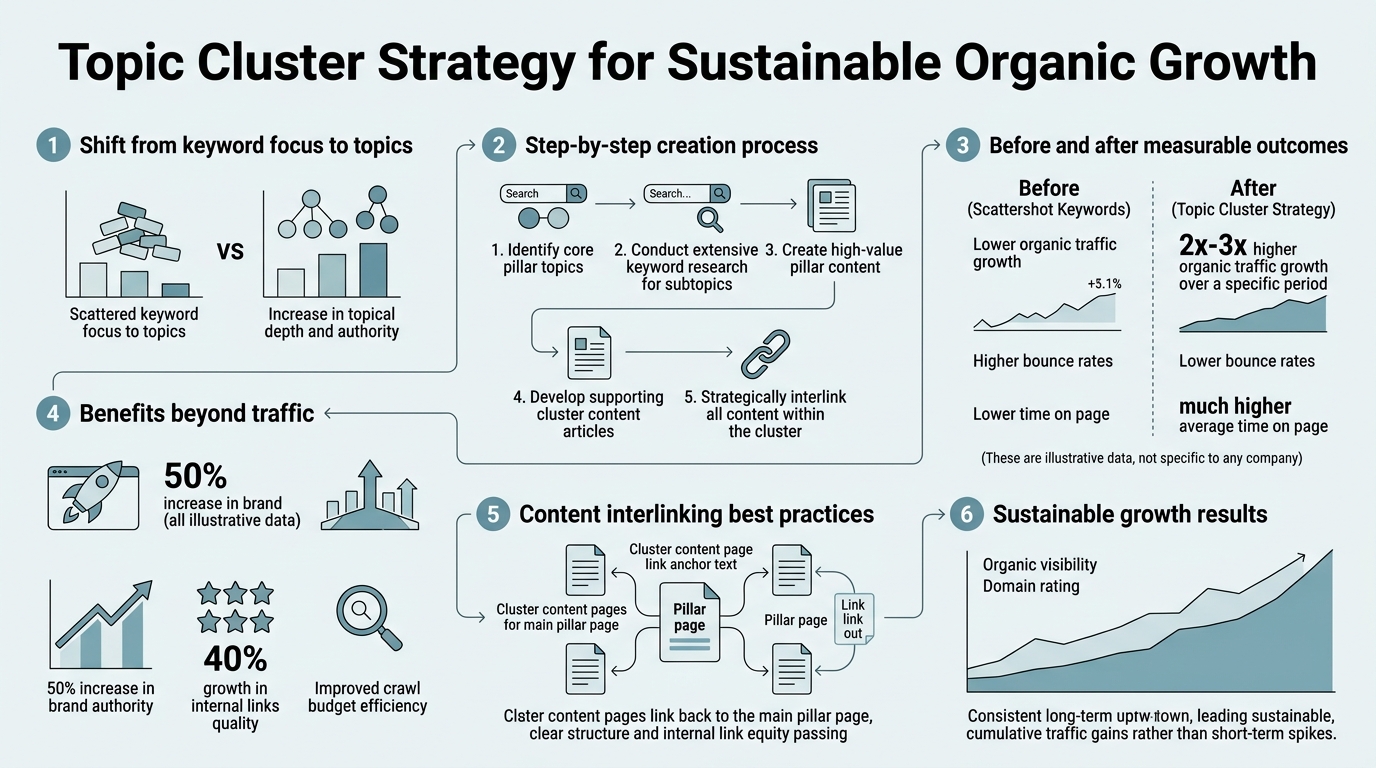
What Is a Topic Cluster Strategy and Why It Drives Sustainable Growth
A topic cluster strategy organizes content around a central theme (the pillar page) supported by multiple related articles (cluster pages) that link back to the pillar with intentional internal linking. Unlike traditional keyword targeting where one page competes for one term, clusters create multiple topical pathways to a single core theme. Search engines reward this semantic depth. Pages within well-structured clusters rank 2.5 times longer than isolated articles, according to 2026 data. The system becomes self-reinforcing: as more cluster pages rank, they drive traffic to the pillar, which strengthens the authority signal, compounding organic growth over quarters and years.
"The shift from publishing what ranks to publishing what converts is the defining change in content strategy for 2026. Topic clusters become powerful when every article feeds a revenue funnel, not just a vanity metric dashboard."
Sustainable growth requires alignment between topic selection and business value. Choosing generic high-volume topics dilutes resources. Choosing topics tied to your highest-value customer segments, key pain points, and product categories creates a compounding effect where search traffic directly feeds your revenue funnel. This shift from "publish what ranks" to "publish what converts" is the defining change in topic cluster strategy for 2026. When you implement content marketing frameworks that prioritize revenue alignment, cluster strategy becomes a tool for scaling both traffic and pipeline.
How to Build a Topic Cluster From Foundation to Launch
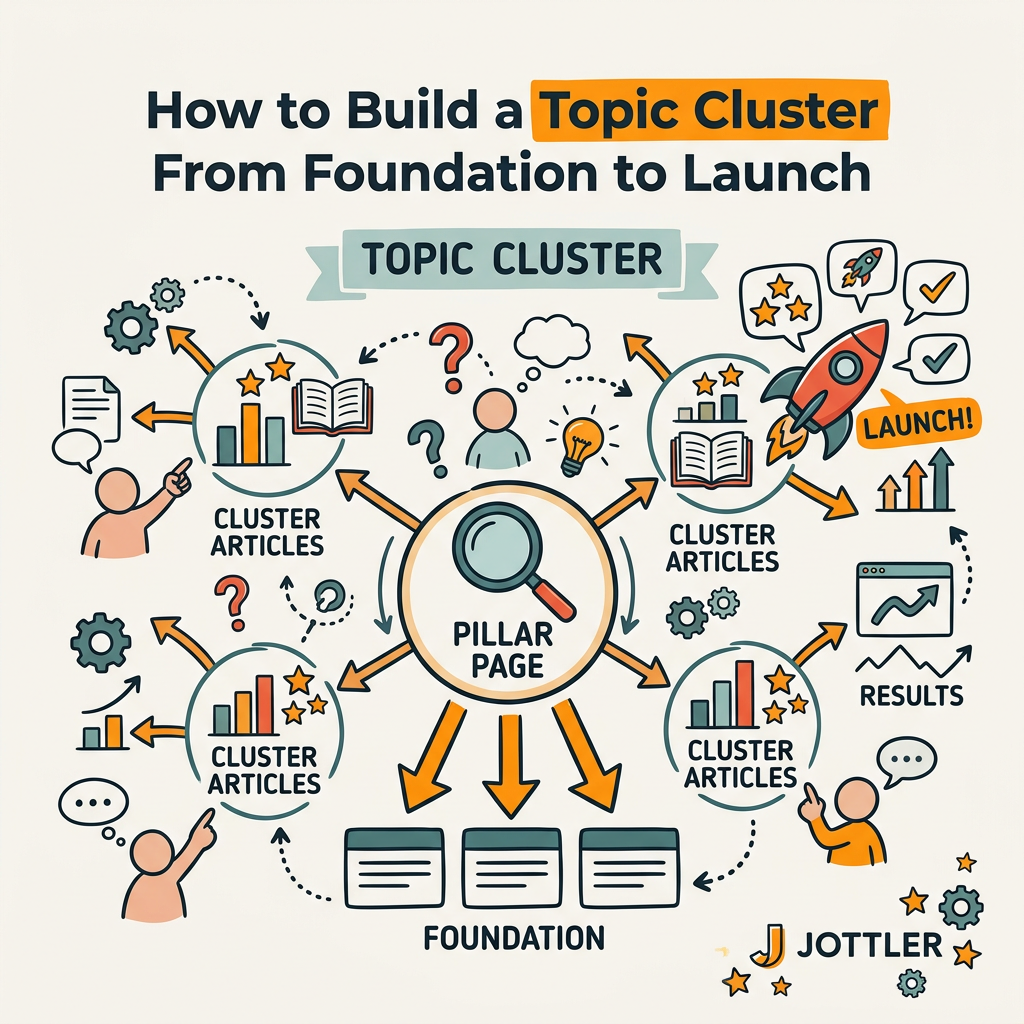
Building a sustainable topic cluster begins with an honest inventory of your content gaps and competitive position. Most teams skip this step and rush to publish. The teams that compound organic growth spend time mapping the landscape first, identifying which topics have both search demand and business value. Here's the framework.
Step 1: Audit Existing Content and Choose Your Core Topic
Start by auditing what you already have. Many teams already own pages that can anchor a cluster — they just haven't linked them intentionally. Use Google Search Console and Google Analytics 4 to identify your existing content's traffic, rankings, and conversion performance. Look for patterns: which topics drive traffic? Which convert? Which have broad intent (pillar potential) versus narrow intent (cluster potential)?
Next, select your core topic. Not all high-volume keywords deserve cluster investment. Choose topics that:
- Have 1,000+ monthly searches: Sufficient demand to justify a multi-article structure.
- Align to business value: Topics tied to your highest-LTV customer segments, key products, or recurring pain points rank infinitely more useful than vanity metrics.
- Have competitive gaps: Are competitors leaving questions unanswered? Can you own subtopics they're ignoring?
- Permit semantic expansion: Can you create 8–12 distinct long-tail subtopics around this core idea? If not, the topic is too narrow.
Step 2: Research and Map Your Subtopics
Once you've chosen your core topic, identify 8–12 supporting subtopics that readers actually search for. Use keyword research to find the specific long-tail queries, customer support tickets, and sales conversation patterns that cluster around your core idea. Map each subtopic to a distinct search intent: some will be educational (how-to, definition), some navigational (comparisons, reviews), some transactional (pricing, implementation). Distinct intent prevents keyword cannibalization — a common cluster failure mode.
Tools like Conductor and other SEO platforms now map these subtopic relationships, but the most reliable approach is manual research: read your competitors' top pages, extract their internal links, and ask your sales team what questions prospects actually ask. When you map subtopics this way, you capture real intent, not just volume.
Step 3: Create or Repurpose Your Pillar Page
Your pillar page is the hub. It should be 2,000–3,000+ words, covering the core topic at a broad level while linking to all cluster articles. The pillar isn't meant to be the deepest dive on any one aspect — it's the connective tissue. A good pillar page typically covers:
- Definition and context: What is this topic? Why does it matter?
- Key frameworks or concepts: The major categories, subtopics, or approaches within the broader theme.
- Overview of cluster areas: Brief introduction to each subtopic with a link to its dedicated cluster page.
- Common questions: FAQ-style content that touches on broader intent while driving readers to specific cluster articles for depth.
If you already have a comprehensive guide or resource page that touches most of these angles, you can repurpose it as a pillar. If you're starting fresh, write or commission a new pillar. This is your highest-impact content investment in the cluster — don't rush it. The strategic approach to content development treats pillar pages as the structural foundation that enables all downstream cluster content to rank faster.
Designing Internal Linking for Maximum Topical Authority
Internal linking is the mechanical force that activates a topic cluster. Without it, your pillar and cluster pages are orphaned. Strategic internal linking from pillar to clusters, and lateral links between related clusters, is what signals topical authority to search engines. This is where most topic cluster projects fail: the structure exists, but the linking is weak, passive, or missing entirely.
"Internal linking isn't about getting clicks—it's about signaling semantic relationships. Every descriptive anchor is a vote that says, 'This page is part of my topical depth.' Search engines count those votes."
Pillar-to-Cluster Linking Patterns
Link from your pillar page to every cluster article, using descriptive anchor text that names the subtopic. Instead of "read more," write "Learn how to implement lead scoring with the BANT framework" (the anchor text itself is SEO-valuable). Each pillar-to-cluster link is a vote that says "this cluster article is part of my topical coverage." Place these links in the pillar's body text, not just in a footer list — contextual links carry more weight.
From every cluster article, link back to the pillar with an equally descriptive anchor. This creates a two-way signal: the pillar is authoritative because it's hub to many clusters; the clusters are relevant because they're tied to the authoritative pillar. Understanding how topical authority is built through linked content architecture reveals why this bidirectional pattern compounds ranking strength over time.
Lateral Cluster Linking and Cross-Topic Bridges
Beyond the pillar-to-cluster structure, link related cluster articles to each other. If you have a cluster article on "lead scoring best practices" and another on "sales-qualified lead criteria," link them bidirectionally with descriptive text. These lateral links prevent siloing and signal to search engines that your content covers the topic comprehensively from multiple angles.
Be intentional: link only when the connection is genuinely useful to the reader. Over-linking dilutes the signal and harms user experience. Aim for 1–3 internal links per cluster article, distributed naturally throughout the text.
Measuring Topic Cluster Performance and Optimizing for Revenue Impact
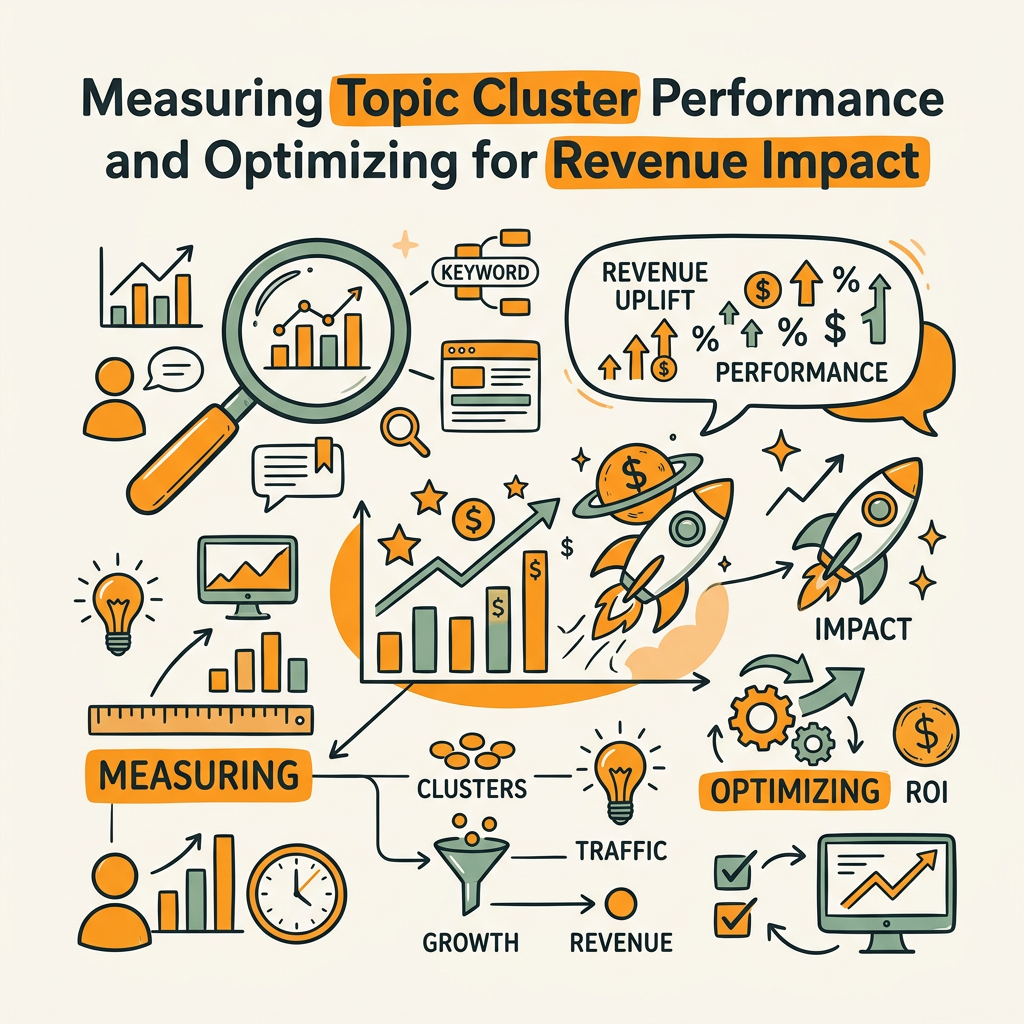
The 2026 shift in content measurement is profound: rankings and traffic alone no longer prove cluster success. You must tie clusters to business outcomes. Teams measuring only organic traffic are missing the conversion story. Here's how to measure effectively.
Create a Multi-Metric Cluster Dashboard
Build a simple dashboard combining Google Search Console, Google Analytics 4, and your CRM data. Track these metrics at the cluster level:
- Organic traffic to pillar and cluster pages: Total traffic, month-over-month growth, trend direction.
- Keyword rankings: How many cluster keywords rank in top 10? Top 20? What's your share of voice vs. competitors in this topic?
- Organic conversion rate: What percentage of cluster traffic converts to a goal (signup, download, form fill, customer)?
- Customer Acquisition Cost (CAC): Cost per acquisition from organic search within this cluster.
- Lifetime Value (LTV): Are customers from this cluster higher-value than baseline? Do they stay longer?
Measure these metrics both pre-cluster and post-cluster. The delta proves whether the cluster is actually moving the needle for your business. A cluster driving 10,000 impressions but zero conversions is a vanity metric. A cluster driving 2,000 impressions and 40 conversions at a $50 CAC is a business asset.
Establish a Baseline and Track Incrementally
Before launching new cluster content, establish a baseline: organic traffic, rankings, and conversion metrics for pages that currently rank in your topic area. After launching the cluster (typically 2–4 months of traffic accumulation), re-measure. Calculate the incremental lift. This comparison reveals whether your cluster strategy is actually working. Search Engine Land recommends this pre/post baseline comparison as the most honest way to measure cluster ROI.
Sustaining Topic Clusters: Maintenance and Expansion
A topic cluster isn't "done" after launch. The most successful clusters operate on a repeating cycle of audits, refreshes, and strategic expansion. Teams that treat clusters as one-time projects see rankings decay. Teams that maintain and expand clusters see compounding growth.
Quarterly Content Audits and Annual Topical Reviews
Every quarter, audit your cluster's performance using the dashboard you built. Ask: Are ranks stable? Is traffic growing? What cluster articles are underperforming? What new subtopics have emerged? Use the answers to inform your next cycle: refresh underperforming articles, strengthen weak internal links, and identify new subtopics worth adding.
Once annually, do a deeper topical map review. Compare your cluster against top-ranking competitors. What subtopics do they cover that you don't? What gaps exist in your coverage? This annual review keeps your cluster competitive and prevents drift. For teams managing multiple content initiatives, content automation systems streamline the audit and refresh cycle, ensuring clusters stay current without constant manual effort.
Refresh Strategy: When and What to Update
Refreshing cluster content every 12–18 months extends ranking stability. Refreshes aren't rewrites — they're targeted updates: add new statistics, update screenshots, add newly published cluster links, strengthen weak sections, and update outdated advice. A 20-minute focused refresh of a pillar page can recover lost rankings and extend its competitive life by another year.
Prioritize refreshes for high-traffic, high-conversion pillar pages first. Then refresh the cluster articles driving the most revenue. This ROI-focused approach ensures your maintenance time compounds business value.
Expansion: Adding New Subtopics as the Cluster Matures
As your cluster gains authority, new subtopic opportunities emerge. Track emerging search queries, competitor expansion, and customer questions. When you identify a gap with search demand and business relevance, create a new cluster article. Link it to the pillar and related clusters. This expansion is essentially free — your pillar has already established topical authority, so new cluster articles will rank faster and stronger than they would as standalone pages.
| Metric | Pillar Page | Cluster Article | Standalone Page |
|---|---|---|---|
| Typical length | 2,000–3,000+ words | 1,200–1,800 words | 800–1,200 words |
| Time to rank (top 10) | 2–4 months | 4–8 weeks* | 3–6 months |
| Ranking longevity | 12+ months (with refreshes) | 8–12 months (with refresh cycle) | 4–6 months (decay without refresh) |
| Organic conversion rate | 2–5% | 1.5–3% | 0.5–1.5% |
| Internal links (inbound) | Many clusters + sidebar | Pillar + 2–3 lateral clusters | Minimal or none |
*Cluster articles rank faster because they inherit topical authority from the pillar and are already internally linked.
Avoiding Common Topic Cluster Mistakes
Topic clusters fail most often not because of structural flaws but because of implementation gaps. Here's what to avoid:
Choosing Topics for Volume, Not Value
The worst cluster mistake is building around a high-volume topic that doesn't align to your business. You'll publish 12 articles targeting a competitive keyword, rank eventually, and realize none of the traffic converts because these aren't your actual customers. Start with business value first, search volume second. Ask your sales team: "Which topic conversations turn into deals?" Build your cluster around that.
Weak or Missing Internal Linking
A pillar and cluster pages with no linking are just independent pages. You gain no topical authority signal. Every cluster project should include a detailed internal linking plan: which articles link where, with what anchor text, when. If you're manually publishing content, maintain a linking checklist. If you're using a CMS, tools designed for content automation handle internal linking across all cluster articles, ensuring no link gets missed and no article stays orphaned.
Publishing Without a Refresh Plan
Publish-and-forget clusters decay. The moment you stop refreshing, competitor content improves, new data emerges, and your rankings drift. Build a refresh schedule into your cluster plan from day one. Quarterly audits, annual reviews, and 12–18 month refresh cycles prevent decay and extend ranking longevity indefinitely.
Building Topic Clusters at Scale: Automation and Workflow
For busy founders and marketing teams at growing companies, the limiting factor isn't strategy — it's capacity. Building a topic cluster manually (research, writing, linking, publishing, tracking) takes weeks per cluster. At scale, this becomes unsustainable.
"If one cluster takes 40 hours of internal labor at $50/hour, that's $2,000 per cluster. Automated clusters cost a fraction of that and ship in days. For teams building 3–5 clusters to compound authority, automation is the difference between execution and perpetual planning."
The answer is content automation. Tools that handle research, writing, fact-checking, and CMS publishing compress the timeline from weeks to days. Systems designed for SEO automation can research topic clusters, write pillar and cluster articles in proper depth, handle internal linking automatically, and publish directly to your CMS. This removes the bottleneck that prevents most teams from scaling clusters.
The ROI math is straightforward: if one cluster takes 40 hours of internal labor at a $50/hour fully-loaded cost, that's $2,000 per cluster. Automated clusters cost a fraction of that and ship in days instead of weeks. For teams building multiple clusters to compound organic growth, automation isn't optional — it's the difference between a cluster project that ships and one that gets deprioritized. Start with an autonomous SEO system and watch how quickly you can compound topic authority across your entire domain.
Conclusion
Topic cluster strategy is no longer a nice-to-have for organic growth — it's the foundational architecture that separates compounding, sustainable growth from one-off blog posts. Teams building 3–5 core topic clusters with 8–12 supporting articles each, refreshed quarterly, see organic traffic grow by 30–40% while maintaining rankings nearly 2.5 times longer than single-page strategies. The compounding effect is real. The business case is proven.
Your next step is simple: audit your existing content, identify your highest-value topic area, and map the subtopics worth covering. Then, choose your execution path — manual or automated. If you're a busy founder or scaling marketing team, automated content systems that research, write, and publish clusters daily remove the bottleneck that stops most companies from taking this seriously. Start with one cluster, measure the revenue impact, then expand. That's how sustainable organic growth compounds. Start your SEO agent today and begin building your first topic cluster.
FAQs
How many articles should a topic cluster include?
A well-balanced topic cluster typically consists of one pillar page (2,000–3,000+ words) plus 8–12 supporting cluster articles (1,200–1,800 words each). This range gives you enough topical breadth to signal authority without overextending resources. If your topic is very broad, you can expand to 15 subtopics; if it's narrower, 6–8 subtopics is sufficient. The key is that each cluster article covers a distinct search intent and subtopic, so you're not cannibalizing or duplicating content. Many successful clusters follow a 3–5 core pillar structure with a sustainable cadence of 1–2 new cluster articles per month.
How long does it take for a topic cluster to start ranking and driving traffic?
Pillar pages typically take 2–4 months to reach top-10 rankings, while cluster articles linked to an established pillar rank faster — often within 4–8 weeks — because they inherit the topical authority signal. However, meaningful traffic accumulation usually doesn't peak until 4–6 months after launch. The timeline depends on domain authority, topic competitiveness, and the strength of your internal linking. Patience is critical: clusters are designed for long-term, compounding growth, not immediate spikes. Teams that measure cluster success at month one are measuring noise; teams that measure at month three and beyond see the actual pattern.
What's the best way to measure if my topic cluster is actually working?
Don't measure by rankings or traffic alone. Establish a pre-cluster baseline (traffic, conversions, CAC for pages currently ranking in your topic), launch your cluster, and measure the incremental lift 3–4 months later. Track organic conversion rate, customer acquisition cost, and lifetime value from cluster traffic. A cluster driving 10,000 impressions with zero conversions is a vanity metric. A cluster driving 2,000 impressions that converts at 2% with a $40 CAC is a business asset. Use Google Search Console for rankings and clicks, Google Analytics 4 for traffic and conversions, and your CRM for revenue impact. This combination reveals whether the cluster is actually moving your business forward, not just vanity metrics.