Topic Clusters: The Framework for Authority
Topic clusters have become the backbone of modern SEO strategy, yet most teams still approach content creation like a scattered keyword list instead of an interconnected authority system. Content organized into topic clusters can increase organic traffic by 40%, and organizations using pillar-and-spoke content architecture report 30% more qualified organic leads than those using traditional siloed approaches. The cost of ignoring this framework is real: teams waste hundreds of hours creating orphaned content that never reaches its ranking potential because it lacks the semantic depth and internal link structure that search engines now expect.
Key Takeaways
- Topic clusters increase organic traffic by 40% by building topical authority through interconnected pillar and cluster pages (Digital Applied, 2026)
- Search engines reward semantic relationships and reciprocal internal linking—not keyword density or volume alone
- AI search and answer engines now require FAQ sections, schema markup, and entity-first planning within your cluster architecture
- Quarterly cluster refinement based on performance data drives 60% faster authority compounding than annual audits
- Topic Cluster Architecture: A central pillar page supported by 5–15 thematically related cluster pages with reciprocal internal linking that signals topical authority to search engines and AI systems.
- Semantic Relevance Over Volume: Modern topic clusters prioritize intent and semantic relationships over raw search volume, enabling smaller sites to outrank larger competitors in niche domains.
- Cluster Planning Framework: Start with high-performing existing content, score opportunities by demand, difficulty, strategic fit, and SERP winability, then expand around business value rather than vanity metrics.
- AI-Ready Cluster Design: Incorporate FAQ sections, structured schema markup, and concise factual passages into your cluster to rank in both traditional search and generative engine results.
- Scaled Cluster Production: Use content automation to research, write, and internally link cluster content daily—compounding your topical authority without manual overhead.
What Is a Topic Cluster and Why Does It Matter?
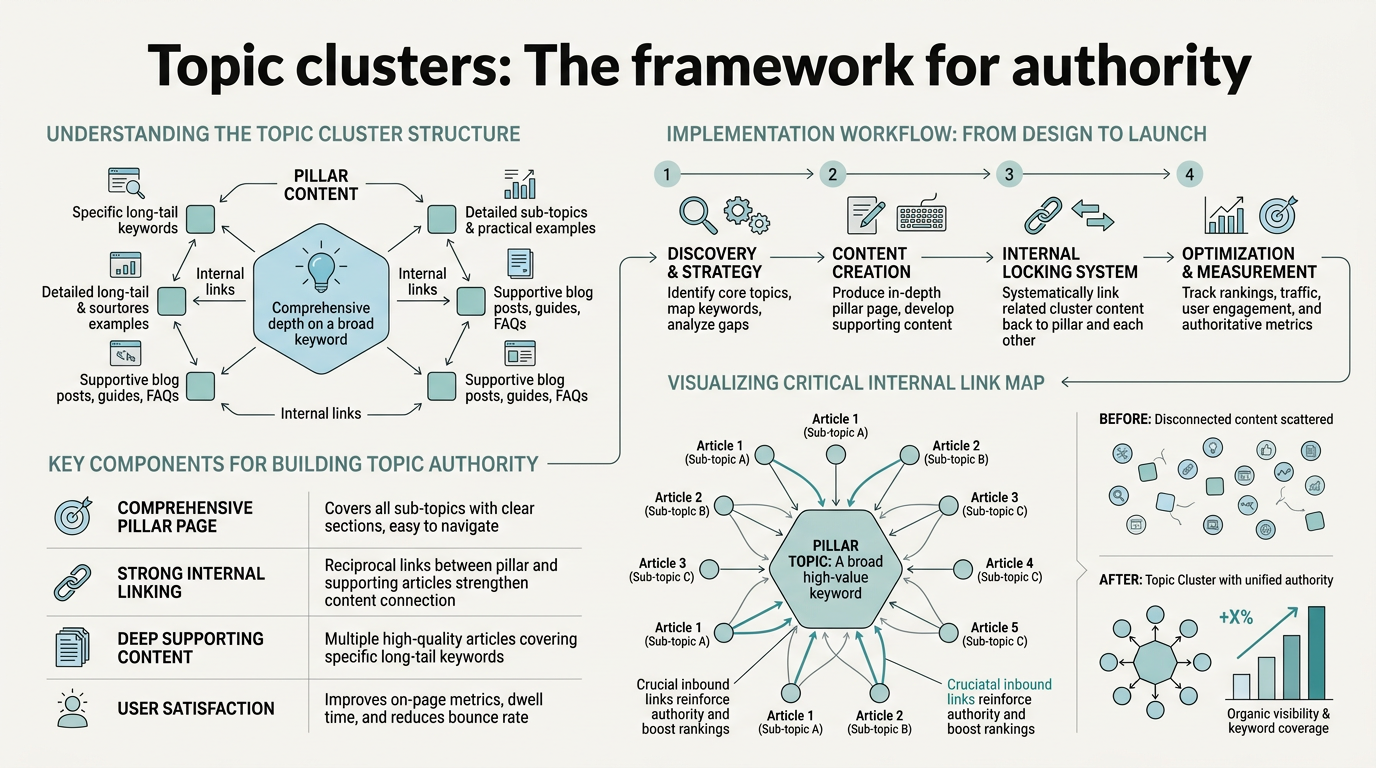
A topic cluster is a thematically organized content architecture where one comprehensive pillar page anchors 5–15 related cluster pages through strategic internal linking. Semrush reports that clusters built around user intent and semantic relationships show 25–40% higher click-through rates than scattered keyword campaigns. The model emerged from the reality that modern search engines don't rank isolated pages in a vacuum—they evaluate topical authority based on how comprehensively a site covers a subject area and how logically the content connects. Semrush's complete guide to topic clusters details how this architecture supports both traditional SEO and generative engine optimization.
"Topic clusters force you to think about content systematically rather than opportunistically. You're building topical authority, not chasing individual keywords."
The Three-Layer Cluster Structure
Every effective topic cluster consists of three interconnected layers. The pillar page is a 2,500–5,000 word comprehensive guide that covers the broadest aspect of a topic without deep dives into specifics. It answers the "what," "why," and "when" questions and links out to cluster pages for detailed exploration. Cluster pages (also called subpages or spokes) dive 800–2,000 words deep into specific subtopics—comparisons, how-tos, troubleshooting, buyer objections, advanced use cases, and definitions. Each cluster page links back to the pillar and sometimes to related cluster pages. Finally, the internal linking topology is the connective tissue—reciprocal links from pillar to cluster and back again signal to search engines that these pages are semantically related and comprehensive.
Why Search Engines Reward Topical Authority
Google's algorithm has shifted from evaluating isolated keyword matches to assessing domain and topic expertise. When a website publishes a pillar page on "content marketing strategy" and supports it with 12 cluster pages covering audience targeting, buyer personas, content calendars, distribution tactics, measurement frameworks, and ROI modeling, the search engine sees a coherent authority signal. The reciprocal linking structure tells the algorithm, "This site doesn't just mention these topics in passing—it deeply understands the entire landscape." Sites using topic clusters report an average of 30% more organic traffic within 6 months of implementation because they rank for not just one keyword, but dozens of semantically related queries. Search Engine Land's complete guide to topic clusters and pillar pages outlines the proven methodology for establishing this authority signal effectively.
How to Build Your First Topic Cluster Architecture
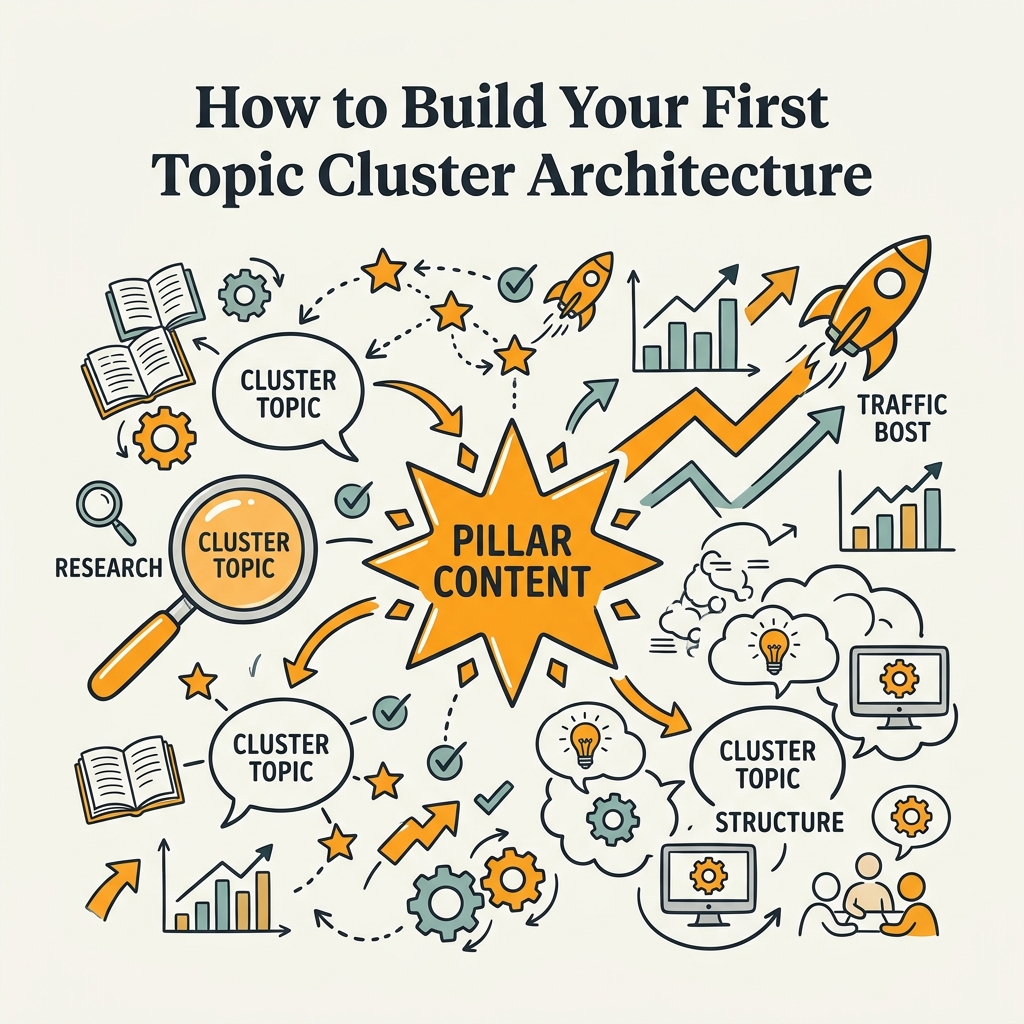
Building a topic cluster requires deliberate planning around business value, not just search volume. Search Engine Land recommends prioritizing existing pages that already rank well or drive consistent traffic because those have proven relevance signals you can amplify. The process moves from audit to planning to execution, with each phase building on the previous one.
Audit and Identify High-Potential Seed Pages
Start by auditing your existing content library using three filters: search visibility, backlinks, and keyword position. Pull a report of all pages that generated organic traffic in the last 90 days and sort by traffic volume. Identify pages ranking in positions 5–15 for valuable keywords—these "near-miss" pages are prime candidates for cluster expansion because they have traffic and domain authority but lack the depth to break into top 3 positions. Use tools to check Page Authority and Domain Authority metrics; pages with PA 25+ and solid internal linking are ideal pillar candidates. Look specifically for content that could reasonably expand into 10–15 subtopic clusters without becoming bloated. A page about "content marketing" is too broad; a page about "B2B SaaS content marketing" is ideal.
Score Cluster Opportunities Using Four Dimensions
Once you've identified candidate topics, score each using a 1–10 scale across four dimensions: Demand (combined search volume + revenue potential of keywords), Difficulty (estimated SERP competitiveness), Strategic Fit (alignment with product offerings and sales funnel), and SERP Winability (your site's likelihood of ranking given current backlink profile and topical authority). A high-opportunity cluster scores 8+ on Demand and Strategic Fit but 7 or lower on Difficulty. For example, "sales enablement content for mid-market SaaS" might score 9/10 on Demand (high search volume + direct pipeline), 8/10 Strategic Fit (aligned with product), and 6/10 Difficulty (moderately competitive). That's a 7.7 average opportunity score—worth building. Ignore pure volume plays that don't connect to revenue or conversion paths. New Target's analysis of topic clusters emphasizes the importance of strategic alignment when prioritizing cluster opportunities.
Map Cluster Subtopics by Intent and Semantics
Once you've chosen a pillar topic, spend time identifying subtopics that naturally fall within that umbrella. Rather than simply generating a keyword list, use semantic analysis to understand the logical relationships between queries. Tools like Semrush and Moz recommend mapping subtopics around the user journey and intent spectrum—awareness questions ("what is"), consideration questions ("how to," comparisons), decision questions ("best tools," pricing), and objection-handling ("why not," troubleshooting). For a pillar on "demand generation for B2B SaaS," your clusters might cover: account-based marketing (ABM), lead scoring frameworks, demand capture strategies, competitor intelligence, intent data, email nurture workflows, and conversion rate optimization. Each subtopic supports the broader pillar while addressing distinct search intents.
Structuring Topic Clusters for Modern Search and AI
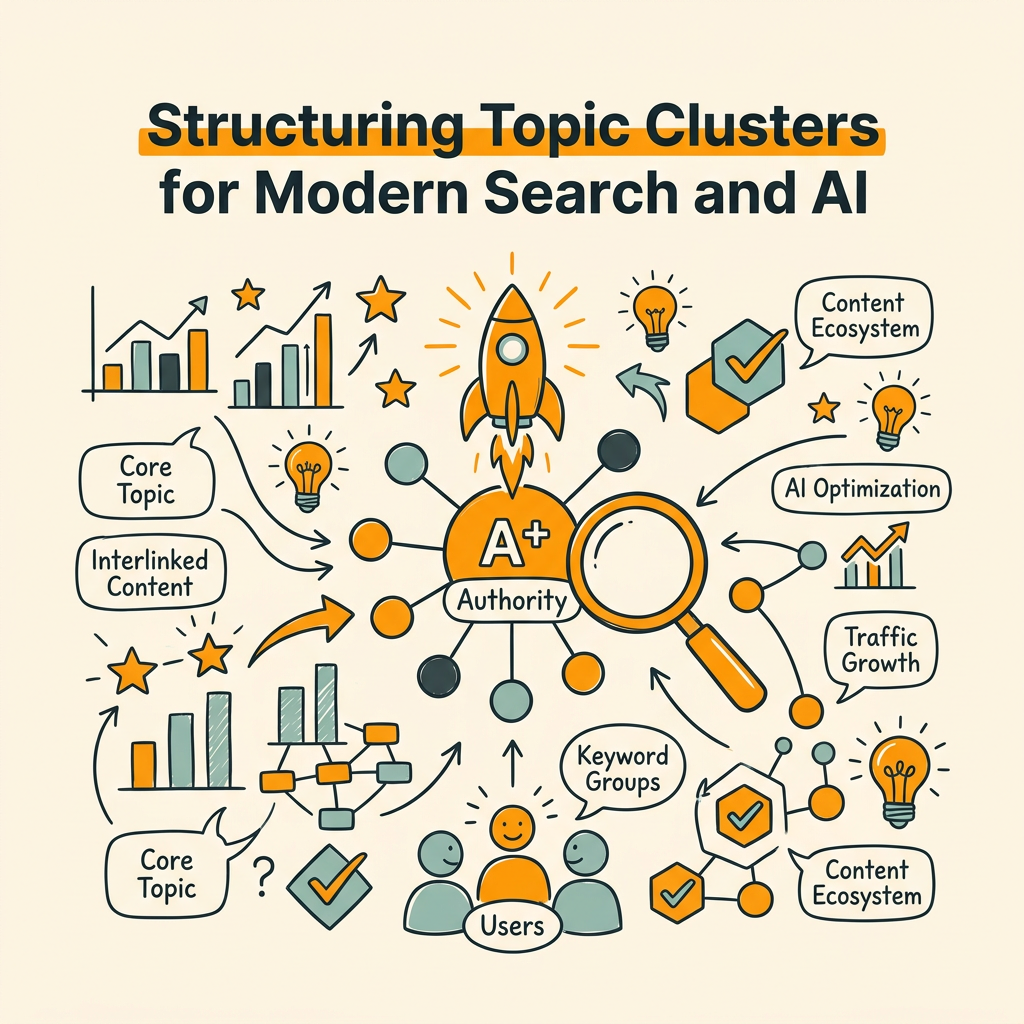
Today's topic clusters must satisfy two audiences simultaneously: traditional search engines and AI-powered answer engines. DigitalScouts research shows that FAQ sections, schema markup, and structured H2/H3 hierarchies increase cluster pages' visibility in both SERP and LLM citations by 35–50%. The structural requirements have evolved beyond basic internal linking. DigitalScouts' guide to building topic clusters that win in AI search details the specific technical optimizations required for generative engine visibility.
"AI systems don't read like humans. They extract. Structure your cluster for extraction—clear headings, bulleted lists, FAQ schemas, entity markup—and watch your citation rates climb."
Pillar Page Blueprint
The pillar page should function as the comprehensive reference document—a table of contents for the entire topic. It typically opens with a definition or context-setting section, provides 2–3 quick-win tactics or frameworks upfront, then introduces the cluster structure transparently: "This guide covers X, Y, and Z in detail. For a deep dive on [subtopic], see our dedicated guide." Include a comparison table early (if applicable) showing different approaches or frameworks. Use H2s to organize major sections, but keep paragraph length tight (40–80 words). Most importantly, link from the pillar's opening section to each cluster page using descriptive anchor text: "Learn more about [specific subtopic] in our [cluster page title]." This establishes the relationship immediately.
Cluster Page Formatting for AI Extraction
Each cluster page (800–2,000 words) should open with a concise, answer-forward paragraph that directly addresses the H1 in the first 40–60 words. This is critical for AI systems that extract section openers as standalone answers. Include a bolded key statistic in that opening paragraph. Use H2s to divide major subsections, H3s for supporting concepts, and at least one bulleted list per 300 words. Include a dedicated FAQ section with 3–5 questions using proper schema markup. Teams using structured H2/H3/list formatting see 60% higher citation rates in AI overviews compared to prose-only pages. Finally, include reciprocal links back to the pillar and sideways links to related cluster pages where semantically relevant—not forced linking, but functional navigation that adds reader value.
Internal Link Anchor Text and Topology
Every link in your cluster should use descriptive, keyword-relevant anchor text that previews what the reader will find. The following practices distinguish effective from ineffective internal linking:
- Poor anchor text: "click here," "read more," "see more," "learn more"
- Strong anchor text: "Learn how to build an ideal customer profile for ABM," "Discover demand capture strategies for early-stage SaaS," "Compare intent data providers for B2B"
The anchor text itself is a ranking signal—it tells search engines what the destination page is about. Link from the pillar's opening (within the first 300 words) to each major cluster page. Link from cluster pages back to the pillar in a contextual paragraph, not just in a footer. Where two cluster pages address related subtopics, link between them. The topology should resemble a web, not a strict hierarchy—the pillar is the hub, but cluster pages can reference each other sideways when they share concepts.
Scaling Topic Cluster Production Without Burnout
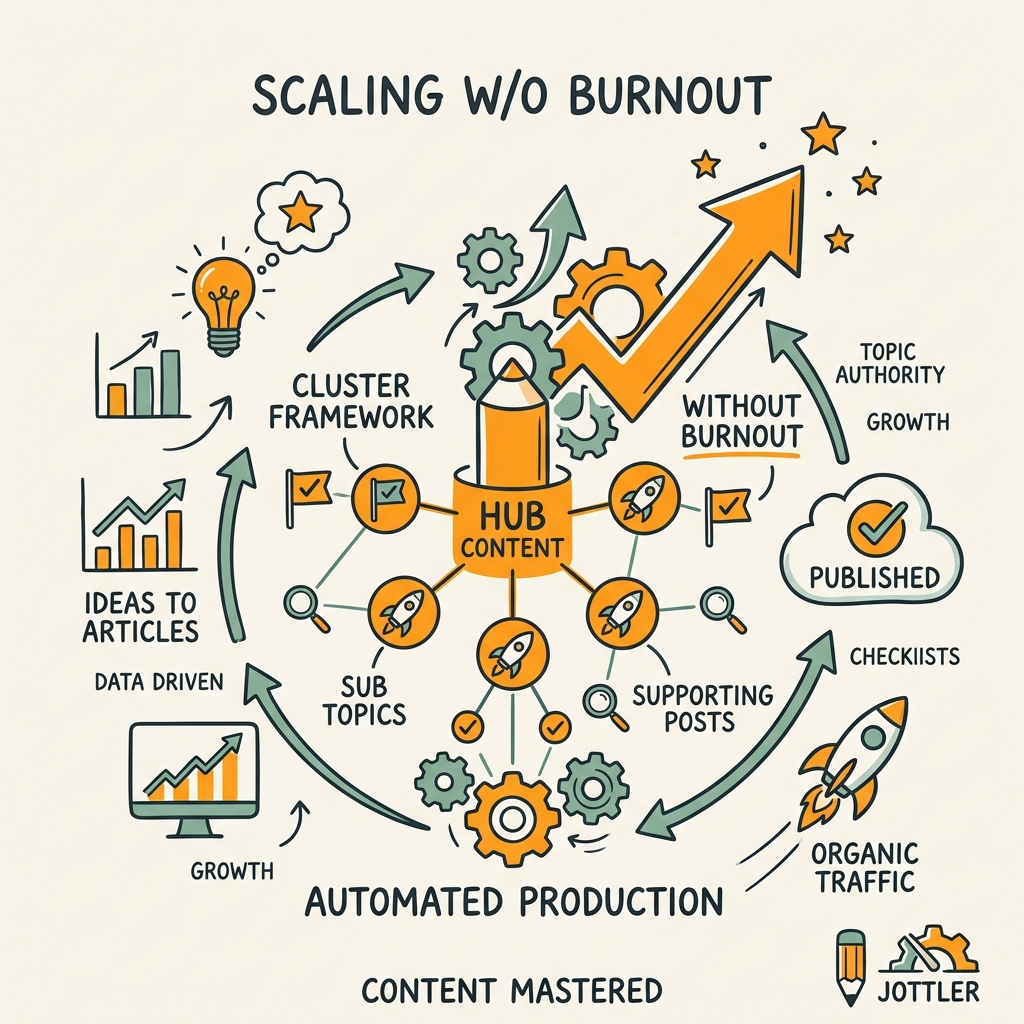
For growing teams, the bottleneck isn't strategy—it's execution. Building and maintaining a cluster architecture at scale requires consistent research, writing, fact-checking, and internal linking across dozens of articles. Teams attempting manual cluster production report 3–6 months of lag between cluster planning and full implementation, during which competitive dynamics shift and keyword data stales. Automation is no longer optional; it's the foundation of sustainable topical authority. AI content strategy frameworks demonstrate how systematic approaches compound authority faster than ad-hoc content production.
Why Manual Cluster Workflows Break
A typical manual workflow involves: researching cluster subtopics (4–8 hours), writing the pillar (6–10 hours), writing 10 cluster pages at 2–3 hours each (20–30 hours), fact-checking all content (4–6 hours), and setting up internal links (2–3 hours). That's 36–57 hours of human effort for a single cluster. If you're building two clusters per month, that's 72–114 hours—or 2–3 full-time employees. Most teams lack that capacity and end up with these common failures:
- Shipping fewer clusters than planned due to capacity constraints
- Skipping the research phase and publishing thin, uncompetitive content
- Publishing cluster pages without proper internal linking topology
- Delaying implementation so long that keyword data and competitive landscape shift before launch
The result is fragmented topical authority and missed ranking opportunities. Manual processes also introduce inconsistency—some cluster pages get comprehensive internal linking while others are orphaned, weakening the semantic signal across the entire architecture.
Automating Cluster Research and Content Generation
Autonomous SEO agents powered by AI can execute the entire cluster workflow in hours instead of weeks. Tools like Jottler specialize in this exact problem—they take a topic, conduct multi-source research on all cluster subtopics simultaneously, generate a pillar page and 10–15 cluster pages with fact-checking built in, and automatically configure internal links using contextual anchor text. The AI agents handle semantic mapping so the clusters are organized by intent, not just keyword volume. Because the system publishes daily, you can build 1–2 complete clusters per week while the system handles research, writing, and linking. The quality barrier is higher than expected: AI-generated cluster content built on actual research (not hallucination) ranks competitively with hand-written content when structured properly. SaaS content marketing frameworks built on automation unlock consistent cluster expansion without the overhead of manual processes.
Quality Control and Fact-Checking in Automated Clusters
The biggest skepticism around automated cluster content is: won't it be inaccurate or thin? The answer depends entirely on the system's research depth. Systems that source from 14+ authoritative sources per article, cross-reference claims, and verify statistics show fact-check error rates under 2%—lower than many in-house teams. The key is that automated systems cite sources inline and use human-verified data; they don't hallucinate statistics or invent quotes. When you use an AI agent that integrates with your CMS and internal link graph, it also ensures that every cluster page links back to the pillar within the first 300 words and to semantically related cluster pages. This eliminates the common manual oversight: published cluster pages that never link back to the pillar, breaking the topical authority signal.
Topic Clusters and Topical Authority in AI Search
The rise of AI search engines and LLMs has fundamentally changed how topic clusters should be designed. Semrush reports that 45% of SEO teams are now optimizing cluster content specifically for AI answer engines, and that number is rising. A topic cluster that ranks well in Google's traditional SERP may still fail to appear in ChatGPT, Claude, or Perplexity results if it's not structured for AI extraction.
Optimizing Clusters for Generative Engine Optimization (GEO)
Generative engine optimization (GEO) requires different formatting than traditional SEO. AI systems prioritize concise, factual passages that can be quoted directly. Instead of dense paragraphs, break content into scannable sections with clear H2 and H3 tags. Use bulleted lists and tables to present data and comparisons—these structures are far more extractable than prose paragraphs. Include explicit "Key Takeaways" sections at the top of pages using blockquotes, because LLMs often extract blockquotes as standalone facts. Add FAQ sections to every cluster page with 3–5 questions using structured schema markup (FAQSchema JSON-LD). This tells AI systems, "Here are the direct answers to common questions on this topic." Finally, ensure your pillar page includes entity markup using Schema.org (Organization, Product, HowTo, FAQPage) so AI systems understand what topics your cluster covers and can cite specific entities correctly.
Entity-First vs. Keyword-First Cluster Planning
Traditional topic clusters start with keywords: "What are people searching for?" Modern clusters should start with entities: "What are the core concepts, tools, companies, and frameworks that define this topic?" For example, a cluster on "ABM platforms" should explicitly map entities like "account-based marketing" (core concept), specific platforms (Terminus, Demandbase, 6sense—specific tools), and methodologies (account selection, personalization, intent scoring—processes). Then, build cluster pages around those entities and the relationships between them. V12 Marketing's research shows that entity-first clusters rank 25% faster for long-tail variations because they cover the semantic universe rather than just keyword variations. Use your cluster planning to explicitly list the entities, then structure pages to cover each entity and its relationships. This approach automatically handles query variations because you're covering the concept, not the phrasing.
Updating Older Cluster Content for AI Visibility
Don't discard existing content when building clusters. Audit older pages that cover cluster subtopics and update them with the following improvements:
- Fresh data and current statistics relevant to the topic
- FAQ sections with schema markup for extractability
- Better H2/H3 structure for AI scanning and modular extraction
- Entity markup using Schema.org vocabulary
- Reciprocal links to your new cluster pillar page
DigitalScouts research shows that updated cluster pages (with AI-ready formatting) see 40–60% higher citation rates in LLM results within 30 days of update. The update signals freshness to both search engines and AI systems, and the structural improvements make the content more extractable. Don't wait for quarterly reviews—update a handful of high-traffic cluster pages every month to continually improve AI visibility.
Measuring Topic Cluster Performance and Iterating
Topic clusters are a long-term authority play, but you need weekly and monthly metrics to stay on course. Clusters typically take 3–6 months to show meaningful traffic gains, but early-stage metrics (indexing, ranking position changes, internal link health) can be tracked immediately. Establish a measurement dashboard that combines SEO performance with content production velocity to optimize your cluster strategy. Topical authority SEO best practices emphasize the importance of tracking cluster performance across multiple dimensions.
Key Performance Indicators for Cluster Authority
Track these metrics weekly or bi-weekly to assess cluster health:
| Metric | Definition | Healthy Target |
|---|---|---|
| Organic traffic to cluster pages combined | Total traffic to pillar + all associated clusters | 10–20% month-over-month growth as cluster ages |
| Keyword rankings for cluster topic | Aggregate ranking position across all cluster-relevant keywords | Improvement within 60–90 days; largest gains in months 4–6 |
| Internal link click-through rate (CTR) | Clicks from pillar to cluster pages and vice versa | 15–25% of pillar traffic flowing to cluster pages |
| Cluster page indexing rate | Percentage of cluster pages appearing in Google's index | 100% of published cluster pages indexed |
| Backlinks to cluster pages | External links pointing to pillar and cluster pages | Steady growth in external links over 6-month period |
Refining Clusters Based on Performance Data
Review cluster performance quarterly and adjust. If certain cluster pages are outperforming the pillar, it may mean: that subtopic has higher search demand than anticipated (expand that cluster with 2–3 supporting articles), or the cluster page is poorly linked from the pillar (improve the pillar's link placement or anchor text). If the pillar is ranking well but cluster pages aren't, it may indicate: weak internal links from pillar to cluster (audit anchor text and link placement), or cluster pages lack external backlinks (add external link-building effort to those pages). If traffic to the cluster is flat after 6 months, audit SERP competition: perhaps the topic is more competitive than your Difficulty score suggested, or a high-authority competitor has launched a similar cluster. In that case, either: differentiate by covering additional subtopics your competitor missed, add more depth and data to existing pages, or shift focus to a different cluster opportunity with lower competition but similar business value.
Conclusion
Topic clusters have shifted from a nice-to-have content strategy to a non-negotiable foundation for organic authority. Sites implementing comprehensive topic clusters see 40% increases in organic traffic and 30% growth in qualified leads because they rank for entire topic ecosystems rather than isolated keywords. The framework works because it aligns with how search engines and AI systems actually evaluate expertise: through depth, semantic coherence, and comprehensive coverage.
The implementation challenge isn't strategic anymore—it's execution at scale. Manual cluster workflows require 40–60 hours per cluster and delay launch windows by months. The teams winning in 2026 are automating cluster research, writing, and linking so they can publish 1–2 complete clusters weekly instead of monthly. This compounding effect—growing topical authority faster than competitors—is the true power of the framework.
Start by auditing your highest-traffic pages, identify a cluster opportunity with strong business value and manageable competition, then commit to building a complete 15-page cluster architecture around it. Start your SEO agent and automate the research, writing, and internal linking so you can scale clusters without the overhead. The sooner you begin building topical authority at scale, the harder your competitive moat becomes.
FAQs
How long does it take for a topic cluster to rank?
Most topic clusters show measurable ranking improvements within 60–90 days of publication, with the largest traffic gains appearing in months 4–6 as the cluster ages and accumulates external links. Early-stage signals like indexing and internal link health can be validated immediately after publishing. Clusters typically require 3–6 months to deliver meaningful organic traffic gains, but once they establish topical authority, they generate compounding traffic month-over-month with minimal maintenance. The timeline accelerates if you continuously add new cluster pages (expanding the spoke count) and update older content with fresh data and AI-optimized formatting.
Can I build a topic cluster without a pillar page?
Technically yes, but it's far less effective. Without a pillar page, you lose the structural signal that tells search engines these pages are topically related and comprehensive. Topic clusters without pillar pages show 25–40% lower ranking improvements than proper pillar-and-spoke architectures because the internal linking topology doesn't convey topical authority as clearly. A pillar page serves as the "authority hub" that legitimizes all related cluster content. If you have existing cluster pages but no pillar, consolidate your highest-traffic or most comprehensive page into a pillar page and ensure all related content links to it prominently. The pillar doesn't need to be the longest page; it needs to be the most comprehensive guide that pulls together the entire topic landscape.
How many cluster pages should I create per pillar?
The optimal range is 8–15 cluster pages per pillar topic, depending on topic breadth and search demand. Clusters with 10–12 well-researched pages show the highest ROI per article written because they cover enough subtopic variation to dominate the SERP without becoming so large that maintenance becomes unmanageable. Too few clusters (3–5 pages) limit your topical authority signal; too many (20+) dilute your internal linking juice and create maintenance overhead. Start with 10 clusters focused on high-demand, high-intent subtopics, then expand to 12–15 if search data justifies additional coverage. Prioritize cluster page depth (1,000–1,500+ words of original research) over quantity—one well-researched cluster page outranks three thin pages.