Writing High-Converting Email Sequences for Automation
Email automation has become the highest-ROI marketing channel available to growing companies. Yet most teams still approach email like a broadcast tool, sending promotional blasts that trigger mass unsubscribes. The difference between a generic email campaign and a high-converting automated sequence is staggering: automated emails generate 320% more revenue than one-off sends, with 42.1% open rates versus 14.5% for batch-and-blast campaigns. The bottleneck isn't technologyit's strategy. This guide walks you through the exact framework to architect email sequences that respond to subscriber behavior, deliver value at the right moment, and convert at 2,361% higher rates than generic campaigns.
Key Takeaways
- Automated email sequences deliver 320% more revenue than manual campaigns and 42.1% open rates versus 14.5% for blasts (2025, Omnisend)
- The five core automated flows (welcome, cart recovery, post-purchase, re-engagement, browse abandonment) drive 80% of all email-generated revenue
- Responding to subscriber behavior within the first minute drives 391% higher conversion rates, making trigger-based automation essential
- Define Your Sequence Trigger and Goal: Map the exact subscriber action that launches the sequence, aligned to a measurable revenue or engagement outcome.
- Build a Multi-Email Flow with Escalating Value: Create 3–7 emails that guide subscribers from awareness to conversion using behavioral data and progressive messaging.
- Segment and Personalize at Scale: Automated sequences segmented by behavior or demographics deliver up to 760% revenue increases and 41% higher click-through rates.
- Test Send Times and Content Variants: Automation platforms optimize send times to lift opens by 26% and clicks by 41%, but manual A/B testing amplifies results.
- Monitor Performance and Iterate: Track open rate, click-through rate, conversion rate, and unsubscribe rate weekly to identify bottlenecks and refine messaging.
Why Automated Email Sequences Outperform Traditional Campaigns
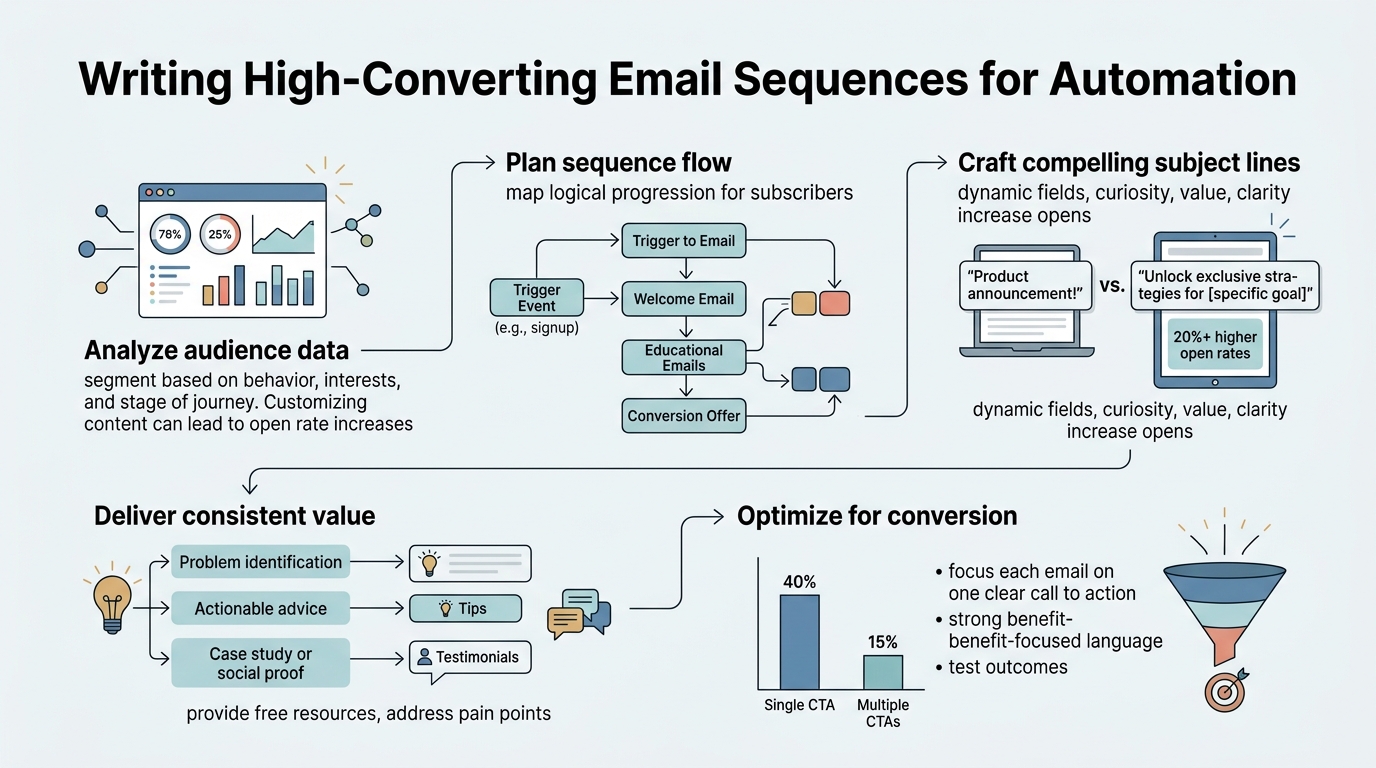
The performance gap between automated sequences and broadcast emails has reached a critical inflection point. Automated emails achieve 4.5x higher click-through rates and 3x higher open rates compared to batch-and-blast sends because they're triggered by subscriber behavior, not marketing calendars. When a subscriber abandons a cart, opens a welcome email, or browses your pricing page, the automation engine responds immediatelyno delay, no context loss. That responsiveness compounds. Businesses responding within the first minute see conversion rates soar by 391%.
The Revenue Equation Behind Automation
Automated emails drive 37% of all email-generated sales despite accounting for just 2% of total email volume. This efficiency is by design. A well-architected welcome series converts new subscribers at rates 2-3x higher than a second welcome email sent weeks later. A cart recovery sequence hits subscribers when purchase intent is at its peaknot when inventory clears or the campaign calendar allows. The math is simple: fewer emails, higher relevance, exponentially better returns. Email marketing delivers $36 ROI for every $1 spent, the highest return of any marketing channel, and automation sequences drive the majority of that return. Teams that build systematic email operations using content marketing automation frameworks see the compound effect accelerate as their email list grows alongside their organic traffic.
Behavior Triggers vs. Time-Based Sends
Automation sequences fall into two categories: triggered (based on subscriber action) and time-delayed (sent on a schedule). Triggered sequences vastly outperform time-based sends because they respond to intent. A subscriber who just downloaded your pricing guide doesn't need a generic "welcome to our list" emailthey need a comparison guide, customer stories, or a discount code. An abandoned cart email sent at 2 PM on Tuesday performs worse than one sent at the exact moment the cart was abandoned. The most sophisticated teams combine both: triggered emails that fire immediately when a subscriber takes action, followed by time-delayed follow-ups that keep the conversation alive. This integration of autonomous agents and trigger-based messaging mirrors how the best marketing automation systems work across all channels.
How to Build Your First High-Converting Email Sequence
Most teams treat email sequences like a checklist: write an email, schedule it, hope for conversions. High-converting sequences are designed backward, from the conversion goal to the first touch. Start with the outcomewhat revenue or engagement metric do you want this sequence to move? Then map the subscriber journey that gets them there. Each email should remove one friction point, answer one question, or provide one piece of proof.
Step 1: Define the Trigger and Target Audience
The trigger is everything. It determines when the sequence fires and which subscribers receive it. The strongest triggers are behavioral: a prospect enters your top-of-funnel segment, a customer completes a purchase, a trial user takes a specific action (or doesn't). Avoid generic triggers like "subscribed to email list." Instead, identify the specific action or attribute that signals intent. A SaaS company might trigger a sequence when a prospect attends a webinar, not when they land on the pricing page. An e-commerce brand might trigger cart recovery when a subscriber abandons a cart with items over a certain price. The trigger should be tight enough to only include subscribers who are actually likely to convert.
Define your target audience within the trigger. Are you sequencing new users who just signed up for a trial? Existing customers who purchased once? Competitors' customers who clicked your ad? The narrower the definition, the more personalized and relevant your sequence becomes. Segmented campaigns deliver up to 760% higher revenue than broadcasts, and that power multiplies across an entire sequence.
Step 2: Map the Email Flow (3–7 Emails, 3–7 Days)
Your sequence structure should guide subscribers from awareness to conversion in a logical progression. Most high-converting sequences follow this pattern:
- Email 1 (Day 0): Acknowledge the trigger and set expectations. If they abandoned a cart, remind them what's in it. If they started a trial, welcome them and explain the first win they can achieve. Keep this under 100 words. The goal is to confirm they made the right choice, not to sell.
- Email 2 (Day 2): Provide immediate value without asking for a purchase. Share a how-to guide, customer story, or comparison resource that answers their most pressing question. This builds trust and proves your expertise.
- Email 3 (Day 4): Address the most common objection. If you're selling, they're thinking about price, competitors, or implementation hassle. Use a case study, testimonial, or pricing breakdown to defuse the objection directly.
- Email 4 (Day 6): Create urgency without being pushy. Mention limited-time discounts, upcoming price increases, or inventory levels. Social proof and scarcity workjust don't overuse them.
Most sequences end after 4–5 emails. If subscribers haven't converted by then, adding more emails tanks engagement and lifts unsubscribe rates. Instead, move them to a nurture sequence or re-engagement flow. Research on email sequence statistics shows that abandoned cart sequences pull the highest performance at 6.3% click-through rate, largely because they're short, timely, and directly address the subscriber's current need.
Step 3: Write Copy That Converts (Value-First, Not Hype)
High-converting email copy shares one trait: it leads with the subscriber's problem, not your product. Instead of "Check out our new feature," try "You're spending 4 hours a week on admin work. Here's how to cut that in half." The first appeals to pride. The second appeals to pain. Subscribers respond to pain relief, not clever marketing.
Each email should focus on one clear message. Avoid the temptation to cram multiple products, links, or calls-to-action into a single email. A/B testing shows that single-CTA emails convert 20–30% better than multi-offer emails. Use short paragraphs (2–3 sentences max), bold the key benefit, and include only one link per email. If a subscriber lands on your email preview with three different CTAs, they'll close it instead of clicking anything.
Personalization amplifies results. Use subscriber first names, reference their specific behavior ("You just attended our webinar on X"), or tailor offers to their industry or company size. Dynamic content blocks that change based on subscriber attributes can lift open rates by 44.3% and click-through rates by 41%. If your automation platform supports conditional logicshowing different content to subscribers based on their attributesuse it. The companies winning with email are the ones treating email marketing as a systematic, data-driven discipline.
Advanced Tactics: Segmentation, Timing, and Personalization
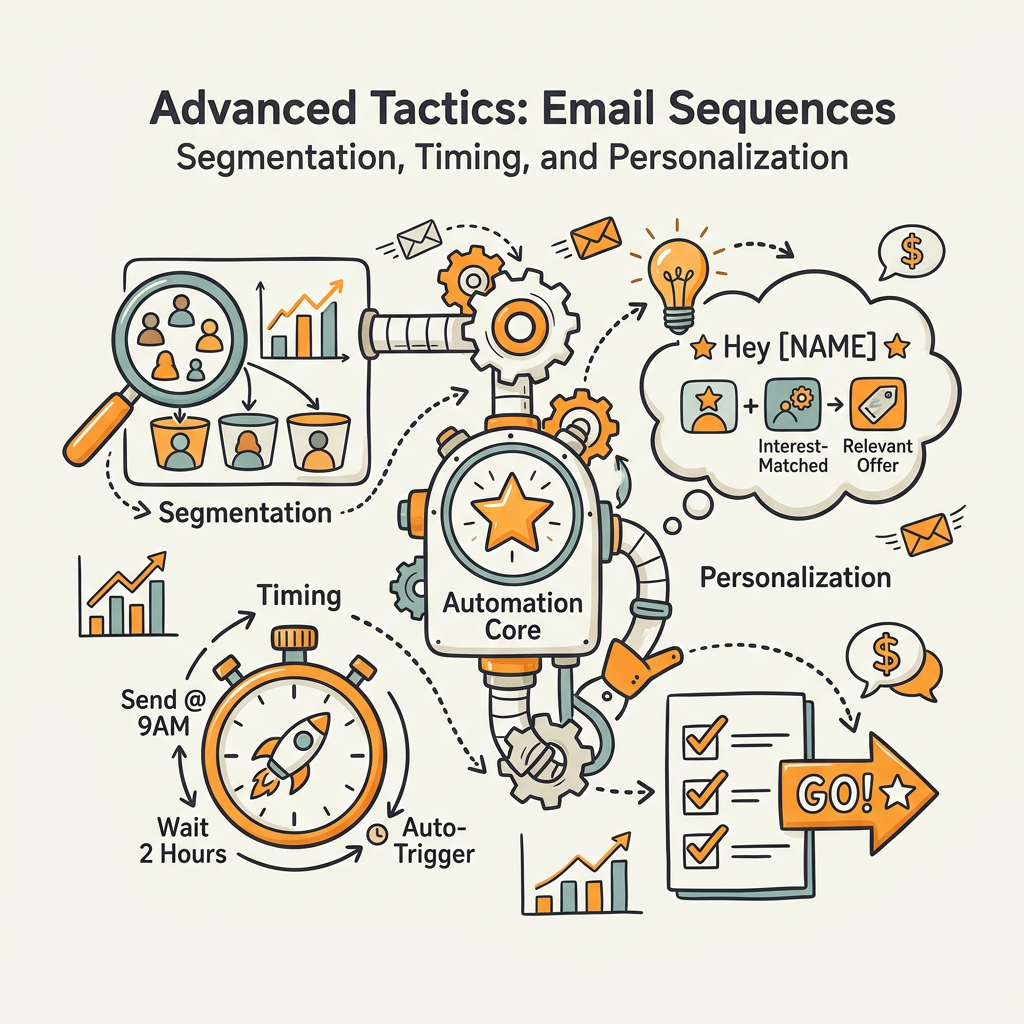
Entry-level automation fires the same sequence to every subscriber who triggers it. Advanced automation divides subscribers into segments and sends different sequences to each cohort. A prospect who clicked a PPC ad gets a different sequence than a prospect who came through organic search. A customer who bought Product A gets different messaging than a customer who bought Product B. This level of segmentation is where the 760% revenue increases come from.
Behavioral Segmentation Rules
The most powerful segmentation rule is behavior. Divide subscribers by actions they've taken: emails opened, links clicked, pages visited, products viewed, purchases made, support tickets filed. A subscriber who visited your pricing page three times but never purchased is in a different segment than a subscriber who bought once six months ago. The first needs messaging focused on value and objection-handling. The second needs a post-purchase upsell or loyalty incentive. Behavioral segmentation lets you send a relevant message at scale, delivering personalization without manual one-offs.
Common segmentation criteria include:
- Purchase history: First-time buyer, repeat customer, high-value account, at-risk customer
- Product engagement: User of Feature A, inactive user, power user, trial user on Day 3 vs. Day 27
- Content consumption: Downloaded ebook, attended webinar, read blog post, watched video
- Company attributes: Industry, company size, location, job title (from enrichment data)
- Intent signals: Searched for pricing, visited careers page, clicked competitor ad retargeting
The best automation platforms allow you to segment dynamically, meaning subscribers move between segments automatically as their behavior changes. A subscriber might start in "Trial Active" but move to "Trial Expiring" after 14 days, automatically triggering a re-engagement sequence.
Send Time Optimization
Open rates and click-through rates vary wildly based on when you send. Your Tuesday 9 AM send might pull 18% opens while Wednesday 2 PM pulls 31%. Most subscribers have different email patterns: some check inbox first thing in the morning, others during lunch break, others late at night. Send-time optimization lifts open rates by 26% and click-through rates by 41% by analyzing each subscriber's historical open behavior and sending at their optimal time. The top automation platforms (and even some email service providers) include this featureenable it. It's a 5-minute setup that compounds across hundreds of thousands of sends.
Progressive Profiling and Dynamic Content
Segmentation requires dataknowing each subscriber's industry, company size, job title, purchase intent, and product usage. Most teams don't have this data when a subscriber first signs up. Progressive profiling gradually builds that profile across multiple emails and website interactions. Instead of a 15-field signup form that kills conversion, ask for email and name. Then, in subsequent emails, include a preference center or ask a single qualifying question. Over time, your data enriches, and your segmentation tightens. This approach lifts form completion rates by 30–40% while still building the data you need for personalization.
Dynamic content goes one level deeper. Instead of sending different emails to different segments, you send one email to everyonebut the content changes based on each subscriber's attributes. A subscriber in tech sees tech-focused benefits. A subscriber in manufacturing sees manufacturing-focused benefits. Dynamic content requires more setup but scales your personalization across all sequences without exponentially multiplying your email variants.
Common Pitfalls and How to Avoid Them
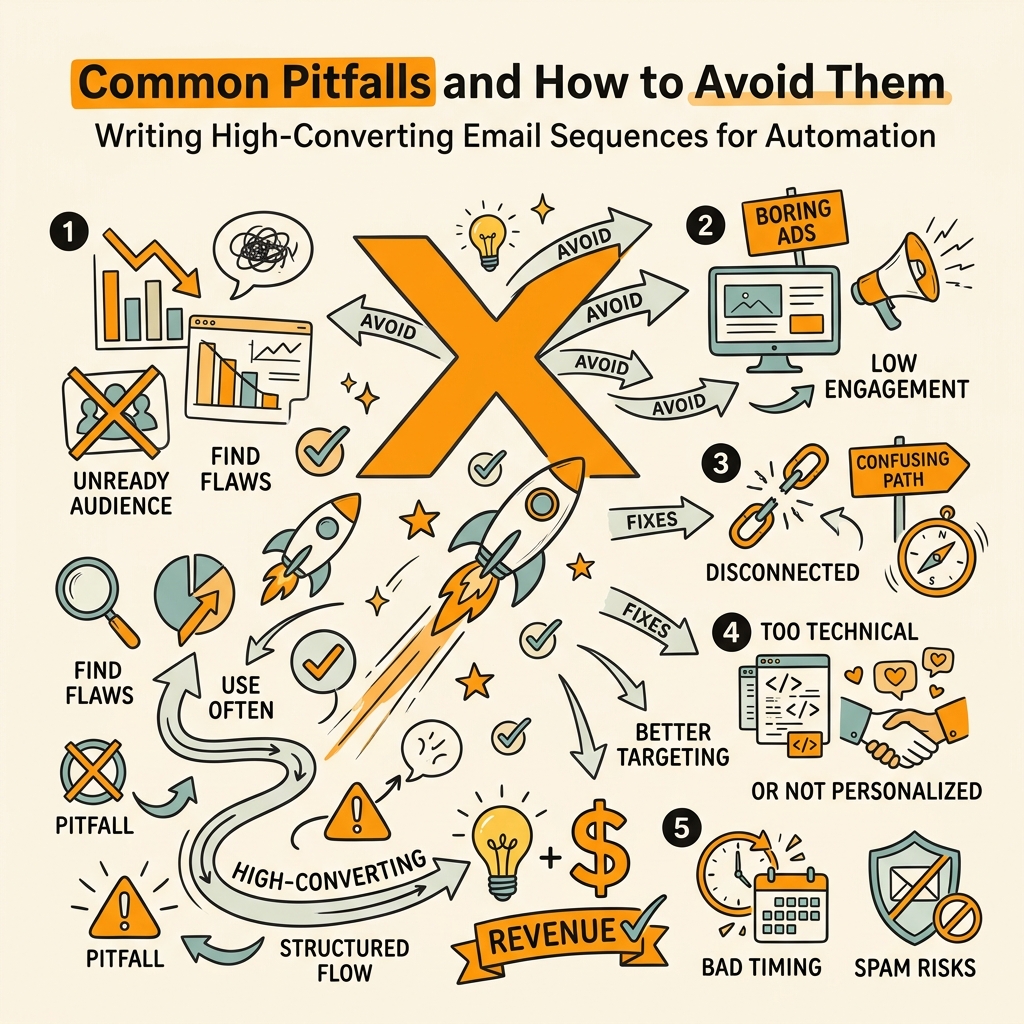
Most failing email sequences fail because of three mistakes: wrong audience, weak value proposition, or frequency fatigue. Avoid these and your sequences will convert.
Mistake 1: Triggering the Sequence Too Broadly
A sequence triggered to "everyone who visits the homepage" will convert at single-digit percentages because you've included people with zero intent. The visitor who landed by accident, the person researching for a competitor, the prospect who will never buy. Tight triggers convert better. Define the exact behavior that signals buying intent: "Downloaded a resource AND visited pricing page," not just "subscribed to newsletter." The narrower the trigger, the higher the conversion rate, even if you reach fewer people overall. Better to convert 5% of 1,000 highly qualified prospects than 0.5% of 10,000 random visitors.
Mistake 2: Selling Too Hard Too Fast
Email sequences that lead with a sales pitch underperform sequences that lead with value. The first email should build rapport, not demand commitment. By the fourth or fifth email, after you've delivered value and established credibility, you can turn up the sales intensity. But the opening move should always be "here's something useful for you," not "buy now." This principle aligns with what top performers have learned:
"People don't buy from emails that feel like an interruptive ad. They buy from emails that feel like a conversation with someone who understands their problem."This insight comes from decades of high-performing email campaigns and is validated by the data showing value-first sequences convert 2–3x better than product-first sequences.
Mistake 3: Ignoring Unsubscribe and Fatigue Data
Oversending kills your sender reputation and shrinks your list faster than poor copywriting. Monitor your unsubscribe rate weekly. If it spikes above 0.5% after a sequence, you're sending too frequently or the messaging is off. The same applies to spam complaints and email bounces. A rising bounce rate signals list quality issues; rising spam complaints signal content relevance issues. Most automation platforms surface these metricscheck them. If unsubscribe rate is climbing, your first fix is to space out emails (move from 3 per week to 2), not to keep pushing. A smaller, engaged list outperforms a large list with fatigue-driven disengagement every time.
Measuring Sequence Performance and Iterating
A sequence isn't "done" on day one. High-converting sequences are living systems that evolve based on data. Track these metrics weekly and adjust messaging, timing, and targeting accordingly. Teams scaling email operations often use AI-powered content generation to fuel email campaigns with fresh, segmented messaging:
| Metric | Good Range | Action If Low |
|---|---|---|
| Open Rate | 25–35% (depending on industry) | Test subject lines, improve sender reputation, check send time optimization |
| Click-Through Rate | 3–6% (for value-first emails) | Simplify copy, tighten CTA, improve email design, check link placement |
| Conversion Rate | 2–5% (industry and offer dependent) | Improve landing page, refine offer, tighten targeting, add proof elements (testimonials, case studies) |
| Unsubscribe Rate | Under 0.5% | Reduce send frequency, improve targeting, audit messaging for relevance |
After 100–200 conversions (or 2–4 weeks, whichever comes first), you have enough data to identify low performers. The email with lowest click rate? Rewrite the subject line and try again. The sequence with highest unsubscribe rate? Space out the emails or shift to a different offer. The email with strong clicks but low conversion? The landing page or offer is the problem, not the email.
The teams seeing highest returns from automation treat every sequence as an experiment. Run A/B tests on subject lines, preview text, send times, email length, CTA text, and offer terms. Most professional teams test at least one variable per sequence send. Over a year, that compounds into sequences that convert 2–3x better than the baseline. When you're scaling content and email as systems scaled through SEO automation, the sequences that feed those systems become your most reliable revenue driver.
Tools and Platforms for Email Sequence Automation
Email sequence automation is only as good as the platform enabling it. Entry-level platforms (Mailchimp, Klaviyo) handle basic triggers and time delays. Mid-market platforms (HubSpot, ActiveCampaign, ConvertKit) add behavioral segmentation, dynamic content, and advanced reporting. Enterprise platforms add AI-driven send-time optimization, predictive content scoring, and omnichannel orchestration. Choosing the right platform depends on three factors: integration ecosystem, segmentation depth, and ease of use.
For busy founders and marketing teams at growing companies, the goal isn't the most powerful platformit's the one that scales your sequences without adding manual overhead. Look for platforms that integrate with your CRM, allow you to sync list segments automatically, and surface performance data in a dashboard. If you're manually toggling sequences on and off or pulling reports into spreadsheets, you've chosen the wrong tool.
Conclusion
High-converting email sequences are the bridge between traffic generation and revenue. A company that acquires 1,000 free trial users per month but converts only 2% faces a math problem. But a company with the same acquisition rate and a 5% conversion email sequence doubles its revenuewithout increasing ad spend. The gap isn't luck. It's a framework: tight triggers, clear value delivery, behavioral segmentation, and disciplined testing. Implement this system and your email channel will compound in power month over month, converting warm leads at rates that make your CAC shrink and your LTV climb. Start with one sequence, measure ruthlessly, iterate weekly, and layer on additional flows as you gain confidence. Within 90 days, email will be your highest-ROI channel. Within a year, it will be your most defensible competitive advantage. Start your SEO agent to build the organic traffic that feeds those email sequences.
FAQs
How long should an email sequence be?
Most high-converting sequences are 3–5 emails spanning 3–7 days. Longer sequences (7+ emails) see declining engagement after the fourth email, with unsubscribe rates climbing sharply. The data shows that abandoned cart sequences, the highest-converting type, average 3–4 emails. Add emails only if you have distinct value to deliver at each stage. If you're repeating the same offer or message, you're oversending. Quality depth per email beats volume.
What's the best day and time to send emails?
No single day or time is universally optimalit depends on your audience and their habits. However, data shows that Tuesday, Wednesday, and Thursday between 9–11 AM pull higher open rates than Monday or Friday afternoons. B2B audiences (decision-makers in offices) peak mid-morning on weekdays. B2C audiences often spike in evenings or weekends. Use your platform's send-time optimization feature, which analyzes each subscriber's historical opens and sends at their personal optimal time. This lifts open rates by 26% and clicks by 41% and requires no manual work once enabled.
How do I know if my conversion rate is good?
Industry benchmarks show a good email conversion rate ranges from 2–5%, with B2B SaaS averaging 2.9% and e-commerce closer to 1.9%. Your target depends on what you're converting: a click-through is easier than a purchase, so the same 2% rate is spectacular for high-ticket B2B but weak for a $19 digital product. Compare yourself to peers in your industry and product category, not global averages. If your conversion rate is in the 2–3% range and your open rate is 20%+, you're performing well. If it's under 1%, the problem is likely your landing page or offer clarity, not the email itself.