Account-Based Marketing and SEO: Alignment for B2B
Most B2B marketing teams treat ABM and SEO as separate strategies. This siloed approach leaves high-value accounts undiscovered and spreads resources thin across generic keyword rankings. 97% of marketers report ABM delivers higher ROI than other B2B strategies, yet only 70% of teams actually run ABM programs, and many fail at the critical step of integrating content discovery with account targeting.
The problem is visibility and scale. Traditional ABM relies on outbound campaigns—emails, paid ads, direct outreach—all labor-intensive. Meanwhile, SEO compounds daily, pulling ideal customer profiles (ICPs) in through organic search. When these two systems run in parallel, you're missing the most cost-efficient channel for account-based discovery: owned, searchable content that ranks for the buying committee's natural research queries.
Here's how to align ABM and SEO for B2B growth: build a content strategy that targets your ICP's buying questions across the full funnel, optimize for both traditional SEO and AI search (where 79% of B2B buyers now search), and use intent data to personalize that content for high-value accounts.
Key Takeaways
- ABM-led teams see 3.4× engagement lift and 28% faster sales cycles when combined with SEO (Digital Applied, 2026)
- AI search now dominates B2B discovery—79% of buyers use ChatGPT, Perplexity, or AI Overviews, requiring GEO alongside traditional SEO
- Aligned sales and marketing ABM strategies achieve 208% increase in marketing-generated revenue (Forrester, 2026)
- Define Your ICP and Buying Committee: Map roles, industries, and business problems to craft content that resonates with each buyer persona within target accounts.
- Develop Account-Targeted Content: Create long-form, research-backed content addressing the full buying journey—awareness to decision—for each ICP segment.
- Optimize for AI Search and Traditional SEO: Blend entity-based optimization, schema markup, and citation-worthy research with keyword targeting for hybrid discovery.
- Automate Content Production and Internal Linking: Scale content frequency and topical authority without manual bottlenecks; compile daily insights into comprehensive pillar pages.
- Measure Pipeline Influence, Not Just Clicks: Align metrics with sales to attribute revenue to ABM-SEO initiatives, not vanity metrics like impressions.
Why ABM and SEO Integration Matters Now
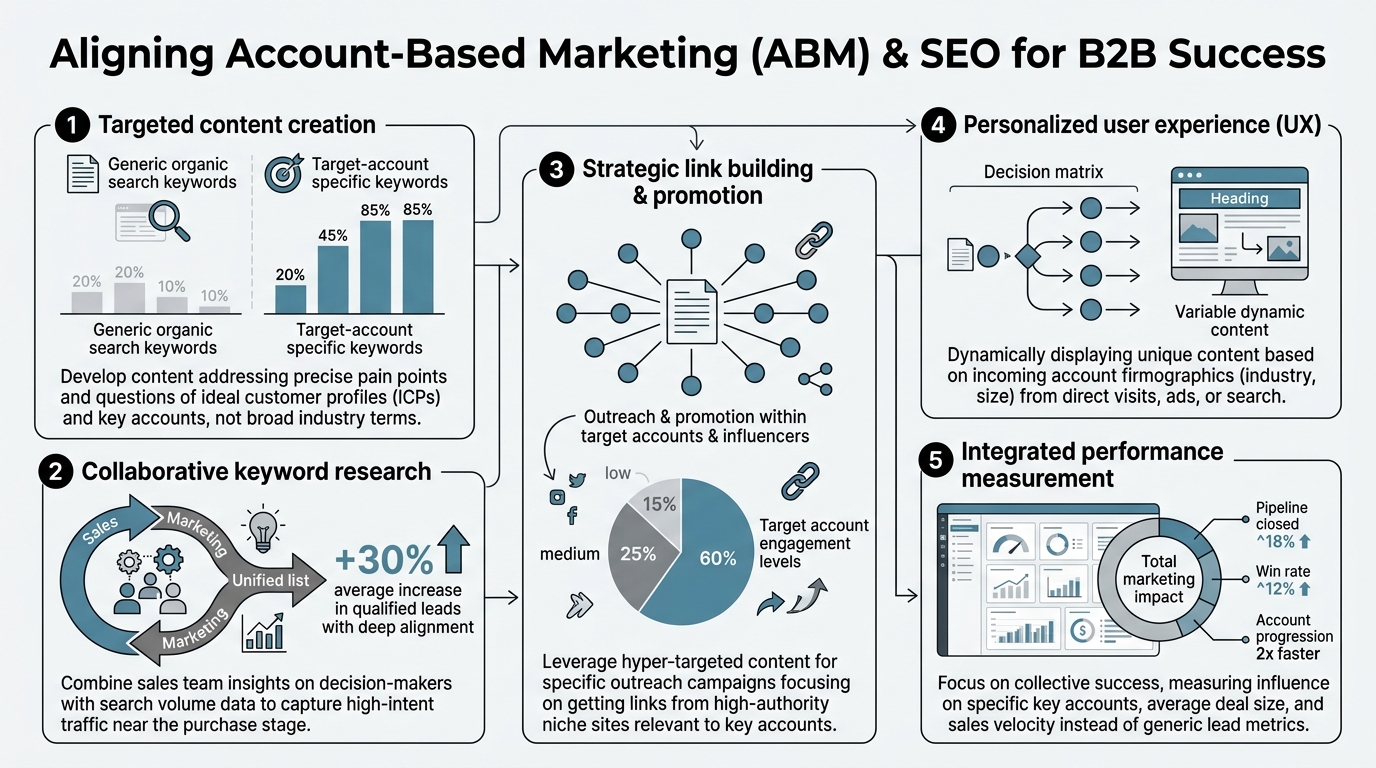
ABM has become the default playbook for complex B2B sales. High-maturity programs achieve 5–9x ROI and 200% larger deal sizes compared to traditional lead-gen approaches. But ABM's effectiveness depends on discovery. If your ICP doesn't know you exist, even the most personalized outreach falls flat.
SEO solves the discovery problem at scale. Unlike paid ads, which stop delivering the moment you stop spending, SEO compounds. A single pillar page on your target buyer's critical pain point can generate qualified account visits for years. Combine that with ABM's account-level targeting, and you're pulling ideal customers into the funnel through their own research.
"The market has fundamentally shifted. B2B buyers now rely on AI-powered search tools as their primary research channel, and companies that ignore this shift are invisible to half their addressable market."
The market has shifted. 79% of B2B buyers now rely on AI-powered search tools like ChatGPT and Perplexity instead of traditional Google. This means your SEO strategy must evolve beyond keyword rankings to address how AI systems surface and cite your content. ABM teams that ignore this shift miss half their audience.
Integration also solves a logistics problem. Most ABM platforms sync with CRM data to identify target accounts. Most SEO tools track keyword rankings and traffic. Connecting these two systems means your sales team knows exactly which accounts discovered you through organic search, which content moved them down the funnel, and which accounts are primed for direct outreach after consuming your research-backed content.
Building Your ICP-Focused Content Strategy for ABM
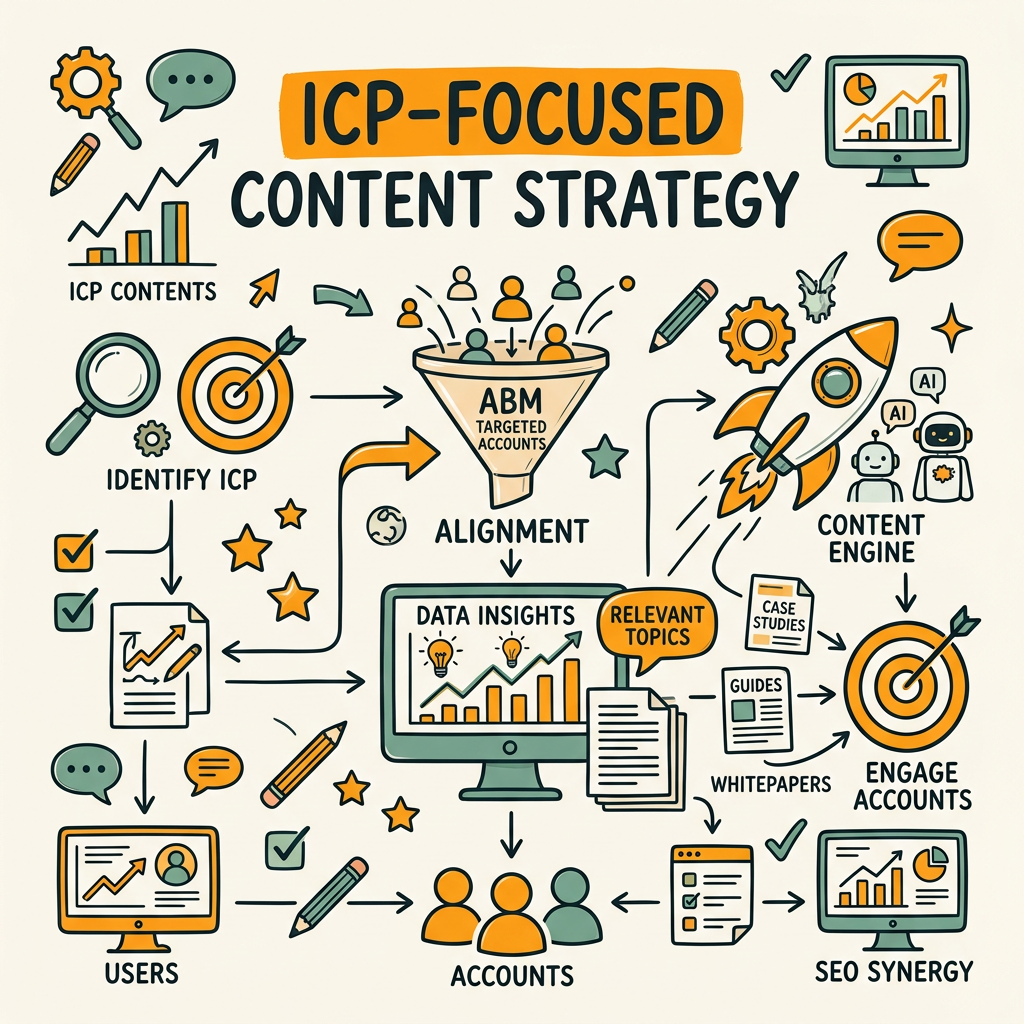
The foundation of aligned ABM-SEO is a crystal-clear Ideal Customer Profile backed by data. ABM teams define ICPs through revenue potential, firmographics, and business problems. SEO should follow the same blueprint, building content pillars around the buyer committee's research behavior and pain points.
Start with your highest-value accounts—the ones closing at $500k+ ACV or higher. Map the decision-making committee: CFO, VP Operations, head of engineering. Each role has different research priorities. The CFO searches for ROI benchmarks and cost comparisons. The engineer searches for technical integrations and implementation complexity. Your ICP content strategy needs to address all three.
"The CFO and the engineer ask completely different questions during the buying process. Your content strategy must answer all of them—or your competitors will."
Next, cluster your ICP by industry vertical or use case. A B2B SaaS platform sells differently to healthcare firms versus manufacturing. The problems they're solving are distinct. Your content should reflect this specificity. Generic guides on "how to choose enterprise software" won't rank for—or convert—your exact buyer.
- Research Your Buyer's Questions: Use SEO tools and CRM intent data to identify what your ICP researches during buying cycles. Look at competitor comment threads, industry forums, and ad copy they respond to.
- Map the Buying Journey by Role: Create separate content tracks for each buyer persona. Finance wants ROI and risk metrics. IT wants security, compliance, and scalability. Sales wants ease of use and integrations.
- Assign Keywords to Account Segments: Group keywords by ICP segment and funnel stage. This ensures your SEO roadmap aligns with ABM target accounts, not broad market keywords with low conversion potential.
- Define Success Metrics with Sales: Before publishing, agree with your sales team on which content pieces are most valuable for account penetration. These become your highest-priority topics.
How to Optimize Content for Both SEO and AI Search Discovery
Traditional SEO optimization—keyword placement, backlinks, page speed—still matters. But AI search introduces a new optimization vector. Google AI Overviews now appear in 13% of search results, and B2B buyers prefer AI-mediated results to click-through to websites. Your content must be discoverable by both systems.
AI search engines prioritize "citation-worthy" content—research, benchmarks, case studies with named sources and data. They value entity clarity (structured data about people, companies, and concepts) and topical depth. A 2,000-word guide that comprehensively covers a topic ranks better in AI systems than a thin 500-word piece, even if both rank equally in Google's traditional SERP.
"AI systems reward comprehensive, research-backed content with multiple citations. Thin content—no matter how well-optimized for traditional SEO—is invisible to AI search engines that power B2B buying."
GEO (Generative Engine Optimization) complements traditional SEO. Where SEO optimizes for keyword queries, GEO optimizes for the way AI systems parse, cite, and synthesize your content. The best practice is to do both simultaneously. Here's the technical approach:
- Write Longer, Research-Backed Content: AI systems favor comprehensive guides with cited sources and specific data. A 3,000+ word pillar article outranks thin content in both traditional search and AI Overviews. This is why scaling content production—publishing 1-3 long-form articles daily—compounds your AI discoverability.
- Use Schema Markup for Entity Clarity: Implement schema.org markup for organizations, people, products, and events mentioned in your content. AI systems use schema to understand what you're writing about and how entities relate to each other.
- Optimize for Topic Clusters, Not Single Keywords: Instead of targeting "account-based marketing ROI" in isolation, build a pillar page on ABM with 10-15 interlinked cluster articles on ABM metrics, ABM tools, ABM for enterprises, ABM and sales alignment, etc. AI systems reward topical authority and interconnected content.
- Prioritize Citation-Worthy Data: Include original research, proprietary benchmarks, or third-party data in your content. AI Overviews cite sources. If your content is cited, you appear in AI-mediated results. Competitor content without citations is invisible to AI search.
Jottler automates this entire process. Instead of manually researching, writing, and fact-checking 3,000-word articles, Jottler's AI agents research topics across 14+ sources, write comprehensive long-form content, verify claims with real-time fact-checking, and publish directly to your CMS with smart internal linking. This means you can publish multiple pillar articles per week—the scale required to build topical authority in ABM and dominate both traditional SEO and AI search results.
Synchronizing Sales and Marketing Data for Account Intelligence
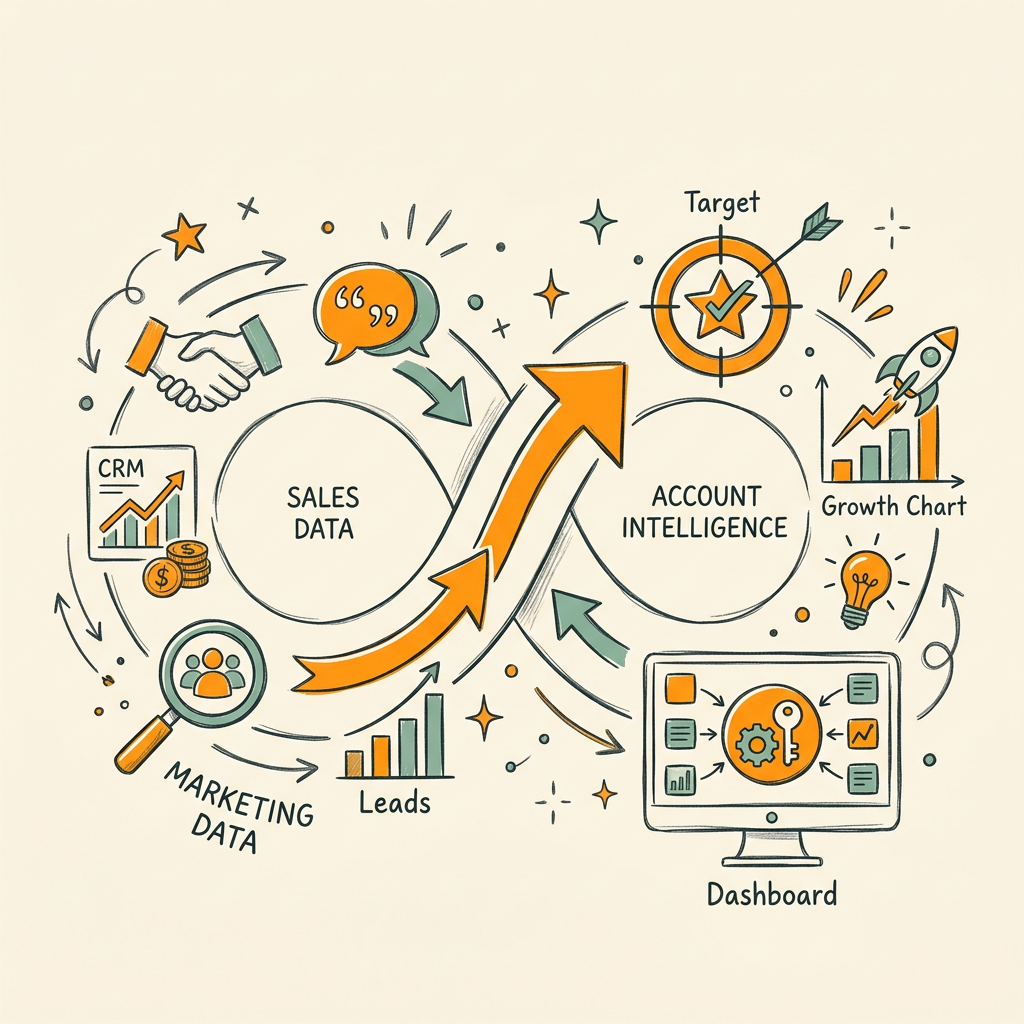
The difference between siloed ABM and true ABM-SEO alignment is data flow. Your sales team has CRM data on target accounts—their stage, engagement, and decision timeline. Your marketing team has web analytics showing which accounts visited your site, consumed what content, and spent time on which pages. These two datasets, when combined, reveal exactly which ABM strategies are working.
Most B2B teams don't connect these dots. Sales doesn't know that a prospect visited your pillar page on ROI benchmarks three times before a sales rep reached out. Marketing doesn't know that the traffic spike to your "ABM for enterprise" guide correlated with a closed deal six weeks later. Syncing these systems unlocks ABM-SEO alignment at scale.
81% of B2B marketers measuring ABM ROI report it outperforms all other initiatives. But this measurement requires integrated data. Here's how to build it:
- Connect CRM to Web Analytics: Use UTM parameters or a data warehouse (Mixpanel, Amplitude, Segment) to match website visitors to CRM account IDs. This reveals which content moves target accounts down the funnel.
- Track Content Engagement by Account Lifecycle: Create views in your analytics that show which accounts are in early research mode (high page views, multiple content pieces) versus late decision stage (fewer visits, deeper engagement with pricing/ROI content).
- Build a Scoring Model: Combine SEO-driven engagement (pages visited, time on page, topic cluster completion) with sales signals (email opens, call attendance, demo requests) into an ABM lead score. High-scoring accounts become priority targets for direct outreach.
- Report Pipeline Influence, Not Vanity Metrics: Stop reporting traffic and clicks. Report what matters: accounts touched by content that closed, average deal velocity for ABM-influenced deals, revenue influenced (not just closed) by organic search.
Scaling Content Production Without Burnout
Here's the hard truth: hand-written ABM-SEO content doesn't scale. A single marketer writing one pillar article per week produces 52 articles annually. That's enough to build topical authority in one narrow niche, but most B2B companies need coverage across 3-5 ICP segments, each with 5-10 content pillars. You're looking at 150-250 articles annually to build defensible topical authority across your entire target market.
Manual content creation becomes a bottleneck. Your team spends weeks researching, days writing, hours fact-checking, and more hours optimizing for SEO and internal linking. By the time the article publishes, market conditions have shifted and the data is stale. Meanwhile, your highest-value accounts are being targeted by competitors who are publishing more frequently and with higher perceived authority (due to volume and consistency).
Automation isn't about replacing writers. It's about multiplying your output without multiplying your team. 96% of marketers now use AI in their workflows, primarily for ideation, drafting, and optimization. The future is teams of humans and agentic AI working in parallel—AI handling research, drafting, fact-checking, and publishing; humans reviewing strategy, personalizing for audience, and refining messaging.
Jottler is built for exactly this workflow. It handles the time-consuming parts of content production—keyword research, source gathering, multi-source fact-checking, SEO optimization, and CMS publishing—leaving your team to focus on strategy, positioning, and ensuring content aligns with ABM goals. If you publish one article daily with Jottler, you generate 365 publications annually, enough to dominate topical authority across your entire ICP landscape and own both traditional and AI search discovery.
Creating an Accountability Framework: Metrics That Matter
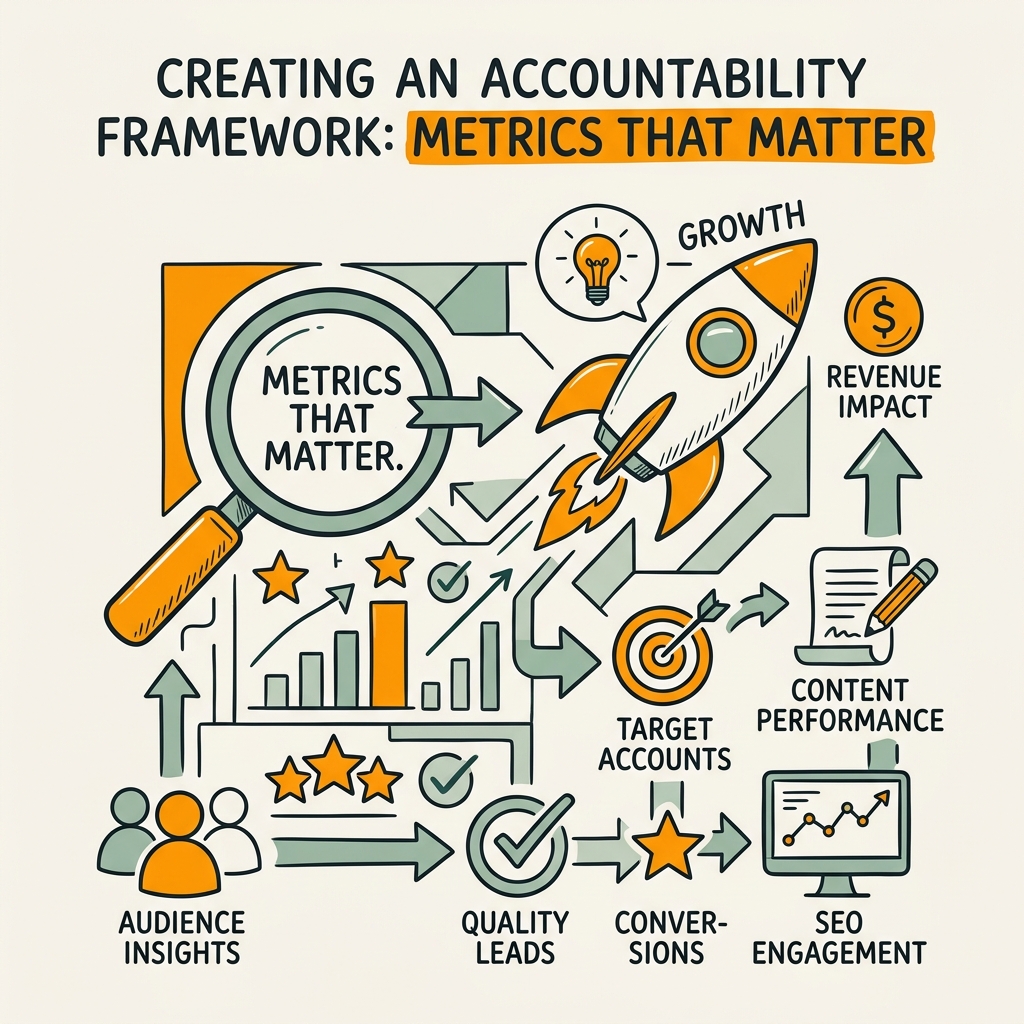
ABM success hinges on measuring the right metrics. Most B2B teams track traffic, bounce rate, and time on page. These metrics are backward-looking and don't connect to revenue. For ABM-SEO alignment, you need forward-looking metrics that tie content to pipeline and revenue.
Aligned sales-marketing teams report 208% increase in marketing-generated revenue compared to misaligned teams. But this alignment requires shared metrics and KPIs that both functions agree on. If marketing reports on traffic while sales reports on deal size, misalignment persists.
Define your ABM-SEO metrics from the top down: start with revenue goals, work backward to pipeline targets, then define content and engagement metrics that drive those pipeline metrics.
| Metric Category | Vanity Metrics (Not Aligned) | ABM-SEO Alignment Metrics |
|---|---|---|
| Awareness / Discovery | Total organic traffic, impressions, CTR | Target account organic visits, account ICP segment distribution, content consumption by buyer role |
| Engagement / Consideration | Average session duration, pages per session | Account topic cluster completion, pillar page engagement, content progression through buying journey |
| Pipeline / Intent | Form submissions, leads generated | Accounts touched by content before sales outreach, MQL-to-SQL conversion for ABM-sourced leads, account stage progression |
| Revenue Impact | Attribution window (30/60/90 days) | Pipeline influenced (all accounts touched before close), revenue closed within 6-12 months of first content visit, deal velocity for ABM-influenced vs. outbound-only |
This framework shifts accountability. Marketing is no longer responsible for "leads" but for moving target accounts through the buying journey. Sales uses content-engagement signals to prioritize outreach to accounts showing high intent. Both functions report on pipeline and revenue, creating alignment.
Build a dashboard that refreshes weekly, showing:
- Target Account Coverage: Of your 100-500 ICP accounts, how many visited your site this month? What content did they consume?
- Buying Stage Distribution: How many accounts are in early research (consuming awareness/education content)? How many are in late decision (consuming ROI/comparison content)?
- Revenue Influence: Of deals closed in the last 6 months, how many had at least one content interaction from our target account before the close?
- Cost Per Account Touched: Divide your monthly marketing spend by the number of target accounts that visited your site. This is your true CAC for ABM-SEO.
Integrating ABM Tools and SEO Platforms
Your tech stack must support ABM-SEO alignment. Most companies use separate tools: SEO platforms (Ahrefs, Semrush, Surfer), ABM platforms (6sense, Terminus, Demandbase), CRM (Salesforce, HubSpot), and analytics (Google Analytics, Mixpanel). Each tool has excellent point solutions but poor inter-system data flow.
The integration challenge: ABM platforms need to know which content keywords your ICP searches for. SEO platforms need to know which accounts visited. Analytics needs to connect both. Most teams handle this manually—exporting CSVs, mismatching data, losing fidelity in translation.
Best practices for tool integration leverage AI-powered SEO systems that natively understand both account targeting and search behavior. Here's the approach:
- Use a Data Warehouse: Implement Snowflake, BigQuery, or Databricks as a central repository. Pull data from SEO tools (keyword rankings, traffic by URL), ABM tools (target account lists, engagement scores), CRM (pipeline, stage), and analytics (visitor behavior, conversion paths). This unified view enables analysis impossible in siloed tools.
- Set Up Account-Based Analytics: In your analytics platform (Google Analytics 4, Amplitude, Mixpanel), create a custom dimension for "ICP Account" that matches visitors to your CRM accounts. This reveals exactly how target accounts interact with your content.
- Automate Content Recommendations: Use intent data (tools like Bombora, intent.com, or your ABM platform's intent feed) to surface timely, relevant content to your sales team. When an account shows buying signals in your intent data, automatically surface the most relevant content piece for that account/role combination.
- Map Keywords to ICPs in SEO Tools: In your SEO platform, tag each keyword and target pillar with the ICP segment it serves. Create a view showing "ABM-Aligned Content Performance" that tracks rankings and traffic only for your priority ABM keywords, not your full keyword universe.
For many scaling companies, custom integration becomes a FTE cost. Jottler solves part of this by automating content production with native SEO optimization and smart internal linking. But integration with your ABM platform still requires custom work or a platform like Zapier/Make to sync data between systems.
Conclusion
ABM and SEO are no longer separate strategies—they're two halves of the same go-to-market engine. ABM identifies your highest-value accounts and tells you what problems they're solving. SEO pulls those accounts toward you through their natural research. Together, they create a flywheel: more content → higher topical authority → better AI and traditional search rankings → more target account organic visits → shorter sales cycles → higher deal velocity and larger ACV.
The data supports this alignment. ABM-led teams achieve engagement lift and faster sales cycles. Aligned sales and marketing teams see significant increases in marketing-generated revenue. The catch is scale: you need enough content to build topical authority across your ICP, and you need to track data across systems to prove ROI.
This is where most teams stumble—not in strategy but in execution. Publishing one article per week won't move the needle on topical authority. Manual ABM-SEO data syncing becomes a part-time job that no one owns. Sales and marketing remain siloed despite best intentions.
Automation is the multiplier. Publishing 3-5 long-form articles weekly—covering your full ABM landscape with research-backed content optimized for AI and traditional search—creates the volume required for topical authority and the consistency required for algorithm trust. Start your SEO agent at https://jottler.co/auth/signup and begin compounding organic traffic into your target accounts today.
FAQs
How do you align ABM strategy with SEO content planning?
Start with your ICP definition and target account list from your ABM platform. Map the buying committee by role—finance, IT, operations—and research what each role searches for during their buying process. Use SEO tools and intent data to identify the keywords and topics each role prioritizes. Then build your content calendar around these research queries, creating pillar articles and cluster content for each ICP segment and buyer role. This ensures every piece of content you publish ranks for—and converts—your actual ideal customers, not generic market keywords.
What metrics prove ABM and SEO alignment is working?
The most powerful metrics are revenue-based: percentage of closed deals influenced by organic content, average deal velocity for accounts that consumed your ABM-aligned content versus cold outreach, and total pipeline influenced by your content. Secondary metrics include target account organic reach, account topic cluster completion, and engagement by buyer role. These metrics connect content to revenue, proving that ABM-SEO alignment drives pipeline, not just traffic.
Can you run ABM without SEO or SEO without ABM?
Yes, but both are weaker in isolation. ABM without SEO relies entirely on outbound—paid ads, email, direct sales outreach—all expensive and exhausting. You're pushing when you could be pulling. SEO without ABM delivers traffic but struggles to convert it: you rank for dozens of keywords that attract different buyer personas and ICPs, making personalization impossible and diluting your sales team's focus. Combining them creates efficiency: SEO pulls your exact ICP toward you through their own research, ABM personalizes that inbound attention, and both functions compress sales cycles while improving deal size and revenue per customer.