Account-Based Marketing: SEO for Enterprise Deals
Enterprise deals require a different approach to marketing. Traditional lead-generation tactics cast too wide a net, wasting resources on accounts that will never close. Account-based marketing (ABM) flips this model: instead of chasing volume, you invest heavily in a small number of high-value accounts. The payoff is substantial. Companies using ABM-driven strategies see 173% higher deal values and 48% win rates compared to non-ABM counterpartsbut only if content, intent signals, and organic visibility work in concert. SEO becomes the delivery mechanism. When your target accounts search for solutions to their problems, your content has to be there, authoritative, and perfectly aligned with their buying stage. This guide covers how to build ABM strategies that compound through organic search.
Key Takeaways
- ABM-influenced deals average $284,000 ACV vs. $104,000 for non-ABM, a 173% premium (2026, Clari + Bombora study).
- ABM deals close 40% faster (120 days vs. 200 days) when paired with intent-driven content and buyer signal integration.
- 87% of marketers report ABM delivers higher ROI than broad demand generation when combined with owned-media strategies like organic search.
- Buyer Intent Alignment: ABM succeeds when SEO targets accounts actively searching for solutions, not generic keywords.
- Account Tier Content Strategy: Segment your content roadmap by account tier (enterprise, mid-market, SMB), with deeper keyword investment in high-value segments.
- Sales and Marketing Alignment Through Data: Unified account scoring ties SEO performance, engagement, and intent signals to the accounts sales is pursuing.
- Scalable Content Architecture: Internal linking and topic clusters enable you to own multiple keywords per account, increasing the likelihood they encounter your content.
- Measurement by Pipeline Metrics: ABM+SEO success is measured by deal velocity, ACV, and win ratenot pageviews or clicks.
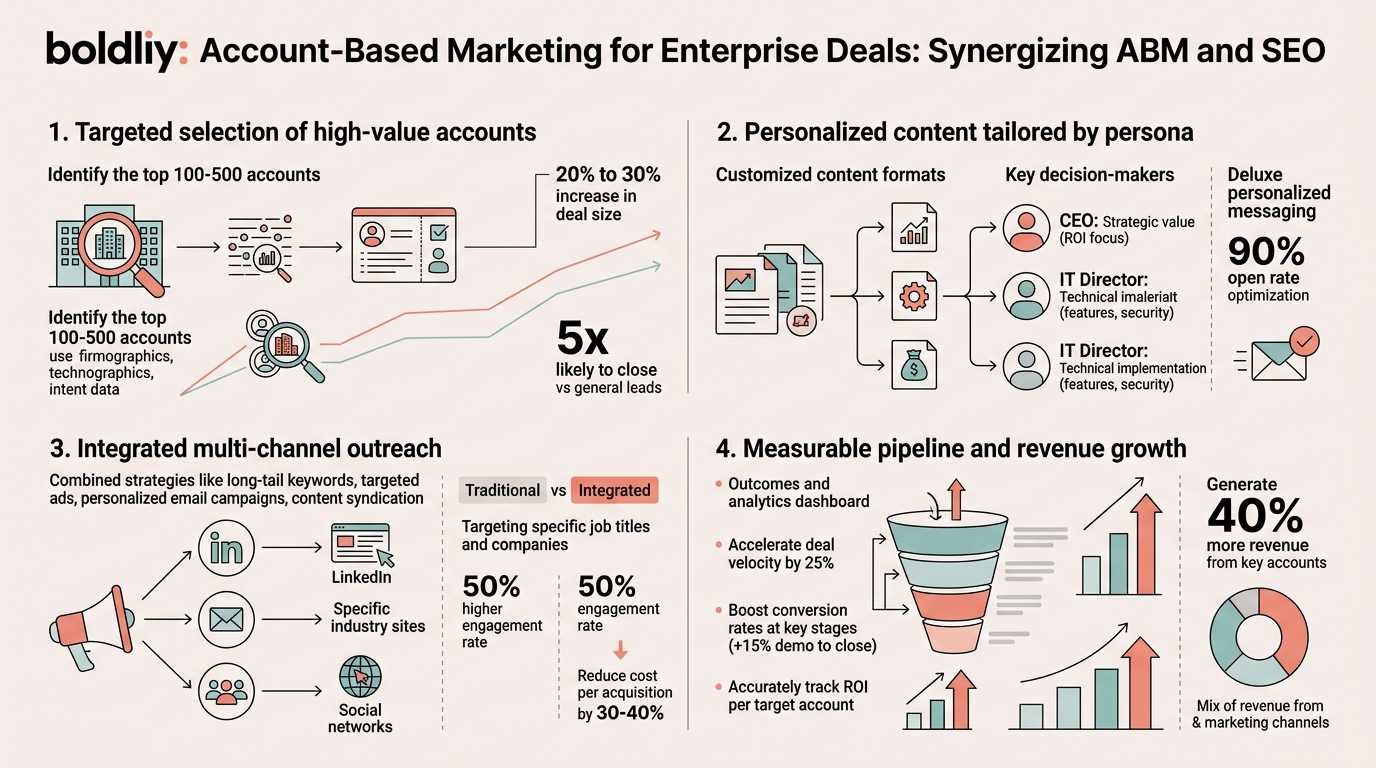
What Is Account-Based Marketing and Why It Transforms Enterprise Sales Cycles?
Account-based marketing is a precision B2B strategy that inverts the traditional sales funnel. Instead of generating many leads and filtering down, ABM starts by identifying a finite list of target accountsusually 20 to 200 depending on your marketand building deeply personalized marketing and sales motions around each one.
The core insight is simple: not all customers are worth the same effort. A $50K annual contract isn't worth the same investment as a $500K deal with a 24-month sales cycle. ABM recognizes this and redirects resources accordingly. Where traditional demand gen asks "How do we get our name in front of as many prospects as possible?", ABM asks "Which accounts will move our revenue needle, and how do we make them impossible to ignore?"
For enterprise deals specifically, ABM is table stakes. Long sales cycles (120+ days), multiple stakeholders, and complex buying committees mean you can't afford scatter-shot messaging. You need every touchpointfrom their first search query to the final contract negotiationto feel custom-built for that specific account.
That's where SEO enters. When a buyer at your target account searches for "enterprise CRM migration services" or "how to reduce cloud infrastructure costs," your content needs to be there, answer their exact question, and guide them toward a conversation with your sales team. Research into ABM statistics for 2026 shows that 25–40% of target accounts engage within 90 days when ABM is paired with intent-driven content strategies.
How to Map Your Target Accounts to Search Intent and Content Gaps
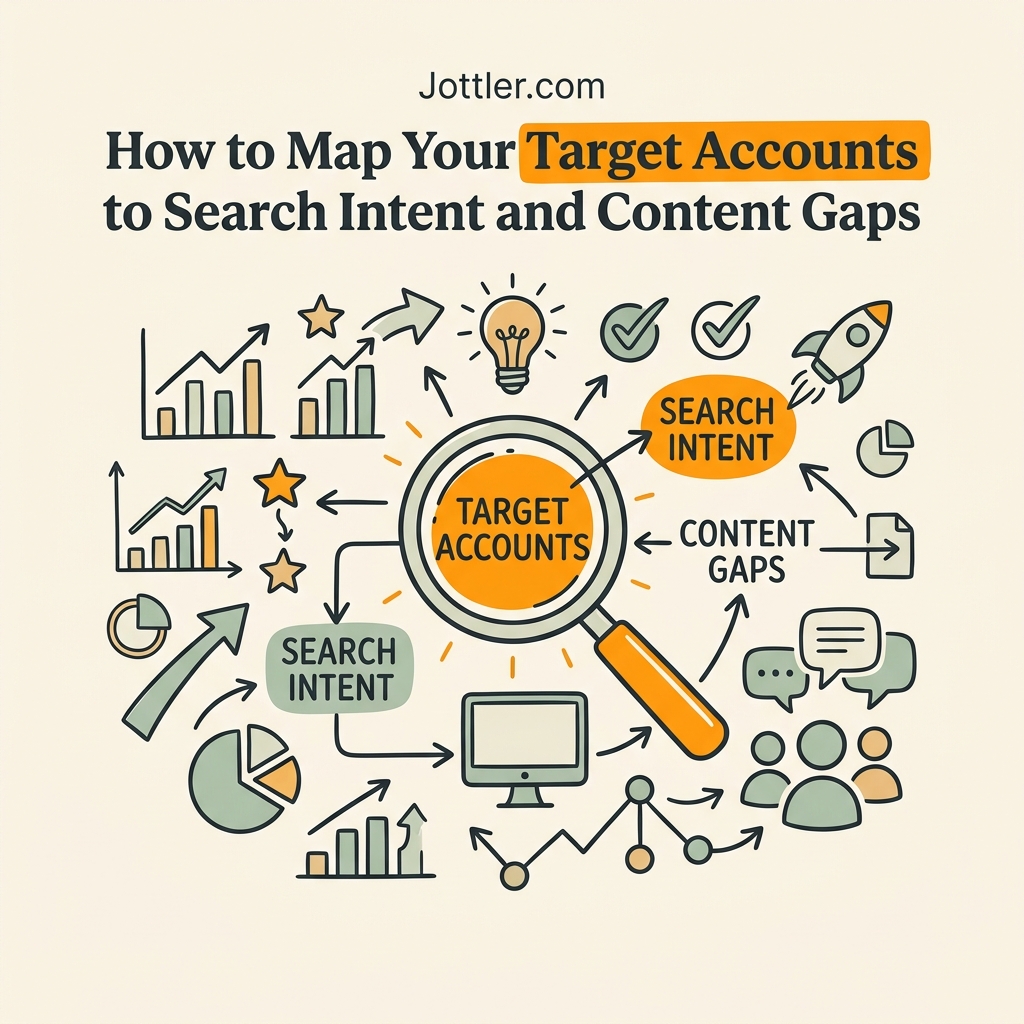
The foundation of ABM+SEO is knowing exactly who your target accounts are and what they're searching for. This requires two parallel activities: account research and keyword research.
Define and Segment Your Target Account List
Start by identifying accounts that meet your ideal customer profile (ICP). In enterprise deals, this usually means companies that fit specific revenue bands, industry verticals, technology stacks, or growth triggers. Your ICP might be: "Mid-market SaaS companies ($10M–$100M ARR) in North America running legacy monolithic systems and actively hiring engineering teams."
Once you have your ICP, segment your target list into tiers. Tier 1 accounts are your highest-priority targetsthe deals that move the needle. Tier 2 accounts are valuable but require less investment. This tiering directly informs your content and SEO strategy. You'll invest more keyword research, deeper content, and more internal linking resources into Tier 1 account keywords.
For example, if you sell enterprise data warehousing and your Tier 1 account is a specific Fortune 500 bank, you'll research exactly what that bank's engineering teams are searching for: "how to migrate data from Hadoop to cloud-native analytics," "enterprise data governance frameworks," and "cost optimization for petabyte-scale databases." This is far more specific than generic "data warehouse" keywords.
Uncover Keyword Gaps by Account Buying Stage
Enterprise deals have distinct buying stages, and each stage has different keyword signals. Your content strategy needs to address all of them:
- Awareness Stage: Your target accounts search for problem-space keywords. A financial services firm might search "how to reduce compliance risk in cloud migrations" or "enterprise fraud detection methods."
- Consideration Stage: They search for solution types and comparisons. "Fraud detection platform vs. rule-based systems" or "cloud migration tools for enterprise."
- Decision Stage: They search for your solution specifically, ROI calculators, and implementation case studies. "Enterprise fraud platform pricing" or "fraud detection implementation case study."
Map your Tier 1 and Tier 2 accounts into these stages and identify which keywords they're likely searching. Tools like Semrush, Ahrefs, and buyer-intent platforms can layer in first-party signalswhat these accounts have actually searched or shown interest into validate your keyword assumptions.
Once you map the intent, identify gaps. If you see that Tier 1 accounts are searching for "how to build enterprise fraud models" but you have no content addressing that query, you've found a priority content gap. This gap-to-content workflow is the bridge between ABM strategy and SEO execution.
How to Build an ABM Content Roadmap Aligned with Organic Search
Your content roadmap should be organized by account tier and buying stage, not by generic content categories. This is where ABM+SEO becomes a compounding system.
Prioritize Content by Account Tier and Intent
Create a matrix: rows are your Tier 1 and Tier 2 accounts (or account segments), columns are buying stages, and cells contain the keywords and content needs for each segment at each stage.
Example for a B2B software company selling enterprise data platforms:
- Tier 1 (Fortune 500 financial services): Build deep content around "enterprise data governance," "petabyte-scale analytics," and "data lineage for regulatory compliance."
- Tier 2 (Mid-market B2B SaaS): Focus on "how to scale analytics with limited engineering," "data pipeline automation," and "cost optimization for growing data teams."
- Awareness: Problem-space content: "Why enterprise data sprawl kills innovation," "Hidden costs of fragmented data systems."
- Consideration: Solution-type content: "Enterprise data platform vs. data lakes," "Managed cloud analytics vs. self-serve BI tools."
- Decision: Your solution content: Case studies from similar companies, ROI calculators, pricing, technical implementation guides.
This structured approach ensures that when a data engineer from your Tier 1 target account searches for "how to audit data lineage at enterprise scale," your content dominates because you've invested specifically in that keyword for that account segment.
Build Content Clusters and Internal Linking Networks
SEO success requires topical authority. Rather than writing isolated blog posts, organize your content into topic clusters: a pillar page that covers a broad topic, with cluster pages diving into subtopics, all internally linked in a strategic architecture.
For example, if "enterprise data governance" is a pillar topic for your Tier 1 accounts:
- Pillar: "Enterprise Data Governance: Complete Framework for Regulated Industries"
- Cluster pages: "Data lineage and metadata management," "Role-based access controls for analytics," "Data catalog tools for enterprises," "Governance workflows for financial services," "Compliance automation in data platforms."
Each cluster page ranks for specific intent-driven keywords within your target accounts' journey. Internal linking between cluster pages and back to the pillar creates a web of authority. When a Tier 1 target account searches for any one of these topics, they land on your content, and the internal linking structure keeps them engaged across multiple pieces, increasing the likelihood of pipeline engagement.
This is where content cluster strategy becomes critical for scaling ABM programs. Manually researching, writing, and linking dozens of content assets is infeasible for most teams. The discipline of building strategic internal links across topic clusters is core to scaling SEO without burnout. Jottler automates this workflow: you define your target accounts and ABM intent, and the platform researches, writes, and internally links 3,000+ word cluster content daily, building topical authority at the speed and depth ABM demands.
How Sales and Marketing Alignment Amplifies ABM+SEO Performance
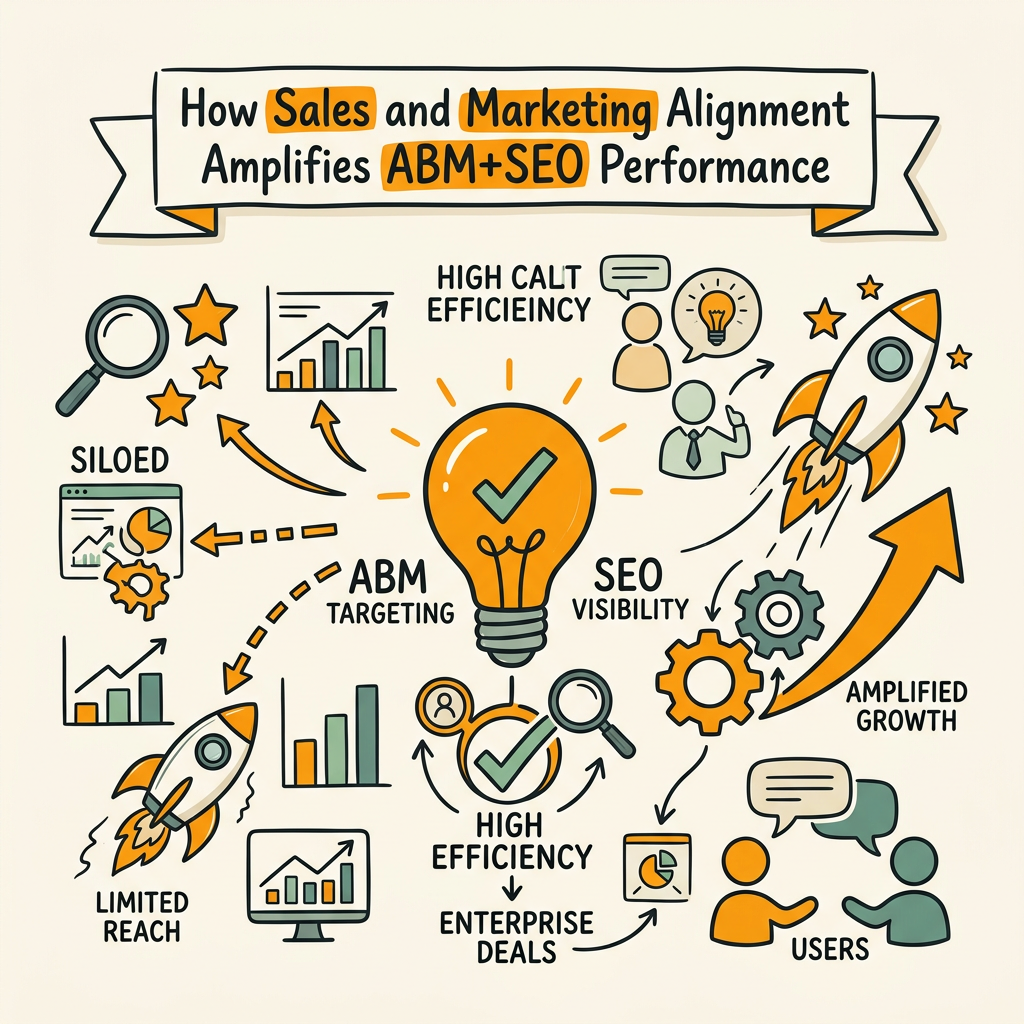
ABM only works when sales and marketing operate from a unified definition of success. For ABM+SEO, that means shared account scoring, account engagement tracking, and pipeline attribution.
Unified Account Scoring Across Marketing and Sales
Set up an account-scoring model that combines first-party intent signals (content engagement, form submissions, time on site) with third-party buyer signals (job openings, funding announcements, technology adoption). This model should feed directly to sales, telling them which target accounts are showing buying signals and when.
When a Tier 1 account engages with three of your highest-intent pieces of contentsay, "Enterprise data governance case studies," "Data lineage tools comparison," and "Compliance automation implementation guide"that's a signal that the account is actively evaluating solutions. Your score should spike, triggering an outbound sales motion.
The strength of ABM paired with mature intent data: research from Mailmodo shows that 73% of companies reported improved sales-marketing alignment from ABM, and 68% reported closing larger deals as a result. Alignment multiplies the value of every piece of content you publish.
Track Content Engagement by Account and Buying Stage
Set up a simple tracking system: tie each piece of content to the buying stage(s) it addresses and the account tier(s) it targets. Then measure which target accounts consumed that content and when.
- Did a Tier 1 account read your awareness-stage content three weeks ago and then visit your pricing page yesterday? That's a signal they're progressing through the funnel.
- Did a Tier 2 account cluster visit 12 pages of your consideration-stage content but no decision-stage pages? They're still evaluating, not yet ready for a demo.
This level of granularity turns marketing data into sales intelligence. Instead of handing sales a lead score, you give them a narrative: "The CFO's team at [Account] has been reading about your ROI framework for three weeks. Last week, their VP of Operations visited the pricing page. They're ready for an inbound conversation." Understanding how topical authority builds trust with account teams will deepen your ABM+SEO execution.
Comparison: ABM+SEO vs. Traditional Demand Generation in Enterprise Markets
To understand why ABM+SEO is the superior approach for enterprise deals, compare it directly to traditional demand generation approaches.
| Metric | ABM + SEO | Demand Gen (Broad) | Winner |
|---|---|---|---|
| Deal Size (ACV) | $284,000 | $104,000 | ABM+SEO (173% higher) |
| Sales Cycle Length | 120 days | 200 days | ABM+SEO (40% faster) |
| Win Rate | 48% | 35% | ABM+SEO (37% higher) |
| Conversion Rate | 5–15% | 2–5% | ABM+SEO (2–3x higher) |
| Sales-Marketing Alignment | High (shared account definition) | Low (different lead definitions) | ABM+SEO |
| Content Efficiency | Targeted (deep, Tier 1 focused) | Scattered (generic, quantity-focused) | ABM+SEO |
The pattern is clear: ABM compounds over time. After 24 months of mature ABM activity, deal-size premiums grow from 173% to 241% because your content, intent data, and sales motions become increasingly aligned and account-specific.
Demand generation chases volume. ABM+SEO chases value. For enterprise deals, value wins.
How to Operationalize ABM+SEO: Daily Content Production at Scale
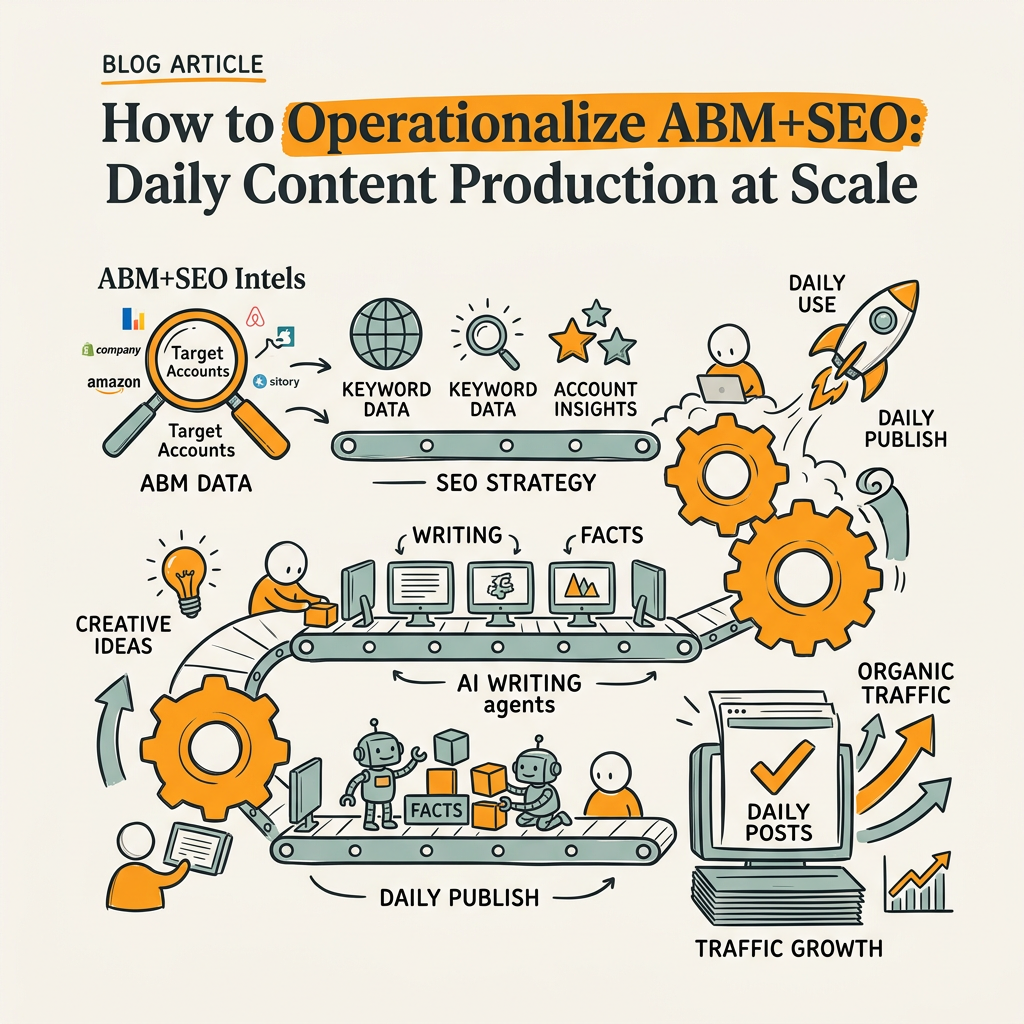
ABM+SEO requires consistent, high-volume content production. A single account might need 30–50 pieces of content across awareness, consideration, and decision stages. With 50–100 Tier 1 and Tier 2 accounts, you're looking at thousands of content assets needed to own your target accounts' search space.
Manual content creation is impossible at this scale. This is why many enterprise teams fail at ABM+SEO: the strategy is sound, but execution is broken. They identify their target accounts, map the keywords, then hit a wall because they don't have the resources to write, fact-check, and publish hundreds of high-quality articles.
Automation becomes the enabler. Tools that handle keyword research, competitive analysis, deep research across 10+ sources, and AI writing can compress the content production timeline from weeks to hours. Platforms that also handle internal linking automaticallybuilding topic clusters and pillar-to-cluster linking without manual curationcollapse the time between strategy and results.
For busy founders and marketing teams at scaling companies, this is the gap Jottler fills. The platform automates the entire ABM+SEO content pipeline: it researches keywords aligned to your target accounts, writes deeply researched 3,000+ word articles, fact-checks against multiple sources, publishes to your CMS, and builds internal link networks automatically. This means your team can execute a year's worth of ABM+SEO strategy in weeks, not quarters. Understanding how content marketing automation scales ABM execution is essential for enterprise teams.
The math is simple. If you're doing ABM properly, you need 500–1,000+ articles to own your target accounts' search space. Writing one article per week takes 10–20 years. Publishing one per day takes 1–3 years. With Jottler publishing 3,000+ words of research and content daily, the majority of your ABM content roadmap can be built in 2–6 months instead of years.
Measuring ABM+SEO Success: Pipeline Metrics That Matter
Enterprise deals demand precision measurement. Vanity metrics like "pageviews" or "sessions" tell you nothing about whether your ABM+SEO strategy is driving revenue.
Account Engagement and Pipeline Velocity
Track which target accounts engaged with your content and measure the pipeline impact. Set up a simple funnel: account engaged with ABM content → account moved to sales-qualified stage → account entered pipeline → opportunity closed. Measure the time from first engagement to close. ABM+SEO success looks like accelerated pipeline velocity for high-intent accounts.
Deal Size and Win Rate by Account Tier
Compare the ACV and win rate of deals from accounts that heavily engaged with your ABM+SEO content versus accounts that didn't. If your Tier 1 accounts that consumed 10+ pieces of your content have a 52% win rate while cold accounts have a 25% win rate, you've quantified ABM+SEO's impact.
Cost Per Closed Account
Divide your total ABM+SEO content investment by the number of target accounts that closed. This is your cost per closed account. For enterprise deals worth hundreds of thousands, even a high content investment ($5K–$20K per account) is negligible against the deal value. ABM+SEO's ROI compounds because the investment is fixed but the deal sizes are massive and variable.
Conclusion
Account-based marketing is no longer optional for enterprise deals. The data is decisive: ABM-influenced deals close 40% faster, have 173% higher contract values, and achieve 48% win rates versus traditional demand generation. But ABM only delivers this value when it's powered by owned media that compounds over timeand that's organic search.
Your target accounts are searching for solutions. Your job is to ensure that when they search, your contenttailored to their account tier, buying stage, and intentis there to guide them. This requires a content strategy aligned to account segments, a cluster architecture that builds topical authority, and sales-marketing alignment to turn engagement into pipeline.
The execution challenge is real: building 500–1,000+ articles to own your target accounts' search space manually is infeasible. Automation is not optionalit's the difference between ABM strategy and ABM results.
Start your SEO agent with Jottler and automate your ABM content roadmap. The platform researches, writes, and publishes 3,000+ words of account-aligned content daily, building the topical authority your enterprise deals demand.
FAQs
What is the difference between ABM and traditional marketing?
Traditional demand generation casts a wide net, aiming to generate as many leads as possible and filtering down to qualified prospects. ABM inverts this: you start by identifying a small number of high-value accounts and customize all marketing and sales motions around each one. ABM requires significantly less volume but delivers 173% higher deal values and 40% faster sales cycles because every touchpoint feels custom-built. Traditional marketing reaches more people; ABM closes bigger deals faster.
How does SEO fit into an ABM strategy?
SEO is the delivery mechanism for ABM. Your target accounts search for solutions, comparisons, and implementation guidesand your content needs to rank for those searches. By mapping your target accounts to intent-driven keywords and building a content cluster strategy around those keywords, you ensure that when your accounts search, they find you. This drives 25–40% engagement within 90 days and accelerates pipeline progression, making SEO the most scalable owned-media channel for ABM programs.
How many accounts should I target in an ABM program?
The number depends on your sales capacity and deal size. Most ABM programs target 20–200 accounts split into tiers: Tier 1 (highest priority, 10–25 accounts receiving maximum investment), Tier 2 (secondary priority, 50–100 accounts), and sometimes Tier 3 (wider list, lower investment). The key is that every account receives a custom content and sales motion. 73% of companies adopting ABM reported improved sales-marketing alignment because this clarity forces the organization to agree on which accounts matter most.