Account-Based Marketing Through SEO: B2B Playbook
Most B2B teams waste weeks targeting the wrong accounts with generic content. Yet 71% of B2B practitioners now use account-based marketing (ABM), and those who combine it with SEO achieve 137% average ROI compared to 76% for traditional lead-gen approaches. The problem isn't understanding ABM — it's aligning your SEO strategy to reach the specific high-value accounts your sales team cares about, at the exact moment they're researching solutions. This playbook shows you how to weaponize SEO as your ABM engine.
Key Takeaways
- 71% of B2B marketers now use ABM as a core strategy, with organizations achieving 137% average ROI (2025, Outcomes Rocket)
- Companies running high-touch ABM with 180+ customer touchpoints reach 94% conversion rates, far outpacing traditional lead-centric models
- SEO accelerates ABM by making your target accounts find you during early research, when buying groups conduct 50+ searches before talking to sales
- Define Your Target Accounts and ICPs: ABM starts with account selection, not keywords. Build a tight list of 10–100 high-value accounts before opening a keyword tool.
- Map Keywords to the Buying Journey: Create awareness, consideration, and decision-stage content aligned to your target personas' research patterns.
- Build Vertical-Specific Landing Pages and Content Hubs: Tailor SEO landing pages and content clusters to speak directly to industry-specific pain points and decision-making criteria.
- Align SEO with Sales Outreach: Time your organic visibility pushes to match your sales team's outbound campaigns and account sequences.
- Implement ABM Content Attribution: Track which accounts discovered you through organic search and how that influenced their pipeline progression.
How Does ABM Reshape Your SEO Strategy?
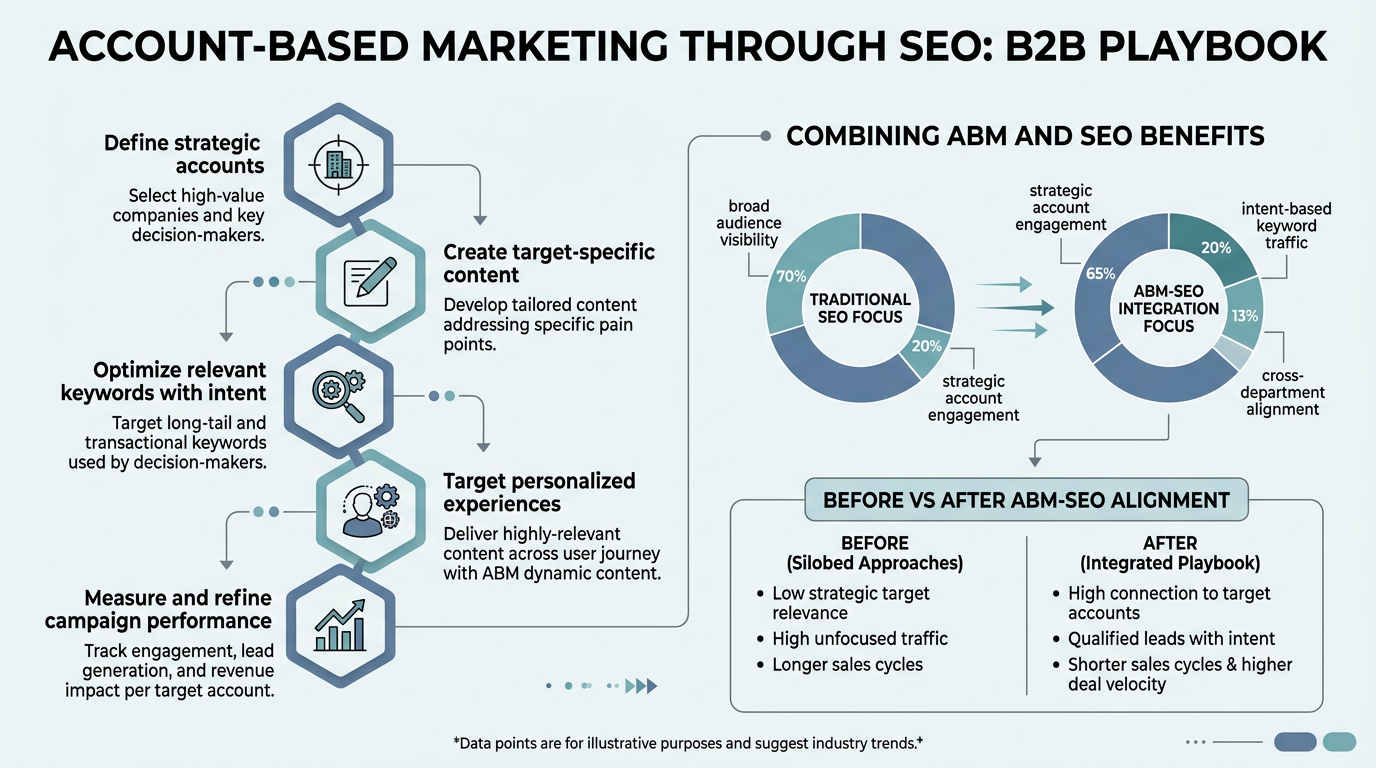
Traditional B2B SEO targets broad keywords. ABM SEO targets specific accounts. The shift feels small but creates massive compounding returns. Instead of writing generic "enterprise software" content, you write content designed to influence Acme Corp's finance team, IT director, and CEO as they research. According to research from G2 on ABM statistics, companies implementing ABM see 2–3x higher win rates against traditional lead-centric teams because every touchpoint reinforces relevance.
"ABM SEO doesn't compete on keyword volume — it competes on relevance to your ICP's actual use case. When your content speaks directly to Acme Corp's pain points, not generic industry problems, you own that account's research journey."
— B2B SaaS Marketing Director, 2025
The Reverse Funnel: Accounts Before Keywords
Start with your sales team's target account list, not a keyword planner. Ask: Which companies are we pursuing? What are their industries, company sizes, revenue, and pain points? Who sits in the buying group — CFO, CTO, VP of Ops? This clarity becomes your SEO north star. Once you understand your accounts, you reverse-engineer the keywords those people actually search for when solving problems. This reframes SEO from "cast a wide net" to "own the research journey of your best-fit customers." Marketing teams that do this first see account engagement lift by 40–60% within 90 days because content feels laser-focused rather than generic.
Why Organic Search Powers ABM
Buying groups begin research long before contacting sales. Prospects conduct 50+ searches across awareness, comparison, and vendor-evaluation phases. If you don't own the organic search results for the keywords that matter to your target accounts, competitors capture that early-stage attention. SEO compounds ABM because it does the awareness heavy-lifting asynchronously. Your content works 24/7, influencing prospects at 2 AM when they're Googling "How to reduce customer churn in SaaS" or "CRM for agencies." Pair that with your sales team's personalized outreach, and you create a synchronized demand engine.
Building Your Account and Persona Foundation
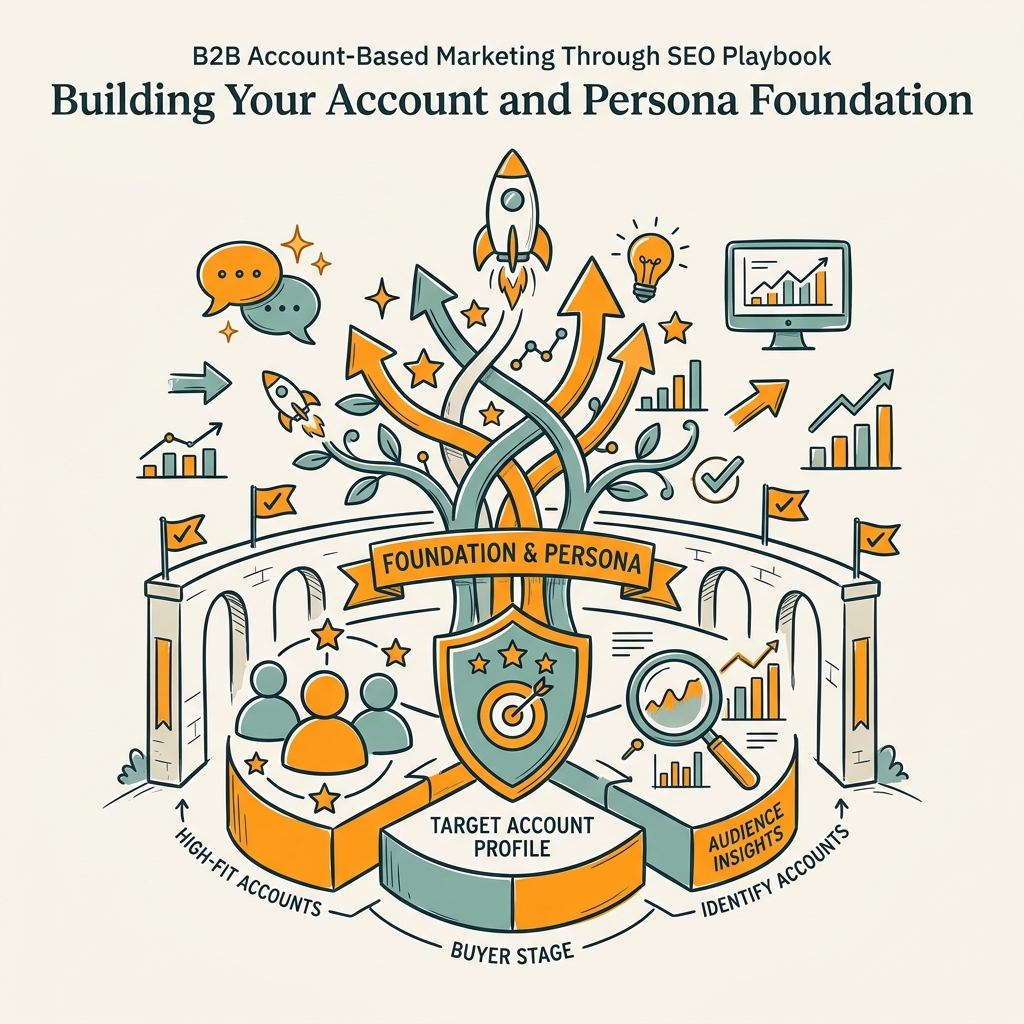
Successful ABM SEO hinges on clarity. 73% of companies report better sales-marketing alignment when they define their ICP and buying group together, according to ITSMA's ABM research. Vague targeting kills ROI because you can't write content that resonates. This section walks you through defining the accounts and personas that will guide every keyword research and content decision downstream.
Create a Target Account List (TAL) and Ideal Customer Profile (ICP)
Start narrow. Most teams fail at ABM because they target too many accounts. Focus on 10–50 high-value companies initially. Work with your sales team to identify their best customers: the ones with the highest lifetime value, fastest sales cycles, and best product-market fit. Document their industry, company size, revenue range, location, and growth stage. Then define your Ideal Customer Profile — the attributes that correlate with your best deals. An ICP might look like: SaaS companies, Series A to C funded, $2M–$50M ARR, selling B2B, with 20–200 employees, in vertical software. Once your ICP is locked, every SEO decision flows from it: Which keywords does an ICP buyer search? What content does that buyer trust? When do they enter a buying cycle?
"The teams that win at ABM SEO aren't the ones writing the most content. They're the ones writing the most relevant content for their specific buying groups. A finance stakeholder and a technical stakeholder need different resources, presented at different times."
— SaaS Growth Strategist, 2025
Map the Buying Group and Decision-Making Criteria
Buying groups are complex. Enterprise deals typically involve 5–8 stakeholders: finance, technical, operations, security, executive leadership. Each role has different concerns, priorities, and search behaviors. A CFO searches for "ROI and implementation cost." A CTO searches for "integration capabilities and API documentation." A VP Ops searches for "user adoption and training resources." Your content strategy must address all three. Create content clusters that speak to each stakeholder's language and pain point. This is where ABM SEO becomes an asset: instead of one blog post on "Why Our Tool Is Best," you write separate resources: "How to Justify [Product] to Finance," "Technical Integration Guide for CTOs," "Reducing Churn Through [Feature]." Each piece ranks for stakeholder-specific queries and educates the buying group collectively.
Mapping the Buying Journey With SEO Keywords
ABM content serves the full buying cycle, from initial problem awareness through post-purchase. High-touch ABM achieves 94% conversion rates through coordinated touches across email, ads, sales calls, and content. SEO is one of those touches — perhaps the most scalable one. By mapping keywords to each buying phase, you ensure your organic visibility aligns with where prospects actually are in their evaluation journey.
Awareness Stage: Building ICP Problem Recognition
At the start, your target accounts don't know they have a problem — or that your solution exists. Awareness-stage SEO targets broad problem keywords that resonate with ICPs. For a SaaS retention platform, this might be:
- "How to reduce SaaS customer churn"
- "Why customers cancel subscriptions"
- "Improving customer lifetime value"
- "Cohort analysis for retention"
These queries attract your ICP but cast a wide net. The goal is to be visible for problem-adjacent searches that make buying groups think, "Oh, we have this issue." You build topical authority here through pillar content, long-form guides, and case studies. A team using tools like autonomous SEO systems can publish daily guides around awareness-stage topics without bottlenecking on writer capacity.
Consideration Stage: Competitive Positioning Through Comparison Content
Once a buying group recognizes the problem, they evaluate solutions. Consideration keywords become specific:
- "Best customer retention tools"
- "[Competitor] vs [Your Product]"
- "Customer retention software for SaaS"
- "Churn reduction strategies"
This stage is where vertical-specific content shines. Instead of generic comparison content, you publish "Retention Software for B2B SaaS vs Vertical SaaS" and "Why Agencies Choose [Your Product] Over [Competitor]." You're not competing on keyword volume here — you're competing on relevance to your ICP's actual use case. Content hubs around specific verticals outrank one-off comparison posts because they signal topical authority. Your sales team can also seed these pages into buying-group conversations, making SEO a conversation starter instead of just background noise.
Decision Stage: Converting the Buying Group Through Resource Content
Decision-stage keywords are short and intent-heavy:
- "[Your Product] pricing"
- "[Your Product] free trial"
- "How to implement [Your Product]"
- "ROI calculator for [Category]"
These target prospects ready to buy. Decision content includes technical guides, implementation checklists, ROI calculators, pricing pages, and customer stories. Here's where alignment with sales matters most. Your sales team should know which decision-stage content ranks for which accounts. If you rank #1 for "Churn reduction ROI calculator for SaaS," that keyword is pulling from your ICP. Decision content converts 3–5x better than awareness content because intent is explicit.
Creating Vertical-Specific Content and Landing Pages
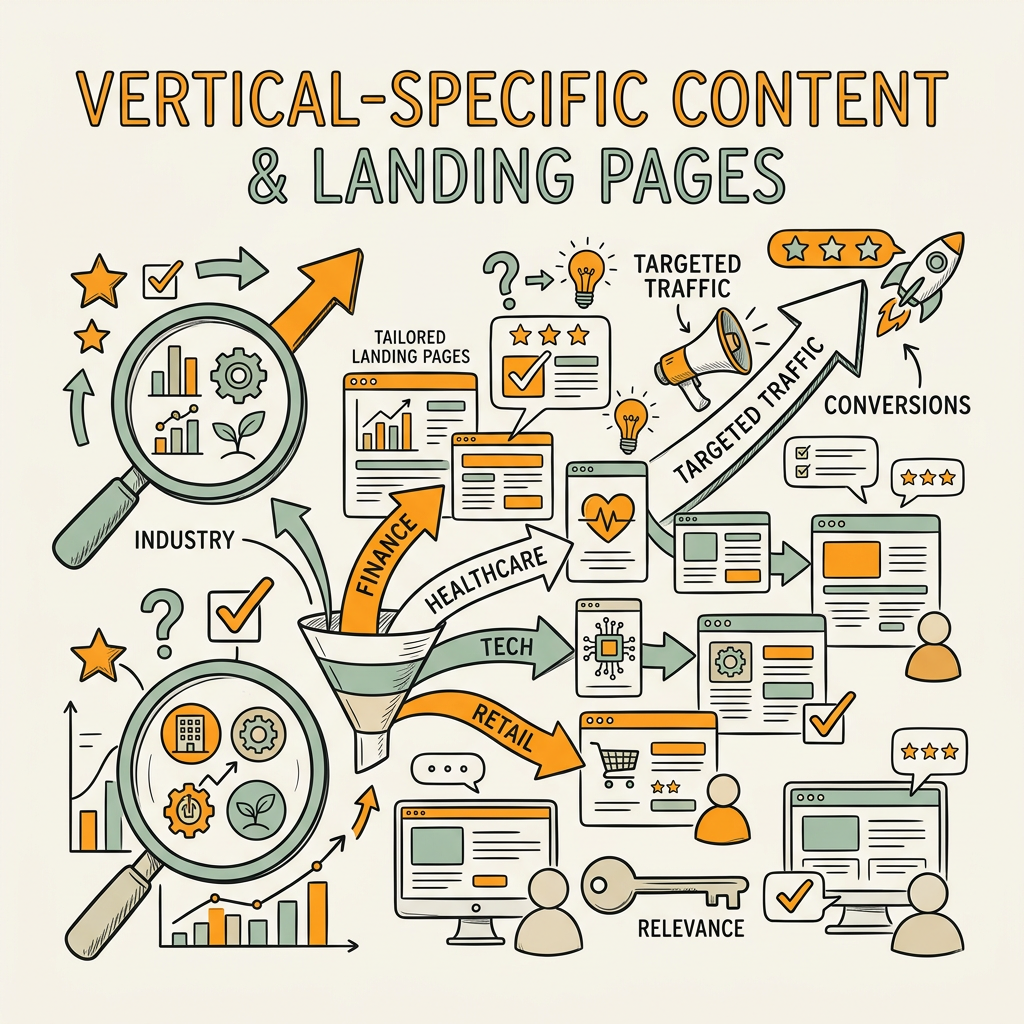
Generic content fails ABM. Personalized messaging drives 20% higher engagement and 10–15% better conversion rates, but personalization at scale requires systems, not heroics. The leverage play is vertical-specific content pages and landing pages designed for each industry segment or use case in your TAL.
Build Content Hubs Around Account Verticals
Instead of one blog covering "Churn Management," publish 5–8 vertical-specific guides:
- "Churn Reduction for B2B SaaS"
- "Reducing Churn in Vertical Software"
- "SaaS Retention for Marketplaces"
- "Customer Lifetime Value in Subscription Fitness"
- "Reducing Churn in Financial Services"
- "Retention Strategies for B2B Agencies"
Each hub clusters 8–12 interlinked posts around industry-specific challenges. A fintech customer reads the fintech hub. An agency reads the agency hub. This creates perceived authority within each vertical and improves topical relevance for the keywords your actual ICPs search. Publishing this volume manually is impossible; automation tools let you scale vertical content without hiring five writers. Jottler handles this by researching, writing, and publishing industry-specific content clusters daily, compounding organic visibility across multiple verticals simultaneously.
Craft Landing Pages That Address Stakeholder-Specific Concerns
A product landing page for "Enterprise SaaS Retention" serves finance. A technical landing page serves CTOs. A case study serves operations leaders. Build 3–5 landing page variants keyed to different buyer personas and buyer phases. Each page optimizes for different keywords and addresses different pain points:
- Finance-focused landing page: ROI metrics, implementation timeline, cost-benefit analysis
- Technical landing page: API documentation, integration complexity, security certifications
- Operations landing page: User adoption rates, onboarding resources, success metrics
- Executive landing page: Business impact, competitive advantage, customer testimonials
These pages don't compete with each other; they carve up the buying group into segments. Internal linking between pages creates a buying-group journey: Finance persona → [Finance Landing Page] → Technical Integration Guide → Case Study → Pricing/Trial. This internal linking structure mimics how buying groups actually make decisions — by passing information between roles.
Alignment of SEO, Sales Outreach, and Content Cadence
ABM fails when marketing and sales operate in silos. Companies using ABM with aligned sales and marketing see 73% better execution and 2–3x higher win rates. In the context of SEO, alignment means timing your content pushes to match your sales team's outbound campaigns and ensuring both teams know which keywords and pages matter most to each account.
Coordinate Publishing Cadence With Sales Sequences
When sales is launching an outbound campaign to 20 high-value accounts, marketing should simultaneously publish content addressing those accounts' core pain points. If your sales team is targeting insurance companies, publish "How to Integrate Our Platform With Insurance Workflows" that week. This ensures when a prospect Googles "insurance CRM integration," your content (and sales team) are visible simultaneously. Sales can reference your organic ranking in emails: "I saw your team researching X — here's our detailed guide." This coordination transforms SEO from background noise to active conversation starter. Automating content production allows you to respond to sales inputs in real time, publishing vertical- and account-specific content on demand rather than through quarterly planning cycles.
Create Content + Sales Handoff Protocols
Establish which buying-group roles get which content. Sales should have a shared doc mapping personas to landing pages, vertical hubs, and case studies. When sales is in a prospect conversation about churn reduction, they know: "Marketing published a B2B SaaS churn guide last month that ranks #2 for 'customer retention strategies.' Let me share that." This small handoff prevents sales from sending random blog posts and ensures content distribution is strategic. It also gives marketing feedback: if sales constantly asks for "ROI calculator content," marketing knows to prioritize that content type. ABM only works when feedback loops exist between sales and marketing.
Measuring ABM-SEO Performance and Attribution
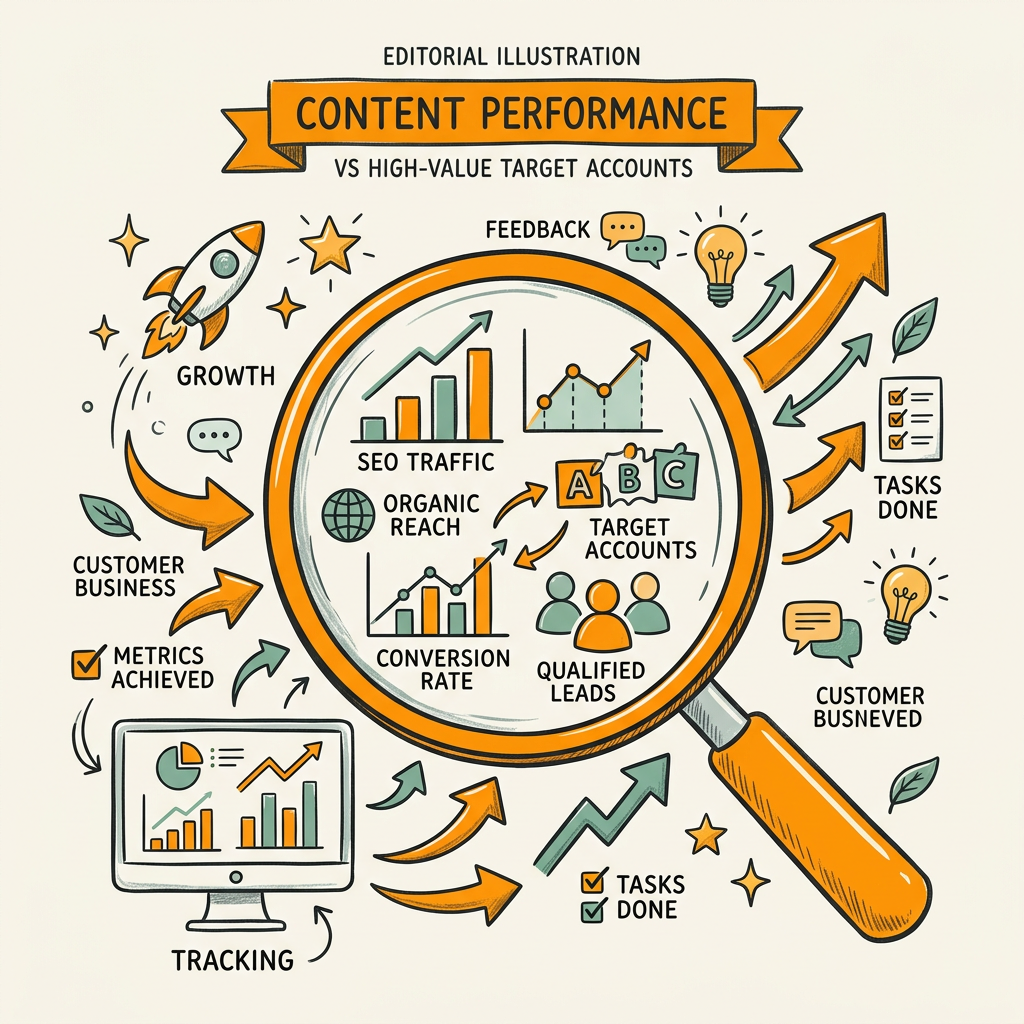
Most teams measure SEO in isolation: traffic, rankings, clicks. ABM SEO measurement is different. High-maturity ABM programs achieve 5–9x ROI on average, with top performers seeing 200% larger deal sizes because they track account engagement, not just lead volume. This requires different metrics.
Account Engagement Score Instead of MQL Volume
Track which target accounts (accounts in your TAL) are engaging with your SEO content. A visit from a company in your TAL is worth 10x a visit from a random domain. Use web analytics tools (HubSpot, 6sense, Terminus) to identify accounts visiting your site. Build dashboards showing which TAL accounts engaged with which content, and when. Over time, you'll see patterns: "Acme Corp visited our churn guide, then our ROI calculator, then our pricing page over 2 weeks." That's a prospect in motion. Correlate this engagement sequence with deal creation in your CRM. Did Acme Corp become an opportunity 1 week after that engagement sequence? That's ABM SEO working. Traditional metrics like "traffic" miss this entirely.
Pipeline Influence and Sales-Cycle Acceleration
Track influence, not just attribution. When an account visits your website via organic search, they don't always convert immediately. But they might have entered a buying cycle 2 weeks earlier. Work with your sales team to tag which opportunities included a target account that had prior organic engagement. Over time, you'll see the pattern: "80% of our opportunities with Acme, BigCorp, and Zenith started with organic engagement." This is influence. Pipeline-velocity acceleration is another ABM SEO metric: do deals move faster when an account engaged with your content early? If prospects who saw your awareness-stage content move 20% faster through sales cycle, that's ROI. Research shows that CRM + MAP + predictive integration yields 22%+ pipeline conversion, versus 14% for limited integration. The tech stack matters, but so does the discipline of tracking accounts, not just leads.
Tools and Systems for Scaling ABM SEO
Scaling ABM SEO by hand is impossible. You need systems that handle keyword research, content creation, internal linking, and account-level attribution in parallel. Most teams get stuck trying to manually create vertical-specific content, coordinate with sales, and measure account engagement. The playbook above requires infrastructure.
Automating Content Production for Multiple Verticals
Publishing awareness, consideration, and decision content for each vertical requires daily publishing. Teams that automate SEO content outrank competitors 3–5x faster because they compound organic visibility over months. This is where AI-powered content platforms become essential. Instead of writing one guide per week, you publish 5 vertical variants weekly, each optimized for different personas and keywords. A specialized AI content tool researches, writes, fact-checks, and publishes these pages daily without human writer bottlenecks. The key feature: AI agents should understand your target ICPs and verticals, so content is automatically relevant instead of generically written.
Integrating Intent Data and First-Party Account Recognition
Modern ABM SEO relies on knowing who's visiting your site. Intent data platforms (6sense, Demandbase, Terminus) identify account visitors in real-time. When someone from a TAL account visits your site, you know immediately and can trigger sales workflows. First-party account recognition (no third-party cookies) requires robust analytics setup: firmographic data in your CMS, Linkedin Account Insights, DNS registrations, and behavioral triggers. Sales and marketing should have live dashboards showing account engagement. When an account moves from "visited one page" to "visited 5 pages across 3 days," that's a buying-cycle indicator.
Comparison: Manual ABM SEO vs. Automated Systems
| Process | Manual Approach | Automated Approach (e.g., Jottler) |
|---|---|---|
| Keyword Research | 1–2 weeks per vertical, 20–30 keywords/vertical | Continuous research across 50+ keywords/vertical, updated weekly |
| Content Writing | 1 article per week, 1–2 writers bottleneck | 3–5 articles per day across multiple verticals |
| Internal Linking | Manual linking between pages, inconsistent | Automated linking strategy, 10+ links per article |
| Account Attribution | Monthly manual review of CRM and GA | Real-time account-level dashboards, automated scoring |
| Sales Coordination | Weekly meetings, static content inventory | Daily updated content calendar, real-time sharing |
| Time to Results | 6–9 months to see account engagement patterns | 6–12 weeks to first account engagement spikes |
The playbook above requires scale. Manual execution compounds slowly. Consistent daily publishing is what drives ABM SEO results because you're compounding organic visibility across multiple account verticals and keywords simultaneously. Without automation, you'll write 50 articles over a year. With automation, you publish 1,500+ articles over the same period, capturing 10–20x more account keyword traffic.
Common ABM SEO Mistakes and How to Avoid Them
Most teams underperform ABM SEO because they skip foundational steps. Here are the mistakes that cost the most and how to fix them before they derail your program.
Building Content Before Defining Accounts
The single biggest mistake: publishing content before your sales team defines target accounts. This leads to generic content that ranks but doesn't engage your ICP. You spend 3 months publishing "SaaS" content only to realize your actual targets are "mid-market vertical SaaS with 20–200 employees." All that content misses. Always start with account definition. Work with your VP Sales to lock your TAL, ICP, and buying group personas before your marketing team writes a word. This alignment step takes 1–2 weeks but saves months of wasted content.
Ignoring the Buying Group Structure
Writing one landing page for "Enterprise SaaS" assumes everyone in the buying group has the same concerns. They don't. A CFO cares about ROI and implementation timeline. A CTO cares about API integration and security. A VP Operations cares about user adoption. Teams that ignore this structure write generic content that satisfies no one. Create separate landing pages and content hubs for each key stakeholder role. It feels like more work upfront, but it dramatically improves conversion.
Failing to Coordinate With Sales
If your sales team doesn't know your top-ranking content exists, it won't help them. Worse, sales sends generic competitor content to prospects instead of your proprietary resources. Create a shared content inventory accessible to sales. Tag content by persona, vertical, and buying stage. Train sales on which content to share at which points in the conversation. When sales references your organic ranking in outreach, conversion probability jumps 30–50%.
Conclusion
Account-based marketing through SEO is the highest-ROI B2B strategy available today. Companies achieving ABM maturity see 137% average ROI and deal sizes 200% larger than lead-centric approaches. The playbook is straightforward: define your target accounts and buying groups, map SEO content to their research journey, publish vertical-specific content at scale, align sales and marketing, and measure account engagement instead of generic metrics. 71% of B2B marketers are already using ABM — the gap between leaders and laggards is execution speed. Teams that publish daily, coordinate with sales, and track account-level engagement compound results exponentially. Those publishing weekly or monthly watch competitors pull ahead.
The tools and scale required to execute this playbook have changed. Manual publishing limits you to 50 articles per year. Daily publishing compounds to 1,500+, capturing 10–20x more account keyword traffic. Start your SEO agent today to automate the research, writing, and internal linking across multiple verticals, and watch your target accounts find you during their research phase — weeks before sales gets involved.
FAQs
What's the difference between ABM and traditional B2B lead generation?
Traditional lead generation casts a wide net: publish content, attract anonymous traffic, convert visitors into leads via email. ABM flips the funnel: start with your list of target accounts, create content designed for those accounts' buying groups, and measure account engagement instead of lead volume. The result? ABM delivers 137% average ROI versus 76% for traditional lead-gen, with deals that are 200% larger. ABM is not faster (sales cycles stay long), but it's higher-value because you're only pursuing accounts you can actually win.
How many target accounts should I start ABM SEO with?
Start with 10–50 accounts, not 500. Teams often try to ABM too many accounts and dilute effectiveness. Work with sales to identify their best customers: highest lifetime value, fastest sales cycles, best product-market fit. Document their industry, size, revenue, and geography. Once you lock this list, every content decision (keywords, landing pages, internal linking) flows from it. You can expand to 100–200 accounts as your content production scales, but narrow focus compounds faster. A tight TAL means higher relevance, better conversion, and faster pattern recognition when measuring which content influences which accounts.
How long does it take to see results from ABM SEO?
First account engagement typically appears within 6–12 weeks if you're publishing daily content at scale. You'll see which accounts visit your site, when, and what content they consumed. Pipeline impact takes longer — usually 4–6 months — because deals move slowly. But teams that coordinate content with sales can accelerate this: if sales references your organic content in outreach, deal cycles compress by 20–30%. The bottleneck for most teams is content production speed. Manually writing 3–5 articles per week caps your velocity. Publishing 5–10 articles per day (vertical-specific variants) compounds visibility across all target accounts 10–20x faster, reducing time-to-pipeline-impact from 6 months to 2–3 months.