AI Content Generators vs. Human Writers: Which Wins for SaaS
Here's the paradox SaaS teams face: AI can generate a full article in 16 minutes, while human writers need about 69 minutes. Yet human-written content drives 5.44 times more traffic on average. So which one should busy founders invest in? The answer isn't either/or—it's knowing when each excels and how to combine them for maximum ROI on your content budget.
Key Takeaways
- Human-written content outperforms AI content by 5.44× in organic traffic (SuperAGI, 2025)
- 94% of marketers now plan to use AI for content creation, but hybrid workflows outperform AI-only approaches
- AI wins on speed and scale; humans win on trust, originality, and engagement (41% longer session duration)
- Speed vs. Quality Trade-off: AI produces drafts in minutes, but human editorial oversight is needed for trust and ranking power.
- Adoption Reality: 80% of marketers now use AI for content, yet long-form human-expert content still dominates high-value SaaS conversions.
- The Hybrid Edge: AI for ideation and drafting, human for fact-checking and voice—this combination drives 3.4× more qualified pipeline than product-only pages.
- Trust and Authority Matter: Buyers consume 79% more vendor content before sales conversations now, and originality is the deciding factor.
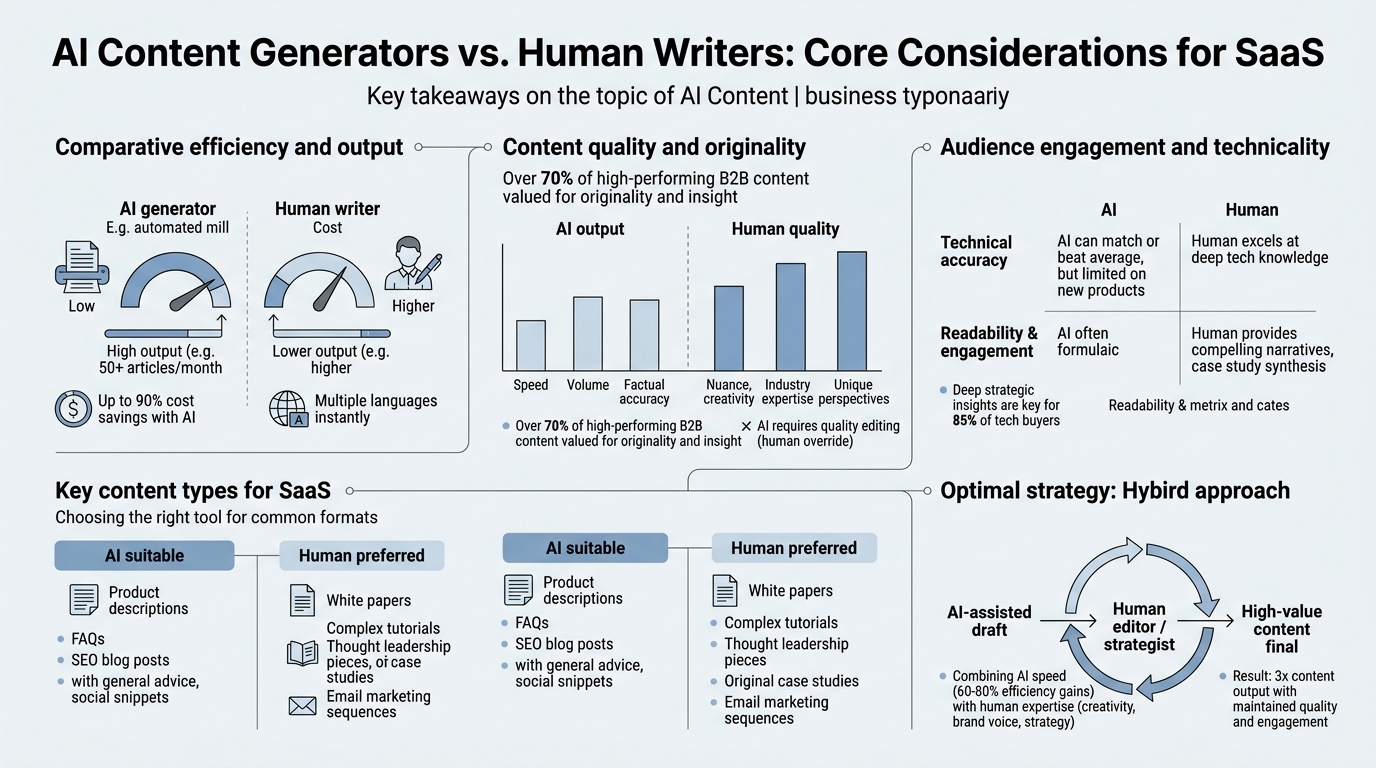
The Raw Numbers: Where AI and Human Writing Actually Differ
The comparison comes down to measurable outcomes. AI content generators produce articles in about 16 minutes, versus the 69 minutes a skilled human writer typically requires. That's a 5–10× speed advantage for AI. On the flip side, human-written content receives approximately 5.44 times more organic traffic in side-by-side studies, and readers stay on pages with human content about 41% longer than AI-generated equivalents. According to research from SuperAGI's analysis of AI vs. human writing efficiency, this gap reflects fundamental differences in how readers engage with authentic voice versus algorithmic output.
"The gap between AI and human-written content isn't small. It's the difference between publishing 30 mediocre pieces and 5 high-performing ones. For SaaS teams with limited time, the question becomes: Can you afford the speed of AI if the quality trade-off kills your SEO momentum?"
Why Speed Alone Doesn't Equal Growth
Volume without authority is just noise in the SaaS space. 79% of B2B buyers now consume at least five vendor-produced content pieces before speaking to sales—up from 67% in 2024. But not all content is equal. Long-form technical guides and original research generate 3.4 times more qualified pipeline than lightweight product-focused landing pages. That advantage goes entirely to human-quality content.
What matters is where you publish, not how fast you publish. Pure AI content often struggles in high-competition niches where expertise and perspective are table stakes. A founder reading AI-generated content about SEO audits can tell the difference immediately—it lacks the specificity, the battle scars, the unconventional insights that come from actually doing the work.
Engagement and Dwell Time Favor Humans
Google's ranking algorithms care about user behavior signals: bounce rate, time on page, return visits. Human-written content consistently shows 41% longer session duration than AI-generated alternatives. The reason is simple: humans write with voice, vulnerability, and unexpected conclusions. AI writes with structure and predictability—which is efficient, but it's also forgettable.
For SaaS, where the goal is to build trust before the sales conversation, that dwell time matters. A buyer who spends five minutes on your explainer article instead of two is more likely to convert later. They felt something. They learned something specific. They didn't feel like they were reading a template.
Why AI Content Generators Win at Scale and Speed
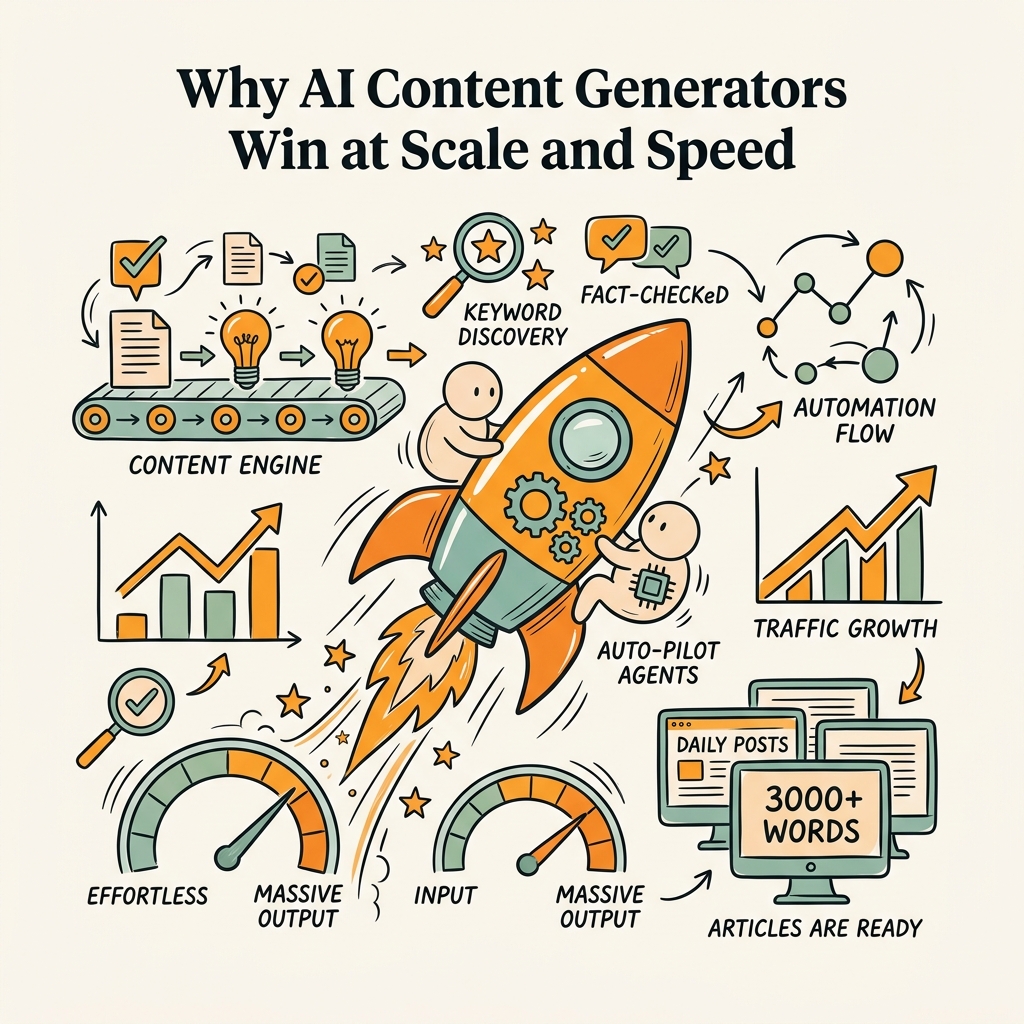
AI's advantage isn't in quality—it's in operation. When you need to cover 100 keyword variations, test multiple angles quickly, or fill content gaps across your entire product suite, AI is unbeatable. 94% of marketers now plan to use AI for content creation, and the adoption isn't slowing. For SaaS teams, the appeal is clear: unlimited production without hiring.
Tools powered by large language models can research, draft, and structure articles without human intervention. They don't need caffeine breaks or health insurance. They never miss a deadline. For founder-led companies or lean marketing teams, that's genuinely transformative. HubSpot's 2026 marketing data confirms that adoption of AI for content creation is accelerating, particularly among SaaS and tech companies competing on speed.
"For founder-led companies or lean marketing teams, AI's ability to produce unlimited content without hiring is genuinely transformative. The economic advantage is undeniable—but only when paired with appropriate human oversight."
Ideal Use Cases for AI Content Generators
AI excels at specific, repeatable tasks. Use AI for:
- Content briefs and outlines: AI can synthesize competitor research, keyword data, and your own insights into a structured outline in minutes.
- First drafts and expansion: Give AI a strong outline and it will produce 80% of the prose. Your writers then refine and personalize.
- FAQ and resource content: Repetitive, factual content like FAQs, product comparison tables, and glossaries are ideal for AI.
- Content repurposing: One authoritative blog post can become 10 social snippets, email sequences, and sidebar callouts with AI assistance.
- Media generation: 75% of marketers now use AI for image and video creation alongside text, which speeds production cycles massively.
The Economics of AI: Saving Time Without Sacrificing Quality
The cost math is compelling. A freelance SaaS writer typically charges $100–300 per article depending on depth and expertise. AI tools run $29–500 per month. At volume, that's a 10–50× cost advantage. But here's the catch: you still need someone to edit, fact-check, and optimize those AI drafts. The time savings are real, but they're partial, not total.
Where AI becomes genuinely economical is when you pair it with lightweight human review. Content automation tools that handle research, drafting, fact-checking, and publishing in one pipeline can reduce your per-article cost and turnaround time dramatically—provided the underlying AI quality is strong and the fact-checking actually works.
Where Human Writers Still Own the Game
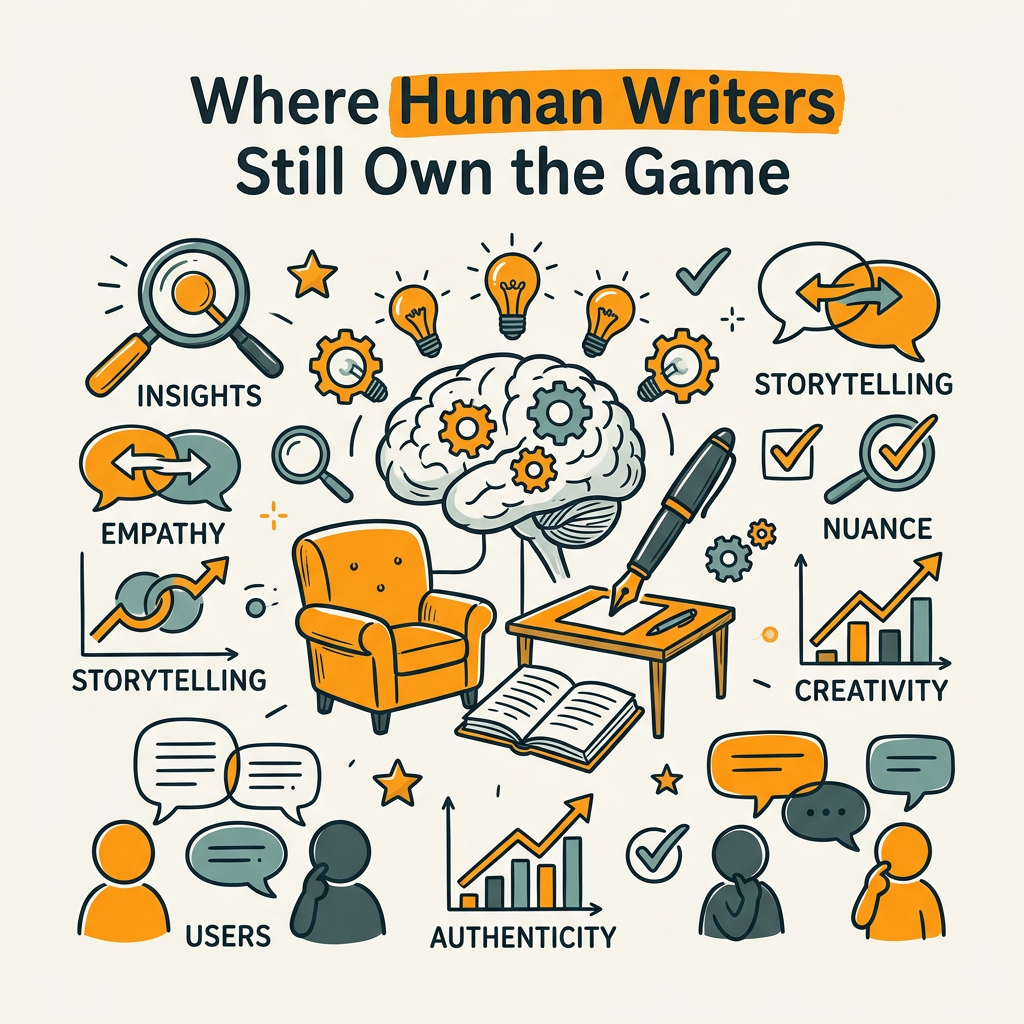
Human writers bring three things AI struggles with: originality, authority, and emotional resonance. In SaaS specifically, these aren't luxuries—they're lead magnets. A well-researched, genuinely insightful blog post from a founder or subject matter expert becomes a competitive moat. AI can't replicate that.
Original Research and Unique Perspective
The most cited SaaS content pieces come from original research: surveys, case studies, proprietary data analysis. When you conduct original research—even simple customer surveys or usage analysis—you own insights that competitors can't copy. AI can write about existing research, but it can't conduct research. It can't run experiments, interview customers, or uncover surprising patterns in your own data.
For content that moves the needle in SaaS, invest human effort here first. Use AI to scale the distribution and commentary around that insight, but the insight itself has to be human-generated.
Trust and Authority Signals
B2B buying decisions hinge on trust. When a potential customer lands on your content, they're evaluating both the information and your credibility to provide it. A byline matters. "Written by Sarah Chen, VP of Product at [Company]" creates trust that "Generated by GPT-4" simply cannot. Readers—and Google—still value human authority.
Research on linguistic patterns between human and AI-generated content shows that AI text is more formal and standardized, while human text retains broader emotional and stylistic range. In practice, that means human writing feels more authentic. It has personality. It's the difference between reading a template and reading a conversation.
Handling Nuance and Complexity
SaaS products are complex. Sales cycles involve multiple stakeholders with conflicting priorities. Implementation has edge cases. Customer success is messy. Human writers can navigate that nuance because they've lived it. AI tends to oversimplify, generalize, or miss the exceptions that matter to your specific buyer persona.
When you're writing a technical guide or a comparison piece where getting the details wrong could hurt credibility, human expertise is non-negotiable. A human writer will call out caveats, competing viewpoints, and tradeoffs. AI will give you the safe middle ground.
The Hybrid Model: How to Actually Win
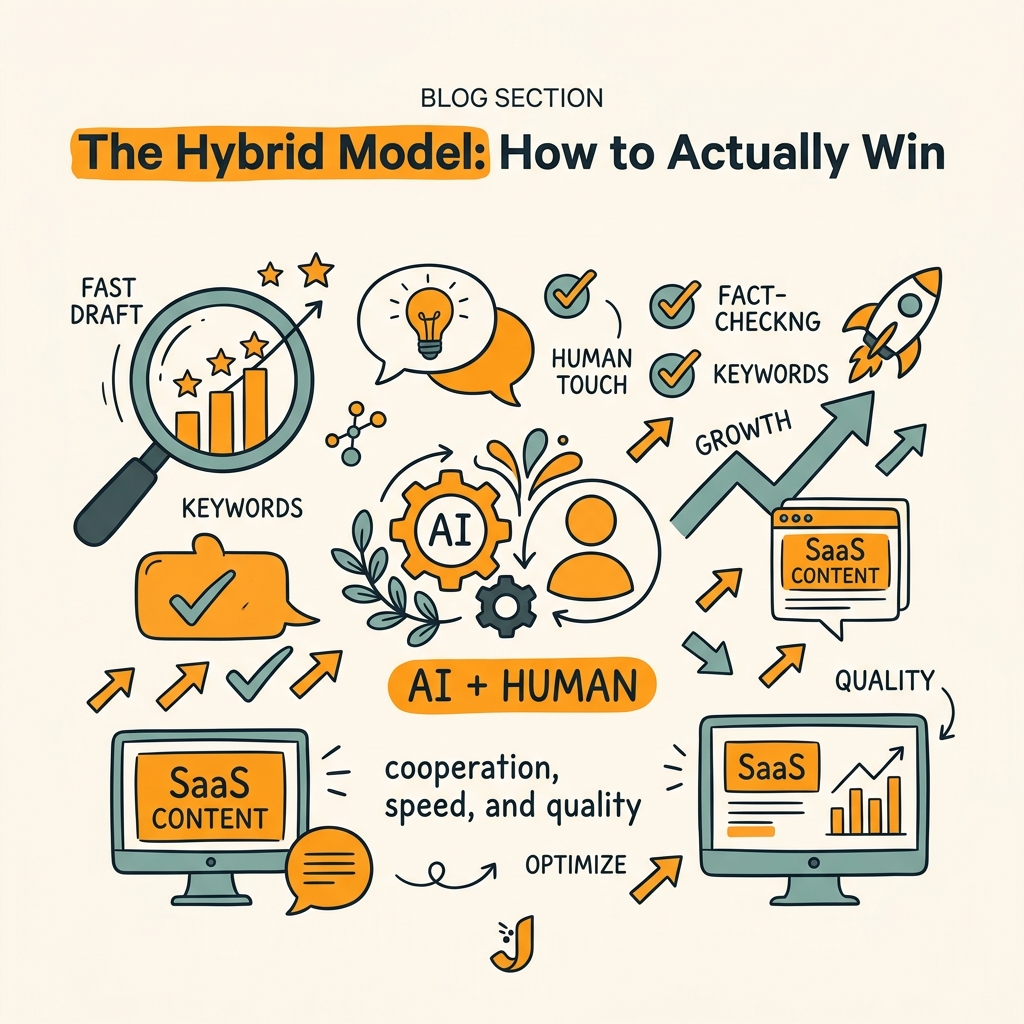
The real answer isn't AI or human. It's AI and human, structured as a workflow. Most best-in-class SaaS content teams in 2026 are building hybrid pipelines: AI handles research aggregation, outlining, and first-draft production. Humans provide strategy, fact-checking, original insight, and final editorial polish.
The Optimal Content Workflow
Here's a production model that works for lean SaaS teams:
- Strategy and research (human): Define the keyword, buyer intent, and angle. What are we trying to prove or teach?
- Brief creation (human + AI): Outline the article structure, key points, and SEO elements. AI can accelerate outline creation from research.
- First draft (AI): Generate long-form content based on the brief. This takes 15–30 minutes instead of 8 hours.
- Fact-check and edit (human): Verify all statistics, quotes, and claims. Rewrite for voice and originality. This is the quality gate.
- SEO optimization (human + AI): Adjust headings, internal links, and call-to-action. AI can suggest internal links; humans decide which ones fit.
- Publish and monitor (automation): Post to CMS, distribute to email/social, and track performance metrics.
This workflow cuts production time from 16 hours per article to about 4–5 hours of human effort, plus AI processing. You get speed without sacrificing trust. SEO automation that includes fact-checking and research verification is critical here—many AI tools skip this step, which is why pure AI content often has credibility problems.
When to Hire Freelance Humans vs. Automate with AI
For consistent SaaS content marketing, the calculation is straightforward:
- Hire a human writer if: You need original research, expert-level insights, or niche technical depth. Invest in 2–4 high-quality pieces per month from skilled writers.
- Use AI for: Scaling coverage of adjacent topics, repurposing core ideas, filling keyword gaps, and generating FAQ and resource content.
- Automate the workflow if: You can commit to publishing 3+ articles per week. Automation becomes ROI-positive at volume.
For early-stage SaaS with limited budget, start with one excellent human writer producing 1–2 pieces per week, supported by AI drafting tools. As you scale and prove ROI on content, add automation to expand volume without losing the human quality layer.
Building a Fact-Checking Discipline into AI Workflows
The biggest risk in AI content is hallucinations—false statistics, misquoted sources, or fabricated claims. Even excellent AI tools make mistakes. Your editorial checklist must include:
- Verify every statistic against the original source
- Check all product features or integrations claimed in the piece
- Confirm quoted experts or their affiliations
- Validate any SEO claims or technical assertions
- Ensure internal links actually exist and are relevant
This checklist takes 20–30 minutes per article but it's the difference between content that ranks and content that tanks your credibility. AI can generate the draft. Humans must verify the facts.
The SaaS Content Opportunity in 2026
SaaS buying has fundamentally changed. Buyers now consume significantly more vendor content before any sales interaction, and they're comparing multiple solutions based on the quality of educational resources available. That shift favors companies with excellent content—whether that content comes from AI, humans, or both.
The competitive advantage goes to teams that use AI to compress timelines without sacrificing quality. You can now produce the volume of a 10-person content team with 2 people and the right tools. But you still need those 2 people to make decisions, edit, and ensure accuracy.
Why Busy Founders Should Automate Content Strategically
For founder-led SaaS companies, time is the scarcest resource. Automating content research, drafting, and publishing removes the friction that prevents consistent publishing. 45% of marketing teams now use AI agents for automation, up from just 15% in 2024. The trend is clear: automation is moving from optional to baseline.
The goal isn't to replace your thinking. It's to compress the repetitive work—research, outlining, drafting, publishing—so your strategic thinking goes into deciding what to write, not wrestling with how to write it. That's where autonomous SEO agents become powerful tools. They handle the production pipeline, leaving you to focus on strategy and voice.
Comparison: AI vs. Human-Written Content
| Factor | AI Content Generators | Human Writers |
|---|---|---|
| Production Time Per Article | 16 minutes | 69 minutes |
| Organic Traffic Performance | Baseline (1×) | 5.44× higher |
| Average Session Duration | Shorter engagement | 41% longer |
| Monthly Tool Cost | $29–500 | $2,000–6,000 per writer |
| Original Research Capability | No | Yes |
| Authority and Trust Signals | Weak (algorithmic) | Strong (byline, expertise) |
| Fact-Checking Required | Essential | Minimal |
| Best Use Case | Scale, FAQ, repurposing | Core content, thought leadership |
Conclusion
AI content generators and human writers aren't competitors—they're tools for different jobs. AI wins on speed and scale, producing dozens of drafts where humans would struggle with one. Humans win on trust, originality, and the kind of authentic insight that moves complex B2B buying decisions. The data is clear: hybrid workflows outperform pure AI, and SaaS teams that combine both are growing their content pipelines 3–5× faster than teams trying to pick a single approach.
For SaaS founders who need consistent, authoritative content without hiring a full team, the answer is automation with human oversight. Use AI to handle the production volume and repetitive tasks. Use humans for strategy, fact-checking, and the original thinking that becomes your competitive moat. The result? More content, better quality, and a sustainable content engine that scales with your company.
Ready to scale your SaaS content without hiring a team? Start your SEO agent and let AI handle research, writing, and publishing while you focus on strategy.
FAQs
Can AI-generated content really rank on Google?
Yes, but with conditions. Pure AI content often struggles against human-written alternatives in competitive niches because Google's algorithms reward engagement signals—time on page, return visits, conversions—and human content typically outperforms on those metrics. However, AI-generated content that is well-researched, fact-checked, optimized for intent, and includes original data or unique angles can rank perfectly fine. The key is treating AI output as a first draft, not a finished product. Many successful SaaS blogs use AI to scale production while humans ensure quality control and originality.
How much does AI writing cost compared to hiring a human writer?
AI writing tools range from $29–500 per month depending on features and volume, making the per-article cost roughly 90% cheaper than hiring freelance writers at $100–300 per piece. The trade-off is that AI requires editorial oversight—fact-checking, rewriting, and optimization—while human writers deliver more finished work. For SaaS teams, the most cost-effective approach is often a hybrid: use AI to generate drafts at scale, then invest 1–2 hours of human editing per piece. This cuts total production cost roughly in half while maintaining quality standards that human-only approaches would deliver.
Should we hire human writers or just use AI content tools?
The answer depends on your growth stage and content strategy. If you need original research, deep expertise, or brand voice, invest in human writers for your flagship content. If you need consistent volume covering adjacent topics and keyword gaps, AI tools are the faster, more scalable choice. Most high-performing SaaS content programs do both: 20–30% human-written original pieces, 70–80% AI-assisted or AI-generated at scale. This ratio lets you maintain authority and trust on core pieces while compounding reach with volume. As your traffic grows and content becomes a revenue driver, this mix often shifts more toward human involvement for competitive differentiation.