Automating Repetitive SEO Tasks for Efficiency
Most marketing teams waste 15–25 hours per week on repetitive SEO busywork: audits, keyword research, rank tracking, and reporting. A founder manually reviewing rank changes daily, an in-house marketer copying data from Google Search Console into spreadsheets, a content team republishing the same optimization templates across 50 articles—these are the invisible time drains that prevent you from growing organic traffic at scale. The problem isn't a lack of effort. It's that 43% of the time between lead capture and first sales contact is lost to manual process overhead (2026, Digital Applied). Automation flips the equation: 65% reduction in total SEO management time is achievable within 90 days when you put the right systems in place.
Key Takeaways
- Teams using automated SEO workflows save 15–25 hours per week on audits, keyword research, and reporting, recovering over 1,000 hours annually per member (Sedestral, 2026)
- Automated content systems achieve 2.5x increase in indexed keywords within 90 days while cutting content cycles from 15 hours to 3 hours per week (AutoSEO, 2026)
- Automating the right tasks—audits, rank tracking, internal linking—while keeping strategy human-led delivers the fastest ROI and prevents costly ranking losses
- Site Audits and Technical SEO: Automated full-site crawls reduce 20-hour manual audits to 20 minutes with instant actionable recommendations.
- Keyword Research and Gap Analysis: AI-driven tools eliminate 12-hour spreadsheet hunts, surfacing 30-minute research with competitor gaps already highlighted.
- Rank Tracking and Competitive Monitoring: Scheduled rank trackers remove manual spreadsheet updates; alerts notify you of ranking shifts in real time.
- Content Optimization and Publishing: AI agents handle on-page recommendations, internal linking suggestions, and direct CMS publishing, cutting cycles from weeks to hours.
- Reporting and Stakeholder Communication: Automated dashboards pull data from Google Analytics and Search Console daily, eliminating manual reporting work.
Which SEO Tasks Should You Actually Automate?
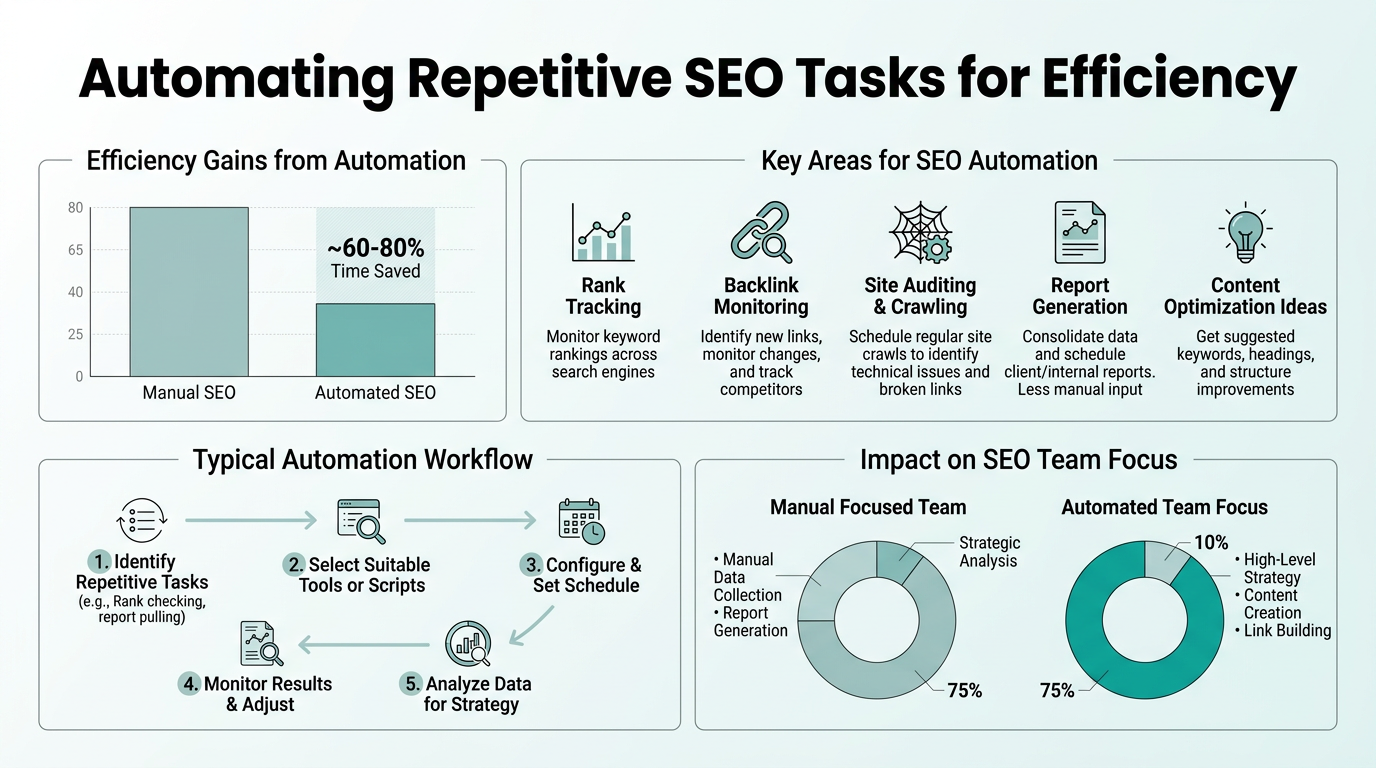
Not every SEO task belongs in automation. The key question: Would you assign this to an intern? Tasks like audits, data analysis, initial research, and report generation are ideal automation targets. Strategic work—keyword strategy, competitor intelligence, content angles, backlink outreach—should stay human-led. The formula that works best is 70% automation + 30% human review. Let tools do the heavy lifting; you handle the final calls and quality gates.
"Automation complements strategy; it doesn't replace it. Expect to spend the first 2-3 weeks setting up your system properly before letting tools run unsupervised."
Repetitive Tasks Worth Automating
Start with tasks that appear on every team member's to-do list at least twice per week. These include site audits (running 20+ hours manually), keyword research in spreadsheets (12+ hours weekly), rank tracking via manual checks, content optimization against competitor benchmarks, and scheduled reporting. Search Engine Land's analysis of SEO automation identifies content gaps, duplicate detection, editorial calendars, and template scaling as quick wins. The common thread? These tasks require no creative judgment—they're data collection and formatting. Automating them frees your best people for strategic decisions. When combined with a comprehensive content automation strategy, these foundational tasks unlock exponential scaling.
Tasks Automation Won't Solve
Automation fails when your underlying system is broken. If you don't have proper conversion tracking, automated audits will miss critical issues. If your keyword strategy is unfocused, automation won't fix it. If you lack organic data density (thin pages, poor internal linking structure), automated reporting becomes noise. Automation complements strategy; it doesn't replace it. Expect to spend the first 2-3 weeks setting up your system properly before letting tools run unsupervised.
How Much Time Does SEO Automation Actually Save?
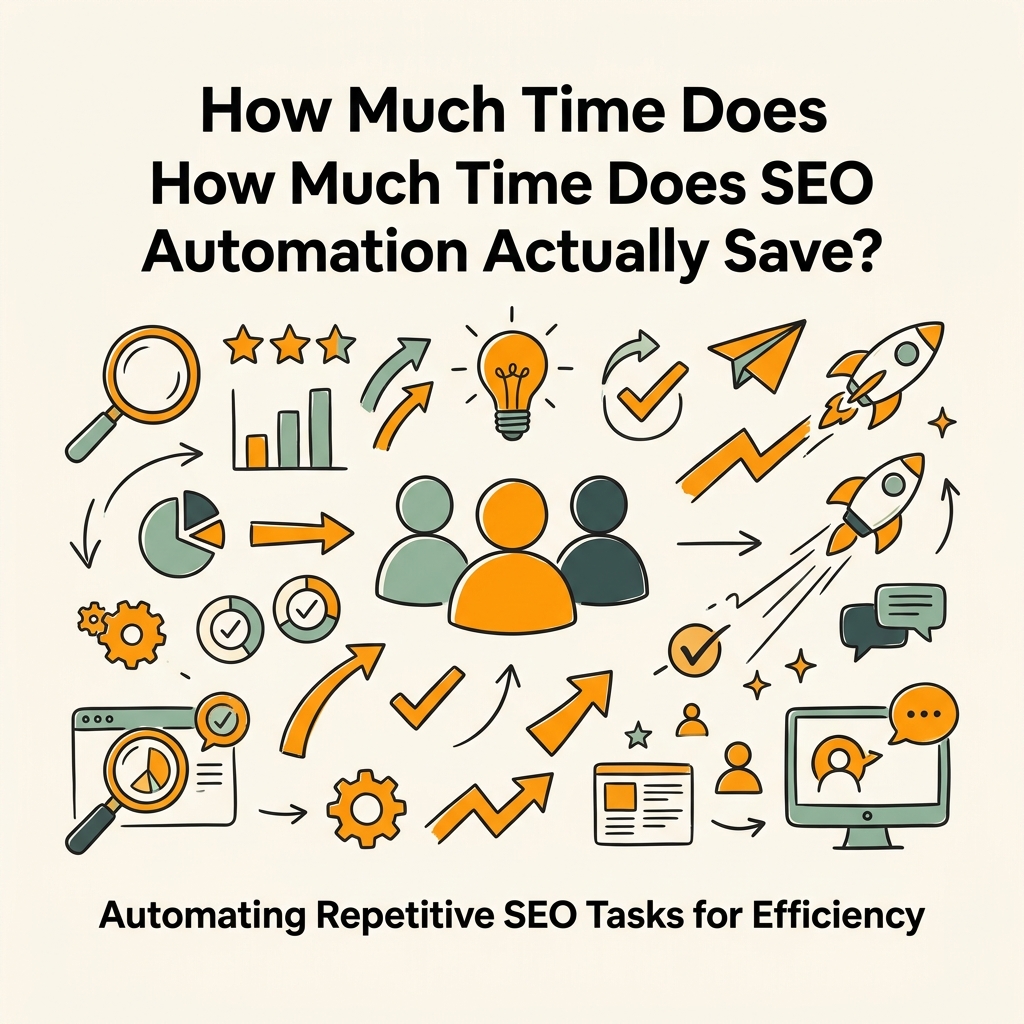
The numbers are substantial and backed by 2026 benchmarks. Sedestral's analysis of SEO automation tools shows site audits drop from 20 hours to 20 minutes per week—a 19.3-hour weekly saving. Keyword research collapses from 12 hours to 30 minutes. Rank tracking eliminates 3–5 hours of spreadsheet updates. For a two-person marketing team, that's 40–60 hours reclaimed monthly. Agencies managing multiple clients report 200+ hours saved quarterly with mature automation stacks.
"Teams achieving 2.5x more indexed keywords within 90 days automate velocity, not just audits. They publish consistently (3–5 articles weekly), automate internal linking based on topic relevance, and use scheduled rank tracking to catch emerging opportunities fast."
What Makes High Performers Different
Teams achieving 2.5x more indexed keywords within 90 days share one trait: they automate velocity, not just audits. They publish consistently (3–5 articles weekly), automate internal linking based on topic relevance, and use scheduled rank tracking to catch emerging opportunities fast. Manual-heavy teams publish 1 article per week and discover ranking wins months after publication. Automated teams see <21 days to first-page rankings because they compound content velocity with real-time topical clustering. This velocity advantage is compounding: by month six, automated teams have published 3x more content, indexed 2.5x more keywords, and captured traffic from 3x more query patterns. That's why autonomous SEO agents that automate research, writing, and publishing accelerate growth faster than tactical tools alone.
The Cost of Not Automating
Every hour spent on manual audits, spreadsheet wrangling, or copy-pasting optimization templates is an hour not spent on strategy, content ideation, or partnership building. If you have one in-house marketer at $65K/year salary, and they spend 15 hours weekly on automatable tasks, that's $15,600 annually burned on busywork. Scale to a small team of three, and you're burning $46,800 per year on repetitive work. Most marketing automation platforms cost under $100–200 monthly, recovering costs within a single month of deployment.
What Tasks to Prioritize First?
You can't automate everything on day one. The winning move is sequencing: start with the tasks saving the most time, then layer in complexity. Your roadmap should reflect two rules: automate high-volume repetitive work first, then add specialized workflows as your confidence grows. Start with three core automations in month one; add five more by month three.
Phase 1: Core Automations (Weeks 1–4)
Site Audits and Technical SEO Monitoring. Set up a weekly or bi-weekly automated crawl covering crawlability, broken links, meta tag gaps, and duplicate content. Tools like Semrush and Screaming Frog can schedule these and alert you to issues automatically. This single automation typically saves 18–20 hours monthly. Rank Tracking with Alerts. Replace manual rank checks with a scheduled tracker monitoring your top 50–100 keywords daily. Set alerts for significant rank shifts (up/down 3+ positions). This catches ranking wins and threats in real time instead of discovering them in next month's report. Automated Reporting Dashboards. Connect Google Analytics and Google Search Console to a dashboard tool (Data Studio, Looker Studio) that updates daily. Pull top performers, traffic trends, and conversion metrics into a single view. This eliminates 4–6 hours weekly of manual report assembly.
Phase 2: Content and Optimization Workflows (Weeks 5–12)
Keyword Research and Content Gap Identification. Use SEO tools' competitor gap analysis features to identify unowned keywords automatically. Pipe results into a shared spreadsheet or project management tool (Airtable, Monday) for review and approval. This replaces 10–12 hours of manual competitive research. Content Optimization Recommendations. Tools like Surfer SEO or Clearscope can analyze top-ranking pages and auto-generate optimization briefs for your writers. This cuts content planning time from 2–3 hours to 30 minutes per article. Internal Linking Automation. Solutions like Jottler handle smart internal linking suggestions based on topical relevance, or even auto-link within your CMS. This prevents the common mistake of isolated content islands and compounds topical authority across your site. Internal linking automation is especially valuable at scale: a 100-article site requires 200–300 manual link reviews; automation reduces that to weekly verification of AI suggestions.
Phase 3: Publishing and Distribution (Month 3+)
Once audit, tracking, and research workflows are stable, layer in publishing automation. This is where AI content generation and SEO automation combine to create true compounding growth. Platforms like Jottler research topics, write full articles, fact-check content, optimize for SEO, and publish directly to your CMS daily. This removes the entire publishing bottleneck for small teams. Instead of a marketer spending 8–10 hours researching and writing one article per week, Jottler publishes 3–5 high-quality, SEO-optimized articles daily—compounding organic traffic 15–20x faster than manual publishing cycles.
Picking the Right Automation Tools for Your Workflow
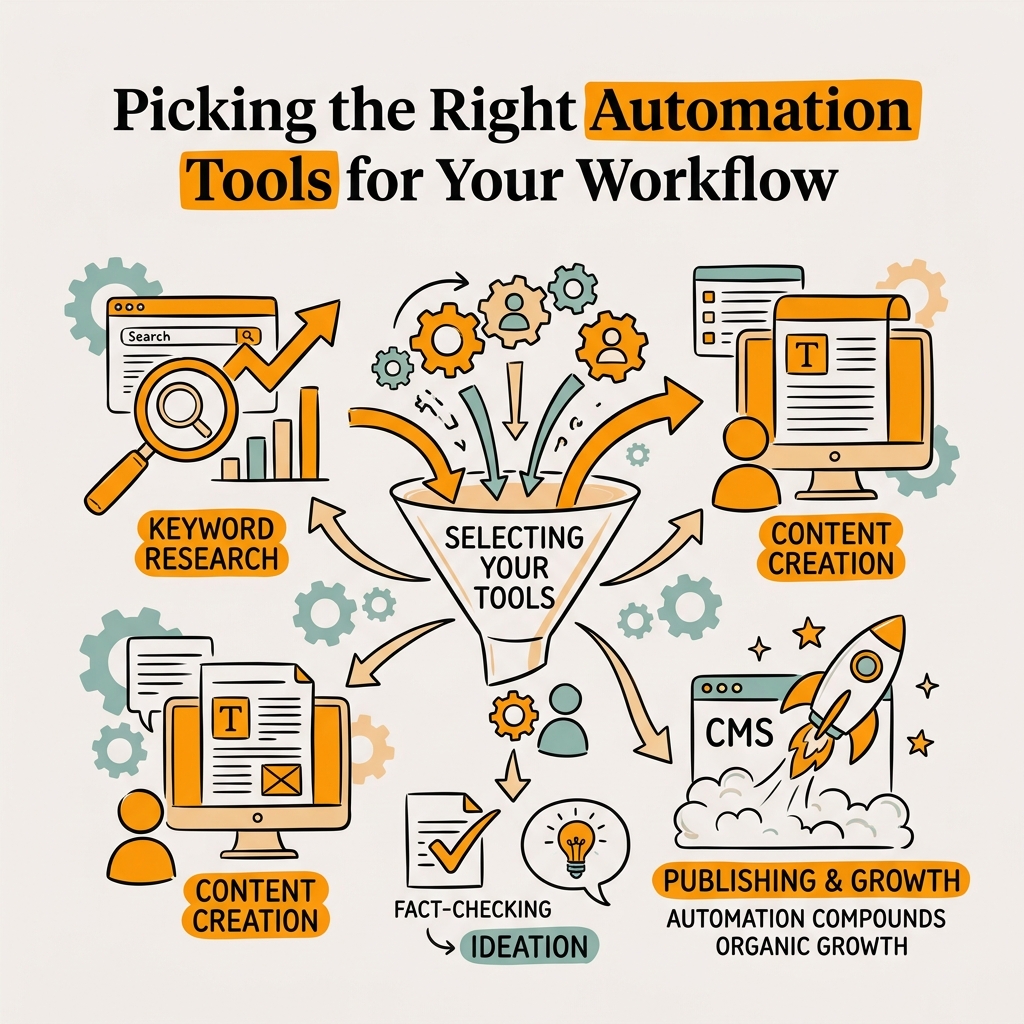
The automation landscape is crowded. Every tool claims to save time, but most excel at one thing and fall short elsewhere. Your choice depends on whether you want an all-in-one platform (Semrush, Ahrefs) or a specialized-plus-connectors approach. All-in-one platforms are easier to set up but typically cost $150–300 monthly. Specialized tools (Gumloop for workflows, Surfer for content optimization, Jottler for publishing) cost $30–100 each but offer deeper features and work better when chained together via APIs or Zapier.
All-in-One Platforms vs. Best-of-Breed
| Automation Category | All-in-One (Semrush/Ahrefs) | Best-of-Breed (Specialized Tools) | Winner for Growing Teams |
|---|---|---|---|
| Site Audits and Technical SEO | Built-in; 40+ workflows | Screaming Frog; SE Ranking (deeper) | Specialized—more actionable detail |
| Rank Tracking | Included; daily updates | Rank Tracker; SerpWatcher (alerts only) | All-in-one—less tool sprawl |
| Content Research & Gap Analysis | Included; limited depth | Competitor.com; Airtable + Zapier (custom) | Specialized—faster iteration |
| Content Optimization | Limited to meta/structure | Surfer SEO; Clearscope (NLP-based) | Specialized—95% accuracy vs. 70% |
| Internal Linking | None native | Jottler; Kenshoo (agentic) | Specialized—Jottler leads for SMBs |
| Publishing & Fact-Checking | None native | Jottler (daily articles); WordPress plugins | Specialized—Jottler for volume/quality |
| Cost (Monthly) | $165–300 (annual commit) | $30–100 per tool; total $150–250 | Specialized—better ROI per dollar |
The clear pattern: all-in-one platforms are safe defaults for teams new to automation, but specialized tools outperform on depth and precision. For busy founders automating SEO in-house, the hybrid approach works best: Semrush for rank tracking and audits + Surfer for content optimization + Jottler for publishing. This stack covers 95% of repetitive workflows and costs roughly $250–300 monthly while delivering 2–3x the output quality versus an all-in-one platform alone. Understanding how to scale organic traffic without burnout requires this kind of strategic tool pairing.
Why Automation Stacks Beat Single Tools
A single tool is convenient but limited. Semrush can audit your site and track ranks, but it can't write optimized articles or fact-check them automatically. Surfer can score your content, but it can't publish or link internally. Jottler can publish daily articles with smart internal linking, but it doesn't track competitor ranks. The best teams chain tools: automation stack = Semrush (audits + ranks) + Surfer (content scoring) + Jottler (research + writing + publishing + linking). Each tool feeds the next. This approach eliminates the weakest link—manual handoffs—and compounds efficiency across the entire workflow.
How to Set Up Your First Automation Without Breaking Anything
Automation can go wrong fast if you don't validate before scaling. A poorly configured rank tracker sends false alerts. A broken internal linking script adds links to the wrong pages. A content automation tool publishes a typo-laden article to production. The fix: treat automation like you'd treat a junior hire. Test first, validate output, set safety gates, then scale.
The Safe Launch Playbook
- Start small, audit everything: Set up your first automation (e.g., weekly audits) and run it for 2 weeks in test mode. Review 100% of outputs before acting on them. This builds trust and reveals issues early.
- Use separate environments if possible: Test on a staging site or with a small keyword subset before applying to production. An internal linking mistake on 10 pages is fixable; on 500 pages, it's a disaster.
- Build approval gates for high-impact tasks: Rank tracking alerts? Automate fully. Publishing new content? Keep a human sign-off step. Content optimization recommendations? Auto-apply to drafts; human approval before publish.
- Monitor the output weekly for the first month: Spot-check audit findings, read a few auto-generated reports, review content recommendations. This catches misconfiguration early before bad data spreads.
- Document your workflows: Write down each automation's trigger, action, and expected outcome. This helps if you need to debug or hand off to a team member later.
Common Automation Mistakes to Avoid
Automating before you have clean data. If your Google Analytics isn't properly set up, automated reports will be garbage. Fix your instrumentation before automating reporting. Expecting 100% accuracy on day one. AI-driven content scoring or link recommendations are 85–90% accurate, not 100%. Always keep a human review loop. Automating tasks that require judgment. Deciding which keywords to target, which competitors to monitor, which content to refresh—these need strategy. Automate the data collection and filtering; keep the decisions human. Ignoring the maintenance cost. Automation tools require upkeep: reviewing alerts, tuning thresholds, updating rules. Budget 2–3 hours weekly for maintenance in your first month; this typically drops to 30 minutes weekly after tuning.
What's the ROI of SEO Automation?

ROI on automation stacks is fast. A typical team of two (founder + marketer) spending 30 hours weekly on SEO busywork recovers $2,100–2,800 monthly in freed labor time. Most automation stacks cost $150–300 monthly, breaking even immediately and delivering profit from month two onward. Better yet: the freed time compounds.
The Multiplier Effect: More Time = More Content = More Rankings
When you reclaim 15 hours per week, most teams don't just relax—they reinvest that time into content. Suddenly a founder with 10 extra hours weekly can write 4 blog posts instead of 1. Or they can spend those hours on strategic partnerships, outreach, or refining topic clusters. This is where automation's true ROI emerges. A team automating audits and rank tracking saves 18 hours monthly. Reinvesting those 18 hours into content strategy generates 2–4 additional articles per month. Over a year, that's 24–48 extra pieces of content. If your content averages 2–3 rankings per article after 90 days, you've gained 50–150 new rankings annually—purely from reinvesting automation's time savings. That's the compounding effect.
Measuring Automation ROI Correctly
Most teams measure ROI as (Time Saved × Hourly Rate) / Tool Cost. That's the floor. The ceiling is (Time Saved × Hourly Rate) + (Additional Output × Revenue per Output) / Tool Cost. If automation saves 20 hours monthly and you reinvest those 20 hours into content that generates leads, the actual ROI is often 3–5x higher than the base time-savings calculation.
Building a Culture Around Automation in Your Team
Technical automation is one thing. Getting your team to trust it, use it consistently, and optimize it over time is harder. The most successful teams treat automation as a ongoing experiment, not a set-and-forget system. Weekly review, monthly optimization, quarterly strategy check-ins keep the flywheel spinning.
Getting Buy-in from Your Team
Automation threatens people who don't understand it. Your content writer might fear that automated content optimization recommendations mean AI is coming for their job. Your marketer might distrust automated rank tracking because they've always tracked manually. Address this directly: automation handles the busywork so your team can focus on creative work. The writer spends less time on formatting and optimization, more time on ideation and unique angles. The marketer stops chasing rank changes manually and starts thinking strategically about content velocity and topic clustering. Frame automation as a tool that makes their work more strategic, not less.
Monthly Automation Sync and Refinement
Schedule 30 minutes monthly to review automation performance. Ask: Are alerts accurate or noisy? Are the recommendations actionable or generic? Are we using this tool's output or ignoring it? Adjust thresholds, retire unnecessary automations, and test new ones. This keeps automation lean and high-value instead of becoming technical debt.
Conclusion
Automating repetitive SEO tasks is no longer a nice-to-have; it's table stakes for teams serious about organic growth. The data is clear: teams automating audits, rank tracking, content optimization, and publishing save 15–25 hours weekly, reduce content cycles from 15 hours to 3 hours per article, and index 2.5x more keywords within 90 days. The ROI is immediate—most automation stacks pay for themselves within a month—and compounds when you reinvest freed time into strategy and content. Start with the core three automations (audits, rank tracking, reporting), validate for two weeks, then layer in content and publishing workflows. Pair specialized tools like Jottler for publishing automation with Semrush for tracking, and you'll outpace competitors still doing SEO manually. The teams winning in 2026 aren't the ones working harder—they're the ones automating the busywork so they can focus on strategy, velocity, and growth.
Ready to reclaim your team's time and compound organic growth? Start your SEO agent with Jottler today. In minutes, set your publishing frequency, and let the AI research, write, fact-check, and publish SEO-optimized articles daily while building internal link networks automatically. See how teams are publishing 3–5 articles per day and indexing 2.5x more keywords within 90 days.
FAQs
What SEO tasks can be safely automated without quality loss?
Site audits, rank tracking, keyword research, competitive gap analysis, and reporting can be fully automated with zero quality loss—these are data collection tasks with objective right answers. Content optimization recommendations, internal linking suggestions, and fact-checking can be automated at 85–90% accuracy; plan for a quick human review of 10–15% of outputs. Publishing and content writing automation should include a human sign-off step before going live. The safest rule: automate data collection and reporting; add human gates for content and strategic decisions.
How long does it take to see ROI from SEO automation?
Most teams see financial ROI (time savings exceeding tool cost) within the first month. A stack like Jottler ($29/month) plus Semrush ($165/month) costs roughly $194 monthly. If it saves one team member 15 hours weekly at $40/hour, that's $2,400 in labor value recovered—breaking even in the first week. The bigger payoff comes in month 3–6 when freed time translates to additional content, stronger rankings, and traffic growth. High performers report 4x ROI by month six when automation drives consistent publishing velocity.
Can small teams afford to implement SEO automation?
Yes. A solo founder or two-person marketing team can start with Jottler ($29/month) for publishing automation, which handles research, writing, fact-checking, and internal linking in bulk. Add a free tier rank tracker (SE Ranking, Ahrefs free tier) and you've got core automations for under $35/month. Even a full stack (Jottler + Semrush + Surfer SEO) costs $250–300 monthly—less than a part-time freelancer—while delivering 3–5x the output volume. The constraint for small teams is usually upfront setup time, not cost.