B2B Link Building Strategy: A Complete Guide for SaaS Companies
Building authoritative backlinks is no longer optional for SaaS companies—it's fundamental to ranking and driving qualified leads. Yet 90% of B2B content has no external backlinks at all, and even thought leadership pieces underperform with a 44.8% fail rate in earning meaningful link velocity. The problem isn't just that backlinks are hard to earn; it's that most SaaS teams treat link building as an afterthought, bolted onto content strategy rather than designed into it from the ground up. The good news? A systematic B2B link building strategy compounds over time, delivering 702% ROI for SaaS companies while organic search drives 68% of website traffic. Here's how to build a repeatable framework that turns your content into genuine authority.
Key Takeaways
- B2B SaaS achieves 702% SEO ROI, with organic search driving 68% of website traffic (2026 data). Backlinks remain the strongest ranking signal for competitive niches.
- 90% of B2B content earns zero backlinks; thought leadership has a 44.8% fail rate. Quality beats volume: long-form content (2,000+ words) earns 77.2% more backlinks.
- Original research drives 42.2% more backlinks and 29.7% organic traffic growth. Guest posts, niche edits, and digital PR deliver the highest ROI for SaaS link building.
- Define Link-Building Goals by Revenue Stage: Target feature pages and product integrations that convert, not vanity metrics like domain authority.
- Create Linkable Assets Systematically: Original research, case studies, and thought leadership attract links 3-10x faster than generic blog posts.
- Build Relationships Before You Pitch: Personalized outreach to niche-specific journalists and industry voices beats templated blasts.
- Earn Links Through Content Distribution: Guest posts and niche edits place your content where your audience already reads; digital PR amplifies reach.
- Automate Link Tracking and Content Refresh: Monitor backlink velocity, identify unlinked mentions, and systematically refresh underperforming content.
Why B2B Link Building Matters More in 2026
The link building landscape shifted in 2026. Top-ranking pages have 3.8x more backlinks than positions 2-10, making backlinks the single strongest ranking signal for SaaS companies competing in saturated niches. Meanwhile, AI search tools like Google's AI Overviews have increased impressions by 49% but cut clicks by 30%, creating an urgent need to build topical authority and brand recognition through links and mentions. Brands without strong backlink profiles fall deeper into obscurity as AI systems prioritize established, cited sources.
"Top-ranking pages have 3.8x more backlinks than positions 2-10, making backlinks the single strongest ranking signal for SaaS companies competing in saturated niches."
For busy founders, the challenge is real: link building requires months of outreach, relationship-building, and content coordination. Yet the payoff is substantial. B2B companies see 748% SEO ROI, with leads from organic search closing at 14.6% compared to 1.7% for outbound campaigns. For SaaS specifically, the average organic conversion rate hits 2.1%, nearly doubling PPC's performance. This is where systematic SaaS SEO strategy becomes essential.
This is where most SaaS teams get stuck. They publish content but don't amplify it. They build backlinks sporadically instead of systematically. And they measure the wrong metrics—tracking domain authority instead of actual traffic and conversions. A proper B2B link building strategy flips this: you design content around what's linkable, build relationships before you need them, and let links compound your authority over time. With tools that automate content research, writing, and publishing, teams can ship the high-volume, high-quality content foundation that links are earned from, freeing up time for the relationship-building and outreach that actually lands them.
How to Define Link-Building Goals That Drive Revenue
Most SaaS teams measure link building success by vanity metrics: total backlinks, referring domains, or domain authority scores. These feel like progress but don't move the needle on revenue. The fix? Define your link-building goals by the pages and keywords that actually convert.
Start with your conversion funnel. Identify the three to five product pages, feature overviews, and use-case articles that drive the highest revenue. These are your linkable targets. For a project management SaaS, this might be your agile workflow page or team collaboration feature. For a data analytics platform, it's your SQL query builder or integration directory. These pages don't need viral backlinks; they need niche-specific, contextually relevant links from industry publications, adjacent SaaS blogs, and thought leadership platforms your buyer reads.
"Define your link-building goals by the pages and keywords that actually convert, not by vanity metrics like domain authority. Revenue-driven targets compound faster than unfocused outreach."
Next, audit your competitors' backlink profiles. Tools like Backlinkshatch and similar link analyzers show you exactly where competing SaaS companies are earning links. You'll notice patterns: which publications cover your category, which angles resonate, which features get cited most. This competitive intelligence becomes your outreach roadmap.
Finally, calculate the actual revenue impact of links. If a feature page generates an average deal size of $5,000 and has a 2% conversion rate, and links to that page increase organic traffic by 30%, that's a direct revenue lift. Track this relentlessly. Set quarterly targets: "Earn 15 niche-relevant links to our product pages" beats "Reach 100 referring domains."
Creating Content Assets That Attract Links Naturally
You can't outreach your way to link velocity without linkable content. Original research drives 42.2% more backlinks and 29.7% organic traffic growth, while long-form content (2,000+ words) earns 77.2% more backlinks than shorter pieces. The reason is simple: writers and journalists need sources. They need data, insights, and original research to cite. Generic blog posts are invisible to them. This is why a sustainable content marketing framework must prioritize depth and originality over quantity alone.
Original Research and Proprietary Data
The highest-performing link magnet for B2B SaaS is original research. Conduct surveys, analyze usage data from your product, or publish proprietary benchmarks in your niche. If you're a customer success platform, survey 500 SaaS founders about their biggest onboarding challenges. Publish the findings with breakdowns by company size, industry, and geography. Suddenly you have newsworthy data that journalists, analysts, and competing SaaS companies want to cite and link to. 88% of SaaS marketers report positive ROI from data-driven content, and the backlinks follow naturally. This is where a tool that automates content production pays dividends: rather than struggling to research, write, and fact-check reports manually, AI-powered platforms can help you produce the supporting thought leadership pieces and data visualizations that amplify the research's reach and credibility.
Case Studies That Prove Category Authority
Case studies showing real customer results are another tier of linkable content. Don't write generic stories. Instead, focus on edge cases and surprising outcomes. "How a 50-person startup reduced onboarding time by 60%" resonates more than "Customer saves time with our product." Case studies become linkable when they're specific enough to reference, data-backed, and useful for your audience to learn from. Industry analysts and competing vendors will cite them.
Thought Leadership From Your Founders or Experts
Thought leadership is the riskiest link magnet. Even though thought leadership accounts for 37% of B2B content, it has a 44.8% fail rate—earning fewer than 50 referring domains. Yet when it works, it works spectacularly. Brands like Salesforce earn 3,500-4,700 referring domains per thought leadership piece because they're already recognized authorities. The gap between high-performing and low-performing thought leadership comes down to one thing: specificity and controversy. Generic advice on "the future of SaaS" won't earn links. But "Why SaaS pricing models are broken and how to fix them" might. You need a unique point of view backed by data and experience. The best thought leadership for B2B SaaS ties directly to your category's biggest unsolved problem.
Building Relationships Before You Need Links

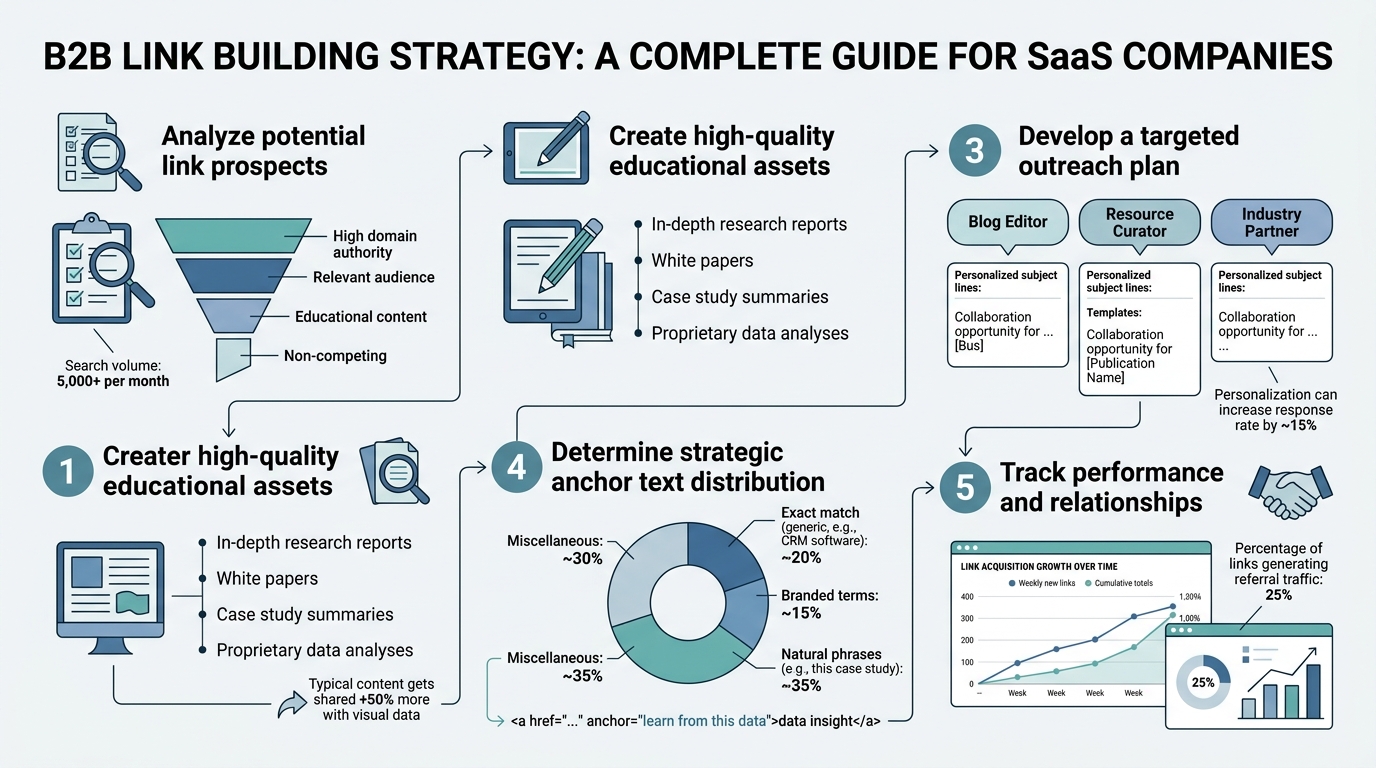
Most SaaS teams fail at link building because they approach it transactionally. They publish a blog post, fire off cold outreach emails, and expect journalists to link to them. This approach yields a 5-10% success rate at best. The better way? Build relationships before you need links. This means months of consistent value-add: sharing journalists' articles, commenting thoughtfully on their work, introducing them to interesting sources, and proving you're a legitimate voice in your category.
Identify and Follow Your Niche's Key Voices
Create a list of 30-50 journalists, bloggers, analysts, and influencers who cover your category. This includes:
- Tier-one tech media (TechCrunch, VentureBeat)
- Industry-specific publications (HR.com for HR tech, LinkedIn for SaaS)
- Individual thought leaders with large followings in your niche
- Analyst platforms and research firms covering your category
- Community forums and discussion boards your buyers frequent
Track what they write, their publication schedule, and their angle. When they publish an article, read it, and if it's relevant, share it with a thoughtful comment. Don't pitch immediately. Build familiarity first.
Provide Value Without Asking for Links
Your relationship-building activities should focus on:
- Sharing insights and data on their published articles
- Introducing them to interesting sources and experts
- Commenting thoughtfully on their coverage and analysis
- Providing exclusive data or unpublished insights before public launch
- Featuring them as sources in your own original research
The goal is to become a trusted source they think of when they're writing their next article, not someone they groan to see in their inbox.
Create a VIP List of Outreach Contacts
Once you've built familiarity, segment your 30-50 contacts into tiers. Tier 1 (top 5-10) are the journalists, platforms, and analysts that would most impact your traffic and authority if they linked to you. These get personalized outreach with specific angles that fit their recent coverage. Tier 2 (15-20) get relevant, tailored pitches. Tier 3 (rest of the list) get broader outreach campaigns. This tiered approach focuses your effort where it matters most, especially when paired with a robust SaaS content marketing strategy.
Earning Links Through Guest Posts and Niche Edits
Two tactics dominate B2B SaaS link building in 2026: guest posts and niche edits. Both are high-effort but high-return, especially when your audience is reading the target publication already.
"Guest posts and niche edits are the highest-ROI link building tactics for B2B SaaS because they place your content where your buyers already read and trust."
Guest Posts: Teach, Don't Promote
A guest post is your opportunity to prove expertise to a new audience. The mistake most SaaS founders make is pitching promotional content—"How [Your Company] Solved X." Smart publications reject these immediately. Instead, pitch educational content that solves a problem for their readers, with a subtle mention of your product where it genuinely fits the narrative. "Five strategies to reduce customer churn" lands. "How [your company] reduced churn for our customers" doesn't.
Target publications your ideal customer already reads. If you're a compliance SaaS, pitch to GovTech, CIO.com, or industry-specific trade publications. If you're a sales tool, pitch to Sales Hacker, HubSpot's blog, or revenue operations communities. The link you earn from a publication your buyer trusts is worth 10 links from random sites.
Niche Edits: Place Links in Existing Evergreen Content
Niche edits (also called "link insertions") are when you convince an editor to add your link to an existing, well-ranking article on a related topic. For example, an article on "SaaS metrics every founder should track" might mention CAC or LTV without linking to a resource. You pitch the editor: "I've published a detailed guide on calculating CAC. It would add value to this section." They add your link into the existing article, and you earn a link to your resource from a page that's already established and driving traffic. This is often easier than getting them to publish a new guest post because the editor sees immediate value in strengthening their existing content.
How to Execute Outreach That Actually Converts

Outreach is the execution layer of link building. Get it wrong, and you'll email 100 journalists and hear back from 2. Get it right, and your reply rate climbs to 20-30%.
Personalize Every Pitch
Never send templated outreach emails. Journalists receive dozens of these daily and delete them immediately. Instead, write each pitch personally by:
- Referencing a specific article they wrote in the last 60 days
- Explaining why your content adds value to their audience specifically
- Showing evidence that you've read their work (quote a specific insight)
- Offering unique data or expertise they can't get elsewhere
- Keeping the pitch to two to three short paragraphs maximum
This takes more time, but it's the difference between ignored and replied-to.
Lead With Value, Not a Link Request
Frame your pitch around what your content does for their readers, not for you. "I thought your audience would find this research on [topic] valuable" beats "We'd love a link to our article." Emphasize the data, the novelty, the insight—not the opportunity for you to get a backlink.
Follow Up, But Don't Spam
If you don't hear back in 7 days, send one follow-up. After that, move on. Most journalists are drowning in pitches and will respond if interested. Hammering them with multiple follow-ups kills any future relationship.
Scaling Link Building With Digital PR and Content Partnerships
Once you've built your outreach foundation, scale through structured digital PR and content partnerships. This means working with publications on ongoing bases, not one-off guest posts.
Develop Ongoing Partnerships With Tier-1 Publications
Instead of pitching individual stories, propose a quarterly partnership. "We'll provide exclusive industry data and expert commentary for four feature stories annually." Publications love this because it ensures fresh, credible content. You get consistent links and bylines that compound your authority.
Sponsor Research Reports and Industry Rankings
Partner with analysts or industry platforms to sponsor annual reports or rankings in your category. Your company gets mentioned, linked, and positioned as an authority. The report becomes a linkable asset for everyone involved.
Coordinate Content Across Multiple Channels
When you publish major thought leadership or research, don't rely on organic discovery. Amplify through your email list, social networks, partner channels, and PR outreach simultaneously. The more signals a piece of content sends (traffic, shares, mentions), the more likely it is to attract unprompted links from industry observers.
Monitoring and Maintaining Your Link Profile
Building links is half the work. Maintaining and leveraging them is the other half. As competitive SaaS niches grow, monitoring your backlink portfolio becomes essential. You need to know which links are working, which content deserves more promotion, and where to double down. Complementary to this is building a topical authority framework that ensures your content clusters compound in authority over time.
Track Unlinked Brand Mentions
Your brand gets mentioned in articles that don't link to you. Find these mentions through tools like Mention or Google Alerts, then reach out politely: "Hey, I noticed you mentioned our company in this article. Would you mind adding a link to our site in that section?" This is a quick win—you're not asking for a new backlink, just converting an existing mention into one.
Refresh Underperforming Content
Identify older content that has few backlinks but ranks for valuable keywords. Update it with new data, expand it to 2,000+ words, and re-promote it to your outreach list. Fresh, improved content earns more links than the original version.
Analyze Competitor Link Growth
Track where competitors are earning new links. Are they guest posting on publications you haven't pitched yet? Are they getting links from industry analyst reports? Use this intelligence to refine your own strategy. If a competitor is getting links from a specific publication, that's a publication you should target too.
Automating the Content Foundation for Link Building
Here's the reality: link building is impossible at scale without consistent, high-quality content to build links to. Most SaaS teams don't link build more aggressively because publishing three to five long-form pieces per week—the cadence needed to create linkable assets—requires a full editorial team. That's where content automation becomes the game-changer.
An autonomous SEO engine that automates the entire content production pipeline means AI agents research keywords and topics, write 3,000+ word articles daily, handle fact-checking and CMS publishing, and build internal links automatically. For a busy SaaS founder, this means you can finally publish the volume of high-quality content that link building depends on, without burning out your team. You set the publishing frequency (1-5 articles per day), and the system ships research-backed, SEO-optimized pieces continuously. This creates a growing library of linkable assets that your outreach team can reference and promote, turning link building from a bottleneck into a compounding advantage.
| Link Building Tactic | ROI Timeline | Effort Level | Best For |
|---|---|---|---|
| Guest Posts | 6-8 weeks | High | Building authority with new audiences; long-term brand lift |
| Niche Edits | 2-4 weeks | Medium | Quick wins; scaling outreach efficiently |
| Digital PR | 8-12 weeks | High | Tier-1 publications; mainstream media coverage |
| Unlinked Mentions | 1-2 weeks | Low | Converting existing mentions; quick conversions |
| Original Research | 4-6 weeks | Very High | Major link magnet; long-term authority compound |
Conclusion
B2B link building for SaaS is not a quick win. It's a three to six-month play where effort compounds. But the payoff is worth it: 702% ROI, 68% of website traffic, and leads that close at 14.6%—far outpacing any other marketing channel. The winning strategy combines three elements: systematically created linkable content (original research, thought leadership, case studies), relationship-building before you pitch, and measured outreach that respects journalists' time and expertise.
Start by auditing your conversion funnel and defining which pages actually deserve link-building effort. Create a VIP list of 30-50 journalists and publishers your buyer already reads. Build relationships month after month through consistent sharing and value-add. Then, when you have something worth sharing, your outreach lands because you're a known, trusted source. The barrier to execution isn't strategy—it's capacity. If you're still manually researching, writing, and publishing content one piece at a time, you'll never accumulate enough linkable assets to fuel a real link building engine. That's why automating content production at scale is not optional for competitive SaaS niches anymore.
Start your SEO agent today and begin building the content foundation that links are earned from.
FAQs
How long does B2B link building take to show results?
Link building typically shows measurable traffic and ranking improvements within three to six months, depending on competition and link quality. High-authority links from tier-1 publications move rankings faster, often within 4-8 weeks. However, the compounding effect accelerates over time—your second and third months of outreach yield faster results as you build relationships and launch more linkable assets. Most SaaS companies see meaningful organic traffic lift at the six-month mark and significant conversion impact by month nine.
What's the difference between guest posting and niche edits for SaaS?
Guest posts are new articles you write and publish on another publication, with a link to your site embedded in the content or author bio. Niche edits are links added to existing, already-published articles by inserting your URL into a relevant section. Niche edits are typically faster to execute and get approved, making them ideal for scaling outreach quickly. Guest posts take longer but often provide more visibility and authority since you're publishing a full byline. For most SaaS teams, a 60/40 split of niche edits to guest posts offers the best ROI.
Do B2B SaaS companies need to hire a link building agency?
Not necessarily. The three essential components—relationship building, outreach, and linkable content creation—can all be handled in-house if you allocate dedicated resources. However, agencies excel at prospecting (finding targets), managing outreach at scale, and leveraging existing media relationships. If you have one person managing link building part-time alongside other marketing duties, outsourcing the execution often delivers better ROI than doing it half-speed in-house. The key is ensuring your content pipeline is strong; no agency can earn links to mediocre content, so invest in building linkable assets first.