B2B SaaS SEO: From Day One to Growth Stage
Organic search generates 44.6% of all B2B revenue, yet most SaaS founders don't build a search strategy until their product is already struggling for visibility. The cost of waiting is steep: starting SEO late means you're competing against established competitors who've been compounding authority for years. But there's a playbook. Whether your SaaS is launching this month or scaling through growth stage, the gap between doing SEO wrong and doing it right comes down to foundational choices made early and sustained execution as you scale. Companies publishing 9+ blog posts monthly see 35.8% year-over-year organic traffic increases, but only when those posts target the right keywords and solve real buyer problems. Here's how to build B2B SaaS SEO from day one and accelerate it through growth stage.
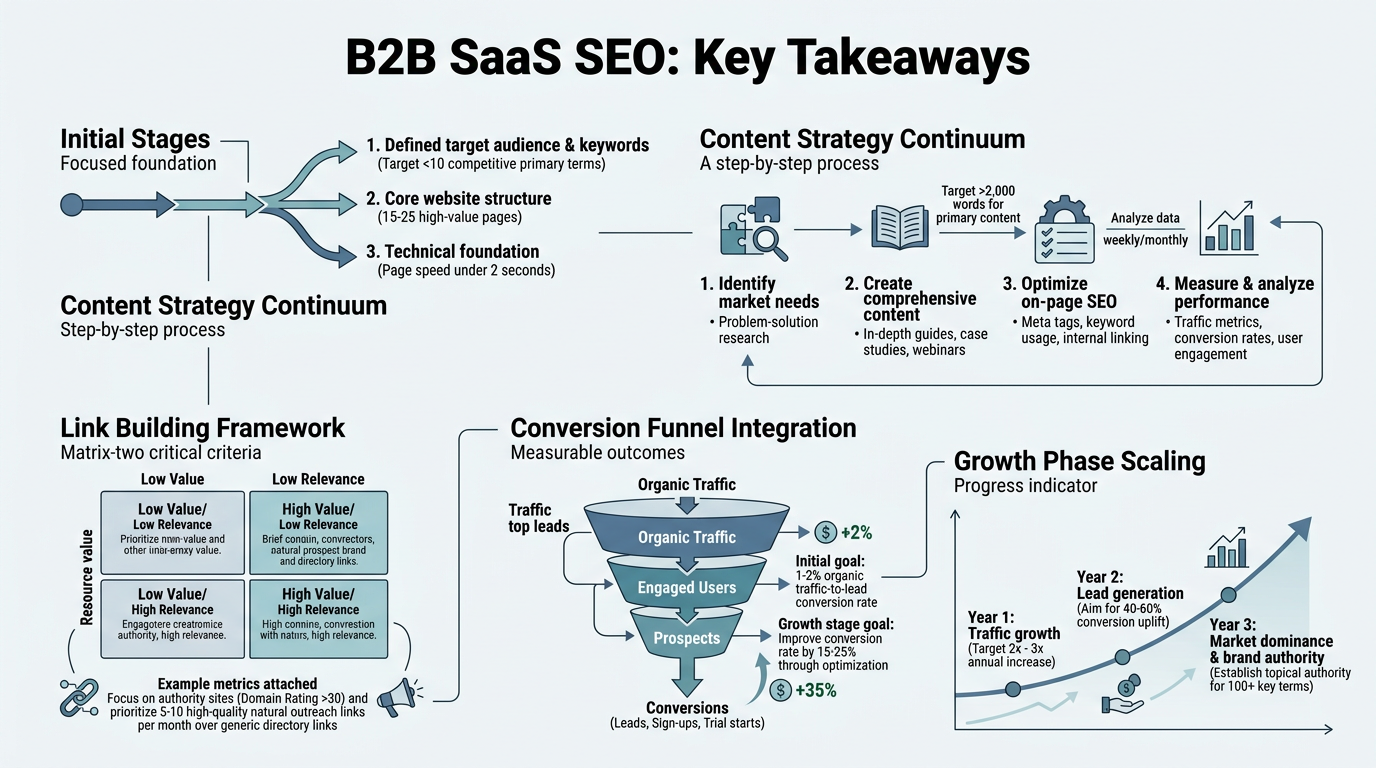
Key Takeaways
- Organic search drives 76% of all B2B website traffic and delivers 702% ROI on average, with break-even in 7 months (2025 data)
- Day One SaaS SEO must prioritize bottom-of-funnel keywords (alternatives, pricing, integrations) targeting immediate signups over vanity traffic
- Content published 2–4 times monthly with keyword difficulty below 20 compounds organic authority without competing against established domains
- Day One Technical Foundation: Fix Core Web Vitals, crawlability, and indexation before publishing—it takes 2 weeks and prevents months of wasted content effort.
- Bottom-of-Funnel Keyword Strategy: Target comparison, alternative, and pricing searches from day one to generate pipeline immediately, not years from now.
- Content Velocity and Difficulty: Publishing 2–4 low-KD articles monthly (difficulty under 20) builds domain authority faster than random high-volume content.
- Hub-and-Spoke Content Architecture: Build 3 content clusters early (1 hub + 10 supporting articles each) to establish topical authority and internal link networks.
- Growth Stage Scaling: Once you've dominated bottom-of-funnel, expand into mid-funnel comparison content and top-funnel educational material with higher keyword difficulty targets.
- AI Visibility and AEO: Optimize for AI Overviews in parallel with Google rankings—94% of B2B buyers now use LLMs during purchase research, and visibility in AI answers is as critical as click-through rates.
Build Your Day One Technical SEO Foundation
Technical SEO is non-negotiable. The most common mistake early-stage founders make is publishing great content to a website that Google can't properly crawl, render, or index. You'll spend weeks writing articles that gain zero traction because search engines never see them. Fix the foundation first.
Core Web Vitals and Site Speed
Google uses three Core Web Vitals metrics to rank pages: Largest Contentful Paint (loading speed), First Input Delay (responsiveness), and Cumulative Layout Shift (visual stability). If your SaaS website takes more than 2.5 seconds to load, you're already at a disadvantage. Early-stage SaaS companies with page loads under 1.5 seconds see conversion rates 20–40% higher than slower competitors.
"Page loads under 1.5 seconds see conversion rates 20–40% higher than slower competitors. This is the single highest-leverage technical fix early-stage SaaS founders can make."
Start with a real audit. Use Google PageSpeed Insights and Google Search Console to identify specific bottlenecks. Common culprits for SaaS sites:
- Unoptimized images: Compress and serve responsive images. A single high-res product screenshot can add 200+ KB.
- Third-party scripts: Google Analytics, Drift, Intercom, HubSpot forms—each adds processing time. Defer non-critical scripts.
- CSS and JavaScript bloat: Minify and eliminate unused styles and code paths.
- Lazy loading: Load images and videos only when users scroll to them, not on initial page load.
This takes 1–2 weeks for a new SaaS site. Don't skip it. Every week you publish content to a slow website is a week wasted.
Crawlability, Indexation, and URL Structure
Search engines can't rank what they can't find. Set up Google Search Console immediately—it's your single source of truth for indexation health. Check the "Coverage" report to identify pages blocked from indexing.
For a SaaS site launching from day one, implement these checks:
- URL structure: Use clean, descriptive URLs.
/pricingis better than/p?id=123. Each URL should reflect the content hierarchy. - Robots.txt: Explicitly allow Google to crawl all public pages. Block internal admin, staging, or duplicate URL patterns.
- XML sitemap: Submit a sitemap listing all content pages so Google knows what to crawl. Update it weekly as you publish.
- Canonicals: Use canonical tags on duplicate pages (if you have /pricing and /pricing/) to tell Google which version is authoritative.
- Mobile-first indexing: Google indexes your mobile version first. Make sure responsive design works flawlessly on phones.
Crawlability takes a few hours to audit and fix. Ignore it, and even your best content will never rank.
Schema Markup and Entity Clarity
Schema markup tells search engines what your content is about. For SaaS companies, the most important types are Organization schema (brand details), SoftwareApplication schema (your product), and FAQPage schema (for Q&A sections). This data helps Google understand your entity and improves visibility in AI answer engines.
Implement at minimum: Organization schema on your homepage, SoftwareApplication schema on your pricing or product overview page, and FAQPage schema on any dedicated FAQ pages. Validation using structured data ensures proper implementation across your site.
Define Your Day One Keyword Strategy Around Bottom-of-Funnel
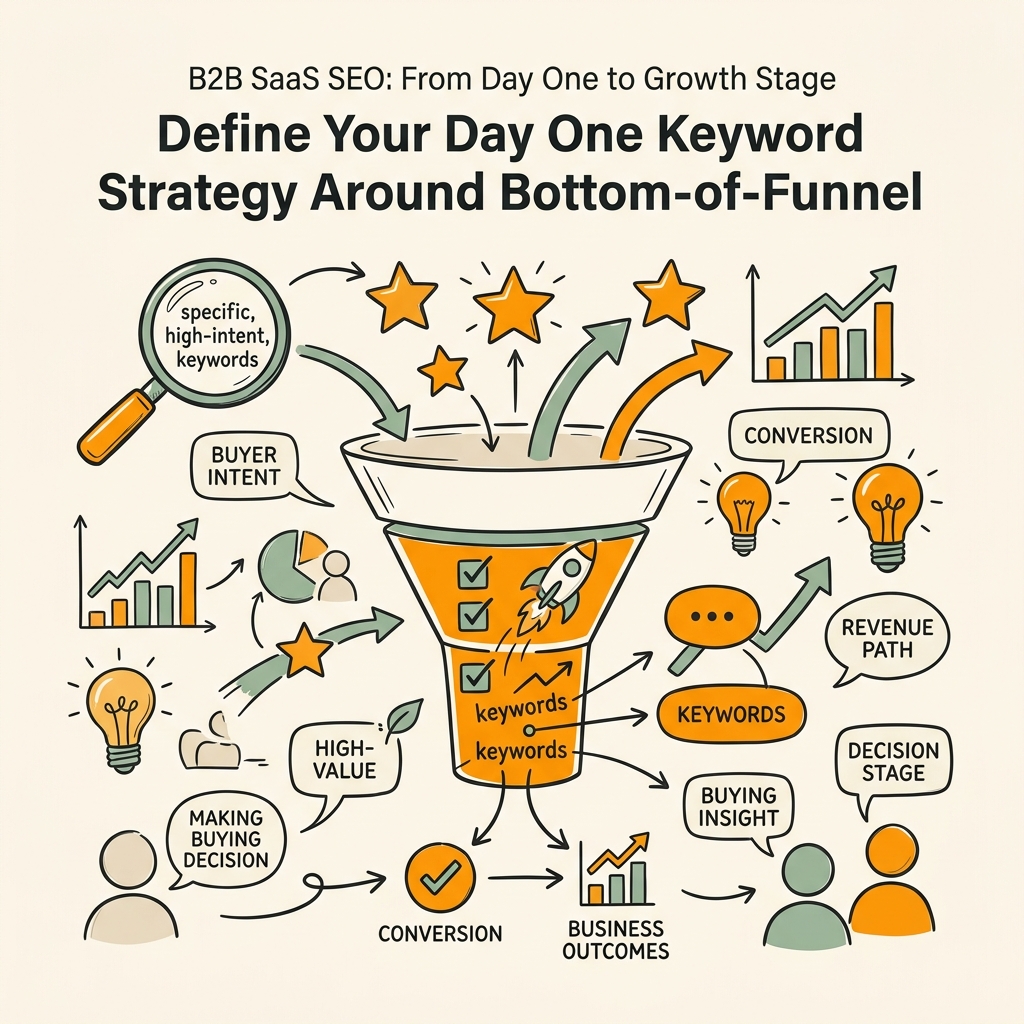
Most SaaS founders start SEO by targeting high-volume keywords like "marketing automation" or "sales CRM." Those keywords are valuable—but not on day one. You'll spend 12 months optimizing for a keyword dominated by Salesforce, HubSpot, and Pipedrive. Instead, flip the funnel: start by dominating keywords that drive immediate signups and pipeline.
The Bottom-of-Funnel Keyword Framework
Bottom-of-funnel (BOF) keywords are searches from buyers ready to convert. They map to your pricing page, product features, and comparison pages. Targeting BOF keywords on day one typically converts 8–14 times faster than mid-funnel searches, because the buyer intent is explicit.
"Bottom-of-funnel keywords convert 8–14 times faster than mid-funnel searches. Start here, not with vanity brand-awareness keywords. Your first 20 articles should all target KD under 20 in comparison, alternative, and pricing categories."
Start with these keyword categories:
- Alternatives: "Alternatives to [Competitor]", "Best [Competitor] alternatives". Buyers searching here have already evaluated competitors and are comparing options.
- Pricing and Cost: "[Your Tool] pricing", "[Competitor] pricing", "How much does [category] cost". Price-conscious buyers are 2 steps away from demo requests.
- Integrations: "[Your Tool] integrations", "[Your Tool] + Slack", "[Your Tool] + Salesforce". Users already bought related products and want your solution to fit their stack.
- Use Cases: "[Competitor] for [industry]", "[Category] for [company size]", "How to [outcome your tool delivers]". Highly specific intent tied to real buyer needs.
- Comparisons: "[Your Tool] vs [Competitor]", "[Competitor 1] vs [Competitor 2]" (position yourself as the better option). Direct comparison pages convert at 3–5x the rate of generic guides.
For each category, search Google and note which keywords appear in the first two pages. If a keyword has less than 10 monthly searches, skip it. If a keyword has a Difficulty above 30, come back to it in 6 months. You're hunting for keywords with 10–100 monthly searches and KD under 20—they're achievable on day one.
Content Clusters and Topical Authority
Don't publish isolated blog posts. Build content clusters: one cornerstone article (the hub) that comprehensively covers a topic, plus 10 supporting articles (the spokes) that go deeper on subtopics. This structure signals to Google that you're an expert on the topic and maximizes internal linking effectiveness.
For a SaaS launching, create 3 content clusters across your highest-intent keyword categories. Example for a project management tool:
- Cluster 1 (Hub): "Asana Alternatives" (covers why teams switch, feature comparisons). Spokes: "Asana vs Monday.com", "Asana Pricing vs Competitors", "Is Asana Good for Remote Teams", "Asana Integrations Guide", etc.
- Cluster 2 (Hub): "Project Management for SaaS Teams". Spokes: "Project Management Tools for Small SaaS", "How to Track Software Development Projects", "Agile Project Management Workflow", etc.
- Cluster 3 (Hub): "Competitive Comparison: Monday.com Alternatives". Spokes: Similar structure targeting a different competitor.
Build Cluster 1 first (your strongest positioning), then 2, then 3. This creates a natural internal link network and tells Google you're the category expert in that specific area.
Publish Content Consistently and Measure Against Growth Benchmarks
Consistency beats perfection. Teams publishing 2–4 articles monthly with keyword difficulty under 20 build measurable domain authority within 6 months, while sporadic publishing (once every 2 months) yields nearly zero results because Google sees no clear publishing pattern.
Publishing Velocity and Content Difficulty
Your goal in the first 6 months is to rank for 20–30 bottom-of-funnel keywords. At 3 articles per month, that's 18 articles hitting different searches across your 3 content clusters. Each article targets 1 primary keyword and 2–3 secondary keywords. Spread across 6 months, you own the search landscape for your immediate category.
The leverage point: articles targeting low-difficulty keywords (KD under 20) rank 3–5 times faster than articles targeting competitive terms. Your first 20 pieces should all target KD under 20. Once you've built authority and backlinks from those wins, you can tackle KD 30–50 keywords. Only after 12 months should you attempt KD 60+ (broad market terms owned by established players).
Create a publishing calendar tracking:
- Target keyword and keyword difficulty
- Article topic and cluster assignment
- Publish date
- Internal linking strategy (which spokes link to the hub, which hub links back)
- Metric goal (target SERP position within 90 days)
Track your progress. Within 90 days of publishing, articles targeting KD under 20 should rank on page 1 or 2. Within 6 months, they should rank in top 5 for their primary keyword. If not, the keyword research was off (too competitive) or the content isn't answering the query.
Quality and Depth Expectations
SaaS content doesn't need to be 5,000 words. Articles between 2,000–3,000 words generate the most leads while remaining reasonably fast to produce. Go deeper only when the topic demands it (comparison articles, ultimate guides) or when you're competing against 10+ existing articles on that keyword. According to Ahrefs B2B SEO statistics, content depth correlates directly with ranking velocity and lead generation.
Every article must:
- Answer the headline within the first 100 words. If the article is "Asana Alternatives", the first paragraph should state what the top 5–7 alternatives are, then elaborate.
- Include original research or data. Companies offering original insights in comparison articles see 29.7% higher organic traffic growth than those using generic content. Screenshot a competitor's pricing, conduct a feature survey, or cite exclusive data.
- Optimize for AI Overviews. Structure content with clear headers, short paragraphs, and bullet lists. AI systems pull from structured content far more effectively than prose.
- Link internally to 3–5 supporting articles. Every spokes article links back to the hub, and the hub links to all spokes. This builds the topical authority signal.
Scale Into Growth Stage: Expand Your Keyword Footprint
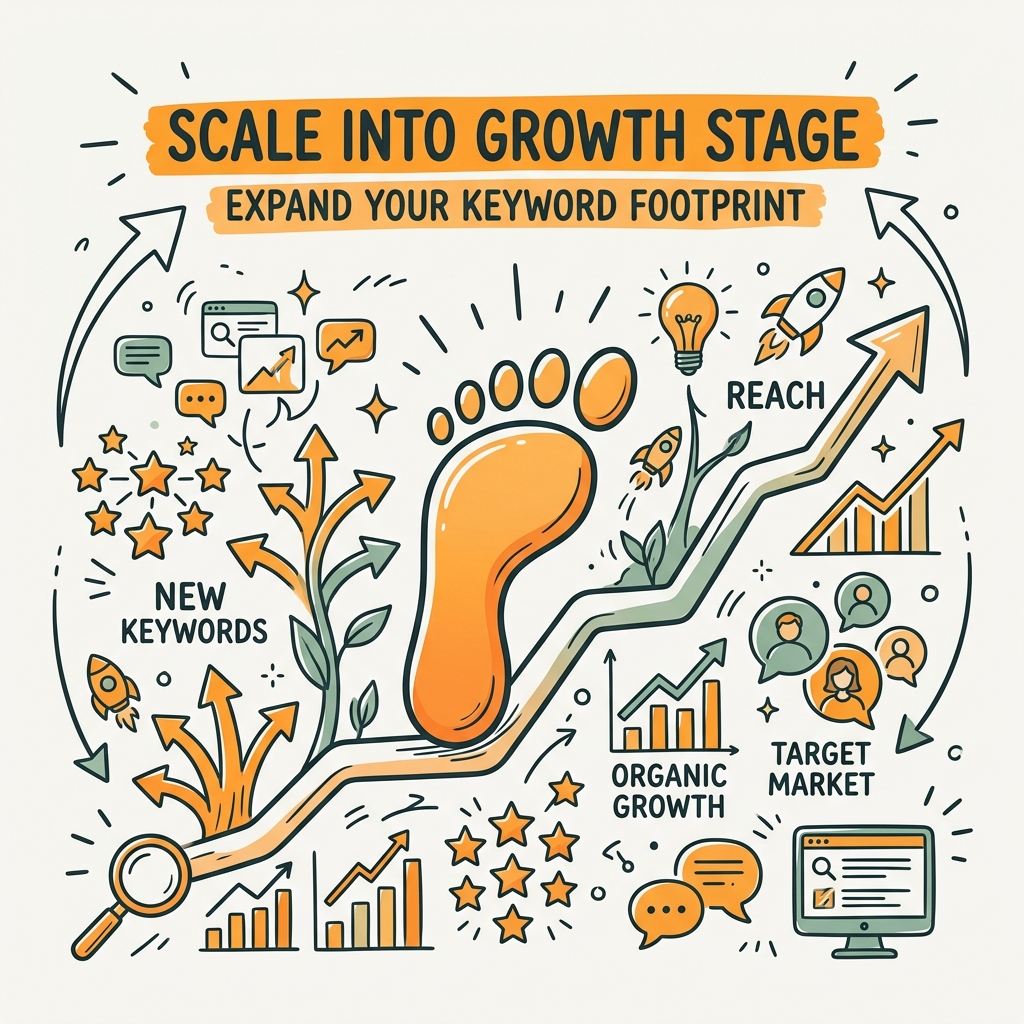
After 6 months of consistent publishing, you've dominated bottom-of-funnel keywords and built domain authority. Now scale. Expansion in growth stage means moving upmarket into mid-funnel and top-funnel keywords, increasing content volume, and building external backlinks.
The Funnel Expansion Model
As your domain authority grows, keyword difficulty thresholds shift. Articles that would have ranked on page 10 for a KD 35 keyword now rank on page 3. Articles targeting KD 50 are now achievable with 2–3 months of ranking time.
In growth stage (months 7–18), expand like this:
- Maintain BOF momentum: Keep publishing 2–4 articles monthly targeting KD 10–25 in your proven categories. This drives pipeline.
- Attack mid-funnel: Publish 3–4 articles monthly targeting KD 30–50 in comparison and category guides. Titles like "Best Tools for [Specific Use Case]", "How to [Outcome] with [Your Category]".
- Establish thought leadership: Publish 1–2 top-funnel articles monthly targeting KD 50–70. These are educational pieces that don't directly convert but build brand authority. Titles like "The Future of [Your Category]", "Trends in [Your Market]".
- Build topical clusters horizontally. If you own "Project Management for SaaS", expand into "Project Management for Agencies", "Project Management for Nonprofits", using the same hub-and-spoke structure in new verticals.
Total output in growth stage: 6–8 articles per month. This compounds organic traffic at 25–40% month-over-month if content quality is high and keyword research is sound.
Link Building and Authority Amplification
In early stage, internal links are enough to build topical authority. In growth stage, external backlinks become critical. Websites earning backlinks from authoritative sources see 3–5x faster ranking velocity than sites relying on internal links alone.
Effective SaaS link-building strategies:
- PR and digital coverage: Send newsworthy updates (funding, new integrations, industry research) to tech journalists. Coverage in publications like TechCrunch or industry blogs passes authority.
- Original research and reports: Publish annual studies or benchmarks in your category. Other sites link to original data. This is why authoritative guides get 50+ backlinks annually.
- Guest posting in authoritative verticals: Write one article monthly for established industry publications. Keeps your brand top-of-mind and passes referral traffic.
- Resource pages and tool roundups: Reach out to sites hosting "[Your Category] Tools" or "[Use Case] Resources" and request a link. Easier than cold PR and still valuable.
Target 3–5 new backlinks monthly in growth stage. By month 18, you'll have 36–90 external links, positioning your domain as an authority in your category.
Optimize for AI Overviews and Answer Engine Optimization
In 2026, ranking in Google is only half the battle. 94% of B2B buyers now use LLMs (ChatGPT, Claude, Perplexity) during their purchase journey, and AI Overviews appear in 48% of Google queries, reducing organic click-through rates by as much as 61% on affected keywords.
The Dual-Channel Discovery Shift
SaaS companies competing only on traditional Google rankings are building half an engine. The winning playbook treats SEO and Answer Engine Optimization (AEO) as a unified strategy, optimizing for both discovery channels in parallel.
"When a VP of Marketing asks ChatGPT 'What are the best project management tools for distributed teams?', your SaaS needs to be cited by name in the response. That's AEO. Simultaneously, you need to rank in the top 3 on Google. Both channels drive pipeline—neither alone is enough."
When a VP of Marketing asks ChatGPT "What are the best project management tools for distributed teams?", your SaaS needs to be cited by name in the response. That's AEO. Similarly, when they search Google, you need to rank in the top 3. Both signals drive pipeline.
| Discovery Channel | Day One Priority | Growth Stage Priority | Strategic Advantage |
|---|---|---|---|
| Google Rankings | Target KD < 20 keywords; optimize title and meta | Expand to KD 30–70; build topical authority | Automates keyword research and ranking optimization across daily content |
| AI Overviews (Google) | Structure content with lists, tables, clear H2s | Publish original research; cite yourself in comparative articles | Ensures fact-checked, structured content eligible for AI extraction |
| LLM Mentions (ChatGPT, Claude, Perplexity) | Build brand clarity with consistent entity language | Earn backlinks and citations; optimize for question-answering content | Publishes citation-worthy content daily, maximizing brand mention frequency |
| Organic Traffic | 400–800/month from BOF keywords | 4,000–8,000/month across the full funnel | Compounds traffic with 1,500+ articles monthly, building topical authority |
Content Structuring for AI Extraction
AI systems extract answers from structured content. Dense paragraphs get skipped. Formatted lists, comparison tables, and clear headers get cited.
Structure your SaaS content for AEO by:
- Leading with answers. First 100 words directly answer the query. AI systems extract from section openers, not buried paragraphs.
- Using lists and tables extensively. Comparison of features? Use a table. Steps in a process? Use an ordered list. Benefits? Bullet points. AI systems pull from formatted content 3x more often than prose.
- Defining terminology clearly. If your content explains "What is X?", use a clear definition in the first H2. AI systems cite these exact definitions.
- Citing yourself correctly. In comparative content, refer to your brand in the third person consistently. "Jottler publishes 3,000-word articles daily" not "We publish articles". This helps LLMs understand your entity in context.
- Building internal link networks. Link related articles to create topical clusters. AI systems favor content clusters over isolated pieces.
When you structure content this way, you're 3–5x more likely to be cited in AI Overviews and LLM responses. That citation drives traffic even when organic CTR drops.
Measure What Matters: Revenue, Not Just Rankings
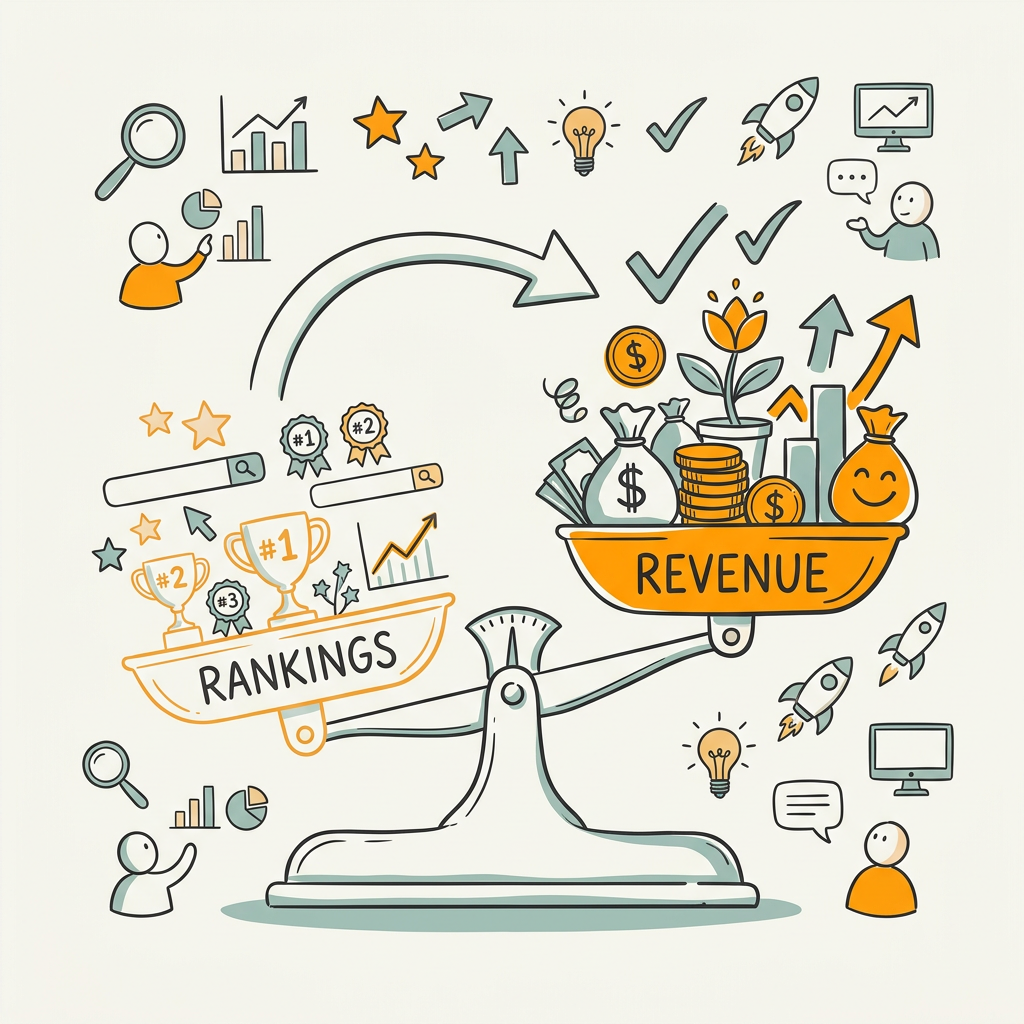
Measure success by outcomes, not vanity metrics. Impressions and rankings don't pay your bills—signups and demo requests do.
The SEO Metrics That Actually Drive Revenue
Set up tracking for:
- Organic conversions and demo requests: UTM parameters on every article. Track which articles drive conversions. Optimize for those topics.
- Pipeline value from organic: Tag organic leads in your CRM. Calculate customer acquisition cost (CAC) from organic vs. paid. In SaaS, organic CAC is 40–60% lower than paid, and LTV is 25–40% higher.
- Organic search positioning: Use Google Search Console to track average position for target keywords. Within 6 months, target keywords should move from position 50+ to position 5–20.
- Content ROI: Divide revenue from organic conversions by total SEO spend (tools, freelancers, in-house salary). B2B SaaS companies see 702% ROI on SEO investment on average, with break-even in 7 months.
- Traffic velocity: Track week-over-week organic traffic growth. Sustainable scaling looks like 5–15% monthly growth. Anything above 30% usually signals a ranking burst (volatile) rather than compounding authority.
Build a simple Google Sheet tracking articles, publish date, target keyword, current ranking position, and monthly conversions. Update monthly. After 3 months, patterns emerge: which topics drive pipeline, which rank fastest, which keywords convert worst despite ranking well (adjust keyword strategy).
Automate Consistency: The Leverage Point for Busy Founders
The single biggest constraint for founder-led SaaS is consistency. Writing, publishing, optimizing, and linking content is a 20–30 hour weekly commitment. Most founders can't sustain that—they're fundraising, shipping product, supporting customers.
This is where automation becomes a competitive advantage. SEO automation tools like Jottler handle the repetitive work at scale. Instead of writing 2–3 articles monthly, you can publish 1–2 daily without burning out.
Jottler researches your target keywords, identifies content gaps, writes 3,000+ word articles optimized for your buyer journey, fact-checks claims with real data, and publishes directly to your CMS while building internal links across your content network. The system uses 12 AI agents working in parallel, compounding your organic authority at velocity most teams can't match manually.
For busy founders in growth stage, this means 5–10 articles published weekly instead of 2–4 monthly. Compounded over 12 months, that's 260–520 articles vs. 24–48. The difference in organic traffic is exponential.
Conclusion
B2B SaaS SEO is a compounding system. Early choices about technical foundation, keyword strategy, and content structure determine whether you dominate your category in 12 months or get buried by established competitors. The playbook is straightforward: fix your technical SEO in week one, target bottom-of-funnel keywords from day one, publish consistently (2–4 articles monthly), expand your content footprint as your authority grows, and measure everything by conversions and pipeline—not vanity metrics.
The companies that win are the ones that start early and stay consistent. Organic search drives 76% of all B2B traffic and delivers 702% ROI on average, with break-even in 7 months. Every month you delay costs you weeks of ranking time and thousands in pipeline. The difference between a SaaS that dominates organic and one that's invisible comes down to a decision made today—to commit to the strategy, set up the foundation properly, and compound it month after month.
Start with your SEO content plan, prioritize your first 3 content clusters, and publish your first article this week. Then do it again next week. By month 6, you'll own your category in search. By month 12, organic traffic becomes your dominant channel—without paid spend, without hustle, just compounding.
Start your SEO agent and automate the consistency. Publish 1–2 articles daily, rank for 100+ keywords within 12 months, and watch organic traffic compound without the weekly writing burden.
FAQs
How long does it take to see SEO results for a new SaaS company?
Bottom-of-funnel keywords rank in 90 days or less when targeting difficulty under 20. If you publish 2–4 articles monthly hitting the right keywords, you'll see measurable traffic within 3 months and meaningful pipeline within 6 months. The break-even point for SEO investment is typically 7 months—meaning your organic leads exceed your SEO costs by month 7. The most important factor is starting immediately and maintaining consistency. Delaying your first article by 6 months costs you 6 months of compounding authority you can never get back.
What type of content converts best for B2B SaaS SEO?
Comparison articles, alternative guides, and feature-specific tutorials convert fastest because they target buyers already evaluating solutions. Articles like "Asana vs Monday.com" or "Hubspot Alternatives" attract high-intent readers comparing tools before purchase. These typically convert at 5–8% (signups or demo requests), versus 1–2% for educational content. Comparison content should target pricing-conscious buyers and directly address feature gaps in competing tools, then position your SaaS as the clear winner. Pair comparison articles with use-case guides ("Marketing Automation for SaaS Teams") to capture mid-funnel readers, then back those with top-of-funnel educational content for brand authority.
How do I balance SEO with product development when I'm a busy founder?
Automation is non-negotiable if you want both SEO and product to scale. Manually writing and optimizing 2–4 articles monthly while shipping product is unsustainable—you'll choose product every time, and SEO goes dormant. Solutions like Jottler handle research, writing, fact-checking, and publishing automatically, freeing your time for product work. This lets you publish 5–10 articles weekly without adding to your workload. The ROI is clear: automated content compounds organic authority at 3–5x the velocity of manual publishing, generating pipeline while you focus on product. Founder-led SaaS that automates content wins against competitors doing it manually.