Broken Link Building for SaaS Brands
Broken link building has been a staple of SEO strategy for over a decade. But in 2026, the landscape has shifted. While 78.1% of SEO professionals report positive ROI from link building overall, broken link building specifically achieves only a 5–8% conversion rate on cold outreach, and merely 18% of SEOs consider it effective as a standalone tactic. For SaaS brands competing in crowded markets, the real opportunity lies not in volume, but in precision. When executed selectively with replacement content that matches or exceeds the original asset, broken link building can still deliver valuable backlinks. This guide shows you how to build a reproducible broken link strategy that compounds organic visibility for growing SaaS companies.
Key Takeaways
- Broken link building converts at 5–8% with cold outreach, but reaches ~20% with perfect content parity (2026, LA Growth Machine)
- Only 18% of SEOs see it as effective; use it selectively alongside digital PR and content assets for SaaS
- Personalization and content relevance matter far more than prospecting volume—focus on 50–100 high-quality targets
- Understanding the Method: Find broken links on authority pages in your niche, create matching replacement content, and pitch linkers with personalized outreach focused on value first.
- Prospecting at Scale: Build a repeatable workflow using Ahrefs, Archive.org, and email-finding tools to identify high-potential targets that align with your SaaS narrative.
- Crafting Replacement Assets: Match or exceed the dead content's quality and relevance; SaaS guides, comparisons, and toolkits outperform generic content replacements.
- Personalizing Outreach: Reference the exact page and broken link, lead with value discovery, and deploy follow-ups across 5–7 day intervals for higher response rates.
- Measuring Real Outcomes: Track referring domain growth, keyword movement, and traffic impact—not just link counts—to understand true business value.
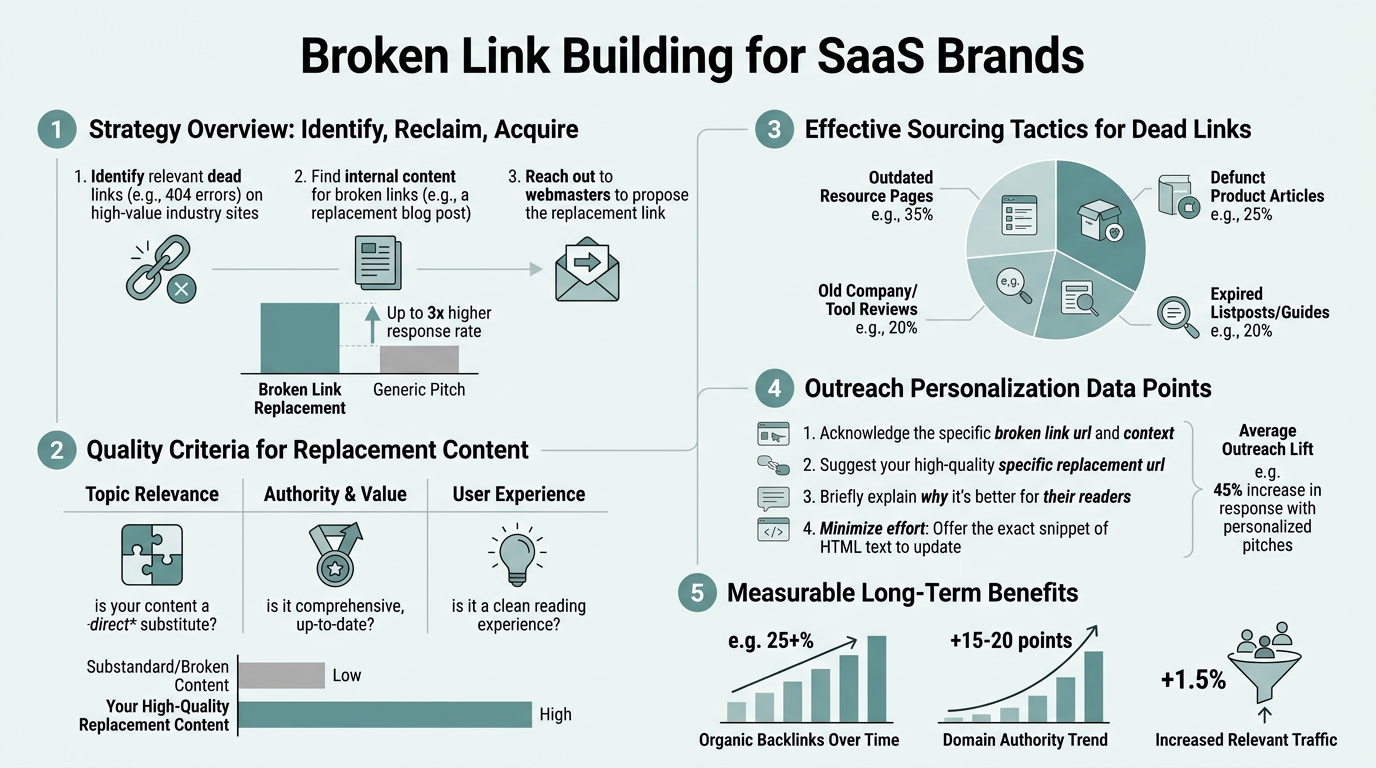
Why Broken Link Building Still Works for SaaS Brands
Broken link building remains a viable tactic in 2026, not because it's a high-volume channel, but because SaaS products naturally align with the types of content that earn quality replacements. Most link-building outreach starts with a request—a naked ask for coverage, a link, or a share. Broken link building flips the script: you lead with a solution, not a demand. When a page admin discovers a broken link on their resource page or guide, they're already in problem-solving mode. Your job is to become part of that solution.
"Dead links damage user experience and SEO authority. Website owners care about fixing them—they just need a compelling replacement. The key is genuine value parity or improvement, not filler content dressed up as a solution."
The reason it works stems from basic human psychology and site architecture. Dead links damage user experience and SEO authority. Website owners care about fixing them—they just need a compelling replacement. BuzzStream's 2025 analysis confirms broken link building remains effective when paired with personalized, value-driven outreach and avoidance of mass generic templates.
For SaaS specifically, broken link building works best when your product fills a genuine gap in the market or when your guides, comparisons, and educational assets are legitimately better than what they're replacing. A blog post comparing five competitor tools might naturally replace a dead roundup. A technical integration guide could plausibly fill the shoes of an outdated resource. The key is genuine value parity or improvement—not filler content dressed up as a replacement. When you have a system that continuously produces high-quality SEO content, these replacement opportunities become abundant.
How to Identify High-Value Broken Link Opportunities
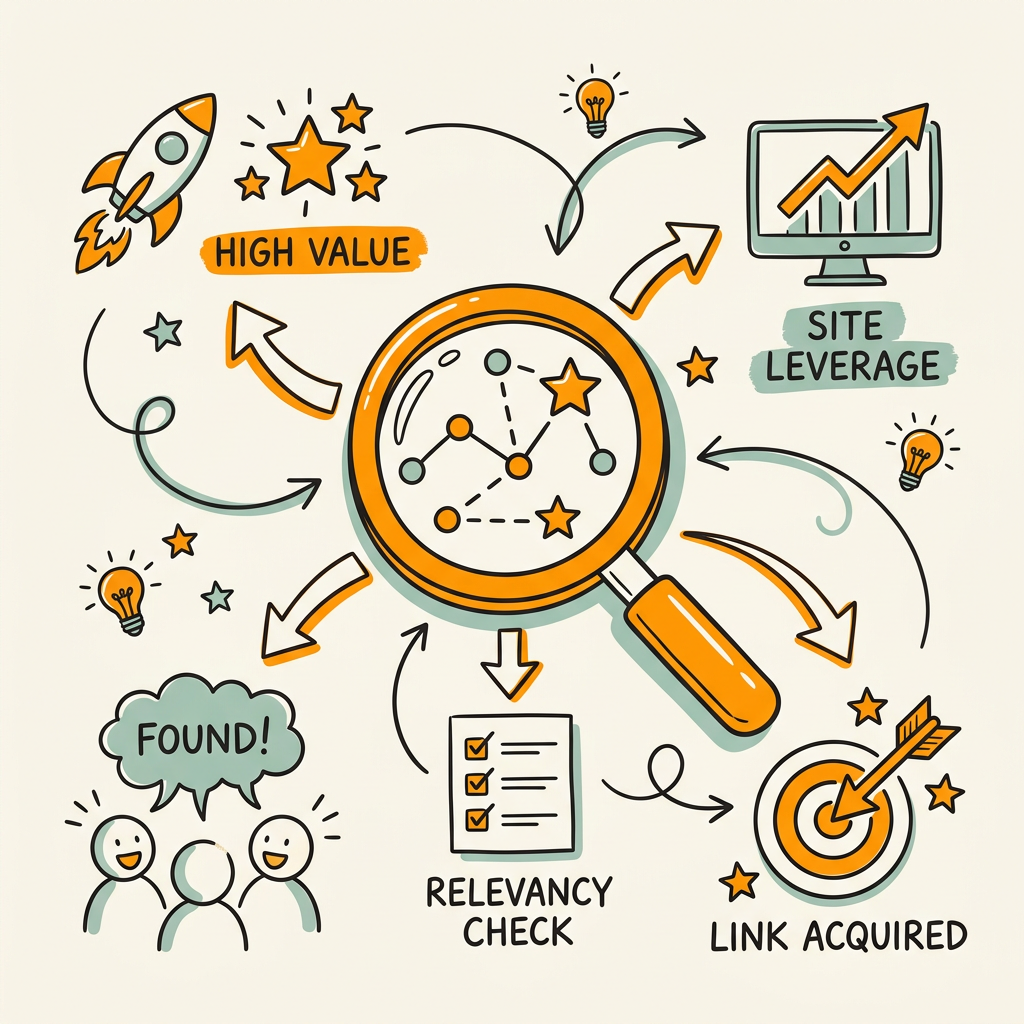
The difference between a wasted outreach campaign and a successful one often comes down to target selection. Not every broken link is worth pursuing, even if your content is strong. Vetting is non-negotiable. The best broken link targets combine three attributes: real authority, topical relevance, and replacement viability. Casting a wide net without discipline leads to low conversion and wasted effort. SaaS teams with limited time need a tight prospecting criteria framework.
Prioritize Pages With High Organic Traffic and Authority
Start by finding pages that already drive meaningful traffic and rank for searchable terms. Pages with no organic visitors are not worth the effort, even if they have a broken link. Use Seoprofy's 2026 SaaS link-building framework, which recommends targeting resource pages, link roundups, and educational guides—the same page types that rank well and have real authority. Look in Ahrefs for pages linking to your competitors or related topics. Filter by Domain Rating (aim for DR 20+), organic traffic (aim for 100+ monthly visitors), and referring domain count (prefer 5+). This simple filter eliminates dead-end targets immediately.
Look for Resource Pages, Roundups, and Comparison Guides
Certain page types are more likely to have both broken links and a willingness to accept replacements. Resource pages—compilations of tools, guides, or references—are golden. Editors maintain these pages regularly and actively seek quality links to include. Link roundups follow the same pattern: they're curated by people who care about relevance and quality. Comparison guides (your product vs. competitors) and educational hubs (how-to guides, glossaries) are equally strong targets because they serve a direct educational purpose. These pages tend to have high authority, good traffic, and editorial intent—all signals that a broken link replacement will actually get fixed and linked to.
Assess Topical Relevance and Link Reason
A broken link on a page with high authority is worthless if it's completely unrelated to your SaaS product. If you sell project management software and the broken link was originally about unrelated tax accounting tools, the replacement value drops dramatically. Assess whether the context makes sense—would your product or content naturally fit the conversation? Check the surrounding text. Read the page's overall topic. Ensure the dead link originally served a purpose closely aligned with your narrative. This reduces rejection rates and speeds up acceptances.
Building Your Broken Link Prospecting Workflow
Manual broken link research is slow and unscalable. Without a repeatable system, you'll burn hours finding opportunities only to discover half are dead ends. The fix is a structured prospecting workflow that feeds a steady pipeline. TheStacc recommends building a pipeline of 50+ qualified targets before outreach and maintaining weekly prospecting sessions. This approach decouples research from outreach, ensuring you're never cold-calling without solid targets in your queue.
"The discipline of building 50+ qualified targets before reaching out transforms broken link building from a sporadic tactic into a predictable, repeatable channel. Weekly prospecting ensures a constant pipeline feeding your outreach efforts."
Step 1: Seed Your Prospect List With Competitor Targets
Begin by identifying competitor mentions and the pages that link to them. Use Ahrefs' "Referring Domains" report to see who's linking to your top three competitors. Export the list. Cross-reference with Semrush to assess traffic and authority. Competitors' backlink profiles are treasure maps for your own link building—if a page links to them, it's likely relevant to your product category. Filter for pages in your exact niche with traffic over 100 monthly visitors. These are authority pages that already understand your market and are primed to accept a relevant replacement link.
Step 2: Mine Industry Roundups and Resource Hubs
Search Google for "best [your category]" and "[your category] tools list" across industry publications, blogs, and SaaS review platforms. Build a list of 15–20 high-traffic roundups and resource hubs. Visit each one and use the browser extension Check My Links to identify dead external links. Document which links are broken and what they originally pointed to. If the context suggests your product could fill that gap, add it to your prospect list. This approach tends to surface highly relevant opportunities because the pages are already curated with your category in mind.
Step 3: Use Archive.org to Understand the Original Content
When you find a broken link, use the Wayback Machine (archive.org) to see what the original page was about. This tells you whether your replacement content is a fair fit. If the dead link led to a competitive tool comparison and you're offering a single-product tutorial, that's a weak fit. If it led to a general resource list or guide and you have an analogous asset, you have a strong case. Archive.org snapshots also show the page's age, giving you a sense of how outdated the content is and whether a replacement is overdue. This intelligence speeds up your vetting and improves personalization.
Creating Replacement Content That Wins Links
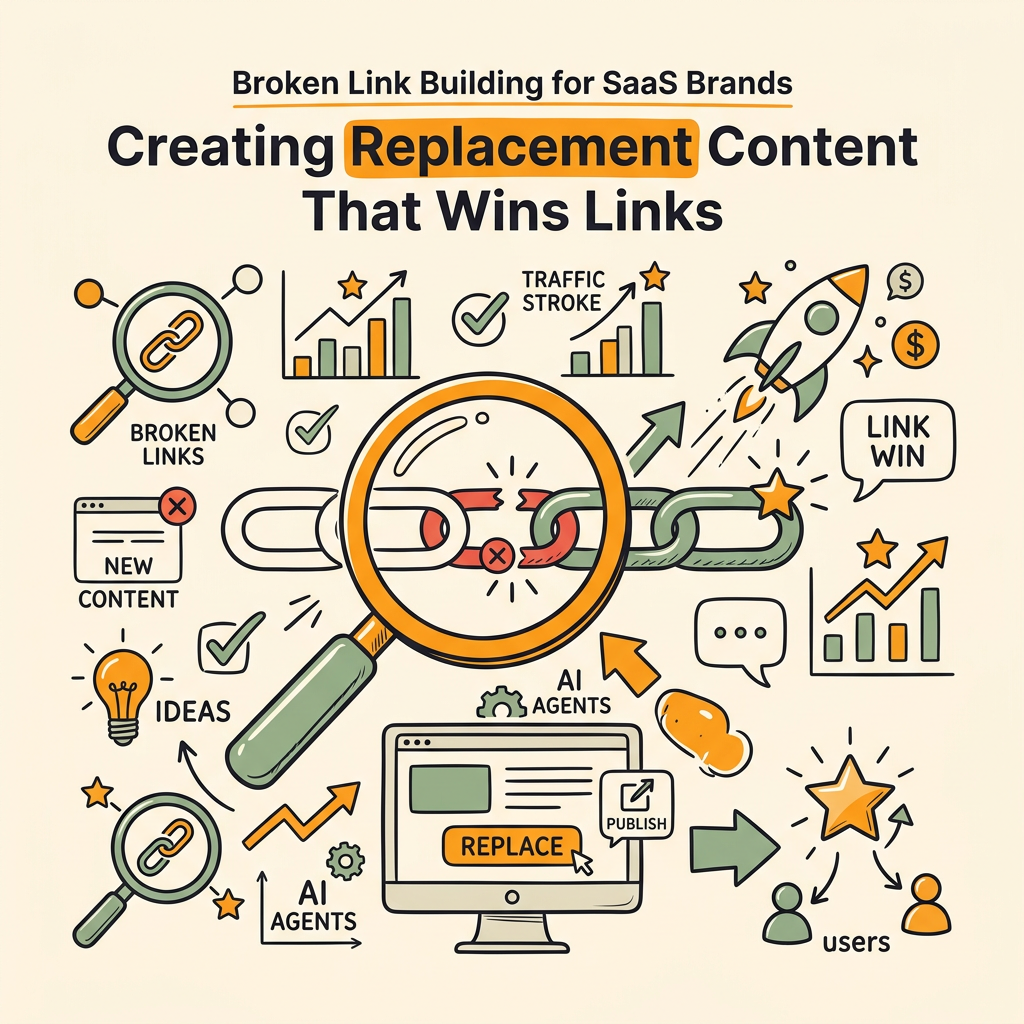
The biggest mistake in broken link building is underestimating the quality bar. A replacement asset only works if it solves the same problem the original did, or does it better. For SaaS teams, this often means investing in guides, comparisons, and data-driven content that genuinely educates. Generic content that merely exists will be rejected or ignored. The data is clear: when replacement content is a near-perfect 1:1 match, conversion rates climb to ~20%. When it's a poor fit, expect only 1–2% conversion.
SaaS Content Types That Replace Broken Links Successfully
Not all SaaS content is equal when it comes to earning replacements. Certain formats have built-in appeal to linkers and readers:
- Comparison guides: "Tool A vs. Tool B" directly replaces dead "best practices" or "alternative tools" links.
- Integration guides: Technical how-to content for your SaaS product naturally fills the void when resource pages lose tool-specific tutorials.
- Data-driven templates: Checklists, templates, and scoring frameworks are attractive replacement assets because they provide immediate value.
- Educational glossaries: If your niche lacks a good terminology resource, a well-maintained glossary is a linking magnet.
- Case studies: Real customer results outrank generic product pages in replacement contexts.
The common thread: all these formats answer a specific question or solve a known problem. They're not advertisements. They're resources that benefit the linker's audience independent of your product. When a roundup page loses a link to "top project management tools," your comparison guide isn't just a link—it's a better resource. That's replacement value.
Quality Over Marketing Spin
Avoid the temptation to over-promote your own product in replacement content. A broken link page didn't die because it was too focused on user benefit—it died for external reasons (site shutdown, migration, abandonment). Your replacement should continue that user-centric tradition. If the original link was to a tool roundup, your replacement comparison should mention competitors fairly and position your SaaS as the best fit for a specific use case, not the obvious winner for all cases. Linkers respect honesty and depth. They reject fluff.
Crafting Outreach That Converts
The outreach email is where most broken link campaigns fail. Cold templates hit delete. Personalization and value discovery shift the conversation from "no thanks" to "actually, yes." The difference between a 1–2% response rate and a 20%+ acceptance rate often hinges on email strategy, not content quality. This section breaks down the framework that actually works.
Lead With the Problem, Not Your Product
Your first sentence should never be "I have a great article you should link to." Instead, open with discovery: "I noticed your [page name] links to [dead resource] as the go-to reference for [topic]. That resource is gone now, but I found something that serves the same purpose." This approach does three things: it proves you read the page (not a template), it offers a real solution (not a pitch), and it creates obligation (you helped first). Only after establishing the problem and solution do you introduce what you're offering as the replacement. This mirrors the psychology that makes broken link building work—you're solving their problem, not asking for a favor.
Personalize With Specific Page Context
Reference the exact broken link, the surrounding section, and why it matters. Instead of "your site has a dead link," say: "Your 'Top SaaS Tools for Startups' section links to [defunct tool], which no longer exists. That guide gets about 2K monthly organic traffic, so fixing that link matters for user experience and SEO." Specific data points show you did real research and care about their site. This level of detail is rare in outreach, which makes it stand out and earns attention.
Use a Structured Follow-Up Sequence
First contact rarely closes the deal. Silence doesn't mean rejection—it often means busy or overlooked. Deploy follow-ups spaced 5–7 days apart. If you get a response, reply promptly and helpfully. If you don't, send a gentle second email that reiterates the value without being pushy. Three touches is standard; four is acceptable for high-value targets. A structured content and link-building workflow automates routine follow-ups while preserving personalization—a critical advantage when scaling outreach across dozens of targets. The discipline of consistent follow-up multiplies conversions more than any single email template.
Tools and Systems for Broken Link Building at Scale
Manual broken link research doesn't scale for SaaS teams balancing content, product, and growth. The best teams use a combination of tools to automate prospecting, verification, and outreach workflow. Here's the standard tech stack in 2026.
| Tool | Primary Function | Key Use in Broken Link Workflow | Best For |
|---|---|---|---|
| Ahrefs | Backlink analysis & competitor research | Identify referring domains, filter by authority, find competitor links | Target prospecting & pipeline building |
| Archive.org / Wayback Machine | Historical page snapshots | Understand original dead content & assess replacement relevance | Vetting opportunity strength |
| Check My Links | Broken link detection (Chrome extension) | Audit prospect pages for dead external links quickly | Fast prospecting on resource pages |
| Hunter.io / Snov.io | Email finder & verification | Find accurate contact emails for site owners and editors | Building outreach contact lists |
Core Tools for Prospecting and Verification
These four tools form a complete prospecting loop. Ahrefs feeds the pipeline, Archive.org validates opportunity strength, Check My Links audits pages for broken links, and Hunter/Snov finds the contact. A SaaS team can prospect 50+ high-quality targets in a few hours with this stack, then spend time on personalized outreach rather than research.
When Automated Content Creation Becomes an Advantage
SaaS teams constrained by content production often skip broken link building because creating replacement assets feels like yet another project. This is where automated content creation becomes strategic. Tools that research, write, and publish 3,000+ word articles in batches can produce the educational assets that serve as replacement content at scale. A 12-AI-agent system that handles keyword research, fact-checking, and internal linking automatically generates a library of high-quality guides, comparisons, and tutorials that naturally feed into broken link opportunities. Instead of pursuing broken links and then scrambling to create content, content-first teams have a ready inventory of assets to deploy for immediate replacement value.
Measuring Broken Link Building Success for SaaS
Teams often measure broken link building success by the raw count of links acquired. That metric is misleading. A single link from a high-authority page that drives traffic and builds topical authority is worth 10 weak links. For SaaS, the real outcome is organic growth and lead generation—not backlink counts. The right KPIs align with business impact.
Track Referring Domain Growth and Quality Signals
Instead of counting placements, track the number of new referring domains you acquire each month. Monitor their average domain authority and relevance. A target of 5–15 new referring domains per month is reasonable for a mid-size growing SaaS. Pair this with evaluation of where the links sit—body text placements beat footer links. Contextual relevance (are they mentioned in the flow of the article, or just added?) matters far more than the anchor text used.
Measure Keyword Movement and Organic Traffic Lift
Link-building ROI ultimately shows up in rankings and traffic. After placing a high-quality link, monitor whether target keywords move. A link from a relevant page should move keywords within 4–12 weeks. Organic traffic growth is the ultimate validation. If broken link placements aren't correlating with traffic increases or new referring visitors, you're likely targeting the wrong pages or replacement content is misaligned with the audience's intent. Strong broken link campaigns produce measurable rank increases in 2–3 months.
Connect Links to Pipeline and Revenue Impact
For SaaS, the gold metric is how acquired links translate to business outcomes. Track how many acquired links drive signups or free trial starts. Use UTM parameters or dedicated landing pages to attribute traffic from specific links back to conversion events. This might seem granular, but it tells you whether your broken link strategy is actually moving the needle on growth—the only metric that matters to founders and board members. A link that drives 100 signups a month is worth ten times a link that drives traffic but no conversions.
Broken Link Building as Part of Your Broader SaaS Link Strategy
Broken link building shouldn't be your only link-building tactic. The data suggests digital PR, data assets, and partnership content are increasingly the primary channels for scaling links sustainably. Think of broken link building as a precision tactic that complements, not replaces, a robust content machine. When paired with proven SaaS link-building strategies, it becomes a reliable secondary driver of domain authority and referring domain growth.
The best SaaS teams combine broken link building with:
- Content-led digital PR: Research-backed guides and original data attract journalists and bloggers organically.
- Strategic partnerships: Co-authored content with complementary SaaS brands creates mutual link-building opportunities.
- Educational asset distribution: High-quality templates, frameworks, and toolkits are naturally linked to and shared across communities.
Broken link building scales when you have a content engine producing the assets required for replacement. Without a steady stream of high-quality guides and comparisons, you'll find yourself constantly scrambling to create content for each broken link opportunity. Automation helps here. Tools that handle research, writing, and publishing at scale create the inventory needed to operate broken link building as a repeatable, low-friction channel.
Conclusion
Broken link building in 2026 is a precision tactic, not a volume channel. When executed with real data, genuine replacement value, and personalized outreach, it still delivers results. The data supports this: 5–8% conversion on cold outreach scales to ~20% when content is a near-perfect match. For SaaS brands with strong educational content and guides, broken link building compounds organic visibility when paired with broader content and link-building strategies. Focus on target quality, replacement asset relevance, and follow-up discipline. Track real business outcomes—traffic, rankings, and pipeline impact—not link counts. And recognize that broken link building works best when you have a content machine producing the guides, comparisons, and resources that linkers actually want to include. Start by building a pipeline of 50+ high-quality targets using Ahrefs and competitor research. Create one exceptional replacement asset and launch a personalized outreach sequence. Measure results in referring domain growth and organic traffic lift. Start your SEO agent to automate the content production that powers your link-building efforts and lets your team focus on high-value prospecting and strategy instead of writing.
FAQs
What is the conversion rate for broken link building in 2026?
Broken link building typically converts at 5–8% on cold outreach, meaning roughly 1 in 12–20 emails results in a placed link. However, when your replacement content is a near-perfect match for the dead page and the target has real authority, conversion rates can climb to ~20%. Generic or poorly matched campaigns convert at only 1–2%, so content relevance and targeting discipline are critical. The difference between a successful campaign and a failed one comes down to asset quality and personalization, not volume.
How long does it take to see results from broken link building?
You'll typically see the link placed within 1–4 weeks of successful outreach. Keyword movement usually follows within 4–12 weeks. Organic traffic lift and pipeline impact can take 8–16 weeks to materialize as the link ages and gains topical authority. The delay is normal—search engines reward links more as they age and as surrounding content compounds value. For SaaS teams, patience is essential. Track keyword movement and referring domain growth as intermediate signals before expecting traffic and conversion lift.
Should we prioritize broken link building or digital PR for link acquisition?
For most growing SaaS companies, digital PR and original research should be your primary focus. Broken link building is a valuable supporting tactic that works well alongside content-led PR. Digital PR (earned media, journalist outreach, data-driven assets) tends to yield higher-authority links and more organic press coverage, which has compounding benefits beyond SEO. Broken link building is best used to fill gaps and acquire secondary links from relevant niche pages when your primary content machine is running. Combine both for maximum impact—a strong editorial calendar with original assets creates natural broken link opportunities as your content becomes the new reference standard in your industry.