Broken Link Building for SaaS Companies
Broken link building remains one of the most underutilized yet effective acquisition channels for SaaS companies. While 78.1% of SEO professionals report positive ROI from link-building efforts (2026), many SaaS teams still rely on generic outreach strategies that yield single-digit response rates. The problem is simple: most SaaS companies chase volume over precision, sending hundreds of template emails instead of targeting the high-value broken links that actually drive qualified traffic. Here's the reality: broken link building works exceptionally well for SaaS when you automate the discovery phase and focus on topical relevance rather than scale.
Key Takeaways
- 78.1% of SEO professionals report positive ROI from link-building efforts (2026), with broken link building achieving 20% success rates on 1:1 topical matches vs. 1-2% for generic outreach.
- SaaS companies spend 28-36% of their total SEO budget on link acquisition, making ROI measurement critical to scaling profitably.
- Precision broken link replacement—matching content quality and relevance exactly—outperforms volume-based campaigns by 10-20x.
- Direct vs. Indirect Approach: Target broken pages with existing backlinks (direct) or pitch your content as a solution to broken links on relevant sites (indirect) for 20% better outcomes than generic outreach.
- Topical Relevance as the Multiplier: Outreach success rises from 1-2% to ~20% when your replacement content matches the original intent and audience perfectly, not just the keyword.
- Automation of Discovery and Outreach: Tools and workflows that automate broken link prospecting, email finding, and campaign tracking reduce manual overhead by 60-70%, freeing teams to focus on content quality.
- Content-First Strategy: SaaS broken link building only works if your replacement assets—benchmarks, calculators, comparisons, templates—solve real problems for the linked audience.
- Scale Through Linkable Assets: Creating proprietary data, SaaS-specific tools, and expert guides gives you replacement content worth linking to, turning broken-link outreach from a spray-and-pray tactic into a precision lever.
How Does Broken Link Building Work for SaaS?
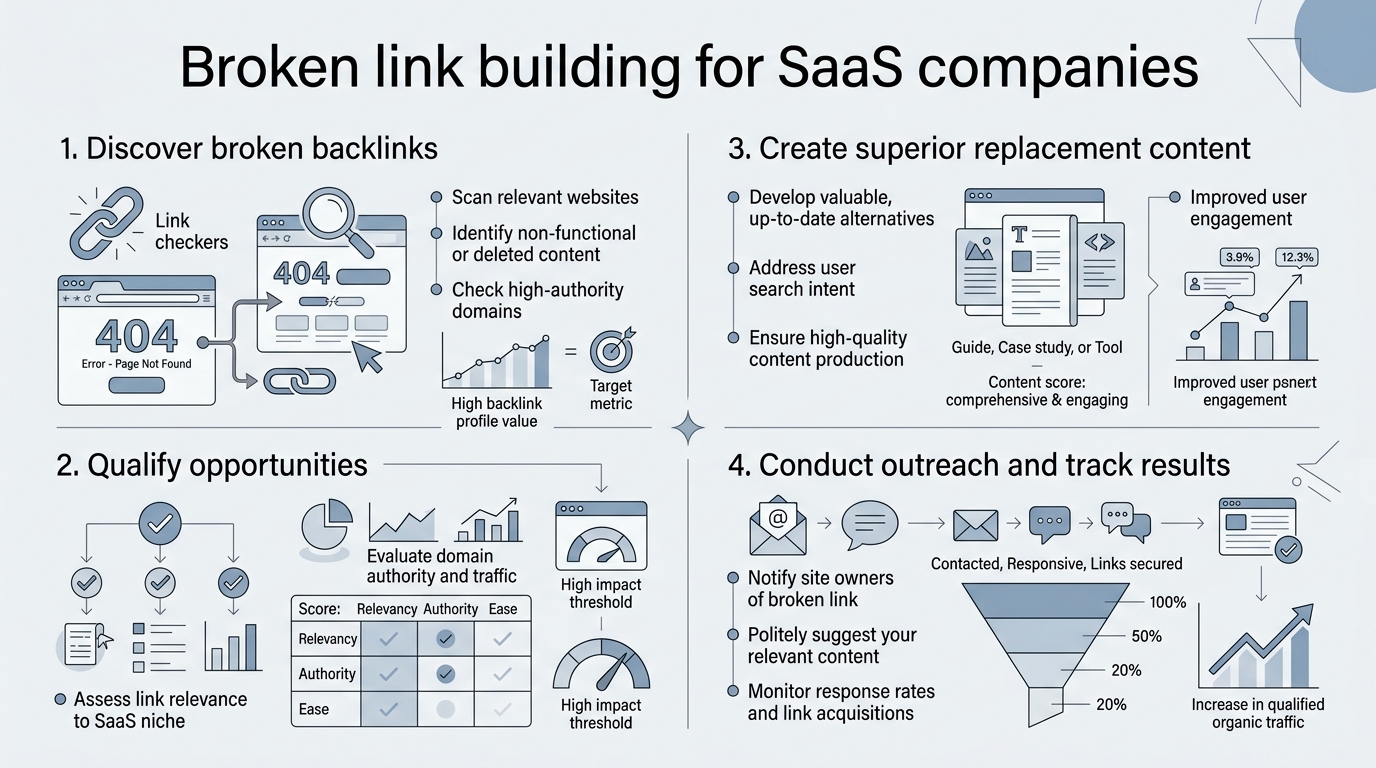
Broken link building is a white-hat SEO tactic that identifies dead or 404-redirected pages on external websites, then proposes your own content as a replacement. For SaaS companies, this works because you control both the discovery and the asset. You find a broken link in your category space, build a replacement resource that solves the same problem but better, and pitch it to the site owner as an upgrade. When done right, 1:1 topical matches achieve success rates of approximately 20% versus 1-2% for generic campaigns (2026), making precision far more profitable than volume.
Direct Broken Link Building: The High-Effort, High-Reward Path
Direct broken link building targets dead pages that still have a strong referring-domain profile. Instead of pitching a similar piece of content, you rebuild the exact asset that disappeared. If a competitor published a SaaS benchmark report three years ago and the page now 404s but retains dozens of inbound links, you rebuild that benchmark with fresh data and updated methodology. The webmasters linking to the original already know its value—your job is to prove your version is worth the upgrade.
"When you email a webmaster with a subject line like 'We rebuilt the [Report Name] your site links to—with 2026 data,' you're not asking for a favor. You're offering value recovery."
This approach requires more effort upfront. You need to identify which broken pages had the most referring domains (quality matters more than quantity), research the original content's depth and scope, and create a replacement that genuinely exceeds the original. But the payoff is proportional. Success rates improve dramatically because you're solving a problem they didn't know they had: a dead link hurting their user experience.
Indirect Broken Link Building: Finding Gaps and Inserting Your Solution
Indirect broken link building flips the model. You don't rebuild dead assets; instead, you identify broken links on active, relevant websites and pitch your existing content as the fix. A SaaS comparison site might link to a competitor's integration guide that's been deleted. You reach out to the site owner, mention the broken link, and suggest your alternative as the replacement. This is lighter on creation overhead but heavier on outreach—you're pitching without the certainty that your content was ever the "first choice."
For SaaS, indirect broken link building works especially well when your asset is genuinely better than what used to be there: more comprehensive, more recent, or more directly relevant to the site's audience. Buzzstream's SaaS link-building guide recommends using tools like Ahrefs Content Explorer to filter by "Only Broken" links, then sorting by referring domains to prioritize high-authority opportunities first. This ensures you're not wasting time on low-value prospects.
Why Broken Link Building Is Uniquely Suited to SaaS
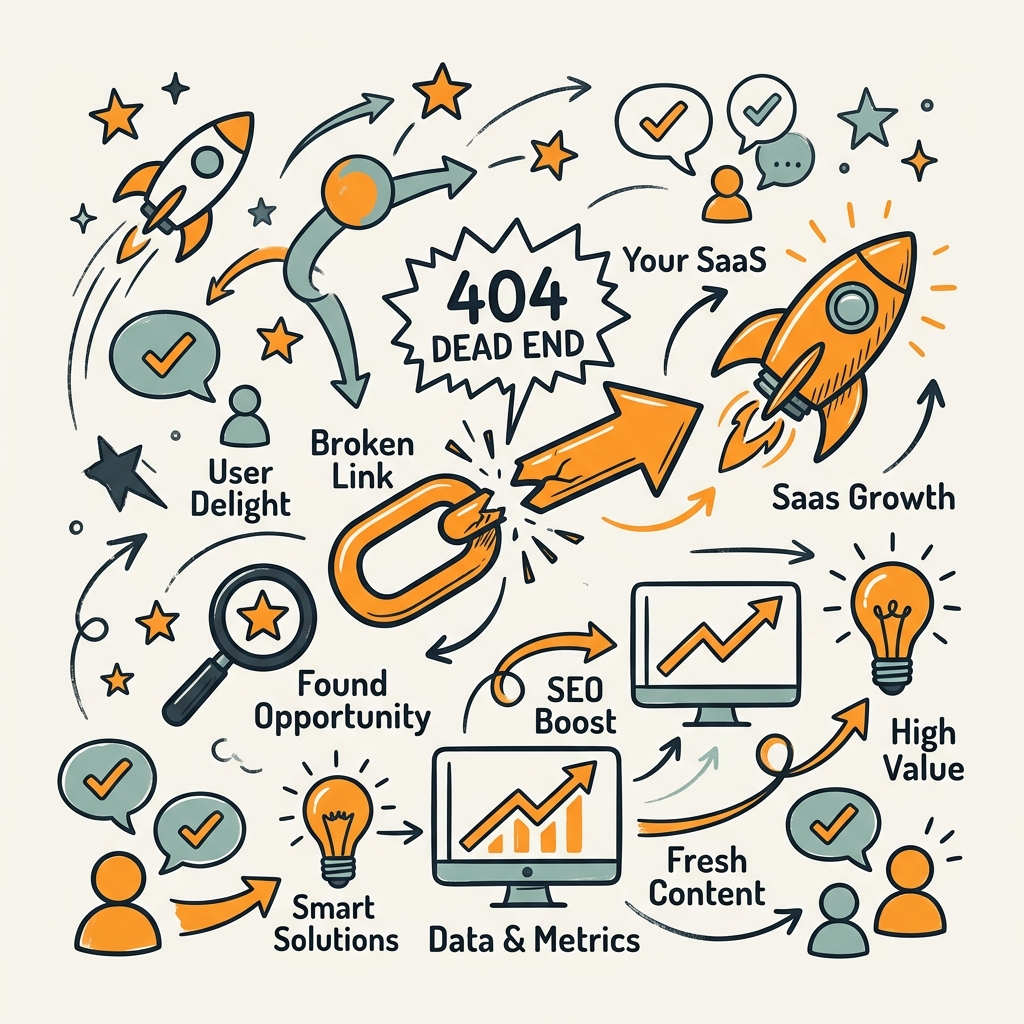
SaaS companies operate in category-specific niches where relevance is everything. Unlike B2C link building, where broad authority from any reputable site can move the needle, SaaS link equity comes from topically clustered links within your software category. A link from a SaaS review site, vendor comparison page, or industry publication carries far more weight than a generic business blog mention. Broken link building leverages this because you're inserting your link into pages that already attract SaaS decision-makers. You're not building links in a vacuum—you're replacing dead assets in the exact footprint where your ideal customers already congregate.
Category Authority Concentration
SaaS categories are dense, organized ecosystems. If you build project management software, your competitors and relevant review sites are all clustered on the first few pages of Google. When one of them publishes a benchmark or buyer's guide and then deletes it, the referring-domain structure remains intact. Those links are orphaned but powerful. By rebuilding that asset, you inherit the link equity and—more importantly—you inherit the audience. The people linking to that old benchmark are likely the exact personas you're trying to reach: other SaaS companies, industry analysts, and content creators.
"The people linking to that old benchmark are likely the exact personas you're trying to reach: other SaaS companies, industry analysts, and content creators."
Linkable Asset Creation Is Built Into Product Development
SaaS companies already create benchmark reports, feature comparisons, integration guides, and educational content. These aren't special "SEO assets"—they're marketing collateral. The advantage is that when you find a broken link to a competitor's guide or report, you can quickly create your own version because you already have the underlying product knowledge. A project management SaaS doesn't need to hire consultants to build a "productivity benchmark"—that data comes directly from your user base and product analytics. This makes replacement asset creation faster and more defensible than it would be for other industries.
SaaS Audiences Are Efficient Link Targets
SaaS buyers actively search for information. They use comparisons, read benchmarks, watch demo reviews, and consult buyer's guides. This concentrated demand means the websites linking to these resources have real traffic and engaged audiences. A dead link on a Capterra page or review site doesn't just represent lost link equity—it represents a broken user experience that site owners actively want to fix. Your outreach resonates because you're solving their problem, not asking for a favor. Broken link building in SaaS is reciprocal value creation.
How to Execute a Broken Link Building Campaign for SaaS
Executing a successful broken link building campaign requires a repeatable workflow: discover broken links with high referring-domain value, identify what the original content covered, create a replacement asset, find contact information for site owners, and pitch with precision. The difference between campaigns that generate 1-2% responses and those that hit 15-20% is methodical prospecting and topical alignment. Automation handles discovery and logistics; strategy handles content and outreach messaging.
Step 1: Prospecting—Find Broken Links Worth Your Time
Not all broken links are created equal. A 404 on a low-authority site wastes your time; a 404 on a Tier-1 industry publication is gold. Start with domain selection by following this approach:
- List the top 30-50 websites in your SaaS category: review sites (G2, Capterra, TrustRadius), industry publications, competitor sites, and authority blogs.
- Use Ahrefs, Semrush, or similar tools to run "broken links" audits on each domain, filtering to show only links with a Domain Rating (DR) of 40+.
- Examine content clusters for broken links in categories relevant to your SaaS product: comparisons, buyer's guides, feature roundups, benchmarks, and tutorials.
- Prioritize by referring-domain count and recency of the original content, focusing on active pages maintained by site owners who will care about fixing the break.
A broken link in a "Top 10 Project Management Tools" article is far more valuable than a broken link in a random blog post. The site owner is actively maintaining category content, which means they'll care more about fixing the break and will appreciate a relevant replacement suggestion.
Step 2: Content Research—Understand What Died and Why It Mattered
Before building your replacement asset, reverse-engineer the original. If the dead link used to point to a competitor's "Productivity Benchmark 2024," search the Wayback Machine to see what that report covered: methodology, key findings, author, publication date, and length. Read any mentions or backlinks to the original to understand why it was cited. Use these research questions to guide your strategy:
- Was it the most comprehensive benchmark available in its category?
- Was it the most recent data source when published?
- What was the visual presentation style or interactive elements?
- Who was the target audience: practitioners, decision-makers, or researchers?
- What specific gaps or pain points did it address?
You're not cloning the original—you're building something that fills the same gap but better. If the original report was data-driven but lacked practical recommendations, your version adds tactical insights. If it was a PDF only, yours is an interactive calculator. The goal is to give the linking site a reason to upgrade the reference, not just swap one 404 for another.
Step 3: Asset Creation—Build Replacement Content That's Worth Linking To
This is where many SaaS teams falter. They find broken links, build generic replacement pages, and wonder why response rates stay below 5%. The issue is that replacement content must be demonstrably better or significantly more relevant than what was there before. For SaaS, this means proprietary data, original research, or tools that solve a specific problem. A generic "10 Features to Look for in Project Management Software" guide won't work. A "2026 Productivity Benchmark: How Remote Teams Are Optimizing Workflow" with real data, visual insights, and comparative analysis will.
The best SaaS broken link replacements share these traits:
- Specific, not broad: Target narrow use cases or personas, not generic categories.
- Timely: Use current data, recent case studies, and up-to-date methodology.
- Immediately useful: Solve a real problem, not academic theory.
- Visually engaging: Use interactive elements, calculators, or compelling data visualization.
- Linkable by design: Create content you'd actually want to cite if writing the article today.
A calculator that helps users right-size their tool choice beats a 5,000-word explainer. A comparison spreadsheet beats a narrative review. When you build replacement assets with the mindset of "Would someone actually link to this if they were writing today?", your outreach success multiplies. This is where comprehensive SaaS link-building frameworks and content automation workflows prove valuable—they ensure you're producing at sufficient volume and quality to sustain an ongoing prospecting pipeline.
Step 4: Contact Discovery—Find the Right Decision-Maker
An perfect outreach email sent to the wrong person gets deleted. Before you pitch, identify the webmaster or content owner responsible for the broken link. For small sites, it's usually the founder or head of content. For larger publications, it's a content editor or SEO manager. Tools like Hunter.io, RocketReach, or BuzzStream automate contact discovery, but email hunting is an art. Use these methods to find the right contact:
- Check author bylines on articles in the category you're targeting.
- Review the site's contact page and "About" page for team member names.
- Search LinkedIn for people who write for that publication.
- Monitor Twitter or LinkedIn for announcements from their content team.
- Check the domain's Whois information for administrative contacts.
Personalization matters enormously. A generic "Hi, I noticed you have a broken link" email from no one gets buried. An email from someone who's clearly read their content and found value in it gets a response. "I read your 2024 SaaS buyer's guide and loved your breakdown of implementation timelines. I noticed your link to [dead resource] is returning a 404. We've just published a 2026 update with fresh vendor data that would be a perfect fit for your article." That's a conversation starter.
Step 5: Outreach—Pitch the Fix, Not the Favor
Your subject line should signal value, not spam. "Broken link on your SaaS guide" gets ignored. "2026 replacement for [Resource Name]" gets opened. In the body, lead with the benefit to them: you're helping them fix a broken user experience and offering a better reference for their readers. Mention the broken link specifically, explain why the replacement is a good fit, and include a direct link with a preview. Three to four sentences max. Longer emails underperform.
Follow these guidelines for maximum impact:
- Subject line should reference the specific resource or topic, not generic "link" language.
- Lead with their problem first: the broken link and its impact on user experience.
- Use 3-4 short sentences maximum; brevity outperforms long-form pitches.
- Offer a direct preview link so they can review before committing.
- Be flexible on link placement: dofollow, nofollow, or text-based credit.
- Plan for follow-up: 2-3 additional touches spaced 2-4 weeks apart.
Offer options. Some site owners will swap the link immediately. Others will need convincing or will want to test your content first. Some prefer a nofollow link. Be flexible. The goal is the link, but the relationship is the asset. Site owners who discover you as a thoughtful, responsive partner are far more likely to link to you again in future content.
| Campaign Phase | Effort Level | Success Rate Multiplier | Time to First Link |
|---|---|---|---|
| Prospecting (Finding broken links with DR 40+) | Low | 1.0x | N/A |
| Content Research (Understanding original asset) | Medium | 1.5x | N/A |
| Generic Asset Replacement (Standard guide/article) | Medium | 1.0x (1-2% success) | 3-4 weeks |
| Proprietary Asset (Benchmark, tool, data) | High | 4-6x (15-20% success) | 5-8 weeks |
| Personalized Outreach (Named decision-maker, specific pitch) | Medium | 2-3x | 1-2 weeks after asset launch |
Tools and Workflows That Scale Broken Link Building for SaaS
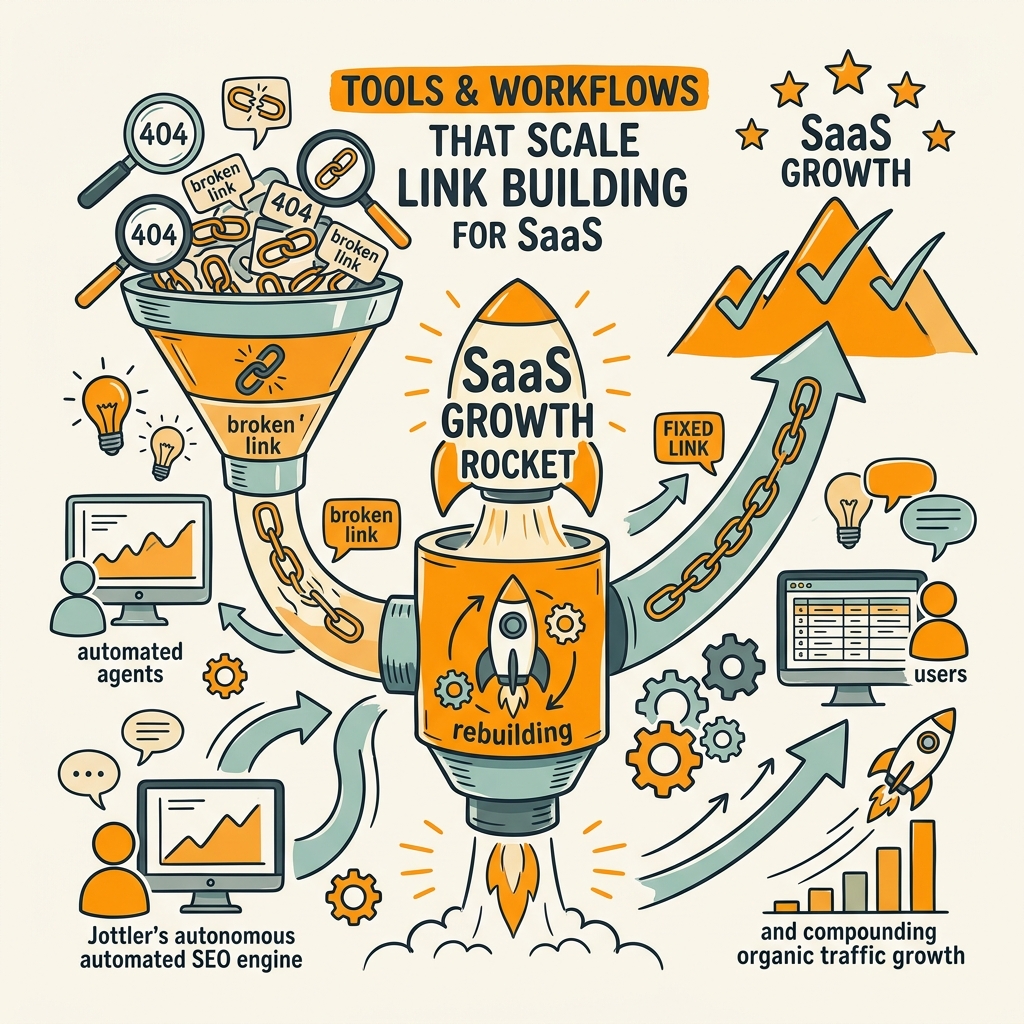
Manual broken link hunting doesn't scale. You need tools that automate discovery, contact finding, and campaign tracking. The best SaaS broken link programs combine specialist tools (Ahrefs, BuzzStream, Hunter.io) with workflows that feed prospecting results to content production pipelines and then to outreach systems. However, the challenge for most teams is orchestration. You'll find a list of 200 broken link opportunities but lack a system to track which assets you've already built, which are in progress, and which have been pitched.
Prospecting and Analysis Tools
Ahrefs Content Explorer and Semrush Site Audit are the industry standards for broken link discovery. You upload a list of target domains, and the tools crawl for 404 errors and dead pages, then rank them by referring-domain count and Domain Rating. Filter by content type and relevance, export the results, and prioritize by opportunity value. This gives you a ranked prospecting list in under an hour. For smaller SaaS teams, Ahrefs' free backlink checker offers a limited alternative, though the premium version's filtering and scale are essential for systematic outreach.
"Ahrefs Content Explorer and Semrush Site Audit are the industry standards for broken link discovery, giving you a ranked prospecting list in under an hour."
Contact Discovery and Outreach Management
BuzzStream, Pitchbox, and Outreach manage the entire outreach workflow: contact finding, email sequencing, response tracking, and reporting. They integrate with email providers, allowing you to send personalized emails at scale without going to spam. For SaaS, these tools are worth the investment because they reduce manual admin overhead and give you visibility into campaign performance. Track these metrics with your outreach platform:
- Response rate by site category (review sites, publications, competitor domains).
- Link placement rate (percentage of outreach that converts to actual placements).
- Time-to-response data across different messaging approaches.
- Referral traffic generated from each placed link.
- Follow-up effectiveness: which touchpoints convert best.
You'll see which types of sites respond best, which outreach timing converts higher, and which messaging resonates by category.
Content Automation for Replacement Assets
The bottleneck in most broken link campaigns is asset creation. Teams find 100 broken links but only have bandwidth to build 10 replacements. This is where content workflow automation becomes critical. Rather than manual freelancer coordination or in-house writing cycles, autonomous SEO systems and content automation platforms can research and draft replacement guides, comparisons, and benchmark frameworks at scale. A properly configured system can produce 5-10 replacement assets per week, each fact-checked and optimized, removing the velocity bottleneck that stalls most broken link programs.
Real Metrics: What Success Looks Like for SaaS Broken Link Campaigns
Broken link building success is measurable but often misreported. Teams cite "10 links acquired" without mentioning it took 500 outreach emails. The real metric is cost per qualified link, not total links or response rate alone. A 20% response rate on a highly topical replacement is worth celebrating. A 2% response rate on generic outreach is not, even if it generated more raw links. For SaaS, track these metrics separately by campaign type.
Response Rate vs. Conversion Rate
Response rate (percentage of people who reply) is not the same as conversion rate (percentage who actually place a link). A site owner might respond positively but never follow through on the edit. Target a 10-15% response rate on personalized outreach to highly relevant prospects. A 5-10% link placement rate (of emails sent) is healthy for most campaigns. Adjust based on asset quality—proprietary SaaS benchmarks typically see 15-20% placement rates, while generic guides see 2-5%.
Link Equity and Traffic Impact
Not all links drive equal traffic. A nofollow link on an industry publication might drive referral traffic worth more than the SEO benefit. A dofollow link from a low-traffic authority site might boost rankings but send no visitors. For SaaS, prioritize links from sites that send referral traffic and attract your target buyer persona, even if their domain authority is lower. Measure both: track referral sessions from each link, monitor your rankings for key terms, and tie link acquisitions back to organic traffic growth over 6-12 months.
Scaling Beyond Manual Outreach: Automating the Full Workflow
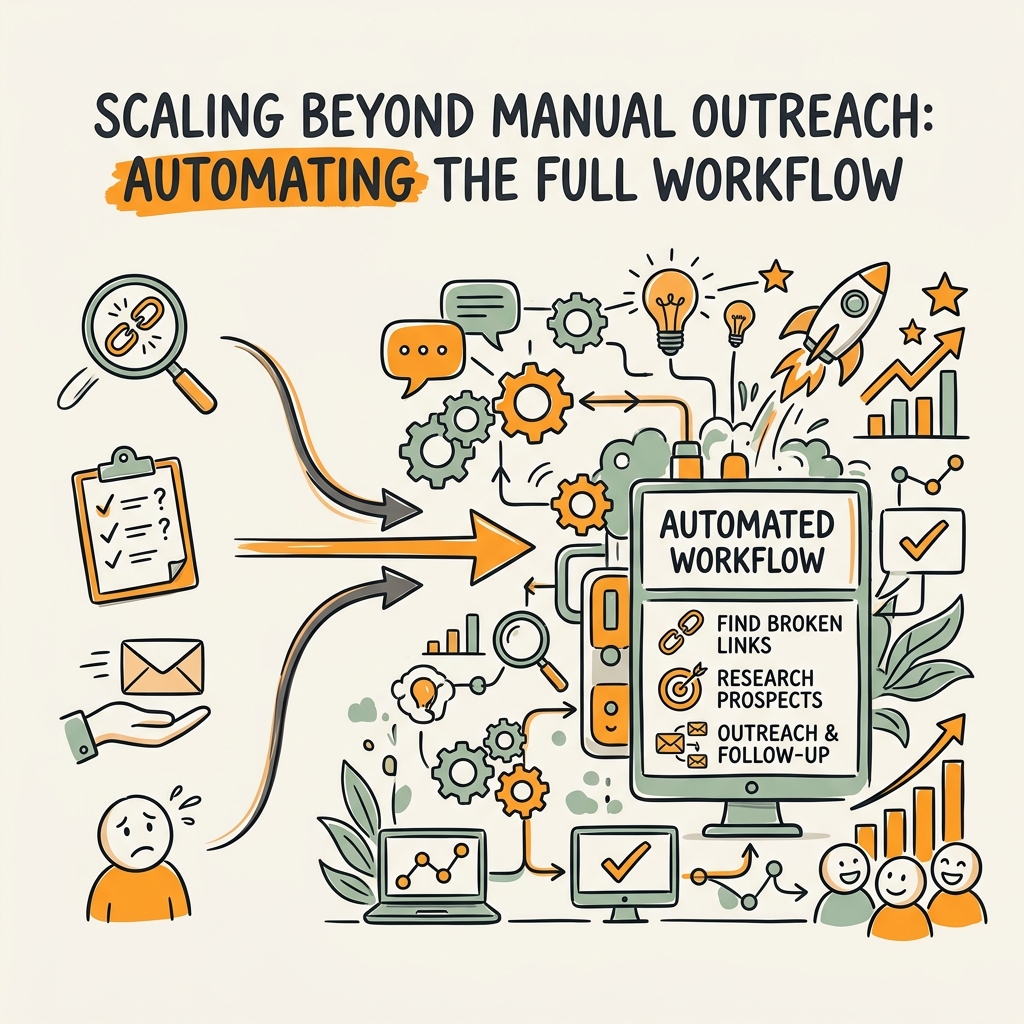
The teams executing broken link building at scale automate everything except the creative decisions. They use prospecting tools to find opportunities, content systems to build replacements, email platforms to pitch, and CRMs to track results. The common thread is workflow: broken links flow into an asset-production pipeline, completed assets flow into outreach sequences, and results flow into reporting dashboards. Manual processes break at scale; systems compound.
"The teams executing broken link building at scale automate everything except the creative decisions. Manual processes break at scale; systems compound."
For growing SaaS companies, this is where the real advantage lies. Rather than hiring a dedicated link-building specialist or agency, invest in systems that make your content team more productive. A small team equipped with the right tools—prospecting software, content automation, email management—can execute programs that typically require three to five dedicated people. This is especially true when broken link assets come from your core content marketing engine rather than bespoke campaigns.
Common Broken Link Building Mistakes SaaS Companies Make
Successful SaaS companies avoid these five critical mistakes:
- Treating broken link building as a volume game: Teams blast 500 generic outreach emails and celebrate 5 links while ignoring that the cost per link was prohibitive. Focus on precision over volume.
- Building replacement assets that aren't genuinely better: You can't outreach your way past weak content. A mediocre guide won't convert, no matter how personalized your pitch.
- Targeting broken links on low-authority sites: A 404 on a dormant blog with 2 referring domains is not worth your time. Focus on broken links on active, high-authority sites in your category.
- Incomplete follow-up: Site owners get busy; emails get buried. A second, third, or fourth touchpoint—spaced 2-4 weeks apart—doubles your link acquisition rate. Most teams give up after one email.
- Failing to measure correctly: If you don't track which prospects responded, which placements converted, and which pieces of content drove the most links, you have no data to optimize future campaigns. Build measurement into your prospecting system from day one.
Conclusion
Broken link building for SaaS companies is not a new tactic, but execution separates winners from the rest. Campaigns focused on 1:1 topical matches achieve 20% success rates compared to 1-2% for generic outreach, and SaaS categories offer concentrated, high-value opportunities in category-specific publications and review sites. The key is precision: find broken links on high-authority sites, build replacement assets that genuinely exceed the original in relevance and quality, identify the right decision-maker, and pitch with confidence that you're solving their problem, not asking for a favor. Automate the discovery, creation, and prospecting logistics so your team can focus on content quality and strategic targeting. SaaS companies that scale broken link building through workflow systems—not just effort and time—compound their link equity and organic traffic year over year.
Start building your broken link program today. Start your SEO agent to automate research, content creation, and internal linking workflows that fuel ongoing link-building campaigns without the manual overhead.
FAQs
How do I find broken links for my SaaS category?
Use Ahrefs Content Explorer or Semrush Site Audit to crawl your top 30-50 competitor and review sites. Filter for 404 errors and broken pages, then sort by Domain Rating (40+) and referring-domain count. Export the results and prioritize by relevance to your product category. The highest-value opportunities are broken links on active, regularly-updated sites like review platforms and industry publications, since those sites care most about fixing user experience issues. Expect to find 20-50 high-quality opportunities per domain.
What kind of replacement content works best for SaaS broken link building?
Proprietary data, benchmarks, and interactive tools outperform generic guides by a significant margin. SaaS buyers actively search for comparisons, benchmarks, calculators, and vendor reviews. If the broken link used to point to a vendor benchmark, rebuild it with 2026 data. If it pointed to a product comparison, create an updated version with current features and pricing. The key is building something you'd actually want to cite if you were writing the article today, not just filling the gap. Tools like product integration guides, ROI calculators, and feature comparison matrices convert at 15-20% while standard articles convert at 2-5%.
How many broken links should I target before launching a campaign?
Start with 20-30 high-quality targets (Domain Rating 40+, high relevance to your product) rather than 500 generic ones. This teaches you what works before scaling. Track response rates, link placement rates, and referral traffic from each placement. Once you have data on which types of sites, content formats, and messaging convert best, expand to larger prospect lists. Most SaaS teams see their most profitable results from 15-50 targeted campaigns per quarter rather than one massive spray-and-pray blitz. Quality prospecting beats volume.