
Case Study Content That Generates Leads
Case studies consistently rank as one of the most credible assets in B2B marketing, yet 58% of marketers use them ineffectively because they treat them as generic success stories rather than strategic lead magnets. The real opportunity? Organizations with documented content strategies generate 3x more leads per dollar spent than those withoutand case studies are their strongest proof point. When structured correctly, case studies bridge the gap between awareness and conversion by showing prospects exactly how your solution solves problems in their specific context. Here's how to transform your case studies from sales collateral into the lead-generating machines your team needs.
Key Takeaways
- Case studies work best in the middle funnel where 58% of buyers research solutions, and they're most effective when paired with a broader content strategy (2026, HubSpot)
- Organizations using documented content strategies generate 3x more leads per dollar spent, with case studies as the anchor proof asset
- The standard 500–1,500 word structure with a prominent snapshot, clear challenge-solution-results framework, and real metrics outperforms longer, narrative-only formats
- Positioning Case Studies in Your Funnel: Case studies work best as middle-funnel assets where buyers are actively evaluating solutions, paired with webinars and reviews.
- Case Study Structure That Converts: Lead with a snapshot, establish the problem clearly, detail the solution, and emphasize measurable results with customer quotes.
- Essential Elements for Lead Generation: Specific metrics, customer names (if possible), before-and-after comparisons, and a clear call-to-action drive qualification and engagement.
- Distribution and Content Integration: Case studies generate 3x more impact when embedded in SEO content, email campaigns, and LinkedIn rather than treated as standalone assets.
- Measurement and Optimization: Only 42% of marketers can measure content ROI, but those who track case study engagement unlock 3.1x budget growth.
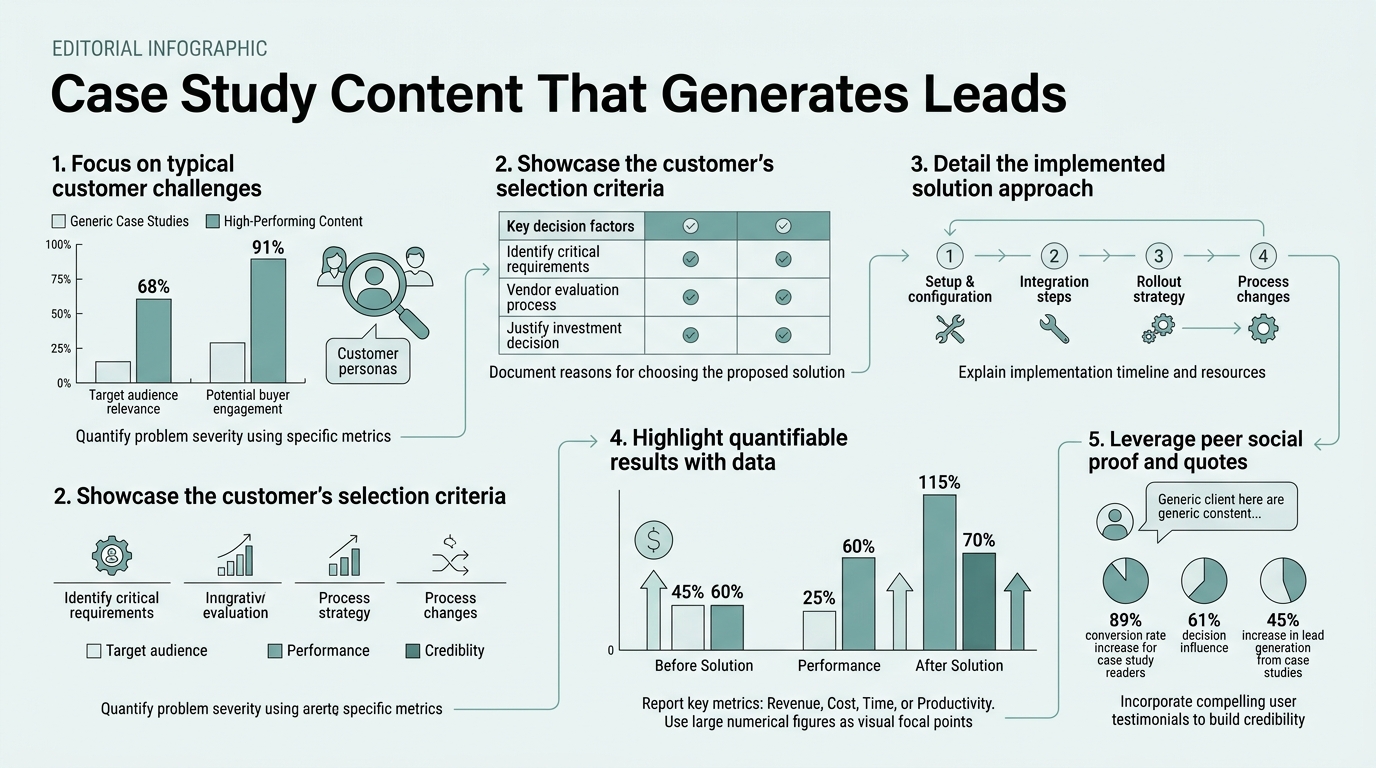
Why Case Studies Outperform Other Lead Magnets
Case studies succeed where generic landing pages fail because they deliver proof, not promises. Unlike whitepapers or ebooks that explain concepts, case studies demonstrate that your solution actually works for real customers in measurable ways. A prospect in your target market reading a case study about a competitor with a similar problem sees a concrete roadmap of success. That psychological certainty is what drives them to take the next stepa demo call, a consultation, or a trial signup.
The data backs this up. According to Martal's 2026 lead generation statistics, webinars (78%), case studies (58%), and user reviews (57%) are the most effective middle-funnel assets. The slight edge to webinars is explained by their interactive format; case studies win when they're embedded in a broader strategy. The reason? Case studies don't stand alone wellthey thrive inside content systems.
The Trust Factor: Why Buyers Believe Case Studies
Your marketing claims mean nothing to a prospect. A customer's story means everything. Case studies are trust content because they shift the narrative from "we say we're great" to "here's what we did for a company like yours, and here are the numbers to prove it." This subtle psychological shift is powerful. When a buyer reads that your SaaS tool reduced onboarding time from 3 weeks to 4 days for a company in their industry, they stop asking "does this work?" and start asking "how fast can we implement it?"
Best practices from Adobe and other authoritative sources consistently recommend: let your data, images, and customer quotes do the talking. Don't oversell. Let the metrics speak.
Case Studies as Content Compounding Assets
Unlike a one-time paid campaign, case studies compound in value. A single case study can be repurposed across email sequences, social media, blog posts, webinars, and LinkedIn. If you're serious about scaling leads without scaling your marketing team proportionally, case studies are one of the few assets that work across multiple distribution channels. This is especially critical for busy founders and growing teams who can't afford to create fresh content for every channel.
The advantage of treating case studies as modular content is that a single piece of customer success can serve 5+ purposes: a download magnet, email nurture sequences, SEO content, sales collateral, and LinkedIn stories. When you structure your case study with distribution in mind from day one, you maximize the lead-generation value per hour invested in creation.
How to Structure Case Studies That Actually Convert Prospects
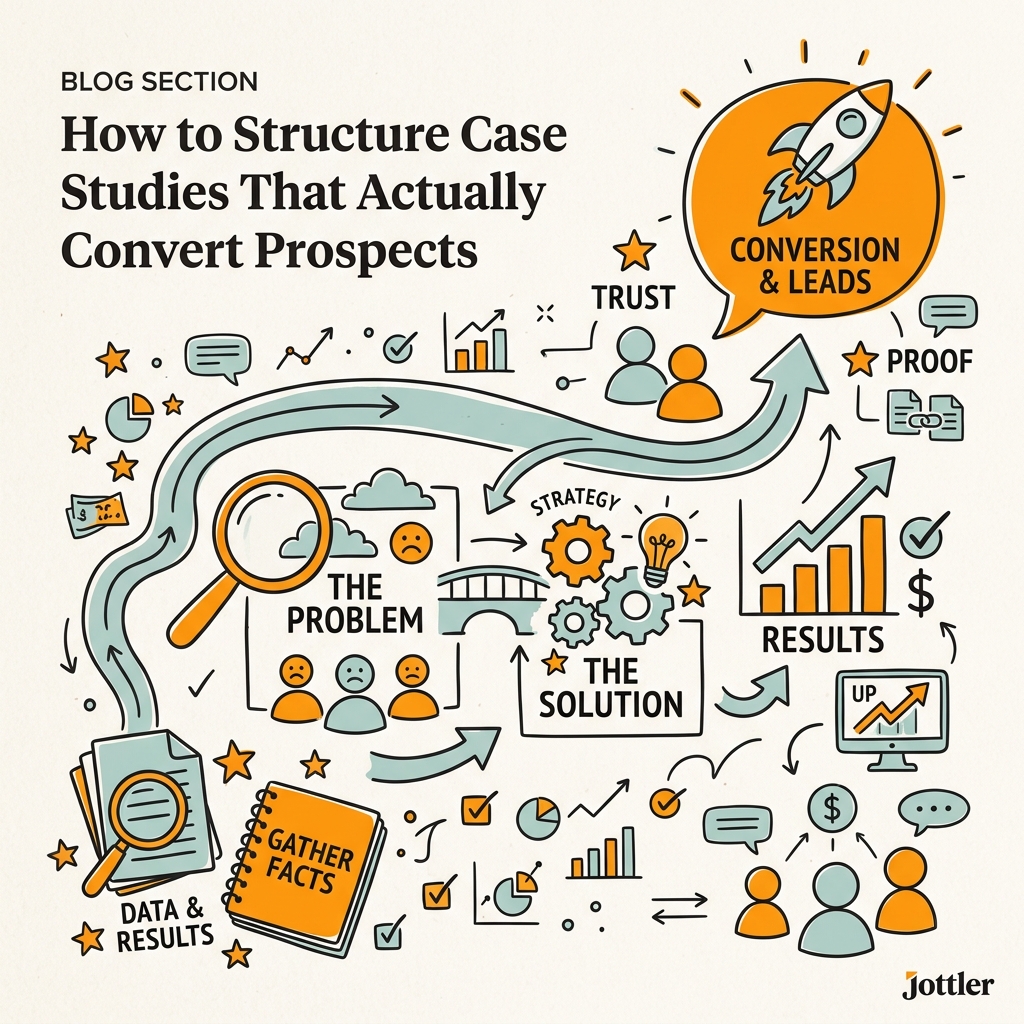
Structure is everything. A poorly organized case studywhere the reader has to dig three sections deep to find what the client actually achievedloses prospects immediately. The best case studies follow a proven template that makes skimming easy and reading rewarding. Here's the structure that works: snapshot first, problem clear and stakes-driven, solution specific and customer-focused, results quantified and visual, and a direct call-to-action.
The Executive Snapshot: Your First 100 Words Count
Most readers will never read your case study from start to finish. They'll scan. Your snapshota short summary of who the customer is, what problem they faced, and what they achievedmust answer the reader's implicit question in the first 30 seconds: "Is this relevant to me, and did it work?" Adobe's guidance is clear: lead with a snapshot of no more than 100 words. Include the customer name (or company type if confidential), the measurable outcome, and the timeframe.
Example framework:
- Customer: [Company name, industry, company size]
- Challenge: [Specific problem, measurable impact before the solution]
- Result: [Primary metric achieved, timeframe to achieve it]
This isn't marketing fluff. It's a data-driven headline that separates qualified readers from tire-kickers in the first paragraph.
The Problem Section: Make the Stakes Visceral
Skipping or minimizing the problem section is a common mistake. Prospects don't care about your solution until they deeply understand why the customer needed it. A strong problem section establishes three things: the specific challenge, the business impact (in dollars or time, if possible), and why the customer couldn't ignore it.
Don't write: "The client faced challenges with process efficiency." Write: "The marketing team was spending 40 hours per week on manual content distribution, costing the company $80K annually in operational overhead and delaying time-to-market by 3+ weeks on campaign launches."
The specificity makes it real. A prospect managing similar problems suddenly sees themselves in the narrative. This is where empathy enters the case study.
The Solution: Customer-Centric, Not Feature-Centric
This is where most case studies fail. Writers default to listing product features instead of explaining how the customer implemented the solution and why they chose that approach. Your solution section should explain the decision-making process, not the spec sheet.
Frame it around the customer's perspective:
- What was the customer's goal? (Not what your product does.)
- What did they try first? (If anythingthis adds realism.)
- Why did they choose this approach? (Rationale matters.)
- How did they implement it step by step? (Timeline and process are credibility markers.)
- What resistance or challenges came up during implementation? (Honesty builds trust.)
When you show that the customer encountered real obstacles and overcame them, you're telling prospects: "Yes, this is hard. Yes, it takes work. But here's how we did it, and here's what happened on the other side."
The Results: Metrics Before Narrative
This is your lead magnet section. Lead with numbers. Quantify everything you claim.
Instead of: "Results improved significantly," write: "Content distribution time dropped from 40 hours to 8 hours per week (80% reduction), freeing the team to focus on strategy. Campaign launch velocity increased 40%, and quarterly lead volume grew 35%."
Use a combination of formats:
- Primary metric: The single most impressive number (e.g., "3x faster content production")
- Supporting metrics: 2–4 secondary outcomes (ROI improvement, time saved, revenue impact)
- Timeline: When did these results happen? (e.g., "achieved in 6 weeks, sustained over 12 months")
- Customer quote: A 1–2 sentence testimonial from a named executive that validates the metrics
- Visual comparison: Before-and-after graphic, chart, or table showing the impact
Research from RingCentral emphasizes: "Don't forget to show your math." If you claim a 35% lead increase, explain the baseline and the methodology. Transparency drives credibility.
Essential Elements That Drive Lead Qualification
Not all case study data is equal when it comes to lead generation. Certain elements consistently separate case studies that drive qualified leads from those that just sit on a server. Focus on these three categories: specificity, proof, and relevance. The comparison below shows how case studies stack up against other B2B content formats in the lead generation funnel.
| Content Format | Funnel Position | Lead Quality | Conversion Impact |
|---|---|---|---|
| Case Studies | Middle-to-Bottom Funnel | High (specific proof) | 58% of buyers use them for decisions |
| Webinars | Middle-to-Bottom Funnel | High (interactive) | 78% effectiveness (highest) |
| User Reviews | Middle Funnel | High (third-party proof) | 57% effectiveness |
| Blog Posts | Top-to-Middle Funnel | Medium (educational) | 3x more leads with documented strategy |
| Whitepapers | Middle Funnel | Medium (abstract) | Lower conversion than case studies |
Customer Context and Industry Specificity
A case study about "an enterprise software company" generates zero engagement from a startup founder. A case study about "a mid-market B2B SaaS company with 50 employees and $5M ARR" hits exactly. The more specific your customer context, the more qualified leads you attract. You're self-selecting for the right buyer, not wasting time on those who can't benefit.
Include in your customer introduction:
- Company name (or anonymized if required: "a Series B-funded SaaS company")
- Industry vertical
- Company size and revenue stage (if applicable)
- Existing tools or workflows (what were they using before?)
- Team size or department affected
This detail filters for fit and creates immediate relevance for prospects in your ICP (Ideal Customer Profile). A competitor in the prospect's industry, solving their exact problemthat's not just a case study, that's a conversion trigger.
Named Executives and Verifiable Quotes
Anonymous case studies with generic quotes get ignored. Named case studies with specific person-to-the-problem quotes get shared. If at all possible, include the customer's name, title, and department. Include their quote about the before-and-after experience. This adds human credibility that generic testimonials can't match.
A good case study quote format:
"We were spending 40 hours a week on manual tasks. Within 4 weeks, that dropped to 8 hours, and our team suddenly had time to think strategically. It changed everything about how we approach our work."
Customer Name, Title, Company
Competitive Comparison or Alternative Approaches
Optional but powerful: a sentence or two on why the customer chose your solution over alternatives. Not a negative attack on competitorsa clear statement of why your approach fit better. "We evaluated three platforms, but this one was the only one that let us customize the workflow without development help," for example. This speaks directly to the trade-offs prospects are weighing.
Distribution Strategy: Where Case Studies Generate the Most Leads
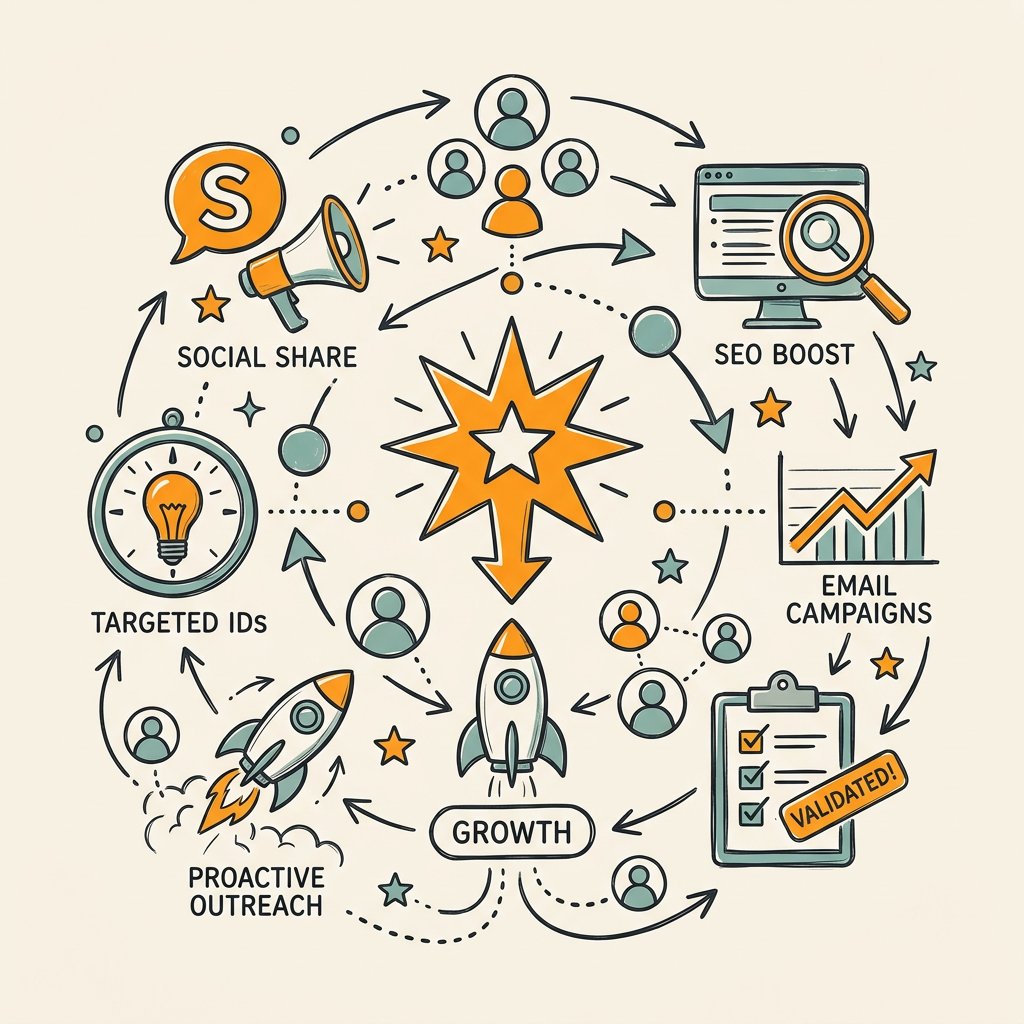
A case study locked in your resource library generates no leads. A case study embedded in your content strategy, distributed across email, LinkedIn, and SEO content, compounds in value. This is where developing a consistent content marketing framework becomes criticalwhen you can publish case studies consistently as part of your organic content engine, rather than as one-off assets, lead generation accelerates.
Embedding Case Studies in SEO Content
The highest-leverage distribution channel for case studies is embedding them into long-form blog content. When you write a pillar article on "How to Implement [Solution] in 6 Steps," linking to or embedding a relevant case study in the results section adds proof to your claims. Strategic content frameworks ensure that every major claim in your blog content is backed by customer proof.
Practical example: If you're ranking for "content automation tools for marketing teams," a blog post that names a customer and their results will outrank a generic comparison post. Google rewards specificity and real-world proof. More importantly, a prospect reading that blog post and seeing "Company X achieved a 35% lead increase" is far more likely to convert than one who only reads generic benefits.
Email Sequences and Lead Nurturing
Case studies excel in email nurture sequences because they're already social proof in narrative form. A typical sequence: awareness email → educational content email → case study email → product demo email. By the time a prospect reads your case study in email, they've already warmed up to the topic and are in a receptive mindset.
The key: segment your email sequences by buyer persona and industry. A case study about a sales team's challenge isn't relevant to a marketing operations buyer. Send the right case study to the right segment, and your click-through rates and demo request rates both rise.
LinkedIn Distribution and Personal Branding
LinkedIn remains the dominant channel for B2B discovery and decision-making. Case studies perform exceptionally well on LinkedIn when framed as learning posts rather than sales pitches. A post like "We helped [Customer] reduce implementation time from 8 weeks to 2 weeks. Here's how they did it" will get far more engagement than a direct link drop.
Visual case studies also perform wellinfographics breaking down the before-and-after metrics, carousel posts walking through the problem-solution-results structure, or video snippets of customer testimonials. Building a sustainable SaaS SEO strategy includes treating case studies as repeatable content assets that can be repackaged for multiple platforms.
Measuring Case Study ROI and Optimizing for Leads
Here's the cold reality: only 42% of marketers can measure content ROI. But those who do unlock 3.1x budget growth. This means that if you implement tracking for your case studies, you'll have data that justifies expansion of your content marketing. Most teams skip this step, which is a missed opportunity. According to Digital Applied's 2026 content marketing statistics, teams with documented strategies and proper measurement see dramatically improved lead generation outcomes.
Tracking Lead Source Attribution
Set up UTM parameters on every case study download, landing page, and email link. Use your CRM to track which leads came from case study touchpoints and which of those converted to opportunities and customers. The question to answer: "What's the lead quality and close rate for leads who engaged with case studies vs. other content types?"
If case studies are driving higher-quality leads or better close rates, that's your signal to produce more of them and distribute them more aggressively. If they're underperforming, dig into why: maybe your messaging is off, the customer story isn't relevant, or the distribution channel is wrong.
Engagement Metrics to Watch
Beyond lead count, track these core indicators:
- Download rate: What percentage of visitors download the case study? (Benchmark: 5-15% is healthy.)
- Completion rate: What percentage of people who start reading finish it? (Longer case studies often have lower completion.)
- Email open and click rate: When you include a case study in an email, what's the CTR vs. other content?
- Time on page: How long are prospects spending with the case study? (Longer = higher engagement.)
Use these metrics to iterate. If completion rate is dropping off after section 3, maybe your problem statement is too long or your solution isn't clear enough. Content marketing automation tools can help you track and publish case studies consistently, turning lead generation into a repeatable system rather than a one-off effort.
Case Study Content as Part of Your Competitive Advantage
The teams winning in B2B marketing right now aren't publishing case studies as afterthoughtsthey're treating them as core to their content strategy. A case study published monthly, distributed across email and content, and optimized for your top customer profiles creates a flywheel: each case study brings in qualified leads, those leads become customers, and new customers become new case studies.
This is where combining SEO strategy with AI content optimization becomes critical. Manually researching, writing, and publishing case studies limits you to one or two per quarter. With an autonomous content system handling the research, writing, fact-checking, and publishing, you can produce case studies weekly or more, compounding your lead generation capacity without proportional increases in team size.
Common Case Study Mistakes to Avoid

Knowing what works is half the battle. Avoiding what doesn't is the other half. Here are the patterns that tank case study performance.
Vague Results Without Numbers
If your case study says "we saw significant improvements," you've already lost the reader. Prospects need numbers to believe you. Even if the customer is confidential, you can say "20% improvement in X metric" or "reduced Y from 6 weeks to 2 weeks." Numbers ground claims in reality.
Feature-Focus Instead of Outcome-Focus
Your product features don't matter. The customer's outcome matters. Don't write "We implemented our platform with API integrations and custom workflows." Write "The customer connected their existing tools without developer help and launched campaigns 40% faster." The outcome is the story; features are just the mechanism.
Missing or Weak Customer Quotes
Generic quotes like "It's a great tool" add zero credibility. Specific quotes like "I went from managing three spreadsheets and two email lists to everything in one dashboardit's cut my administrative work in half" sell the story. Record actual customer feedback and use it verbatim when possible.
Too Long, Not Scannable
A case study longer than 1,500 words is rarely read in full. Respect your reader's time. Use short paragraphs, clear headers, bold key metrics, and visuals (charts, comparison tables, infographics). Make your case study skimmable. A prospect who spends 3 minutes scanning your case study and grasps the core story is far more likely to take the next step than one who gets lost in a wall of text.
Building a Case Study Pipeline for Sustainable Lead Generation
One case study generates a blip in lead volume. A pipeline of case studies generates momentum. This is where most teams stumblethey lack a process for consistently capturing, writing, and publishing customer success stories. The teams that scale lead generation don't do case studies reactively; they do them systematically.
Identifying and Qualifying Case Study Candidates
Not every customer is a good case study. You need customers who: (1) achieved measurable results, (2) are willing to go on record (with name or industry profile), and (3) represent your ideal customer profile. The best time to identify case study candidates is at the moment of their biggest winwhen they're excited about the results and most likely to participate.
Create a simple qualification checklist:
- Did they achieve a metric we can quantify? (Revenue, time, efficiency, quality improvement)
- Are they in our target market? (Industry, company size, role)
- Are they willing to participate? (Quote, interview, potential testimonial video)
- Can we name them or describe them specifically? (Confidentiality constraints)
Customers who meet all four criteria are your case study goldmine.
The Interview and Documentation Process
Effective case studies come from deep customer conversations, not thin data. Schedule a 30-45 minute interview with the customer, their manager, or a power user. Ask:
- What was the situation before? (Challenges, pain, cost, impact on the business)
- Why did you choose our solution? (Decision-making process, alternatives considered)
- How did you implement it? (Timeline, team involvement, challenges overcome)
- What results did you achieve? (Metrics, timeline, unexpected benefits)
- What would you tell other companies considering this? (Candid advice, caveats)
Record the call (with permission) and take detailed notes. The raw interview material is your source for authentic quotes and specific details that make case studies credible.
Writing, Review, and Publication Workflow
Create a standard template so every case study has consistent structure and components. This also speeds up writingyou're filling in a framework, not starting from scratch each time. After writing, send it back to the customer for review and quote approval. Most customers will appreciate the opportunity to refine their story and ensure accuracy.
Once approved, publish it not just as a downloadable PDF but as a blog post, an email series, and a LinkedIn story. Make it part of your organic content ecosystem, not a siloed asset.
Conclusion
Case studies are the bridge between "here's what we do" and "here's proof that it works for companies like yours." When structured strategically with clear problems, specific solutions, and quantified results, case studies don't just build credibilitythey drive qualified leads. The data is clear: teams with documented content strategies that include case studies generate 3x more leads per dollar spent, and those who can track ROI unlock 3.1x budget growth. The teams winning in lead generation aren't publishing case studies as afterthoughts. They're treating them as core assets, repeating the process monthly or more, and distributing them across email, content, and social channels.
The challenge for busy founders and growing marketing teams is capacity. Writing, fact-checking, and publishing case studies consistently requires resources most teams don't have. This is where automation becomes the differentiator. Rather than publishing one or two case studies per quarter, teams using the right tools can produce case study-driven content weekly, compounding their lead generation system without hiring additional staff. Start with one customer who had a measurable win. Interview them, document their story, and publish it across your channels. Measure what happens to your lead volume and quality. Then do it again for the next customer. Over six months, you'll have a pipeline of proof that prospects can't ignore.
FAQs
What length should a case study be for lead generation?
500 to 1,500 words is the ideal range for case studies that drive leads. The key is frontloading your snapshot to no more than 100 words so readers get the "who, what, and result" immediately. Longer case studies (2,000+ words) rarely get read in full; instead, they get skimmed. If you must go longer, break it into sections with clear headers and bold key metrics. A 1,000-word case study with visuals, customer quotes, and obvious metrics always outperforms a 2,500-word narrative. Respect your reader's time, and they'll reward you with qualified interest.
How do you turn case studies into downloadable lead magnets?
Create a landing page with a simple form asking for name, email, and company. Position the form to the right of a preview or summary of the case study. The form should request only essential data (more fields = lower conversion). Host the full PDF or article behind that form gate. To maximize distribution, also publish the case study as a public blog post with SEO optimizationthe public version ranks in search and drives organic awareness, while the gated PDF version captures email addresses from prospects already interested enough to download. This dual approach balances reach with lead capture. Track download rate, form completion rate, and whether gated leads convert better than organic visitors.
How often should you publish new case studies?
Monthly is the target for competitive teams, though quarterly is realistic for most. Publishing one case study per month means you'll have 12 proof points circulating across your channels by year-end. Consistency matters more than volumea case study published every month compounds in value as you repackage it across email, LinkedIn, and blog content. If monthly feels unattainable with your current team, prioritize quality over frequency. One exceptional, well-researched case study per quarter beats four rushed, generic ones. The bottleneck for most teams is customer recruitment and interview capacity, not writingso start by identifying three customers with measurable wins and locking in interview time with them before you worry about publication frequency.