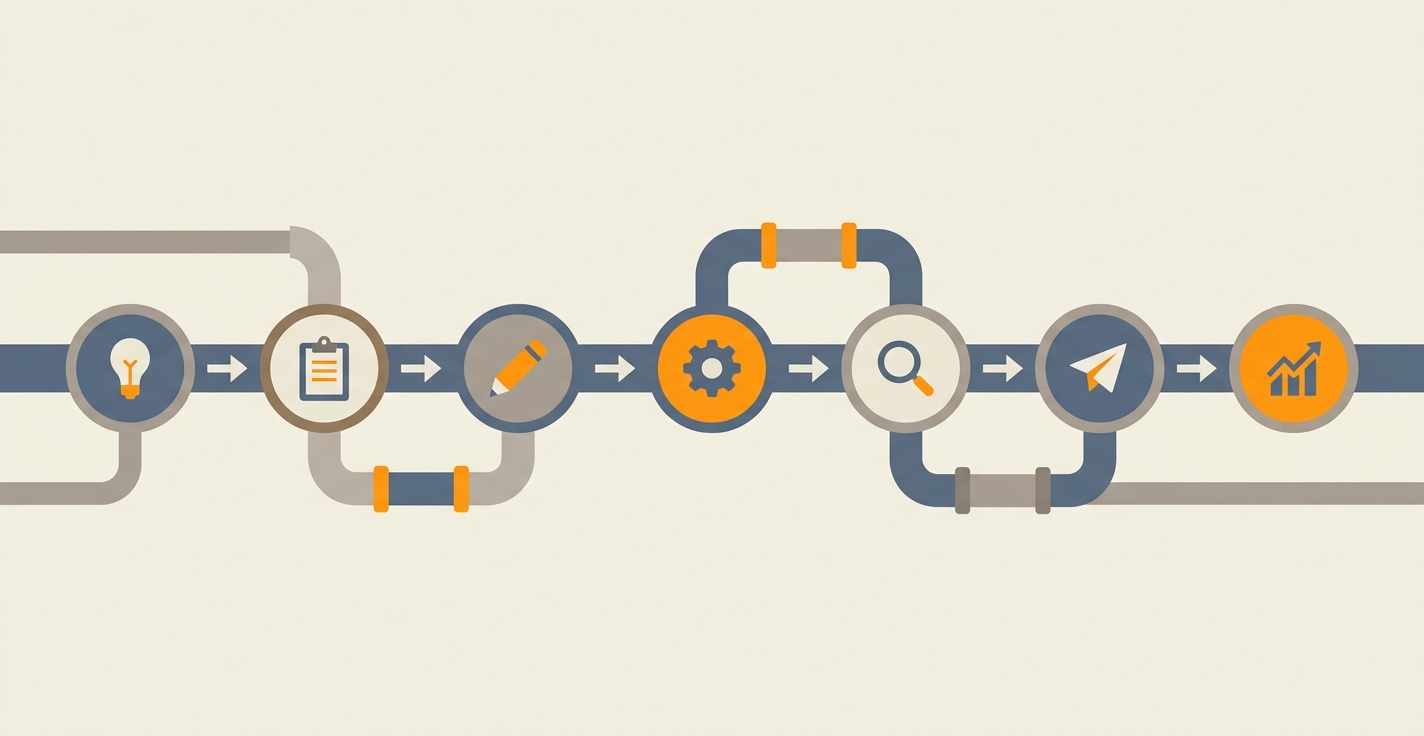
The 7-Stage Content Production Workflow That Ships
Most content teams know what a workflow is. Fewer can describe the exact stages a single article passes through from idea to live URL. That gap is why articles sit in Google Docs for three weeks and why "we published 12 posts last quarter" turns into "actually we drafted 12 and published 4."
A content production workflow is the linear pipeline that takes one article from topic validation to a published, measured page. It is different from content ops as a program. Ops is the team, the calendar, and the budget. Production is the assembly line that runs inside it.
Key Takeaways
- A content production workflow has 7 linear stages: topic validation, brief, draft, edit, SEO polish, final review, publish and measure.
- Each stage has a single output and a clear gate. An article cannot move forward until that output exists.
- Bottlenecks almost always happen at the edit and SEO polish stages, not the draft stage.
- Teams with a documented production workflow publish 3 to 5 times more articles per month with fewer revision cycles.
- Autonomous agents now collapse stages 2 through 5 into a single automated run, which is where Jottler fits.
This guide walks through every stage with the inputs, outputs, and common failures. Use it as a template for your own process or to audit why your current pipeline stalls. Every stage here assumes you are publishing for SEO, not one-off campaigns.
Stage 1: Topic Validation
Topic validation is the only stage where you can cheaply kill a bad idea. Once a brief is written, the sunk cost of drafting starts pulling the team forward even when the topic was wrong.
Validation answers three questions. Is there real search demand? Can the site realistically rank for it? Does the topic map to a product-relevant intent? If any answer is no, the topic is rejected before it enters the pipeline.
The inputs are a seed keyword, a target cluster, and existing site authority data. The output is a one-page decision: approved, rejected, or deferred. Pull search volume and keyword difficulty from a source like DataForSEO keyword data, not intuition. A keyword with 10 searches per month and a difficulty of 70 is not a fight worth starting.
Rejection is a feature, not a failure. According to Ahrefs' 2025 study of 1 million pages, 96.55% of pages get zero organic traffic from Google. Most of those pages failed at stage 1, not at drafting. Strong validation kills dead topics before they consume writer hours.
A good validation checklist includes search volume above a threshold you set (30 per month is a common floor for long-tail), keyword difficulty within your domain rating range, evidence of commercial or informational intent matching your business, and no cannibalization with an existing article.
Stage 2: Brief Creation
The brief is the blueprint. A bad brief produces a bad draft every time, no matter how strong the writer is. A great brief makes mediocre writers look skilled and cuts revision cycles in half.
A content brief for SEO contains the primary keyword, 2 to 4 secondary keywords, the target word count based on top-ranking competitors, the search intent, a recommended H2 outline, internal link targets, and two or three sources to reference. That is the minimum.
Write the outline in H2 form, not as "a section about X, then a section about Y." Top-ranking pages for most keywords follow predictable structures. Match that structure so you compete on the same axis. A full walkthrough lives in this SEO content brief guide.
The common failure at this stage is the vague brief. "Write about content marketing ROI, around 1,500 words" is not a brief. It is a prompt. A real brief tells the writer what each H2 covers, what questions to answer, and what to link to. If the brief fits in one Slack message, it is too thin.
This stage is where autonomous agents save the most time. Tools that generate briefs from SERP analysis remove 60 to 90 minutes of manual work per article. Human editors still review the brief, but the first pass is machine-generated.
Stage 3: Drafting
Drafting is the only stage where a writer (human or AI) should have a blank document in front of them. Every decision that could have been made earlier should already be made.
The input is the approved brief. The output is a complete first draft that follows the outline, hits the word count, and uses the target keywords naturally. Not polished. Not final. Complete.
Writers who draft from a strong brief finish faster because they are not making structural decisions in real time. They are executing decisions that were already made. Average draft time for a 2,000 word article with a strong brief is 90 to 180 minutes. Without a strong brief, it is 5 to 8 hours.
The common failure is premature editing. A writer drafts, rereads, rewrites, rereads, and rewrites again. Every pass at the draft stage kills momentum. Write through to the end, then stop. Editing is a separate stage with separate cognitive demands.
If you are producing at volume, drafting is also where AI writers enter the pipeline. Tools that generate long-form content from a brief can produce a complete draft in under 15 minutes. That draft still needs stages 4 and 5, but the raw output is usable starting point. See how long-form AI content compares to human drafting.
Stage 4: Editing
Editing is where most pipelines quietly break. A writer finishes a draft, passes it to an editor, and the article enters a limbo that can last days or weeks. That limbo is the single biggest reason articles miss publishing dates.
The editor's job at this stage is structural, not cosmetic. They check that the article answers the target question, that the structure matches the brief, that claims are supported, and that the argument flows. They do not fix commas. Commas get fixed at stage 5.
The output is either an approved draft or a revision request with specific notes. Vague feedback like "tighten this up" or "make it more engaging" wastes another full cycle. Specific feedback like "section 3 is 400 words but covers no unique point, cut to one paragraph" produces a fix in under 30 minutes.
Teams that document editorial standards cut revision cycles by 40 to 60 percent. According to Semrush's 2025 State of Content Marketing, the top challenge for content teams is creating content that generates quality leads, which starts with disciplined editing. A rubric removes subjectivity. An editor grading against the rubric produces consistent decisions across articles.
Stage 5: SEO Polish
SEO polish is a separate stage from editing because it requires different eyes. An editor optimizes for reading. An SEO optimizer optimizes for search. Trying to do both in one pass compromises both.
The input is an editorially approved draft. The output is the same draft with the title tag finalized, meta description written, H1 and H2s keyword-aware, internal links placed, image alt text written, and schema markup decided. Word count may shift up or down slightly.
This is where most in-house teams lose the most time. They publish, then retrofit SEO weeks later when a page fails to rank. Doing SEO polish as a dedicated stage before publishing costs 20 to 40 minutes per article and prevents the retrofit loop entirely.
Tools like Surfer and Clearscope help at this stage, but they are not the stage itself. The stage is a person or agent reviewing 10 to 15 specific on-page elements against a checklist. Jottler's content engine runs this stage as part of a single automated pass, so the polish happens before any human sees the draft.
Also confirm internal linking at this stage. Four to five contextual links to related posts, pillar pages, and relevant feature pages build topical authority. Use descriptive anchor text, not "click here." A guide on internal linking strategy covers this in depth.
Stage 6: Final Review and Publish
Final review is the shortest stage and the one most teams skip. The result is articles that go live with broken images, missing CTAs, or formatting that looked fine in Google Docs and terrible in the CMS.
The input is the SEO-polished draft. The output is a published URL. The checks are mechanical: does the page render correctly, do all images load, do internal links resolve, does the schema validate, does the meta preview look right in a Twitter card or Slack unfurl, and is the URL slug correct.
One person owns this stage. It is a final gate, not a committee review. Ten minutes per article. If something fails, it goes back one stage. If everything passes, the article publishes.
Publishing itself should not be a stage. It should be a click or an automated trigger. If your publish step takes more than 5 minutes, you are doing CMS work that should have been done earlier. Auto-publishing to WordPress, Webflow, or Shopify removes this friction entirely.
Stage 7: Measure and Iterate
An article that publishes and is never measured is an article that cannot teach you anything. Measurement is the stage where production feeds back into planning.
The inputs are the published URL and a tracking window. 30, 60, and 90 day checkpoints are standard. At each checkpoint, pull organic traffic, ranking positions for target and secondary keywords, conversions or downstream events, and backlinks earned. The output is a decision: keep, refresh, or cut.
Most articles do not rank immediately. According to Ahrefs, only 5.7% of pages reach the top 10 within a year of publication. That means 94% of your articles need either more time, a content refresh, or a link-building push. Measurement is how you decide which bucket each article falls into.
Refreshes are often higher value than new articles. An article that reached position 11 needs a small push to crack page one. That push takes 2 to 3 hours. A new article from scratch takes 8 to 15 hours. Your production workflow should have a sub-loop for refreshes, not just greenfield articles.
This stage also closes the topic validation loop. If articles in a cluster consistently underperform, the cluster was wrong. If they outperform, double down on that cluster. A full walkthrough is in this content marketing ROI guide.
Where Automation Changes the Math
The seven stages above are the same whether you publish one article a month or fifty. What changes is the automation. Stages 1, 6, and 7 are decision stages that benefit from human judgment. Stages 2 through 5 are production stages that can run end-to-end through an agent pipeline.
Jottler handles stages 2 through 5 as a single automated run. The agent takes an approved topic, generates the brief, drafts the article, runs editorial pass, and applies SEO polish. A human reviews the final output at stage 6 and hits publish. See how Jottler's autopilot compresses a 10 to 15 hour production cycle into a single review.
That is the structural shift worth understanding. You do not remove humans from the workflow. You move them from drafting to deciding. Validation, final review, and measurement are still yours. Production becomes a background process.
Frequently Asked Questions
What is a content production workflow?
A content production workflow is the linear set of stages a single article passes through from topic idea to published and measured page. It includes topic validation, brief creation, drafting, editing, SEO polish, final review and publish, and measurement. It is different from content operations, which is the broader program of team, budget, and calendar.
How long should a content production workflow take per article?
For a 2,000 word SEO article with a strong brief and no bottlenecks, 8 to 15 hours of human time is typical. With an AI agent handling stages 2 through 5, the human time drops to 1 to 2 hours focused on validation and final review. Calendar time is often longer because articles sit in editorial queues.
How is content production different from content operations?
Content production is the per-article pipeline that turns one topic into one published URL. Content operations is the system around it: the team, the editorial calendar, the budget, the tooling, and the governance. Production is the assembly line. Operations is the factory. You need both, but they are not the same thing.
Where do content production workflows usually break down?
The two biggest bottlenecks are the edit stage and the SEO polish stage. Edits stall because feedback is vague and articles ping-pong between writer and editor. SEO polish gets skipped because teams rush to publish, then try to retrofit weeks later. Automating brief creation and SEO polish removes the most common failure points.
Can AI replace the entire content production workflow?
AI can handle stages 2 through 5 end-to-end. Humans still own stage 1 (should we write this?), stage 6 (is this ready to publish?), and stage 7 (did it work?). The goal is not full replacement. It is collapsing the mechanical stages into an automated run so humans spend time on strategy and measurement, not on producing first drafts.
A working content production workflow is what separates teams that publish consistently from teams that publish eventually. Seven stages, clear gates, a single output per stage. If you are trying to run this pipeline by hand at volume, the math stops working somewhere around 15 articles per month. That is where automation stops being a nice-to-have.
If you want to see what stages 2 through 5 look like when a pipeline runs them for you, start a Jottler free trial and watch a full article move from brief to publish in under an hour.