Content SEO Optimization Best Practices
Search visibility is no longer optional for growing companies. 39.8% of all clicks go to the #1 organic result, yet 95% of pages have zero backlinks—meaning content quality and optimization directly determine whether your articles reach your audience or disappear. Teams that optimize content for both search engines and AI systems see 4-5x higher conversion rates from their organic traffic. The problem? Most founders and marketing teams lack the time to implement comprehensive optimization across keyword research, on-page elements, internal linking, and AI visibility signals. That's where a systematic approach to content SEO becomes the competitive advantage that compounds over time.
Key Takeaways
- Position 1 captures 39.8% of clicks vs. position 2's 14.8%, making optimization across all on-page elements critical. (AIOSEO, 2026)
- High-quality content remains the #1 strategy for earning backlinks, but AI-generated content now appears in 17.3% of Google's top 20 results.
- Teams using AI tools for content optimization report 70% higher ROI through faster research, drafting, and publishing workflows.
- Strategic Keyword Research: Balance search volume with user intent and conversion potential by targeting long-tail keywords that attract qualified prospects, not just traffic.
- On-Page Optimization: Lead with your primary keyword in the H1, first 100 words, and meta description while maintaining natural readability for human readers.
- Content Structure and Readability: Use heading hierarchies, bullet points, and short paragraphs to improve both user experience and AI indexing of your content.
- Internal Linking Strategy: Build topical authority by linking related articles with descriptive anchor text, creating content clusters that signal expertise to search engines.
- Content Depth and Comprehensiveness: Aim for 1,500+ word articles with original research, statistics, and expert quotes to compete with AI-generated content and rank for multiple related keywords.
- Technical SEO and Mobile Optimization: Ensure fast load times, responsive design, and proper schema markup so search engines and AI systems can crawl and understand your content.
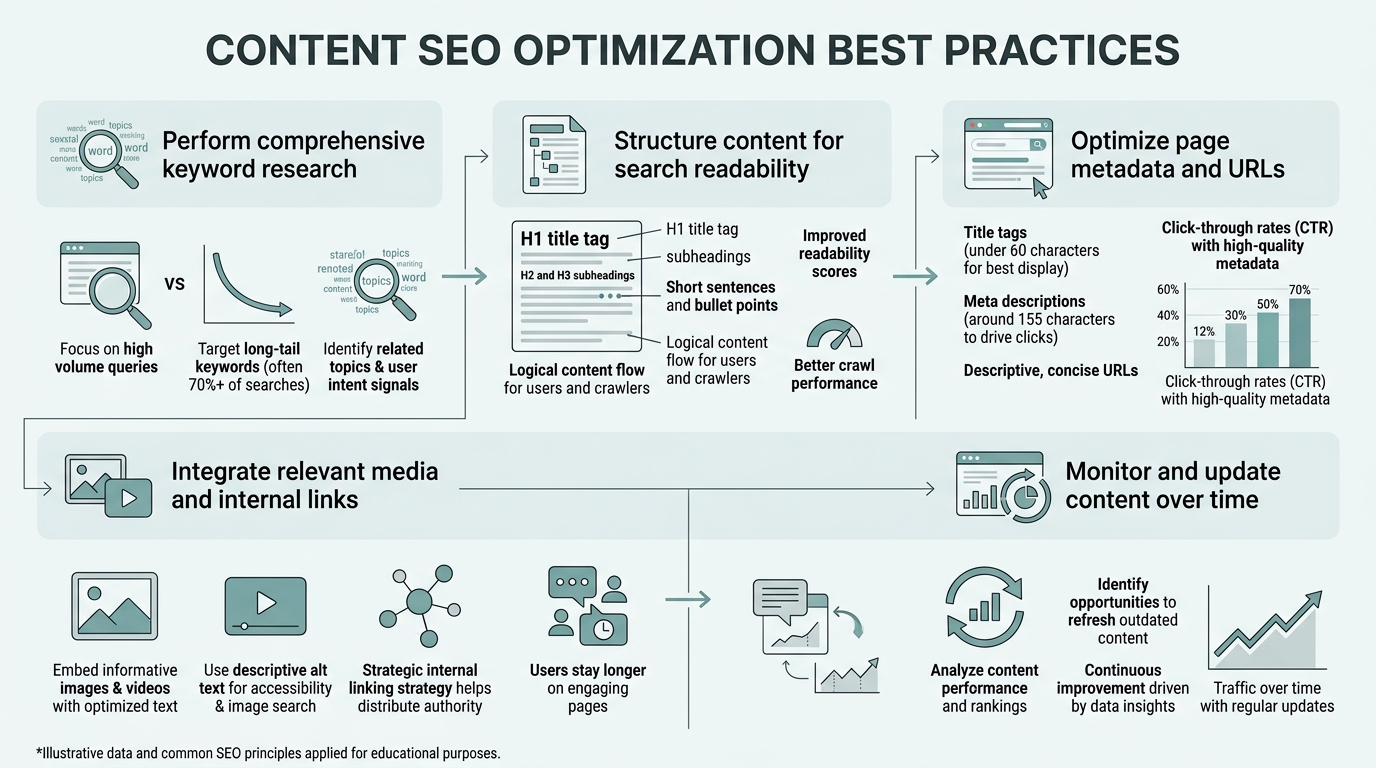
How to Conduct Keyword Research That Drives Results
Keyword research forms the foundation of every piece of content you publish. Without it, you're writing for an audience you haven't identified, optimizing for terms that don't convert, and ignoring low-hanging fruit that competitors haven't touched. Modern keyword research goes beyond simple volume metrics—it requires understanding user intent, competition level, and where your content fits in the buyer's journey. AIOSEO research shows that high-quality content remains the top backlink strategy in 2026, but you only earn those links if you target keywords your audience is actually searching for.
Understanding Search Intent Classification
Not all searches are created equal. A user typing "content marketing tools" has a different goal than someone typing "how does content marketing work." The first person is ready to buy. The second is still learning. Classifying search intent separates profitable keywords from traffic traps.
Search intent breaks into four categories: informational (seeking knowledge), navigational (looking for a specific site), commercial (comparing options), and transactional (ready to buy). When optimizing content, match your article's intent to the keyword's intent. An informational keyword deserves a comprehensive guide or explainer article. A commercial keyword works better as a comparison piece or case study. A transactional keyword pairs with your product page or pricing overview.
"Intent alignment directly impacts conversion rates and time-to-purchase. A searcher comparing content platforms has a fundamentally different mindset than someone learning content marketing philosophy."
For example, "best content marketing platforms" is commercial intent—the searcher wants to compare solutions. If you write a guide explaining content marketing philosophy on that keyword, you'll attract curious learners, not prospects. Target that keyword with a comparison table, feature overview, and customer success stories instead. Intent alignment directly impacts conversion rates and time-to-purchase.
Prioritizing Long-Tail Keywords Over High-Volume Terms
The instinct to target high-volume keywords like "content marketing" is understandable but counterproductive for most teams. These broad terms face massive competition from established brands, enterprise-grade budgets, and AI-generated content dominating the SERP. Long-tail keywords—specific three to five-word phrases like "AI-powered content optimization for SaaS teams"—offer higher conversion rates, lower competition, and faster ranking velocity.
Long-tail keywords typically have lower search volume but dramatically higher commercial intent. A user searching "content marketing" might be a student, curious entrepreneur, or competitor researcher. Someone searching "how to optimize blog posts for AI search engines" is far more likely to be a marketer actively solving a real problem. Your content should target the second group.
"65% of search queries are long-tail, and long-tail keywords convert at higher rates because they represent users further along in their decision journey."
The data supports this. 65% of search queries are long-tail, and long-tail keywords convert at higher rates because they represent users further along in their decision journey. Build your content calendar around 10-15 long-tail keywords per pillar topic, then layer in one or two higher-volume secondary keywords per article to capture adjacent searches.
Using Competitor Keyword Gaps to Find Untapped Opportunities
Your competitors' content is a roadmap to keyword gaps. Identify the top three to five ranking articles for your primary keyword, then analyze which secondary keywords they rank for. Now find the reverse: keywords your competitors rank for that you don't. These gaps represent untapped traffic reserves.
Tools like MarketMuse and Semrush expose these gaps instantly, but you can also do this manually. Visit your top competitor's highest-ranking articles and check their keyword targeting. If they rank for "content optimization for e-commerce" but you've only written about "content optimization for SaaS," you've found a gap. Create targeted content around the e-commerce angle and claim that traffic.
Competitor analysis also reveals keyword difficulty trends. If all top-ranking articles for your target keyword have domain authority above 60, you might struggle to rank there initially. Pivot to related keywords with lower competition and build authority over time. This data-driven prioritization ensures your content efforts compound rather than spin wheels against impossible competition.
Optimizing On-Page Elements for Search Visibility and AI Systems
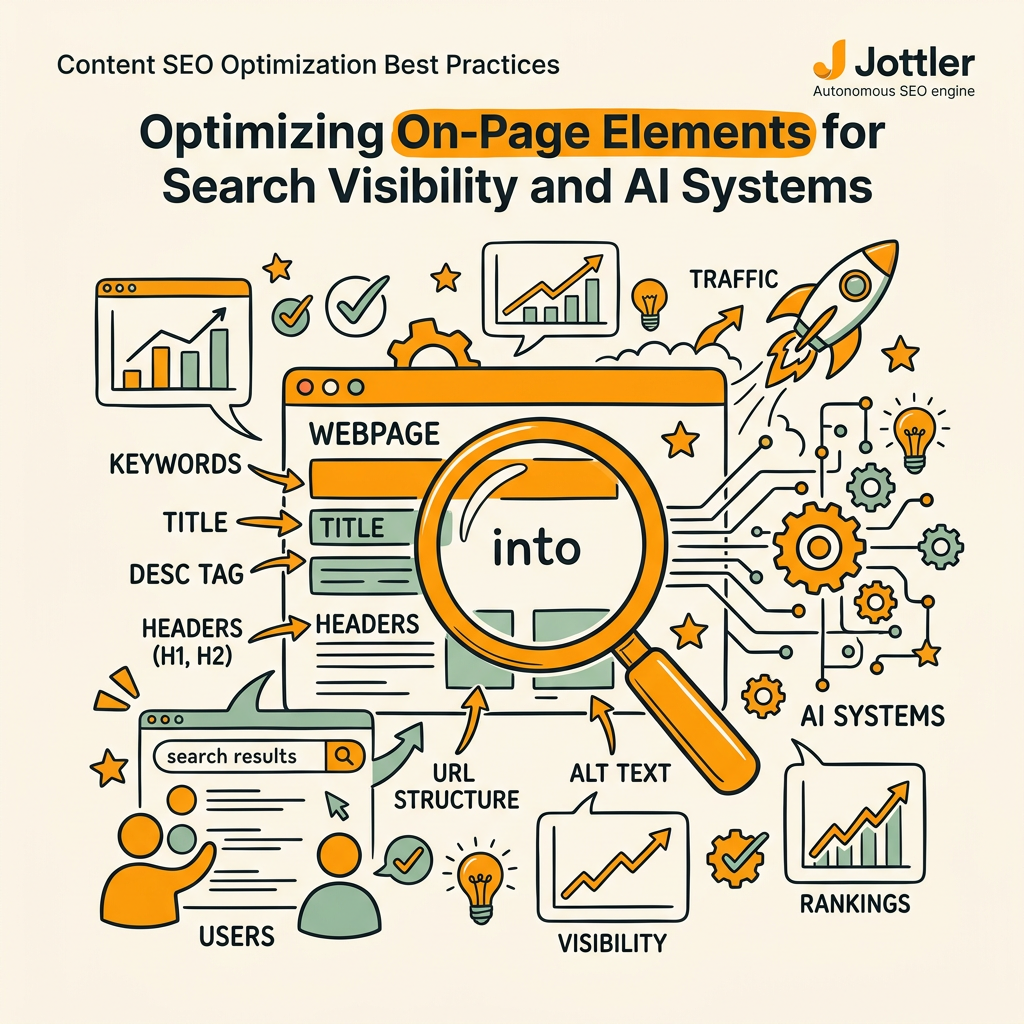
Once you've chosen your target keyword, every on-page element must work in concert to signal relevance to both Google's algorithm and AI systems like ChatGPT and Gemini. AI systems now capture 1% of sessions for many websites and convert at 4-5x the rate of traditional organic traffic, making optimization for AI visibility as critical as ranking for Google. The on-page elements that matter most are title tags, meta descriptions, H1 headers, and the first 100 words of your content.
Strategic Keyword Placement in Titles and Headers
Your H1 (title) is your first optimization opportunity. Place your primary keyword near the beginning of the H1—ideally within the first three words. This signals relevance immediately to both search engines and AI systems. But don't sacrifice readability for keyword placement. A title like "Content Optimization Strategies That Drive Organic Traffic Growth" outperforms "Content Optimization Strategies" because it adds benefit-driven context without keyword stuffing.
After your H1, place the primary keyword again in the first 100 words of your article body. This reinforces topical relevance and helps Google understand what the page is about. For longer articles, repeat the primary keyword naturally in two to three H2 headers throughout the article—but never force it. Each header should read like a chapter title that would appear in a table of contents, not like keyword scaffolding.
Meta descriptions (the 155-character preview below your SERP snippet) should include your primary keyword and a compelling benefit statement. A meta description like "Learn 7 proven content optimization strategies that drive 70% higher organic traffic. Step-by-step tactics for 2026." performs better than a generic description because it promises a specific result and includes the primary keyword.
Writing for Humans First, Search Engines Second
The SEO industry has shifted fundamentally toward content quality as the core ranking signal. Google's algorithm uses 200+ ranking factors, with high-quality content, backlinks, and intent matching the top three. No amount of keyword optimization compensates for shallow, copied, or low-value content. Write for your reader's problem first. Optimize for search engines second.
This means:
- Lead with value: Your first paragraph should answer the searcher's core question, not bury it in context.
- Use short paragraphs: Keep paragraphs to 40-80 words, two to three sentences max. This improves readability and helps AI systems extract key claims.
- Include original data: Statistics, case studies, and research findings boost content quality and earn backlinks. AI-generated content without original research ranks lower than comprehensive, data-backed pieces.
- Cite your sources: Link to the studies, tools, and companies you reference. This builds trust and creates link equity pathways.
Teams using autonomous SEO agents to automate research and fact-checking maintain higher content quality standards at scale because the system enforces these practices across every article. Manual content workflows often skip source verification and original research due to time pressure—automation ensures these best practices are never skipped.
Building Internal Link Networks That Signal Topical Authority
Internal linking serves two critical functions: it distributes page authority throughout your site, and it signals topical authority to search engines. When you link related articles together with descriptive anchor text, you're telling Google: "These articles form a cohesive topic cluster. This site has deep expertise in this area." Sites that implement strategic internal linking see measurable improvements in ranking velocity and keyword coverage.
Creating Content Clusters Around Pillar Topics
A content cluster is a group of related articles orbiting a central pillar article. The pillar article is comprehensive and broad. Cluster articles drill into specific subtopics. All articles link to each other contextually, creating a web of topical authority.
For example, if your pillar topic is "Content Marketing Strategy," your cluster might include:
- How to build a content calendar (cluster article)
- SEO keyword research for content marketing (cluster article)
- Content distribution channels that actually drive traffic (cluster article)
- How to measure content marketing ROI (cluster article)
Each cluster article links back to the pillar article with the anchor text "content marketing strategy." The pillar article links to each cluster article using the topic as anchor text. When a user or search engine crawls your site, they encounter the same topic from multiple angles, signaling deep expertise.
"Content clusters improve user experience by letting readers explore related content without leaving your site. Lower bounce rates and longer session durations send positive signals to Google, improving rankings further."
This structure also improves user experience. Readers finishing one article can explore related content without leaving your site. Lower bounce rates and longer session durations send positive signals to Google, improving rankings further. Content clusters are the foundational architecture of topical authority in 2026.
Anchor Text Optimization for Contextual Relevance
Not all internal links are equal. The anchor text—the visible, clickable text of a link—carries SEO weight. Descriptive anchor text like "learn how to optimize content for SEO" is worth far more than generic links like "click here" or "read more." Descriptive anchor text tells search engines what the linked page is about and reinforces the topical relevance of both pages.
When linking internally, follow these guidelines: use the target keyword or a semantic variant as anchor text, keep anchor text concise (two to five words), and vary your anchor text across multiple links to avoid over-optimization. If you link to the same article three times, use different anchor text each time. This looks natural and communicates different aspects of the page's relevance to search engines.
Strategic Placement of Links Within Content
Link placement matters. A link in the first paragraph of an article gets more authority weight than a link in the footer. Links in the body content pass more value than sidebar links. This is because search engines infer that links prominent in the content are editorially important.
For your own content, place your most important internal links—those pointing to your highest-value articles or target pages—early in each article. Link to your conversion-focused pages (pricing, case studies, product pages) contextually within the body when readers are engaged, not in footers or sidebars where engagement is lower.
How to Structure Content for Both Search Engines and AI Systems
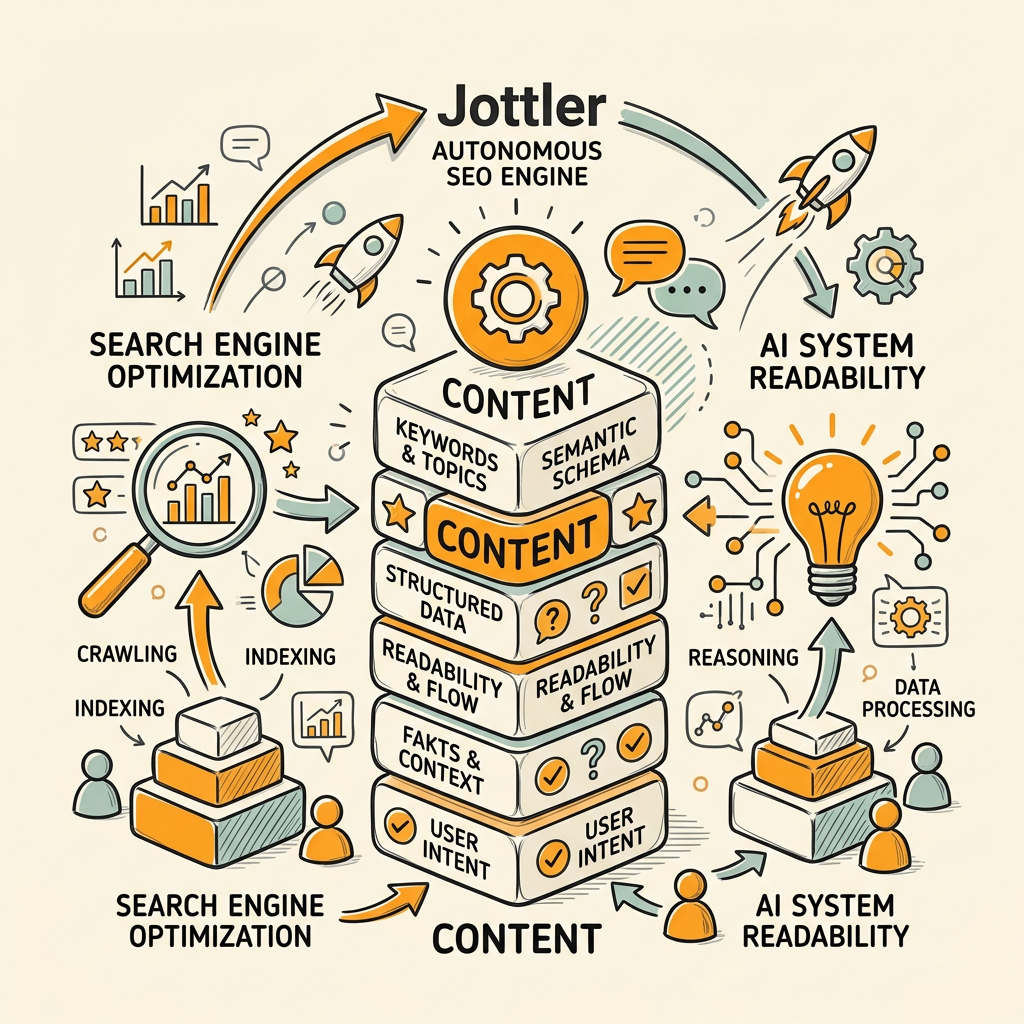
Content structure—how you organize headers, lists, tables, and paragraphs—affects both your Google ranking and your AI citation rate. Semrush reports that 86% of SEO experts now use AI, and AI systems like ChatGPT preferentially cite well-structured content because it's easier to extract and attribute. If you're writing long-form content without structure, you're invisible to AI systems that power ChatGPT's responses and Google's AI Overviews.
Using Headers and Subheaders to Create Scannable Content
Readers don't read web articles—they scan them. Your heading hierarchy must enable readers to understand your article's structure in 10 seconds. Use one H1 (your main title), two to four H2 headers (major sections), and two to three H3 headers under each H2 (subsections). This pyramid structure guides readers and helps AI systems understand content hierarchy.
Each header should be descriptive and benefit-oriented. "How to Optimize Content for SEO" is better than "Content Optimization." "Why Keyword Research Matters" is better than "Keyword Research." Benefit-driven headers communicate what readers will learn, not just the topic name.
Formatting Content with Lists, Tables, and Blockquotes
Text-heavy paragraphs are harder to read and less likely to be cited by AI systems. Break up content with lists, tables, and blockquotes. Bullet-point lists improve scannability. Numbered lists work for sequential steps or ranked items. Tables allow direct comparison of data. Blockquotes highlight expert insights and add credibility.
For every 300-400 words of body text, include one list, table, or blockquote. This creates visual variety and helps AI systems extract structured data. When ChatGPT cites your content in an answer, it often pulls directly from lists or tables because the structure makes extraction and attribution easier.
| Content Element | Impact on SEO | Impact on AI Citation |
|---|---|---|
| Bullet-point lists | Improves readability; reduces bounce rate | Easy to extract; highly cited |
| Numbered lists | Signals procedural content; strong for "how-to" queries | Often quoted verbatim in AI responses |
| Data tables | Rich result eligibility; improves SERP click-through | Preferred for comparisons; high citation rate |
| Blockquotes | Reduces keyword density; improves credibility | Signals expert insight; increases attribution |
| Subheaders (H3+) | Keyword distribution; topical relevance | Navigation aid for AI extraction |
This structure directly supports AI content strategy in 2026, where visibility depends on structure as much as keyword optimization. Platforms that automate content production often miss this nuance, producing flat text without strategic formatting. Jottler's AI agents understand content structure deeply—they write articles with proper header hierarchy, integrated lists, and formatted content that ranks in both Google and AI Overviews.
Implementing Technical SEO Foundations for Crawlability and Speed
Technical SEO creates the foundation that allows search engines to find, crawl, and rank your content. No amount of on-page optimization compensates for slow page speed, poor mobile responsiveness, or indexing issues. Technical SEO improvements yield 117% ROI, yet many teams skip these fundamentals in favor of flashy content tactics. Technical SEO doesn't generate headlines—it generates traffic.
Page Speed and Core Web Vitals Optimization
Google's Core Web Vitals measure page experience: loading speed, interactivity, and visual stability. Sites with poor Core Web Vitals experience lower rankings and higher bounce rates. Users expect pages to load in under 3 seconds. Every additional second increases bounce rate by 7%.
Optimize page speed by compressing images (40-60% of page weight is usually images), enabling browser caching, minifying CSS and JavaScript, and using a content delivery network (CDN). Tools like Google PageSpeed Insights identify specific issues on your pages. For content-heavy sites, implementing lazy loading on images ensures that images below the fold don't slow initial page load.
Mobile Responsiveness and Structured Data Implementation
Mobile-first indexing means Google crawls the mobile version of your site first when deciding rankings. If your mobile site is slow, broken, or unresponsive, Google will penalize you regardless of desktop performance. Test your site on mobile devices. Ensure buttons are tappable, text is readable without zooming, and all functionality works on small screens.
Structured data (schema markup) tells search engines what type of content your page contains: an article, a product, a recipe, an FAQ. Rich results—SERP snippets that show ratings, images, or additional data—get 58% click-through rate compared to 41% for plain blue-link results. Adding schema markup for articles, FAQs, and breadcrumbs increases your SERP real estate and improves AI system understanding of your content.
Measuring Content SEO Performance and Iterating
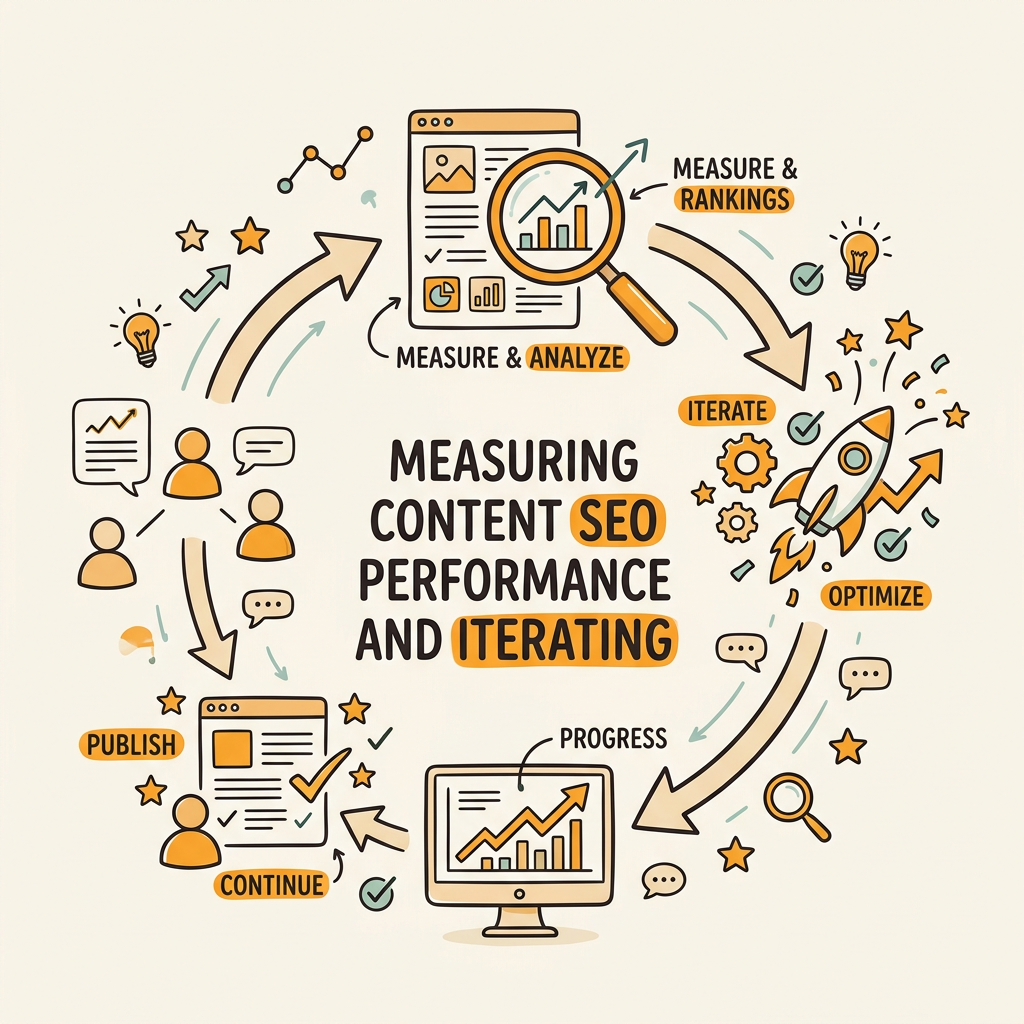
Optimization without measurement is just guessing. Set baseline metrics before publishing, then track them continuously. The metrics that matter depend on your goal: traffic growth, lead generation, or brand awareness. Most B2B companies optimize for qualified traffic and conversion rate, not vanity metrics like total pageviews.
Core Metrics to Track Consistently
Track these metrics for each article: organic traffic, average position (ranking), click-through rate, bounce rate, and conversion events (newsletter signup, demo request, etc.). Use Google Search Console to see which keywords drive traffic and which pages have low CTR despite high ranking. Use Google Analytics 4 to understand user behavior and conversion paths.
Set targets: a new article should rank in the top 50 for its target keyword within 30 days and break into the top 10 within 90 days. If an article isn't moving, update it with fresher data, improve the structure, or add internal links. Don't publish and abandon—treat content as an ongoing investment that compounds over time.
Using Keyword Rank Tracking and Competitive Intelligence
Track your ranking position for target keywords using tools like Semrush or Ahrefs. Monitor competitor rankings simultaneously. When a competitor ranks higher for a keyword you also target, analyze why: do they have fresher data? Better structure? More backlinks? Use this intelligence to improve your content before updating.
Competitive intelligence also reveals emerging keywords. If a competitor publishes an article on a new keyword and immediately ranks in the top 10, that signal suggests the keyword is valuable. Target it quickly before more competitors establish authority.
Why Automation Accelerates Content Optimization at Scale
Content SEO optimization is systematic. You research keywords, optimize on-page elements, build internal links, check technical foundations, and measure results. Each step is repeatable. Each step compounds. The challenge for busy founders and growing teams is repeating this process consistently for 10, 20, or 100 articles per month without burnout.
This is where content automation changes the game. Rather than spending 10-15 hours per week on keyword research, writing, and optimization, teams can configure automated systems to handle it continuously. Platforms that automate research, writing, and publishing allow you to set your optimization standards once, then let AI agents apply those standards to every article automatically—every day, at scale, without human oversight.
The best performing content strategies in 2026 combine human strategic direction with AI execution. You decide your topical priorities and optimization targets. AI agents handle keyword research, competitor analysis, article drafting, fact-checking, internal linking, and publishing. The result is consistent, optimized content that builds topical authority and compounds organic traffic growth without requiring your hands-on attention.
Conclusion
Content SEO optimization best practices have converged around three core principles: strategic keyword research targeting user intent, comprehensive on-page optimization for both search engines and AI systems, and systematic internal linking that builds topical authority. Teams executing all three see 39.8% of available clicks flowing to position 1, while competitors optimizing piecemeal capture far less. The data is clear: quality content, properly optimized, converts at 4-5x higher rates than non-optimized organic traffic.
The compounding effect matters most. Each optimized article improves your site's topical authority, builds internal link equity, and captures long-tail traffic that drives qualified leads. After 50 optimized articles, you're no longer competing for individual keywords—you're dominating entire topic areas. This is the strategic difference between founders who scale sustainably and those who plateau.
Start by conducting comprehensive keyword research, then audit your top 10 articles against these best practices. Fix technical foundations immediately. Build internal linking networks around pillar topics. Implement structured data. Measure everything. Most importantly, commit to consistency—publish optimized content regularly, not sporadically. Start your SEO agent and let automation handle the execution while you focus on strategy.
FAQs
What is the most important SEO ranking factor in 2026?
High-quality, original content remains the single most important ranking factor, according to AIOSEO's 2026 analysis. Google's algorithm evaluates 200+ signals, but content quality, backlinks, and user intent consistently rank as the top three. AI-generated content has commoditized basic article production, making original research, verifiable expertise, and specific data the differentiators that earn rankings. Content without depth, citations, or original insights now faces downranking pressure from both Google and AI systems.
How long should SEO-optimized content be to rank well?
Aim for 1,500-2,500 words for pillar articles and 800-1,200 words for cluster articles. However, word count is a proxy for depth, not a ranking factor itself. A 1,500-word article with original research, statistics, and expert insights outranks a 3,000-word article that rehashes generic information. Google rewards comprehensiveness—covering all angles of a topic with original evidence—not word padding. Structure matters too: well-formatted long-form content with lists, tables, and subheaders ranks better than text-heavy articles of the same length.
How often should you update existing content for SEO?
Audit your top-performing articles quarterly and update them whenever ranking position drops or organic traffic declines. Content freshness matters primarily for news and trend-based topics; evergreen content like how-to guides can rank for years without updates. However, proactively refreshing underperforming content by adding newer data, improving structure, or expanding sections typically improves rankings within 2-4 weeks. Set calendar reminders for your top 20 revenue-driving articles and review them annually, updating any outdated claims, statistics, or competitive comparisons.