
Developing a Winning B2B SEO Strategy
B2B companies that execute a focused SEO strategy generate twice as much revenue from organic search as from any other channel. Yet 73% of B2B websites are losing organic visibility, often because they treat SEO as a one-time project rather than a compounding system. The gap between leaders and laggards comes down to strategy clarity: understanding your decision makers, targeting the right keywords, publishing original insights, and building authority over time. Here's how to build a B2B SEO strategy that actually generates revenue.
Key Takeaways
- B2B SEO delivers 748% ROI with leads averaging 14.6% close rates—six times higher than outbound efforts (Oliver Munro, 2026)
- B2B keywords typically get 10–500 searches per month, requiring precision targeting over volume plays
- Securing a top-three SERP position yields 54.4% of all clicks; first-page ranking is critical as 96.98% of clicks go to positions 1–10
- Build Decision Maker Personas: Identify who searches for your solutions at target companies—often a specific role like CFO, CMO, or VP of Operations—and understand their pain points.
- Execute Intent-Driven Keyword Research: Target long-tail B2B keywords (10–500 monthly searches) aligned to awareness, consideration, and decision stages, not generic high-volume terms.
- Publish Original Insights: Create content that demonstrates expertise and unique perspective, not recycled third-party frameworks—this signals topical authority to Google.
- Build Topical Authority Clusters: Organize content into semantic clusters around core topics relevant to your decision makers' buying journey.
- Automate Content Production at Scale: Use AI-powered tools to research, write, fact-check, and publish long-form content consistently without manual bottlenecks.
How Are B2B and B2C SEO Different?
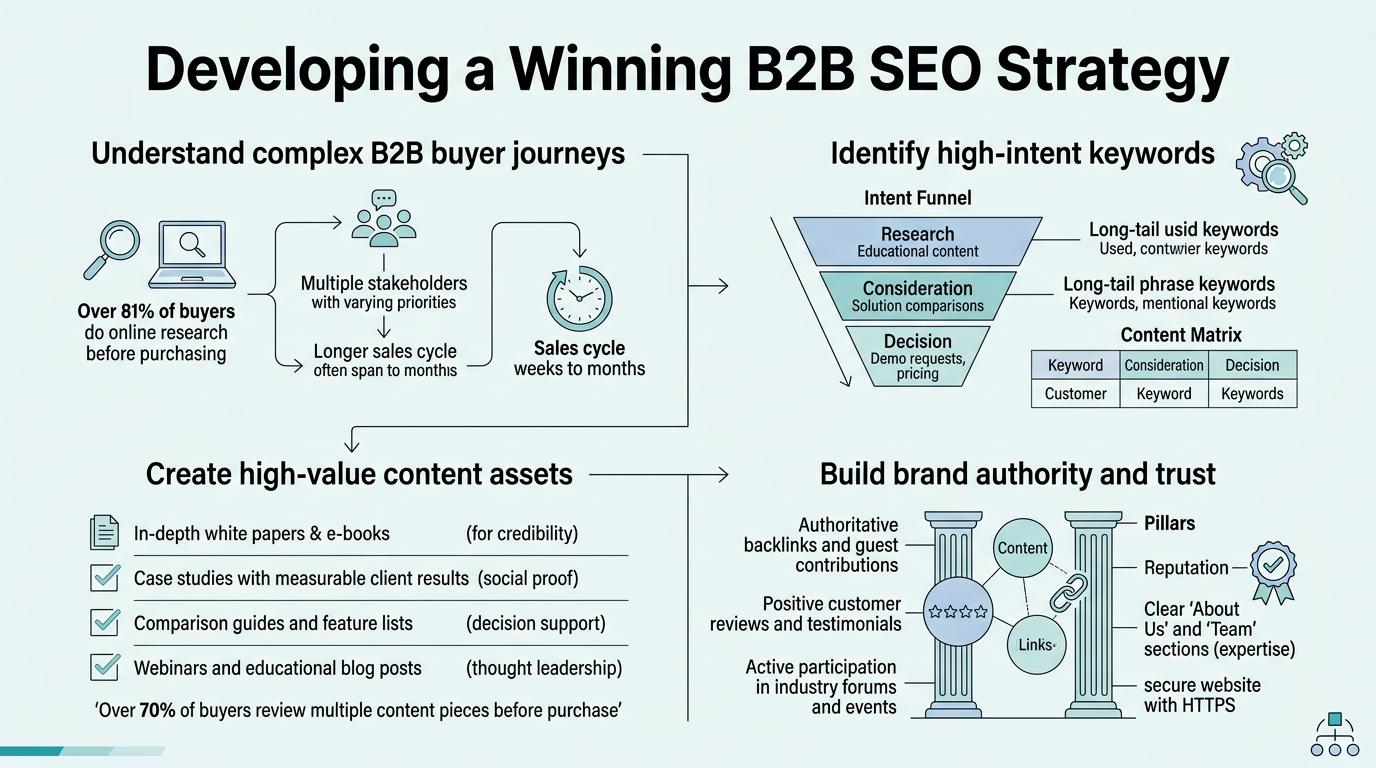
The fundamentals of SEO are identical across both channels—there's no "B2B algorithm." Yet in practice, B2B SEO operates under entirely different constraints. B2B keywords typically get 10–500 monthly searches, while B2C keywords range from 1,000 to 100,000+. This shifts your entire strategy from volume-based targeting to precision-based lead generation.
"B2B SEO wins are built on precision targeting of decision makers, not broad demographic groups. A single CFO convinced by three of your articles moves a six-figure deal. That's the fundamental difference from B2C."
Decision Maker vs. Audience Targeting
B2C SEO targets broad demographic groups. B2B SEO targets a specific person at a specific company—a CFO deciding on enterprise software, a VP of Operations evaluating supply chain tools, or a marketing director researching analytics platforms. That single person, once convinced, can unlock a six- or seven-figure deal. Your content and keywords must speak directly to their priorities, not to a generic "business owner." Relevance compounds: if a decision maker finds three of your articles addressing their exact stage in the buying cycle, trust and authority follow.
Content Format and Channel Priorities
B2C companies often succeed with social video and short-form content. B2B winners focus on long-form, evergreen content that ranks in Google for decision-maker searches. Email marketing, webinars, and industry reports matter far more than TikTok. Your B2B SEO strategy should ruthlessly prioritize channels where your decision makers actually search and learn—Google search, industry research platforms, and internal documentation tools. Every piece of content should ladder up to lead generation or deal acceleration, not brand awareness.
Building Decision Maker Personas for Your B2B Strategy

You cannot target keywords or create content for a persona that doesn't exist. B2B marketers who skip persona development waste 60% of their content production budget on misaligned topics. A decision maker persona is not a demographic—it's a profile of the person at your target company who can approve, influence, or veto a purchasing decision.
Core Persona Components
A complete persona answers: Who is this person? What is their job title and functional responsibility? What problems do they face in their role? What does success look like for them? What does failure cost them?
- Title and Function: CFO, VP of Sales, Director of HR Operations—be specific enough that you could identify them in 30 seconds on LinkedIn.
- Business Challenges: Not generic "business challenges"—specific, quantified problems they lose sleep over. "Reducing manual data entry in reconciliation" not "improving efficiency."
- Success Metrics: How does their boss measure their performance? Revenue, cost reduction, team retention, compliance? Your content should connect to these metrics.
- Information Sources: Where do they research solutions? Google, industry blogs, peer recommendations, podcasts? This dictates your content distribution strategy.
- Buying Cycle Timeline: B2B sales cycles are long. Is your persona in the early research phase (6+ months before purchase) or evaluating final vendors (2–4 weeks)? Content strategy changes dramatically.
Using Customer Data to Refine Personas
Don't guess. Interview your sales and customer success teams. Review CRM records to identify the specific people who champion your solutions internally. Look at your email open rates by title—who actually engages with your outbound content? Run a survey among your current customers asking how they discovered you and what pain you solved. This research pays for itself in a single quarter through better targeting and higher-quality content.
Executing Intent-Driven Keyword Research for B2B
81% of B2B marketers report that SEO generates higher-quality leads than PPC, with an average 14.6% close rate compared to 1.7% for outbound efforts. This precision is possible only when you target the right keywords—not the highest-volume terms, but the ones aligned to your decision makers' actual search journey.
"A keyword with 50 searches per month from CFOs evaluating spend management software is worth 10x more than a keyword with 5,000 searches attracting freelancers and students. Intent ranking, not volume ranking, defines B2B keyword strategy success."
Mining Intent, Not Just Volume
Most SEO tools rank keywords by volume alone. B2B demand generation requires intent ranking. A keyword with 50 searches per month from CFOs evaluating spend management software is worth 10x more than a keyword with 5,000 searches that attracts freelancers and students. Use tools that cluster keywords by search intent—awareness, consideration, decision—so you can build content against each funnel stage.
- Awareness Stage: "How to reduce accounts payable processing time" – Your persona doesn't yet know your solution exists.
- Consideration Stage: "AP automation software comparison" – They know solutions exist; they're evaluating options.
- Decision Stage: "Bottomline AP automation pricing" – They've narrowed it down; they're ready to buy or request a demo.
Each keyword tier requires a different content approach. Awareness content should educate and position your company as a thought leader. Decision content should address objections and showcase ROI. Konstructdigital's B2B keyword research guide emphasizes that this prioritization is the core difference between B2B and B2C research strategies.
Long-Tail Keywords as Your Competitive Advantage
High-volume B2B keywords are competitive nightmares. Target long-tail variations instead. "Enterprise resource planning" gets 60,500 monthly searches globally. "ERP implementation for pharmaceutical manufacturers with 200+ employees" might get 80 searches—but those 80 are qualified, decision-making searches your competitors are ignoring. Long-tail wins compound: each long-tail article ranks faster, converts at higher rates, and becomes a building block in your topical authority clusters.
Publishing Content That Builds Topical Authority
Google rewards topical authority—the signal that your domain is a trusted reference for a specific subject area. 61% of B2B marketers say SEO and organic traffic is their top inbound marketing priority, yet most publish generic, recycled content instead of original insights. The gap between first-place and second-place rankings is often original research, novel frameworks, or proprietary data.
"Your audience follows your company for original perspective—your unique take on a problem, your methodology, your proprietary data. If every article paraphrases HubSpot or McKinsey, you signal follower status, not authority. Publish what competitors cannot easily replicate."
Original Insights Over Content Recycling
Your audience can find third-party frameworks anywhere. They follow your company for original perspective—your unique take on a problem, your methodology, your proprietary data. If every article is a paraphrase of HubSpot, Gartner, or McKinsey, you signal follower status, not authority. Publish content that your competitors cannot easily replicate.
- Original Research: Survey 100+ decision makers in your target audience on a pressing challenge. Publish the results with unbiased analysis. You now have a defensible asset competitors can't copy.
- Proprietary Frameworks: If you've built a methodology that works, give it a name and own it. Relate all future content back to that framework. Repetition builds authority.
- Customer Case Studies: Publish detailed, data-backed results from customers you've worked with. Real numbers (not case-study fluff) move decision makers and rank well.
Building Semantic Clusters Around Core Topics
Don't publish articles in isolation. Organize content into clusters—a pillar article addressing a core topic, surrounded by 3–7 satellite articles exploring specific aspects. Link them semantically so Google understands you own this topic comprehensively. A pillar on "AP automation strategy" might cluster with articles on "selecting an AP automation vendor," "implementing AP automation without disrupting finance teams," and "measuring ROI from AP automation." This structure signals depth and authority.
Automating Your B2B Content Production Pipeline
The bottleneck in B2B SEO isn't strategy—it's execution. Most teams know what to do but lack the bandwidth to do it consistently. Keyword research, content planning, fact-checking, and publishing are manual, time-consuming tasks that drain resources. This is why SEO automation is critical for scaling organic growth without additional headcount.
From Manual to Autonomous Content Operations
Manual content workflows typically look like: research keyword opportunities (3–5 hours), brief a writer, receive a draft, edit and fact-check (2–4 hours), hand-optimize for SEO, coordinate with design, schedule publishing, and manually link internally. One article takes 15–25 hours across multiple team members. Scaling to 3–5 articles per week becomes impossible. Autonomous SEO engines like Jottler change this equation entirely. The system researches trending keywords aligned to your audience, generates comprehensive outlines with fact-checking built in, writes long-form articles optimized for search and conversion, and publishes directly to your CMS with internal linking already configured. One person manages the entire workflow instead of one team producing one article per week.
The Case for AI-First Content Operations
The most effective B2B content strategies in 2026 pair human strategy with AI execution. You handle strategy—persona development, keyword selection, quality oversight, and performance analysis. AI handles volume—research, writing, optimization, and publishing. This unlocks consistency that compounds. If Jottler publishes 15 articles per month on your behalf while your team focuses on strategy and revenue alignment, you're building topical authority at a pace your competitors literally cannot match with manual processes.
| Content Operation Model | Articles Per Month | Cost Per Article | Fact-Check Quality | Internal Linking |
|---|---|---|---|---|
| Manual In-House | 4–6 | $800–$2,000 | Inconsistent | Manual, sparse |
| Freelance Writers + In-House Optimization | 8–12 | $400–$800 | Varies by freelancer | Manual coordination required |
| Jottler Autonomous SEO Engine | 60–150 | $29–$150/mo (per 3–15 articles daily) | Verified sources, fact-checked | Automatic smart linking |
This isn't about replacing writers—it's about amplifying strategy. You decide the direction, validate the output, and let automation handle the repetitive work. A documented SaaS content marketing framework combined with autonomous execution compounds your results quarter over quarter.
Building Authority Through Strategic Link Acquisition
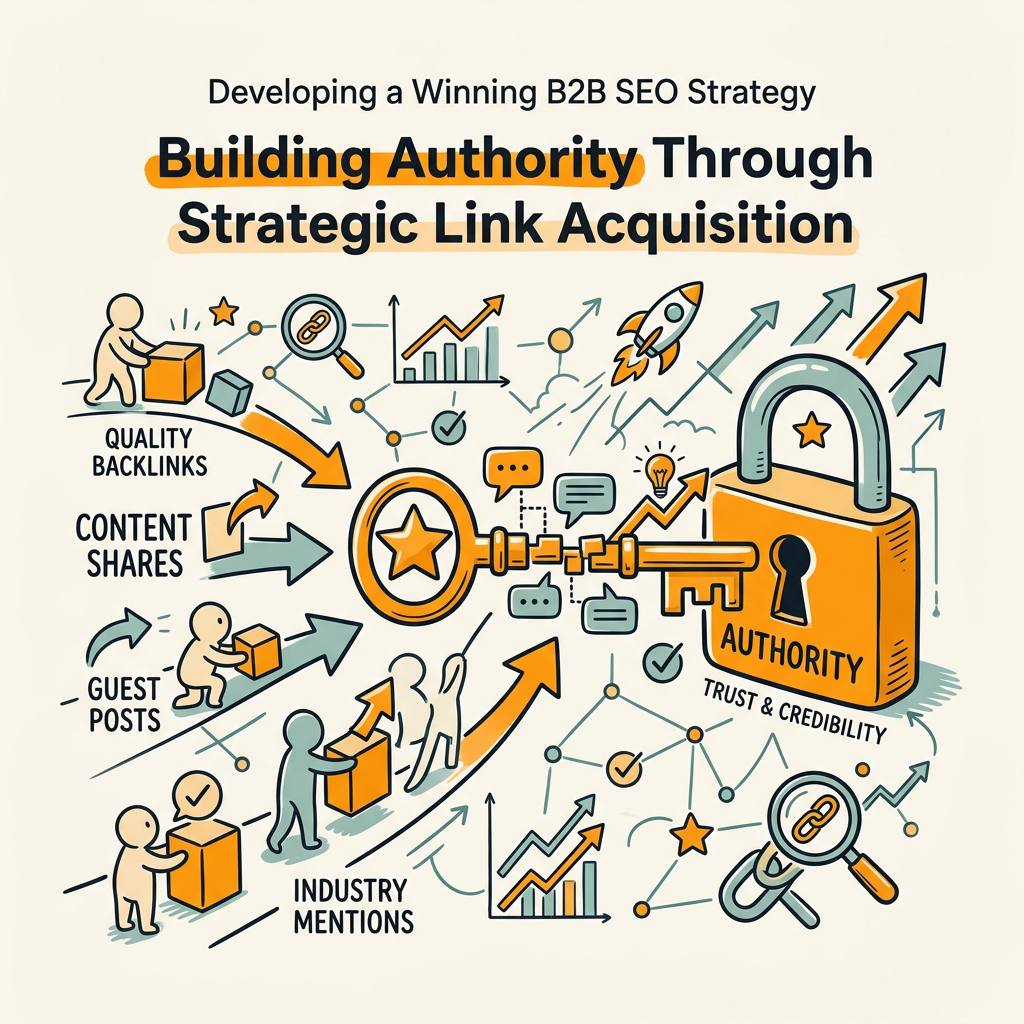
Rankings depend on authority, and authority requires backlinks. 76% of AI Overview citations are pulled from pages ranking in Google's top 10 organic results, which means first-page rankings unlock visibility not just in traditional search but in AI-powered overviews as well. Strategic link building accelerates this.
B2B Link Acquisition Strategies
B2B link building is relationship-driven, not spray-and-pray. Effective B2B link-building strategies focus on industry partnerships, guest contributions to high-authority publications, and participation in industry research and benchmarking initiatives. A single link from a top-tier industry publication—a Gartner report, a major analyst firm, or a trusted industry blog—is worth dozens of low-quality links.
- Industry Research Participation: Contribute data to analyst reports, benchmark studies, and industry surveys. You'll earn citations and backlinks from publications your audience trusts.
- Guest Contributions: Write guest articles for authoritative blogs in your vertical. Each guest post is an authority-building asset and a backlink to your site.
- Strategic Partnerships: Partner with complementary (non-competitive) companies for co-authored content, whitepapers, and joint webinars. Partners promote the content within their networks, multiplying reach.
- Thought Leadership Content: Original research and proprietary frameworks earn backlinks naturally. When you publish something competitors can't replicate, journalists and industry writers reference it.
Measuring and Iterating Your B2B SEO Strategy
B2B SEO wins are measured in revenue, not traffic. Average CPL from organic traffic is $147, compared to $280 from paid search. This cost advantage is only valuable if you're tracking where leads come from and how they close. Without proper attribution, you'll underinvest in SEO.
Key Metrics Beyond Traffic
Move beyond vanity metrics. Track:
- Qualified Leads from Organic: How many leads come directly from organic search each month? Tag them in your CRM by source article or topic cluster.
- Sales Cycle Impact: Do organic leads close faster or at higher ASP? B2B organic leads typically show 14.6% close rates—measure yours specifically.
- Cost Per Customer Acquisition from Organic: Divide total SEO investment by new customers acquired. This tells you the true ROI of your strategy.
- Topical Authority Growth: Track rankings for entire keyword clusters, not individual keywords. Are you gaining visibility across awareness, consideration, and decision keywords?
Quarterly Review and Adaptation
B2B SEO compounds over time, but quarters still matter. Every 90 days, audit which topics are driving qualified leads, which are driving traffic without conversion, and which keywords your audience has moved away from. Reallocate production toward high-performing clusters. Kill content that underperforms after reasonable time to rank. SEO strategy should evolve with your market and buyer behavior.
Conclusion
A winning B2B SEO strategy is built on three foundations: precision (targeting decision makers through intent-driven keywords), authority (publishing original insights that build topical dominance), and consistency (producing content at scale without exhausting your team). The best-performing B2B companies don't out-spend competitors on marketing—they out-execute in content production and strategy alignment.
B2B companies that generate twice as much revenue from organic search as from any other channel don't achieve that through luck. They develop a repeatable system: personas inform keywords, keywords inform content clusters, clusters build authority, and authority compounds into leads and revenue. Start with one decision maker persona, identify 20–30 high-intent keywords aligned to their buying journey, and publish original content addressing each stage. Then automate your production so you can scale this system from 10 articles per quarter to 60+ per month without additional headcount.
This is how you stop competing on paid ads and start winning on search. Start your SEO agent and let autonomous publishing compound your organic advantage.
FAQs
How long does it take to see results from B2B SEO?
B2B SEO typically shows measurable results within 6–12 months of consistent effort, with peak performance arriving in year two or three. Long-tail keywords rank faster (30–90 days), making them ideal for early wins and demonstrating ROI to stakeholders. High-volume, competitive keywords take 6+ months. The key is consistency—if you publish two articles one month and none the next, you reset your topical authority signal. Autonomous SEO engines compress this timeline by enabling daily, consistent publishing without interruption.
What's the difference between B2B keyword research and B2C?
B2B keyword research prioritizes intent over volume and targeting specific decision maker roles over broad demographics. B2B keywords typically get 10–500 monthly searches versus 1,000–100,000+ in B2C, so you focus on precision targeting rather than competing for high-volume terms. You also layer in buying cycle stage—awareness, consideration, decision—because a CFO researching AP automation software in January may not convert until May. B2C is the opposite: high volume, faster decisions, less role-specific targeting. Long-tail B2B keywords outperform high-volume ones because they eliminate noise and attract qualified buyers.
How do you build topical authority at scale without exhausting your team?
Topical authority requires consistent content production across semantic clusters—typically 60–120 articles per quarter to signal dominance in a category. Most teams cannot produce this volume manually. The solution is autonomous content operations that research, write, fact-check, and publish without human involvement beyond strategy and oversight. Set your topic clusters, connect your CMS, and let AI agents handle daily production. Your team focuses on validating output, refining strategy, and measuring results—not the mechanical work of writing, optimizing, and linking. This is how you scale authority without burnout.