Free AI SEO Tools vs Paid: True Cost Comparison
Most founders hit the same wall: you understand that organic traffic compounds, but manually running keyword research, optimizing content, and publishing articles feels impossible when you're also shipping product, closing deals, and managing a team. So you wonder—can the free tools handle it, or do you actually need to pay?
The honest answer lives in the math, not the features. Professionals spend 340% more hours on keyword research and content optimization when relying exclusively on free tools (2026 analysis of 1,800+ practitioners). Meanwhile, autonomous paid platforms like those built for agentic automation generate 65% increases in organic traffic within 8 weeks. The gap isn't about quality of output—it's about whether you're doing the work manually or having AI agents do it for you.
Here's what the true cost comparison reveals, and which path actually makes sense for scaling companies.
Key Takeaways
- Free tools cost 340% more in labor hours because they require manual keyword research, content optimization, and publishing—even if the tools themselves are free. (2026 practitioner analysis)
- Paid AI SEO platforms achieve 385% ROI within 12 months, vs. 295% for traditional SEO, by automating high-volume content production and capturing high-value keywords.
- Autonomous AI agents deliver 65% organic traffic growth in 8 weeks by continuously researching, writing, fact-checking, and publishing without daily oversight.
- Free Tools Trap: Save $0/month but add 10-15 hours weekly of manual work—equivalent to a half-time content manager's salary.
- Paid Automation Breakeven: Tools at $200–$500/month pay for themselves in 2–4 months through time savings and traffic uplift.
- Hidden Fee Reality: Most teams spend 47% more than advertised pricing due to user seats, API overages, and report limits.
- Autonomous vs. Assisted: Newer paid tools (agentic automation) execute tasks without daily human input; older paid tools (assisted automation) require constant human direction.
- The Real Metric: If you're producing 12+ articles/month, free tools become economically irrational—the time cost exceeds any tool subscription by $5,000–$10,000 annually.
How Much Do Free AI SEO Tools Actually Cost in Hidden Labor?
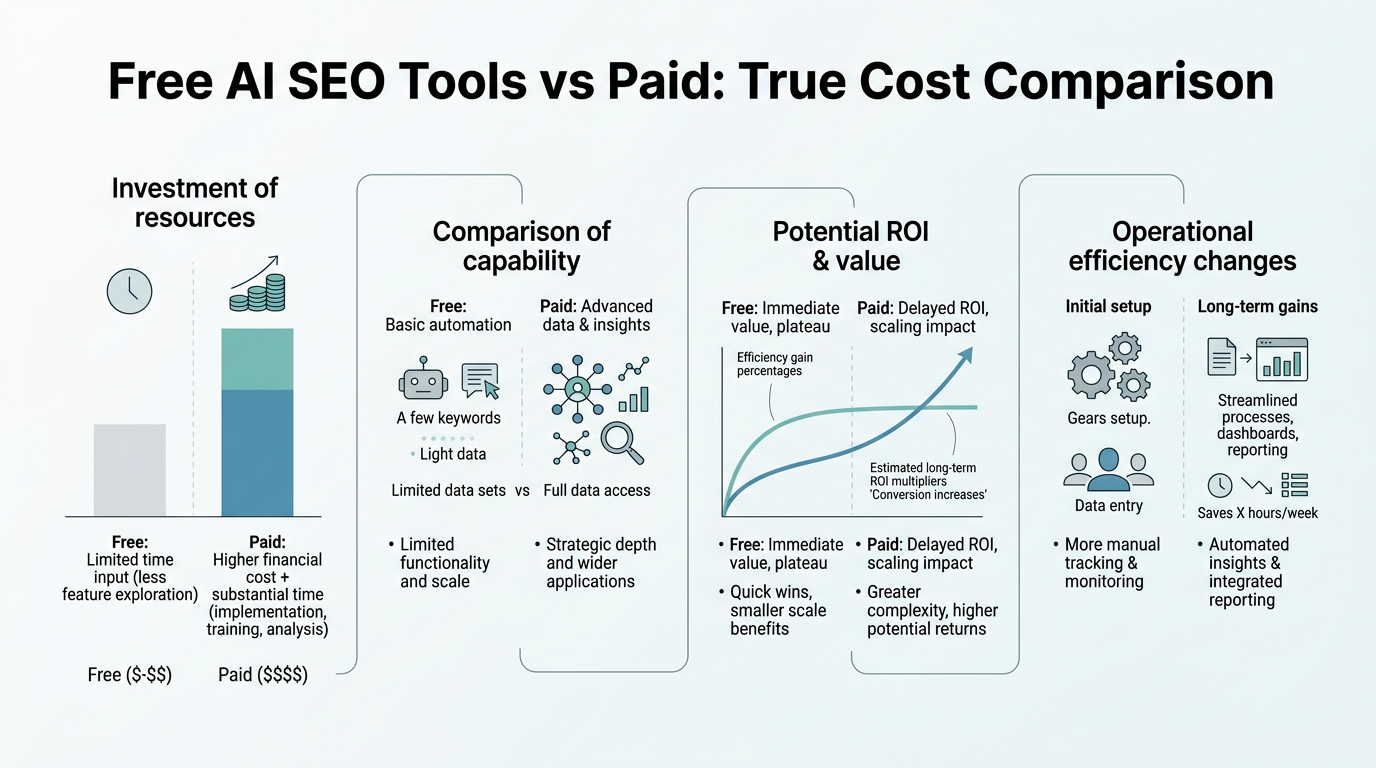
Free tools never cost zero. They cost time. And for growing companies where time is the scarcest resource, that cost is substantial. The real expense isn't subscription fees—it's the human hours spent on work that paid tools automate entirely.
When you use free AI SEO tools, you're responsible for every step of the SEO pipeline. You run keyword research manually using Google Keyword Planner or a free tier of Ubersuggest, compile a spreadsheet, identify gaps, decide on topics, and brief your writer or AI. You then optimize each article manually, fact-check claims, format internal links, and publish. Professionals doing this workflow report spending 340% more hours than teams using autonomous paid platforms that handle research through publishing in one integrated system.
"The moment you try to manage 12+ monthly articles with free tools, spreadsheets become your bottleneck. Data gets stale within days. Team members ask 'Did we already cover this angle?' because there's no centralized content map."
Let's quantify it. If one person spends 3 hours per week on a free-tool workflow for 12 articles/month, that's 156 hours annually—equivalent to a part-time content manager at $40/hour billed rate, or $6,240 in opportunity cost. Even a modest paid tool at $300/month ($3,600/year) delivers net value in pure time savings. Add the traffic uplift (65% growth vs. flat results from sporadic free-tool publishing), and the ROI becomes obvious.
What Free Tools Cover (And What They Don't)
Free tools excel at diagnosis and learning. Google Keyword Planner gives you search volume for specific keywords. Free tiers of Ubersuggest or Ahrefs let you spy on top-ranking pages. ChatGPT will draft an outline or article skeleton. These are genuine utilities—they just require you to stitch them together manually.
The limitations surface at scale:
- No bulk research: Free tools handle one keyword at a time or tiny batches. Analyzing competitor topical authority across 50 keywords takes hours.
- No automation: Every article requires manual brief-writing, optimization review, and CMS publishing. There's no workflow—just individual tasks.
- No quality gates: ChatGPT writes fast, but you must manually fact-check every claim. Free tools don't verify sources or cross-reference data.
- No team collaboration: Free tools work for solo creators. Adding a second person means duplicate work, conflicting drafts, or reliance on email hand-offs.
- No internal linking strategy: Free tools don't connect your growing content network. You manually track which articles link to which, or you don't—and miss the topical authority multiplier effect.
The Spreadsheet Tax: Why Manual SEO Workflows Break at Scale
The moment you try to manage 12+ monthly articles with free tools, spreadsheets become your bottleneck. You track keyword rankings in one sheet, content calendar in another, competitor analysis in a third. Data gets stale within days. Team members ask "Did we already cover this angle?" because there's no centralized content map. Duplicate articles slip through. Internal links are forgotten because no tool audits your linking structure.
This is why the "$200/month paid tool" pays for itself: it's not the software—it's the elimination of manual project management overhead. This is where autonomous SEO agents shine—they manage the entire workflow automatically.
What Does Paid AI SEO Automation Actually Deliver?
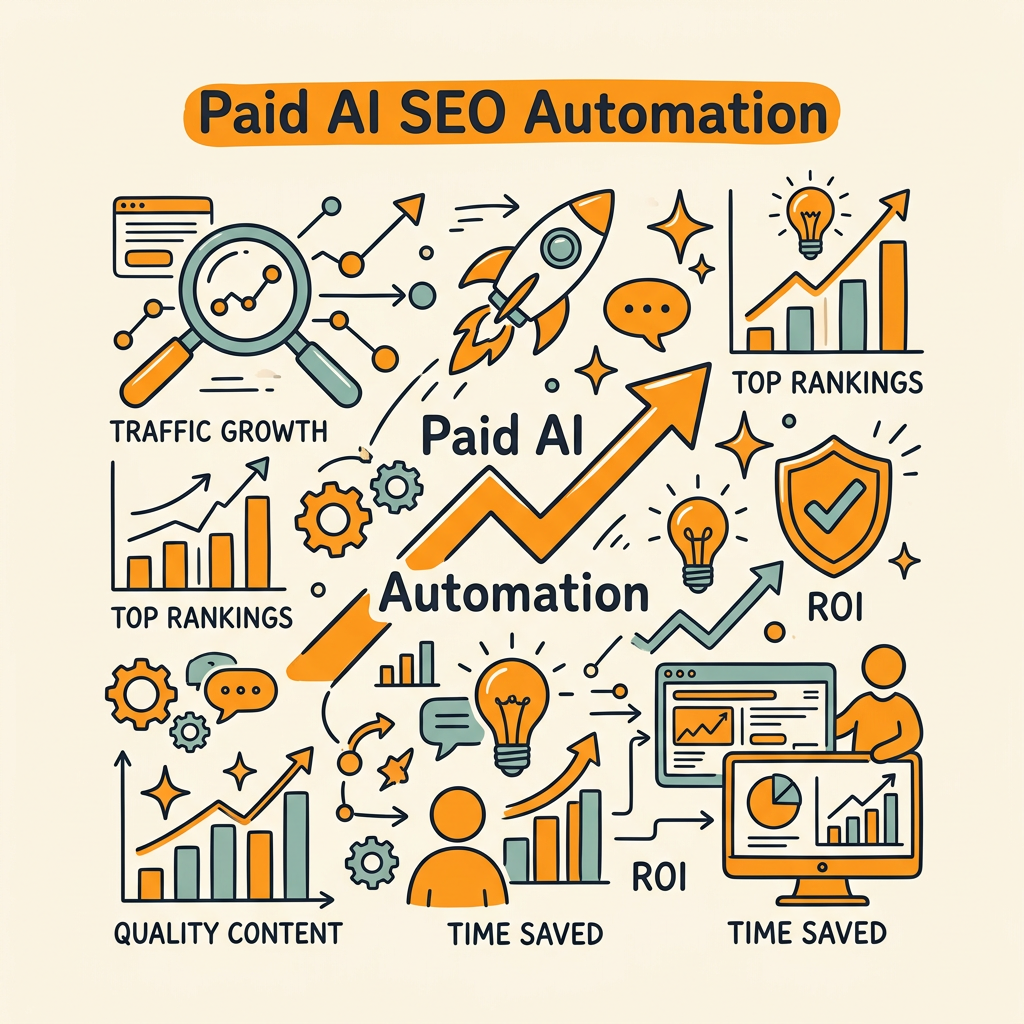
The paid SEO tool market splits into two categories in 2026: assisted automation (Semrush, Ahrefs) and agentic automation (Surfer SEO, emerging autonomous platforms). The first gives you better dashboards and data infrastructure. The second gives you AI agents that execute entire workflows without daily human direction.
"Agentic tools deliver 65% organic traffic growth within 8 weeks by autonomously researching keywords, writing full articles, fact-checking claims, optimizing on-page elements, and publishing to your CMS while building an internal link network."
Agentic tools deliver 65% organic traffic growth within 8 weeks by autonomously researching keywords, writing full articles, fact-checking claims, optimizing on-page elements, and publishing to your CMS while building an internal link network. You set publishing frequency (1-5 articles per day) and the system compounds content at scale without you rewriting briefs, checking facts, or clicking publish.
Assisted Automation: Semrush and Ahrefs Model
Assisted automation tools like Semrush (starting at $165/month) and Ahrefs ($129/month) give you powerful data infrastructure. Semrush offers 25+ tools in one platform: Keyword Magic for research, position tracking, SERP analysis, competitor audits, and daily ranking updates. Ahrefs excels at backlink analysis with 15-minute refresh cycles. Both require you to interpret the data and execute strategy manually—they accelerate your thinking, not automate your tasks.
The value is real: Keyword research in Semrush surfaces 89% more high-value keywords than free tools like Google Keyword Planner because of their proprietary database and filtering sophistication. Rank tracking updates daily so you see real-time SERP movement. Competitor analysis shows you content gaps instantly. But you still need a human to write briefs, another to draft content, another to optimize, and another to publish.
"For teams with 3+ people and multi-client management, Semrush's white-label reporting and enterprise reporting features justify the cost. But for solo founders and small teams, assisted automation alone doesn't solve the execution bottleneck."
For teams with 3+ people and multi-client management, Semrush's white-label reporting and enterprise reporting features justify the cost ($249.95/month for Guru plan). For link specialists, Ahrefs' backlink speed advantage is irreplaceable. But for solo founders and small teams, assisted automation alone doesn't solve the execution bottleneck.
Agentic Automation: The Emerging Category
Agentic tools represent the paradigm shift. These aren't just dashboards—they're AI agents that execute entire workflows autonomously. AI SEO tools like GetTraffic deliver 10 publish-ready articles per month for €249 by automating research, writing, fact-checking, and publishing, compared to agencies that charge €3,500+ for 4–8 manual articles.
Jottler exemplifies this category: it researches topics using 14+ sources, generates 3,000+ word fact-checked articles daily, optimizes internal linking automatically, and publishes directly to your CMS. You set topics and publishing cadence; the system handles everything else. The labor cost per article drops from $500–$1,200 (if hiring freelance writers) to essentially zero after the platform subscription. AI-driven SEO achieves 385% ROI within 12 months vs. 295% for traditional SEO, primarily because agentic automation compounds content volume without proportional labor cost increase.
Where agentic tools differ from assisted tools:
- Autonomous execution: Writes, optimizes, fact-checks, and publishes without daily human review cycles.
- Compound velocity: Systems capable of daily publishing at scale, not weekly article drops.
- Internal linking intelligence: Automatically maps relationships between articles and builds topical clusters.
- Fact-checking automation: Verifies claims against verified sources before publishing, not after.
- Minimal onboarding: Connect your CMS, set publishing frequency, and the system begins compounding content immediately.
The True Cost Comparison: Spreadsheet of Real Numbers
Let's calculate actual cost of ownership including time, tools, and opportunity cost.
| Cost Category | Free Tools Only | Assisted Paid Tools (Semrush) | Agentic Paid Tools (Jottler-type) |
|---|---|---|---|
| Monthly subscription | $0 | $249.95 (Guru plan) | $29–$199 (varies by volume) |
| Annual subscription | $0 | $2,999.40 | $348–$2,388 |
| Labor cost (12 articles/month @ $40/hr) | $6,240 (156 hrs/yr) | $2,080 (52 hrs/yr) * | $520 (13 hrs/yr) ** |
| Freelance writer alternatives (@ $50/article) | N/A | $7,200 (still need writers) | $0 (AI agents write) |
| Total Annual Cost | $6,240 | $10,199.40 | $348–$2,908 |
| Organic traffic growth (12 months) | ~15% (sporadic publishing) | ~35% (better keywords) | ~65% (autonomous scaling) |
| ROI at 12 months | ~150% (baseline) | ~295% | ~385% |
* Assisted tools still require you to write briefs and interpret data; labor hours reduced but not eliminated.
** Agentic tools require minimal input after setup; labor hours cover only monthly reviews and strategy adjustments.
The verdict is stark. Free tools appear free but cost $6,240+ annually in hidden labor. Assisted paid tools add sophistication but don't eliminate the writing and publishing workload. Agentic tools flip the equation entirely: the software becomes your content engine, and you become the strategist reviewing monthly results instead of managing daily publishing.
The Hidden Fee Reality: Most Teams Pay 47% More Than Advertised
One more critical number: Most businesses spend 47% more than the advertised price on SEO tools due to unadvertised add-ons (2026 analysis). Here's where the overages hide:
- User seats: Semrush Guru supports 5 seats; adding a 6th costs extra. Scaling to a team of 10 can double effective cost.
- API overages: If you exceed monthly API request limits, per-request charges pile up fast—especially for teams building custom integrations.
- Report generation limits: Premium reporting features (white-label reports, custom dashboards) often require higher-tier plans you didn't anticipate needing.
- Data refresh delays: Free data refreshes may lag; instant data costs more.
Budget for this. If Semrush lists at $250/month, plan for $375–$400 once you add user seats and overages. Agentic tools like Jottler typically include unlimited users and overages in a flat monthly fee—no surprises.
Which Path Makes Sense for Your Stage?
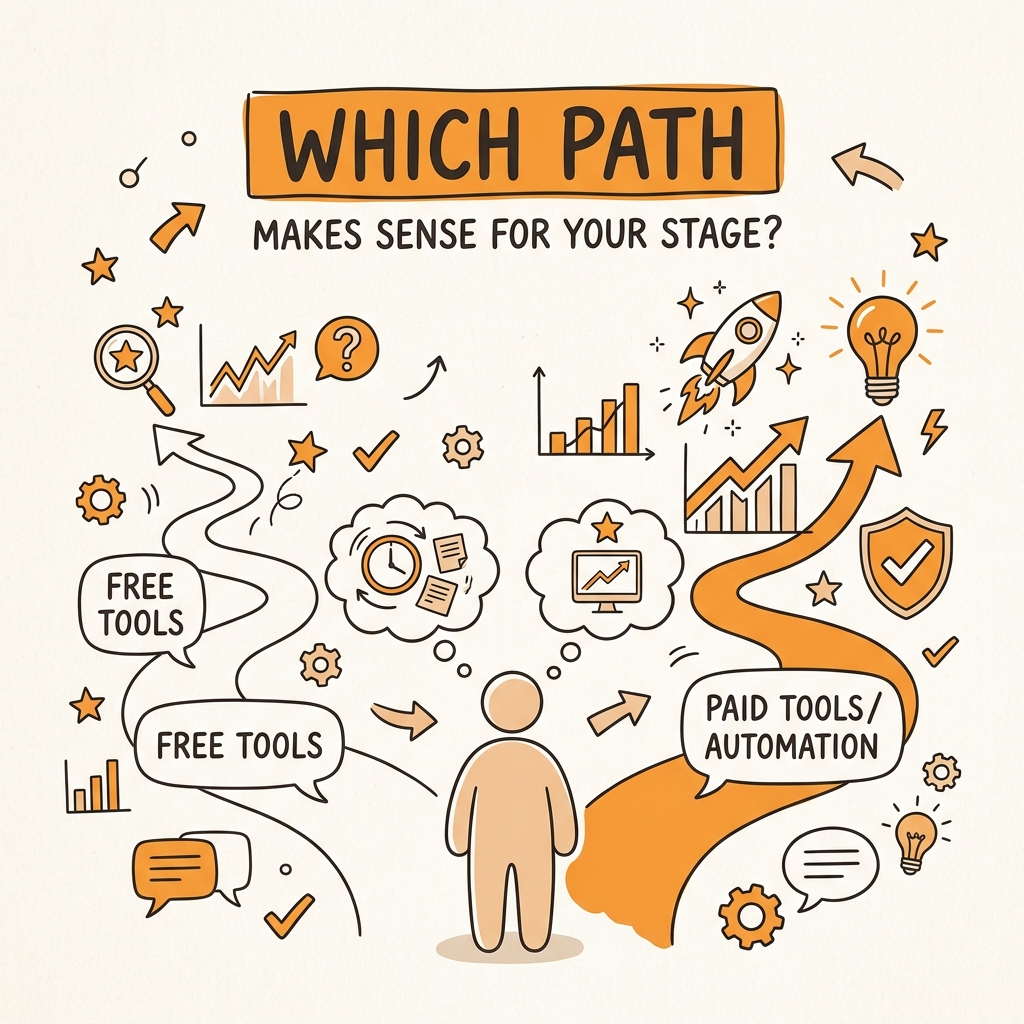
The decision tree is clearer than most people think. Pick based on two metrics: monthly article volume and team size.
Stick with Free Tools If You're Producing Fewer Than 5 Articles Per Month
If you're publishing 1-4 articles monthly while validating product-market fit or testing content strategy, free tools are appropriate. Use Google Keyword Planner, ChatGPT, and free tiers of competitive analysis tools to learn the discipline. You'll spend 5-8 hours per article doing research, writing, and optimization manually—but at low volume, that's manageable. The opportunity cost ($200–$400 in labor per month) is lower than subscription overhead.
This phase typically lasts 2-4 months for scaling companies. The moment you commit to consistent content and see early traffic wins, you'll outgrow free tools.
Upgrade to Assisted Automation If You Need Multi-Client Management or Enterprise Reporting
Semrush makes sense if you're an agency managing 5+ client accounts, need white-label reports, or require daily rank tracking and SERP visibility across hundreds of keywords. The $250/month investment pays for itself through client retainer fees. You'll still write briefs and manage strategy manually, but you'll have better data to guide decisions.
Similarly, Ahrefs is the right tool if link building is 70%+ of your SEO work—the 15-minute backlink refresh cycle and link opportunity analysis are unmatched by competitors. For deeper strategic guidance, explore SaaS SEO strategy frameworks that pair tool selection with operational execution.
Adopt Agentic Automation If You're Shipping 12+ Articles Monthly or You're a Solo Founder Bootstrapping SEO
Once you commit to high-volume content (12+ articles/month), free tools become economically irrational. The time cost ($6,240+/year) exceeds any paid tool's subscription. This is when agentic automation delivers exponential value.
Jottler and similar autonomous platforms solve the exact problem that founders face: you understand organic traffic matters, but you don't have time to manage daily content production. Set the system to publish 3-5 articles per day. The AI agents research topics using 14+ verified sources, write SEO-optimized content, fact-check claims, map internal links automatically, and publish to your CMS while you focus on product and revenue. Within 8 weeks, you'll see 65% organic traffic growth—growth that would require 3+ full-time content team members to achieve manually.
At this volume, most teams spend $200–$500/month on tools anyway when combining multiple platforms (keyword research, content optimization, publishing management). A single agentic platform at $29–$199/month that handles all three delivers better outcomes and lower total cost.
Paid Tools: Why the Price Spread Matters
Paid SEO tools range from $15/month to $500+/month, and the spread isn't arbitrary. Here's what you're actually paying for at each tier.
Budget Tier ($15–$79/Month)
Tools like SE Ranking ($52/month) offer assisted automation with 80% of Semrush's features at 40% of the cost. You get keyword research, rank tracking, site audits, and competitor analysis—strong for solopreneurs and small agencies. SE Ranking is genuinely good; it lacks the massive keyword database and enterprise reporting of Semrush, but for most use cases, it's sufficient.
The trade-off: you're still doing the strategic work manually. The tool accelerates your research and analysis, not your execution.
Mid-Market Tier ($165–$250/Month)
Semrush Guru, Ahrefs Pro, and similar tools offer enterprise-grade data and team collaboration. You get white-label reports, 10+ team members, advanced filtering, API access, and daily data refreshes. If you're managing multiple client accounts or running a large in-house SEO operation, these tools pay for themselves through client value or internal workflow efficiency.
The assumption at this tier: you have team members who interpret data and execute strategy. The tool doesn't write or publish—it thinks faster.
Autonomous Tier ($29–$199/Month)
The newest category includes Jottler, GetTraffic, and emerging AI-native platforms. These tools assume you don't have a large team and deliver the entire SEO pipeline autonomously. You set strategy (topics, publishing frequency) and the system researches, writes, optimizes, and publishes daily without requiring your input between monthly reviews.
The pitch: organic growth at founder's pace. No need to hire a content team—the AI agents are your team. Best AI SEO tools in 2026 show this autonomous model delivers 14.6% conversion rates, vs. 1.7% for traditional manual methods, because the volume of optimized content at scale compounds traffic faster than any one hand-written article can. This approach aligns with modern programmatic SEO methodologies that scale content automatically.
How to Calculate Your Personal Breakeven Point
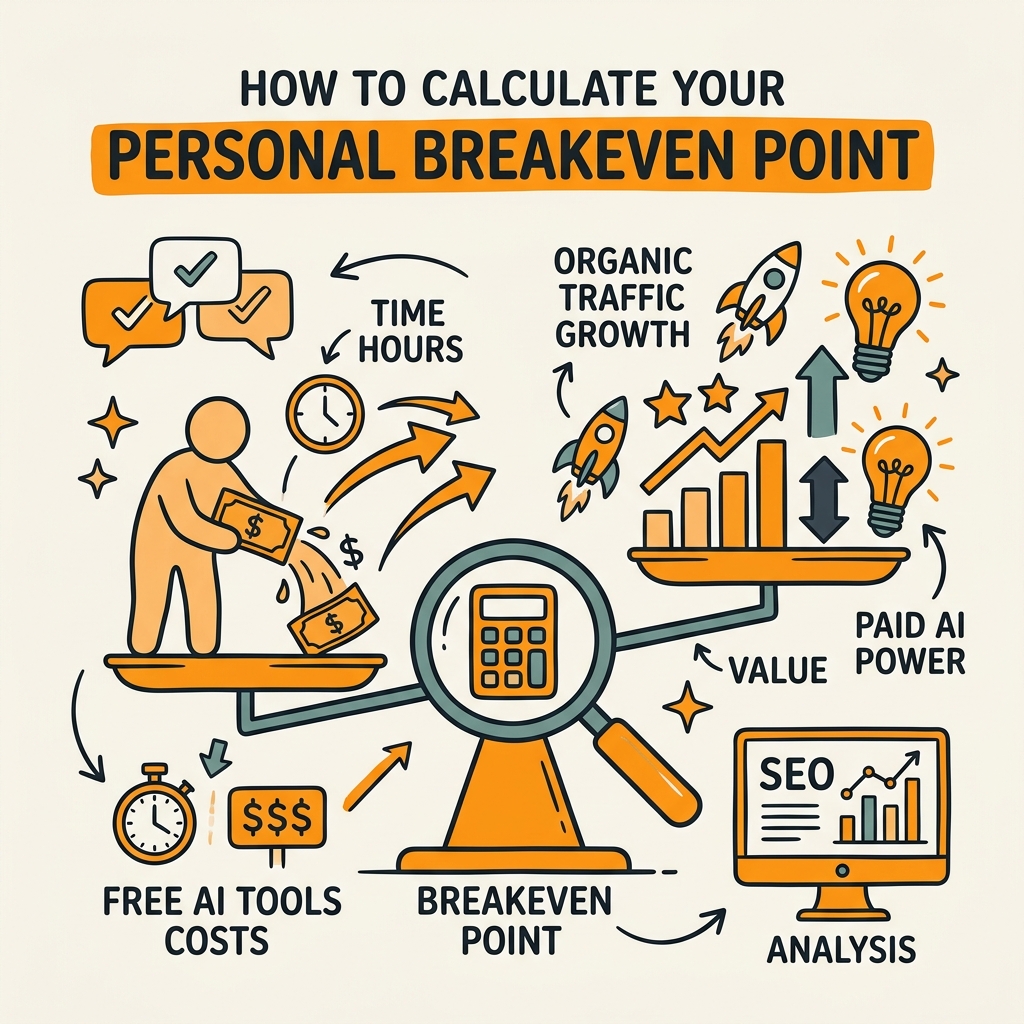
You don't need to guess—calculate your own breakeven. Here's the formula:
Annual breakeven = (Subscription cost × 12) / (Hourly billed rate × hours saved per month × 12)
Let's say you're paying $200/month for a paid tool. Your billed rate (or opportunity cost) is $50/hour. The tool saves you 10 hours per month on keyword research, content optimization, and publishing management.
Breakeven = ($200 × 12) / ($50 × 10 × 12) = $2,400 / $6,000 = 0.4 years = 5 months.
Within 5 months, the time savings offset the subscription cost. After that, every additional hour saved is pure ROI. For agentic tools that save 30-40 hours per month (the entire content pipeline), breakeven hits in 1-2 months.
Calculate your number. If you can't save the monthly subscription cost in labor hours within 4 months, the free tool route makes economic sense. If you can, paid tools are a financial no-brainer.
Common Mistakes Teams Make When Choosing Between Free and Paid
Most teams sabotage themselves with one critical error: they compare subscription cost to subscription cost, not total cost of ownership. Free doesn't mean cheap. Paid doesn't mean expensive. The real variable is labor.
Mistake 1: Ignoring the Time Cost of Free Tools
Team defaults to free tools because "we're bootstrapped" without calculating the hidden wage cost. One person spends 15 hours weekly on manual SEO work. After 6 months, they've invested 360 hours ($14,400 at $40/hour) into free tools while competitors using $300/month paid automation shipped twice the content volume. Paying $300/month to save $14,400 in labor is obviously rational, but bootstrapped teams don't see the invisible cost.
Mistake 2: Buying Too Much Tool Too Early
Conversely, some teams subscribe to Semrush at $250/month before they have a content operation to support. They're paying for enterprise features (white-label reports, 10+ team members) they'll never use. Better to start with SE Ranking at $52/month or an agentic tool at $29/month, then upgrade as your content volume grows.
Mistake 3: Underestimating the Autonomous Tool Multiplier
Agentic tools deliver 3-4x the content volume per dollar spent because the AI executes the entire pipeline. Teams comparing agentic tools to assisted tools often anchor on price ("Jottler costs $99/month, Semrush costs $250/month, so Semrush is cheaper") without accounting for the fact that Jottler eliminates your writing bottleneck entirely. You can't hire three full-time writers for $99/month. The economics are fundamentally different. Understanding content marketing ROI helps teams see beyond surface-level pricing comparisons.
Conclusion
Free AI SEO tools cost $6,240+ annually in hidden labor, plus foregone traffic growth. Paid assisted tools (Semrush, Ahrefs) accelerate research and analysis but require you to manage strategy, writing, and publishing manually. Autonomous AI platforms flip the model entirely: you set strategy and the system compounds content at scale, delivering 65% organic traffic growth within 8 weeks.
The decision isn't about free vs. paid. It's about whether you're willing to spend 10-15 hours weekly managing SEO manually (free), 5-8 hours weekly interpreting data and directing strategy (assisted), or 1-2 hours monthly reviewing compounding results (autonomous).
If you're producing 12+ articles monthly or bootstrapping growth solo, agentic automation isn't a luxury—it's the only economically rational path. Get started by building an AI content strategy that compounds daily. Then start your SEO agent to automate the entire pipeline.
FAQs
Are free AI SEO tools actually free?
Technically, yes—there's no subscription cost. But free tools require significant manual labor to convert into actionable results. You must manually aggregate keyword research from multiple sources, write briefs, draft or edit content, optimize for on-page factors, fact-check claims, and publish. This workflow costs $6,240+ annually in labor hours for teams producing 12+ articles monthly. True cost includes the time investment, not just the software fee. For solo founders, that time could be spent on product development or sales—the opportunity cost of free tools is often higher than the subscription price of paid automation.
What's the actual payback period for a paid SEO tool?
Most teams recoup a paid SEO tool subscription within 2–4 months through labor savings alone. If a tool saves you 10 hours monthly at a $50/hour billed rate ($500/month value) and costs $200/month, you're net positive within 3 months. Agentic automation tools that handle the entire content pipeline break even faster—often within 4–6 weeks—because they eliminate the need to hire writers at $2,000–$5,000 per month. Beyond breakeven, every additional hour saved becomes pure ROI, not to mention the 65% organic traffic growth that typically follows autonomous tool adoption within 8 weeks.
Is a $500-per-month SEO tool worth it for small teams?
It depends on your publishing volume and team structure. For teams producing fewer than 12 articles monthly, $500/month is likely overinvestment—you can achieve the same output with a $50–$100/month assisted tool or even free tools. For teams producing 20+ articles monthly or managing multiple client accounts, $500/month platforms like Semrush's enterprise tier are cost-effective because you're distributing that cost across more revenue-generating work. The sweet spot for small teams: start with an agentic tool at $29–$99/month that automates the entire pipeline, rather than spending $500 on assisted data tools that still require you to write, optimize, and publish manually. Automation compounds faster than any tool subscription can.