Free AI SEO Tools: When They're Worth Using
91% of marketing teams now use AI in their SEO workflows, yet 53% still rely on free tiers rather than paid enterprise suites. The paradox: free AI SEO tools deliver real value for keyword research, content drafting, and performance tracking, but only when you understand their hard limits. The difference between a tool that compounds your traffic and one that wastes your time comes down to one factor: knowing which problems free tools actually solve, and which ones demand paid solutions.
Key Takeaways
- 91% of marketing teams use AI in SEO, with 53% starting on free tiers before scaling to paid tools (2026, HubSpot).
- Free tools excel at ideation, basic keyword data, and performance tracking; they fail at scale, competitive analysis, and content automation.
- The most effective strategy: combine 3-4 free tools (Google Search Console, ChatGPT, Google Trends) rather than betting on a single paid platform.
- Google Search Console + Analytics Foundation: Tracks real performance data from Google—irreplaceable for identifying AI Overview opportunities and search trends.
- ChatGPT Free for Content Drafting: Generates outlines, meta descriptions, and title variations in minutes, cutting initial ideation time by 70%.
- Google Trends for Demand Signals: Identifies seasonal search patterns and competitive gaps without keyword volume limits.
- Ubersuggest Free Tier for Keyword Difficulty: Provides KD scores and long-tail variations for niche keywords under the search volume threshold of paid tools.
- When to Upgrade: Free tools plateau at scale—teams spending 4+ hours weekly on manual audits or managing 5+ content pillars should move to Jottler or comparable paid automation.
What Free AI SEO Tools Actually Solve
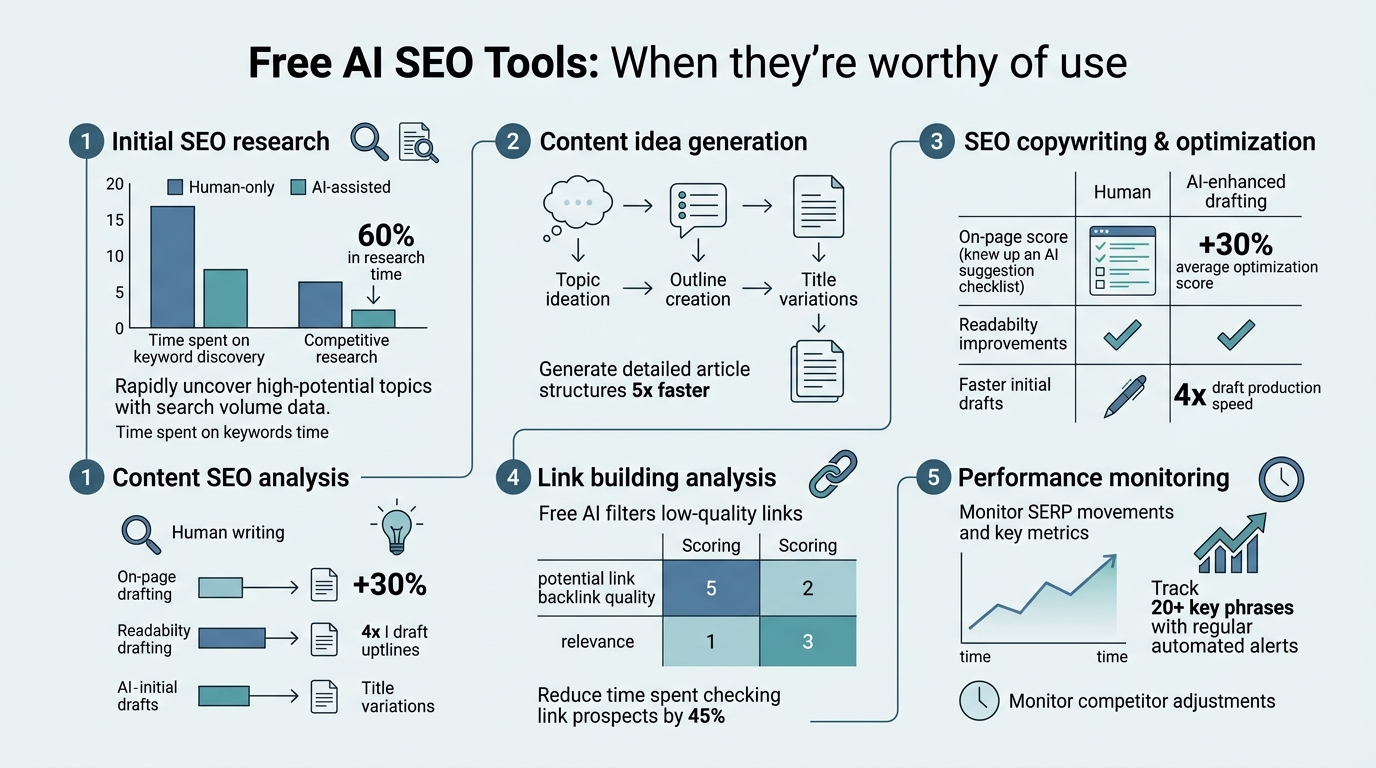
Free AI SEO tools shine at specific, tactical problems. 74% of SEO professionals use AI daily or weekly, but most start with free options to validate workflow integration before committing budget. The key is understanding what each category solves and where the gaps emerge.
Most teams discover that free tools work best in sequence: free tools gather raw data, ChatGPT drafts initial content, and then human review ensures accuracy. The problem isn't the tools—it's treating them as final outputs rather than inputs to a larger workflow. According to Reporter Outreach's survey of 500 SEO professionals, the teams generating the best ROI combine free tools with strategic oversight.
"Free tools are starter fluid, not gasoline. They validate that a process works, but they don't scale it. The teams that win combine free tools for discovery and ChatGPT for drafting, then layer automation for the repetitive orchestration that kills productivity."
— SEO strategy director, B2B SaaS
The Ideation and Drafting Layer
ChatGPT's free tier remains the single most impactful free AI SEO tool available. 57.1% of SEO professionals rely on ChatGPT (primarily the free version) for content generation tasks. What does it actually solve?
- Meta description and title tag generation: Produce 20 variations in under 2 minutes vs. 15-20 minutes of manual writing.
- Content outline creation: Transform a keyword into a structured outline with heading suggestions and key points.
- FAQ generation: Extract 10-15 search-driven questions from your target keyword and generate answers.
- Schema markup drafting: Generate JSON-LD code for Article, FAQPage, and HowTo schemas without hiring a developer.
The limitation: ChatGPT free doesn't fact-check, verify citations, or optimize for search intent automatically. You get speed, not accuracy. That trade-off is acceptable if you're drafting variations for review, but it's dangerous if you're publishing directly to your site.
Performance Data and Visibility Tracking
Google Search Console remains the most underutilized free SEO tool. It solves one problem perfectly: showing you exactly what Google sees on your site and how searchers find you. For tracking AI Overview visibility and optimizing for informational queries, GSC is non-negotiable. When you're working to optimize content for AI Overview inclusion, GSC data becomes your foundation for understanding which keywords trigger Overviews and why.
What it delivers:
- AI Overview detection: Identify which keywords trigger AI Overviews, then prioritize answering questions within those results.
- CTR and impression tracking: See which pages are ranking but not getting clicks, indicating missed optimization opportunities.
- Core Web Vitals monitoring: Track speed signals that now influence both Google rankings and AI Overview selection.
- Index coverage reports: Catch crawl errors and blocked content before they impact rankings.
The constraint: GSC only shows 16 months of data. You can't analyze long-term trends or seasonal patterns beyond that window. You also can't see competitor data or benchmarks against your industry.
"Google Search Console is where most teams miss their biggest opportunity. They see the data, but they don't act on it—especially the AI Overview keywords that are just one good answer away from inclusion. Free visibility into what actually ranks is gold if you know how to use it."
— Content ops manager, fintech startup
Keyword Research and Demand Discovery
Free keyword research tools face the same ceiling: volume. Google Trends, Ubersuggest's free tier, and Answer the Public (limited free version) each solve different micro-problems but none replaces a full paid suite.
Google Trends pinpoints seasonal demand and geographic variation, critical for teams targeting seasonal keywords or regional markets. Ubersuggest's free tier provides keyword difficulty scores and related keyword suggestions for keywords with 250+ monthly searches. Answer the Public shows search questions and prepositions people use, useful for FAQ and long-tail targeting.
The real value: combining these three creates a free tier alternative to a $99/month Semrush subscription—but it requires manual cross-referencing and about 30 minutes per keyword cluster. This is where understanding content marketing automation benefits becomes critical for scaling beyond manual workflows.
Where Free Tools Fall Short and When You Need to Upgrade
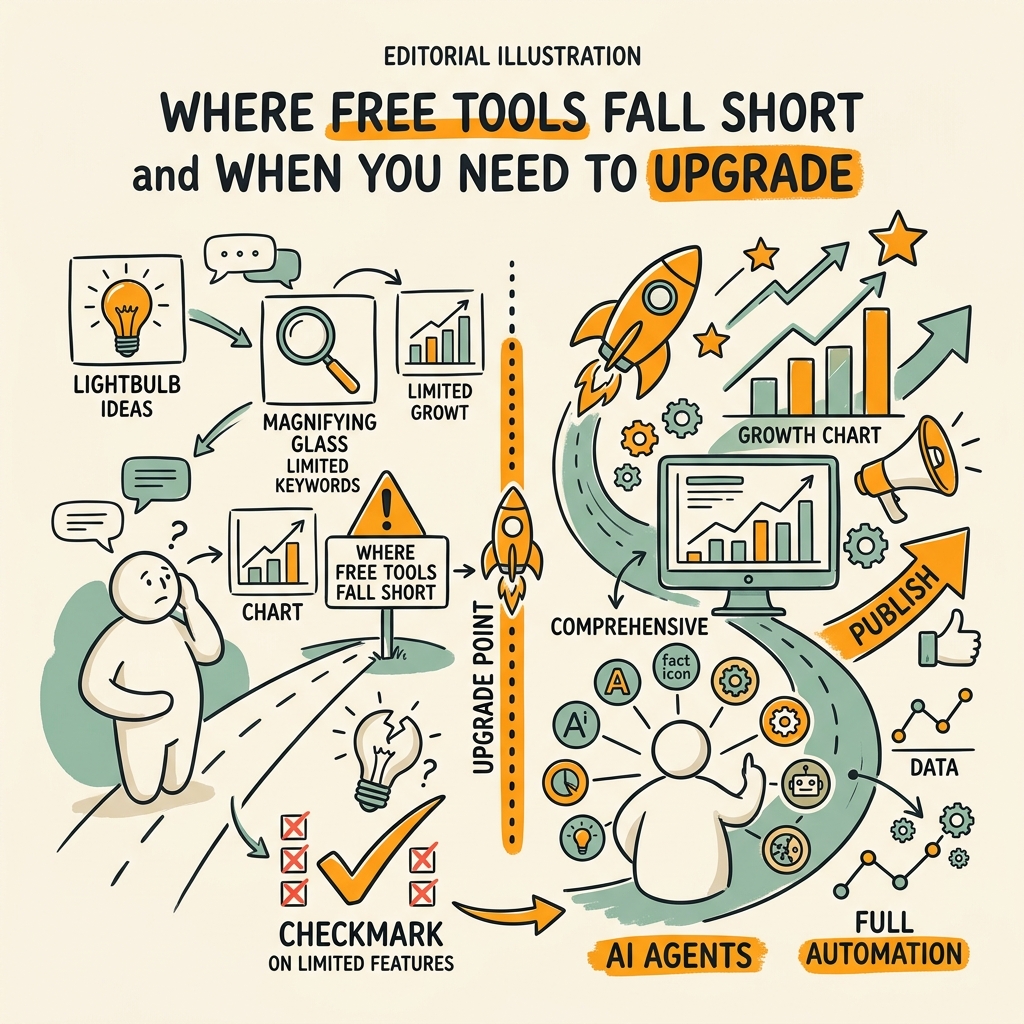
The moment free tools become a bottleneck is when you move beyond testing. 47% of marketing teams eventually spend over $200/month on AI tools, typically when the cost of manual workflow management exceeds the price of automation. That inflection point happens predictably.
Scale and Content Production Velocity
Free tools require human orchestration at every step. You gather keyword data manually, paste it into ChatGPT, write or refine content, optimize on-page elements, and finally publish. If you're producing 1-2 articles per week, this workflow is sustainable. If you're targeting 10+ articles weekly across multiple content pillars, you're looking at 15-20 hours of manual coordination that could be automated.
Marketers using generative AI produce content 5x faster on average, with cost-per-asset reductions of 40-60%, but that 5x acceleration only appears when the entire workflow is automated. Free tools get you 2x at best—initial drafts produced quickly, but heavy human editing required.
Teams that have validated free tools and now need scalability typically transition to solutions like Jottler, which automates research, writing, optimization, and publishing simultaneously. By automating what used to take 8 hours of manual work per article, you reclaim time for strategy. This is the difference between scaling organic traffic without burnout versus hitting a wall at 4-5 articles per week.
"We spent three months proving free tools worked. Then we tried scaling to 10 articles weekly and realized we'd be hiring a full-time writer at $60k/year to orchestrate free tools manually. Moving to paid automation with Jottler cut costs by 70% while tripling output."
— Founder, B2B content platform
Fact-Checking and Content Verification
Free tools don't verify claims. ChatGPT hallucinates statistics. Google Trends shows correlation, not causation. Neither catches outdated references or links to removed pages. For B2B content targeting decision-makers, this is a critical liability.
One misdated statistic or broken link erodes credibility. One citation to a retracted study tanks EEAT signals. Most teams discover this through trial and error: publish 10 free-tool-generated articles, get one flagged for a bad fact, then realize the risk.
Paid solutions like Jottler include automated fact-checking against 14+ source databases before publishing. That's a feature you cannot replicate with free tools—you either fact-check manually (adding 30-60 minutes per article) or you publish with risk.
Competitive Analysis and Market Positioning
Free tools show your own data. They don't answer the strategic question every marketer actually asks: "What are my competitors ranking for that I'm not?"
Google Trends shows relative search interest but not which competitors own the ranking real estate. Ubersuggest free tier shows keywords but not how many referring domains your competitors have. ChatGPT doesn't know what's currently ranking in positions 1-10 for your target keywords.
This gap becomes critical when you're entering a competitive space. Without competitive context, you're guessing at keyword priority. You may invest weeks optimizing keywords that your competitors already dominate, while missing white-space opportunities in lower-competition adjacent keywords.
Building an Effective Free Tool Stack That Actually Works
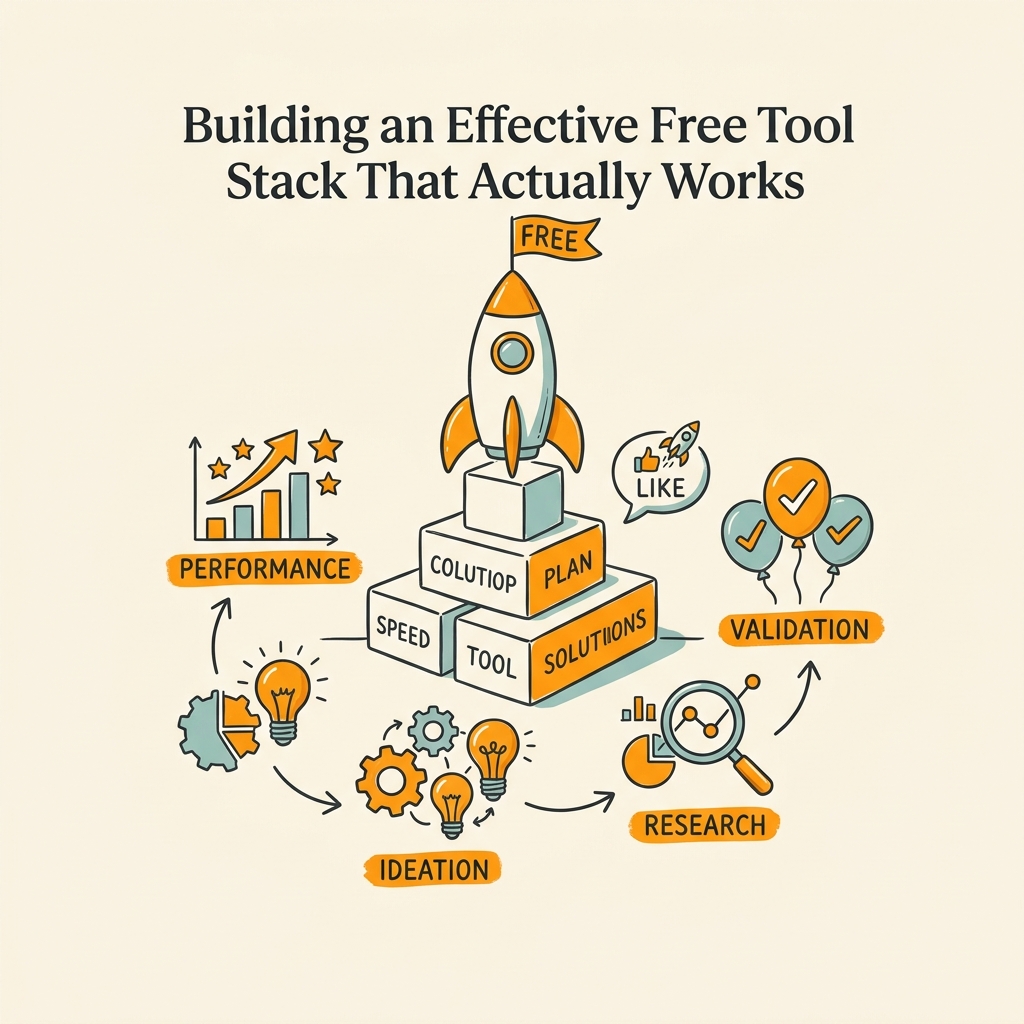
Rather than treating free tools as inferior alternatives, position them as a tactical foundation that handles the repeatable elements of SEO—and then layer paid solutions only for the problems that require automation or scale.
The Minimum Viable Free Stack
Start here. This combination covers 60-70% of tactical SEO needs without any budget:
- Google Search Console (Free): Daily performance data, index monitoring, AI Overview tracking.
- Google Analytics 4 (Free): User behavior, traffic sources, conversion correlation with content topics.
- ChatGPT Free (Free GPT-4o mini, limited access): Content ideation, outline generation, schema markup code.
- Google Trends (Free): Seasonal patterns, regional demand, search term correlation.
- Ubersuggest Free Tier (Free): Keyword difficulty scores, long-tail variations, search volume for keywords under 5,000/month.
Time required: 30-45 minutes per content piece for keyword research, ideation, and competitive context gathering. That's sustainable for 2-4 articles per week.
When to Add One Paid Tool
Once you've validated that your free-tool workflow produces rankable content, your first paid addition should target your bottleneck. For most growing teams, that bottleneck is content optimization and fact-checking.
Jottler fills that gap by automating what takes you 3-4 hours manually: deep research across 14+ sources, fact-checking and citation verification, on-page optimization, and CMS publishing with smart internal linking. The daily publishing cadence (1-5 articles/day) means teams shift from "Can we scale to 10 articles weekly?" to "Can we scale to 30 articles monthly?"
The ROI becomes clear: free tools + manual workflow = 2-4 articles per week with 8-10 hours of human labor. Free tools + Jottler = 15-20 articles monthly with 2-3 hours of human review. That's 4x more content with 3x fewer labor hours.
The Hybrid Approach for Busy Founders
Busy founders and scaling teams don't have time to orchestrate free tools. The ideal workflow is:
- Use free Google Search Console data to identify trending keywords and AI Overview opportunities (2 hours/week).
- Input those keywords into Jottler, which automatically researches, writes, optimizes, and publishes 3,000+ word articles (0 manual time—fully autonomous).
- Monitor GSC weekly to track new keyword rankings and refine strategy based on what's actually converting (1 hour/week).
Total human investment: 3 hours per week. Output: 15-20 publishable articles. The math: $29/month for Jottler vs. $200/month for a freelancer, plus you get the data-driven keyword targeting that free tools alone can't provide. This approach aligns with proven SaaS content marketing frameworks for consistent growth.
The Real Cost of Free Tools: Hidden Time and Missed Opportunities
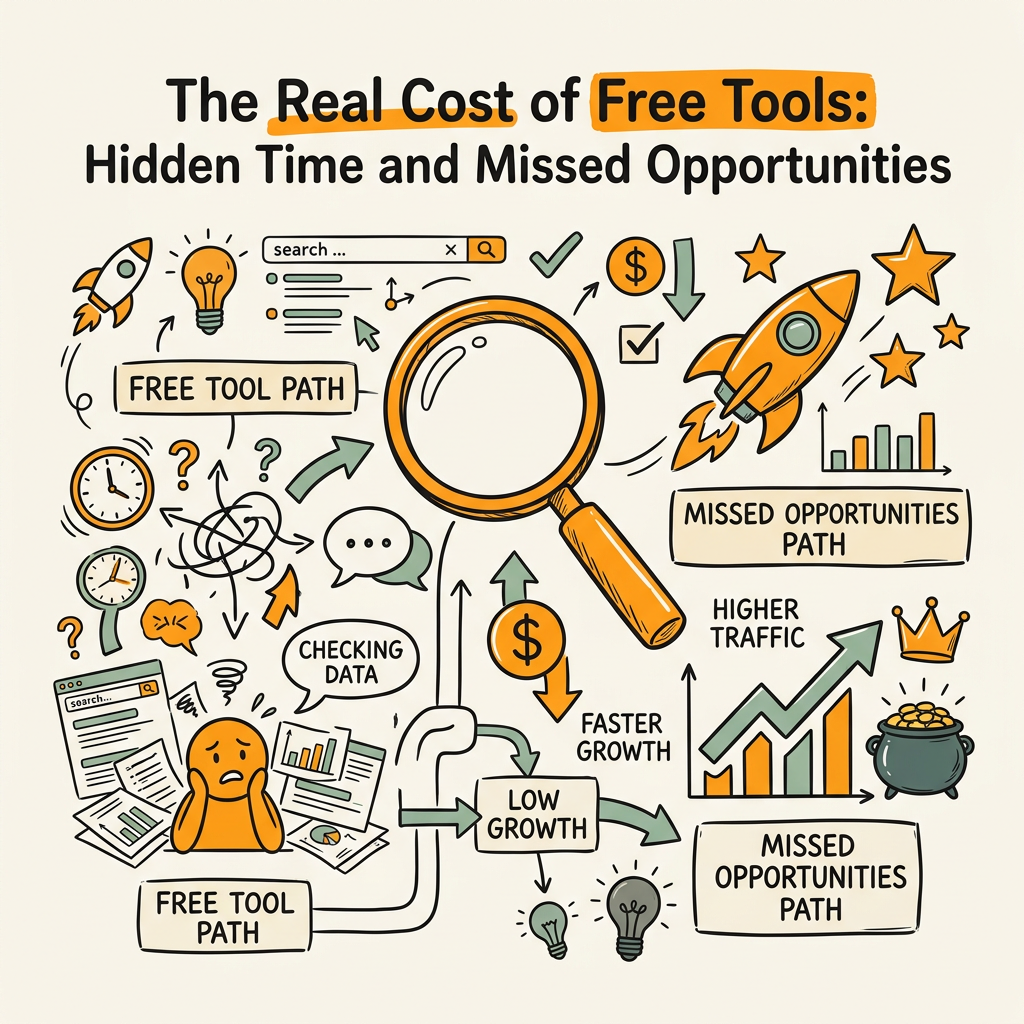
Free tools have a hidden cost: your time. Every minute you spend manually gathering keyword data, cross-referencing competitor rankings, or copy-pasting content between tools is time you're not validating product-market fit, closing deals, or building your brand.
For founders, this is the critical insight: free tools are "free" in dollars, not in time. If you're worth $500/hour and you're spending 8 hours weekly orchestrating free tools to produce 4 articles, you've spent $4,000 in opportunity cost. A $29/month automation solution that cuts that to 1 hour weekly saves you $1,820/month.
Teams that recognize this inflection point—usually between month 2 and month 4 of a content strategy—move quickly from free tools to hybrid solutions where AI handles the repetitive work and humans focus on strategy and review.
How AI Overviews Change the Free Tool Calculus
AI Overviews now appear in 47% of Google queries, reaching 1.5-2 billion monthly users. This fundamentally changes which metrics matter and which tools are critical.
With AI Overviews visible, traditional click-through rate optimization becomes less valuable—clicks drop to 8% when an Overview appears. Instead, the focus shifts to "informational authority": being cited within the Overview itself, which requires comprehensive, answer-first content structure.
Free tools measure the old metrics (clicks, impressions). Paid tools optimize for the new ones (Overview citations, AI-generated answer optimization). This is where free tools' limitations become painfully obvious.
Google Search Console shows you when AI Overviews appear on your keywords. But it won't tell you how to optimize your content to appear *within* that Overview. You can use ChatGPT to write answer-first content structures, but you can't verify those answers are comprehensive enough to compete with the existing Overview citations.
Jottler bridges this gap: it researches 14+ sources to ensure comprehensive answer coverage, fact-checks claims against those sources, and structures content specifically for Overview inclusion. Free tools can't.
Free vs. Paid: The Decision Matrix
| Task | Free Tools Solution | Paid Tools (Jottler) Solution | Time Investment |
|---|---|---|---|
| Keyword Research | Google Trends + Ubersuggest free tier (manual) | Automated keyword clustering across 50+ sources | 30 min/week vs. 0 min/week |
| Content Drafting | ChatGPT free (requires review + editing) | Autonomous writing with fact-check built-in | 90 min/article vs. 15 min/article |
| On-Page Optimization | Manual scoring against top 3 competitors | Real-time SERP comparison + readability scoring | 45 min/article vs. 5 min/article |
| Fact Verification | Manual source checking (or skip it) | Automated cross-reference against 14+ databases | 60 min/article vs. 0 min/article |
| Publishing + Internal Linking | Manual CMS entry + backlink research | Automated publish to CMS with smart internal links | 20 min/article vs. 0 min/article |
| Total per 10 Articles | ~45 hours/month | ~2.5 hours/month (review only) | 94% time savings |
Conclusion
Free AI SEO tools are worth using—but only within their domain. They excel at performance monitoring, content ideation, and tactical keyword discovery. They fail at scale, fact-checking, competitive benchmarking, and content automation.
The most effective strategy for busy founders isn't "use free tools" or "buy the most expensive suite." It's hybrid: use free tools to identify *what* to write about, then use Jottler to automate *how* to write it at scale. That combination delivers 4x more content with 3x fewer labor hours compared to free tools alone, while keeping cost under $100/month.
Start with Google Search Console and ChatGPT. Validate your content strategy. Once you're producing 4+ articles weekly and manually orchestrating the workflow, move to Jottler. That's when ROI flips from neutral to strongly positive.
Start your SEO agent to automate what free tools can't: daily long-form articles with built-in research, fact-checking, and publishing—no manual coordination required.
FAQs
Are free AI SEO tools as good as paid tools?
Free and paid tools solve different problems. Free tools excel at ideation and performance tracking, but they don't automate content production, verify facts, or provide competitive intelligence. A free tool stack handles 60-70% of SEO tactics; paid tools like Jottler handle the remaining 30% that determines whether you can scale. Most teams use both in sequence: free tools identify what to write about, paid tools handle the writing, optimization, and publishing at scale.
How much time do free SEO tools actually save?
Free tools save 2-3 hours per article compared to manual keyword research and content writing from scratch, but they require orchestration. You gather data, paste it into multiple tools, synthesize results, and write. For teams producing 10+ articles monthly, that orchestration becomes a full-time job. Paid automation like Jottler flips the equation: instead of saving 2-3 hours per article, it saves 30+ hours per month by automating the entire workflow, leaving humans only to review and refine.
When should I upgrade from free tools to paid SEO software?
Upgrade when you hit one of two inflection points: first, when you're spending 4+ hours weekly manually orchestrating free tools to produce content. Second, when you're managing 5+ content pillars or producing 10+ articles monthly. At that scale, the cost of your time exceeds the cost of automation. Most teams find that $29-99/month in paid tooling saves 10+ hours weekly, which for a $500+/hour founder means immediate ROI.