Google Local Pack Optimization for Multi-Branch Firms
Multi-location businesses face a distinct challenge: ranking in Google's Local Pack requires balancing centralized brand authority with location-specific relevance signals. 44% of all clicks on local search results go to the Google Local Pack (the top 3 map results), meaning each location that ranks dominates its market. Yet most multi-branch firms optimize inconsistently, with duplicate content, NAP inconsistencies, and fragmented review strategies that suppress rankings across all locations simultaneously.
The cost of failure is measurable: a business missing the Local Pack loses roughly 7x more clicks than those appearing in the pack. For multi-location firms, that multiplies quickly. The fix requires a framework: Google Business Profile (GBP) optimization at scale, location-specific content architecture, consolidated review systems, and citation management that maintains consistency without sacrificing local relevance. Here's how to build it.
Key Takeaways
- 44% of local search clicks go to the Google Local Pack, making it the highest-leverage ranking opportunity for multi-branch firms. (2025, Digital Applied)
- Review velocity—the rate of new reviews per month—now matters more than total review count. Consistent, monthly review generation outranks one-time review bursts.
- Duplicate location pages trigger Google's thin content filter. Each location needs unique content: local staff, testimonials, nearby landmarks, and location-specific services.
- Google Business Profile at Scale: Each location requires a separate, fully verified GBP listing with specific category selection and complete profile data.
- Location-Specific Content: Unique landing pages for every branch that answer local questions, feature local team bios, and showcase location-specific case studies.
- NAP Consistency Across Citations: Name, Address, and Phone data must be identical across all directories—including punctuation and abbreviations.
- Sustained Review Velocity: Automated systems that generate 5-10 authentic reviews per location per month, not seasonal bursts.
- Local Link Acquisition: Build citations and backlinks to location pages from neighborhood directories, local news, and community resources.
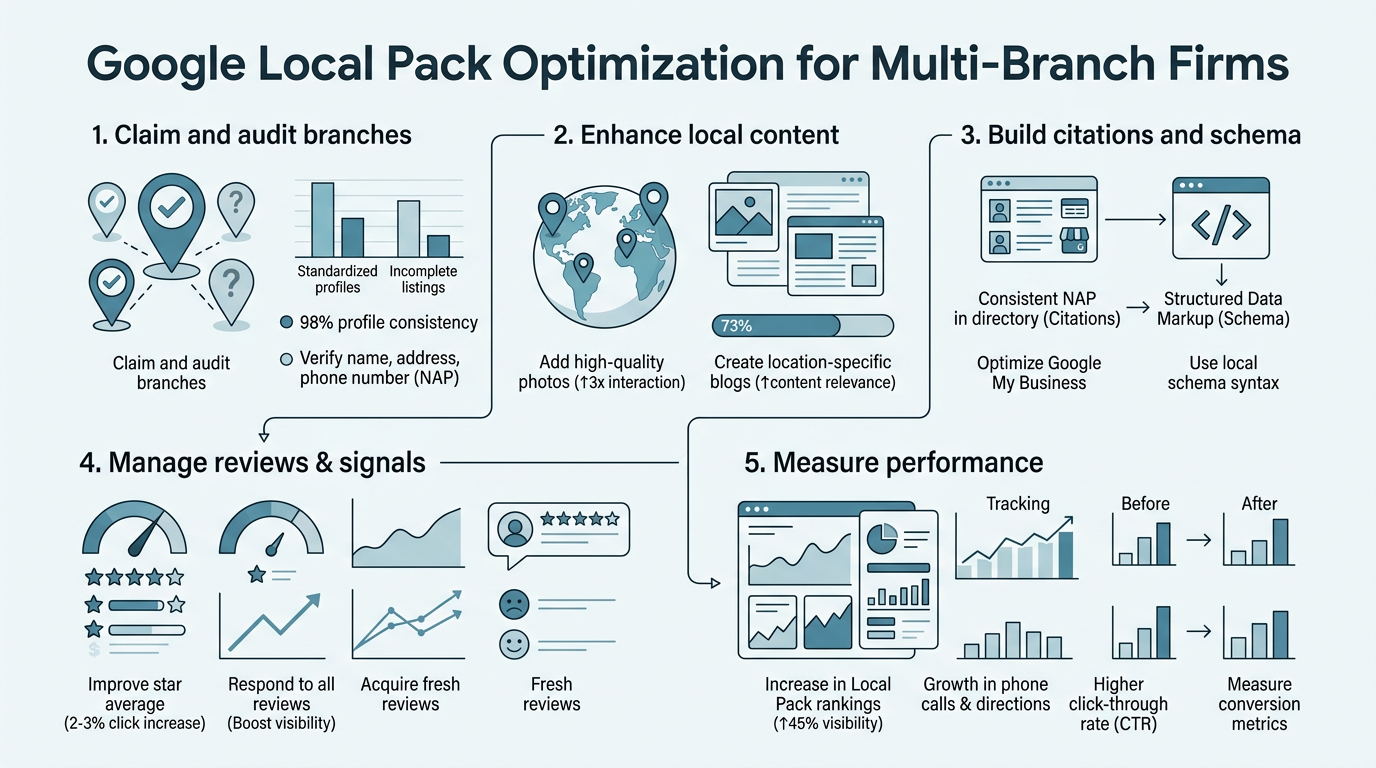
How Google's Local Pack Algorithm Ranks Multi-Location Businesses
Google's local search algorithm uses three equally weighted ranking pillars: Relevance (~35%), Distance (~35%), and Prominence (~30%). For multi-location firms, the challenge is optimizing all three across dozens or hundreds of locations without creating conflicting signals that confuse Google's ranking system. Google's Local Pack algorithm prioritizes businesses that match the searcher's intent, are physically close to the user, and have established authority in their market.
"The Local Pack is a zero-sum game. When you rank in the top three, you capture the majority of clicks and calls for that location. When you don't, you're essentially invisible to local searchers despite having a physical address in their market."
Relevance: Category Selection and GBP Signals (35% Weight)
Relevance is determined primarily through GBP category selection. Businesses with a specific primary category (e.g., "Italian Restaurant" vs. just "Restaurant") rank significantly higher than those using generic categories. This is not optional—it is the single most influential ranking factor.
The framework is simple but often overlooked:
- Primary Category: Choose the most specific category that describes your business. "Contractor" is weak; "HVAC Contractor" is strong; "Emergency HVAC Repair Contractor" is ideal.
- Secondary Categories: Add 3-5 additional relevant categories without keyword stuffing. These provide context but do not override the primary category signal.
- Service Descriptions: Write service descriptions for each offered service. These are indexed by Google and increase relevance for local searches.
- Business Name Keywords: If your legal business name includes a keyword (e.g., "Smith HVAC Solutions"), Google weighs this heavily. Do not artificially add keywords to your business name just for ranking—this is penalized as spam.
For multi-location firms, consistency in category selection across all locations is critical. If one location uses "Italian Restaurant" and another uses "Restaurant," Google's algorithm views them as less coherent, reducing the cumulative brand authority signal for the entire firm.
Distance: Proximity and Service Area Definition (35% Weight)
Distance is partially determined by the searcher's location relative to your business address—a factor you cannot control. However, you can influence how Google perceives your service area coverage through strategic location pages and service area settings in GBP.
For multi-location businesses, distance optimization involves:
- Accurate Service Area in GBP: Define your service area as tightly as possible without losing legitimate search volume. A plumber serving "Los Angeles" casts a wider net than one serving "West LA and Pasadena"—but the latter appears closer to searchers in those neighborhoods.
- Neighborhood-Level Location Pages: Create dedicated content for specific neighborhoods within your service area. A roofing company in Denver should have pages for "Roofing in LoDo," "Roofing in Cherry Creek," etc.
- Satellite Locations in High-Demand Areas: If you serve a region but don't have a physical office in a key neighborhood, consider opening a small satellite location. This resets the distance calculation and increases local pack visibility.
Prominence: Reviews, Links, and Citations (30% Weight)
Prominence is the perceived authority and trustworthiness of your business. Google signals this through review count and velocity, citation volume, backlinks, and online mentions. For multi-location firms, prominence compounds—strong performance across all locations elevates the brand's overall authority.
Key prominence signals:
- Review Velocity: 5-10 reviews per location per month outperforms one-time review bursts. Consistent, recent reviews signal an active business with current customer engagement.
- Review Rating Threshold: Businesses in the Local Pack maintain 4.0+ star ratings on average. Ratings below 3.8 stars suppress rankings significantly.
- Review Diversity: Reviews from different platforms (Google, Yelp, industry-specific sites) strengthen prominence more than reviews from a single source.
- Citation Volume: Mentions of your business across high-authority directories (Yelp, Apple Maps, local chamber of commerce sites, etc.) signal prominence to Google.
Building Optimized Google Business Profiles for Every Location
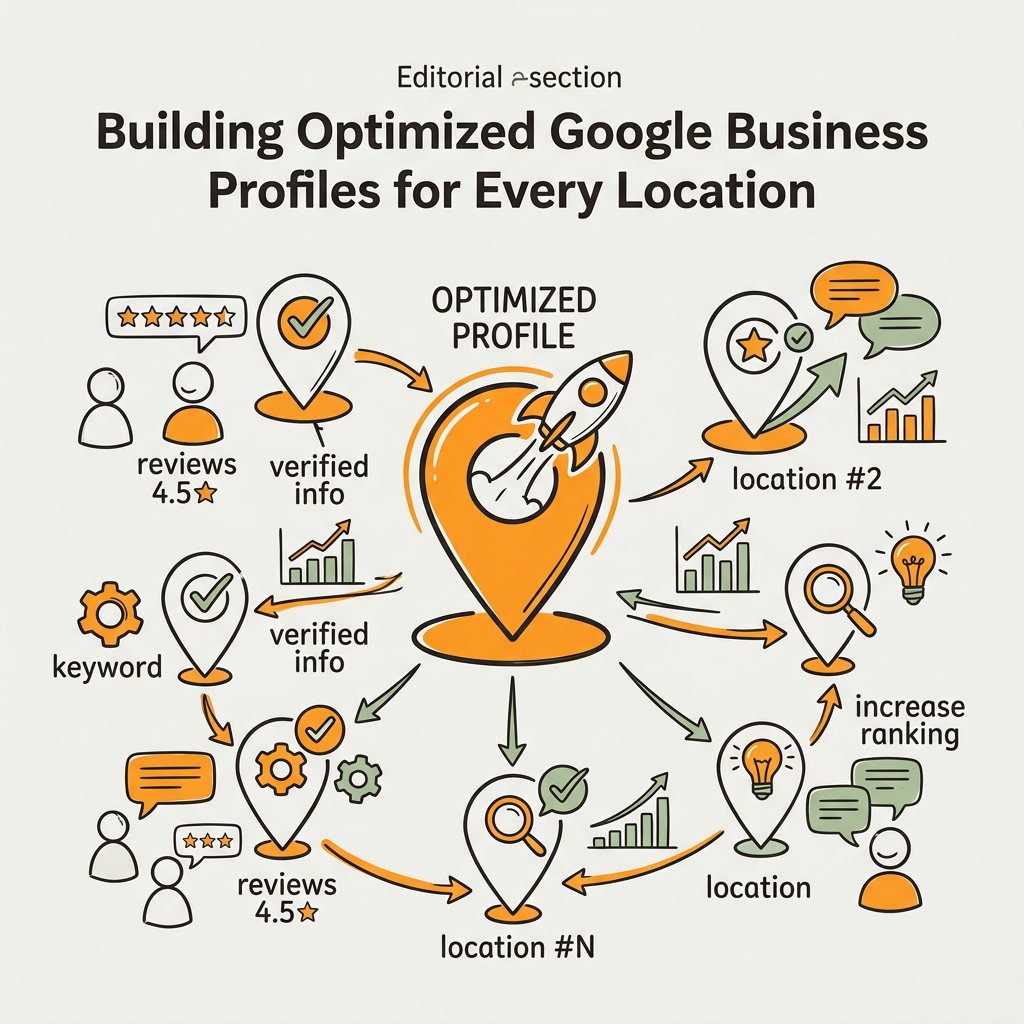
Each location in a multi-branch firm requires a separate, fully verified GBP listing. This is non-negotiable. A single GBP listing cannot rank multiple physical locations in the Local Pack—Google's algorithm is designed to show one result per business location per search.
GBP optimization is not a one-time task. The platform evolves constantly, and profiles require sustained activity to maintain rankings. For multi-location firms managing 10+ locations, this becomes operationally challenging without automation. When you're managing dozens of locations, SEO automation platforms can systematize profile updates across all locations simultaneously.
"A fully optimized GBP profile with complete data, recent photos, consistent posting, and active review management receives 7x more visibility than an incomplete profile in the same market. The difference isn't incremental—it's exponential."
The Core Elements of a High-Ranking GBP Listing
A complete GBP profile includes over 20 editable fields. The highest-impact fields for ranking are:
- Business Name: Use your legal business name. Do not artificially add service keywords (e.g., "Smith Plumbing +Emergency Repair+")—this triggers Google's spam filter.
- Primary Category: The single most important field. Select the most specific category available in Google's taxonomy.
- Address: Must be real, physical, and verified by mail. P.O. boxes are not accepted for location-based businesses.
- Phone: Use a location-specific number if possible. This allows call tracking per location and strengthens local relevance.
- Website: Link to the location-specific landing page, not the homepage. This increases relevance for local searches.
- Hours: Keep hours current. Outdated hours trigger suppression and negative user signals.
- Service Area: Define the specific neighborhoods/cities you serve. Be granular.
- Photos and Videos: High-quality, location-specific photos (storefront, team, projects) increase click-through rates and engagement signals.
- Posts: GBP posts are a ranking signal. Publish 2-4 posts per location per month about events, promotions, or location-specific content.
For firms with 50+ locations, manual GBP management becomes unsustainable. Most turn to automation platforms like those tracked by Birdeye and other enterprise local SEO tools that manage bulk GBP updates, review aggregation, and citation synchronization. The efficiency gains are significant—automated platforms reduce manual update time by 90%.
Verification and Claiming Your Listings
Every GBP listing must be verified by Google. The verification process typically involves:
- Mail Verification (Primary): Google sends a postcard to your business address with a verification code. This takes 1-2 weeks but is the most common method.
- Phone Verification: Google calls the business phone number to confirm ownership. Fastest method, usually instant.
- Email Verification: Available for some business types. Instant but less reliable than mail or phone.
For multi-location firms, batch the verification process: submit all locations simultaneously so Google's verification timeline aligns across locations. This prevents some locations from ranking while others are still pending verification.
Creating Unique Location Pages That Drive Local Pack Rankings
Google's thin content filter explicitly penalizes location pages that are identical except for the city name. Each location page must contain genuinely unique content—otherwise, it suppresses rankings for all locations on the site simultaneously.
The framework for unique location pages balances scalability with uniqueness:
The Core Location Page Structure
Every location page needs:
- Location-Specific H1 and Meta Title: "Roofing Services in Denver" not "Roofing Services." Include the city name naturally.
- Local Introduction (100-150 words): Address the specific location directly. Example: "Serving Denver's Highlands neighborhood since 2015..." Mention local landmarks, neighborhoods, and local market dynamics.
- Local Team Bios (150-200 words): Name and brief bio of team members who work at this location. This is a ranking signal and provides genuine uniqueness.
- Location-Specific Services (200-300 words): Services offered at this specific location. Some firms may offer different services in different regions due to local demand.
- Case Studies or Project Examples from This Location: Feature 2-3 real projects completed in the local market. Use location names, client names (with permission), and before/after visuals.
- Local Testimonials: Include reviews or testimonials from customers in this specific location. Quote them by name and neighborhood.
- Local FAQ: Answer questions specific to the location. "What are Denver building codes for roofing?" "Does Denver permit residential solar?" Localize the FAQ based on actual customer questions from that market.
- NAP (Name, Address, Phone): Display prominently in a schema markup block. Use location-specific phone numbers.
- Local Images: Show photos of actual projects, team members, and office locations in this specific area. Avoid generic stock photos.
Avoiding the Duplicate Content Trap
The single biggest mistake multi-location firms make is creating "template" location pages where 80% of the content is shared and only the city name changes. Google's algorithm detects this and suppresses rankings for all locations.
To avoid suppression:
- Unique Word Count per Location: Aim for at least 40-50% unique content per location page. If you have 20 locations, invest in creating genuinely different content for each.
- Local Content Management: Consider hiring a local contractor or having employees at each location contribute unique content (local market insights, team interviews, project photos).
- Dynamic Schema Markup: Use LocalBusiness schema with location-specific fields (address, phone, hours, opening date, team). This signals to Google that each page is unique.
Managing NAP Consistency and Citation Building at Scale
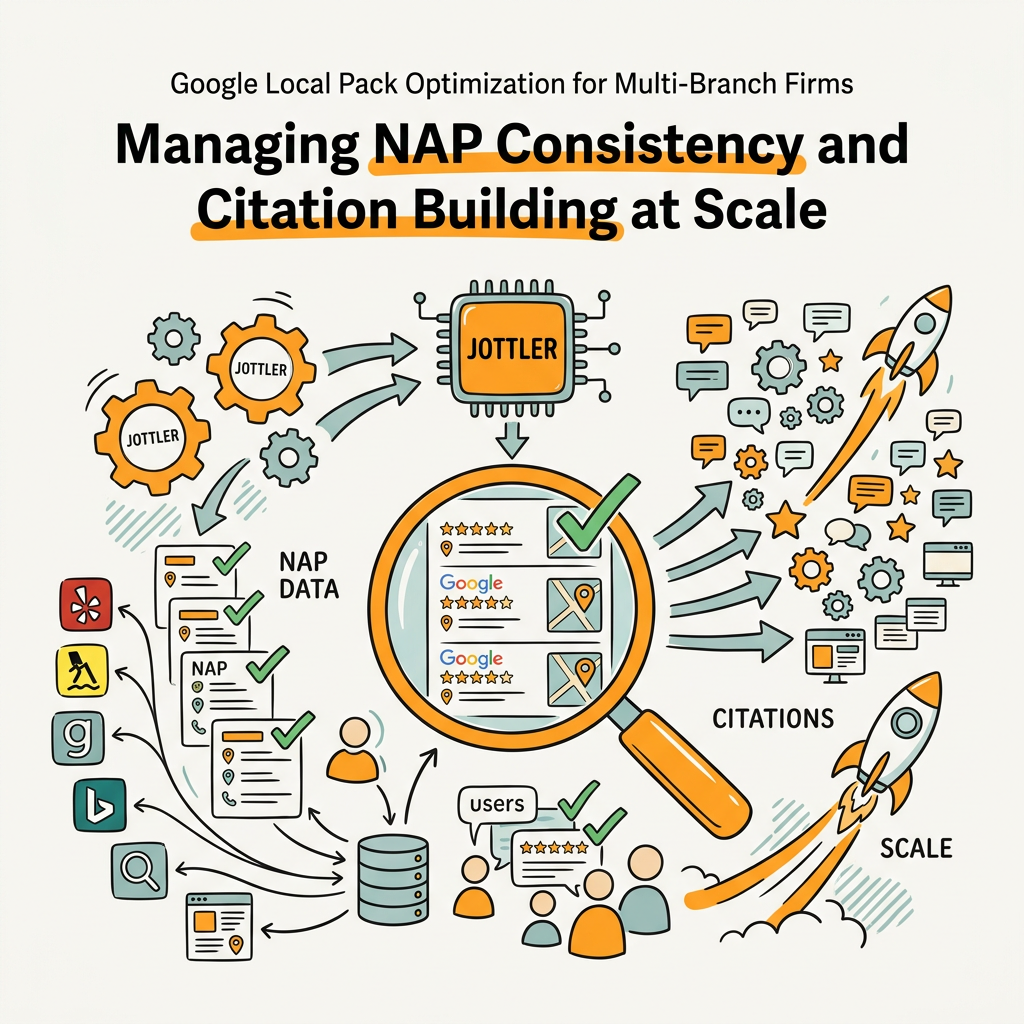
NAP consistency—ensuring Name, Address, and Phone data are identical across all directories—is a foundational ranking factor for multi-location firms. A single inconsistency (e.g., "123 Main Street" vs. "123 Main St") across directories can suppress rankings for all locations.
The NAP Consistency Audit
Start with a complete audit of all your locations across major citation sources:
- Major Directories: Google Business, Yelp, Apple Maps, Facebook, Mapquest, Yahoo
- Industry-Specific Directories: Angi (home services), Healthgrades (medical), TripAdvisor (hospitality)
- Local Aggregators: Chamber of Commerce sites, local business directories, neighborhood-specific listings
For each location, verify that:
- Business name is identical everywhere (including punctuation)
- Address format is consistent (Street abbreviations, suite numbers, etc.)
- Phone number format is consistent (with or without hyphens, country codes)
- Website URL points to location-specific pages
- Business hours are current
- Service area is consistent with GBP definition
Citation Building Strategy for Multi-Location Firms
Citations are mentions of your business name, address, and phone across the web. Building citations is not about quantity—it's about consistency and authority. 50 citations from high-authority sources outperform 500 citations from spam directories.
Priority citation sources (in order of ranking impact):
- Tier 1 (Highest Authority): Google Business, Yelp, Apple Maps, Facebook, Better Business Bureau
- Tier 2 (Industry-Specific): Angi (home services), Thumbtack, local chamber of commerce, trade association directories
- Tier 3 (Local Relevance): Neighborhood blogs, local news outlets, community boards, neighborhood-specific directories
For multi-location firms with 10+ locations, managing citations manually is unsustainable. Automation platforms reduce citation management overhead by 80-90%, allowing teams to focus on content quality and review velocity instead of directory updates.
Implementing Sustained Review Velocity for Consistent Rankings
Review velocity—the rate of new reviews per month—now matters more than total review count. A business with 20 reviews earned over the past 3 months ranks higher than one with 200 reviews from 3 years ago. This signals to Google that the business is active, current, and engaged with customers.
Setting Up a Scalable Review Acquisition System
Manual review requests sent to customers one-by-one do not scale. For multi-location firms, an automated review generation system is essential.
The framework:
- Automated Post-Purchase Requests: Email or SMS customers 2-3 days after purchase with a direct link to leave a review. Timing matters—customers are most satisfied shortly after purchase.
- Incentivize Thoughtfully: You can offer discounts for leaving a review, but Google penalizes obvious quid-pro-quo arrangements. Instead, request reviews for genuine customer service touchpoints: "We'd love to hear about your experience."
- Location-Specific Requests: Request reviews to location-specific profiles, not the main business profile. This distributes review velocity evenly across locations.
- Target 5-10 Reviews Per Location Per Month: This is the velocity sweet spot. Less than 2/month suppresses rankings; more than 20/month in a burst signals artificial activity to Google.
- Monitor Review Quality: Some review generation tools use spam farms to artificially inflate counts. Google detects this. Use only legitimate customer review requests.
Response Strategy for Managing Reviews at Scale
Responding to reviews signals engagement to Google. But responding to 100+ reviews monthly is operationally challenging. Use a templated response system:
- 5+ Star Reviews: Brief thank-you: "Thanks for choosing us! We look forward to serving you again."
- 3-4 Star Reviews: Acknowledge feedback and offer improvement: "We appreciate your feedback. We'd love to address your concern—please contact us directly."
- 1-2 Star Reviews: Professional apology with solution: "We're sorry we didn't meet your expectations. We'd like to make this right—please contact us."
For multi-location firms, centralize response management through a platform dashboard rather than having each location owner respond individually. This ensures consistency and prevents responses from sitting unanswered.
Content Automation as a Scaling Solution for Multi-Location Growth
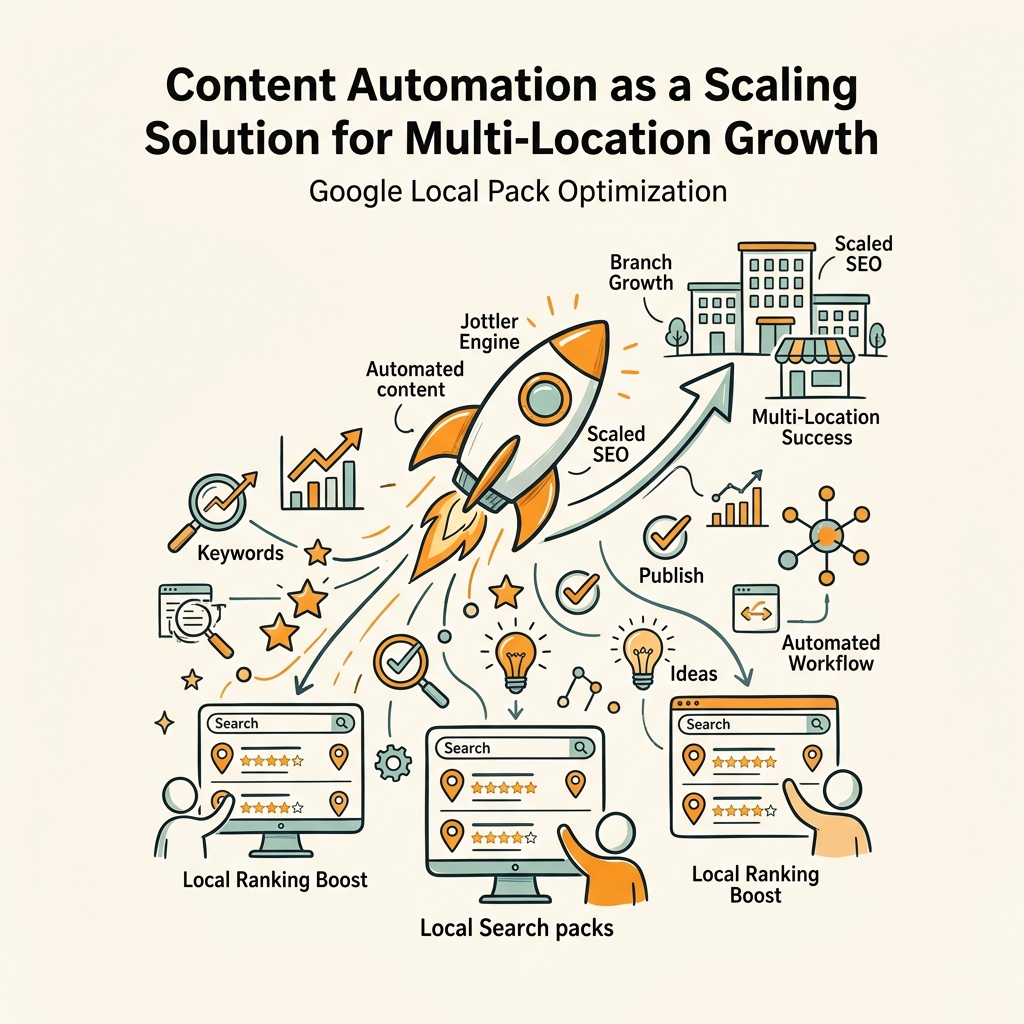
Multi-location SEO requires consistent output across many locations: unique location pages, location-specific blog posts, GBP updates, and local content calendars. Producing this manually becomes prohibitive at scale.
Content automation platforms can help—but only if they maintain quality and relevance standards. Most content automation tools produce thin, generic content that triggers Google's duplicate content filter.
The Right Way to Automate Local Content
If you're automating location content, follow these principles:
- Genuinely Unique Outputs Per Location: Automation should generate location-specific content, not swap city names in templates. Look for AI tools that research local information (local news, market data, local regulations) and weave it into content.
- Quality Over Quantity: One well-researched 2,000-word location page per location outperforms 10 thin 400-word pages. Prioritize depth.
- Human Review Before Publishing: Even the best AI-generated content requires human review to catch factual errors, tone mismatches, and local inaccuracies.
- Internal Linking to Location Pages: Automation can systematically link from main content to location pages, building internal link authority to key pages. This is a high-leverage tactic most firms ignore.
For multi-location firms specifically, content automation platforms designed for SEO can publish location-specific landing pages daily, automatically routing them to location-specific URL structures while maintaining unique content and internal linking. This allows a team of 2-3 people to manage SEO for dozens of locations without burnout.
Building Local Links and Authority for Each Location
Link authority is a prominence signal. Building links specifically to location pages strengthens rankings more than general domain-level links.
Local Link Building Strategy for Multi-Location Firms
Prioritize links that mention the location explicitly:
- Local Sponsorships and Community Involvement: Sponsor local school sports teams, community events, or nonprofits. Request a link from their website with your location name: "Sponsor Smith HVAC Denver."
- Local Press Coverage: Pitch local journalists stories that are relevant to your location. A story about "Denver-Based HVAC Company Helps Low-Income Families Reduce Energy Bills" gets you a link with local context.
- Local Business Associations: Join your local chamber of commerce, board of trade, or industry associations. These sites typically link to member businesses.
- Local Resource Links: Contact local neighborhood blogs, community centers, and municipal websites. Offer to be a resource for local customers.
- Local Q&A and Directory Submissions: Submit your location to local directories specific to your neighborhood or region.
For each location, aim for 5-10 high-authority local links within the first 6 months. These can take time to acquire, so start early and delegate this task to location managers or a dedicated local marketing person.
Measuring Local Pack Performance and Optimization
You cannot optimize what you don't measure. Set up tracking for each location across these metrics:
| Metric | How to Track | Target / Benchmark | Optimization Action |
|---|---|---|---|
| Local Pack Rank | Semrush, BrightLocal, Local Falcon (location-specific keyword tracking) | Top 3 for primary keywords | If ranking 4-10, increase GBP completeness and review velocity |
| Click-Through Rate (CTR) | Google Search Console (map results segment) | 15%+ CTR from local pack results | If CTR below 10%, rewrite GBP title and snippet for clarity and local relevance |
| Phone Calls from GBP | Call tracking numbers (location-specific) or Google Ads call extensions | 20+ calls/month per location | If below 10 calls/month, boost GBP post frequency and improve phone number visibility |
| Review Velocity | Manual count or Google Business Profile dashboard | 5-10 reviews/month per location | If below 2/month, launch automated post-purchase review requests |
| Competitive Rank Gap | Manual search or local SEO tools (BrightLocal rank comparison) | Outrank competitors in top 3 | If outranked, analyze competitor GBP completeness, reviews, and citation profile |
Core Local Pack Metrics
- Local Pack Visibility: Track whether your location appears in the top 3 map results for your target local keywords. Tools like Semrush, BrightLocal, and Local Falcon provide location-specific rank tracking.
- Click-Through Rate (CTR): Monitor CTR from local pack results to your website. CTR above 15% indicates a compelling title and snippet.
- Phone Call Volume: Track calls from GBP (use location-specific phone numbers with call tracking). Calls indicate high relevance and proximity signals.
- Review Velocity: Set a monthly review target (5-10 per location) and track actual performance. Consistent monthly growth outperforms sporadic bursts.
- Competitive Rank Gap: Monitor your ranking versus competitors. If competitors outrank you in the local pack, analyze their GBP completeness, review velocity, and citation profile.
Use these metrics to prioritize optimization efforts. If a location has strong review velocity but weak GBP completeness, focus on GBP optimization. If GBP is complete but reviews are stagnant, invest in review generation.
Common Pitfalls Multi-Location Firms Make and How to Avoid Them
The following mistakes suppress local pack rankings and are surprisingly common:
Mistake #1: Using a Single GBP Listing for Multiple Locations
Google's algorithm requires one GBP listing per physical location. Using a single listing for multiple branches or using a headquarters address for all service areas will suppress rankings. Create separate verified listings for every physical location.
Mistake #2: Duplicate or Template Location Pages
Location pages that differ only in the city name trigger thin content filters and suppress all location pages. Each page needs 40-50% unique content: local team bios, local case studies, local testimonials, and local market insights.
Mistake #3: Inconsistent NAP Across Directories
A single NAP inconsistency (e.g., "123 Main Street" vs. "123 Main St") confuses Google's ranking algorithm and suppresses all locations. Audit NAP across all directories and fix inconsistencies immediately.
Mistake #4: Ignoring Review Velocity
Businesses that generate reviews in seasonal bursts or one-time campaigns rank lower than those with consistent monthly review velocity. Set up automated review request systems that generate 5-10 reviews per location per month consistently.
Mistake #5: Weak GBP Profile Completeness
Incomplete GBP profiles (missing photos, hours, descriptions) receive lower rankings. Aim for 100% profile completeness. For multi-location firms, auditing completeness across all locations can be automated.
Conclusion
Google Local Pack rankings for multi-location firms are determined by three factors: relevance (category selection and content), distance (service area definition and location pages), and prominence (reviews, citations, and links). Mastering all three requires a systematic approach: optimized GBP listings at every location, genuinely unique location pages, NAP consistency across all directories, consistent review velocity, and local link building.
The payoff is significant. Local Pack results capture 44% of all clicks on local search result pages—more than organic results. For a multi-location firm with 20 locations, dominating the Local Pack in each market compounds to enormous organic traffic and lead generation gains. Businesses with complete GBP listings receive 7x more clicks than those without, making this the highest-leverage optimization work most firms ignore.
The operational challenge is scale. Manual GBP management, location page creation, review request systems, and citation tracking become unsustainable beyond 5-10 locations. 68% of multi-location businesses now use automation platforms to manage these tasks. If you're still managing locations manually, switching to Jottler's autonomous SEO platform can reduce operational overhead by 80-90% while maintaining the unique, high-quality content local pack rankings require. Start your SEO agent today and let AI handle the repetitive work while your team focuses on strategy.
FAQs
How often should I update my Google Business Profile for each location?
Update your GBP at least monthly to signal activity to Google's algorithm. This includes refreshing hours (especially for seasonal changes), responding to reviews within 24 hours, and publishing 2-4 GBP posts per month. Sustained monthly activity signals an engaged, current business. Many successful multi-location firms treat GBP as a real marketing channel, not a one-time setup task, and update it consistently alongside their content calendar. For firms with 50+ locations, automated GBP management platforms reduce this to 1-2 hours per month across all locations combined.
Can I use the same content for multiple location pages if I change the city name?
No—Google's algorithm explicitly penalizes this as thin content. Location pages that are identical except for the city name will suppress rankings for all locations simultaneously. Each location page needs genuine, unique content: local team bios, location-specific case studies, local testimonials, local market insights, and location-specific service offerings. At minimum, aim for 40-50% unique content per location page. The investment pays off—location pages with unique content rank 2-3x higher than templated pages.
How long does it take to rank in the Google Local Pack for a new location?
A fully optimized new location can rank in the Local Pack within 6-12 weeks if you follow the framework: verified GBP profile with specific category, complete profile information, unique location page, and initial review velocity of 3-5 reviews in the first month. The first 30 days are critical—getting early reviews and complete GBP data signals to Google that this is an active, legitimate location. Locations that remain incomplete or receive no reviews can take 3-6 months to rank, if they rank at all. For established locations with inconsistent optimization, ranking typically improves within 4-8 weeks of implementing these tactics.