Guest Posting Strategy for SaaS Authority Building
Most SaaS founders treat guest posting like a commodity. They blast generic pitches to hundreds of blogs, publish thin content with forced links, and wonder why rankings don't budge. The result? Average guest post costs of $220 deliver minimal authority gains because low-quality placements do nothing to signal expertise to Google. But when executed correctly, guest posting becomes one of the most powerful levers for building sustained organic traffic and thought leadership. The difference between a wasted campaign and a winning one comes down to strategy, not effort.
Key Takeaways
- SaaS companies publishing 9+ posts monthly (including quality guest posts) achieve 35.8% year-over-year organic traffic growth; those without consistent guest content average just 9.3% (Oliver Munro, 2026)
- Agencies handling guest posting and link building drive 2.3x faster organic traffic growth compared to in-house efforts, because they've already built editor relationships (RevenueZen, 2025)
- Guest posting wins for authority building when focused on audience alignment and placement context over domain rank chasing
- Defining Guest Posting Goals: Clarity on audience reach, brand positioning, and traffic targets sets the foundation for every pitch and placement decision.
- Target Site Selection: Vetting blogs by traffic, relevance, and audience overlap beats chasing high domain ratings with generic readerships.
- Content That Earns Links: Guest posts with original research, data, or frameworks rank and drive citations naturally, not through forced anchor text.
- Relationship-First Outreach: Warm prospecting and genuine pitches to editors see 3x higher acceptance rates than cold, templated email blasts.
- Scaling Guest Content Production: Automation tools and content frameworks let busy founders publish quality guest posts monthly without daily involvement.
Why Guest Posting Remains the Authority-Building Cornerstone for SaaS
Guest posting still works for SaaS authority building because Google now treats backlinks as contextual validation of expertise, not just link votes. When your SaaS gets mentioned on a niche CRM blog alongside competitors, inside a relevant paragraph with proper byline attribution, that's a trust signal. When you land a feature on a publisher your customers already read, you're not just gaining a linkyou're gaining credibility in your buyer's eyes.
55% of B2B buyers report thought leadership content significantly influences their purchase decisions, and guest posts are the fastest way to position your founders as category experts. The key difference between 2026 guest posting and what failed five years ago is this: volume is dead. Relevance and placement context rule everything now.
How Modern Guest Posting Differs from the Old Volume Game
The guest posting tactics that worked in 2020sending 50 pitches to irrelevant blogs, publishing thin 800-word posts with three embedded links, hoping for any backlinkno longer move rankings. Google's entity-based understanding means a single link from a highly relevant, high-traffic niche publisher outweighs 10 links from generic tech blogs.
What changed is how Google weighs links. A link's value now depends on:
- Relevance: Does the linking site share audience overlap with your SaaS niche?
- Traffic: Is the publisher getting real organic visitors, not just DR score inflation?
- Placement context: Is your link woven naturally into a related paragraph, or forced into a listicle?
- Content depth: Does the publisher create original research and analysis, or regurgitate trend reports?
One relevant guest post from a site your customers already trust beats ten generic placements. This is why SaaS companies prioritizing quality over quantity in their content strategy see 35.8% faster organic growth than those chasing link volume.
Thought Leadership as a Growth Channel
Guest posting positions founders as category authorities, which compounds in two ways. First, when your founder's byline appears on industry-recognized blogs, it builds trust with prospects before they even land on your site. Second, byline visibility attracts inbound partnership and speaking opportunities, extending your reach beyond the initial article.
The math is simple: positioning yourself as an expert costs far less than paid ads to build the same credibility. And unlike ads, guest posts compoundthey keep driving traffic and attracting links long after publish date.
How to Define Your Guest Posting Goals and Target Audience

Before pitching a single blog, you need clarity on what success looks like. Too many founders treat guest posting as a checkbox ("We need more backlinks") instead of a strategic channel with specific conversion goals. This confusion is why only 19% of SaaS companies collaborate with agencies for guest posting, yet those who do credit agencies with 43% of their SEO strategy winsagencies force clarity by requiring goal definition upfront.
Defining Your Core Guest Posting Objectives
Start by asking: What does a successful guest post do for us? The answer determines where you pitch and what you write.
If your goal is brand awareness in a new market segment, you target publications that reach that audience (e.g., if you're a security SaaS expanding into healthcare, pitch healthcare tech blogs). If your goal is thought leadership positioning, you prioritize tier-one industry publications even if they're harder to land. If your goal is direct referral traffic and leads, you target smaller, highly niche blogs where your ideal customer profile hangs out, even if the DR is 30 instead of 60.
Most SaaS teams confuse domain rank with authority. They chase publications with high DR but irrelevant audiences. Then they wonder why a guest post on TechCrunch (DR 92, massive audience, zero overlap with their ICP) generated zero pipeline. Meanwhile, a competitor placed on a smaller but highly targeted SaaS review site and captured qualified leads.
- Awareness goal: Prioritize publications with large, engaged audiences in your target vertical
- Authority goal: Prioritize tier-one publications (industry leaders, top analyst firms, major media)
- Pipeline goal: Prioritize niche publications where your ICP reads and makes buying decisions
- SEO goal: Prioritize high-traffic, relevant niche sites with active backlink profiles
Mapping Your Ideal Guest Posting Audience Profile
Your guest posting targets should align with your ideal customer profile, not generic "tech blogs." If your SaaS solves a specific problem for a specific buyer, your guest posts must reach that buyer where they already read.
Example: A project management SaaS for in-house creative teams should guest post on design blogs, agency blogs, and creative operations publicationsnot generic project management blogs that draw enterprise CTOs who'll never convert.
Map your audience by:
- Identifying your ICP's top 10 pain points and use cases
- Finding publications that write regularly about those pain points
- Checking if those publications have "Write for Us" pages or stated guest posting guidelines
- Validating each publication has real organic traffic (use Semrush or Ahrefs to check monthly visitors)
- Reviewing past guest postsare the authors credible, is the writing quality high?
How to Identify and Vet High-Impact Guest Posting Opportunities

Not all guest posting sites are created equal. A common mistake is vetting publications by domain rank alone, which misses the actual ROI drivers. Research on SaaS link building effectiveness shows that relevance, traffic, and placement context matter far more than domain rank. A DR 35 niche blog with 5,000 monthly visitors from your target audience delivers more value than a DR 75 generic tech blog with 100,000 visitors from everywhere.
Screening for Traffic and Audience Quality
Start your vetting with traffic data, not domain scores. If a publication has low organic traffic, it means either the content isn't valuable or the audience isn't engaged. Either way, a guest post there won't help your authority.
Use Semrush, Ahrefs, or SimilarWeb to check:
- Monthly organic traffic: Aim for sites with 5,000+ monthly visitors minimum (higher is better)
- Traffic sources: Does traffic come from organic search (good) or mostly referral links (weaker audience)
- Audience geography: Does traffic align with your target market (U.S., Europe, etc.)?
- Content freshness: Are posts updated regularly, or is the site dormant?
Red Flags That Disqualify a Publication
Some publications look good on the surface but will hurt your authority if you guest post there. Watch for:
- Open submission policies ("Anyone can write"): These sites accept spam. One guest post alongside 100 low-quality articles tanks your credibility.
- Outdated content: If the most recent post is six months old, the site is inactive and won't promote your article.
- Low engagement: Check if articles get comments, social shares, or citations. Dead traffic is worthless.
- Keyword stuffing or low editorial standards: If past articles read like AI slop with poor grammar, your byline sits next to garbage.
- Paid-only guest posting: If they only accept guest posts through paid placements ($2,000+), the links are less valuable (Google devalues paid links).
The best vetting process combines automated tools with manual review. Tools like Ahrefs show backlink profiles and traffic; manual review of 3-5 recent posts tells you if editorial standards match your brand.
Creating Guest Post Content That Ranks and Drives Citations

The single biggest mistake in guest posting is treating it like paid advertising. Founders write self-promotional puff pieces about their product, and editors reject them instantly. Or worse, editors accept them and publish low-value content that damages the site's credibility (and reflects poorly on the guest author).
Guest post content must serve the host publication's audience first. It's not a trojan horse for your product pitch. It's a genuine piece of value that happens to mention your company (once, naturally) because your company solves the problem being discussed.
The Guest Post Content Framework That Works
High-performing guest posts follow a specific structure that balances value delivery with subtle positioning:
- Hook with a surprising insight or data point (not your product; something the reader needs to know)
- Build context and define the problem clearly (show you understand your audience's pain)
- Share a unique framework, process, or original research (this is where your expertise shines)
- Include one supporting case study or example (shows real-world application, can be your product if relevant)
- Conclude with actionable takeaways (leave readers with something they can implement immediately)
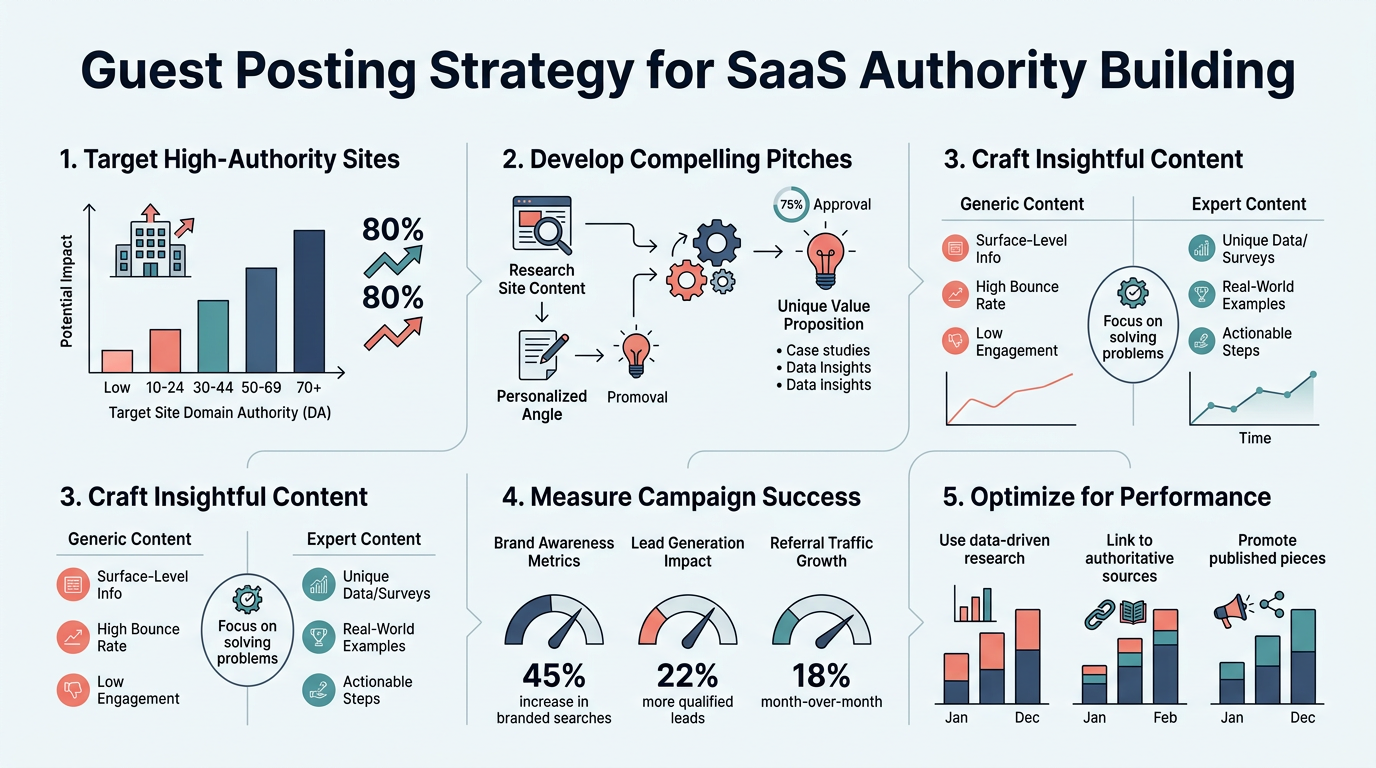
The key insight is this: quality guest posts with original research see 29.7% higher organic growth contributions compared to thin, generic posts at 9.3%. Original data wins. It's why SaaS benchmarking data shows companies investing in research-backed guest content compound their authority faster.
Linking Strategy Within Guest Posts
Resist the urge to cram your website URL everywhere. Most editors allow 1-3 links per guest post, and best practice is placing one in the body naturally, one in the author bio.
A natural link placement example: "When evaluating CRM systems, look for platforms that integrate with your existing stack. Tools like [Your Product] handle this seamlessly because..." Here, the mention flows from context, not forced.
Avoid:
- Anchor text like "best project management software"it screams paid link
- Multiple links to the same domain in one article
- Links in the introduction (bury them in the middle where they flow naturally)
- Obvious call-to-actions like "Try [Product] free today"save that for the author bio
How to Pitch and Land Guest Posts on Top-Tier Publications
The pitch is where most SaaS founder guest posting attempts fail. A generic email to "editor@publication.com" with subject line "Guest post opportunity" gets deleted in seconds. High-acceptance guest posting requires relationship-first outreach and pitches that make editors' jobs easier.
Building Relationships Before the Pitch
The best guest post opportunities don't come from cold outreach. They come from existing relationships with editors and writers who respect your work. This is why SaaS marketing leaders emphasize relationship building as the foundation of scalable guest posting.
Start this now, even if you don't have a guest post idea yet:
- Follow target publications on social media: Like and comment on their posts to get on their radar
- Cite them in your own content: Link to their best articles; they'll see the referral and notice you
- Share their content with your network: When you share their work, tag them; editors notice promoters
- Engage with their writers directly: Comment thoughtfully on articles, engage with their tweetsbuild familiarity before pitching
When you finally pitch, the editor already knows who you are. Your email reads like a natural continuation of an existing conversation, not a cold sell.
The Guest Post Pitch Template That Works
Your pitch email should be short (5-7 sentences), specific, and make the editor's job easier. Generic pitches fail because they require the editor to imagine the article. Specific pitches succeed because they deliver a complete idea ready to review.
Here's the structure:
- Personalized opener: "I've been reading [Publication] for [timeframe], and I loved your recent piece on [specific article]."
- Proposed article idea in one sentence: "I'd like to contribute a guest post on [specific topic] because [why it matters for your readers]."
- Why you're credible: "I [brief expertise credential], and I've [supporting accomplishment]."
- Reader benefit: "This piece will give your audience [specific takeaway or outcome]."
- Soft call-to-action: "I have a draft outline ready if you'd like to review. Let me know if this interests you."
The pitch should feel like a colleague suggesting a good idea, not a marketer pitching a sponsored post. Short, confident, specific.
Scaling Guest Posting Production Without Burnout
One-off guest posts are fine for thought leadership, but they don't compound your authority fast enough. Scaling guest posting means publishing quality posts monthly or quarterly across multiple publications. For busy founders, this requires automation and process design, not more hours.
Building a Repeatable Guest Posting Content System
Instead of writing each guest post from scratch, build templates and frameworks you can reuse. Your company probably has internal data, customer stories, and frameworks that fit multiple publications with minimal customization.
Example: A project management SaaS has a "How to Structure Your Sprint Planning Process" framework. You can adapt this framework into:
- A guest post for an agile methodology blog (angle: agile best practices)
- A guest post for a business productivity publication (angle: team efficiency)
- A guest post for an operations management site (angle: reducing planning overhead)
Same core content, three different angles for three different audiences. This is how SaaS teams automate content production without sacrificing quality. The framework stays constant; the angle shifts per publication.
Using Automation to Manage the Guest Posting Pipeline
Guest posting involves more than writing: prospecting publications, tracking outreach status, managing editor responses, coordinating revisions, and monitoring performance. Doing this manually creates bottlenecks.
Tools like BuzzStream and Airtable can automate the pipeline:
- Publication tracking: Keep a master list of target sites, contact info, acceptance status, and publish dates
- Outreach logging: Track every pitch sent, response rates, and follow-up timing
- Performance monitoring: Log traffic from each guest post, backlinks earned, and ranking impact over time
When you can see your full pipeline at a glance, you move faster. You know which editors respond, which publications deliver traffic, which topics resonate. You stop pitching editors who never reply and double down on relationships that convert.
Beyond tracking, consider how to systematize content creation itself. If you're publishing guest posts monthly, writing a new 2,000-word article each time is exhausting. But if you build content clusters where each guest post supports a pillar article on your own blog, the effort compounds. One research project feeds multiple articles across multiple publications, both guest and owned.
Measuring Guest Post ROI and Iteration
Most SaaS teams publish a guest post, share it once on social media, then move on. But guest posts generate value for months if you treat them as ongoing assets.
For each guest post, track:
- Referral traffic: Use UTM parameters in your author bio link to track traffic quality
- Ranking impact: Monitor if publishing positions you as an expert (track branded searches and topical keywords)
- Pipeline influence: Ask sales where deals come fromwere any influenced by a guest post?
- Backlink acquisition: Use Ahrefs to see if the guest post earned citations or links from other sites
Once a post performs well, repurpose it. Share the article multiple times across social (LinkedIn, Twitter, your newsletter). Use quotes from the piece in future pitches. Link to the post from related articles on your blog to build topical authority.
Conclusion
Guest posting remains one of the highest-leverage tactics for SaaS authority building because it combines brand positioning, SEO benefit, and relationship building into one activity. But it only works when executed strategicallytargeting relevant publications, creating genuinely valuable content, and building relationships with editors.
The data is clear: SaaS companies publishing 9+ monthly posts (including quality guest posts) achieve 35.8% year-over-year organic traffic growth, and those collaborating with partners see 2.3x faster growth than isolated in-house efforts. The winning playbook is consistency combined with audience focus.
If you're publishing guest posts today, shift your focus from domain rank chasing to audience relevance and publication credibility. If you're not yet, start with three target publications where your ideal customers already read, build relationships with editors over the next month, and plan your first pitch for month two. One quality guest post compounds authority faster than a dozen generic placements.
For SaaS teams scaling content production without dedicated SEO staff, tools like Jottler can handle the research, fact-checking, and content framework development that makes guest posting sustainable. Your role becomes pitching and relationship buildingthe high-leverage work. Start your SEO agent and let it handle the writing infrastructure that powers your guest posting strategy at scale.
FAQs
How often should SaaS companies publish guest posts?
Most successful SaaS companies publish one quality guest post per quarter at minimum, ideally monthly. The key is consistency over frequency. Publishing one exceptional guest post monthly on a relevant publication outperforms publishing five weak posts on generic blogs. Companies publishing 9+ blog posts monthly (a mix of owned and guest content) achieve 35.8% faster organic traffic growth. Start with quarterly posts on high-relevance publications and scale to monthly as you build editor relationships and content systems.
What's the difference between guest posting and niche edits for SaaS link building?
Guest posts give you complete control over the narrative and narrative qualityyou write original content the publication publishes under your byline. Niche edits are link insertions into existing articles (usually paid), offering speed but less author control. Guest posting wins for authority building and thought leadership because your name is attached to high-quality content. Niche edits win for quick ranking boosts on competitive keywords. Use guest posts for brand positioning and long-term authority; use niche edits when you need urgent ranking help on specific pages.
How do I measure the ROI of a guest posting campaign?
Track four metrics: referral traffic (from the guest post to your site), ranking gains for related keywords, backlinks earned (citations of the guest post), and pipeline influence. Use UTM parameters in author bio links to isolate guest post traffic. Monitor your site's authority tools (Ahrefs, Semrush) to see if rankings for topical keywords improve after publishing. Most valuable: ask your sales team if they've seen deals influenced by specific guest posts. Long-term, a single guest post on a high-authority site might drive 200+ referral visits over 12 months, plus 3-5 earned backlinks, plus improved search positioning for your category keywords.