How to Audit Your Backlink Profile for Quality and Authority
A bad backlink profile doesn't just slow your SEO progressit can tank your rankings outright. 23% of websites are affected by toxic backlinks, and many site owners don't even realize they have a problem until traffic plummets. The stakes are real: websites with spam scores above 30% see measurable ranking declines, yet most teams lack a systematic way to monitor and fix their link health. The good news? A structured backlink audit reveals exactly what you need to keep, improve, or remove to rebuild authority fast. Here's how to audit your backlink profile effectively and protect your domain's reputation.
Key Takeaways
- Links from high-authority domains (DR 70+) have 5.2x more impact than links from low-authority sites, but relevance matters equally58% of SEO professionals prioritize topic relevance over raw authority (Ranktracker, 2025).
- Toxic backlinks affect nearly a quarter of all websites; unaddressed spam scores above 30% cause measurable ranking declines, making regular audits essential for competitive sectors.
- Audit frequency depends on site size: quarterly for small sites (≤500 backlinks), bi-monthly for mid-market (500–5,000), and monthly for enterprise (Tapita, 2025).
- Define Your Audit Scope: Establish baseline metrics and frequency based on site size and competitive pressure to catch issues before they impact rankings.
- Export and Deduplicate Backlink Data: Pull complete link profiles from multiple sources and organize by referring domain to eliminate noise and spot patterns.
- Score Links on Authority, Relevance, and Trust: Evaluate each domain against key quality signals including domain rating, topical alignment, editorial context, and spam indicators.
- Identify Toxic and Suspicious Patterns: Flag sitewide links, unnatural anchor text, link velocity spikes, and foreign-language mismatches that signal low-quality or manipulated placements.
- Take Action on High-Risk Links: Request removal, disavow, or monitor suspicious links while preserving links that deliver real authority and relevance to your domain.
- Establish Ongoing Monitoring: Set up regular checks to track new links, monitor lost authority, and benchmark your link growth against competitors.
Why Backlink Quality Matters More Than Quantity
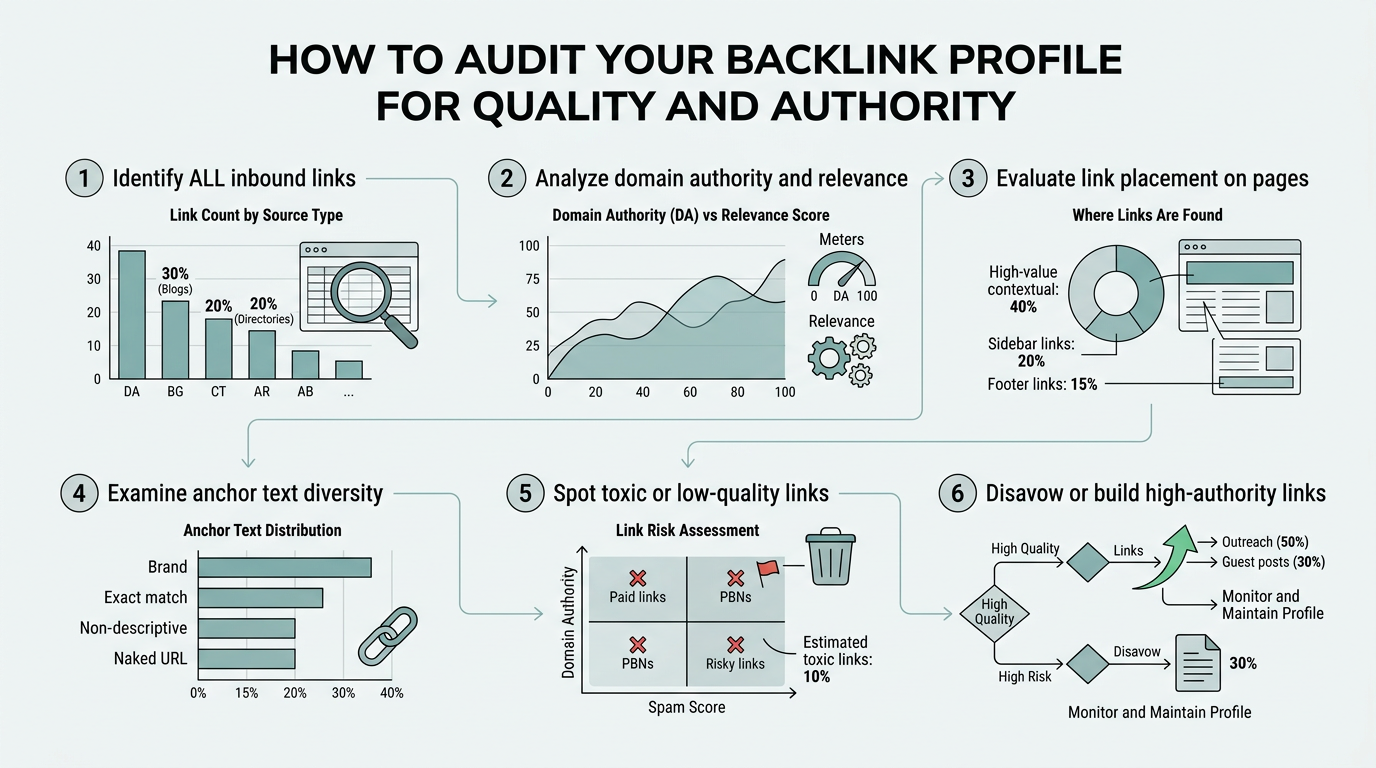
The backlink landscape has shifted dramatically. Quality trumps volume nowa single link from a domain with authority rating 80+ can be worth 10–20 lower-tier links in ranking power, yet many sites are still chasing link count instead of link value. The reason is simple: Google has become far better at distinguishing between earned editorial links and manufactured ones. Links that appear naturally within relevant content carry exponentially more weight than sitewide footer links or placements on thin pages. A 2025 backlink analysis by Ranktracker found that 58% of SEO professionals prioritize relevance as the top quality factor, ahead of authority (23%), traffic (12%), and placement (7%). This shift means your audit must evaluate authority and topical fit together, not separately.
Authority vs. Relevance: Which Matters More?
This is the central tension in link quality assessment. A link from a high-authority site that's completely off-topic carries less real value than a link from a moderately authoritative but perfectly relevant site. Why? Because Google looks for signals that a human editor chose to link to you because your content genuinely serves their audience. Relevance signals that intention. Authority signals trust in the linking domain. Together, they form the strongest backlink profile. Links embedded in 1,500+ word editorial pages pass 27% more authority than links buried in thin-content pages, which tells you that context and surrounding content quality matter deeply.
For busy teams at growing companies, this hierarchy saves time: focus your audit effort on the top 50 referring domains first, score them on authority plus relevance, and address the clear winners and losers before diving into edge cases.
Toxic Backlinks and Spam Flags
Toxic links aren't always obvious. A link from a domain with a high spam score, or placed alongside dozens of low-quality links, or using exact-match anchor text that screams manipulationthese are the red flags that should trigger closer inspection. Websites with spam scores above 30% see measurable ranking declines when those problematic links go unaddressed. The problem escalates when link velocity spikes (hundreds of new links in days) or when you spot sitewide links from unrelated domains, because these patterns suggest either a bad link-building campaign or a compromised site you didn't even know was linking to you.
An audit must surface these patterns early. Most teams don't have time to manually review thousands of links, which is why AI-assisted backlink auditing is now standard practice at enterprise scaletools flag anomalies so your team investigates the exceptions rather than every link.
How to Set Up Your Backlink Audit Framework
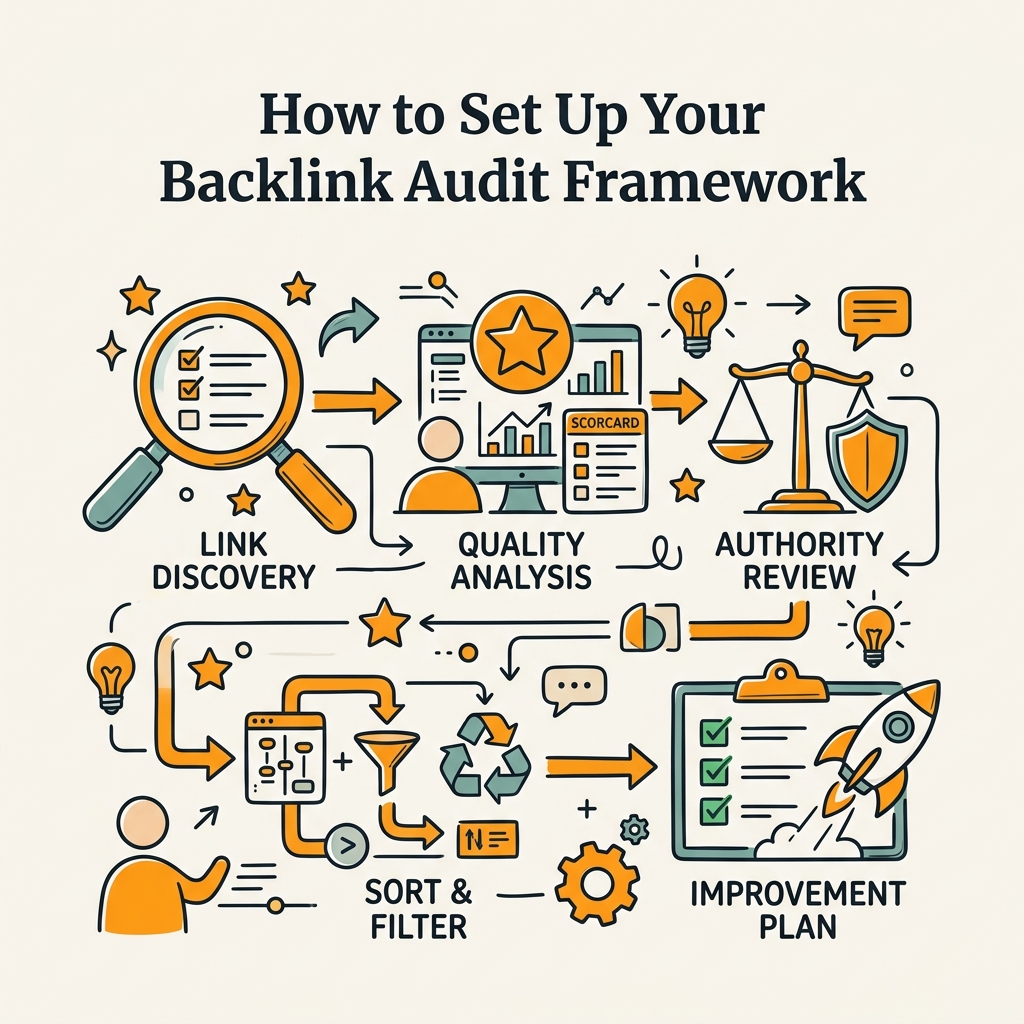
A backlink audit works best when structured as a repeatable process, not a one-time event. Start by defining what you're measuring: domain authority, topical relevance, trust signals, spam indicators, and link velocity. Then establish a baseline and audit frequency based on your site's size and competitive environment. Most SaaS teams benefit from monthly or quarterly audits to catch emerging issues before they escalate.
Choosing Your Audit Frequency and Scope
Audit frequency should match your link growth and competitive pressure. Small sites with fewer than 500 backlinks can audit quarterly. Mid-market sites with 500–5,000 backlinks should audit bi-monthly. Enterprise sites with 5,000+ backlinks need monthly reviews. But this isn't rigidif you're in a competitive vertical where spammy competitors are aggressively link-building, increase frequency. If you've just recovered from a penalty, audit monthly until patterns stabilize. The goal is to catch toxic links or suspicious patterns before they harm rankings, not after the fact.
Define your scope upfront: Are you auditing only links to your homepage? All internal pages? Links by referring domain or by individual link? For most audits, grouping by referring domain simplifies analysisyou'll evaluate each unique linking site once, then decide whether to keep, monitor, or disavow all links from that domain. This prevents decision fatigue and keeps the process manageable.
Selecting Data Sources and Tools
No single tool owns 100% of the backlink data. Google Search Console shows links Google discovered, but it's slower to update and incomplete. Ahrefs, Semrush, Moz, and Majestic each crawl the web independently and find different subsets of your links. A professional audit pulls data from at least two sources to catch links one tool missed. Start with Google Search Console for your official Google-indexed links, then cross-check with a premium tool for comprehensiveness.
Once you've exported the data, deduplicate and organize by referring domain. Most tools let you export as CSV, making it easy to sort, filter, and prioritize. For manual audits at scale, automation saves hourstools can bulk-score domains by authority and flag spam indicators without human review of every single link.
How to Score Backlinks on Quality Dimensions
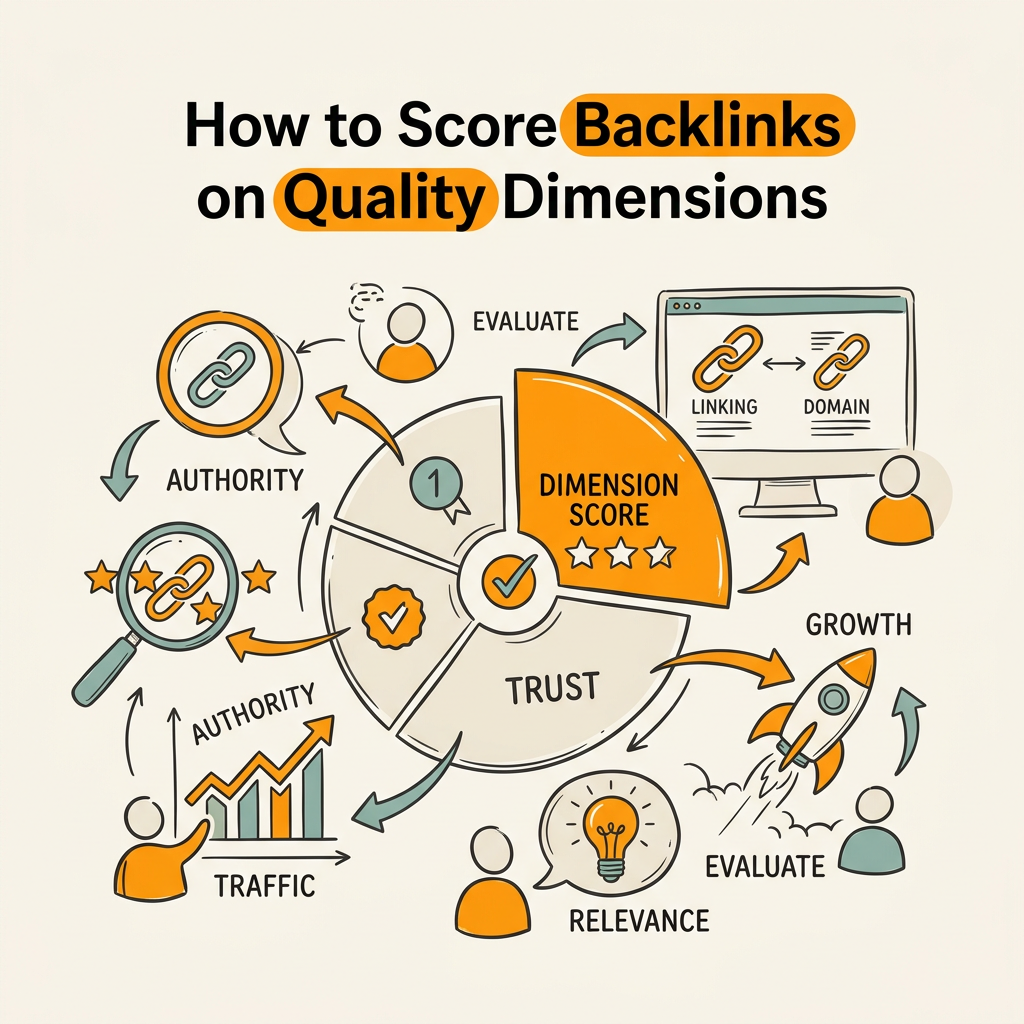
Not all backlinks are equal, and scoring them properly separates signal from noise. Build a simple scorecard that evaluates each referring domain on five core dimensions: authority, relevance, editorial placement, trust signals, and spam/toxicity risk. This framework lets you quickly categorize links into high-value (keep), low-value (investigate), and toxic (disavow) buckets. Most audits benefit from a weighted scoring system where authority counts for 30%, relevance 30%, placement 20%, and spam risk 20%adjust these weights based on your industry and competitive environment.
Evaluating Domain Authority and Trust Metrics
Domain authority (or domain rating, depending on your tool) is a starting point, not the whole story. A link from a DR 70+ domain carries more weight than one from DR 30–40, but only if the referring page itself is authoritative and relevant. Check the linking page's own metrics: Does it rank for related keywords? Does it have substantial traffic? Is it a real editorial page or a thin affiliate site? Links from high-authority domains with no incoming internal link equity are less valuable than links from smaller but more focused, well-maintained sites.
Trust signals matter equally. Is the linking domain registered through a legitimate registrar? Does it have a clear editorial policy and author attributions? Are its pages indexed by Google? Red flags include domains with no real content, multiple unrelated niches, or a history of hosting spam. This information isn't always obvious, so spend 30 seconds on each high-value domain: visit it, skim the site, check its Whois, and see if it looks like a real operation or a link farm.
Assessing Topical Relevance and Contextual Fit
A link from a wildly off-topic domain is a yellow flag. If you run a B2B SaaS blog about project management and you have links from gambling sites or adult content domains, those are worth investigating or disavowing. But relevance isn't binary. A link from a business productivity magazine is more relevant than a link from a casino, but less relevant than a link from a project management forum. Score relevance on a scale: exact match (same industry/topic), related (adjacent industry), and unrelated (no topical fit).
Anchor text reveals intent and relevance too. If the link uses your exact keyword match ("best project management software") it's relevantbut too many exact-match anchors signal optimization manipulation, which hurts credibility. Natural anchor text includes your brand name, variations of your main keyword, generic phrases like "here" or "this," and mentions of your topic without explicit keyword stuffing.
Identifying Placement Quality and Link Context
Where a link sits on the page affects its value. Links in the main editorial content, from an authoritative byline, or within a context that naturally recommends your resource carry far more weight than footer links, sidebar widgets, or links buried at the end of thin pages. Sitewide linkswhere your URL appears in the header, footer, or navigation on every page of the linking siteare worth less than single contextual placements because they're template-generated and not editorial.
Check whether the link is editorial (the author chose to place it for relevance) or templated (it appears everywhere by default). Editorial links are treasures. Templated links are often ignored by Google or even treated as spam if found in suspicious patterns. Links preceded by "sponsored," "ad," or "affiliate" disclosures are marked as nofollow by policy and carry no ranking valuethey're good for referral traffic but not SEO authority.
Detecting Toxic and Suspicious Link Patterns
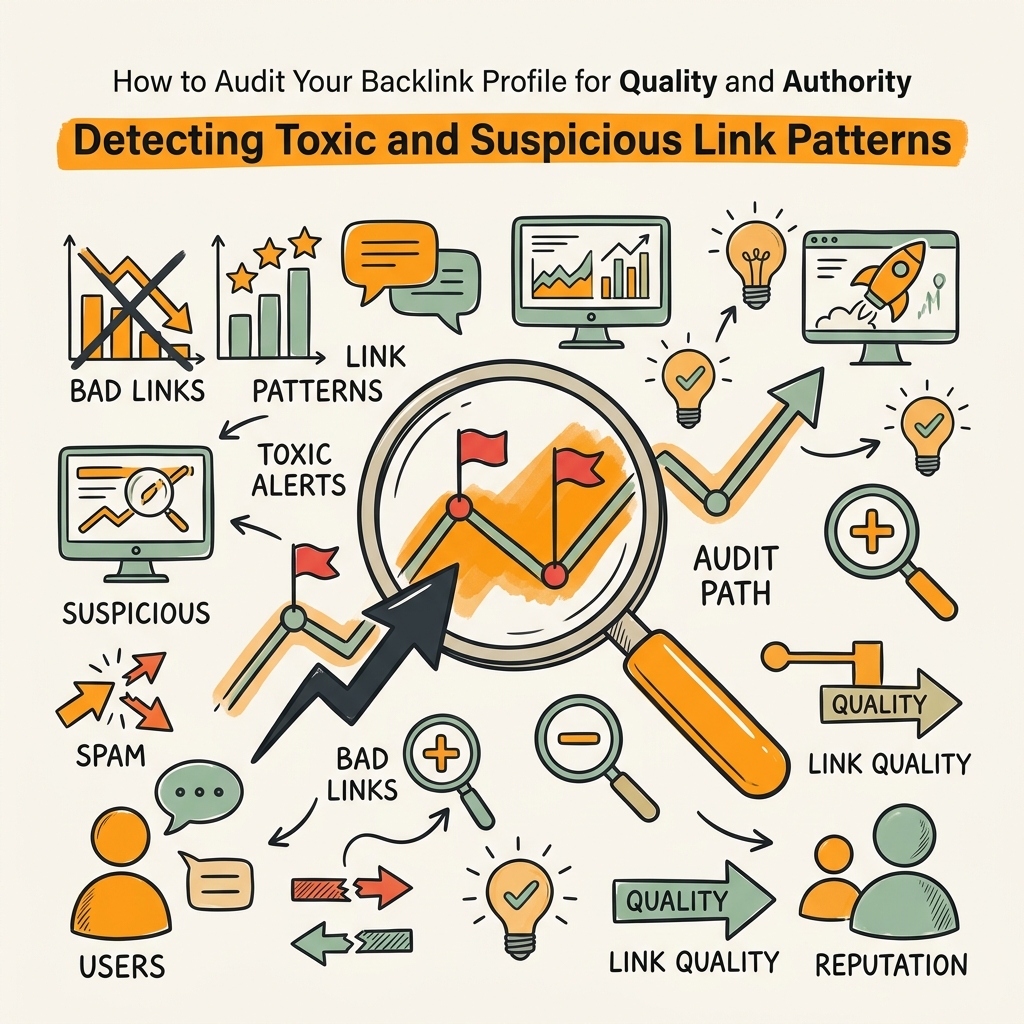
Spotting toxic links separates an effective audit from a surface-level review. Toxic doesn't always mean deliberately spammysometimes it means your link appears on a compromised or hacked domain, or next to so many low-quality links that Google discounts the entire page. Watch for these red flags during your audit.
Sitewide Links and Link Velocity Anomalies
A sitewide link means your URL appears in the header, footer, or sidebar of a domain, showing up on thousands of pages. These are almost always template-generated and carry minimal authority. If 10% or more of your links are sitewide, you likely have a link-building campaign or a bad vendor to blame. Sitewide links aren't automatically penalizable, but they're suspicious and worth investigating.
Link velocitythe rate at which you acquire new linksmatters too. If you suddenly get 500 links in a week, Google notices. Slow, steady growth looks earned. Spikes look artificial. If you see a velocity anomaly, check what happened that week: Did you get coverage in a major publication? Release a viral tool? If there's no obvious reason for the spike, investigate the linking domainsthey may be spam.
Anchor Text Overoptimization and Mismatches
Anchor text is the visible text of a link. Natural anchor text varies: sometimes it's your brand name, sometimes a generic phrase, sometimes a partial keyword match. When more than 5–10% of your anchors use your exact target keyword, it signals optimization that doesn't look natural and can trigger a manual review or algorithmic demotion. Equally suspicious: if most anchors are exact matches but have nothing to do with your site's topic (e.g., "weight loss" anchors linking to your SaaS blog), you're looking at a bad vendor or a hacked profile.
Check anchor text distribution in your audit. You want mostly branded anchors, generic phrases, and long-tail keyword variations. Anything else requires investigation.
Spam Score Signals and Domain-Level Warnings
Tools like Moz and Semrush assign spam scores to domains based on link patterns, blacklisting history, and content quality. A domain with a spam score above 30% should raise your eyebrows. Check whether it's a known spam neighborhood (a domain that hosts many affiliate links or low-quality content) or a legitimate site with a few bad links. If most of your links come from high-spam domains, you have a real problem. If it's just a few outliers, they're candidates for disavowal.
Also check for blacklist status: Has the domain been flagged by Google, MalwareBytes, or Spamhaus? Is it listed on PBN (private blog network) databases? These signals indicate the domain is intentionally hosting low-quality content for SEO manipulation, and any links from there should be disavowed immediately.
How to Take Action on Your Backlink Audit Results
An audit with no action is just data. Once you've scored your links, you need to decide what to do with each bucket. High-value links deserve monitoring and reinforcement. Low-value links warrant investigation and possible outreach. Toxic links need disavowal or removal requests. Establish a clear decision framework so you're not making judgment calls on each individual link.
Requesting Removal and Handling Outreach
The first step for any questionable link is requesting removal directly from the webmaster. Most legitimate sites respect removal requests. Send a polite email to the site's contact address (often found in the footer or via Whois lookup) explaining that you'd like the link removed and why. Be specific: "I'd like you to remove the link to example.com from this page: [URL]." Most removals happen within days.
If the domain looks spammy or unresponsive, skip the outreach and move straight to disavowal. But try removal first for legitimate sitesit's faster and cleaner than disavowing.
Using Google's Disavow Tool Strategically
Disavow tells Google to ignore specific links when calculating your site's authority. Use it only for links you can't remove and that appear genuinely harmful. Disavowing good links by mistake isn't catastrophic, but it's wasted opportunity. Reserve disavow for: links from high-spam domains, sitewide links from unrelated sites, and links with heavy anchor text manipulation.
Submit a disavow file to Google Search Console listing one URL or domain per line. Google processes it within days. Monitor your rankingsif nothing improves, the links may not have been hurting you anyway.
Reclaiming Lost Authority and Building on Strong Links
While you're removing bad links, identify your strongest links and amplify them. High-authority, high-relevance links should be featured in case studies, press releases, or outreach. If a major publication linked to you, create follow-up content that's even better so they'll link again. This flips the audit from a defensive (remove bad) to an offensive (build on good) exercise. Teams that treat audits as input for future link-building strategy see faster authority recovery than teams that audit once and move on.
Setting Up Ongoing Backlink Monitoring and Reporting
A one-time audit becomes outdated within weeks. Establish a monitoring cadence to catch new toxic links, track authority growth, and benchmark against competitors. Most tools let you set up automated alerts for new links, lost links, and competitor link activity. A monthly monitoring report takes 30 minutes and can save you from a future penalty.
Building a Monitoring Dashboard and Alert System
Create a simple dashboard tracking: new links acquired, lost links, average referring domain authority, spam score trend, and toxic link count. Tools like Ahrefs, Semrush, and Moz offer built-in monitoring. Set alerts for: any new sitewide links, spikes in anchor text variation, and any domain with spam score above 50 linking to you. When alerts fire, review them within daysthe faster you respond to toxic links, the less damage they do.
For teams scaling content operations, consider whether link monitoring can be automated alongside content production. Many teams build new content and lose track of incoming links in the process. Jottler's approach to autonomous SEO includes smart internal linking that compounds your authority over time by automatically connecting new articles to your strongest existing pages, while your monitoring system tracks external link health separately.
Tracking Competitor Backlink Strategies
Understanding what links your competitors have tells you where to pursue links and what to avoid. Run competitor backlink audits quarterly. Find their highest-authority referring domains, check whether those domains accept guest posts or link opportunities, and research their anchor text strategy. If a competitor has thousands of exact-match anchors, you know that strategy is risky. If they're getting steady links from industry publications, you should pitch those publications too.
Competitor audits also reveal industry link neighborhoods. Some domains are go-to sources for links in your spaceindustry directories, association sites, software review platforms. Once you identify them, reach out for placements or updates to existing profiles.
Scheduling Quarterly and Annual Review Cycles
Make auditing a ritual. Schedule monthly monitoring (15 minutes), quarterly deep audits (2–3 hours), and annual strategic reviews (half day). The monthly check catches emergencies. The quarterly audit surfaces trends. The annual review asks bigger questions: Are we building links in the right niches? Is our link growth keeping pace with competitors? Should we shift our link-building strategy? Routine audits become much faster once you have a processthe first audit takes longer because you're building the framework, but subsequent audits follow the same steps and get faster each time.
| Audit Dimension | What to Measure | High Quality | Low Quality / Red Flag |
|---|---|---|---|
| Domain Authority | Referring domain's rating (DR/DA/PA) | DR 60+, with real traffic and indexed content | DR below 20, or no visible traffic or content |
| Topical Relevance | Does linking domain match your topic? | Same or adjacent industry; contextual link placement | Unrelated niche; link appears random or in spam section |
| Link Placement | Where the link appears on the page | Editorial body content; natural context; author attribution | Footer, sidebar, sitewide, or surrounded by low-quality links |
| Anchor Text | Text used for the link | Brand name, generic, long-tail keyword mix | Exact-match keyword (5%+ of total); mismatched or spammy |
| Spam Score | Domain's spam risk rating | Below 20%, no blacklist history | Above 30%, or flagged on spam databases |
| Link Velocity | Rate of new links per week/month | Steady, predictable growth; 5–20 new links/month for most sites | Sudden spike; 500+ links in one week with no clear cause |
Conclusion
A strong backlink audit protects your domain's authority and reveals opportunities to amplify the links that matter most. High-authority, high-relevance links drive 5.2x more ranking impact than low-quality links, yet most teams audit only when a penalty hits. Proactive audits catch toxic links early, preserve your authority, and feed your link-building strategy with data on what actually works in your space. Start with your top 50 referring domains, score them on authority and relevance, and establish a quarterly monitoring cadence. For teams managing multiple content initiatives, consider how an autonomous SEO system compounds your authority by automating not just content production but also smart internal linking and monitoring workflowsso you audit less, but audit smarter. The goal is a backlink profile that looks earned, not built, to Google's algorithm.
FAQs
How often should I audit my backlinks?
Audit frequency depends on your site's size and competitive environment. Small sites with fewer than 500 backlinks can audit quarterly. Mid-market sites with 500–5,000 backlinks should audit bi-monthly. Enterprise sites with more than 5,000 backlinks need monthly reviews. Regardless of size, if you're in a competitive vertical or have recently recovered from a ranking drop, increase frequency to monthly or even weekly spot-checks. Set up automated alerts for new toxic links so you catch problems fast rather than waiting for a quarterly review.
What makes a backlink toxic?
A toxic backlink typically comes from a domain with a high spam score (above 30%), appears alongside hundreds of low-quality links on the same page, uses unnatural anchor text patterns, or sits on a compromised or PBN (private blog network) site. Sitewide links from unrelated domains are also suspicious. However, toxicity isn't always obvioussometimes it's contextual. A link from a legitimate site that happened to include too many low-quality links is less toxic than a link from a known spam farm. Evaluate each link's source domain, placement quality, and anchor text together rather than flagging single signals in isolation.
Should I disavow all bad backlinks or request removal first?
Request removal first if the linking site looks legitimate. Send a polite email to the webmaster and most will remove the link within days. Disavow should be reserved for links you can't remove and that appear genuinely harmfulhigh-spam domains, obvious PBNs, or sitewide unrelated links. Disavowing too aggressively can accidentally remove credit for good links if you're not careful, so use it strategically. For low-risk links or borderline cases, monitoring is often enoughthey may never hurt you and forcing removal adds unnecessary work.