
Implement Pillar-Cluster Content Model
 Aidan Buckley
SEO
Aidan Buckley
SEO
March 20th, 2026
17 minute read
Table of Contents
- Quick-Scan Summary
- Understanding the Pillar-Cluster Model: Foundations for SEO Success
- Strategic Planning: Identifying Your Core Pillars and Clusters
- Content Creation: Building Your Pillar and Cluster Pages
- Internal Linking and Site Structure: Connecting Your Content
- Measuring and Optimizing Your Pillar-Cluster Performance
- Leveraging AI for Efficient Pillar-Cluster Implementation
- Common Challenges and How to Overcome Them
- Conclusion
In the rapidly evolving digital landscape of 2026, businesses face unprecedented challenges in capturing and retaining organic visibility. Organic search traffic declined 2.5% YoY across top U.S. websites in 2025, with Google organic referrals falling approximately 16% from early 2025 levels due to the rise of AI Overviews and zero-click searches. This shift means that traditional content strategies are no longer sufficient. The stakes are high: without a robust, adaptable SEO strategy, businesses risk losing significant traffic, leads, and ultimately, revenue. However, there's a proven framework that not only counters these trends but also compounds organic growth: the pillar-cluster content model. This guide will walk busy businesses, SaaS companies, e-commerce stores, and more through implementing a modern pillar-cluster strategy, leveraging AI to streamline the process, and ensuring your content remains visible and valuable in an AI-dominated search environment.
Quick-Scan Summary
- Understanding the Model: Grasp the foundational principles of the pillar-cluster model and its relevance in today's AI-driven search.
- Strategic Planning: Develop a strategic approach for identifying core pillars and comprehensive cluster content.
- Content Creation: Learn practical steps for creating high-quality pillar and cluster pages that rank, with pillar pages being at least 2000 words.
- Internal Linking: Master internal linking and site structure to maximize topical authority and user experience.
- Performance Measurement: Identify key metrics and methods for measuring and optimizing your pillar-cluster performance beyond just traffic volume.
- AI Integration: Leverage AI tools, including Jottler, to automate and enhance your content strategy, with 94% of marketers planning to use AI in content creation processes in 2026.
- Overcoming Challenges: Address common challenges and implement solutions for sustained growth in a zero-click search environment.
Understanding the Pillar-Cluster Model: Foundations for SEO Success
The digital marketing landscape is increasingly competitive, with organic search traffic declining 2.5% YoY across top U.S. websites in 2025. In this environment, the pillar-cluster model stands out as a critical framework for maintaining and growing organic visibility. It's a structured approach that helps establish deep topical authority, a non-negotiable for 2026 SEO.
Defining Pillars and Clusters in the Modern SEO Landscape
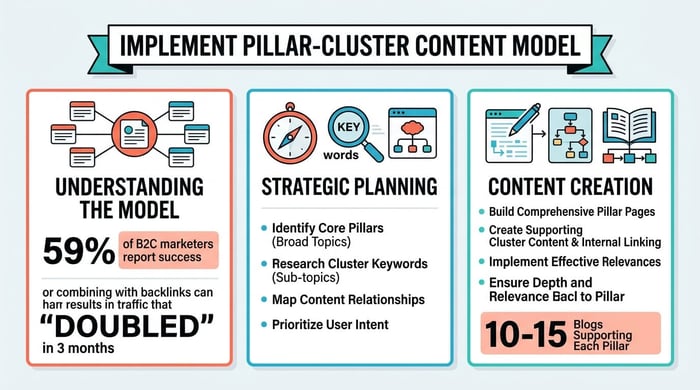
The pillar-cluster model is a strategic content organization framework designed to build topical authority around broad subjects (pillars) supported by detailed sub-topics (clusters). In 2026, this model is more critical than ever, as search engines prioritize comprehensive, authoritative content. A pillar page acts as a comprehensive guide on a broad topic, linking out to more specific cluster content. Cluster pages, in turn, delve deeper into specific aspects of the pillar topic, linking back to the main pillar. This interconnected structure signals to search engines that your site is a definitive resource on a given subject. In fact, 59% of B2C marketers report that high-quality pillar cluster content works best for SEO success.
Key characteristics of the pillar-cluster model:
- Pillar Page: A broad, comprehensive overview of a core topic.
- Cluster Pages: Detailed articles exploring specific sub-topics related to the pillar.
- Internal Linking: Strategic links connecting clusters to the pillar and to each other.
- Topical Authority: Establishes your website as an expert resource on a subject.
- Improved SEO: Signals relevance and depth to search engines.
Why the Pillar-Cluster Model is Essential in 2026
The shift towards AI-driven search and zero-click experiences necessitates a content strategy that establishes deep topical authority. As Rand Fishkin notes, "Zero-click experiences will become the majority of online journeys." A well-implemented pillar-cluster model helps your content appear in AI Overviews and answer boxes by providing structured, comprehensive information. It also improves user experience by offering clear navigation and a logical content hierarchy. Combining pillar-cluster with backlinks has been shown to double a client's website traffic in 3 months, underscoring its impact.
The reality is that Google organic referrals fell approximately 16% from early 2025 levels. To counteract this, a strategic approach like the pillar-cluster model is vital for maintaining visibility. This pillar cluster model for scalable SEO growth is designed to adapt to these shifts.
"The website now influences the web more than it captures traffic."
The Evolution of Topical Authority and Semantic SEO
In 2026, search engines are increasingly sophisticated, moving beyond keyword matching to understand semantic relationships and user intent. The pillar-cluster model naturally aligns with semantic SEO by organizing content around topics, not just keywords. This allows search engines to better understand the context and relevance of your content, leading to higher rankings for a wider range of related queries. Semantic SEO can lead to up to a 50% traffic boost, demonstrating the power of this approach.
Benefits of aligning with semantic SEO:
- Improved understanding of user intent by search engines.
- Higher rankings for a broader range of related queries.
- Enhanced content relevance and context.
- Better user experience through more accurate search results.
Strategic Planning: Identifying Your Core Pillars and Clusters
Effective pillar-cluster implementation isn't just about writing content; it's about strategic foresight. With 62% of marketers using AI for topic brainstorming, the research phase is both more efficient and more critical than ever to ensure your content addresses genuine audience needs and aligns with business objectives.
Conducting Comprehensive Topic Research and Keyword Analysis
Effective pillar-cluster implementation begins with thorough research. Identify broad topics that are central to your business and audience's needs. Use keyword research tools to uncover high-volume, relevant keywords for potential pillars, and then drill down to long-tail keywords for your cluster content. Consider user intent at every stage. Long-tail keywords drive 70% of traffic and can boost conversions by 20%, making their identification paramount.
Steps for effective topic and keyword research:
- Identify broad, relevant business topics.
- Utilize keyword research tools for high-volume pillar keywords.
- Drill down to specific long-tail keywords for cluster content.
- Analyze user intent for each keyword.
- Assess competitive landscape for chosen topics.
Mapping Your Content with a Topic Tree
Once you have your core pillar topics, begin to map out potential cluster content. Each pillar should be supported by a robust set of cluster articles. Think of this as structuring content with a topic tree, where the pillar is the trunk and the clusters are the branches. Aim for a comprehensive, yet manageable, number of clusters per pillar. Recommended scale suggests 10-15 blogs supporting each pillar page, plus 10-15 blogs for cluster pages, or initially 5-10 clusters per pillar, expanding to 15+.
Prioritizing Pillars and Clusters for Maximum Impact
Not all topics are created equal. Prioritize pillar and cluster topics based on search volume, business relevance, competitive landscape, and potential for conversion. Focus on areas where you can establish deep expertise and differentiate your brand. For pre-revenue startups, focusing on 2-3 core clusters initially can build foundational authority, with these startups typically creating 1-2 posts/week.
Prioritization criteria:
- Search volume and potential traffic.
- Relevance to business goals and audience needs.
- Competitive analysis for ranking potential.
- Conversion potential for leads or sales.
- Ability to establish deep expertise and thought leadership.
Content Creation: Building Your Pillar and Cluster Pages
The creation phase is where the strategic planning comes to life. Given that 44% of marketers use AI for writing drafts, the challenge is to produce high-quality, authoritative content that resonates with both human readers and AI search algorithms, especially as ~60% of searches now yield no clicks.
Crafting Authoritative Pillar Pages
Pillar pages are the backbone of your strategy and need to be comprehensive. They should be at least 2000 words and cover the broad topic in depth, providing a high-level overview while still offering valuable insights. Use clear headings, subheadings, and a table of contents to enhance readability and user experience. HubSpot's own Instagram marketing pillar, for example, linked to clusters like “How to Use Instagram Stories” and “80+ Instagram Stats,” significantly boosting user navigation and topical authority.
Elements of an effective pillar page:
- Minimum 2000 words in length.
- Comprehensive coverage of a broad topic.
- Clear headings, subheadings, and a table of contents.
- High-level overview with valuable insights.
- Links out to supporting cluster content.
Developing In-Depth Cluster Content
Cluster pages provide the granular detail that supports your pillar. Each cluster should focus on a specific sub-topic, ranging from 1500-2500 words. These pages should offer actionable advice, unique perspectives, and answer specific user questions related to their sub-topic. The depth of these articles is crucial for establishing expertise and capturing long-tail search intent.
Optimizing Content for AI Overviews and Zero-Click Searches
In 2026, content must be structured not only for human readers but also for AI. This means using clear, concise language, bulleted lists, tables, and direct answers to common questions. This optimization increases the likelihood of your content being featured in AI Overviews, even if it doesn't result in a direct click to your site. AI Overview CTR impact can be -35% when present, but appearing in the overview still builds brand recognition.
"Internet users will consume 10x more content via AI summaries than all longer-form text (blogs, articles, podcasts, e-commerce pages) combined in 2026." Rand Fishkin, SparkToro
Internal Linking and Site Structure: Connecting Your Content
Beyond individual content pieces, the way your content is interconnected plays a pivotal role in its discoverability and perceived authority. Strategic internal linking is not merely an SEO tactic; it's a fundamental aspect of user experience and site architecture, especially when organic share of total traffic was down 3.65% in 2025.
Implementing Strategic Internal Linking for Topical Authority
Internal linking is the glue that holds your pillar-cluster model together. Each cluster page should link back to its parent pillar page, and the pillar page should link out to all relevant cluster pages. Additionally, consider linking between related cluster pages to create a dense, interconnected web of content. This signals to search engines the depth of your topical expertise, helping to improve rankings. Best practice dictates using internal links to connect cluster content back to the pillar page and between related clusters, enhancing topical authority and user navigation.
Internal linking best practices:
- Link all cluster pages back to their main pillar page.
- Pillar pages should link out to all relevant cluster pages.
- Link between related cluster pages to form a content web.
- Use descriptive anchor text for internal links.
- Ensure links are natural and add value to the user.
Enhancing User Experience Through Intuitive Navigation
A well-structured internal linking strategy not only benefits SEO but also significantly improves user experience. When users can easily navigate between related topics, they are more likely to spend more time on your site, reducing bounce rates and increasing engagement. This is crucial in an era where website/blog/SEO is ranked as the #1 ROI channel by marketers.
"The website now influences the web more than it captures traffic." Rand Fishkin, SparkToro
Leveraging Site Structure for SEO Gains
Beyond internal links, your overall site structure should reflect your pillar-cluster model. Use categories, tags, and breadcrumbs to reinforce the hierarchical relationship between your content. This clear organization helps search engine crawlers understand your site's architecture and index your content more effectively. For example, enterprise SEO initiatives like Flyhomes' expansion to 425,000 pages achieved 10,737% organic traffic growth in 3 months by leveraging robust site architecture.
Elements of an optimized site structure:
- Logical hierarchy reflecting pillar-cluster relationships.
- Use of categories and tags for content organization.
- Implementation of breadcrumbs for user navigation.
- Clear URLs that reflect content structure.
- XML sitemaps to aid search engine crawling.
Measuring and Optimizing Your Pillar-Cluster Performance
In 2026, the metrics for content success have evolved. With organic traffic declining and ~60% of searches resulting in no clicks, simply tracking traffic volume is insufficient. A more nuanced approach to measurement is essential for proving ROI and driving continuous improvement.
Key Metrics for Tracking Success Beyond Traffic Volume
In 2026, focusing solely on traffic volume can be misleading, as organic traffic declined 2.5% YoY in 2025 and ~60% of searches now yield no clicks. Instead, track metrics like conversions, lead generation, time on page, engagement rates, and topical authority scores. Organic traffic conversion is still a respectable 16%, making conversion-focused metrics paramount.
| KPI | Benchmark | Target/Note |
|---|---|---|
| Blog conversion rate | 0.8%-1.1% average | Aim for 3x higher (2.4%-3.3%) |
| Organic traffic conversion | 16% | With 30% new users/70% total from organic; 4.5% return in 90 days |
| Social engagement | <1% median | Target >3%; 20% audience reach; 5+ shares/week; 3+ comments/post |
| Interactive content success | 44.4% mildly/very successful | Vs. 39.9% without |
Iterative Optimization Based on Performance Data
Regularly analyze your content's performance. Identify underperforming pillar or cluster pages and look for opportunities to update, expand, or re-optimize them. This iterative process is crucial for sustained growth. Unfortunately, 56% of B2B marketers struggle with ROI attribution, highlighting a common challenge in this area. Understanding ROI from automated SEO content publishing systems can provide a clearer picture.
Optimization strategies:
- Regularly review content performance data.
- Identify underperforming pillar or cluster pages.
- Update and expand outdated content.
- Re-optimize content for new keywords or AI features.
- Conduct A/B testing on headlines and CTAs.
Adapting to Algorithm Changes and AI Search Trends
The SEO landscape is constantly shifting, particularly with the rapid advancements in AI. Stay informed about algorithm updates and new AI search features. Be prepared to adapt your content strategy to maintain visibility. This means creating "deep edge" expert content that AI cannot easily replicate, providing proprietary insights.
"What we’ve seen break in ABM programs across 20 mid-market SaaS companies." Heinz Marketing, Heinz Marketing Blog
Leveraging AI for Efficient Pillar-Cluster Implementation
The advent of AI has profoundly reshaped content marketing, offering unprecedented opportunities for efficiency and scale. In 2026, 94% of marketers plan to use AI in content creation processes, making AI integration a critical component of any successful pillar-cluster strategy.
Streamlining Content Research and Topic Clustering with AI
AI tools are revolutionizing the efficiency of content creation. For pillar-cluster models, AI can significantly speed up the initial research phase. AI-powered platforms can analyze vast amounts of data to identify high-potential pillar topics and suggest comprehensive cluster ideas, saving countless hours. For instance, 62% of marketers use AI for topic brainstorming, and 53% for summarizing, streamlining the foundational steps of content strategy.
How AI streamlines research:
- Automated identification of high-potential pillar topics.
- Generation of comprehensive cluster ideas.
- Analysis of vast data sets for keyword and trend insights.
- Reduction of manual research time.
- Enhanced accuracy in topic clustering.
Automating Content Generation and Optimization
Generative AI can assist in drafting both pillar and cluster content, helping you scale your output without sacrificing quality. While human oversight remains crucial for factual accuracy and brand voice, AI can handle the heavy lifting of initial drafts, allowing your team to focus on refinement and strategic input. A remarkable 44% of marketers use AI for writing drafts, and 86% report saving >1 hour daily on tasks using AI.
Using Jottler to Accelerate Pillar-Cluster Content
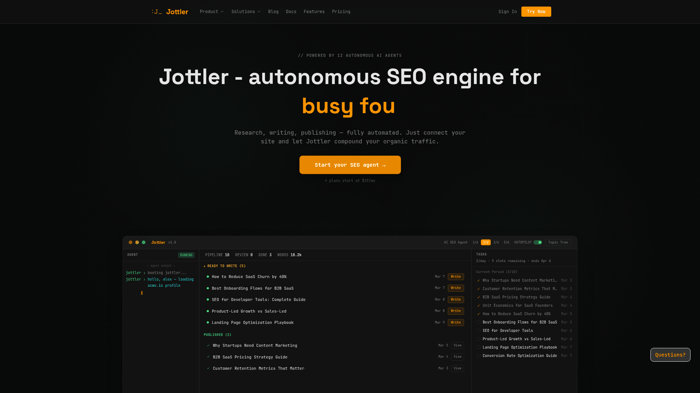
For busy businesses, SaaS companies, and e-commerce stores, Jottler offers an autonomous AI SEO engine that automates content research, writing, and publishing. Specifically, Jottler's AI keyword research and topic clustering capabilities can identify optimal pillar and cluster opportunities, while its daily long-form article generation streamlines the creation of high-quality content for your entire pillar-cluster structure. This allows you to build out comprehensive topical authority at an unprecedented pace, effectively addressing the need to future-proof your content with AI SEO agents. The platform is designed to produce up to 100 articles/month (3,000+ words each) starting at just $29/month, making scalable content accessible.
Jottler's key features for pillar-cluster content:
- Autonomous AI SEO engine.
- Automated content research and topic clustering.
- Daily long-form article generation.
- Streamlined creation of high-quality pillar and cluster content.
- Scalable content production (up to 100 articles/month).
Enhancing Internal Linking and Site Structure with AI
Advanced AI tools can also analyze your existing content and suggest optimal internal linking opportunities, ensuring that your pillar and cluster pages are effectively interconnected. Some platforms can even help you visualize and optimize your site's overall structure for maximum SEO benefit. Jottler's smart internal linking features ensure that your newly generated cluster content automatically connects to its relevant pillar pages and other related articles, strengthening your site's topical authority and improving crawlability, a key function of effective AI SEO agents.
Common Challenges and How to Overcome Them
Despite the clear benefits, implementing a pillar-cluster model, especially with AI, comes with its own set of challenges. Resource constraints, quality control, and adapting to a rapidly changing search environment are top concerns for marketers, with 42% citing resource constraints as a major issue.
Overcoming Resource Constraints with AI and Automation
Many businesses, especially small to medium-sized ones, face resource limitations for content creation. AI offers a powerful solution. By leveraging AI for content generation and optimization, businesses can produce 5-10x more content at 75-85% lower cost per article compared to traditional methods. This efficiency gain is crucial for scaling content efforts without significant increases in budget or headcount.
AI solutions for resource constraints:
- Produce 5-10x more content.
- Achieve 75-85% lower cost per article.
- Automate repetitive content tasks.
- Free up human resources for strategic work.
- Enable scalable content efforts without large budget increases.
Ensuring AI Content Quality and Factual Accuracy
While AI is powerful, it's not infallible. It's crucial to implement a robust review process to ensure AI content quality and factual accuracy. Human editors should verify information, refine the tone, and add unique insights that AI cannot replicate. As Ann Handley wisely states, "Content should be useful, inspired, and pathologically empathetic to the needs of the people you are trying to reach." This human touch is what differentiates truly valuable content.
Adapting to the Zero-Click Search Environment
With ~60% of searches now yielding no clicks, the goal shifts from solely driving traffic to establishing brand visibility and authority within search results. Optimize your content for rich snippets, featured snippets, and AI Overviews, even if it means users get their answer directly from the SERP. This builds brand recognition and trust. AI Overview CTR impact is -35% when present, but appearing in the overview still provides valuable exposure.
Navigating the E2B Content Marketing Landscape
B2B content marketing faces unique challenges, including long sales cycles and the need for deep expertise. The pillar-cluster model is particularly effective for B2B, allowing companies to establish thought leadership and address complex buyer journeys. B2B SaaS SEO paired with a $205 organic CAC yields 702% ROI, demonstrating the high impact of a well-executed content strategy in this sector.
B2B content marketing considerations:
- Longer sales cycles require sustained content engagement.
- Need for deep expertise and thought leadership.
- Complex buyer journeys require comprehensive content.
- Pillar-cluster model effectively addresses these needs.
- High ROI potential (e.g., 702% ROI for B2B SaaS SEO).
Conclusion
Implementing a robust pillar-cluster content model is no longer optional but a necessity for businesses aiming to thrive in the 2026 digital landscape. By strategically organizing your content around comprehensive pillars and detailed clusters, you build undeniable topical authority, improve user experience, and future-proof your content against evolving search algorithms. Leveraging AI tools can dramatically accelerate this process, allowing you to scale your content efforts efficiently and effectively. Businesses that embrace this model can expect significant returns, with SEO delivering 748% ROI and content marketing generating 3x more leads than outbound at 62% less cost. Don't let the complexities of modern SEO deter you; empower your strategy with the pillar-cluster model and watch your organic traffic compound. To learn more about how autonomous AI can transform your content strategy, visit Jottler.co.
FAQs
like this today.