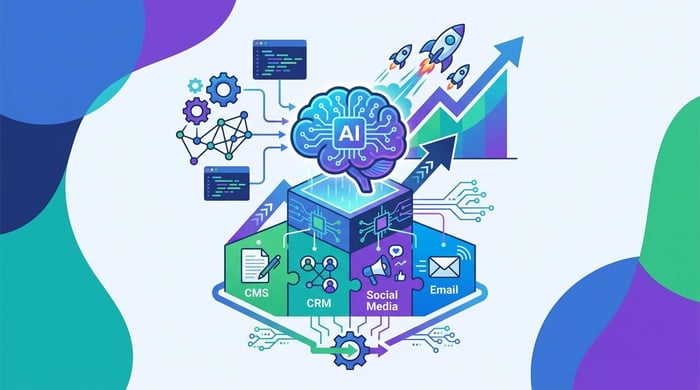
Integrate AI Content with Your Marketing Stack
 Aidan Buckley
SEO
Aidan Buckley
SEO
March 19th, 2026
15 minute read
Table of Contents
- The AI Content Revolution: Why Integration is Key
- Strategic Planning: Aligning AI with Your Marketing Goals
- Choosing the Right AI Content Tools for Your Stack
- Seamless Integration: Connecting AI with Existing Platforms
- Optimizing Workflows: Human-AI Collaboration for Content Excellence
- Measuring Success: KPIs and ROI for AI-Powered Content
- The Future of Content: Scaling and Evolving with AI
- Conclusion
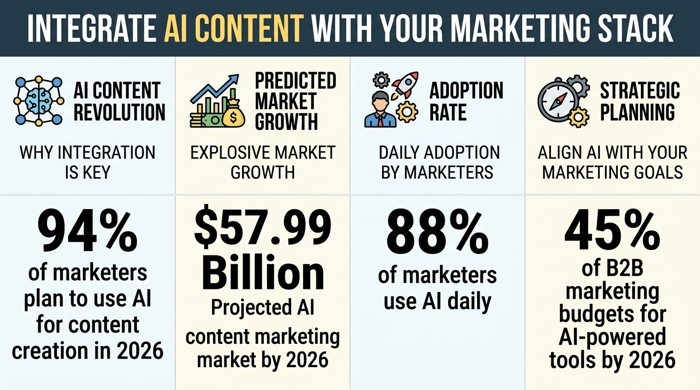
The digital landscape of 2026 demands more than just content; it demands intelligent, integrated content. Businesses across all sectors—from bustling e-commerce stores to intricate B2B enterprises—are grappling with an insatiable demand for high-quality, personalized content. This challenge is compounded by the sheer volume required to maintain visibility and engagement in an increasingly crowded market. The AI content marketing market is projected to reach an astounding $57.99 billion in 2026, underscoring a pivotal shift in how content is created and managed. Without a cohesive strategy to integrate AI into your existing marketing stack, businesses risk falling behind, facing fragmented workflows, escalating costs, and missed opportunities for significant ROI. The solution lies in a strategic, integrated approach to AI content, transforming your marketing operations from reactive to autonomously proactive. Here's a quick summary of how to integrate AI content into your marketing stack effectively:
- The AI Content Revolution: Deep integration of AI is critical for sustained success, with 94% of marketers planning to use AI for content creation in 2026.
- Strategic Planning: Align AI content objectives with overarching business goals, as B2B marketers prioritize AI-powered tools at 45% of their 2026 budgets.
- Choosing the Right AI Content Tools: Select tools based on integration capabilities and brand voice adherence, considering the AI content creation and optimization software market's projected growth to $6.5 billion by 2034.
- Seamless Integration: Connect AI with existing platforms using APIs and middleware, as 38% of marketers prioritize seamless API connectivity for real-time data flow.
- Optimizing Workflows: Foster human-AI collaboration to redefine roles and maximize efficiency, with 73% of marketers combining AI with human oversight for best results.
- Measuring Success: Track KPIs like content production volume and conversion rates, as companies integrating AI achieve 32% higher conversion rates.
- The Future of Content: Prepare for agentic AI and AI search optimization, given a significant shift towards AI agents.
The AI Content Revolution: Why Integration is Key
The rapid evolution of AI has fundamentally reshaped the content marketing landscape. What was once a futuristic concept is now a daily reality for the vast majority of marketers. This widespread adoption is evident, with 94% of marketers planning to use AI for content creation in 2026. This section explores the driving forces behind this revolution and the compelling reasons why deep integration, rather than superficial adoption, is critical for sustained success.
The Irreversible Shift to AI-Powered Content
The statistics paint a clear picture: AI is no longer optional. 88% of marketers already use AI daily. This widespread adoption is driven by AI's ability to address key pain points: speed, scale, and personalization. AI improves content delivery speed by 84% and can boost output volume by 300% for mid-sized enterprises. This shift is so profound that non-AI blog creation dropped from 65% to a mere 5% in just two years. The market itself reflects this growth, with the AI content generation market valued at $1,767 million in 2025 and projected to expand at a 25% CAGR into 2026.
The Cost of Fragmentation: Why a Unified Stack Matters
Despite the high adoption rates of AI tools, true integration remains a challenge. Only 23.3% of companies have AI agents fully integrated into marketing stacks in 2026. This fragmentation leads to inefficiencies, inconsistent branding, and a failure to capitalize on AI's full potential. Integrated AI yields 2x+ higher marketing-driven profitability, and integrated stacks enable 12% conversion rates versus 2% for fragmented setups. The goal is not just to use AI, but to embed it strategically into your entire content workflow. As Jed Hartman, President of Activation Partnerships at Zeta Global, notes, "Brands can’t afford fragmented decision-making... unify everything around a single AI and identity-powered technology layer."
Strategic Planning: Aligning AI with Your Marketing Goals
Before diving into tools, a clear strategy is paramount. This section outlines how to define your AI content objectives, identify key use cases, and establish a framework for successful implementation. 68% of B2B marketers explore or develop AI strategies, highlighting the critical need for thoughtful planning.
Defining Your AI Content Objectives
Successful AI integration begins with clearly defined goals. What specific marketing challenges do you aim to solve with AI? Are you looking to increase content output, improve SEO performance, enhance personalization, or reduce operational costs? For instance, B2B marketers prioritize AI-powered tools (generative AI, predictive analytics) at 45% of their 2026 budgets, often focusing on lead generation and sales enablement. By setting measurable objectives, such as "increase organic traffic by 50% using AI-generated long-form content" or "reduce content production time by 40%," you create a roadmap for your AI journey.
AI Content Strategy Framework
A robust framework ensures that AI efforts are aligned with overarching business goals. Consider the following steps:
- Audit Your Current Content Operations: Identify bottlenecks, repetitive tasks, and areas where human effort is disproportionately high.
- Identify AI Opportunities: Map AI capabilities (e.g., keyword research, drafting, personalization, distribution) to your audited pain points.
- Define Pilot Projects: Start with small, manageable projects to test AI's impact and gather initial data. For example, use AI for generating social media captions or drafting blog post outlines.
- Establish Metrics for Success: Beyond general KPIs, define specific metrics for AI-driven content, such as AI-assisted content production volume, time saved per article, or conversion rates for AI-personalized campaigns.
- Plan for Human-AI Collaboration: Recognize that AI augments, not replaces, human creativity and oversight. Design workflows that leverage the strengths of both.
"AI won’t replace marketers, but it will start handling multi-step workflows — drafting content, suggesting audiences, scheduling sends, and flagging issues — with minimal oversight."
Choosing the Right AI Content Tools for Your Stack
The market is flooded with AI tools, each promising revolutionary results. This section provides criteria for selection and highlights how to identify tools that genuinely fit your needs, including a specific recommendation. The AI content creation and optimization software market is projected to grow from $2.3 billion in 2026 to $6.5 billion by 2034, indicating a diverse and expanding ecosystem of solutions.
Criteria for Selecting AI Content Tools
When evaluating AI tools, consider these critical factors:
- Integration Capabilities: Can the tool seamlessly connect with your existing CMS, CRM, SEO tools, and other marketing platforms? Look for robust APIs and native integrations.
- Scalability: Can the tool handle your current and future content volume?
- Brand Voice & Customization: Can the AI be trained to adhere to your specific brand guidelines, tone, and style?
- Accuracy & Quality: How reliable is the output? Does it require extensive human editing or fact-checking?
- User-Friendliness: Is the interface intuitive for your team, minimizing the learning curve?
- Cost-Effectiveness: Evaluate the ROI, considering both subscription fees and potential savings in time and resources.
- Security & Compliance: Ensure the tool meets your data privacy and security requirements.
Tools for Every Need: From Drafting to Distribution
| Tool | Best For | SEO Optimization | Content Strategy | Brand Voice | Starting Price |
|---|---|---|---|---|---|
| Jasper AI | Versatile content creation | ✅ | ❌ | ✅ | $59/month (annual) |
| Semrush Content Toolkit | SEO-focused blog drafting | ✅ | ✅ | ❌ | $60/month |
| StoryChief | Multi-channel distribution | ✅ | ✅ | ❌ | $55/month |
| Copy.ai | Short-form & GTM content | ❌ | ❌ | ❌ | Free/$24/month (annual) |
| Surfer SEO | SERP-driven optimization | ✅ | ❌ | ❌ | $79/month (annual) |
| Blaze AI | Social media automation | ❌ | ✅ | ❌ | $46/month (annual) |
Using Jottler to Scale Content Operations
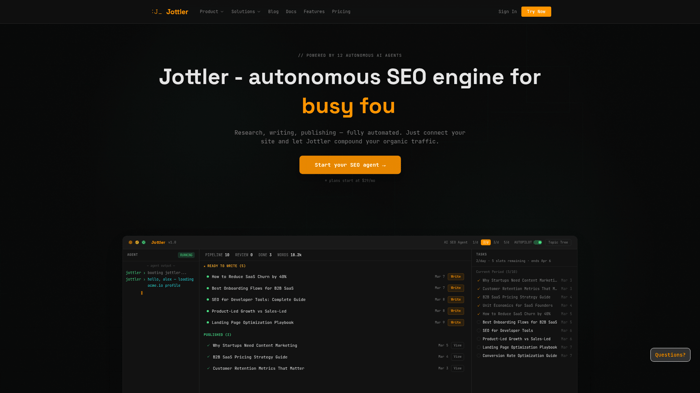
For busy businesses, SaaS companies, and publishers looking for an autonomous solution, Jottler stands out. Jottler is an autonomous AI SEO engine that automates content research, writing, and publishing to compound organic traffic. It excels in delivering daily long-form articles, performing AI keyword research, and automatically publishing to your CMS, making it a powerful tool for scaling content operations and driving organic growth without extensive manual oversight.
Jottler's approach directly addresses the pain points of consistent, high-quality content production. By leveraging its 12 AI agents, businesses can move from a state of content scarcity to one of abundance, ensuring their online presence is continually fed with fresh, SEO-optimized material. This level of automation is crucial given that 95% of CMOs report growing demand for content, with AI fundamentally changing production rules in 2025.
Seamless Integration: Connecting AI with Existing Platforms
The true power of AI content lies in its ability to integrate smoothly with your existing marketing technology stack. This section details how to achieve this synergy, ensuring data flows efficiently and workflows are streamlined. Only 23.3% of companies have AI agents fully integrated into marketing stacks in 2026, highlighting a significant opportunity for improvement.
Mapping Your Current MarTech Stack
Begin by thoroughly auditing your current marketing technology stack. List all tools used for:
- Content Management Systems (CMS): WordPress, HubSpot, Webflow, etc.
- Customer Relationship Management (CRM): Salesforce, HubSpot CRM, Zoho CRM, etc.
- SEO Tools: Semrush, Ahrefs, Google Search Console, etc.
- Marketing Automation Platforms: HubSpot, Marketo, Pardot, etc.
- Social Media Management: Hootsuite, Buffer, Sprout Social, etc.
- Analytics: Google Analytics, Adobe Analytics, etc.
Understanding these connections is crucial for identifying integration points and potential friction areas.
Strategies for Effective Integration
- API-First Approach: Prioritize AI tools that offer robust APIs, allowing for custom integrations and data exchange with your existing platforms. 38% of marketers prioritize seamless API connectivity to reduce manual effort and ensure real-time data flow.
- Middleware Solutions: Tools like Zapier or Make can act as bridges, connecting disparate AI tools and marketing platforms through automated workflows. For example, you can use Zapier to automatically push AI-generated content drafts from a writing tool to Google Docs for human review, and then to your CMS.
- Native Integrations: Leverage AI features built directly into your core platforms, such as HubSpot's AI assistants or Adobe GenStudio, which enables creative teams to generate content variations at scale across touchpoints.
- Unified Data Layer: Strive for a centralized data repository where all marketing data, including AI-generated insights, can be accessed and analyzed. This enables predictive analytics and hyper-personalization. As Robert Rose, Chief Troublemaker at Seventh Bear, advises, "This isn’t about automation; it’s about augmentation. The smart playbook is to embed AI into the strategic layers of content operations: tagging frameworks, content modeling, and journey orchestration."
Optimizing Workflows: Human-AI Collaboration for Content Excellence
The most effective AI content strategies involve a harmonious blend of artificial intelligence and human expertise. This section focuses on designing workflows that maximize efficiency while maintaining quality and brand authenticity. 73% of marketers combine AI with human oversight for best results, underscoring the importance of this collaborative approach.
Redefining Roles in an AI-Powered Content Team
AI doesn't eliminate the need for human talent; it redefines it. Teams will shift from purely generative tasks to more strategic roles:
- Content Strategists: Focus on identifying content gaps, refining AI prompts, and overseeing the overall content roadmap.
- Editors & Fact-Checkers: Ensure AI-generated content aligns with brand voice, is factually accurate, and meets quality standards.
- SEO Specialists: Optimize AI-generated content for search engines and LLMs, adapting to new search paradigms like Answer Engine Optimization (AEO).
- AI Trainers/Prompt Engineers: Develop and refine prompts to guide AI tools in producing desired outputs.
"The key is connecting AI to your actual content workflow instead of treating it as a separate tool."
How Jottler Approaches Human-AI Collaboration
Consider how tools like Jottler can integrate into your team's daily operations. Jottler automates content research, writing, and publishing, freeing up human resources for higher-value activities. This allows teams to shift from the laborious aspects of content creation to more strategic oversight and refinement.
For instance, Jottler's AI-driven research and outlining capabilities autonomously perform AI keyword research and generate comprehensive outlines for long-form articles. Human strategists can then review these outlines, adding unique insights or adjusting the focus based on their expertise. This collaborative step ensures that while the heavy lifting of structure and initial content is handled by AI, the strategic direction and nuanced understanding come from human intelligence. The platform then drafts daily long-form articles, providing a strong starting point that human writers and editors can refine, inject brand personality, add case studies, and ensure narrative flow. This hybrid approach has been shown to yield significantly better engagement than AI-only content.
Finally, Jottler's automatic CMS publishing feature streamlines the final step, removing manual upload tasks and allowing human teams to focus on promotion and performance analysis. This integrated workflow ensures that the entire content lifecycle benefits from AI efficiency while retaining human quality control, leading to superior results and allowing for efficient full automation that could eliminate most agency costs for many businesses.
Measuring Success: KPIs and ROI for AI-Powered Content
Demonstrating the value of AI integration requires robust measurement. This section outlines key performance indicators (KPIs) and strategies for calculating the return on investment (ROI) of your AI content initiatives. Companies integrating AI content into marketing stacks achieve 32% higher conversion rates and 22% higher ROI.
Essential KPIs for AI Content
- Content Production Volume & Velocity: Track the number of articles, posts, or assets produced per week/month with AI assistance versus without. AI-generated content can cut production costs by up to 40% and boost output volume by 300%.
- Time Saved per Content Piece: Quantify the reduction in hours spent on research, drafting, and editing. 86% of businesses save over 1 hour daily on tasks like brainstorming (62% usage), summarizing (53%), and drafting (44%) with AI.
- Cost Reduction per Content Piece: Calculate the financial savings from reduced labor or agency fees. Level 3 integrated teams produce 5-10x more content at 75-85% lower cost per article.
- Organic Traffic Growth (AI-Assisted Content): Monitor SEO performance specifically for content generated or optimized with AI. Companies integrating AI achieve significantly higher organic traffic increase and more MQLs.
- Conversion Rates (AI-Personalized Content): For campaigns using AI for personalization, track improvements in lead generation, sales, or sign-ups. Integrated AI leads to 32% higher conversion rates.
- Engagement Metrics: Analyze bounce rate, time on page, social shares, and comments for AI-assisted content.
- Brand Sentiment & Quality Scores: Implement systems to assess the perceived quality and brand alignment of AI-generated content.
Calculating ROI for Your AI Investment
To calculate ROI, compare the total investment in AI tools and training against the measurable gains.
ROI = (Total Gains - Total Investment) / Total Investment * 100
- Total Gains: Include increased revenue from higher conversions, cost savings from reduced production time and agency fees (60% of CMOs spend less on digital and content agencies due to AI tools), and the value of increased organic traffic.
- Total Investment: Include software subscriptions, training costs, and any initial setup or integration expenses.
Case studies demonstrate significant ROI: an unnamed content marketing firm achieved a significant ROI, new revenue, and a 32% close rate on a $1.7M pipeline through AI-driven content. This showcases how AI is fundamentally changing production rules, leading to substantial financial benefits.
The Future of Content: Scaling and Evolving with AI
The integration of AI into your marketing stack is not a one-time project but an ongoing evolution. This section looks ahead to future trends and strategies for continuous adaptation. By 2026, a significant percentage of B2B marketers will be using AI applications, with a significant shift towards AI agents.
Embracing Agentic AI and Hyper-Personalization
The next frontier is agentic AI, where AI systems autonomously execute multi-step workflows. This will enable hyper-personalization at scale, with 71% of consumers expecting personalized interactions and top performers generating 40% more revenue from it. Your integrated stack should be designed to support this, allowing AI agents to connect data points across CRM, CMS, and ad platforms to deliver truly individualized content experiences. As Tim Waring, Content Supply Chain AI Advisor at Adobe, notes, "You’re able to use the AI features to generate different variations at scale across different touch points. You can create different variations, plus the translated versions of that Content quickly by scaling it through those AI agents."
Optimizing for AI Search and New Content Formats
The rise of LLMs and AI-powered search engines means optimizing for Answer Engine Optimization (AEO) and Generative Engine Optimization (GEO) will become paramount. LLM referral traffic grew significantly year-over-year, indicating a shift in how users discover information. Your AI for content creation strategy must adapt to create content that is not only SEO-friendly but also easily digestible by AI models for summaries and direct answers. Furthermore, AI will continue to drive new content formats, such as AI-generated video and interactive experiences. 75% of marketers rely on AI for video and image creation.
Continuous Learning and Adaptation
The AI landscape is constantly changing. To stay ahead, foster a culture of continuous learning within your team. Experiment with new AI features, monitor industry trends, and be prepared to iterate on your integration strategy. Organizations training employees in AI achieve significantly higher deployment success and sales ROI gains. The goal is to build a resilient, adaptable marketing stack that can leverage the latest AI advancements to maintain a competitive edge.
Conclusion
Integrating AI content with your marketing stack is no longer a strategic advantage; it's a necessity for survival and growth in 2026. By strategically planning, selecting the right tools, seamlessly integrating them, and fostering human-AI collaboration, businesses can unlock unprecedented levels of efficiency, personalization, and ROI. Companies that embrace this integrated approach achieve 32% higher conversion rates and 22% higher ROI, while simultaneously improving content delivery speed by 84%. The future of content is intelligent, automated, and deeply integrated, promising exponential growth for those who master its potential. Start your SEO agent today to transform your content strategy and achieve measurable growth.
FAQs
What is the projected market size for AI content marketing in 2026?
How much can AI improve conversion rates and ROI when integrated with marketing stacks?
How important is human oversight in AI content creation?
like this today.