Integrating AI into Your B2B Content Workflow
94% of B2B marketers now use AI in some form, yet 85% of AI-generated content still requires human editing before publication. The challenge isn't adoption—it's integration. Most teams treat AI as a writing tool when it should be the backbone of an entire content system: research, drafting, optimization, publishing, and linking all working in concert.
The gap between having AI tools and having an AI-powered workflow costs growing companies weeks of manual labor every month. Teams that automate their full content pipeline see 75% faster campaign launches and 50-60% time savings on production (McKinsey, 2025; Content Marketing Institute, 2025). But getting there requires rethinking how work flows through your organization, not just bolting on a ChatGPT subscription.
Key Takeaways
- 94% of B2B marketers now use AI for marketing tasks, with 80% specifically using AI for content creation (HubSpot, 2026)
- 43% of marketers struggle to differentiate content in a saturated market driven by mass-produced AI output (Omnibound, 2026)
- Human oversight is non-negotiable: 85% of AI content requires editing, and successful integration depends on structured workflows, not AI alone (Semrush, 2025)
- Audit your current workflow: Identify bottlenecks, manual tasks, and decision points where AI can add speed without sacrificing quality or differentiation.
- Layer AI strategically: Use AI for research, ideation, and first drafts; reserve human expertise for verification, tone, and unique insights that competitors lack.
- Build for consistency: Automate repetitive elements (metadata, internal linking, formatting) so human reviewers can focus on strategic decisions.
- Measure at every stage: Track time-per-article, publish velocity, engagement lift, and organic traffic gains to justify further investment in automation.
How Should You Map Your Current Content Workflow?
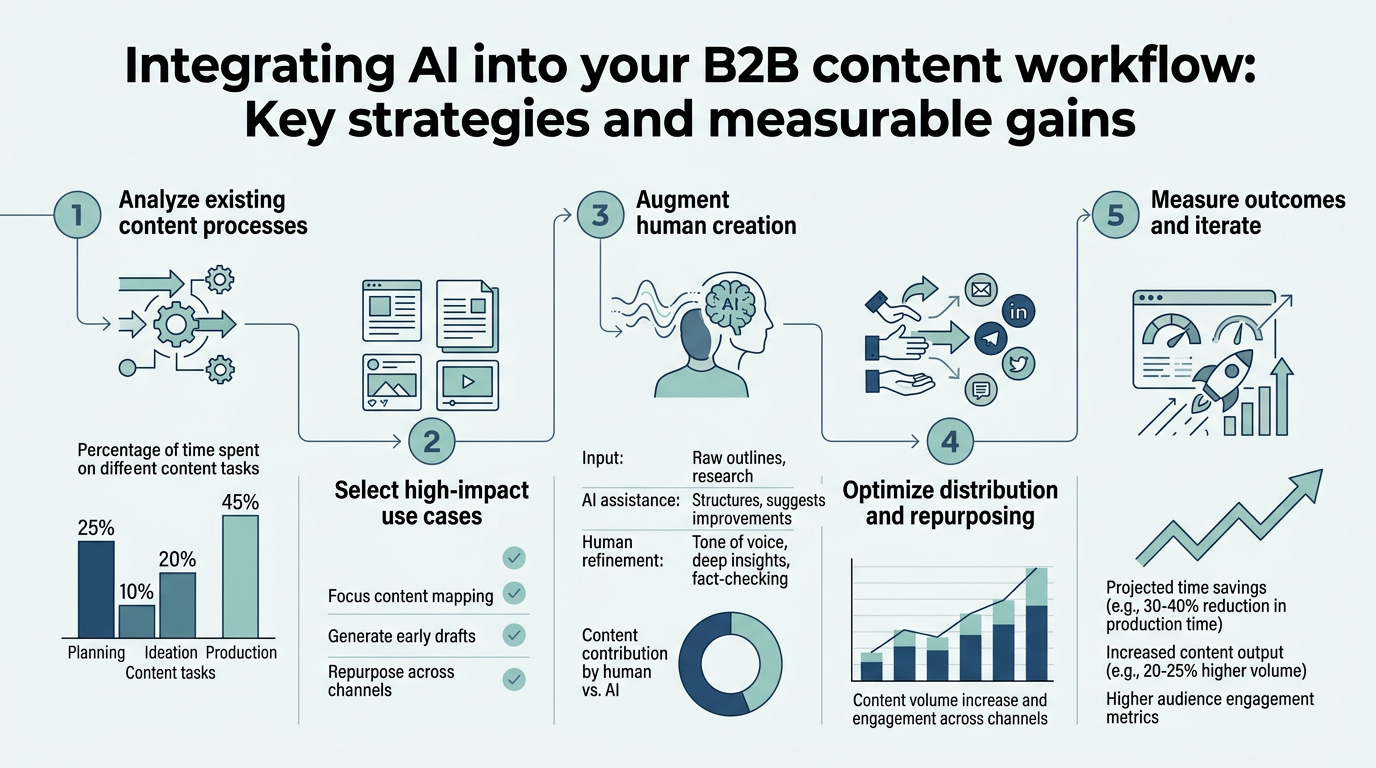
Before AI can streamline anything, you need to see what you're actually doing. 78% of B2B marketers now use automation for content workflows, but most skipped the foundational mapping step that determines where AI adds real value (Leadfeeder, 2026). Without this picture, you'll either over-automate low-impact tasks or miss opportunities to cut 20+ hours per week of manual work.
Document Every Step From Ideation to Publishing
Start by breaking down your content lifecycle into discrete stages. List every decision, approval, and tool touch-point. How does a topic get chosen? Who reviews drafts? How long does publication take? The goal is brutal honesty about time spent.
Most growing teams spend 2-4 hours on keyword research per article, 3-5 hours writing, 1-2 hours editing, and another 1-2 hours on formatting, metadata, and CMS publishing. That's 7-13 hours per piece—before you even think about internal linking or promotion. If your team publishes 2-4 articles per week, you're burning 14-52 hours of labor on process overhead alone.
"Documented workflows correlate with 30% faster content velocity. Teams that map their processes before implementing AI see significantly better ROI on automation tools because they know exactly which steps to optimize."
Map this visually if you can. Use a spreadsheet or a workflow tool (Miro, Lucidchart) to show who owns each step, how long it takes, and which tasks could be parallelized or eliminated. This becomes your baseline for measuring AI gains later. According to Content Marketing Institute research on B2B trends, documented workflows correlate with 30% faster content velocity.
Identify AI-Addressable Bottlenecks
Not all bottlenecks are created equal. A 30-minute approval step isn't a good AI target. A 4-hour research phase definitely is.
Look for tasks that are: time-consuming, repetitive, rule-based, and non-strategic. Those are AI's sweet spot. Keyword research, competitive analysis, first-draft generation, metadata creation, internal linking suggestions—these can be partially or fully automated. Human judgment, voice development, fact-checking, and topical decisions cannot.
One founder of a B2B SaaS company recently mapped her content workflow and found that 40% of time went to research and ideation—exactly where tools like AI agents could backfill work without sacrificing quality. She then prioritized AI integration at that stage, freeing her team to focus on editing, strategic positioning, and promotion.
Evaluate Tool Integration Points
Examine your existing tech stack. Do your tools talk to each other? If you use Google Docs for writing and a custom CMS for publishing, there's manual copy-paste overhead. If your keyword research lives in one spreadsheet and your calendar in another, data syncing is a chore.
"A streamlined AI-powered workflow requires connectors. Fewer handoffs equal faster velocity and fewer errors. Systems that integrate across research, writing, publishing, and analytics cut setup time by 40% and eliminate the context-switching tax that kills productivity."
A streamlined AI-powered workflow requires connectors. Look for solutions that integrate with your CMS, your analytics platform, your design tools, and your project management system. Fewer handoffs = faster velocity and fewer errors. Autonomous SEO agents that directly publish to your CMS, for example, eliminate the formatting and publishing steps entirely.
What Does an AI-Integrated Content System Look Like?
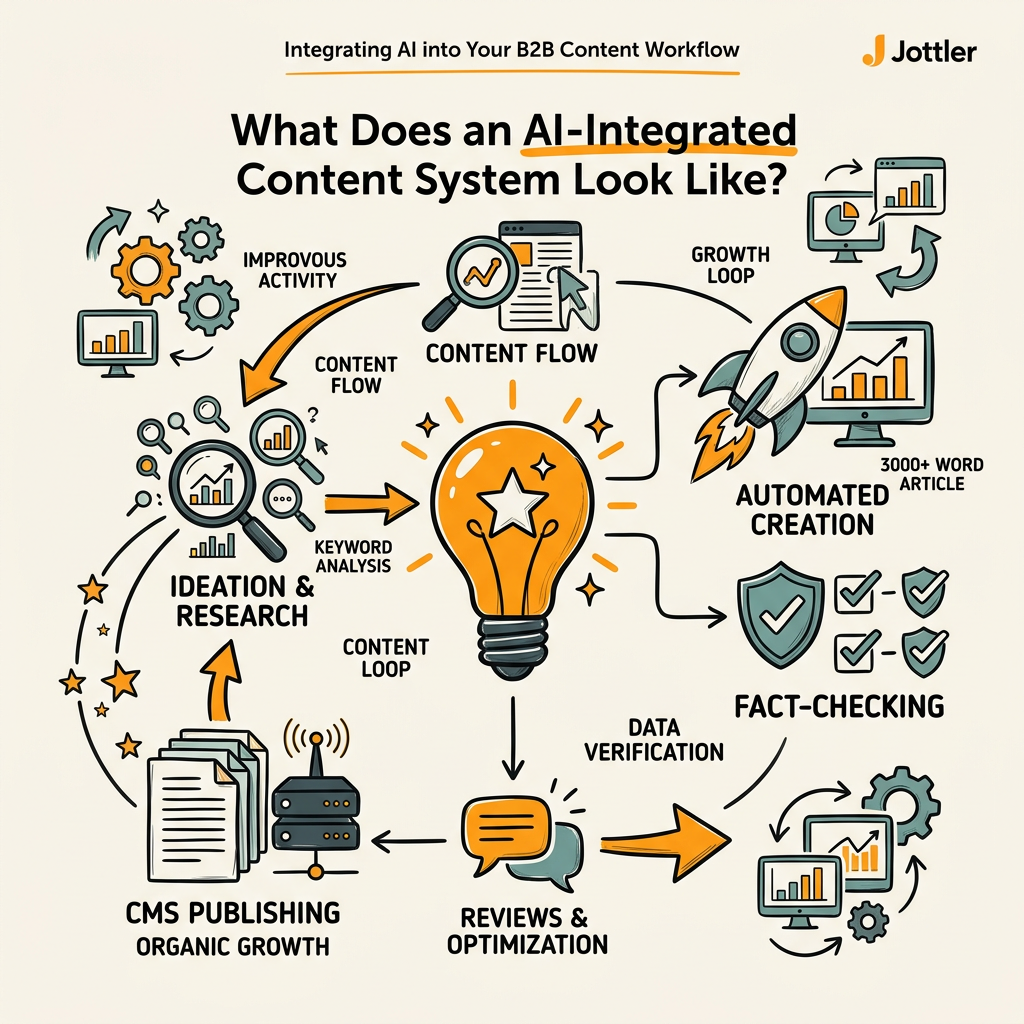
The best B2B content workflows aren't chaotic. They're pipelines. AI-driven campaigns launch 75% faster than non-AI campaigns, but that speed comes from structure, not from writing more (Sopro.io, 2026). Here's how the best teams organize it.
Research and Ideation at Scale
AI should do the grunt work of research. Keyword research, competitor analysis, topic clustering, and audience signal interpretation are tasks where AI can examine dozens of sources, extract insights, and surface opportunities faster than any human could.
The output isn't a final article outline—it's a structured brief. Here's what a modern AI research phase looks like: keyword volume and difficulty scores, top-ranking competitor content summary, semantic variations and related queries, audience intent signals, and suggested content angles based on gaps in the current top 10. Your team then decides which angle to pursue based on strategic fit.
This phase used to take 2-4 hours per article. AI agents can do it in 10 minutes, with human review taking another 15 minutes. That's a 90% time compression without sacrificing strategic thinking. According to Sopro.io's analysis of AI marketing statistics, teams using AI for research see 47% better click-through rates on resulting campaigns.
Writing With AI as Your Research Assistant, Not Your Ghostwriter
This is where most teams get it wrong. They feed AI a brief and expect a publishable article. That's why 43% of B2B marketers struggle to differentiate their content in a saturated market driven by mass-produced AI output (Omnibound, 2026).
Better approach: use AI to generate structure, citations, and reference material. The writer's job shifts from "write this article" to "synthesize this AI-generated research into a unique perspective." AI pulls in data from 14+ sources, extracts quotes, identifies patterns. Your expert writes the actual narrative and adds context competitors miss.
AI content strategy that balances automation with human judgment produces articles that rank better and convert better. Tools that skip human judgment produce undifferentiated content that floods the market.
Fact-Checking and Verification Before Publishing
Here's a non-negotiable step most automation-first teams skip: verification. Only 4% of marketers consider AI-generated content highly trustworthy without human oversight (Omnibound, 2026). That's not paranoia—it's reality. AI hallucinates statistics, misrepresents competitor features, and occasionally cites sources that don't exist.
"Every article needs a fact-checker. It's not optional. It's not a nice-to-have. It's the wall between you and legal liability. Build 20-30 minutes into every article's timeline for verification, and your content quality—and brand trust—will be significantly stronger than competitors publishing without review."
Build a verification checkpoint into your workflow. One person (ideally someone skilled at research) reviews every claim. Did the AI cite a statistic? Verify the year and the source. Did it quote a CEO? Make sure that quote exists. Did it describe a feature? Check that the feature still exists and wasn't removed in a product update.
This step usually takes 15-30 minutes per article and prevents the reputational damage of publishing false claims. Skip it at your peril.
Structuring Content for SEO and Internal Linking Automatically
Metadata, formatting, and internal linking are purely mechanical. AI shouldn't just handle these—it should build them into the foundation of the article.
An intelligent system generates: proper H2/H3 hierarchy for featured snippets, meta descriptions optimized for click-through, image alt text, schema markup for FAQ sections, and—critically—internal link opportunities tied to your existing content and topical clusters. Rather than manually hunting for linking opportunities after writing, the system suggests links as the article is drafted.
This stage saves 45-60 minutes per article and produces better SEO outcomes because it's strategic, not haphazard. Content automation tools for SaaS teams that integrate SEO directly into the workflow eliminate the publish-then-optimize cycle.
How Do You Measure Success in an AI-Integrated Workflow?
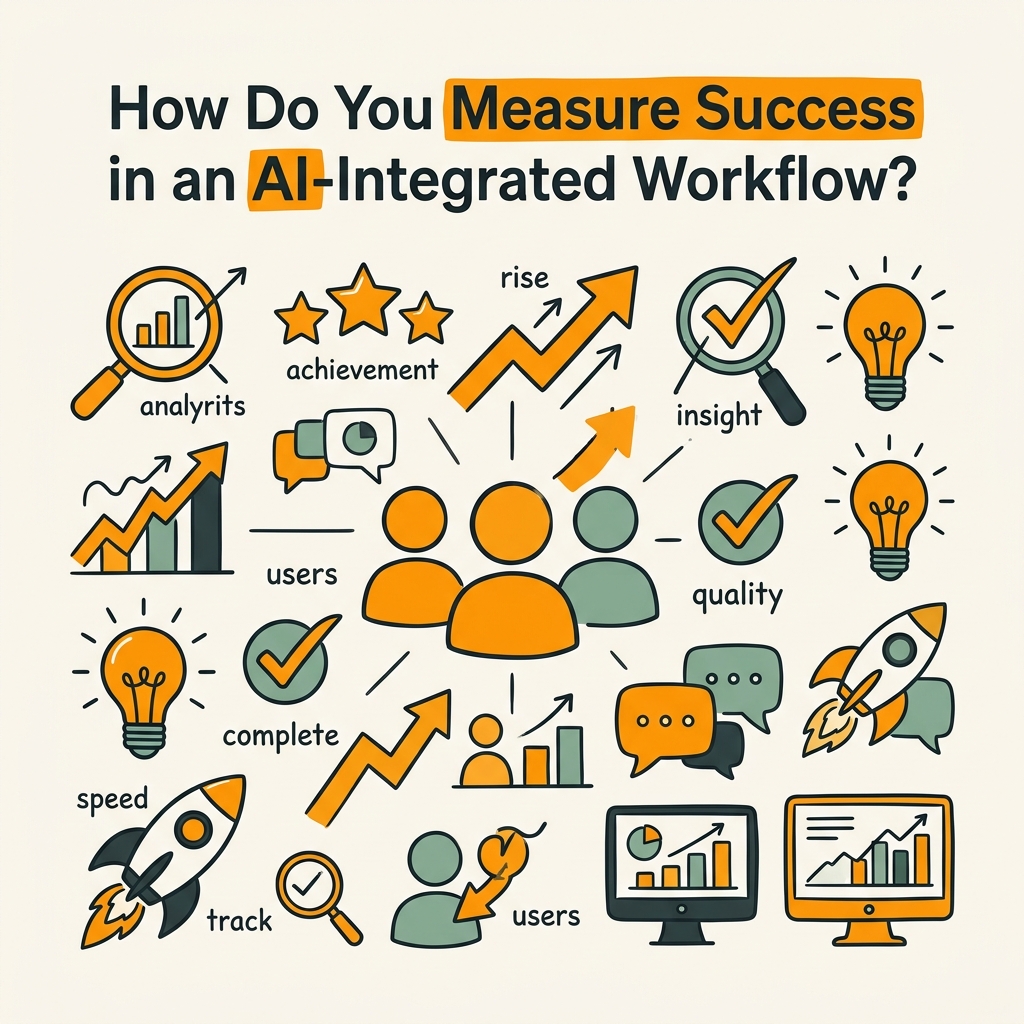
You can't optimize what you don't measure. Most teams track output metrics (articles published) when they should track outcome metrics (time saved, quality, and traffic gained). Here's what matters.
Time-to-Publish as a Core Metric
Set a baseline: How many hours per article does your team currently spend? Once you integrate AI, this should drop dramatically. Teams using AI-powered content automation see 25% faster time-to-publish, with enterprise users averaging $4.20 revenue per $1 spent on automation (MarketBetter, 2026).
Track this metric weekly. If your goal is to publish 3 articles per week with a team of 2 people, and you're currently at 8 hours per article, your target is 2-3 hours per article (leaving buffer for reviews and strategy). Measure whether your AI integration is getting you there.
One growing company tracked time-to-publish and found that AI research saved 2.5 hours per article, but poor internal linking setup cost 1.5 hours of additional editing. Adjusting the workflow to prioritize linking suggestions upfront brought their total to 3.2 hours per article—a 60% reduction from baseline.
Content Differentiation and Engagement Lift
Publishing faster is useless if traffic and engagement fall. The inverse is also true: perfect content nobody reads wastes everyone's time.
Track organic traffic and engagement (time on page, scroll depth, click-through to product pages, shares). You should see improvement, not decline, after integrating AI. AI-driven campaigns show 47% better click-through rates and 35% higher engagement (Sopro.io, 2026; MarketBetter, 2026). If your numbers are flat or declining, the workflow integration itself isn't the problem—the content quality is.
This usually points back to one of two issues: either you're automating too much (writing without human judgment), or you're not actually using AI's strength (bulk research and synthesis) effectively. Adjust the balance.
Organic Traffic Growth and SEO Gains
The ultimate metric: Does AI-integrated publishing drive more organic traffic? Two-thirds of businesses using generative AI in marketing and sales report revenue growth, with 5-10% revenue growth documented from AI adoption (McKinsey, 2025).
| Metric | Manual Workflow (Baseline) | AI-Integrated Workflow (Target) | Expected Outcome |
|---|---|---|---|
| Hours per article | 8-12 hours | 2.5-4 hours | 60-75% time savings |
| Articles published per month | 8-12 | 20-30 | 3x output increase |
| Average time to rank (keywords) | 8-12 weeks | 4-6 weeks | 50% faster ranking |
| Organic traffic per month | 5,000-10,000 sessions | 15,000-30,000 sessions | 2-3x traffic growth |
| Cost per article (labor) | $400-600 | $125-200 | 60-70% cost reduction |
Your timeline for seeing results should be 2-3 months of consistent publishing at the new velocity. You're compounding—more articles, more keywords, more opportunities to rank. After 6 months of publishing 4-5 articles per week instead of 2-3, you should see noticeable SEO gains and increased organic revenue.
What Are the Common Pitfalls When Integrating AI Into Content Workflows?
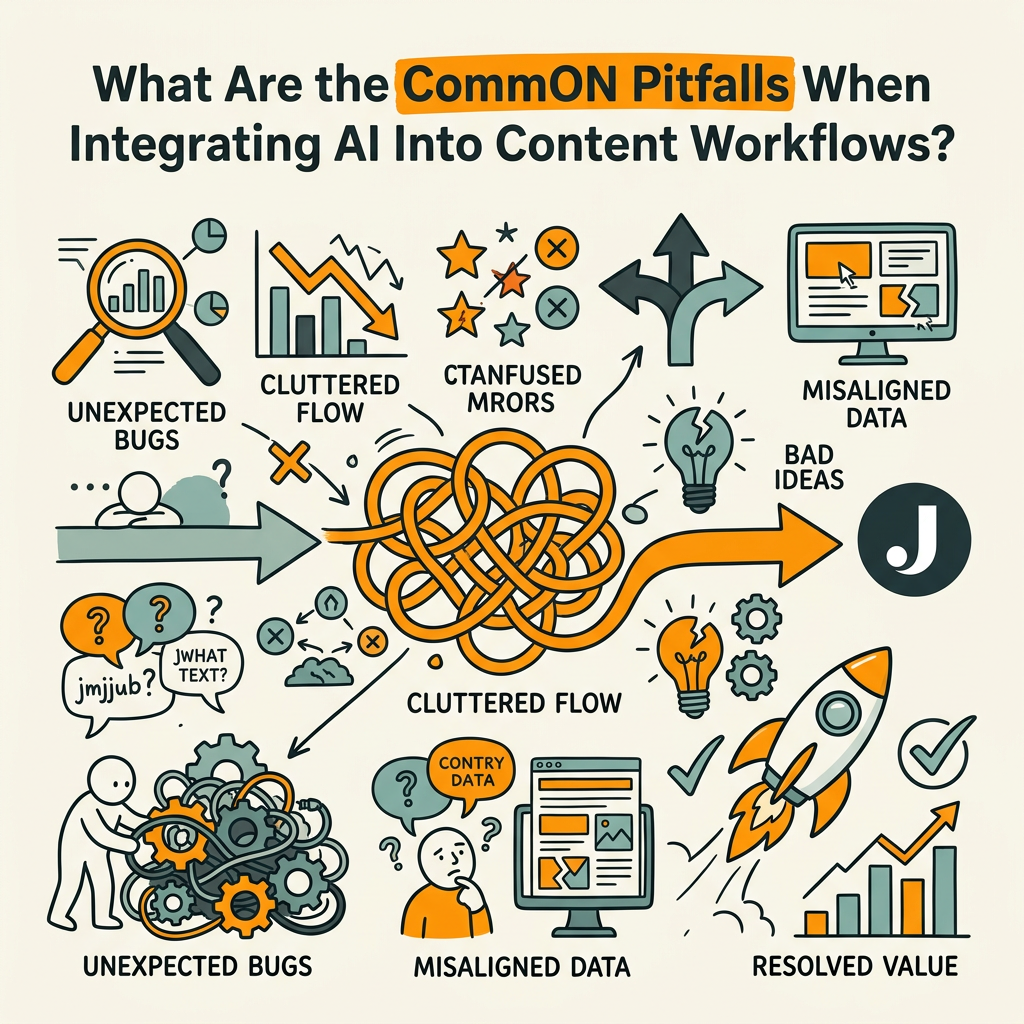
Most failures don't happen because AI is broken. They happen because teams skip critical steps or treat AI as a replacement instead of a force multiplier.
Automating Without a Differentiation Strategy
The easiest mistake: publish fast without publishing smart. If your AI workflow generates bland, generic content because you deprioritized human judgment, you've wasted time and damaged your brand authority.
The fix: build strategy into your workflow before content generation begins. What's your unique angle? What competitor gap are you filling? What expertise does your team have that competitors lack? These decisions happen before AI drafts a single word. AI's job is to make execution of that strategy faster, not to create the strategy itself.
Skipping the Verification Step
AI generates confident-sounding misinformation. It will cite fake studies, misquote executives, and invent statistics. Only 4% of marketers trust AI output without human review—and for good reason (Omnibound, 2026).
Every article needs a fact-checker. It's not optional. It's not a nice-to-have. It's the wall between you and legal liability. Build 20-30 minutes into every article's timeline for verification.
Underestimating the Infrastructure Challenge
AI can write fast, but your CMS, analytics, and linking architecture need to keep pace. If your publishing process requires manual metadata entry, CMS-specific formatting, and a human to add internal links by hunting through Google Docs, you haven't actually integrated AI. You've just shifted the bottleneck.
Look for tools and workflows where publishing, metadata, and linking are automated or semi-automated. SEO automation platforms that integrate with your CMS can publish articles directly with proper formatting, schema markup, and internal links already embedded—that's the infrastructure win that actually matters.
Publishing Inconsistently
AI makes it easy to publish 1 article one week and 4 the next. SEO rewards consistency. Search engines like predictable, reliable content signals. So do readers.
Build a sustainable publishing cadence and stick to it. If you commit to 3 articles per week, publish 3 articles every week. If you commit to 2, do 2. Consistency compounds. Sporadic bursts don't.
How Should You Choose Tools for AI-Integrated Workflows?
The market offers hundreds of content AI tools, most claiming to be the solution. The best approach: look for integrated systems rather than point solutions.
All-in-One vs. Best-of-Breed Comparison
There's a tradeoff between integrated platforms and specialized tools. HubSpot handles research, drafting, publishing, and analytics in one platform. Specialized tools like Ahrefs handle research better, but you then need separate writing, publishing, and analytics tools.
For busy founders and lean teams, integrated workflows win. You want one system that handles keyword research, AI drafting with fact-checking, CMS publishing, and performance tracking—not 5 tools with poor integration between them. The switching costs and context loss kill the velocity gains.
Critical Features for B2B Content Workflows
When evaluating tools, look for:
- Deep research capability: Can it pull from 10+ authoritative sources, not just generate from training data?
- Native CMS integration: Does it publish directly to your platform, or does content require manual copying?
- Fact-checking and verification: Does it flag unverified claims or citations for human review?
- Internal linking automation: Can it suggest relevant internal links based on your existing topical authority structure?
- SEO optimization built-in: Does it generate metadata, schema markup, and optimize for featured snippets without extra steps?
- Consistency and brand voice: Can you train it on your tone, terminology, and style so output aligns with your brand?
Most point solutions handle 1-2 of these well. Integrated systems handle all of them, though some better than others.
Implementation Timeline and Training
Tools with faster onboarding don't always produce better results. A tool that takes 2 weeks to set up but integrates perfectly with your CMS saves more time than one with a 2-hour setup that requires manual steps every article.
Factor in training time too. If your team needs a week to learn a tool's workflow, that's a sunk cost you'll recoup in the first month of usage, but it's real. Look for tools with templates, pre-built workflows, and active support for B2B teams specifically. SaaS content marketing frameworks guide implementation roadmaps for teams new to automation.
Conclusion
Integrating AI into your B2B content workflow isn't a technology problem—it's a process design problem. 94% of B2B marketers already use AI, but most see modest gains because they're bolting tools onto broken workflows instead of redesigning the workflow itself.
The teams seeing 75% faster campaign launches and 50-60% time savings did the hard work first: mapping current workflows, identifying bottlenecks, and rebuilding around automation. They chose integrated systems over scattered point tools. They preserved human judgment where it matters (strategy, differentiation, verification) and let AI handle what it's actually good at (research, synthesis, formatting).
The math is straightforward. If you can reduce per-article time from 10 hours to 3 hours, you can triple your publishing velocity while cutting labor costs by 70%. Over a year, that compounds into massive organic traffic gains and measurable revenue impact.
Start your SEO agent and automate the workflow that's currently eating your team's time. Build the content machine that compounds.
FAQs
How much time does AI actually save in a content workflow?
Teams using AI-integrated workflows reduce per-article time from 8-12 hours to 2.5-4 hours, a 60-75% reduction. The biggest wins come from research (2-3 hours saved), structure and drafting (1.5-2 hours saved), and metadata/linking automation (45-60 minutes saved). Fact-checking and human editing still require 45 minutes to 1.5 hours per article because this step cannot be automated without risking accuracy. The remaining time is spent on strategic decisions and quality review—work that should never be fully automated in B2B content.
Can AI-generated content rank as well as human-written content?
Yes, but only if human judgment drives the strategy and differentiation. 35% of B2B marketers report improved content performance after integrating AI, but this requires treating AI as a research and drafting tool, not a replacement for human expertise. The content that ranks best combines AI's ability to synthesize 14+ sources with human judgment about what angle matters to your audience. AI content without strategic direction or fact-checking ranks poorly because it's generic—it sounds like everything else. AI content with human oversight outperforms manual-only content because it combines speed with credibility.
What's the best tool for automating a B2B content workflow?
Integrated platforms beat best-of-breed combinations for most growing teams because they eliminate handoffs and context switching. Look for tools that handle keyword research, AI drafting with fact-checking, CMS publishing, and internal linking in one system. The tool should integrate directly with your CMS (not require manual copy-paste), provide built-in SEO optimization, and support your brand voice. Pricing starts at $29-50/month for core features, though enterprise-grade systems run higher. The ROI comes from reducing per-article time and publishing velocity gains—not from the tool alone, but from the workflow redesign that the tool enables.