Intent-Based B2B SEO: Target Buyers, Not Just Traffic
Most B2B companies optimize for traffic volume. They chase keyword rankings, hit monthly page-count targets, and call it a win. But B2B buyers conduct an average of 12 online searches before landing on a brand's website, and 81% of sales representatives report that prospects research far more before making direct contact. The disconnect? Ranking high doesn't mean ranking in front of actual buyers ready to move forward. Companies using intent-based strategies see 30% shorter sales cycles and dramatically higher conversion rates. Intent-based B2B SEO flips the script. Instead of fishing for volume, you target the specific search behaviors that map to buying decisions—pricing comparisons, competitor reviews, demo requests, use-case solutions. The result is fewer visitors, but visitors with genuine intent to buy.
Key Takeaways
- B2B buyers conduct 12 searches before visiting a brand site—targeting intent at each stage captures them earlier (2025 data)
- Commercial-intent keywords (pricing, comparison, demo) convert 2–3% at baseline, 5–7% for high-intent targeting (2025–2026 benchmarks)
- Intent-based SEO requires mapping keywords to funnel stage and buyer role, not just chasing volume—automating this research and content production scales the strategy without burnout
- Why Intent Beats Volume: Commercial-intent searches have 10–20x higher conversion potential than informational keywords with the same volume.
- The Four Intent Types: Informational, commercial, transactional, and navigational keywords signal different buyer stages—each requires different content strategy.
- Mapping Keywords to Your Sales Funnel: High-intent BOFU (bottom-of-funnel) searches like "pricing," "demo," and "vs." generate more SQLs than generic awareness-stage terms.
- First-Party Intent Signals Over Third-Party: Your own site behavior—pricing-page visits, demo form submissions, download velocity—predicts buying intent more reliably than external data.
- Scaling Intent-Based Content Production: Manual keyword research and intent mapping locks teams into reactive, inconsistent output. Automation platforms handle continuous keyword discovery and intent alignment at scale.
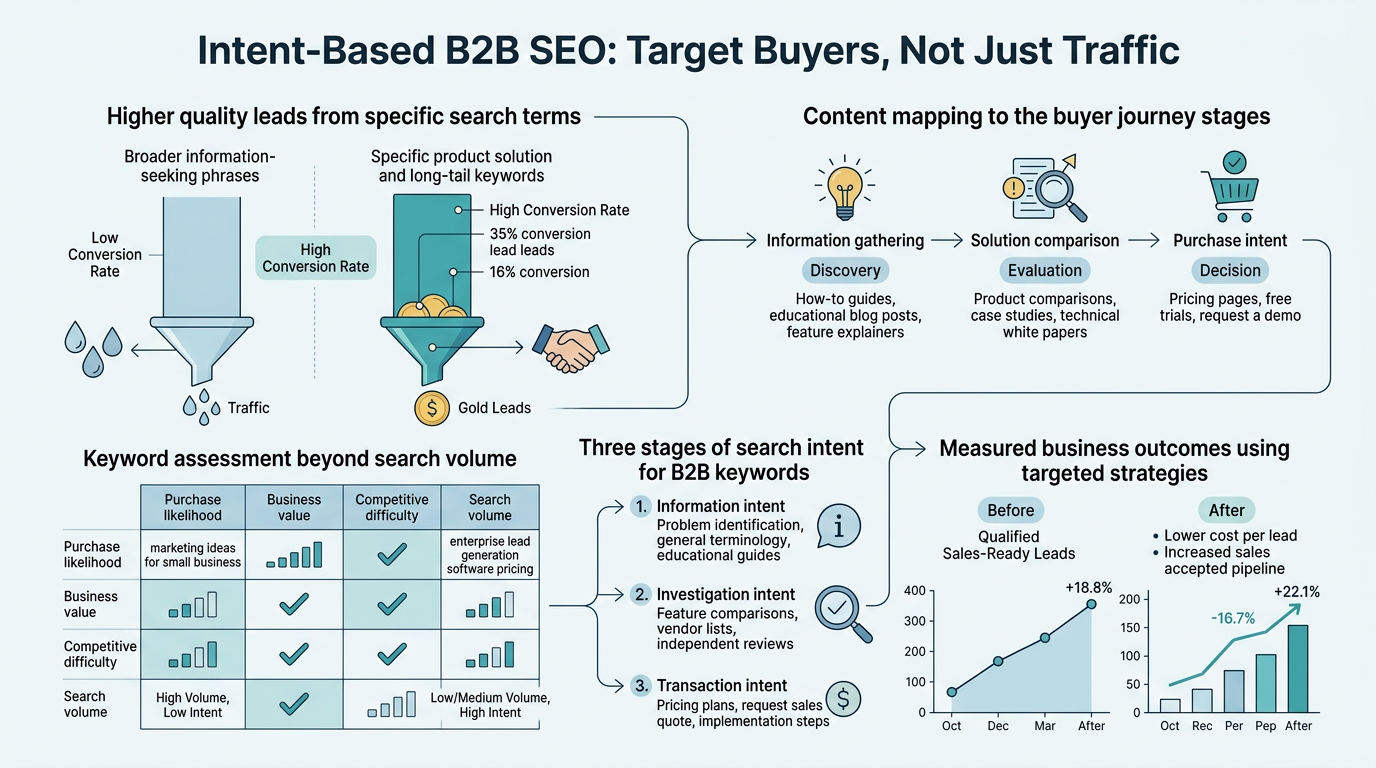
Why Intent Matters More Than Volume in B2B SEO
The traffic myth is persistent: Rank for volume, and conversions follow. In B2B, this is backwards. A single visitor searching for "CRM pricing" is worth 50 visitors searching for "what is a CRM." The first has buying intent. The second is still in research mode, months away from a purchase decision. Targeting intent means focusing your keyword strategy on the searches that actually move deals forward.
"B2B companies that prioritize intent-based keywords over volume see conversion rates jump from 2–3% to 5–7%, directly impacting pipeline and sales cycle velocity. Intent signals where a buyer sits in their journey; traffic volume does not."
The Cost of Chasing Volume Without Intent
Teams that rank for high-volume, low-intent keywords pay a hidden cost. They attract traffic that rarely converts. They invest resources in content that doesn't support sales cycles. Meanwhile, competitors who focus on commercial-intent queries win the demos, accelerate deal flow, and improve ROI per content dollar spent. B2B lead-generation sites typically convert 2–3% of visitors, but top performers targeting intent-driven keywords reach 5–7% conversion rates. The difference is often worth hundreds of thousands in pipeline. When you filter for intent, you're filtering for revenue potential. A proper B2B SEO strategy that scales without burnout prioritizes intent over volume from the start.
How Buyers Signal Intent Before They Contact Sales
B2B purchase journeys are self-directed and research-heavy. Prospects visit pricing pages multiple times. They compare competitors. They download case studies. They watch demo videos. They search for implementation guides specific to their industry. Each of these behaviors is an intent signal. High-intent behaviors cluster around repeated visits to product, pricing, and comparison pages—signals that someone has moved past learning and into evaluation. Intent-based SEO means creating content that catches buyers at each of these stages and helps them move forward.
The Four Types of Search Intent and What Each Signals
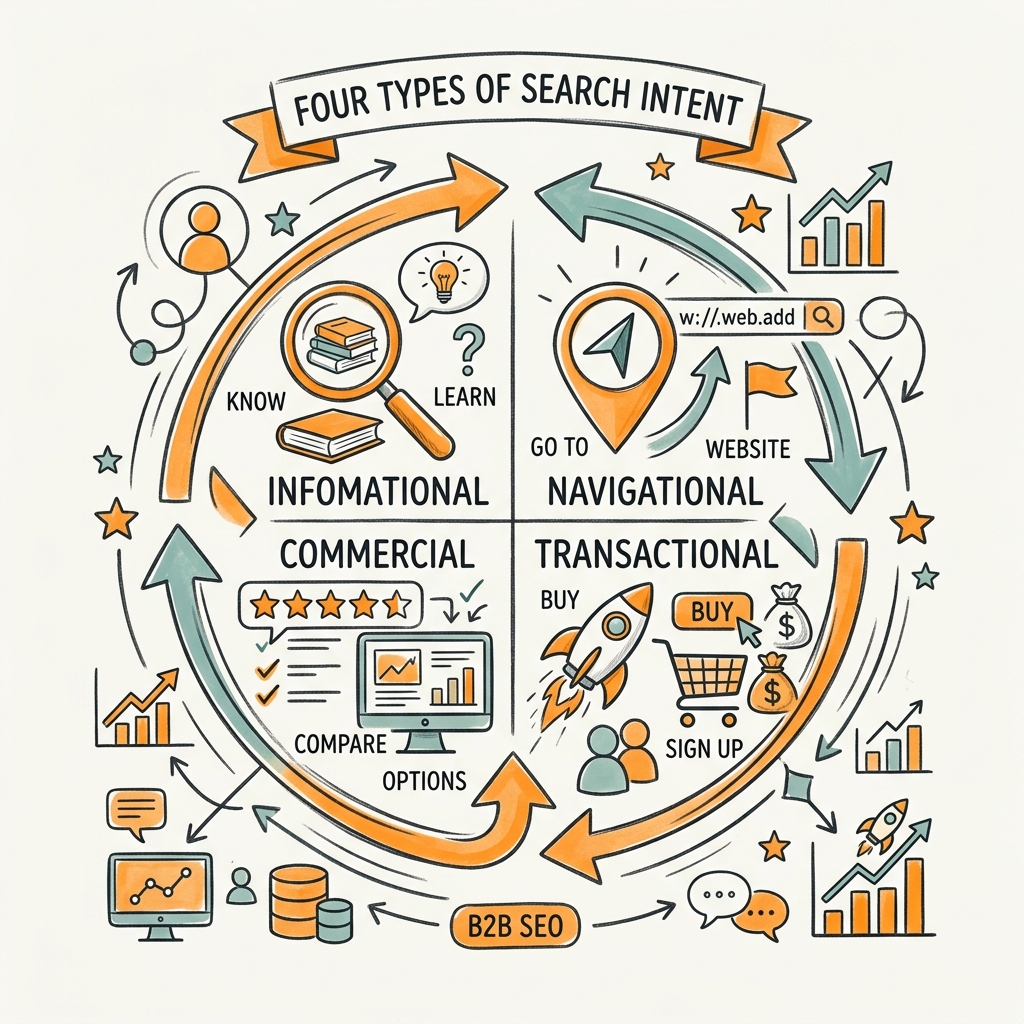
Not all searches are created equal. Understanding intent type—informational, commercial, transactional, or navigational—is the foundation of intent-based B2B SEO. Each signals where a buyer sits in their journey. Each requires different content, messaging, and landing-page design. Miss this, and your content misses the moment.
Informational Intent: Building Awareness (TOFU)
Informational searches signal early-stage research. A prospect searches "how to choose a CRM" or "what is demand generation?" They're exploring problems and solutions, not yet sold on anyone. This traffic has value—it builds brand awareness and supports top-of-funnel nurture. But it doesn't convert immediately. Content targeting informational intent should educate, compare frameworks, and build credibility. The conversion happens later when that same person re-searches with commercial intent.
Commercial Intent: Evaluating Options (MOFU)
Commercial-intent keywords reveal active evaluation. Searches like "best CRM for teams," "CRM vs. Salesforce," or "CRM software comparison" show that someone is actively weighing solutions. This is the zone where content wins deals. These searches convert 2–3x higher than informational keywords because the buyer is already in the market. Content here should compare solutions directly, showcase advantages, address buying concerns, and make next steps (demo, trial, pricing) frictionless. Tools like Factors recommend mapping commercial queries to specific MOFU pages and monitoring competitor mentions—if prospects are searching "vs. [competitor]," you need a direct answer.
"When a prospect searches 'vs. [competitor],' they've already decided they need a solution in your category. Your job is to be in that search result and give them a reason to choose you over the alternative. This single search type often determines deal outcomes."
Transactional Intent: Ready to Buy (BOFU)
Transactional keywords are decision-stage. "CRM pricing," "Salesforce demo," "book a consultation," "free trial"—these searches show immediate purchase intent. Conversion rates spike here. Traffic is lower, but value is highest. Content must be ultra-clear: pricing transparency, feature breakdowns, fast onboarding paths, and urgency signals. Many teams waste this opportunity by burying pricing or making demo requests hard to find. Intent-based teams create dedicated BOFU pages that assume the reader is ready to move forward.
Navigational Intent: Brand-Aware Searchers
Navigational keywords like "Salesforce pricing" or "Jottler login" signal that someone already knows your brand or a competitor's and is looking for a specific page. This traffic is typically highly qualified. Your job is to make sure you own the ranking and that the landing page is frictionless. For competitive brand searches—especially "competitor vs. us"—you need pages that directly address the comparison and pull the prospect toward your offering.
How to Map Keywords to Funnel Stage and Buyer Role
Intent-based B2B SEO requires deliberate mapping: Which keywords align with which funnel stage? Which buyer roles are searching for what? Skipping this step means scattering content effort across unconnected keywords. Doing it well means every piece of content has a clear job in your sales funnel.
Step 1: Identify Your Buyer Personas and Their Roles
Before you map keywords, you need to know who's buying and what their titles are. In B2B, a single deal often involves a marketer, a CFO, a CTO, and a department head. Each persona has different concerns and searches differently. A marketer might search "marketing automation platform"; a CFO might search "marketing automation ROI"; a CTO might search "marketing automation API integration." Mapping keywords to personas means understanding these differences and creating relevant content for each role. This is why generic, one-size-fits-all content underperforms in B2B. Scaling B2B SEO without burnout requires systems that handle persona-specific content at scale.
Step 2: Create a Keyword-to-Intent Matrix
Build a spreadsheet that ranks your keywords by intent strength and conversion probability. High-intent, high-conversion keywords get BOFU pages. High-intent, low-conversion keywords get MOFU nurture content. Low-intent, high-volume keywords deserve skepticism—volume doesn't equal revenue. This prioritization prevents you from wasting time on keywords that won't move the needle.
| Intent Level | Funnel Stage | Example Keywords | Content Type |
|---|---|---|---|
| Informational (Low) | TOFU | "What is SEO?", "How to do keyword research" | Guides, how-tos, educational blogs |
| Commercial (Medium) | MOFU | "Best SEO tools", "SEO tool comparison", "vs" keywords | Comparisons, case studies, feature breakdowns |
| Transactional (High) | BOFU | "SEO tool pricing", "free SEO trial", "schedule demo" | Pricing pages, product tours, demo requests |
| Navigational (Varies) | MOFU+BOFU | "Jottler login", "Jottler pricing", "Jottler alternative" | Brand pages, comparison pages, landing pages |
Step 3: Extract Buyer Language from First-Party Signals
Your best keyword research doesn't come from tools—it comes from your own data. Listen to sales calls. Read support tickets. Check your CRM for deal closed notes. What phrases do buyers use when they're ready to move? When they're evaluating? These first-party signals reveal intent better than any third-party tool. Many teams find low-volume, high-intent keywords through sales intelligence that traditional SEO tools completely miss.
Prioritizing High-Intent Keywords and Commercial Qualifiers
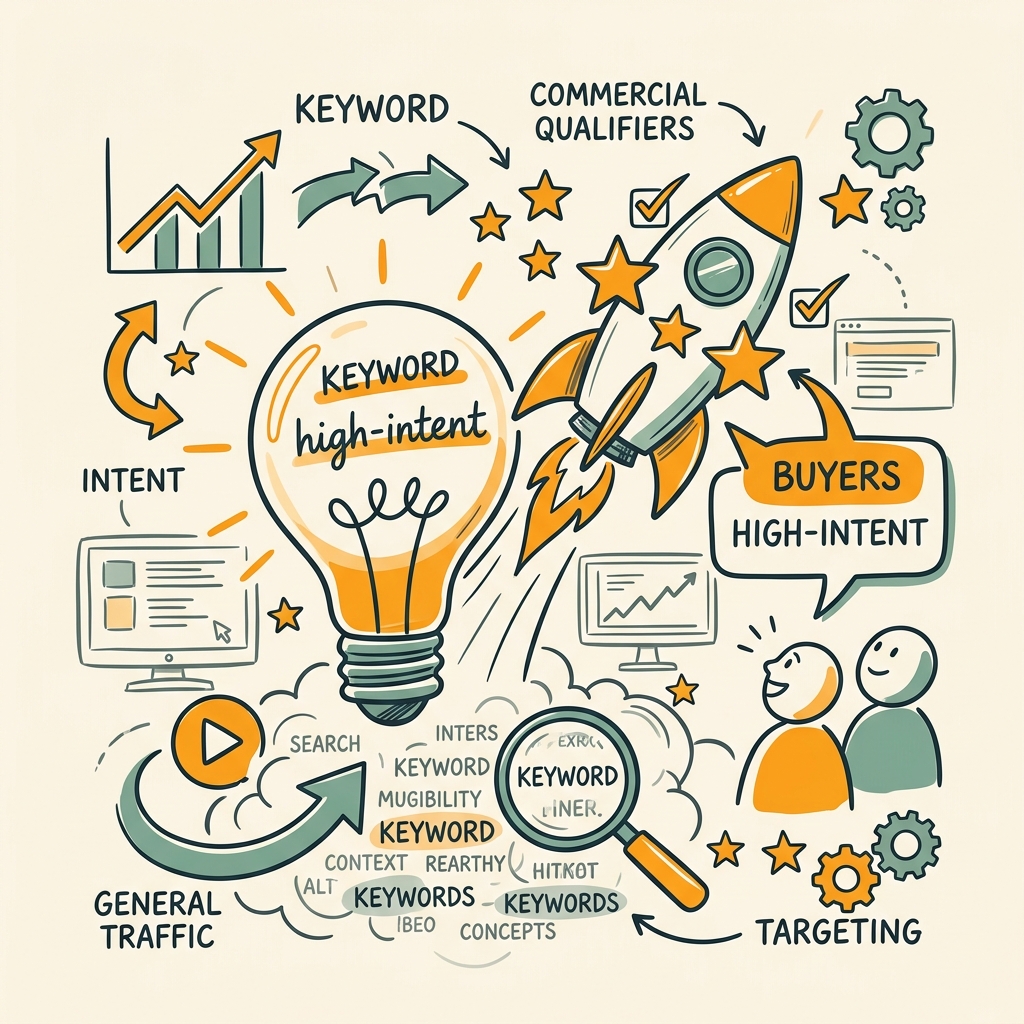
Not all keywords are worth targeting. Intent-based SEO means ruthlessly prioritizing keywords that drive revenue. Commercial modifiers—words that signal buying readiness—should be your focus. These modifiers transform generic keywords into intent signals.
Using Commercial Modifiers to Signal BOFU Intent
Add commercial modifiers to your keywords to capture ready-to-buy traffic. These modifiers include:
- "Pricing" – "B2B SEO tool pricing," "content automation pricing"
- "Demo" or "free trial" – "Schedule a demo," "free trial"
- "Comparison" or "vs." – "Jottler vs. ContentStudio," "best B2B SEO tools comparison"
- "Best" or "top" – "Best SEO automation tools," "top content marketing platforms"
- Use-case qualifiers – "B2B SEO for SaaS," "content automation for scaling teams"
- Industry or vertical – "B2B SEO for tech companies," "content marketing for agencies"
Each modifier narrows intent and raises conversion potential. "Content marketing tools" is generic. "Content automation tools for B2B SaaS teams" is commercial intent. Rank for the longer, more specific version and you'll see dramatically higher conversion rates.
Validation: Using PPC Data to Confirm Commercial Intent
Before investing heavily in organic content, validate keyword intent with paid search data. If a keyword has high ad CTR, high CPC, and low bounce rate in your PPC campaigns, it's signaling strong commercial intent. That's a keyword worth prioritizing organically. Conversely, if a keyword gets clicks but zero conversions in PPC, it probably doesn't deserve organic investment. Let your paid campaigns guide your organic roadmap.
Content and Landing Page Strategy for Intent-Driven SEO
Ranking for high-intent keywords is only half the battle. If a prospect lands on generic content or a confusing page, they'll bounce. Intent-based SEO requires dedicated, specific landing pages that match exactly what the searcher is looking for. A strong AI content strategy ensures every page is built for a specific buyer intent, not generic best practices.
Create Separate Pages for Different Intent Variations
Don't try to answer "pricing," "demo," and "comparison" on a single page. Create separate pages for each. A prospect searching "B2B SEO tool pricing" needs to see pricing immediately. A prospect searching "B2B SEO tool free trial" needs to see how to start a trial. A prospect searching "Jottler vs. Semrush" needs a dedicated comparison page. This specificity is what separates high-converting intent-based SEO from generic content that tries to be everything to everyone.
Optimize BOFU Pages for Clarity and Urgency
Your BOFU pages—pricing, demo, comparison—should follow a consistent pattern: short paragraphs, bullet points, clear CTAs, and minimal friction. 91% of B2B researchers now use mobile devices during the purchase process, so mobile optimization isn't optional—it's the baseline. Don't hide pricing behind a form. Don't make demo requests require five fields. Remove friction. Make next steps obvious. If a prospect has intent, your job is to not slow them down.
Use Internal Linking to Build Intent-Based Topic Clusters
Link your funnel content strategically. Your TOFU guides should link to relevant MOFU comparisons. Your MOFU comparisons should link to BOFU pricing or demo pages. This architecture guides prospects through the funnel and tells search engines that your content is interconnected and comprehensive. Tools like Jottler automatically handle internal linking across content clusters, ensuring that every new piece connects meaningfully to existing content and builds topical authority.
Automating Intent-Based Content Production at Scale
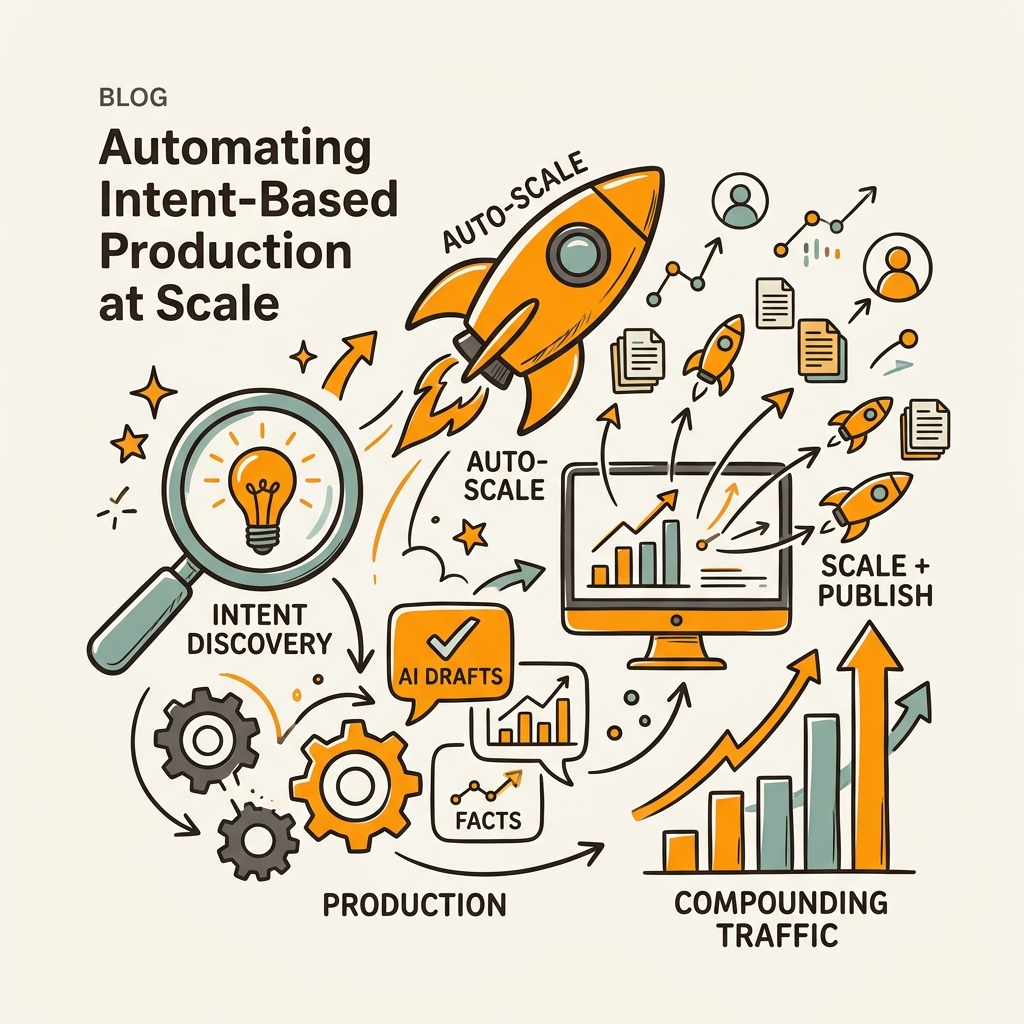
Intent-based B2B SEO is thorough. It requires continuous keyword research, intent classification, funnel mapping, and content creation. Most teams do this manually, which means they're constantly behind. One solution: automate the research, writing, and publishing pipeline. Content marketing automation platforms built for intent-based SEO handle the heavy lifting so you can focus on strategy.
"Teams attempting intent-based SEO manually hit a ceiling around 50–80 pages per quarter. Automation platforms scale that to 200–500 pages per quarter while maintaining intent accuracy and internal linking. The difference is not incremental—it's transformational for organic pipeline."
Why Manual Intent-Based SEO Doesn't Scale
Intent research is iterative. You discover new keywords constantly. You need to re-evaluate intent for each one. You need to draft content that matches intent precisely. You need to optimize landing pages based on buyer feedback. You need to build internal links strategically. Doing this manually—even with a full team—is slow and inconsistent. Many teams start with intent-based frameworks and abandon them because the operational lift is too high. Automation removes the friction.
How AI-Driven Content Platforms Handle Intent at Scale
Modern content platforms use AI to research, classify, and create intent-driven content in minutes. They analyze your site, understand your buyer personas, scan competitor content, and identify content gaps aligned with high-intent keywords. They draft long-form, SEO-optimized articles that target specific buyer stages. They add internal links, fact-check claims, and publish directly to your CMS. What would take a marketing team weeks happens in hours. For scaling companies, this is the only way to sustain consistent, intent-driven content output without burnout.
Measuring Intent-Based B2B SEO Performance
The metrics you track reveal what you actually care about. Most teams track rankings and traffic. Intent-based teams track what matters: qualified leads, demo requests, sales conversations, and pipeline contribution. Content marketing ROI is measured through pipeline, not impressions—this principle is core to intent-based SEO.
Move Beyond Rankings: Track Revenue-Driven Metrics
Stop optimizing for position five versus position three. Instead, measure:
- Form submissions and demo requests – How many prospects are requesting a demo from organic traffic?
- Marketing qualified leads (MQLs) – How many organic visitors meet your definition of a qualified lead?
- Sales qualified leads (SQLs) – How many organic visitors are passed to sales as ready to talk?
- Pipeline contribution – How much revenue-stage pipeline came from organic?
- Deal influence – What percentage of closed deals involved organic research at any stage?
These metrics require closer CRM/analytics integration, but they're non-negotiable for intent-based programs. If your organic channel isn't producing SQLs and pipeline, it's not delivering business value.
Segment Traffic and Conversion by Intent Type
Track conversion rates separately for TOFU, MOFU, and BOFU traffic. You'll likely see: TOFU converts at 0.5–1%, MOFU at 2–3%, and BOFU at 5–10%. This tells you which stages are working and which need optimization. If BOFU is underperforming, your pricing or demo pages need work. If MOFU is flat, your comparisons aren't compelling enough. Segmentation reveals where the real opportunities are.
Conclusion
Intent-based B2B SEO flips the fundamental question from "How much traffic can we get?" to "What traffic can we convert?" This shift transforms SEO from a traffic channel into a revenue channel. B2B buyers conduct 12 searches before contacting a brand, and each search signals intent—awareness, evaluation, or decision-readiness. By mapping keywords to funnel stage, creating dedicated pages for each intent type, and using buyer-language to guide strategy, you capture prospects at the exact moment they're ready to move forward. The result is 30% shorter sales cycles, higher conversion rates, and demonstrable pipeline impact. For busy founders and scaling teams, automating this process—research, writing, optimization, and publishing—is the only way to compound organic growth without burning out. Intent-based SEO wins not because you attract everyone, but because you attract the right people at the right time. Start your SEO agent and let AI handle the research, writing, and internal linking while you focus on strategy.
FAQs
What is the difference between high-intent and low-intent keywords in B2B SEO?
High-intent keywords signal active buying behavior. They include commercial modifiers like pricing, demo, comparison, or specific use cases: SEO automation for SaaS teams or content marketing tool for agencies. These searches come from prospects already evaluating solutions and ready to move through the funnel. Low-intent keywords are informational—what is B2B SEO, how to do keyword research. They capture early-stage learners, not buyers. High-intent keywords convert 2–10x better than low-intent keywords because they map to decision-stage searches. Prioritizing high-intent keywords means targeting smaller volume with far higher revenue potential.
How do I know which keywords my B2B buyers are actually searching for?
Your best source is first-party data. Listen to sales calls and extract exact phrases prospects use when they're evaluating or asking about pricing. Review CRM notes from closed deals—what problems and keywords led to conversations? Read support tickets to find language buyers use post-purchase. Check your analytics for high-converting pages and reverse-engineer the searches that led there. Then validate with paid search: Run PPC campaigns on those keywords and watch which ones drive conversions. This combination of sales intelligence, customer language, and PPC validation reveals keywords that traditional SEO tools completely miss—often low-volume, high-intent terms that competitors aren't targeting yet.
Can I automate intent-based keyword research and content creation?
Yes. AI-driven content platforms now handle the full intent-based pipeline: researching keywords, classifying intent, mapping to funnel stage, drafting content, optimizing for conversion, and publishing. These platforms analyze your site structure, buyer personas, and competitive landscape to identify high-intent gaps. They generate SEO-optimized articles that target specific buyer stages and add internal links automatically. What takes a manual team weeks happens in hours. For scaling companies, automation is the only way to maintain consistent, intent-driven content output without burnout. The platforms that do this best integrate with your CMS so content publishes directly, and they fact-check claims using multiple sources to ensure accuracy.