Interpreting Traffic Attribution Models for Better ROI
Most marketing teams are leaving money on the table without realizing it. 73% of DTC brands still rely on last-click attribution, which can misattribute $2.8M annually per $10M in revenue. The result? Budgets flow toward flashy bottom-funnel tactics while strategic awareness campaigns get starved. The fix isn't guesswork or spreadsheet purgatoryit's understanding how to interpret attribution models correctly and use them as a ROI compass, not a crystal ball.
Key Takeaways
- Last-click attribution overstates paid search by 40–65% and understates content and display by 150–400%, per XICTRON analysis (2026).
- Organizations implementing multi-touch attribution report 18% higher marketing ROI, 22% better lead quality, and 15% lower CAC (2026).
- Data-driven and machine-learning attribution models deliver 25–35% more accurate ROI measurements than traditional models (Forrester, 2025–2026).
- The strongest 2026 practice is hybrid measurement: use attribution for optimization, but validate with incrementality testing and CRM data.
- Understanding Attribution Model Types: Last-click, multi-touch, and data-driven models each tell a different story about where your revenue actually comes from.
- Interpreting Model Outputs: Raw numbers from attribution systems require contextsignal loss, identity resolution gaps, and privacy changes distort all models equally.
- Validating Attribution with Incrementality: Holdout tests and conversion lift experiments reveal the true causal impact platforms claim to measure.
- Building a Hybrid Measurement Stack: Combine attribution, marketing mix modeling (MMM), and first-party CRM data to triangulate truth.
- Translating Attribution into Budget Decisions: Move money gradually, audit monthly, and reallocate in small 10–15% increments every 60–90 days.
What Attribution Models Actually Measure (And What They Don't)
Attribution assigns credit for conversions across touchpoints. The model you choose determines what story your data tells about ROI. Organizations using multi-touch attribution see 18% higher marketing ROI compared to single-touch approaches, yet most teams still rely on simpler, less accurate models because they're easier to implement and explain to leadership.
The Three Core Attribution Archetypes
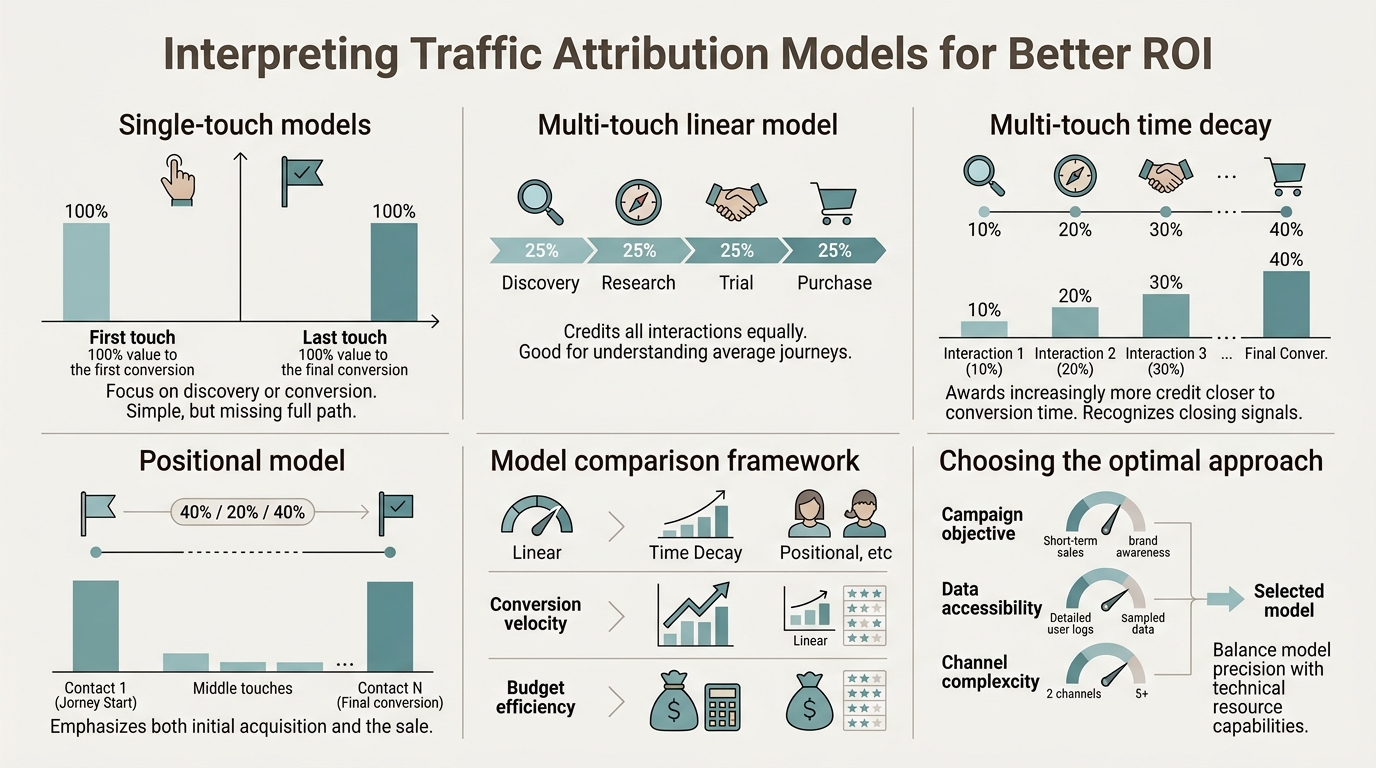
Last-click attribution awards 100% credit to the final touchpointusually the paid search click or direct visit. It's operationally simple: one database query, one answer. The problem? It distorts reality. Last-click systematically overcredits high-intent, lower-funnel channels like search and retargeting while erasing the influence of awareness-building channels like content, social, and display.
Multi-touch attribution splits credit across multiple touchpoints in a customer's journey. Common approaches include linear (equal credit to all touches), time-decay (more credit to recent touches), and position-based (40% first, 40% last, 20% middle). Multi-touch is theoretically more accurate but demands cleaner data, better identity resolution, and more sophisticated analytics infrastructure.
Data-driven (machine-learning) attribution uses statistical models to infer credit weights based on historical conversion patterns. It's the most complex to implement but also the most granular. ML-powered attribution can achieve 25–35% more accurate ROI measurements than traditional models because it learns which touchpoint combinations actually convert, rather than applying a fixed formula. When you layer proper AI-powered SEO practices on top of solid attribution, the compounding effect is significant.
Why All Models Are Currently Broken (And How to Use Them Anyway)
Here's the uncomfortable truth: every attribution model is distorted by the same structural problems in 2026. iOS privacy changes, third-party cookie deprecation, and fragmented identity resolution have degraded signal quality across the board. Multi-touch attribution coverage has fallen to 30–60% of 2020-level signal because browsers and mobile devices now hide user paths. Walled-garden platforms like Meta and Google report their own conversions privately, making reconciliation with first-party data nearly impossible.
This doesn't mean attribution is worthlessit means you can't treat any model as ground truth. Instead, use attribution models directionally. They're diagnostic tools: they flag which channels show suspicious patterns, reveal data quality issues, and identify where to focus incrementality tests. Amraandelma's 2026 attribution statistics report that advanced ML-powered approaches achieve 27% CAC reduction in year one and $4.80 return per $1 spent on infrastructure.
How to Read Attribution Output Without Fooling Yourself
When your analytics tool shows that a channel generated 1,000 attributed conversions last month, that number is a point estimate wrapped in uncertainty. Here's what you're actually looking at and how to interpret it correctly.
Spotting Identity Resolution Gaps
Attribution only works if you can stitch together a user's journey across devices and platforms. When that stitching failsbecause a user clears cookies, switches devices, or browses in private modethe journey breaks. A customer might have seen your ad on mobile, researched on desktop, and converted on tablet. If identity resolution fails at any step, the conversion appears to come from a single touchpoint even though it resulted from three.
Look for these red flags in your attribution data: huge jumps in direct-traffic conversions, attribution rates that drop sharply in particular cohorts or geos, and numbers that don't reconcile with your CRM pipeline. These suggest identity resolution is failing. When you spot a gap, dig into your implementation: check if you're using first-party IDs consistently, verify that your CMS/e-commerce platform is firing pixels correctly, and audit whether third-party integrations are losing data in transit.
Interpreting Cross-Channel Credit Splits
Assume you run campaigns in search, email, social, and content. A typical multi-touch attribution model might assign search 35%, email 25%, social 20%, and content 20% of conversion credit. This split feels intuitive. But it's not a ROI ranking. It's a co-occurrence ranking. It tells you which channels appear together in converted journeys, not which channels drove conversions.
A customer who sees a content piece, then social, then email, then converts doesn't necessarily convert because of that sequence. They might have converted anyway if the offer was good enough. Attribution can't answer that causal questiononly a controlled experiment can. Use multi-touch splits as a starting point for hypothesis formation, not for final budget allocation. If email consistently shows high assists (credit in non-final touches), that's a signal to test email more rigorously. If content shows low attributed conversions but high assists in high-LTV cohorts, that's a signal to measure content by different metrics than bottom-funnel channels.
Platform-Reported ROAS vs. Actual Incrementality
Google and Meta report ROAS (return on ad spend) based on their own attribution models. For Google Ads, it's typically last-click. For Meta, it's a proprietary multi-touch model. The problem? These models include both incremental revenue (conversions that wouldn't have happened without the ad) and cannibal revenue (conversions that would have happened through another channel anyway).
One 2026 analysis found that platforms can over-report conversions by 1.3x to 2x compared to incrementality-based ground truth. A campaign reporting $5 ROAS might actually return $2–3.50 ROAS when tested via holdout. This gap is especially large for retargeting, brand search, and audiences with high baseline conversion rates. Solution: Run incrementality tests quarterly for your biggest channels. A simple holdout test works: pause campaigns to a random 10% cohort for 7–14 days, measure the conversion rate difference, and use that delta to calibrate platform-reported ROAS down to a more realistic number.
Building a Data-Driven Attribution Interpretation Framework

You can't rely on any single model, but you can triangulate truth by combining multiple perspectives. Teams using hybrid measurement stacks that layer attribution, MMM, and first-party CRM data together achieve the highest confidence in ROI reporting.
The Hybrid Measurement Stack: Three Lenses on the Same Data
Start with your primary attribution model (multi-touch or data-driven, depending on conversion volume). This gives you channel journey pathways and assists. Layer on marketing mix modeling (MMM) for budget-level insights. MMM treats each week or month as an experiment: it regresses conversions against spend across all channels simultaneously, inferring elasticity (how much revenue you gain per dollar spent). MMM works with aggregated data, so it's less affected by identity resolution gaps. Use MMM for strategic allocation decisions; use attribution for tactical optimization.
Validate both with incrementality tests. Run holdout tests on your three largest channels at least quarterly. Compare conversion rates (and revenue per spend) in holdout vs. control cohorts. Use the true incremental ROAS to calibrate down your platform-reported numbers and your attribution model weightings if they diverge by more than 20–30%.
This hybrid approach is labor-intensive but defensible. When your CEO asks "Why did we shift $500K to email?" you can say: "Our attribution model showed email assists on 35% of conversions. MMM estimated email elasticity at 2.1x. We validated with a holdout test: email drove true incremental ROAS of $3.20, and we're reallocating at 10% per month to avoid overcorrection." Content marketing ROI measurement works the same wayattribute traffic and conversions, then validate with incrementality.
Monthly Monitoring, Quarterly Audits, Annual Recalibration
Attribution isn't a setup-once operation. Here's the operating cadence that keeps measurements honest:
- Weekly: Check that your analytics pipeline is firingrun a smoke test on a few sample users and verify that touchpoints are being recorded.
- Monthly: Compare attributed conversions against CRM pipeline. If CRM shows 50 new opps but attribution shows 60 attributed leads, you have a 10-unit gap. Investigate whyit's usually a tracking or CRM sync issue.
- Quarterly: Run incrementality tests on your top 3 channels. Update your ROAS calibration ratios based on results.
- Annually: Audit your entire attribution setup: pixel fires, ID resolution logic, model selection, and business assumptions. Recalibrate if signal quality has shifted or your mix of channels has changed significantly.
Teams that skip this rigor usually drift into relying on whatever model is easiest to access, which is often platform-reported attribution. Within 6 months, that model becomes stale and misaligned with reality. Monthly monitoring catches drift early.
Translating Attribution Insights into ROI-Driven Budget Decisions
Attribution interpretation only matters if it changes what you spend. Here's how to move from "we understand the numbers" to "we're allocating based on them."
The 10–15% Monthly Budget Shift Rule
Once you've identified a high-performing channel via attribution, you'll be tempted to move money fast. Don't. Reallocate no more than 10–15% of budget per month, and wait at least 60–90 days before the next shift. This guards against overreacting to noise. Attribution models include uncertaintyany individual month's results might be 20–30% off due to seasonality, creative decay, or measurement lag. By moving gradually, you avoid killing channels prematurely.
Example: Your attribution model flags that video has 40% higher assist rate than display. You want to cut display and boost video. Instead of moving $100K in one month, move $10–15K. Monitor results for 60 days. If video continues outperforming, move another $10–15K. This reduces the risk of a big bet based on incomplete data. Most scaling teams leverage content marketing automation to fill the awareness funnel while paid budgets are being optimized and tested.
Using Attribution to Segment Budget by Funnel Stage
Different channels excel at different funnel stages. Attribution models that include position-based weighting can reveal this pattern. Channels that often appear first (awareness phase) might have low final-touch credit but high first-touch credit. Channels that appear last (decision phase) show the opposite pattern.
Use this segmentation to build a funnel-stage budget model:
- Awareness budget (30–40%): Content, organic social, display, podcast sponsorships. Optimize for reach and engagement. Measure by top-of-funnel metrics: content views, shares, website traffic.
- Consideration budget (30–40%): Email nurture, retargeting, video, case studies. Optimize for engagement and lead quality. Measure by CTR, landing-page conversions, MQL rate.
- Decision budget (20–30%): Paid search, direct sales outreach, free trials. Optimize for conversions. Measure by ROAS, CAC, and LTV.
Jottler helps teams execute this strategy by automating content production for the awareness phase. Rather than manually creating hundreds of blog posts and landing pages, Jottler's AI agents research, write, and publish long-form articles daily, building organic traffic and top-of-funnel pipeline without manual effort. This means you can allocate more budget to paid awareness while content compounds in the background. See how SEO automation fits into your broader measurement strategy.
Comparing Attribution Outputs Across Platforms
Most scaling teams run multiple platforms: Google Ads, Meta, LinkedIn, perhaps TikTok. Each reports attribution differently. Google uses last-click by default. Meta uses multi-touch. LinkedIn uses its own proprietary model. If you compare their reported ROAS directly, you're comparing apples to oranges.
Instead, create a unified attribution view by passing all conversions through a single analytics system (GA4, Mixpanel, Amplitude). Feed all platform data into that system, then apply a consistent attribution model across all channels. Now you have a fair comparison. Improvado's attribution models guide walks through building unified dashboards in detail.
You can also build a simple efficiency table:
| Channel | Monthly Spend | Attributed Conversions (Multi-Touch) | Attributed Conversions (Data-Driven) | Incrementality-Validated ROAS | CAC (at current volume) |
|---|---|---|---|---|---|
| Google Paid Search | $50,000 | 250 | 220 | $2.80 | $200 |
| Meta Social | $35,000 | 180 | 160 | $2.20 | $219 |
| LinkedIn Ads | $25,000 | 90 | 75 | $2.50 | $278 |
| Organic Search | $0 | 120 | 110 | N/A (organic) | $0 |
This table shows multi-touch, data-driven, and incrementality-validated metrics side-by-side. When these three columns align, you have confidence. When they diverge by >20%, investigate whyit's usually a data quality issue or a channel where attribution is systematically broken (like iOS retargeting or brand search).
Common Attribution Pitfalls and How to Avoid Them
Even teams that understand attribution theory often stumble in practice. Here are the mistakes that kill ROI interpretation.
Mistake 1: Over-Trusting Platform Attribution
"We saw that platform-reported ROAS was $5, but when we ran a holdout test, the true incremental return was $2.50. That gap50%changed our whole budget allocation."
Marketing director, B2B SaaS company. Platforms have an incentive to report high ROASit justifies customer spend. Their models include both incremental and cannibal conversions. Solution: Run quarterly holdout tests, especially for channels where platform attribution is your only signal. Treat platform ROAS as an upper bound, not gospel.
Mistake 2: Ignoring Identity Resolution Failures
Cross-device and privacy-driven signal loss mean that even sophisticated attribution models are missing 30–60% of true customer journeys. When you see attribution outputs, ask: "What journeys am I not seeing?" The answer is usually: users on Safari, private browsing modes, mobile-only users, and cross-device journeys. These cohorts are systematically underrepresented in your attribution data, which means your model might misrepresent their behavior.
Guard against this by comparing attributed conversion rates against actual conversion rates in your CRM or order database. If your attribution system says 5% of users convert but your CRM shows 6%, there's a 1-point identity gap. It's not huge, but it's directional bias. For some channels or cohorts, that gap might be 10–20%, which is material.
Mistake 3: Using Attribution to Drive Tactical Decisions Too Quickly
Attribution is noisy at the monthly level. One 2026 recommendation is to limit budget shifts to 10–15% per month and wait 60–90 days before re-evaluating. If you shift 50% of budget to a channel based on one month's attribution data and results decline the next month, you'll have no control group left to understand what happened.
Instead, use monthly attribution data to flag hypotheses. Use quarterly incrementality tests to validate them. Use annual audits to make structural decisions about channel mix.
Conclusion
Attribution models are imperfect mirrors of reality, but they're the best tool we have for understanding where ROI actually comes from. The teams winning in 2026 aren't using a single perfect modelthey're using three lenses: attribution for journey analysis, MMM for strategic planning, and incrementality testing for causal validation. They interpret attribution outputs monthly, audit quarterly, and reallocate gradually. Most importantly, they recognize that no single number tells the whole story.
When you triangulate attribution, MMM, and incrementality testing together, organizations report 43% average marketing ROI improvement and 27% CAC reduction in year one alone. The investment in proper measurement infrastructure compounds: top-quartile performers achieve $4.80 in revenue per $1 spent on advanced attribution.
Start with a single hybrid measurement audit this quarter: pick your top 3 channels, run holdout tests, and compare platform ROAS against incremental ROAS. The gap you find will change how you interpret every number your analytics tool produces from that point forward. Then move money gradually, monitor monthly, and let data compound your advantage.
To build the organic traffic foundation that complements your paid attribution strategy, start your SEO agent with Jottler. Automate the production of content at scale, building awareness-stage touchpoints that attribution models often undervalue.
FAQs
What is the difference between last-click and multi-touch attribution?
Last-click attribution awards 100% of conversion credit to the final touchpointusually a paid search click or direct traffic. Multi-touch attribution splits credit across multiple touchpoints in a customer's journey. Last-click is simpler to implement and understand but systematically overstates high-intent channels like search and undervalues awareness-building channels like content and display. Multi-touch better reflects how customers actually decide, which is why organizations using multi-touch report 18% higher ROI and 22% better lead quality. However, multi-touch requires cleaner data and more sophisticated identity resolution. Choose based on your conversion volume and data quality: start with multi-touch if you have solid first-party tracking; fall back to last-click if signal loss is severe.
How do I know if my attribution model is accurate?
No attribution model is 100% accurate, but you can validate it against ground truth. Run a holdout test: pause campaigns to a random 10% cohort for 7–14 days and measure the conversion rate difference. Compare the incremental conversion rate against what your attribution model predicts for that channel. If your model says a channel drives $3 ROAS but the holdout test shows $2 ROAS, your model is overstating impact by 50%which is common. Use the holdout result to calibrate down your model's output. Also compare attributed conversions against your CRM pipeline monthly; unexplained gaps signal identity resolution or tracking failures. When platform ROAS, your attribution model, and incrementality tests all align within 10–20%, you have reasonable confidence.
Should I trust platform-reported ROAS or build my own attribution?
Neither fully, but both together. Platform-reported ROAS is often 1.3x to 2x higher than true incremental ROAS because it includes cannibal conversions. Building your own attribution model in a tool like GA4 or Mixpanel gives you consistency and independence. However, even your own model will diverge from reality due to signal loss and identity gaps. The best practice is hybrid: use platform ROAS as a directional signal, build your own multi-touch model for consistency, and validate both quarterly with incrementality tests. Treat platform numbers as an upper bound, your internal attribution as a check, and holdout tests as ground truth. This three-lens approach is labor-intensive but prevents costly misallocation.