Keyword Research Framework for B2B SaaS Growth
B2B SaaS companies spend heavily on contentblogs, guides, and comparison pagesyet much of that traffic never reaches the pipeline. The culprit? They're targeting broad, low-intent keywords that inflate pageviews without filling demos. In 2026, AI-powered search engines have fundamentally changed how buyers discover solutions, making vanity metrics irrelevant. What matters now is linking keyword research directly to buyer intent and deal velocity. Companies that segment audiences by industry see 28.7% higher organic traffic growth than those chasing volume alone. Here's how to build a keyword research framework that compounds organic traffic and revenue.
Key Takeaways
- B2B SaaS companies targeting 20-30 intent-mapped keywords see 6-12 months to meaningful pipeline impact, with SEO delivering 702% ROI long-term (2026, First Page Sage via Powered by Search).
- Intent-first keyword research outperforms volume-chasing; high-volume keywords without buyer alignment generate zero conversions despite traffic.
- Segment keywords by buyer journey stageawareness, consideration, decisionand prioritize product-aware terms like "[competitor] alternatives" for faster conversion.
- Long-tail keywords drive 70% of search traffic with 3-6% better CTR than head terms; AI tools identify 95% more long-tail opportunities than manual research.
- Seed Keywords from Customer Problems: Extract 10-20 real pain points from sales calls, lost deals, and support tickets to anchor your research in what buyers actually search for.
- Classify Intent and Map to Funnel Stages: Bucket keywords by navigational, informational, commercial, and transactional intent, then align each to awareness, consideration, or decision-stage content.
- Score Keywords on Conversion Fit, Not Just Volume: Evaluate each keyword's likelihood to drive qualified pipeline using ICP filters, tech stack relevance, and realistic ranking chances.
- Build Topical Authority with Clustered Content: Organize content into pillar-cluster networks where a core keyword supports 5-10 related long-tail variations, strengthening E-E-A-T signals.
- Integrate Intent Signals from Sales and Product Data: Sync first-party data (CRM, product usage) with SEO to identify real-time buying signals and prioritize content that moves deals forward.
Why Traditional Volume-First Keyword Research Fails in 2026
The pre-2019 keyword research playbookfind high-volume searches, create content, rank, profitno longer works. Google's AI Overviews now appear in 47% of search results, answering queries directly and causing 34%-70% CTR drops for organic links. According to Position Digital, Reddit outranks B2B SaaS brands in 49.2% of analyzed keywords, especially for high-CPC "money" terms. Volume-first strategies ignore the fact that 94.74% of all keywords have search volumes of 10 or fewer per month, yet those long-tail terms generate the traffic and drive the conversions that scale sustainable growth.
The Hidden Cost of Traffic That Doesn't Convert
Targeting a high-volume keyword like "SaaS marketing tools" may bring 500 visitors monthly. But if your tool solves a niche problemsay, attribution for B2B enterprisesthose 500 visitors are mostly broad-funnel prospects who never convert. You're optimizing for vanity. The real opportunity? A phrase like "attribution software for enterprise SaaS sales teams"fewer searches (maybe 30-60/month), but 90% buyer alignment. That's why companies segmenting audiences by industry report 28.7% organic traffic growth vs. 4.1% without segmentation. Intent trumps volume every time.
AI-driven search has made this trade-off permanent. Google's algorithm now evaluates not just keyword matching but user intentthe underlying problem behind the search. A buyer typing "Slack alternative for finance teams" has a different intent than someone typing "team messaging app." The first is solution-aware and high-conversion. The second is exploratory. Your keyword research must separate signal from noise at this level of granularity.
The Real SEO Opportunity in 2026: Problem-Focused Keywords
The highest-ROI B2B SaaS keywords don't mention your category at all. They describe the problem. "Why does my sales team lose deals to competitors?" "How do we improve sales pipeline visibility?" "What's the cost of bad data in our CRM?" These problem-aware searches come from buyers early in their journey, educable, and urgently searching for solutions. They lack transactional intent signals (low CPC, lower competition) but deliver the highest conversion quality because they map to buyer pain. When you solve that pain in content, subsequent solution-aware searches (like "best sales engagement platform") feel like a natural next step.
Long-tail problem keywords also benefit from the content depth that Google's 2026 algorithms reward. A 3,000-word guide on "why your sales process is losing deals and how to fix it" ranks for dozens of related long-tail variations"common sales process mistakes," "sales pipeline leakage causes," "why deals fall through"because the semantic depth signals E-E-A-T authority. Tools like autonomous SEO agents automate this depth, researching and writing comprehensive articles that capture entire problem clusters in a single publication.
How to Map Keywords to Your B2B Buyer Journey
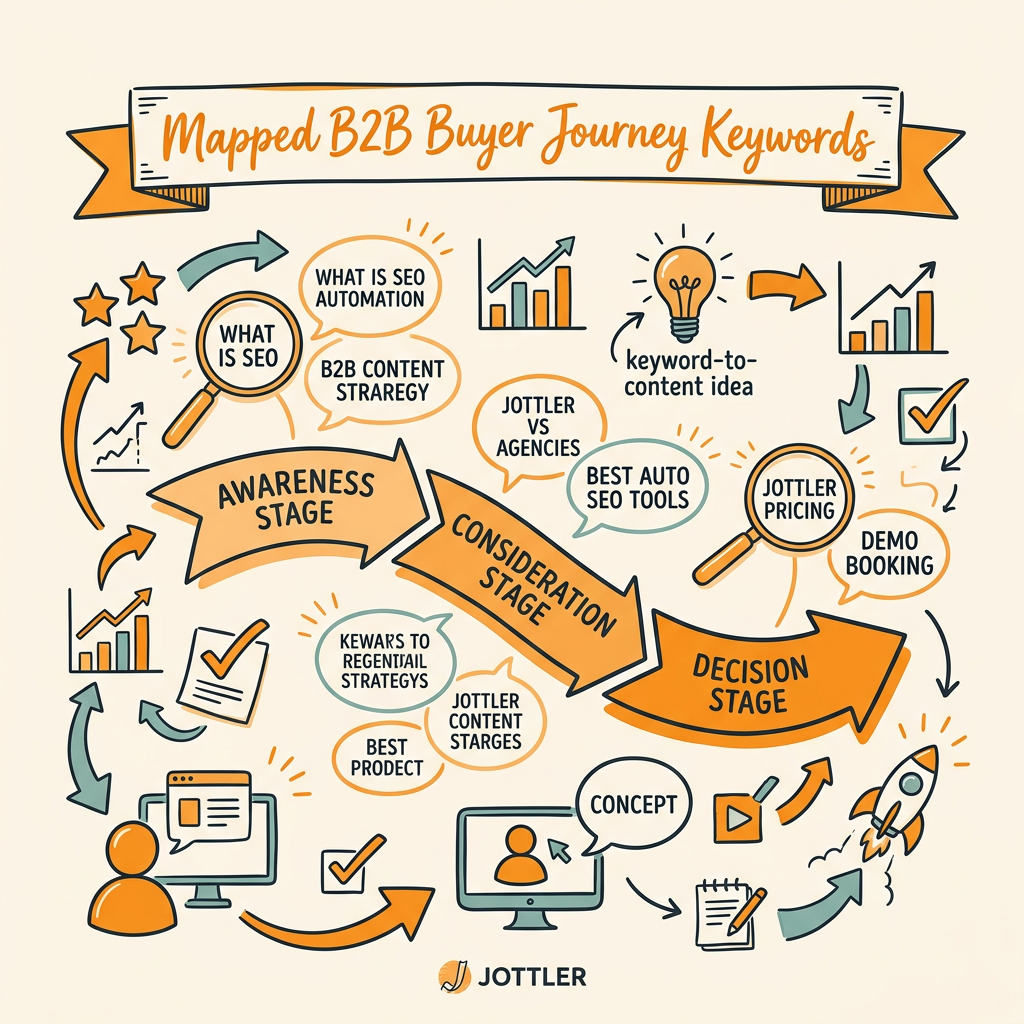
B2B SaaS buyers don't move linearly through decision stages. They loop back, research in parallel, and involve multiple stakeholders. A framework keyword research approach segments opportunities across three distinct funnel zones, each with different content and conversion mechanics. The key is balance: over-index on decision-stage keywords and you miss early-stage awareness. Ignore bottom-funnel terms and you won't capture ready-to-buy momentum.
Awareness Stage: Problem-Focused and Educable Keywords
Awareness-stage buyers don't know your solution exists. They're searching for the problem itself: "how to improve sales team productivity," "what causes sales pipeline lag," "why is our sales accuracy poor." These keywords have informational intentguides, research, education, not transactional pushes. They're typically longer, question-based phrases with lower competition and higher volume at the keyword cluster level. A single awareness keyword might bring only 50 searches/month, but 20 related variations together drive thousands of impressions.
Awareness content positions your company as a problem-solver and educator, not a vendor. Case studies, research reports, and how-to guides thrive here. The goal isn't immediate signupit's trust and visibility. According to Powered by Search, companies offering original research gained 29.7% organic traffic growth versus 9.3% without, because original research signals authority and attracts backlinks. When your awareness content dominates the top 10 results for problem-focused queries, you own that buyer's earliest research phase. Effective awareness content is also the foundation of consistent SaaS content marketing growth.
Consideration Stage: Comparative and Solution-Aware Keywords
Consideration-stage buyers now know the problem and are evaluating solution categories. They search: "best sales engagement tools," "Salesforce vs. HubSpot for sales teams," "top CRM software for B2B SaaS." These have commercial intentcomparisons, reviews, alternativesand higher competition because every vendor targets these keywords. But conversion rates are also higher. A visitor who reads your comparison guide has narrowed their choice set and is closer to a decision.
Content here is comparative and product-aware but not salesy. Comparison tables, tool reviews, and "vs." posts dominate. The secret to winning consideration keywords is honest comparisonacknowledge competitor strengths, then pivot to why your solution fits their specific problem better. This builds trust and surfaces nuance that generic product pages miss. Your keyword list at this stage might include 5-10 primary competitors mentioned alongside your solution.
Decision Stage: Transactional and Product-Specific Keywords
Decision-stage buyers are ready. They search: "Salesforce pricing," "HubSpot free trial," "[your product name] demo." These are transactional keywordshigh intent, high competition, lower volume. Traffic here is lowest volume but highest conversion. Visitors are one step away from signup. Your content is pricing pages, free trial CTAs, and product demosthe straight handoff from marketing to sales.
Rarely are transactional keywords where SEO delivers the biggest ROI for SaaS (paid search handles many of these). But they matter for brand visibility and competitive defense. If a prospect searches "[competitor] alternative" and your page ranks in the top 3, you've captured high-intent traffic mid-decision. This is where long-tail product-aware keywords shine: "[competitor] alternative for [use case]" has lower volume (maybe 100-300 searches/month globally) but higher specificity and conversion rates.
Building a Balanced Keyword Portfolio Across Stages
A well-researched keyword framework balances all three stages:
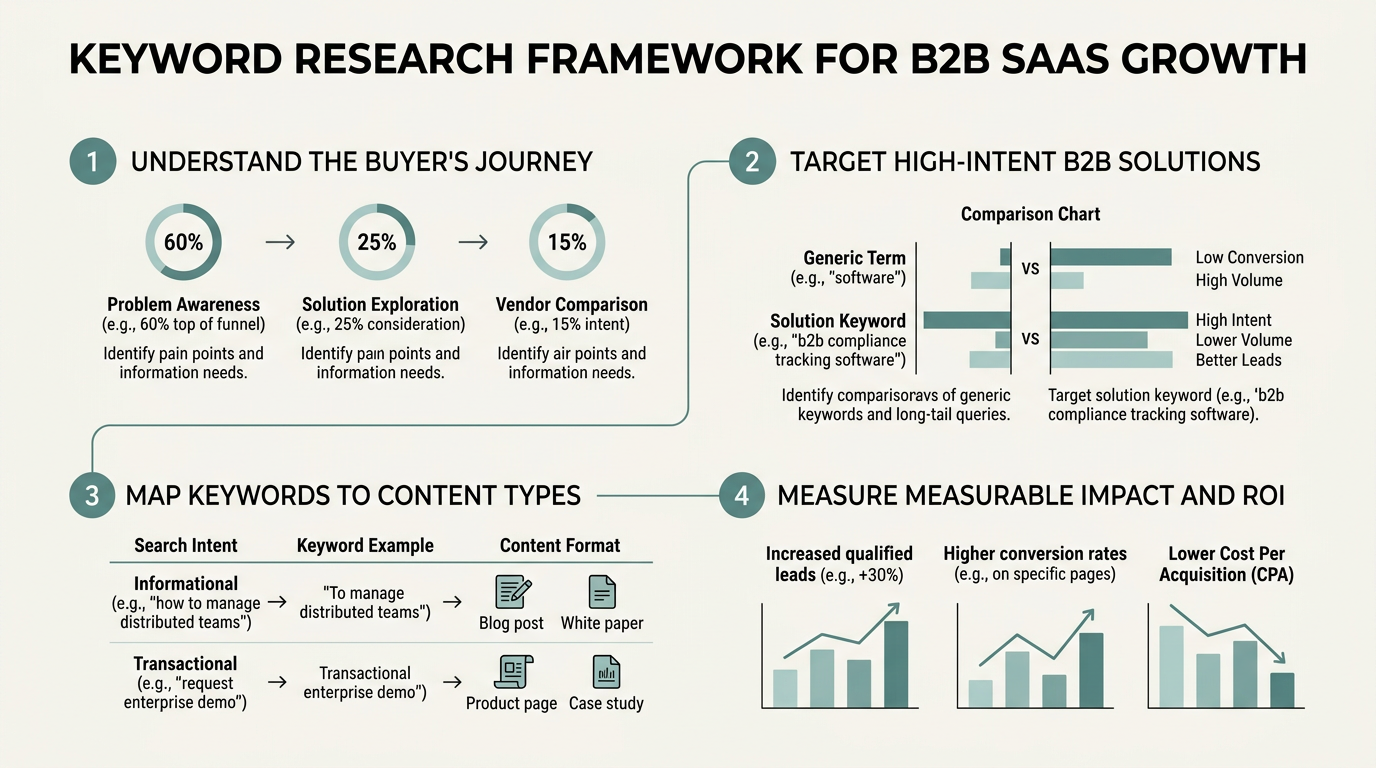
- Awareness (60% of keyword targets): Problem-focused, educational, lower competition. Build topical authority herethis is where you own the conversation early.
- Consideration (30%): Comparative, solution-aware, moderate-to-high competition. Win the comparison battle and you'll capture high-intent consideration-stage traffic.
- Decision (10%): Transactional, brand/product-specific, high competition. Defend your brand and capture the final funnel step.
This 60-30-10 split isn't rigidadjust based on your product lifecycle and competitive landscape. Mature markets (e.g., CRM, project management) need heavier consideration and decision focus because awareness is saturated. New categories need awareness dominance to educate. The principle: score each keyword on its conversion fit, not volume alone, then allocate content resources proportionally.
The Four-Step Framework to Prioritize High-Impact Keywords
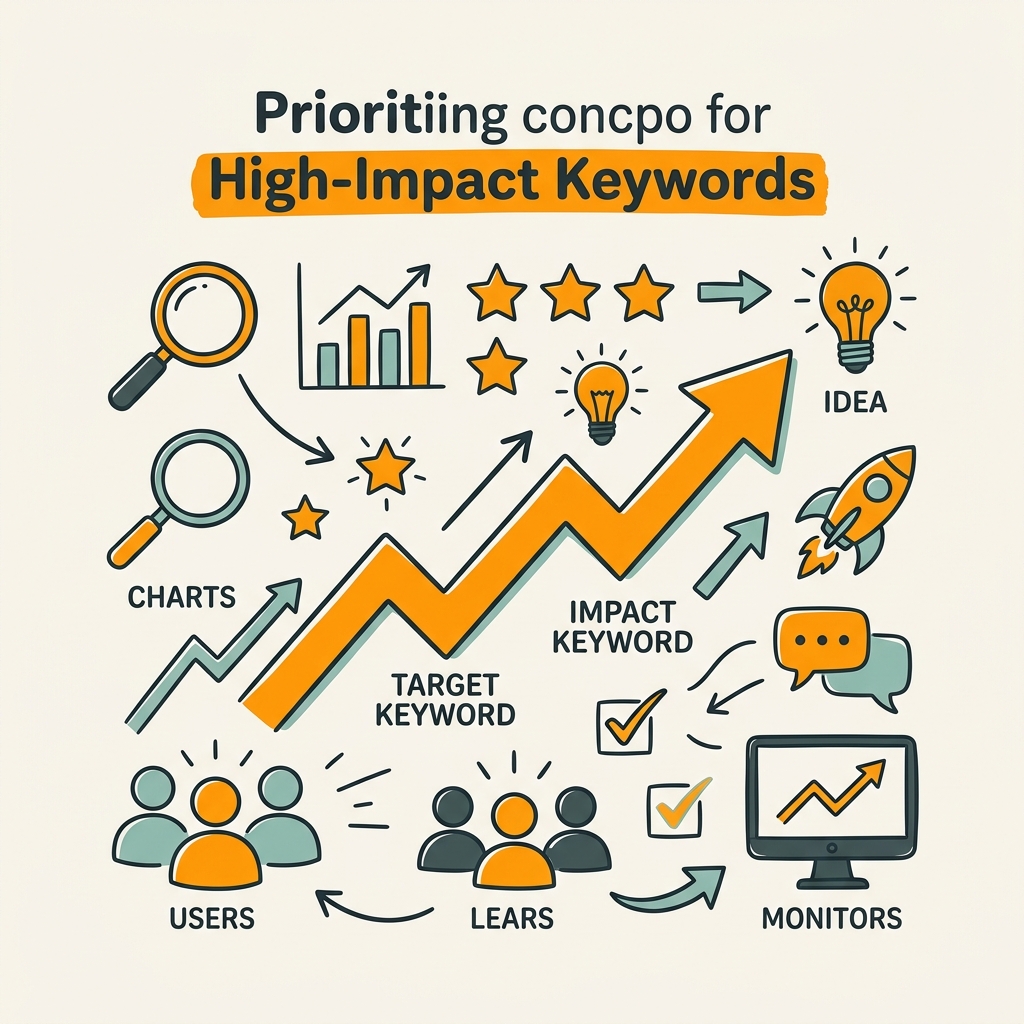
With thousands of potential keywords across your market, prioritization is critical. This framework filters candidates down to a manageable 20-30 keywords that drive the most qualified pipeline. The scoring system combines intent alignment, competitive feasibility, and conversion likelihoodall data points you can source from customer conversations, SEO tools, and SERP analysis.
Step 1: Extract Seed Keywords from Real Customer Language
Your best seed keywords come from customers, not keyword tools. Pull 10-20 real phrases from sales calls, lost deal debriefs, support tickets, and product feedback. Verbatim customer language is powerful because it represents how actual buyers search and speak about your problem. If your sales team hears "we need better data visibility in the pipeline" repeatedly, that phrase (or variations) should be in your keyword listnot just the polished category term "sales pipeline management software."
Customer language also reveals the buyer personas behind the search. A customer who says "how do we stop our sales team from missing follow-ups" is a sales ops leader or VP of Sales with a specific operational problem. This buyer has high conversion likelihood because their pain is acute and measurable. By comparison, someone searching "how does CRM work" is still exploratory. Your framework prioritizes the first over the second.
- Sales Calls: Record objections, stated problems, decision criteria. "Our deals are too hard to close" → keyword seed: "sales cycle too long," "how to shorten sales cycle."
- Lost Deal Reports: Why did deals close with competitors? "They said the competitor's tool integrates better with Slack" → "CRM with Slack integration," "best CRM for remote sales teams."
- Support Tickets: Common user questions reveal keyword opportunities. "How do I track email opens in our CRM" → "email tracking CRM," "email open tracking software."
- Product Feedback: Feature requests and complaints signal keywords your audience searches for before buying. "We need better reporting" → "sales reporting software," "deal analytics tools."
Step 2: Classify Keywords by Intent and Buyer Fit
Not all keywords are created equal. Two keywords with the same search volume can have vastly different conversion potential based on the intent behind them. Intent classification sorts keywords into four buckets: navigational, informational, commercial, and transactional. For B2B SaaS, you'll focus primarily on informational and commercial, with sparse transactional.
- Navigational: "Salesforce login," "[your company name]." Direct traffic to your site, low content opportunity.
- Informational: "How to improve sales team productivity," "what is sales pipeline visibility." Problem-aware, educable, high awareness-stage value.
- Commercial: "Best CRM software," "Salesforce vs. HubSpot," "CRM software comparison." Solution-aware, consideration-stage, high conversion interest.
- Transactional: "[Product] pricing," "[Product] free trial," "buy [product]." Ready to buy, high intent, typically lower organic volume.
Next, score each keyword 1-3 on three dimensions: Intent Fit, Competitive Feasibility, and Conversion Likelihood.
| Scoring Dimension | Score 1 (Weak) | Score 2 (Medium) | Score 3 (Strong) |
|---|---|---|---|
| Intent Fit (Does the searcher match your ICP?) | Broad, exploratory intent; searcher may not be your target buyer | Mixed intent; keyword may attract prospects outside your ICP | Highly specific to your ICP; keyword aligns with buyer problem and use case |
| Competitive Feasibility (Can you realistically rank?) | Very high competition; top 10 dominated by large brands or authority sites | Moderate competition; mixed domain authority and content quality in top 10 | Low-to-moderate competition; opportunities to outrank with quality content |
| Conversion Likelihood (Will ranking drive qualified pipeline?) | Low alignment to product value; visitor unlikely to become lead or trial signup | Moderate fit; visitor might convert after additional consideration | High product alignment; visitor likely to engage demo, trial, or sales conversation |
Total Score Range: 3-9. Target keywords scoring 7-9 for high-priority content. Score 5-6 keywords are medium priority (build over time). Below 5, deprioritize or skip entirely. This scoring system forces you to align keyword selection with actual conversion potentialthe metric that matters to your board.
Step 3: Use AI to Discover Long-Tail Variations and Gaps
You've identified 15-20 seed keywords and scored them. Now scale the list with long-tail variations. AI tools identify 95% more long-tail keywords than manual research, and that's where the volume and ROI compound. Long-tail keywords like "sales CRM for SaaS startups" or "how to improve B2B sales conversion rate" are specific, lower-competition, and high-intent because they target a narrow buyer segment. According to Explodingtopics, long-tail keywords make up 70% of all search traffic and typically have better CTR than competitive head terms.
Tools that automate keyword research and content creationlike AI SEO tools built for SaaScrawl your seed keywords and SERP results to surface related queries, People Also Ask questions, and missing content gaps. The output is a prioritized list of 50-100 long-tail variations that your sales team probably hasn't heard of but your buyers are searching for.
From that expanded list, select the top 20-30 keywords for your initial content roadmap. Focus on keywords that:
- Have 20-150 monthly searches (sweet spot for low competition + volume)
- Score 7+ on your intent/feasibility/conversion scale
- Appear in People Also Ask sections for your primary keywords (signals search relevance)
- Are mentioned by your sales team but don't have dedicated content yet (hidden opportunities)
Step 4: Map Keywords to Content Pillars and Publishing Cadence
Once you've prioritized 20-30 keywords, organize them into content clusters or "pillars." A pillar is a comprehensive, deep article (3,000+ words) that targets a primary keyword and internally links to 5-10 related long-tail content pieces. This structure strengthens E-E-A-T signals to Google and distributes ranking potential across the keyword cluster. Read how content cluster strategy improves SEO performance and topical authority.
Example pillar structure for "sales pipeline visibility":
- Pillar: "Sales Pipeline Visibility: The Complete Guide" (3,000 words, targets primary keyword)
- Cluster Articles:
- "How to Set Up Sales Pipeline Tracking in 5 Steps" (long-tail: "sales pipeline tracking setup")
- "Sales Pipeline Metrics That Actually Matter" (long-tail: "key sales pipeline metrics")
- "Why Sales Managers Struggle to Forecast Accurately" (long-tail: "sales forecasting problems")
- "The Hidden Cost of Manual Sales Reporting" (long-tail: "sales reporting software benefits")
Group your 20-30 keywords into 4-5 pillars. Each pillar addresses a core buyer problem; cluster articles elaborate on aspects of that problem. When published together with strategic internal linking, a pillar cluster dominates a topic space and captures dozens of related long-tail searches.
Publishing cadence matters too. B2B SaaS companies publishing 9+ blog posts monthly see 35.8% YoY organic traffic growth. But quality over quantity: one 3,000-word pillar beats five 600-word posts. Set a realistic targete.g., 2-3 pillars and 6-8 cluster articles per monthand stick to it. Consistency is the compounding lever that separates winners from tire-kickers in organic growth.
Avoid Common Keyword Research Mistakes That Waste Content Resources
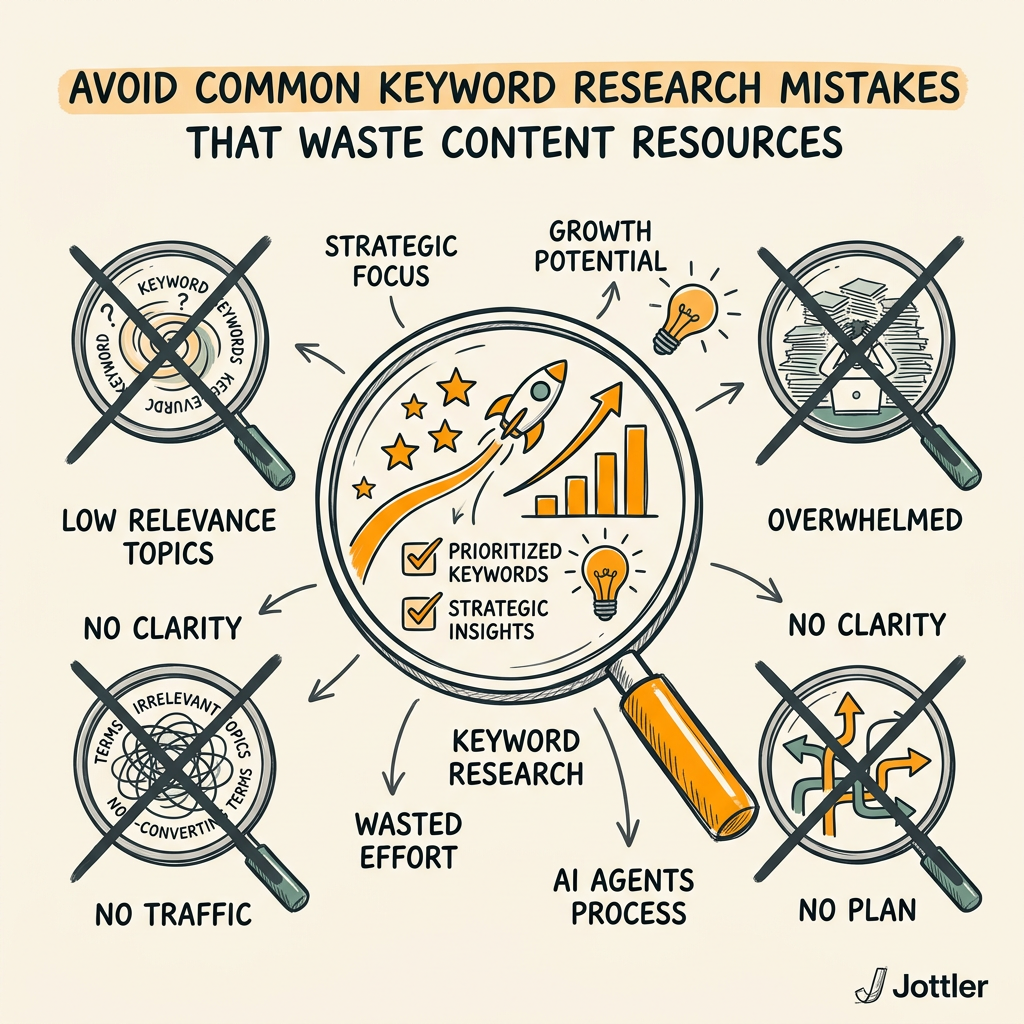
Even well-intentioned keyword research frameworks fail when teams make recurring mistakes. These are the pitfalls that burn content budgets and produce zero pipeline impact.
Mistake 1: Targeting Keywords Without Validating SERP Ranking Feasibility
A keyword looks attractive until you examine the top 10 results and realize every position is held by a category-dominating enterprise vendor or category authority. You can't outrank themnot without significant domain authority and backlink equity. Smart keyword researchers verify SERP feasibility before committing content resources. Ask: "Who ranks #1-3 for this keyword, and why? Can we realistically displace them?"
For SaaS, this means checking the domain authority (DA) of top rankers, the keyword density and content length, and whether the ranking domains are direct competitors or adjacent players. If the top 3 results are all DA 70+ enterprise software sites, that keyword is likely not worth your initial effort. Low-DA sites in the top 10 for a keyword signal feasibilityyou have a fighting chance.
Mistake 2: Ignoring the Intent-Conversion Bridge in Your Scoring
A keyword might have perfect intent classification and reasonable competition, but if your product doesn't solve the searcher's problem, ranking won't drive conversions. Ask before committing: "If someone reads our content for this keyword, is there a natural path to trying our product?" If the answer is no or "maybe," the keyword is a waste. This is where sales and product input matters. Your sales team knows which conversations lead to deals. A keyword that aligns with those conversations scores high on conversion likelihood.
Mistake 3: Over-Optimizing for Search Volume at the Expense of Specificity
High-volume keywords are tempting3,000+ monthly searches feels like a jackpot. But for SaaS, volume-first chasing leads to low conversion rates and wasted content effort. The best keywords often have 30-150 monthly searches because they're specific enough to signal genuine buyer intent. Avoid the trap of inflating your keyword target list with hundreds of low-intent, high-volume searches. Quality of buyers beats quantity every time.
How to Operationalize Your Keyword Research Framework
A framework is only useful if it's repeatable and integrated into your publishing workflow. This section covers the operational mechanics: tools, cadence, and team alignment.
Build a Keyword-to-Content Workflow
Your keyword research shouldn't live in a spreadsheet that no one updates. Embed it into your content operations: keyword research → topic selection → content assignment → publication → linking → performance tracking. Automation reduces friction. Tools that combine keyword research, content creation, and publishinglike autonomous SEO platformshandle the end-to-end workflow, turning keyword research into published, internally linked articles automatically. For busy founders, this is the compounding difference: instead of quarterly keyword research followed by manual writing, you get continuous keyword discovery, content generation, and publication that compounds over months.
Align Sales, Product, and Marketing on Keyword Strategy
Keyword research that ignores sales input will miss the highest-intent opportunities. Monthly sync-ups between marketing and sales on: new objections they're hearing, most common prospect questions, competitive concerns, and lost deal reasons. These insights feed back into keyword research, keeping your strategy grounded in real customer language. Product teams contribute by identifying feature-specific keywords and use-case variations they see in support tickets.
Track and Iterate
Measure keyword performance quarterly: which keywords drove traffic? Which converted to leads? Which had zero impact? Retire zero-impact keywords from your targeting and double down on winners. Over time, this feedback loop refines your scoring system and makes future keyword research more accurate and efficient.
Conclusion
A keyword research framework for B2B SaaS growth is not a one-time exerciseit's a repeatable system that aligns search intent with buyer journey stages and conversion outcomes. Companies that adopt intent-first keyword research, score feasibility and conversion potential, and organize keywords into content pillars see 6-12 months to meaningful pipeline impact, ultimately delivering 702% ROI. The frameworkextract customer language, classify intent, discover long-tail variations, and map to content clustersturns keyword research from guesswork into strategy.
The compounding leverage comes from consistency. Companies publishing 9+ pieces monthly see 35.8% YoY organic traffic growth. To hit that cadence without burnout, automate the research and writing. Start with 20-30 prioritized keywords and 4-5 content pillars, then expand monthly as your framework proves itself. Every pillar published is dozens of long-tail keywords captured and compounded organic growth for months to come.
Ready to scale your keyword research without the manual overhead? Start your SEO agent and let AI handle keyword discovery, writing, and publishing while you focus on strategy.
FAQs
How many keywords should a B2B SaaS company target?
Start with 20-30 well-researched, intent-mapped keywords scored on conversion fit and competitive feasibility. This focused approach outperforms targeting hundreds of low-intent, high-volume keywords because it concentrates content resources where they drive the most qualified pipeline. As your framework matures and you publish 4-5 content pillars with clustering, each pillar captures 20-50 related long-tail variations, multiplying your effective keyword reach without needing to separately target every variation. Quality beats quantity in B2B keyword research.
What's the difference between informational and commercial keyword intent?
Informational keywords reflect problem-awareness: "how to improve sales pipeline visibility," "why sales forecasting is hard." These are awareness-stage searches, low competition, and drive educational content like guides and case studies. Commercial keywords reflect solution-awareness: "best CRM software," "Salesforce vs. HubSpot." These are consideration-stage, higher competition, and drive comparison content and reviews. B2B SaaS should allocate 60% of content to informational (build topical authority and trust early) and 30% to commercial (capture consideration-stage high-intent traffic). The 10% remaining goes to transactional decision-stage keywords like pricing and free trial pages.
How long does it take to see results from keyword research and content?
Meaningful pipeline impact from a keyword research framework takes 6-12 months, with initial search traffic appearing in 2-4 months after publication. The lag exists because Google's crawl and ranking cycle takes time, especially for newer domains. However, the compounding effect accelerates results: your first pillar might bring 50-100 qualified leads monthly by month 6; your second pillar starts contributing by month 8. By month 12, the cumulative effect of 4-5 pillars and dozens of cluster articles produces sustained, compounding organic growth. Patience and consistency are non-negotiable for SEO-driven SaaS growth.