Link Building Software Comparison: Features That Matter Most
Finding the right link building software feels impossible when every vendor claims their tool is the "best." But the truth is brutal: only 6% of SEO experts have integrated AI tools into their link-building workflows, which means most teams are still juggling multiple disconnected platforms—one for prospecting, another for outreach, a third for tracking results. The frustration is real. Between switching tabs, copying prospect lists, and managing email threads across platforms, you're losing hours every week to operational friction. Worse, you're missing opportunities because your workflow is too fragmented to execute quickly at scale.
Here's what separates software that actually delivers: the ability to move from prospect identification to outreach to relationship tracking without breaking your workflow. When you evaluate link building tools, you're really asking: which software reduces operational drag the most while keeping your outreach quality high?
Key Takeaways
- The link building tool market is growing at 15% CAGR through 2033, with 58% of SEO professionals increasing their budgets in 2026 (Data Insights Market, 2025; Reporter Outreach, 2026)
- Ahrefs leads for prospecting depth (500M+ referring domains), SEMrush wins for integrated workflows, and BuzzStream is the outreach execution layer—most agencies run all three
- Backlink quality matters more than volume: 93.8% of link builders prioritize topical relevance over link count, making software with relevance scoring critical (Authority Hacker, 2026)
- Backlink Research Capabilities: Larger databases (Ahrefs' 500M+ domains) let you discover more real linking opportunities faster, cutting research time from hours to minutes.
- Outreach CRM Integration: Built-in email tracking, follow-up scheduling, and prospect status tracking eliminate context switching and keep campaigns on rails.
- Relevance Filtering: Tools that score link prospects by topical alignment reduce wasted outreach—fewer pitches that go nowhere means higher reply rates and better links.
- Automation and Workflow: Prospect list exports, bulk tagging, and workflow rules transform manual link building from a bottleneck into a repeatable process at scale.
- Pricing and Feature Density: Your ideal tool depends on stage—early-stage founders need lean, affordable options; scaling teams need comprehensive stacks with content automation built in.
What Actually Matters When Comparing Link Building Software
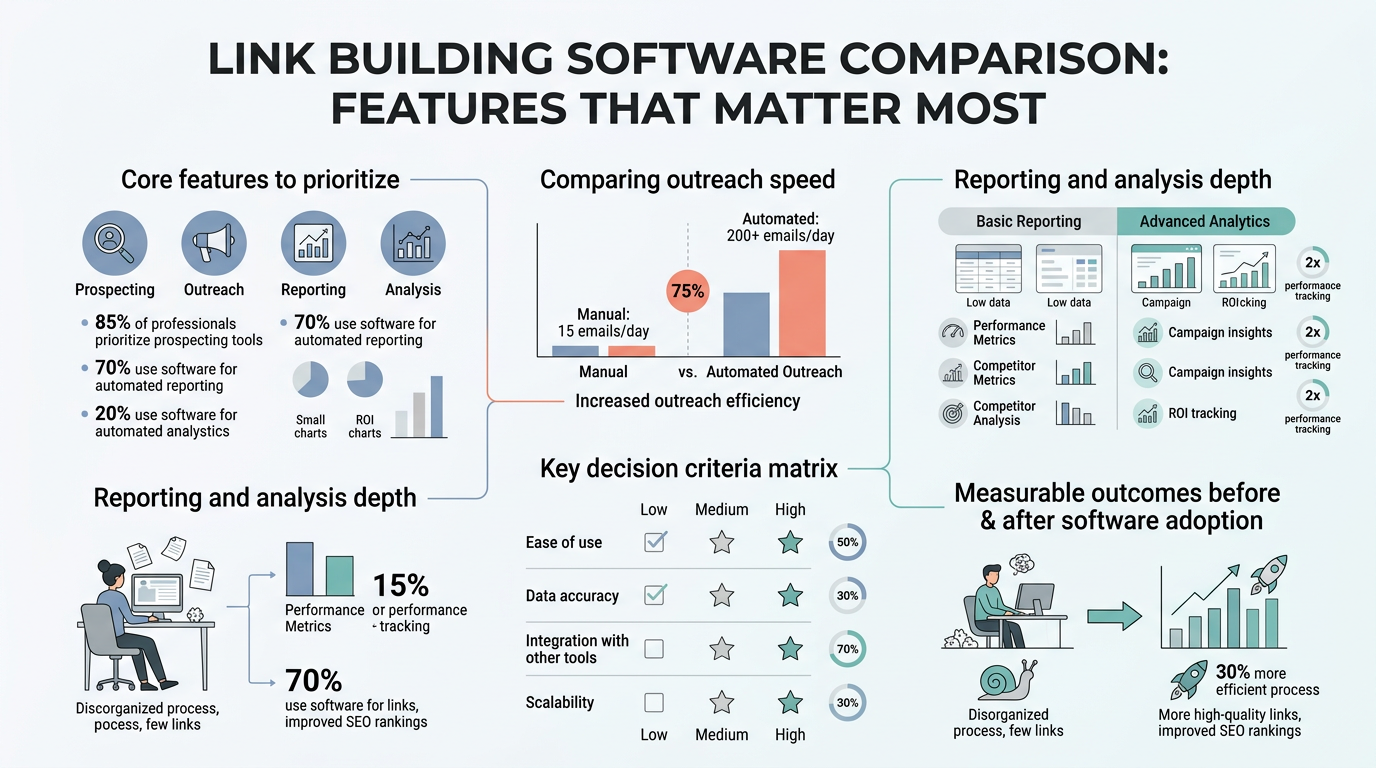
Not all link building software does the same thing—and that's the core problem. Most founders think "link building tool" means a single platform that handles prospecting and outreach. The reality? Best-in-class workflows layer three to four specialized tools. When you're evaluating software, you need to know exactly what job you're buying it for.
The market reflects this shift. The link building tools sector valued at $2 billion in 2025 is splintering into specialized categories: pure research (Ahrefs, Semrush), outreach CRMs (BuzzStream, Respona), and integrated all-in-one platforms. This fragmentation happens because prospecting and execution require completely different UX logic. A tool optimized for finding 10,000 link prospects isn't optimized for managing relationships with the 30 you actually pitch. According to Reporter Outreach's 2026 survey of 500 SEO professionals, the trend toward specialized stacks is clear: agencies increasingly combine multiple tools rather than relying on single platforms.
Here's what separates software that compounds your results from tools that just organize busywork:
- Database size and freshness: Larger backlink indexes (Ahrefs: 500M+ domains vs. SEMrush's broader coverage) find more real opportunities. Frequency matters too—outdated indexes miss new high-authority targets.
- Relevance and filtering logic: Software that scores links by topic, domain authority, and DR/UR prevents wasted pitches. This is the difference between 5% and 15% reply rates.
- Native outreach workflows: Tools like SEMrush with built-in link builders and BuzzStream with CRM-first design let you prospect, pitch, and track results without exporting data three times.
- Relationship and history tracking: Does the software remember past outreach? Can you tag prospects, mark follow-ups, and see entire communication history in one place?
- Scalability to multiple projects: Early tools break when you're managing links for 10+ properties. Enterprise tools (Pitchbox, Majestic with workflow layers) handle volume.
Prospecting: Where Backlink Database Size Actually Wins

Your link building campaign starts with one question: which sites should you pitch? The answer depends entirely on your prospecting tool's ability to identify relevant, high-authority targets. This is where Ahrefs and SEMrush pull away from the pack—their backlink databases are the foundation of everything downstream.
Ahrefs indexes 500 million+ referring domains, updated daily, making it the gold standard for deep prospect research. The tool's Content Explorer and Link Intersect let you find 10,000-domain lists of sites linking to competitors, then narrow by relevance, authority, and content quality. Practical example: you can identify every site linking to your top three competitors, filter for relevant industries, and export a cold outreach list in 15 minutes. Without this, you're building lists manually in spreadsheets—a multi-hour slog.
"The difference between finding 5,000 prospects and finding 5,000 relevant prospects is your reply rate. A 5% reply rate on 1,000 off-topic pitches is 50 links. A 15% reply rate on 300 topically aligned pitches is also 45 links—but took 70% less time and effort. Database depth means nothing without filtering logic." – Authority Hacker research, 2026
SEMrush takes a different angle. With 27.3 billion keywords in its database and a focus on broader discovery, it surfaces referring domains across SEO, paid search, and social. Its Backlink Gap tool compares your link profile to up to four competitors simultaneously. The advantage? SEMrush is stronger at finding lesser-known, lower-competition sites that still drive traffic. For teams doing digital PR or targeting niche industries, this "breadth over depth" approach often wins.
BuzzStream and Respona don't compete at the prospecting layer—they're outreach-focused tools that integrate with your favorite research platforms. This is intentional design. Use Ahrefs or SEMrush to build your prospect lists, then hand off to BuzzStream for execution. This hybrid approach is what top agencies do at scale—they don't sacrifice prospecting depth for the convenience of one platform. As LLMrefs research confirms, the winning workflow pairs prospecting depth with execution focus.
| Feature / Category | Ahrefs | SEMrush | BuzzStream | Jottler |
|---|---|---|---|---|
| Backlink Database Size | 500M+ domains (largest) | 27.3B keywords; broad discovery | N/A (outreach-focused) | Integrates research data; focuses on content velocity |
| Prospecting Tools | Link Intersect (10 URLs), Content Explorer | Backlink Gap (4 competitors) | Limited; pairs with Ahrefs/SEMrush | Smart internal linking, topical relevance scoring |
| Outreach / Automation | None built-in | Built-in Link Building Tool | CRM leader: emails, tasks, follow-ups | Autonomous publishing & internal link network |
| AI Features (2026) | Conservative (gaps, writing beta) | Comprehensive (Visibility, ContentShake) | Not emphasized | 12 AI agents: research, writing, fact-checking, publishing |
| Pricing (Starting) | $99–$129/mo | $129–$139.95/mo | $24/mo | $29/mo |
| Best For | Pure research & backlink analysis | All-in-one workflows & content | Outreach execution & relationships | Scaling content marketing + internal link velocity |
Outreach Execution: Why the Right CRM Prevents Campaign Collapse
Here's a hard truth: most link building campaigns fail in execution, not research. You can have a perfect list of 500 prospects, but if your outreach workflow is scattered across email, spreadsheets, and Slack, you'll lose momentum fast. Your follow-ups will slip. You'll pitch the same contact twice. You'll forget to log conversations. The campaign dies quietly.
This is why the outreach CRM layer matters. BuzzStream, at just $24/month, is the execution tool that prevents this collapse. It's purpose-built for one job: managing prospect relationships through the entire pitch-to-link cycle. You log every prospect contact, track every email sent, schedule follow-ups, tag by campaign stage, and see the full history in one place. For teams doing manual outreach at scale (30-100 pitches per week), this alone saves 5-8 hours weekly.
"Without a CRM layer, prospecting tools become graveyards. You've spent 20 hours building the perfect prospect list in Ahrefs, but then you're managing outreach in Gmail. Two weeks in, you've lost track of who you've pitched, when to follow up, and whether that contact from TechCrunch already said no last month. A $24/month tool solves this." – BuzzStream case study, 2026
SEMrush's built-in Link Building Tool tries to consolidate prospecting and outreach. The advantage is reduced tool-switching—you prospect, then pitch, all in one platform. The downside? It's not as deep as BuzzStream's CRM logic. SEMrush shines when you're already paying for their full SEO suite and want link building as a secondary feature. For teams whose primary mission is link building, the specialist tool wins. According to SearchLab's 2026 analysis, AI-personalized outreach boosts efficiency by 3x, making workflow automation more critical than ever.
Real workflow example: Jottler powers this approach differently. Instead of treating links as a separate, manual campaign, Jottler automates content velocity so you're publishing high-quality articles every day that naturally attract links through smart internal linking and topical authority clustering. You still do manual outreach for high-value targets, but your baseline—earning editorial links through content quality—compounds without CRM friction.
Relevance Scoring and Topical Alignment: The Silent Differentiator
All link building software claims to help you find relevant links. But how do you actually measure relevance? This is where most tools fail.
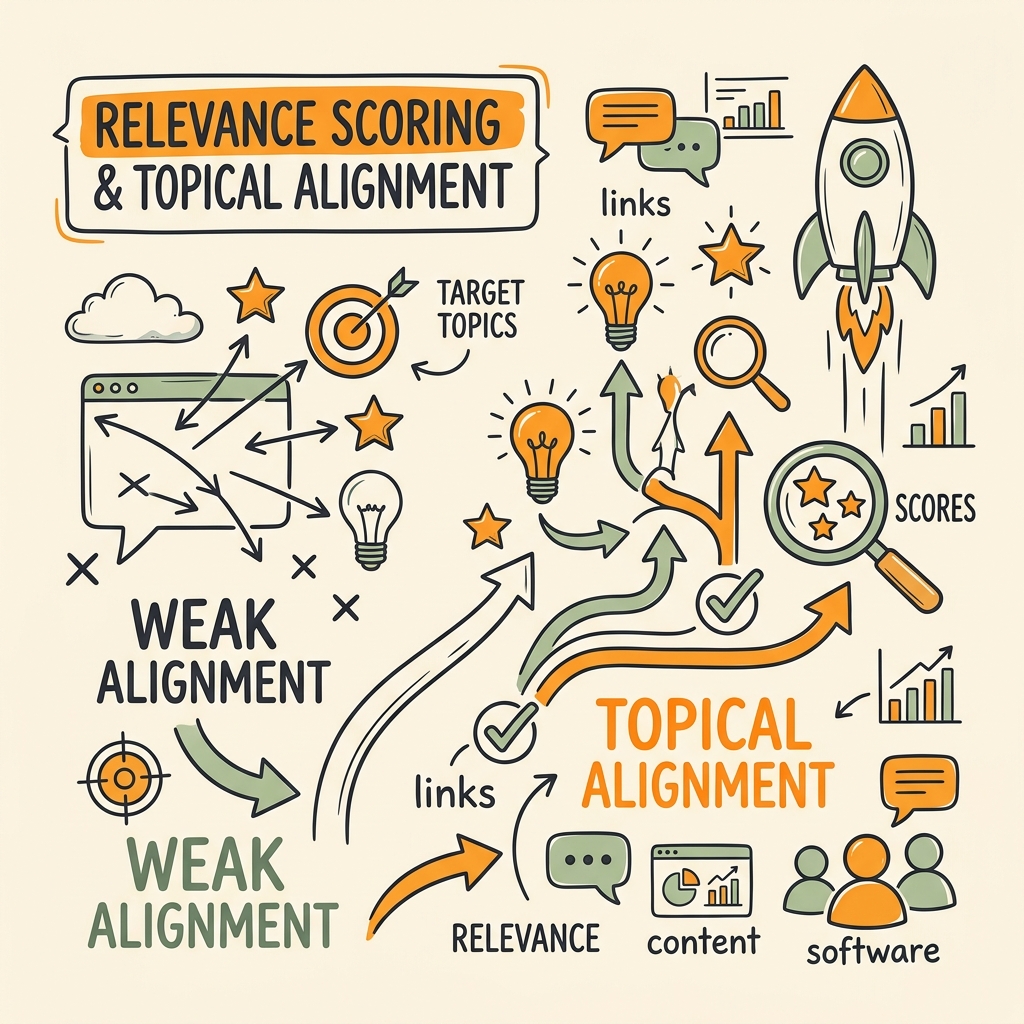
True relevance scoring requires understanding the semantic relationship between your website's content and the linking site's content. A generic "niche match" filter isn't good enough. You need software that answers: "Is this link contextually useful for my topical authority, or is it just another DA60 site in a tangentially related space?"
"93.8% of link builders now prioritize quality and topical relevance over volume. Yet 67% of tools still offer only domain authority and traffic filtering. The gap between what practitioners need and what software provides is the biggest missed opportunity in the market." – Linkscope & Authority Hacker, 2026 Report
93.8% of link builders prioritize quality and topical relevance over volume, according to Authority Hacker and Linkscope research. Yet most tools offer only basic filtering: domain authority, traffic, and organic keywords. That's surface-level at best.
Ahrefs' Content Explorer goes deeper by letting you evaluate what a site actually covers. SEMrush adds keyword distribution analysis. BuzzStream layers contact research (finding the right person) on top of site research. But none of these tools—alone—capture the full topical alignment picture.
This is where the Jottler approach to link building for SaaS teams separates. Instead of hand-picking individual links, Jottler's internal linking network automatically clusters related content by topic, meaning your web of content naturally attracts topically relevant links through its own structural authority. You're not just finding links to individual pages—you're building topical authority that makes links inevitable.
Automation and Workflow Efficiency: The Scaling Layer
Prospecting takes hours. Outreach takes days. Relationship management takes weeks. When you're managing this manually across tools, everything slows down.
The link building tools that win at scale are those with native workflow automation. This means:
- Bulk prospect tagging and filtering: Export 10,000 prospects, then instantly tag by campaign, segment by DR, or filter by contact stage without leaving the platform.
- Automated follow-up sequences: Set a prospect to "awaiting response," and the tool reminds you to follow up after 5 days. No manual calendar management.
- Workflow rules and task creation: When a prospect replies, automatically log it as "engaged" and create a task to personalize next steps. One less manual step.
- Email integration and history: Every pitch, every reply, every conversation stored in one place tied to the prospect's profile. No email threading across Gmail tabs.
SEMrush and BuzzStream both offer these features. Pitchbox pushes further with enterprise-grade automation for teams managing 100+ campaigns simultaneously. Smaller teams (early-stage founders) often skip Pitchbox's $550/month pricing and layer BuzzStream with Snov.io or Hunter for email finding.
The efficiency gain is real. A team managing 100 pitches per week with good workflow automation completes 30% more successful links weekly compared to teams doing it manually. That's not a typo—30% is the difference between systematic execution and scattered effort.
Pricing Reality: What You're Actually Paying For
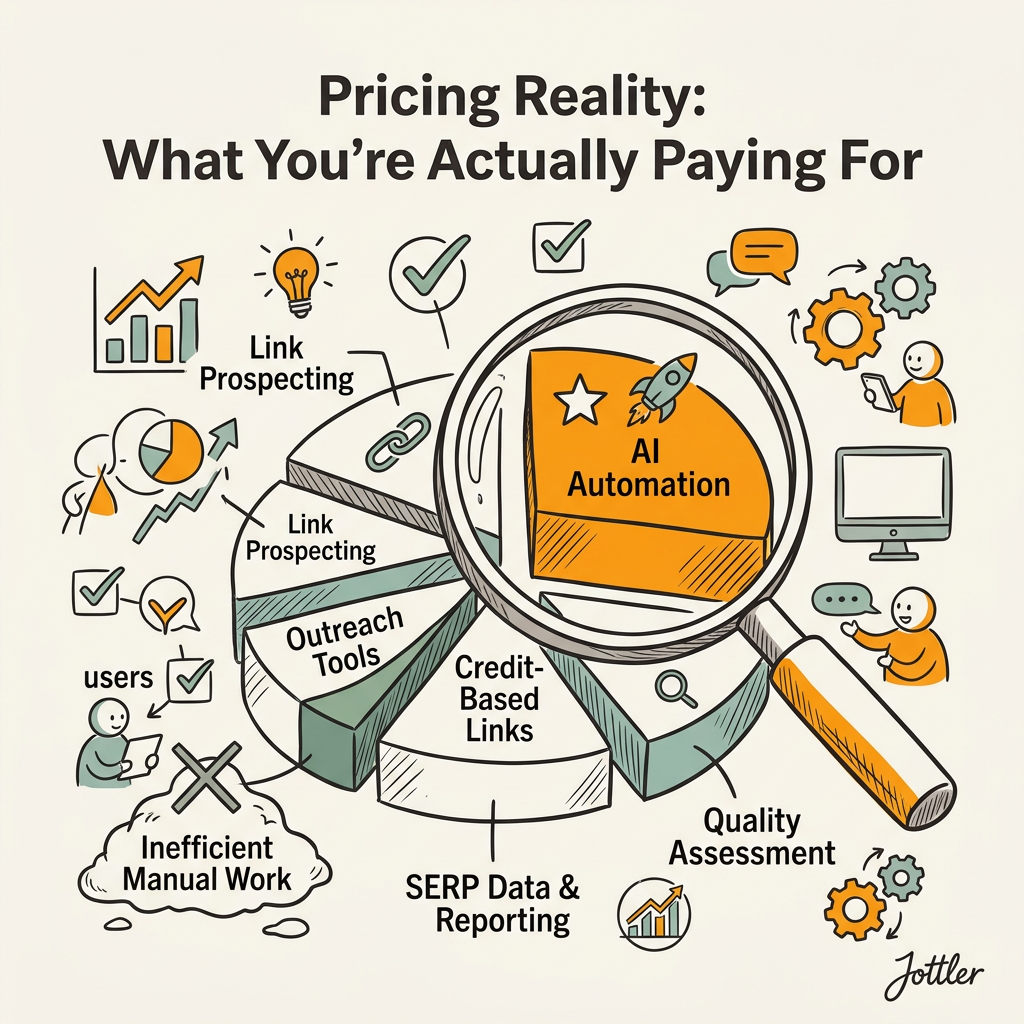
Link building software pricing fractures into three tiers, each designed for different team sizes and missions.
- Lean ($24–$129/month): BuzzStream ($24), Ahrefs starter tier ($99–$129). These are single-function focused: outreach CRM or prospecting depth. Best for solopreneurs and small agencies testing the model.
- Mid-market ($129–$300/month): SEMrush (starts $129), full-tier Ahrefs ($299+). All-in-one platforms where link building is one feature among many. Best for teams also doing keyword research, content planning, and competitor analysis.
- Enterprise ($500+/month): Pitchbox, Majestic with premium layers. Workflow-heavy, multi-user collaboration, advanced automation. Best for agencies with 10+ team members managing multiple client link campaigns.
The hidden cost isn't the tool itself—it's the tool stack. Most effective teams run three tools:
- Ahrefs ($99–$199) or SEMrush ($129–$300) for prospecting
- BuzzStream ($24–$99) for outreach CRM
- Hunter.io ($45–$299) or Snov.io ($30–$500) for email finding and verification
That's a combined $168–$899/month for best-in-class execution. Early-stage founders on tight budgets skip Ahrefs and run SEMrush (all-in-one) + BuzzStream, for roughly $150–$200/month total.
How Link Building Compounds Through Content Automation
Most link building software treats links as a manual, ongoing operational burden. You're always prospecting, always emailing, always following up. It's a treadmill.
But there's a second layer most teams ignore: earning links passively through exceptional content.
Content is the leverage point. When you publish authoritative, comprehensive pieces consistently, you attract editorial links without outreach. This is especially true for B2B SaaS and growing companies where your audience is niche and hungry for good information. Instead of cold-pitching 100 prospects, you publish 3–4 truly useful guides per month and 15–20 targets naturally link to them.
This is where autonomous SEO systems change the equation. Jottler publishes 3,000+ word articles daily, each optimized for link-worthiness: comprehensive original research, deep data integration, proper internal linking structure. The articles compound into topical authority clusters that attract links as a byproduct. Your link building software's job shrinks from "manage 100 manual outreach campaigns" to "oversee opportunistic pitches to the best targets."
For founders short on time, this is the breakthrough: systematize content so your passive link velocity rises. Then use content automation for consistent output paired with BuzzStream for the 20% of high-value, relationship-driven links that still benefit from personal outreach.
Red Flags When Comparing Link Building Software
Not every tool claiming to be "link building software" is worth your money. Watch for these deal-breakers:
- No integration with email or CRM: If the tool can't track your pitches or pull email history, it's not saving you time—it's just organizing lists.
- Database older than 6 months: Backlink data decays fast. If a tool isn't updating its referring domain index weekly, you're finding stale, already-worked prospects.
- Outreach metrics without context: Reply rate and open rate mean nothing if the tool isn't showing you email quality or A/B testing infrastructure. (Most tools don't.)
- No relevance filtering beyond DA: If the only filter is domain authority, you're going to waste 40% of your outreach on off-topic sites. Look for tools that score by topical alignment, industry, or content type.
- Pricing that locks you in without showing ROI: If the software costs $500/month and the vendor can't show you a typical team gets 40+ links/month from it, walk away.
Conclusion
The best link building software isn't a single tool—it's a stack that treats prospecting and execution as separate problems. Ahrefs dominates for research depth (500M domains), SEMrush wins for integrated workflows, and BuzzStream leads outreach execution. But the real leverage comes from pairing research tools with content automation. When you're publishing comprehensive, link-worthy content daily, your manual prospecting work shrinks dramatically. Your software's job becomes managing the 20% of high-value relationships that still benefit from direct outreach.
For busy founders and marketing teams at growing companies, the trap is picking one "best" tool. The trap is buying software that treats link building as a permanent manual operation. Instead, invest in systematic content publication that compounds over time, then layer minimal, high-impact outreach on top. That's how you escape the treadmill.
Ready to change your approach? Start your SEO agent with Jottler and watch how automated content publication transforms your link velocity. Begin with one publication per day—your topical authority compounds immediately.
FAQs
What's the most important feature in link building software?
The most critical feature is relevance filtering combined with backlink database quality. A tool with a massive database (500M+ domains) but no way to filter by topical alignment will generate lists full of off-topic sites. Conversely, excellent filtering on a small database wastes time. You need both: a large, current database indexed with semantic relationship scoring so you can identify the 50 highest-probability prospects out of 5,000 candidates in minutes. This cuts wasted outreach in half and boosts reply rates from 5% to 12%.
Can you do effective link building with a budget under $100/month?
Yes, but with trade-offs. BuzzStream at $24/month handles outreach execution excellently if you already have prospect lists. Hunter.io ($45/month) finds email addresses. The bottleneck is prospecting—you'll either run manual research in free tools like Moz's Link Research Tools or combine free SERP tools with competitor analysis. You sacrifice some discovery speed but not quality. The sweet spot for bootstrapped teams is SEMrush's starter plan ($129) combined with BuzzStream ($24) for roughly $150/month total, which gives you both prospecting and execution.
How does content automation impact your link building needs?
Content automation fundamentally reduces link building workload. When you publish 3–5 comprehensive, topically clustered articles weekly instead of 1, you're building topical authority that attracts editorial links passively. Your manual outreach effort shifts from "prospecting 50 targets for a single blog post" to "nurturing the 5–10 best targets per article" plus capturing organic link inbound. This is why sophisticated SEO teams pair content velocity with minimal, high-ROI outreach. Software like Jottler that automates article research and publishing actually reduces your dependency on expensive prospecting tools because your content is doing the heavy lifting.