Link Building Strategy for B2B SaaS Growth
Link building has become the defining barrier between B2B SaaS companies that compound organic growth and those that plateau. Most SaaS founders understand that backlinks matter. Yet 77% of SaaS companies still treat link building as an afterthought, spraying generic guest post pitches at hundreds of websites and wondering why their domain authority stays flat. The problem isn't effort. It's strategy. The cost of a quality backlink has risen to $508 in 2026, while the ROI of a well-executed link campaign has never been higher. B2B SaaS businesses with solid link building strategies grow their organic revenue 2x faster than those relying solely on content and technical SEO. Here's how to build a link strategy that actually compounds your authority and feeds your sales engine.
Key Takeaways
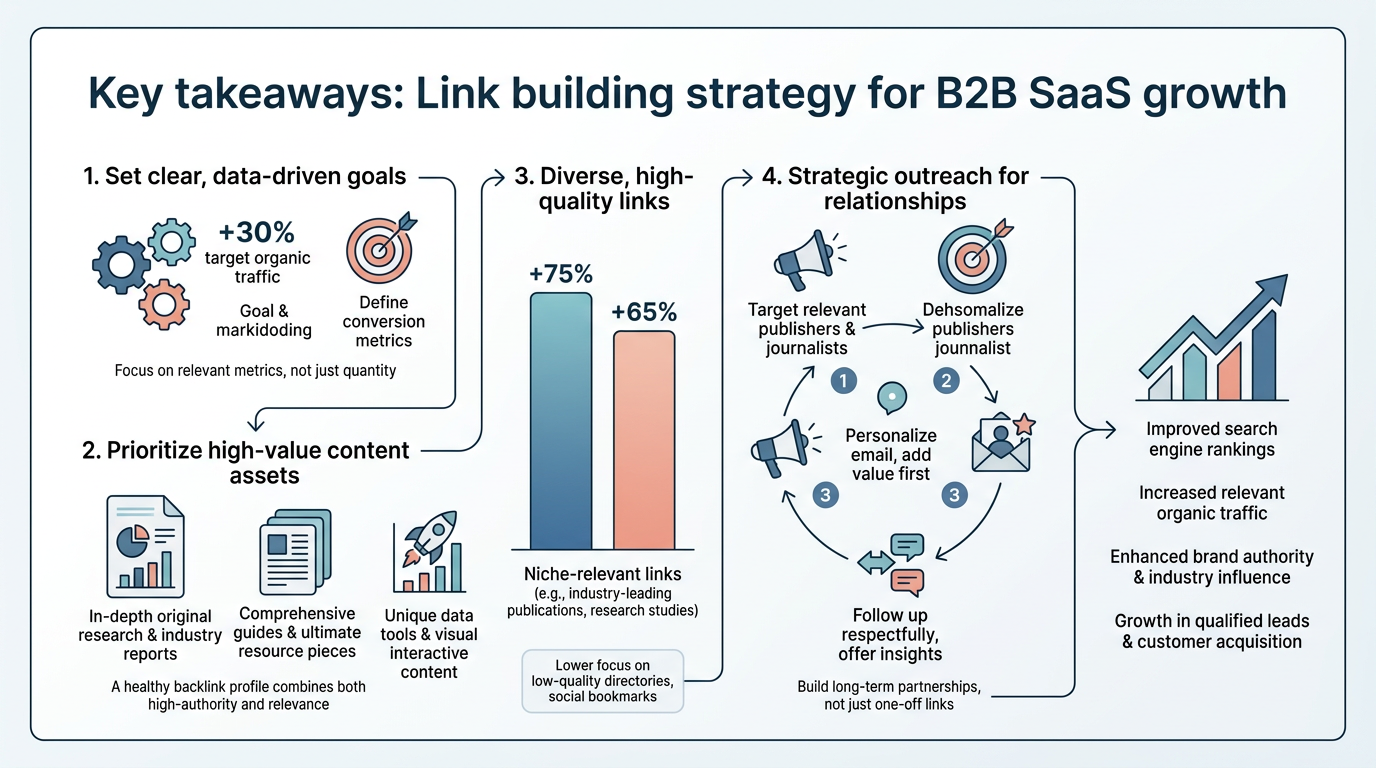
- Top-ranking pages in competitive SaaS categories average 247 referring domains (2026, Link Building Journal)
- Just 30–35 high-quality backlinks generate approximately 10,500+ monthly organic visits
- Original research and benchmarks attract 3.5x more backlinks than standard blog posts, making them the highest-ROI link assets
- Integration partnerships on Slack, HubSpot, and Zapier are the most underrated yet highest-converting link sources in 2026
- Link Quality Over Volume: A single link from a topically relevant DR 40–50 blog beats ten links from low-authority irrelevant sites, directly impacting your keyword rankings.
- Content-Driven Assets: Building linkable assets like original research and comparison tools generates 3.4x higher link velocity than generic blog posts.
- Integration Marketplaces: Securing placement on major integration platforms (Slack, HubSpot, Salesforce) is the fastest and most underused channel for high-authority backlinks.
- Target High-Authority Sites Systematically: Use competitor gap analysis to identify authority sites linking to rivals but not to you, then build customized outreach.
- Align Link Building with Content Strategy: Your link building strategy and content strategy are inseparable. Most editorial links go to blog content, not product pages.
Why Link Building Is Non-Negotiable for SaaS Growth
Google's algorithm has evolved dramatically since 2023. The search engine now ignores manipulative links far more effectively while rewarding editorial mentions from genuinely relevant sources. For B2B SaaS, this shift creates both a problem and an opportunity. The problem: you can't buy your way to the top anymore. The opportunity: if you build links the right way, your domain authority compounds much faster than a competitor using outdated tactics.
The Financial Case for Link Building
B2B SaaS generates 702% SEO ROI, the second-highest of any vertical behind real estate. But ROI only materializes if your pages rank. Without authority, even perfectly-written content stays on page three. Here's where link building closes the gap: pages in the top SERP positions for competitive SaaS queries average 3.8x more backlinks than pages in positions two through ten. For "best [category] software" queries, the #1 page averages 247 referring domains versus 62 for the #10 position. That's not correlation. That's causation. Links move you from invisible to revenue-generating.
Additionally, SEO-driven leads convert at a 14.6% close rate versus 1.7% for outbound marketing. You're not just chasing rankings. You're chasing the highest-quality leads available. According to Link Building Journal's 2026 research, brands investing consistently in link building grow their organic revenue 2x faster than those relying solely on content and technical SEO alone.
"Without authority, even perfectly-written content stays on page three. Links move you from invisible to revenue-generating."
Why SaaS Link Building Demands a Different Playbook
Link building for SaaS is different because your buyer's journey is different. Nobody writes a roundup about project management software and links to your pricing page. They link to your blog content. That's why your content strategy and link building strategy are inseparable. More links to your content means higher rankings, which means more traffic to conversion-path pages, which means more sign-ups.
You're also operating in a technically niche vertical. Fewer websites naturally write about your category, shrinking the pool of relevant, linkable domains. The ones worth targeting are being pitched by your competitors. You can't succeed by spraying outreach. You need precision.
How to Build Linkable Assets That Earn Editorial Links
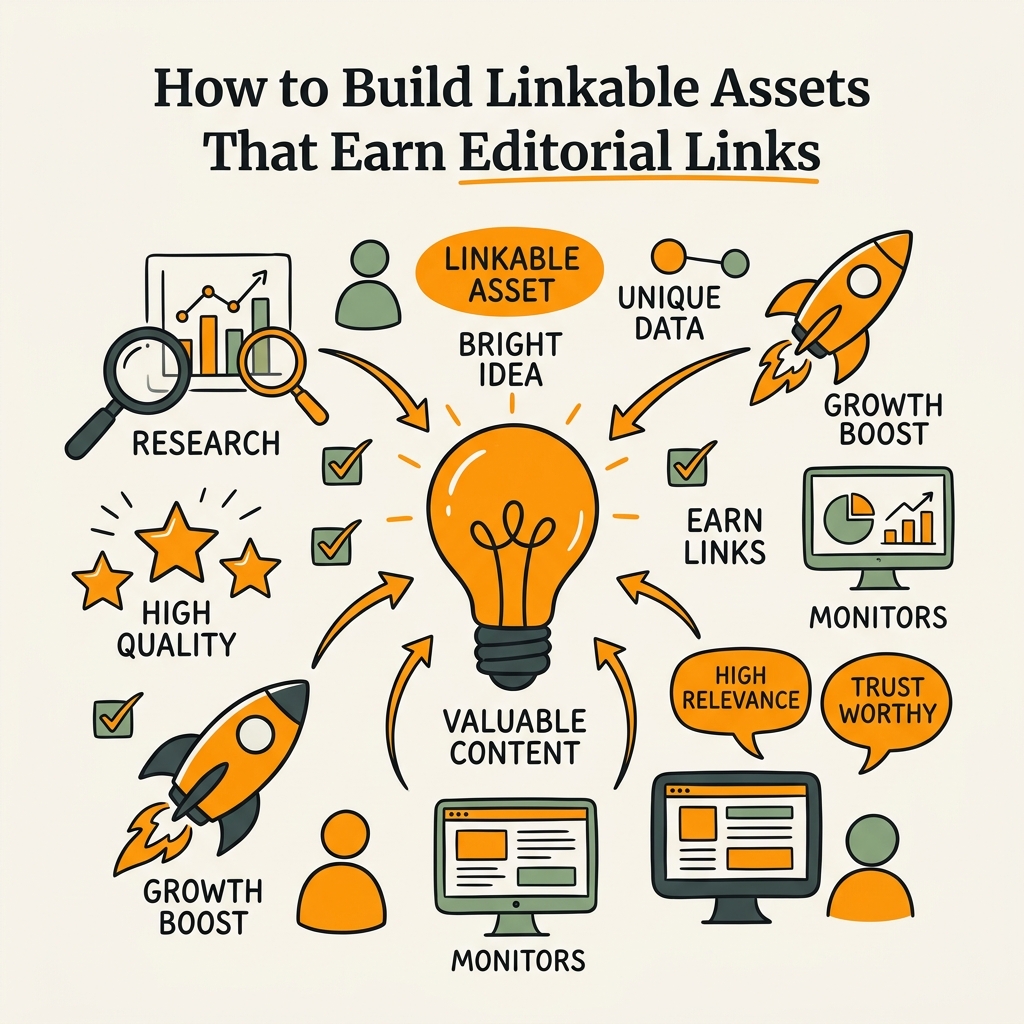
The biggest mistake SaaS teams make is building links first and assets second. It should be the opposite. Your strategy starts with understanding what content actually earns links, then working backward to pitch it. Generic blog posts don't cut it anymore.
Create Original Research and Benchmarks
Original research is the link-building asset class that moves the needle. Benchmark studies, product data, and proprietary research generate 3.4x higher link velocity than generic surveys or roundup articles. Why? Because journalists, analysts, and other SaaS founders need novel data they can cite. Your blog post about "5 tips for customer retention" is useful. Your study showing how top-performing SaaS companies retain 89% of customers through onboarding is linkable.
The execution matters. Create something with real data, novel findings, or actionable insights. Survey your customers about their biggest challenges. Analyze public data from your vertical. Build an interactive comparison tool. The barrier to entry is effort, not money. Most competitors won't do this work, which is exactly why it works.
"Original research generates 3.4x higher link velocity than generic surveys or roundup articles because journalists, analysts, and other SaaS founders need novel data they can cite."
Build Interactive Comparison Tools and Benchmarks
Interactive tools outperform static content for links because they provide value that persists. A comparison guide is useful once. A real-time pricing comparison tool or customer-segmentation calculator becomes a reference asset that editors link to repeatedly. Tools also perform better in AI Search Overviews because they offer unique, structured data that language models can pull from.
You don't need a massive engineering budget. Platforms like Carrd, Webflow, or even Google Sheets published as a web app can power simple interactive experiences. The ROI is worth it: interactive content attracts 2x more links than text-only equivalents and drives sustained traffic over months. BacklinkGrid's 2026 data shows that content-driven link building now accounts for 67% of successful campaigns, a massive shift from purely tactical outreach-based strategies.
Publish Case Studies With Quantified Results
Case studies are often overlooked link assets. A well-executed case study showing how a customer reduced churn by 32% or increased revenue per user by $15,000 is immediately linkable to analysts, industry commentators, and other SaaS marketers. The key is real numbers and real customer permission.
Reach out to your best customers and offer to document their story in exchange for link placement. Most will agree because the exposure benefits them too. Position the case study on your blog and notify your network. Journalists love stories with quantified outcomes.
How to Identify and Win High-Authority Link Opportunities
Executing link building at scale requires a system. You can't manually find opportunities one at a time. Use data and automation to shortlist targets, then apply personalized outreach to the ones that matter. According to DWI's 2025 SaaS link-building guide, the median cost per backlink continues rising, making strategic targeting more critical than ever.
Conduct Competitor Gap Analysis
Start by identifying which high-authority domains link to your competitors but not to you. This is your shortlist. These sites have already published content in your category and linked to similar companies. They're warm audiences. Use tools like Ahrefs or SEMrush to pull all referring domains for your top five competitors, then filter for DR 40+. Cross-reference against your own backlinks. The sites in your competitor list but not in yours are your priority targets.
Focus on topically relevant sites first. A link from a blog about SaaS operations management is worth 10x more than a link from a general business site, even if the general site has higher DR. Google evaluates the context around the link. Editorial relevance is your primary ranking factor.
Target Integration Partner Platforms
Integration marketplaces on Slack, HubSpot, Salesforce, and Zapier represent the most underrated link opportunity in 2026. Getting your product listed on these platforms earns you high-authority backlinks (these platforms have DR 70–80), drives qualified traffic, and builds channel partnerships simultaneously. Most SaaS companies deprioritize this work, which is a massive blind spot. Integration partnership links carry a median cost of just $140 with an 82% success rate.
The process is straightforward: build or ensure your app is Zapier-ready, submit it to the app store, write great product copy, and handle their review process. Rinse and repeat for HubSpot, Slack, and Salesforce. Each integration listing is a permanent backlink to your site and a channel to qualified customers.
Mine Listicles and "Best Of" Publications
SaaS buyers increasingly rely on AI and search-driven listicles like "best project management tools" or "top CRM software." These articles concentrate linking power. The top pages for "best [category] software" queries average 247 referring domains. Getting mentioned in these articles is high-impact work. Find the top 20 listicles in your vertical, analyze who they linked to, and pitch why you're a better fit than one of the included tools. Make a concrete case: "You included [competitor], but [your product] does X better."
This approach works because you're not asking for a favor. You're improving the article. The editor benefits from including a more current or more relevant tool. Frame it as an upgrade, not a pitch.
How to Execute Outreach That Actually Converts
Finding link opportunities is half the battle. The other half is executing outreach that gets responses. Most SaaS teams fail here because they spray generic emails at hundreds of sites. Personalization and relevance are non-negotiable.
Personalize Your Pitch Based on Content and Audience
Before you pitch, read the article you're trying to get linked from. Understand the writer's angle and their audience. If they cover SaaS founders, your pitch should emphasize how your product or content serves founders. If they cover B2B operations, emphasize operational benefits. Generic pitches get sub-1% response rates. Personalized pitches get 5–15% responses depending on list quality.
Reference something specific from their recent content. Show them you've done your homework. Example: "I saw your article on 'How to Reduce CAC for SaaS Teams.' Your point about product-led growth was spot-on. We just published research showing that companies using PLG reduce CAC by 34% on average. Would that data be useful for a follow-up piece?" This approach works because it's genuine and helpful. You're not asking for a link. You're offering value.
Run Small, Targeted Campaigns Instead of Mass Outreach
Avoid the temptation to send 500 emails and hope 2% respond. Instead, run 10-campaign cycles targeting 50 relevant sites each. Measure response rates for each segment. Refine based on what works. This approach builds a repeatable system while preserving your sender reputation.
Track which segments generate the best links and which generate low-quality responses. Maybe your integration partner outreach converts at 82% while your guest post pitches convert at 12%. Double down on what works. Kill or redesign what doesn't. Data compounds over time. By month three, you're running outreach that converts at 20%+ instead of 2%.
Use AI-Assisted Outreach to Scale Personalization
AI tools have reduced campaign costs by 31% on average while improving personalization. Use AI to generate custom pitch variations for different segments. One version for editors (emphasizing newsworthiness), another for SaaS founders (emphasizing operational benefits), another for integration partners (emphasizing channel growth). Tools like Jottler can automate much of the research and outreach framework, allowing your team to focus on follow-ups and relationship-building rather than prospecting grunt work.
Building Momentum Through Consistent Content Production
Link building is not a one-time project. It's a system that compounds. Every piece of content you publish is a potential link target. To sustain momentum, you need to publish consistently. This is where most founders fail. They publish five articles, get a few links, then stop. The system falls apart.
Publish 1–3 Linkable Assets Per Week
Set a publishing cadence that your team can maintain indefinitely. For most SaaS teams, this means one substantive blog post per week plus one original data asset (comparison tool, benchmark, or case study) every two weeks. This keeps your content pipeline full and gives your outreach team fresh hooks to pitch.
The key is consistency over perfection. An 80% polished post published on schedule beats a 100% perfect post published three weeks late. Links follow consistent signal. The more content you publish, the more opportunities editors have to find you and link to you. This is exactly why a SaaS content marketing framework built for consistency compounds so much faster than manual ad-hoc publishing.
Build Your Content Calendar Around Link Velocity
Not all content is equally linkable. Plan your content calendar around topics and assets that have high historical link velocity in your vertical. Use tools to track which content types and topics earn the most backlinks in your category, then overweight your calendar toward those formats.
For SaaS, this typically means: original research (highest velocity), comparison guides, case studies, how-to content for specific buyer personas, and industry commentary. Thin, generic content (500-word tips roundups) generates few links. Invest your time where it compounds.
Tracking ROI and Optimizing for Revenue, Not Vanity Metrics
Link building only matters if it drives revenue. Many teams track domain rating and referring domains—vanity metrics that don't correlate with sales. You need to track differently.
Map Links to Traffic and Qualified Leads
For each significant link you earn, monitor the traffic it drives. Use UTM parameters to tag all outreach to track which sources send the most visits. Cross-reference traffic against your CRM to identify which sources send the most qualified leads. A single link from a highly relevant publication might drive 100 visitors a month, 5 of whom become qualified leads, 1 of whom converts to a customer at $50k ACV. That's $50k in revenue from one link.
This metric—revenue per link—is the one that matters. Track it obsessively. It changes your prioritization. A link from a low-traffic niche site might generate $100k in revenue if the site reaches your exact buyer. A link from a high-traffic generic publication might generate $2k.
Optimize Spend Based on Link Quality Tiers
Segment your targets by likely ROI. Integration partnerships at $140 per link with 82% success rate? Allocate 40% of your budget. Guest posts at $560 per link with 20% success rate? Allocate 30%. Digital PR at $1,200+ per link but only 10% of link builders do it? Allocate 10% as an experiment. Let data guide your allocation. Rebalance quarterly as you learn.
| Link Source | Median Cost | Success Rate | Timeline | Best For |
|---|---|---|---|---|
| Integration Partnerships (Slack, HubSpot) | $140 | 82% | 2–6 weeks | High-quality links + qualified traffic |
| DR 30–50 SaaS Blogs | $245 | 35% | 2–6 weeks | Building domain authority quickly |
| Guest Posts (DR 50–70) | $560 | 20% | 3–8 weeks | Topically relevant authority |
| Digital PR (earned media) | $1,200+ | 15% | 4–12 weeks | Breaking news + huge PR lift |
| Niche Edits (existing articles) | $350 | 45% | 1–3 weeks | Fast link acquisition |
Why Automation Is Essential for SaaS Link Building at Scale
Manual link building doesn't scale. If your team spends 40 hours a week finding, vetting, and pitching links, you'll never maintain velocity. Automation isn't about replacing humans. It's about handling the repetitive discovery and research work so your team focuses on relationship-building and strategic decisions.
Automate Competitor Tracking and Opportunity Identification
Set up alerts that notify you whenever your competitors earn a new link. Most link-building tools offer this. The moment your competitor gets linked from a relevant source, you have a warm target. That publication already published about your space. Pitch them within 48 hours with an angle for why your content is fresher or better.
Automate domain monitoring too. Track whenever new DR 50+ sites publish content in your category. These are fresh link opportunities. Automated tools can flag these daily, giving your outreach team a steady pipeline of targets.
Use AI to Generate Outreach at Scale Without Losing Personalization
AI-assisted outreach platforms now generate personalized pitches that perform at near-human quality while reducing labor by 70%. Instead of writing 50 custom emails, you write five templates (one for each audience segment), feed in the target list, and the AI generates personalized variations. This is especially valuable for SaaS because your buyer personas are distinct.
The winning approach: Use AI for initial outreach and relationship discovery, but handle negotiations and high-touch follow-ups manually. Most rejections come at the initial pitch stage. Win those, and your team can focus on closing conversations.
Common Link Building Mistakes to Avoid
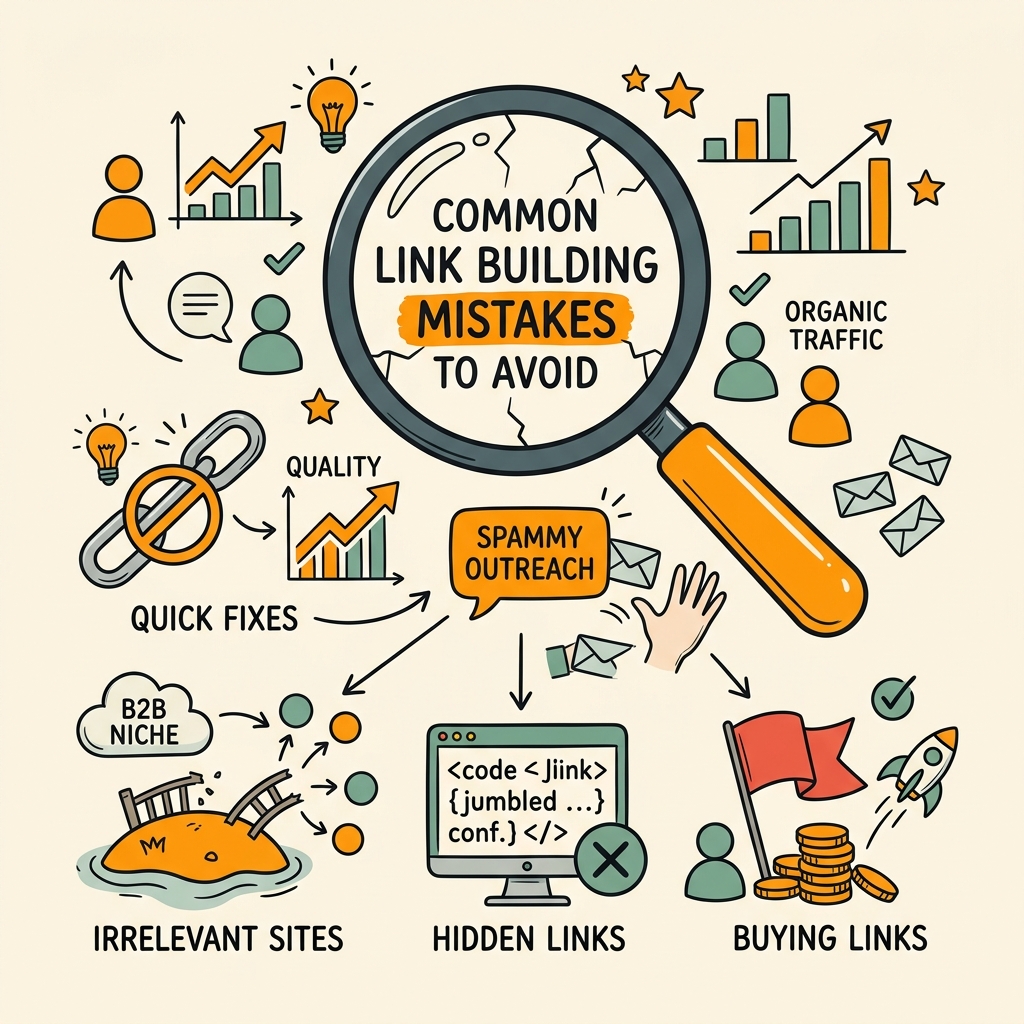
Even with the right strategy, execution failures derail most link-building programs. Here are the biggest traps:
- Prioritizing DR over Relevance: A DR 50 link from a topically perfect SaaS operations blog beats a DR 70 link from a general business publication. Relevance compounds. Generic links decay.
- Pitching Without Reading: Sending templated pitches to 500 sites gets you 1% responses. Reading the target content and personalizing your pitch gets you 10–15%. The ROI on 30 minutes of research per pitch is massive.
- Ignoring Link Velocity Decay: A link from a publication with high traffic churn might drive traffic for three months, then die. A link from an evergreen authority site drives traffic for years. Prefer longevity.
- Treating Link Building as Separate from Content: Your content strategy and link strategy are one system. Link building without great content fails. Content without link building stays invisible. Treat them as two sides of one growth engine.
- Giving Up Too Early: Most SaaS teams execute link building for two months, get 5–8 links, then declare it "not working." Link building compounds. By month six, your outreach converts at 3–5x the rate it did in month one because your domain authority has grown and your brand carries more weight.
Building Your First Month: The Action Plan
Theory is useful. Execution is everything. Here's a concrete 30-day plan to get your first links:
- Week 1: Audit and Plan — Analyze your top five competitors' backlinks. Identify 30 relevant DR 40+ domains linking to them but not to you. Segment by source type (blogs, listicles, integration platforms).
- Week 2: Build Your First Linkable Asset — Create one original piece of content: a comparison tool, customer survey data, or case study. Publish it on your blog. Write three variations of outreach copy for different audiences.
- Week 3: Launch Outreach Campaign — Run your first 50-person outreach campaign focused on one segment (integration partners or niche blogs). Track open rates and response rates. Note which email variations work best.
- Week 4: Refine and Scale — Analyze responses. Which pitches worked? Which didn't? Publish a second linkable asset. Launch a second 50-person outreach cycle with lessons from week 3 embedded. Aim for 2–4 links from month one. That's success.
How Jottler Compounds Link Building Momentum
The biggest bottleneck in link building is consistent content production. Every link campaign needs fresh hooks. Yet most SaaS teams publish one or two pieces per month, which starves their link-building program of ammunition.
Jottler solves this by automating the research, writing, and publishing of 3+ long-form articles per day. Your team connects their site, sets publishing frequency, and the AI agents handle keyword research, deep fact-checking, and CMS publishing. More content published means more link-earning assets in market. More assets means higher link velocity. Higher velocity means authority compounds faster.
Rather than your team spending 40 hours a week on content creation, they focus on the 5 hours a week that actually matters: relationship-building with editors and optimizing which content pieces get pitched to which audiences. With content marketing automation handling the publishing pipeline, your link-building ROI accelerates.
Conclusion
Link building for B2B SaaS has never been more important and never been clearer in execution. The fundamentals haven't changed: earn editorial links from relevant, authoritative sites by creating content worth linking to. But the execution has evolved. Spray-and-pray guest posting is dead. AI-powered research and personalized outreach are standard. Integration partnerships are underrated. And original research generates 3.4x the link velocity of generic content.
Your competition is building links. Top-ranking pages in competitive SaaS categories average 247 referring domains. Even pages in position #10 average 62. If your domain has fewer than 35 high-quality backlinks, you're not competing yet. You're still building the foundation. Start this month. Build one linkable asset. Run one 50-person outreach campaign. Earn two or three links. Month two, publish two assets and run two 50-person campaigns. By month six, you're running a system that compounds. By month twelve, links are flowing in from sources you never pitched—because your domain authority and brand are strong.
Start your SEO agent today and automate the content creation that fuels your link-building velocity.
FAQs
How many backlinks do I need to rank in Google?
For mid-difficulty SaaS keywords, top-ranked pages typically possess 5–20 referring domains. High-difficulty terms in mature categories require the higher end of that range. For competitive "best [category] software" queries, the #1 position averages 247 referring domains, while position #10 averages 62. The takeaway: don't obsess over an exact number. Instead, focus on earning links from topically relevant, high-authority sources. Ten links from relevant SaaS blogs outperform 100 links from irrelevant directories. Quality and relevance compound much faster than volume.
What's the fastest way to build backlinks for SaaS?
Integration partnerships on platforms like Slack, HubSpot, and Zapier are the fastest channel. These links have an 82% success rate, cost a median of just $140, and take 2–6 weeks to secure. You're not pitching. You're submitting your product to app marketplaces where the ecosystem expects integrations. The process is straightforward: make your product integration-ready, submit it to marketplaces, handle reviews, and earn permanent high-authority backlinks. Most SaaS teams ignore this channel, which is why it works so well. It's fast, high-success, and directly builds your partnership channel simultaneously.
Can I do link building myself or do I need an agency?
Small SaaS teams can execute link building internally if they commit to the system. The key is building linkable assets first (original research, comparisons, case studies), then running targeted outreach campaigns to relevant segments. What you can't do alone is maintain velocity at scale. A one-person team can earn 2–3 links per month. A three-person team running automation and personalization can earn 15–20 per month. The ROI often justifies hiring a contractor or fractional link-building specialist when your domain reaches DR 25+. Until then, focus on asset creation and small targeted campaigns yourself. The learning curve is steep, but the fundamentals are teachable.