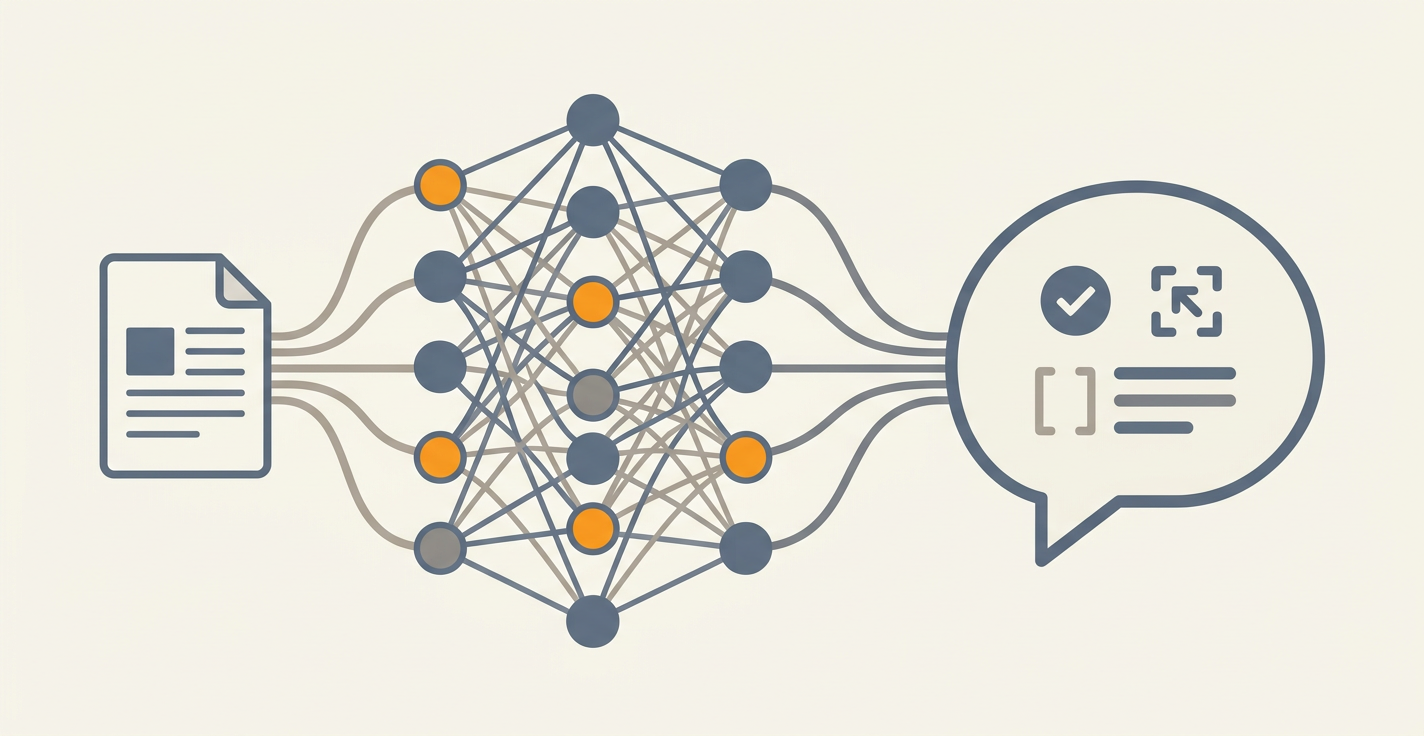
LLM SEO: How to Get Your Content Into ChatGPT and Claude
LLM SEO is the practice of structuring web content so that large language models retrieve, trust, and cite it inside their answers. It covers how ChatGPT, Claude, Gemini, and Perplexity find sources during inference or retrieval-augmented generation (RAG), and how to make your pages the ones they pick.
Traditional Google SEO optimizes for a ranked list of links. LLM SEO optimizes for a synthesized paragraph that rarely shows a link at all. The mechanics are different, and most content built for Google was never structured for the way language models actually read a page.
Key Takeaways
- LLM SEO is the discipline of optimizing content so language models retrieve and cite it during inference, RAG pipelines, and AI-powered search products.
- Language models read pages as token sequences and embedding chunks, so short paragraphs, clear entity definitions, and answer-first structure outperform keyword density.
- 44.2% of all LLM citations come from the first 30% of a page, which means the intro, key takeaways, and first H2 carry most of the citation value (Ekamoira, 2026).
- Freshness signals, structured data, and an explicit robots.txt policy for AI crawlers (GPTBot, ClaudeBot, Google-Extended, PerplexityBot) control whether your content is even eligible to be cited.
- LLM traffic is small but converts at up to 18%, compared to 1-3% for organic search, so a single citation can outperform dozens of blue-link visits (Search Engine Land, 2026).
What LLM SEO Actually Means
LLM SEO is shorthand for the set of content and technical decisions that determine whether a language model references your page when it answers a question. It is related to generative engine optimization and answer engine optimization, but it focuses specifically on the mechanics inside the model, not just the AI-powered search product on top.
Three different retrieval paths matter here. Models cite content pulled live from a search API (ChatGPT search, Perplexity, Google AI Overviews). They cite content chunked and embedded inside a vector database for RAG. And they reproduce content absorbed during pre-training, usually without attribution. Each path rewards different optimizations.
ChatGPT reached 900 million weekly active users by February 2026, more than double the 400 million reported a year earlier (TechCrunch, 2026). Those users are asking questions that used to go to Google. Whether your content shows up in the answer depends on decisions most sites never revisit after they publish.
How Language Models Actually Read a Page
Search crawlers index text. Language models do something closer to parsing, chunking, and embedding. Understanding each step changes what you optimize for.
Tokenization
Every page a model sees gets broken into tokens, the small units a model actually processes. One token is roughly three-quarters of a word in English. A 3,000-word article becomes about 4,000 tokens. Long sentences, rare words, and unusual punctuation burn more tokens per idea, which reduces how much of your content fits in the model's working context.
Clean prose tokenizes efficiently. Em dashes, nested parentheticals, and odd typography waste tokens. So do walls of jargon. Writing in plain, specific sentences is not just a style choice, it is a compression choice that lets more of your argument survive the context window.
Chunking
For RAG and for most live search products, a model does not see the full page. It sees chunks, typically 200 to 1,000 tokens each, split along natural boundaries like headings and paragraphs. A chunk either answers the user's question on its own or it does not.
Pages built around 40-to-80-word paragraphs with descriptive H2s chunk cleanly. Pages built around 400-word walls of text chunk badly, because a chunk might end mid-argument with no context. The fix is not more headings for their own sake, it is paragraph and section boundaries that match the semantic shape of the content.
Embedding Retrieval
Each chunk is then embedded as a vector, a list of numbers representing meaning. When a user asks a question, the question is also embedded, and the system retrieves the chunks whose vectors sit closest to the question in vector space.
This is why keyword matching alone does not work for LLM SEO. A paragraph that says "How to reduce cart abandonment" will be retrieved for a query about "shopping cart conversion issues" if the meaning is close, even if the words do not match. What matters is whether each chunk clearly expresses a specific idea. Vague, filler-heavy chunks end up far from every real query.
LLM SEO vs Traditional Google SEO
The two disciplines share a foundation. Indexation, crawlability, authority, and topical depth still matter. But the surface behaviors that drive wins diverge quickly.
Google rewards relevance at the document level. LLMs care about relevance at the passage level. A 5,000-word page can rank for a broad keyword on Google while failing to earn a single LLM citation, because no individual passage answers a specific question cleanly.
Google cares about inbound links as a primary authority signal. LLMs care about citation density, quoted sources, and mentions across the training corpus. A study covered in Search Engine Land found that sites with over 32,000 referring domains are 3.5 times more likely to be cited by ChatGPT than sites under 200, but the relationship is weaker than in classic SEO, and off-site mentions on review platforms like G2 and Trustpilot drive a separate 3x uplift.
Google penalizes thin, spun content after the fact. LLMs filter promotional or vague content at retrieval time, before it ever reaches the user. Content that would rank page one on Google in 2019 is now invisible to ChatGPT, because it does not contain enough specific, verifiable claims to be worth citing.
We cover the broader comparison in detail in our guide on SEO vs AI optimization. The short version: Google SEO gets your content indexed, and LLM SEO gets it cited. Ignoring either is a mistake.
The Anatomy of a Citable Page
Passage-level citability comes from structural choices that most content teams still treat as cosmetic.
Answer-First Intros
44.2% of all LLM citations come from the first 30% of a page, with intros carrying disproportionate weight (Ekamoira, 2026). The first two paragraphs are the single most valuable real estate on the page for LLM SEO. If the reader cannot extract a clear, self-contained answer from them, neither can a model.
A good LLM intro defines the concept in the first sentence, gives context in the second, and does not make the reader scroll to find the thesis. Ours for this post does exactly that. Yours probably does not, if you have not rewritten intros with this constraint.
Key Takeaways and Direct Answers
Blockquoted key takeaways, FAQ blocks, and definition boxes are the most extractable content on most pages. Language models favor passages that can be quoted verbatim without editing. That means complete sentences, no pronouns with ambiguous referents, and numbers with their units.
The bullet list at the top of this post is an LLM SEO pattern. Each bullet stands alone. Each bullet could be pulled into an answer without losing meaning. That is the shape to aim for.
Entity Definitions
Models score passages on how clearly they define the entity being discussed. A page titled "Topical authority" that takes 800 words to say what topical authority is will lose to a page that defines the term cleanly in sentence one, then elaborates. The model pulls the definition, not the elaboration.
This is why glossary-style sections work well inside long-form content. They give the model a concentrated, unambiguous passage to cite.
Freshness Signals
LLMs weight freshness heavily, especially for live-search and RAG use cases. A model fetching pages in real time treats an article dated 2023 differently from one dated this month, even if the content is identical.
Four freshness signals move the needle. A visible, machine-readable publication date in the page body and schema. A recent dateModified value when the content is genuinely updated, not just touched. References to 2025 or 2026 statistics, product versions, and events. And a regular update cadence that the model can detect through sitemap and RSS crawls.
Jottler handles freshness automatically through smart scheduling, but the principle applies to any publishing workflow. A page that was last meaningfully updated two years ago is a liability for LLM SEO. The fix is a review cadence, not a single rewrite.
Structured Data for LLMs
Schema.org markup helps language models classify what a page is and what it contains. The schemas that matter most for LLM SEO are Article, FAQPage, HowTo, Product, and Organization. Each gives the model a structured skeleton of your content that is easier to parse than HTML.
FAQPage schema is especially valuable. A well-formed FAQPage block turns each question into a directly citable answer unit. Models can and do pull those units verbatim into responses. The same applies to HowTo schema for step-by-step content.
JSON-LD is the preferred format. Keep the schema accurate, not aspirational. Declaring a page as a HowTo when it is actually an essay hurts citation quality, because the model's extracted structure does not match the real content.
For a deeper look at schema in long-form content, see our guide on AI-powered SEO.
Robots.txt for LLM Bots
The control layer most sites ignore is robots.txt for AI crawlers. Different bots read your file, and each one controls a different corner of how your content flows into AI products.
GPTBot is OpenAI's training crawler. Blocking it removes your content from future ChatGPT training, but not from ChatGPT's live search product. OAI-SearchBot is the live search crawler for ChatGPT search, and blocking it removes you from that product's citations entirely. ChatGPT-User is triggered when a user plugin or action fetches your page in real time, so blocking it prevents on-demand retrieval.
ClaudeBot is Anthropic's equivalent training and retrieval crawler. Google-Extended is the flag Google respects for AI model training (but not for search indexing). PerplexityBot handles Perplexity's crawls, and CCBot is Common Crawl, the dataset most open LLMs train on.
Most sites should explicitly allow OAI-SearchBot, ChatGPT-User, ClaudeBot, and PerplexityBot, because these control citation eligibility in live products. The decision on GPTBot and Google-Extended is more political: do you want your content used for training? There is no right answer, but there is a wrong one, which is doing nothing and finding out your crawler settings are blocking citation.
A minimal LLM-friendly robots.txt might look like this:
User-agent: OAI-SearchBot
Allow: /

User-agent: ChatGPT-User
Allow: /

User-agent: ClaudeBot
Allow: /

User-agent: PerplexityBot
Allow: /

User-agent: GPTBot
Allow: /
Flip the Allow to Disallow for any bot you want to exclude. Use a sitemap link at the top of the file so crawlers can find your latest content.
Internal Linking and Context Windows
LLMs build mental models of a site through internal links. A page with 5 descriptive internal links to related concepts passes more context to a model than an orphaned page with none. This mirrors how human readers build context, which is not a coincidence.
Two patterns move LLM SEO. Descriptive anchor text, because the anchor becomes part of the context the model holds for the target page. And cluster-based linking, where related posts link to each other so the model sees the cluster as a coherent body of work, not a collection of disconnected posts.
We lay out the full approach in our post on internal linking strategy. The short version: link to the other pages a reader would want after this one, use descriptive anchors, and keep the cluster tight.
Tools That Help
Three categories of tooling matter for LLM SEO. Citation tracking tools (Profound, AirOps, Adobe LLM Optimizer) tell you when and where your content appears in AI answers. Content platforms with LLM-aware output shape articles in the structure that language models prefer. And traditional SEO platforms cover the indexation foundation that LLM SEO still depends on.
Jottler falls in the second category. The content engine produces long-form articles with answer-first intros, blockquoted key takeaways, FAQ schema, and direct answer formatting built into every post. It is the same pattern this article uses, because the pattern is what language models reward.
That is not a coincidence either. We rebuilt the output format after watching our own posts get cited less often than competitors who had half our word count but better passage-level structure. Most content tools still optimize for word count and keyword density, which is a 2018 playbook. Jottler's AI citation format optimizes for the way models actually retrieve passages in 2026.
Measuring LLM SEO
Measurement is the weakest part of the LLM SEO stack right now. Traditional analytics show almost nothing. LLM referral traffic is still only about 0.1% of total web traffic, according to a 13-month Search Engine Land study, but it grew 165x faster than organic search over that period and converts at roughly 18% versus 1-3% for organic (Search Engine Land, 2026). The traffic numbers understate the actual value.
The practical measurement stack has three layers. Referral tracking from chat.openai.com, perplexity.ai, claude.ai, and gemini.google.com captures clicks from citations. Brand-query monitoring in ChatGPT and Perplexity (manual for now, or via a citation-tracking tool) shows whether your content appears for the prompts that matter. And server-log analysis of AI crawler hits tells you which pages are being fetched during live retrieval, which is the leading indicator for citations.
None of these are complete. The industry is roughly where web analytics was in 2004: the signals exist, but the attribution is messy. The right move is to start measuring now, because the dataset compounds.
Common LLM SEO Mistakes
Four patterns show up in almost every audit. Posts that open with a throat-clearing intro instead of answering the question. Paragraphs that run past 100 words, which chunk badly and lose citation value. Stats without sources, which are filtered out by any model that checks factual grounding. And robots.txt files that block AI crawlers by accident, usually because someone copied a wildcard block from a 2023 blog post.
Each one is cheap to fix. Each one, un-fixed, is the reason a competitor with weaker SEO signals is getting cited by ChatGPT while you are not.
Frequently Asked Questions
Is LLM SEO different from traditional SEO?
Yes. Traditional SEO optimizes for ranked links on a search engine results page. LLM SEO optimizes for being cited as a source inside an AI-generated answer. The two share technical foundations like crawlability and authority, but they reward different content structures. LLM SEO favors short paragraphs, answer-first intros, and schema-backed passages, while traditional SEO rewards depth and authority at the document level.
How do I know if LLMs are citing my content?
Check referral traffic from chat.openai.com, perplexity.ai, claude.ai, and gemini.google.com in your analytics. Run sample prompts related to your content in ChatGPT and Perplexity and note which sources appear. For systematic tracking, citation monitoring tools like Profound, AirOps, and Adobe LLM Optimizer log which prompts surface your domain as a source across multiple AI platforms.
Should I block GPTBot in my robots.txt?
Most sites should not block GPTBot. Blocking it removes your content from future ChatGPT training but does not affect live citations, which are controlled by OAI-SearchBot and ChatGPT-User. Blocking the live-search bots is what actually hurts visibility. The training question is a separate values call, but the practical recommendation for LLM SEO is to allow all live-retrieval AI bots.
Does word count matter for LLM SEO?
Word count matters less than passage structure. A 1,200-word post with clean answer-first intros and blockquoted takeaways can out-cite a 5,000-word post that buries the answer. Models retrieve passages, not full articles. Length is still useful because it supports topical depth, but only if the long-form content is structured in citable chunks rather than a single wall of prose.
Can AI content rank for LLM SEO?
Yes, if it is written for passage-level citability rather than stuffed with keywords. Language models have no way to detect AI authorship directly. They detect vague, generic, or promotional content, and those traits correlate with lazy AI use. Well-researched AI content with real sources, specific data, and structured output performs as well as human-written content on every LLM SEO signal we measure.
Where LLM SEO Goes Next
LLM SEO is a moving target, but the underlying mechanics (tokenization, chunking, embeddings, retrieval) are stable. The content patterns that win today will still win in a year, because they match how models read. What changes are the details: which bots matter, which schemas get respected, which citation-tracking tools become standard.
The safest move is to build a content operation that is LLM-friendly by default, so you are not retrofitting every post when the next model launches. That is the bet Jottler's autopilot mode is built around: every article it publishes is structured for both Google rankings and LLM citations, without a separate optimization pass. If you are publishing content today that ignores how models read, you are losing citations you could otherwise earn, and the gap compounds every week.