Local SEO Ranking Factors and Optimization
Local search has become non-negotiable for most businesses. When someone searches for "dentist near me" or "coffee shops in my area," Google's local algorithms decide which three businesses appear in the Map Pack. The stakes are real: 87% of consumers read online reviews before visiting a local business, and businesses with 50+ Google reviews are 266% more likely to appear in the Local Pack than those with fewer than 10. Yet many founders and marketing teams still treat local SEO as an afterthought, missing the compounding traffic that consistent optimization delivers. Understanding the ranking factors that actually move the needleand automating their executionis how growing businesses capture local market share without burning out their teams.
Key Takeaways
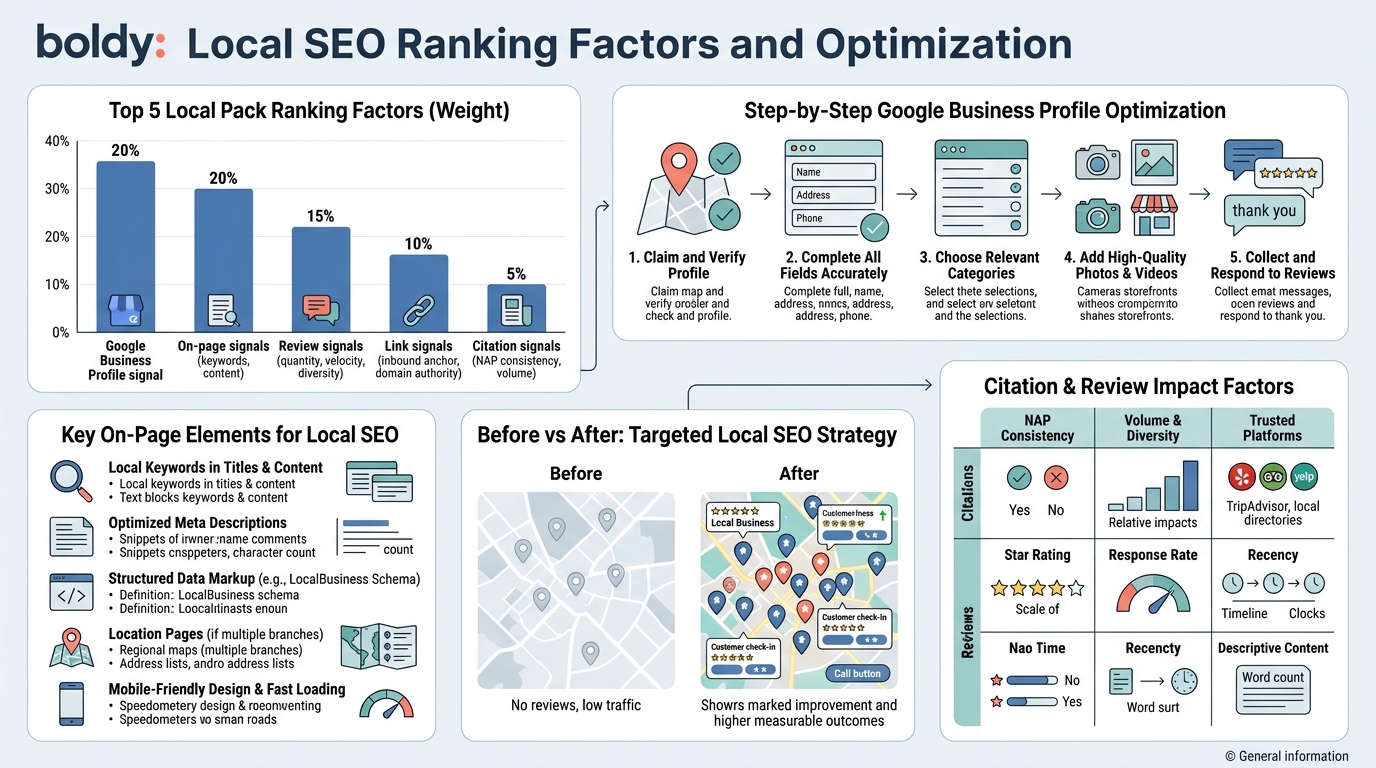
- Google Business Profile completeness, review signals, and citation consistency are the three pillars of local ranking (2026 Rankmax data)
- Businesses ranking in the top three local positions average 561 reviews with a 4.8-star ratingquality and freshness matter more than volume alone
- 52% of local marketers prioritize Local Pack rankings, but only consistent optimization across GBP, reviews, citations, and on-page content compounds results over time
- Google Business Profile Optimization: Complete, accurate GBP data is the foundational local ranking signalit's how Google verifies your business exists and where it operates.
- Review Acquisition and Management: Fresh, high-quality reviews drive both rankings and trust; businesses that respond to reviews see stronger engagement signals.
- Citation Consistency and Authority: NAP accuracy across directories and citations builds trust with Google's algorithms and local search engines.
- Local On-Page SEO: Targeting location-specific keywords and optimizing landing pages for geographic intent improves relevance signals.
- Link Building and Authority: Backlinks remain a major ranking factor; local businesses need links from relevant, authoritative sources in their space.
- Behavioral Signals and Engagement: Click-through rate, dwell time, and customer actions on your GBP listing influence ranking position.
How Does Google Business Profile Optimization Drive Local Rankings?
Your Google Business Profile (GBP) is the single most important factor in local search. It's where Google verifies your business exists, validates your location, and displays your information directly in search results. Complete, accurate GBP data is the foundation every local business needs. Google's own guidance emphasizes providing complete business information including address, phone number, business category, and relevant details like parking or Wi-Fi availability (2026).
Core GBP Completeness and Verification
A fully optimized GBP profile includes far more than name, address, and phone number (NAP). You need accurate business hours, service areas, categories, photos, and a compelling business description. The more complete your profile, the higher the confidence signal you send to Google's algorithm. Unverified or incomplete profiles are filtered out early in the ranking process.
Verification is non-negotiable. Google sends a postcard to your business address containing a verification code. Without this verification, your business profile has minimal ranking power. Once verified, you gain access to features like Q&A responses, appointment booking, and direct messagingall of which create engagement signals that influence your local ranking.
Photos, Videos, and Visual Content on GBP
GBP allows you to upload high-quality photos and videos of your business, team, products, and customer experience. These visual signals matter. Businesses with recent, relevant photos see higher engagement and click-through rates. Video content is even more powerfulit keeps potential customers on your profile longer and signals freshness to the algorithm.
Update your GBP photos regularly, especially seasonal or new service highlights. Include staff photos, storefront images, and customer testimonials in photo form. This ongoing content strategy keeps your profile active in Google's eyes.
Why Do Review Volume, Quality, and Freshness Impact Local Rankings?
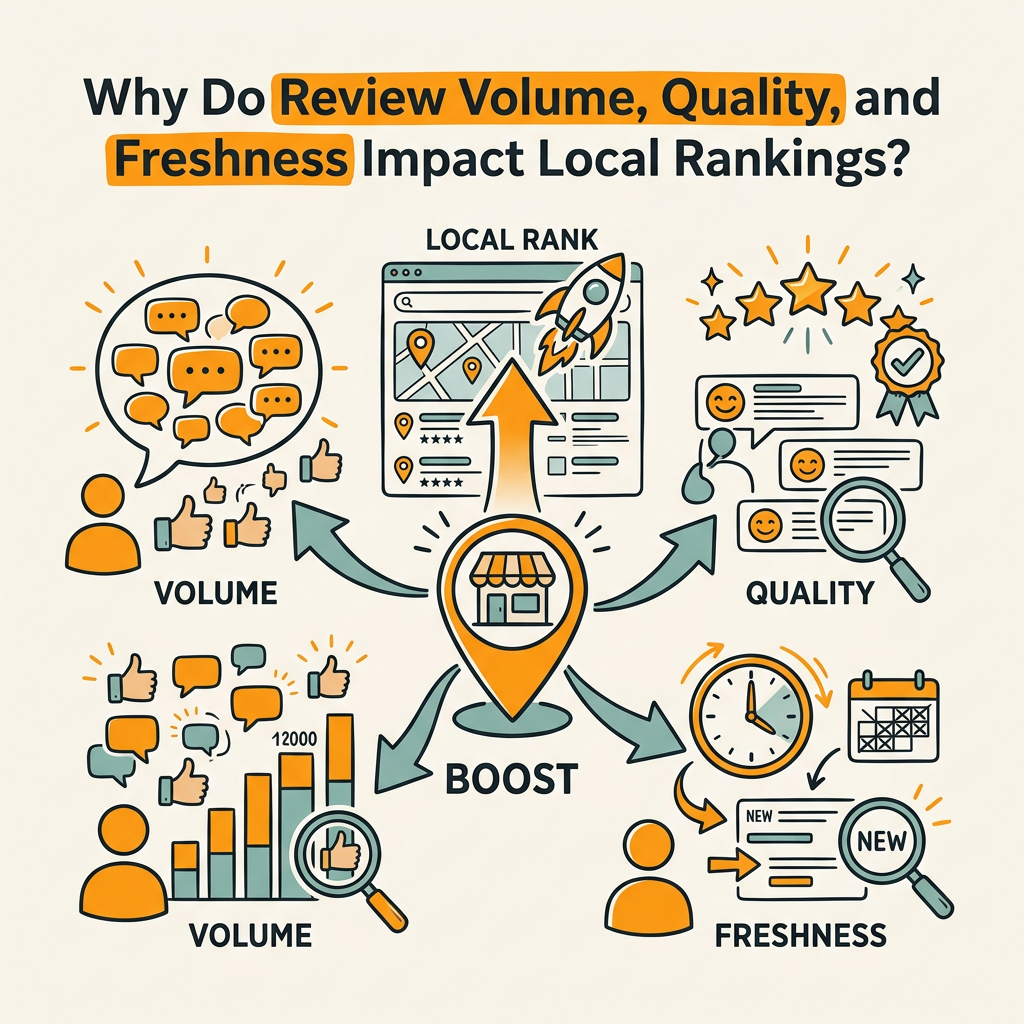
Reviews are the second pillar of local SEO. They serve two purposes: they build trust with potential customers, and they send ranking signals to Google about your business. 71% of consumers would not consider a business with a rating below 3 stars, and 88% say they would use a business that responds to both positive and negative reviews (Rankmax, 2026). This means reviews are both a ranking factor and a conversion factor.
Review Volume and Star Rating Benchmarks
The math is clear: businesses ranking in the top three local positions average 561 reviews and a 4.8-star rating (Rankmax, 2026). But volume alone doesn't guarantee ranking. A business with 100 recent 5-star reviews will outrank one with 300 reviews from two years ago. Freshness and consistency matter more than bulk.
Set a goal of acquiring at least 50 reviews firstthis threshold has been identified as a critical tipping point for Local Pack visibility. Once you hit that milestone, focus on maintaining a steady stream of fresh reviews rather than chasing high volume.
Review Quality, Text Content, and Response Strategy
Not all reviews are equal. A 5-star review that simply says "Great service!" carries less weight than a detailed review that mentions specific services, outcomes, or experiences. Reviews containing relevant keywords and substantive customer stories improve your local relevance signals.
Response strategy is equally important. Responding to reviewsboth positive and negativedemonstrates customer engagement and provides an opportunity to address concerns publicly. Businesses that respond to reviews show higher engagement metrics, which influence local rankings. Make it a practice to respond to every review within 24-48 hours.
How Do Citations and NAP Consistency Strengthen Local Authority?
Citations are structured mentions of your business's NAP (Name, Address, Phone number) across the web. They function as local SEO citations, not backlinksthey don't directly drive traffic but they validate your business information with Google. Citations matter most when they are accurate, distributed across multiple platforms, high quality, and relevant to the business or locality (Moz, 2024). Quality over quantity is the rule.
Citation Sources and Directory Authority
Not all directories carry equal weight. High-authority citation sources include Google Maps, Apple Maps, Yelp, Facebook, and industry-specific directories (e.g., Healthgrades for medical practices, Angi for home services). Building citations on these authoritative platforms is far more valuable than submitting your business to 100 low-authority aggregator directories.
Start with the major platforms: ensure your business is listed on Google My Business, Yelp, Facebook Business, Apple Maps, and the top 2-3 industry-specific directories for your field. These will compound faster and carry more weight than a scattered approach.
NAP Consistency Across Web Properties
Consistency is the foundation. Your NAP must be identical across your website, GBP, Yelp, Facebook, and all citations. Even a small variation (e.g., "Suite 200" vs. "Ste 200") can confuse Google's algorithm and weaken your citation authority. Audit all your web properties quarterly and correct any inconsistencies immediately.
This is an area where automation helps enormously. Tools that sync your business information across multiple directories ensure NAP consistency without manual work on every platform. As a founder automating content production, you can apply the same thinking to your business information across the web.
What Role Do Local On-Page SEO and Content Play in Rankings?
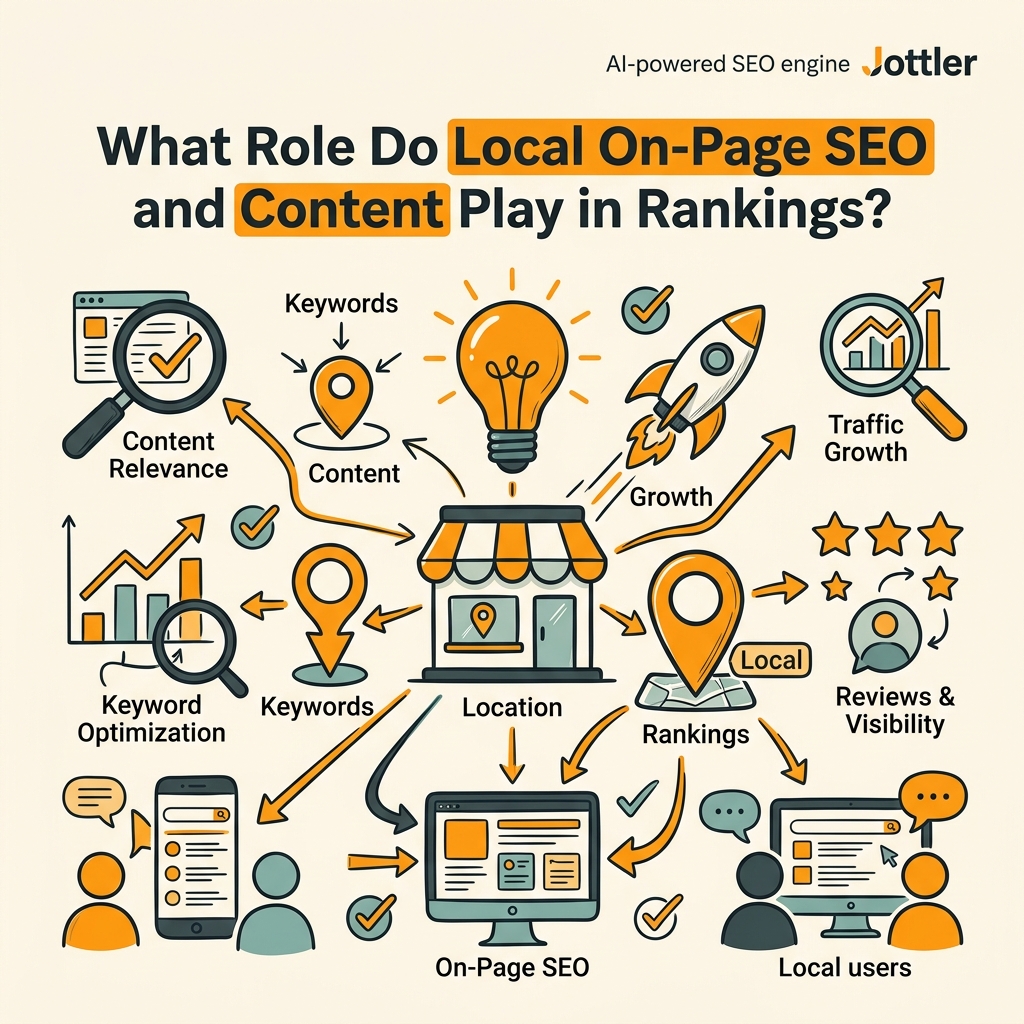
Local rankings are not determined by Google Business Profile alone. Your website's on-page SEO and content also influence how Google ranks you for local searches. When someone searches "dentist in Austin," Google examines both your GBP profile and your website's relevance to that geographic and service query.
Location-Specific Keywords and Landing Pages
Target location-specific keywords in your on-page content. If you operate a service-based business in multiple cities, create dedicated landing pages for each location optimized for local keywords like "plumber in Denver" or "tax accountant in Portland." Each location page should have unique, valuable content that addresses local customer needsnot boilerplate text repeated across 50 pages.
Include your city, region, or service area naturally throughout your content. Mention local landmarks, neighborhoods, and community details that establish relevance. This local context helps Google understand your geographic footprint and improves your relevance for location-based queries.
Schema Markup and Structured Data
Implement LocalBusiness schema markup on your website. This structured data tells Google exactly what your business is, where it's located, what services you offer, and other key details. Schema markup is the bridge between your website and Google's understanding of your local business profile.
Use LocalBusiness schema on your homepage and location pages. Include Organization schema for company-wide information (name, logo, contact) and Service Area Business schema if you serve multiple regions. Proper schema implementation signals professionalism to search engines and improves your eligibility for rich snippets in local search results.
How Do Backlinks and Authority Signals Impact Local SEO?
Link building is often overlooked in local SEO discussions, but backlinks remain a major ranking factor. Links rank as a critical local ranking factor, with link signals determining relevance across geographic regions (The HOTH, 2026). A local business with strong local backlinks and authoritative inbound links will outrank competitors without a link profile.
Local Link Building and Community Authority
Build backlinks from local sources: local news outlets, community organizations, industry associations, and local business networks. A link from your chamber of commerce or a local nonprofit carries more weight than a link from a random national directory.
Earn links by sponsoring local events, participating in community initiatives, or being quoted in local media. This approach builds both authority and trust within your local market. Consistent local link building compoundseach link strengthens your domain authority and relevance for local queries.
Content Marketing and Link Velocity
Publishing valuable, location-relevant content naturally attracts local links. Content marketing frameworks that emphasize consistency and relevance are the foundation for sustainable link growth. Write about local market trends, publish guides specific to your geographic area, and create resource pages that local websites want to link to.
Consistent publishing drives link velocitythe rate at which you acquire new backlinks. A business that publishes new content weekly will accumulate backlinks faster than one publishing annually. This is where scaling content production becomes a local SEO advantage. SEO automation platforms that publish content consistently build link equity faster by maintaining a steady flow of linkable content.
What Behavioral and Engagement Signals Drive Local Ranking Position?
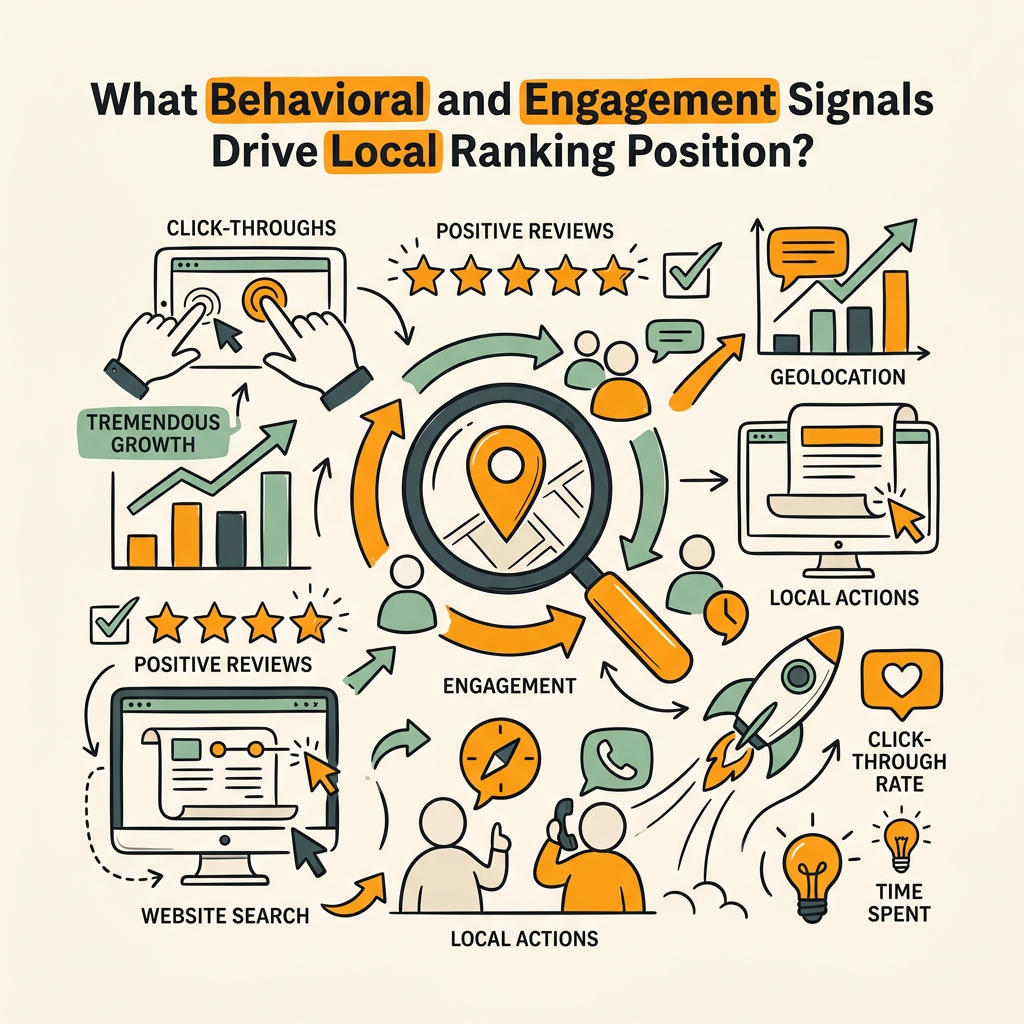
Google observes how people interact with your GBP listing and website. Click-through rates, calls, direction requests, and time on page all signal relevance and usefulness. Businesses in top-three positions see significantly higher engagement metrics than those in positions 4-10 (Rankmax, 2026). The ranking positions themselves create a positive feedback loophigher ranking generates more clicks, which reinforces the ranking.
Click-Through Rate and GBP Visibility
Your GBP profile's appearance in search resultsthe photo, rating, and descriptiondirectly influence whether someone clicks on your listing. Optimize for CTR by using a compelling business photo, clearly stating your top service offerings in the description, and displaying your star rating prominently (if it's positive).
The more clicks your listing receives, the stronger the signal to Google that your business is relevant for that search query. This creates a competitive advantage: businesses with strong visuals and clear value propositions generate more clicks, which reinforces their ranking position.
Phone Calls, Bookings, and Direction Requests
These are critical conversion and ranking signals. Make it easy for customers to call, book, or request directions from your GBP profile. Every call, booking request, or direction click sends a signal to Google that your business is useful. Services with appointment booking features integrated into GBP see higher engagement.
Track these metrics in Google Business Profile Insights. A business that generates 50 direction requests per month is signaling higher relevance than one with 5. Use this data to refine your optimization strategyif calls are low but your rating is strong, improve your GBP description and call-to-action to emphasize the booking process.
How Can You Build an Integrated Local SEO Optimization Strategy?
Local SEO success requires coordinating five major areas: GBP optimization, review generation, citations, on-page content, and link building. These factors compound when executed together. A business that fully optimizes its GBP but ignores reviews will never reach its full potential. Conversely, a business with excellent reviews but an incomplete GBP profile limits its visibility.
Building a Local SEO Operating System
Create a repeatable system for local SEO execution. This system should include: (1) a monthly GBP audit, (2) a review generation and response process, (3) a citation audit and update schedule, (4) location-specific content creation, and (5) local link acquisition targets. Assign ownership and build it into your marketing calendar.
The challenge for busy founders is consistency. Local SEO ranking factors don't change overnight, but they compound over months and quarters. A business that spends 3 hours per month optimizing GBP and acquiring reviews will see measurable ranking improvements in 90 days. A business that does nothing will fall behind as competitors capture those positions.
Automation and Scaling Local SEO Execution
Review management and citation updates are manual tasks that can be partially automated. Sending review requests to customers, updating business information across directories, and publishing location-specific landing pages are all candidates for automation. Content automation tools designed for consistent publishing can publish location-specific pages and blog content at scale, ensuring you never miss an opportunity to build topical authority and local relevance.
The most effective local SEO strategy combines manual outreach (relationship-building with local organizations, personalized review requests) with automated processes (citation updates, content publishing, listing monitoring). This hybrid approach maximizes impact without burning out your team.
| Local SEO Factor | Impact Level | Effort to Optimize | Automation Potential |
|---|---|---|---|
| Google Business Profile | Critical (Ranking + Visibility) | 2-4 hours initial, 1 hour/month maintenance | Low, requires manual content updates and photo uploads |
| Review Acquisition & Response | Critical (Ranking + Conversion) | Ongoing, 30 min/week to respond and request reviews | Medium, automated review requests, manual responses recommended |
| Citations & NAP Consistency | High (Authority Signal) | 4-6 hours initial audit, 2 hours/quarter maintenance | High, citation management tools automate updates across directories |
| Location-Specific Content | High (Relevance + Links) | 8-12 hours per location page | Medium to High, templated pages reduce time; content generation can be automated |
| Link Building | High (Authority) | 5-10 hours/month outreach | Low to Medium, prospecting and relationship-building are manual; tracking can be automated |
| Behavioral Signals (CTR, calls) | Medium to High (Ranking Reinforcement) | Minimal, optimize once, monitor monthly | High, GBP Insights reporting is automated |
Conclusion
Local SEO ranking success is built on six compounding factors: Google Business Profile completeness, review quality and freshness, citation accuracy and authority, location-specific content, backlinks from local sources, and engagement signals from customer behavior. Businesses that master these fundamentals see measurable improvements in Local Pack visibility within 90 days and sustained growth over 6-12 months. The competitive advantage belongs to teams that execute consistently, not perfectlypublishing location pages monthly, responding to reviews weekly, and building local citations quarterly creates compounding ranking power that competitors without systems cannot match.
The bottleneck for most founders is consistency and time. Local SEO execution is straightforward but labor-intensive. Autonomous SEO platforms that publish location-specific content automatically while maintaining local relevance compress months of manual work into daily automated publishing cycles. When you have a system that researches local keywords, writes location-relevant content, and publishes new pages every day, your local authority compounds in ways single-article-per-month strategies cannot match.
Start with this priority order: (1) Fully optimize your GBP profile, (2) build a review acquisition process, (3) audit and correct NAP consistency across citations, (4) publish 2-3 location-specific landing pages, (5) begin monthly local link building. This sequence takes 30-40 hours of focused work and delivers measurable ranking improvements. Once this foundation is solid, scale by automating content and citation updates.
FAQs
What is the most important local SEO ranking factor?
Google Business Profile optimization is the foundational factorit's how Google verifies your business exists and validates your location for local search. Without a complete, verified GBP profile, you have minimal ranking potential. Review signals and citation authority come second and third. However, no single factor dominates; success requires coordinating GBP, reviews, citations, on-page content, and links together. The businesses that rank highest combine all five areas consistently.
How long does it take to see results from local SEO optimization?
You'll see initial movement within 30-60 days if you optimize your GBP profile fully and start acquiring reviews. Significant Local Pack ranking improvements typically appear within 90 days of sustained effort. Full authority and competitive positioning takes 6-12 months of consistent citation building, content publishing, and link acquisition. The key is momentumbusinesses that execute one optimization per month will outrank those that do a one-time optimization and stop. Consistency compounds faster than intensity.
Can I rank locally without many reviews?
You can rank locally with fewer than 50 reviews, but your position will be limited. Businesses with 50+ reviews are 266% more likely to appear in the Local Pack than those with fewer than 10, so you're competing at a disadvantage. However, review quality matters more than quantitya business with 20 recent, detailed 4.8-star reviews will often outrank one with 100 stale 4-star reviews. Focus on acquiring reviews consistently rather than chasing a magic number. Start with a goal of 50 reviews; once you hit that, maintain a steady stream of new reviews every month to keep your rating signal fresh.