Map Content to the Buyer Journey Across All Stages
 Aidan Buckley
SEO
Aidan Buckley
SEO
March 20th, 2026
17 minute read
Table of Contents
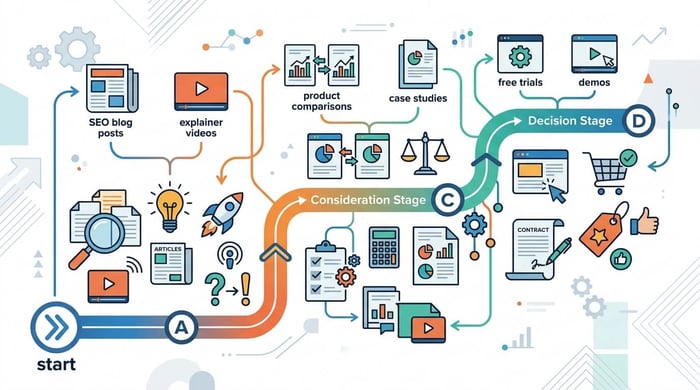
In the rapidly evolving digital landscape of 2026, understanding and adapting to the buyer journey is no longer optional—it's imperative for survival and growth. Companies actively mapping customer journeys achieve 54% higher returns on marketing investment, a stark contrast to those operating without a clear path. Without a strategic approach to content mapping, businesses risk significant missed opportunities, including conversion rate improvements and substantial ROI from their marketing efforts. This guide provides a comprehensive, actionable framework for busy businesses, SaaS companies, e-commerce stores, and more, to effectively map content to every stage of the buyer journey. We'll explore each stage, from initial awareness to final decision, and reveal how leveraging cutting-edge AI tools can automate and optimize this critical process, ensuring your content resonates, converts, and compounds organic traffic.
- Understanding the Buyer Journey Stages: Define the modern buyer's path, identify audience needs, and leverage data for effective mapping.
- Mapping Content to the Awareness Stage: Create discovery-oriented content, optimize for zero-click experiences, and build off-site authority.
- Mapping Content to the Consideration Stage: Nurture leads with personalized content, showcase solutions, and leverage social proof.
- Mapping Content to the Decision Stage: Drive conversions with high-impact content, personalize the purchase experience, and plan for post-purchase retention.
- Optimizing Content Performance Across the Journey: Implement multichannel strategies, measure influence beyond clicks, and continuously iterate.
- Leveraging AI for Scalable Content Mapping: Automate research, generate optimized content, and achieve hyper-personalization at scale.
Understanding the Buyer Journey Stages
The buyer journey in 2026 is more complex and non-linear than ever before, characterized by multiple touchpoints and channels. Customers now use 3-6 touchpoints per purchase, up from 2 previously, highlighting the need for a comprehensive content strategy. This section will break down the traditional three-stage model—Awareness, Consideration, and Decision—and adapt it to the nuances of today's digital interactions, emphasizing the importance of a "pathologically empathetic" content approach.
Defining the Modern Buyer's Path
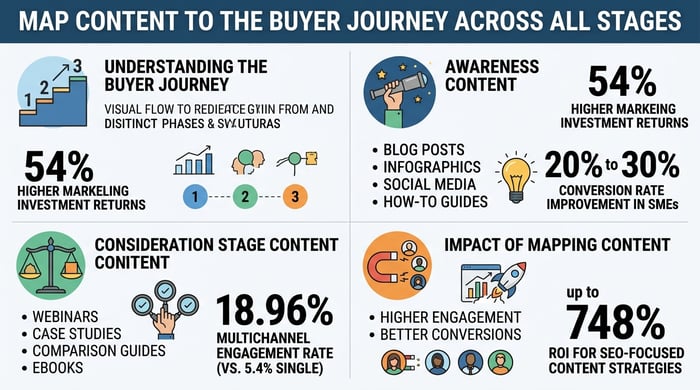
The contemporary buyer's path is rarely a straightforward funnel; it's a dynamic ecosystem where prospects jump between channels and touchpoints. This fluidity means content must be accessible and relevant at every potential interaction. Understanding this non-linearity is crucial, as businesses that effectively map customer journeys achieve 54% higher returns on marketing investment. What does that mean in practice? It means moving beyond a linear sales process to anticipate diverse customer behaviors.
"Marketers used to optimize for traffic. Now they need to optimize for influence."
Rand Fishkin, CEO and Co-founder, SparkToro
Identifying Your Audience and Their Needs
Effective content mapping begins with a deep understanding of your target audience. Creating detailed buyer personas, informed by zero- and first-party data, is crucial. This involves not just demographics but also pain points, aspirations, and information-seeking behaviors at each stage. For B2B companies, this extends to understanding organizational roles and decision-making hierarchies. For example, 70% of marketers use basic personalization (industry/vertical, company size, location) and 65% apply role-based details (title, seniority, department).
- Demographics: Age, location, income, industry, company size.
- Psychographics: Motivations, pain points, goals, values.
- Behavioral Data: Past interactions, content consumed, purchase history.
- Information Channels: Where do they seek information? Blogs, social media, forums, industry reports?
“The gap in 2026 won’t be between brands using AI and brands not using AI. It’ll be between brands with rich customer data and brands guessing at what their customers want.”
Maria Tselonis, Klaviyo
The Role of Data in Journey Mapping
In 2026, data is the bedrock of successful buyer journey mapping. Leveraging customer data platforms (CDPs) and analytics tools allows businesses to track customer interactions, identify drop-off points, and personalize content delivery. This shift towards a privacy-first approach, emphasizing zero- and first-party data, is critical for compliant and effective personalization. Why? Because 59% of marketers achieve positive ROI from on-site personalization, proving data's direct impact on revenue.
- Zero-Party Data: Information customers explicitly share, like preferences or interests.
- First-Party Data: Data collected directly from your interactions with customers, such as website behavior or purchase history.
- Customer Data Platforms (CDPs): Consolidate customer data from various sources to create a unified profile.
- Analytics Tools: Track user behavior, content engagement, and conversion metrics to identify patterns and areas for improvement.
“With stricter EU and Apple regulations and rising consumer demands for privacy, marketers need to shift to a privacy-first approach emphasizing zero- and first-party data.”
Christian Nørbjerg Enger, Chief Product Officer, Segmento
Mapping Content to the Awareness Stage
At the Awareness Stage, prospects are identifying a problem or need. Your content should focus on educating them, providing value, and establishing your brand as a helpful resource, not a sales pitch. This includes blog posts, guides, and infographics that address broad pain points and common questions. Blog content appears in 70% of conversion paths, making it a cornerstone of this stage.
Creating Discovery-Oriented Content
The goal here is to attract a broad audience by addressing their nascent pain points and questions. Think top-of-funnel content that educates and informs without pushing a product. This includes comprehensive blog posts, "how-to" guides, educational videos, and infographics. For instance, an e-commerce platform might publish a guide on "The Best Eco-Friendly Packaging Options," attracting businesses exploring sustainable practices. This foundational content is key for scalable SEO growth.
- Educational Blog Posts: Address common industry challenges or questions.
- Infographics: Present complex data in easily digestible visual formats.
- "How-To" Guides: Offer solutions to general problems relevant to your industry.
- Videos: Explain concepts or demonstrate processes in an engaging way.
Optimizing for Zero-Click Experiences and AI Summaries
Rand Fishkin predicts that "zero-click experiences will become the majority of online journeys," and Internet users will consume 10X as much content via AI summaries as all longer-than-a-paragraph text combined. This necessitates optimizing content for generative engine optimization (GEO), ensuring it's discoverable and digestible in AI-driven search results and conversational interfaces. Focus on clear, concise answers and well-structured information that AI can easily parse and summarize.
- Structured Data: Use schema markup to help AI understand your content.
- Direct Answers: Provide clear, concise answers to common questions within your content.
- Natural Language Processing (NLP): Write content that sounds natural and conversational.
- Concise Summaries: Ensure your content has easily extractable summaries for AI models.
Building Off-Site Authority and Influence
Beyond your owned channels, building authority off-site is crucial for the Awareness Stage. This involves leveraging podcasts, press mentions, and YouTube as "new homepages" where potential buyers discover brands. Thought leadership content, interviews, and expert opinions help establish credibility before a prospect even visits your website. Consider that 85% of buyers use AI weekly for research, meaning your brand's presence and authority across diverse platforms, including those AI models draw from, is more critical than ever.
- Guest Appearances: Participate in industry podcasts or webinars.
- Media Mentions: Secure coverage in relevant news outlets or trade publications.
- Social Media Engagement: Actively participate in industry discussions and share valuable insights.
- Thought Leadership Articles: Publish expert opinions on platforms like LinkedIn or Medium.
Mapping Content to the Consideration Stage
In the Consideration Stage, prospects are actively researching solutions and comparing options. Your content should provide deeper insights, demonstrate expertise, and build trust. This is where personalized content, such as targeted email campaigns, case studies, and detailed whitepapers, becomes critical. Triggered email campaigns generate 77% of email marketing ROI.
Nurturing Leads with Personalized Content
At this stage, generic messaging falls flat. Prospects are looking for solutions tailored to their specific needs. This is where AI-powered content strategies become invaluable, enabling hyper-segmentation and personalized messaging. Think targeted email sequences that respond to specific actions, personalized landing pages based on industry, and dynamic content that adapts to user behavior. For B2B, 65% of marketers apply role-based details (title, seniority, department) for personalization.
- Targeted Email Campaigns: Deliver content relevant to a prospect's expressed interests or actions.
- Personalized Landing Pages: Tailor page content based on referral source or user segment.
- Interactive Tools: Quizzes, calculators, or configurators that provide personalized results.
- Webinars & Demos: Offer live or on-demand sessions demonstrating solutions to specific pain points.
Showcasing Solutions and Value Propositions
Content at this stage should clearly articulate how your product or service addresses the prospect's identified problem. This includes solution-oriented blog posts, comparison guides, webinars, and product demos. Webinars appear in 20% of conversion paths, indicating their effectiveness in moving prospects further down the funnel. The key is to move beyond problem identification to solution presentation, demonstrating clear value.
- Case Studies: Illustrate how your solution helped real customers achieve their goals.
- Comparison Guides: Position your product against competitors, highlighting your unique advantages.
- Whitepapers & Ebooks: Offer in-depth analysis of industry challenges and your approach to solving them.
- Product Demos: Provide a detailed look at your product's features and benefits.
Leveraging Social Proof and Expert Endorsements
Prospects in the Consideration Stage are looking for validation. Incorporating testimonials, customer reviews, and industry expert endorsements can significantly influence their decision-making. Highlighting success stories and demonstrating real-world impact builds confidence and reduces perceived risk. For instance, 88% of B2B SaaS marketers report positive ROI from data-driven/proprietary content, much of which derives its power from demonstrating proven results and social proof. This is critical for generating ROI from data-driven/proprietary content.
- Customer Testimonials: Short, impactful quotes from satisfied clients.
- Case Studies: Detailed narratives of how your product solved a customer's problem.
- Industry Awards & Recognition: Showcase any accolades or certifications.
- Expert Reviews: Highlight endorsements from influential figures or publications.
Mapping Content to the Decision Stage
The Decision Stage is where prospects are ready to make a purchase. Content here should directly facilitate conversion, addressing any remaining doubts and providing clear calls to action. This includes pricing pages, free trials, demos, consultations, and personalized offers. For e-commerce, product recommendations account for up to 31% of revenue.
Driving Conversions with High-Impact Content
At this critical juncture, your content needs to be highly persuasive and remove any friction from the purchase process. This means clear pricing, compelling offers, and easy access to sales or support. For e-commerce personalization, dynamic product recommendations and tailored bundles are essential. For SaaS, free trials or personalized demos can be the deciding factor. The key is to provide all necessary information and incentives for the prospect to commit.
- Pricing Pages: Transparent and easy-to-understand pricing structures.
- Free Trials/Demos: Allow prospects to experience your product firsthand.
- Consultations: Offer personalized guidance to address specific needs.
- Personalized Offers: Discounts or bundles tailored to the prospect's profile.
Personalizing the Purchase Experience
Hyper-personalization is key to closing deals in 2026. This means tailoring the entire purchase experience, from dynamic pricing to customized product bundles and personalized landing pages. AI-driven personalization can lift retail profits by up to 15% and cut marketing costs by 20%. This level of customization makes the prospect feel understood and valued, significantly increasing the likelihood of conversion.
"Consumers expect granular matching of niche interests, mood, location, and social context."
Lorrain de Silva, Managing Director, Best Nights VC
- Dynamic Pricing: Adjust prices based on demand, user segment, or browsing history.
- Customized Product Bundles: Offer relevant product groupings based on past behavior.
- Personalized Landing Pages: Ensure the page content directly addresses the prospect's specific needs when they arrive.
- Real-time Chat Support: Provide immediate assistance to resolve any last-minute queries.
Post-Purchase Content for Retention and Advocacy
The buyer journey doesn't end at purchase. Post-purchase content, such as onboarding guides, customer support resources, and loyalty programs, is vital for retention and turning customers into advocates. This stage also includes content designed to encourage reviews, referrals, and repeat purchases. Businesses that prioritize this stage see significant benefits, with 65% of e-commerce stores reporting increased conversion rates after adopting personalization.
- Onboarding Guides: Help new customers get started and maximize product value.
- Customer Support Resources: FAQs, knowledge bases, and tutorials to resolve issues.
- Loyalty Programs: Reward repeat purchases and encourage continued engagement.
- Feedback Surveys: Collect insights to improve products and services.
Optimizing Content Performance Across the Journey
Converting customers engage with an average of eight touchpoints across four channels. A robust content strategy must be multichannel, ensuring consistent messaging and seamless experiences wherever your audience interacts with your brand. Multichannel campaigns yield an 18.96% engagement rate, significantly outperforming single-channel efforts.
Implementing Multichannel Content Strategies
In today's fragmented digital landscape, customers interact with brands across numerous platforms. A truly effective content strategy ensures a cohesive narrative and consistent brand experience, whether the prospect is on social media, email, your website, or a third-party review site. This integrated approach is critical, as multichannel campaigns yield an 18.96% engagement rate, compared to just 5.4% for single-channel efforts.
- Content Syndication: Distribute your content across various platforms.
- Cross-Promotion: Leverage one channel to drive engagement on another.
- Consistent Messaging: Ensure your brand voice and key messages are uniform.
- Adaptive Content: Tailor content formats for different channels (e.g., blog post to social media graphic).
Measuring Influence Beyond Clicks
In an era of zero-click experiences, traditional metrics like website traffic alone are insufficient. Marketers must shift to measuring influence, aligning product, marketing, and sales efforts to understand the true impact of content. This includes tracking brand mentions, engagement rates on third-party platforms, and direct conversions from AI interactions. Why? Because 50% of buyers make purchases after AI use, and 22% of buyers make purchases directly in AI tools, fundamentally changing how success is defined.
“Zero-click experiences will become the majority of online journeys.”
Rand Fishkin, CEO and Co-founder, SparkToro
- Brand Mentions: Track how often your brand is discussed across the web.
- Social Engagement: Monitor likes, shares, comments, and sentiment on social platforms.
- AI Interaction Metrics: Analyze how users engage with your content through AI summaries or chatbots.
- Qualitative Feedback: Gather insights from customer interviews and surveys.
Continuous A/B Testing and Iteration
The digital landscape is dynamic, and content strategies must evolve. Regular A/B testing of headlines, calls to action, content formats, and distribution channels is essential. Iterating based on performance data ensures your content remains effective and relevant to your audience's changing needs. This iterative approach directly contributes to measurable growth, with SMEs implementing journey mapping reporting 20-30% conversion rate improvements within one year.
- Headline Testing: Experiment with different titles to optimize click-through rates.
- Call-to-Action (CTA) Testing: Vary wording, placement, and design of CTAs.
- Content Format Testing: Compare the performance of blog posts, videos, infographics, etc.
- Distribution Channel Testing: Evaluate which platforms yield the best engagement and conversions.
Leveraging AI for Scalable Content Mapping
AI tools are revolutionizing content creation by automating tedious research and ideation processes. From keyword research to topic clustering and competitive analysis, AI can quickly identify content gaps and opportunities, allowing content strategists to focus on high-level strategy and creativity. AI can save 70% writing time and 3x content output when augmenting humans.
Automating Content Research and Ideation
The initial stages of content creation, traditionally time-consuming, are now largely automatable with AI. Tools can perform rapid keyword research, identify trending topics, analyze competitor content, and even suggest content outlines. This efficiency gain allows content strategists to focus more on creative storytelling and strategic alignment, rather than manual data gathering. The result? A significant boost in productivity, as AI saves 70% writing time and can 3x content output.
- Keyword Research: AI identifies high-volume, low-competition keywords.
- Topic Clustering: Group related keywords and topics to build comprehensive content hubs.
- Competitive Analysis: Analyze what competitors are ranking for and identify content gaps.
- Content Outlining: Generate structured outlines for articles and blog posts.
AI-Powered Content Generation and Optimization
AI is no longer just for basic content; advanced AI SEO engines can autonomously generate high-quality, SEO-optimized articles, blog posts, and marketing copy tailored to specific buyer journey stages. These tools ensure content velocity and publishing frequency, which for Seed stage SaaS, drives 3.5x more conversions than monthly publishing. Jottler, for example, automates content research, writing, and publishing, enabling busy businesses to compound organic traffic without extensive manual effort.
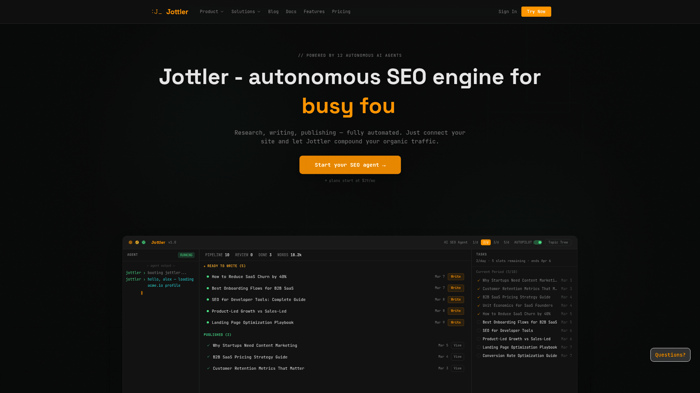
Jottler approaches content mapping by providing an autonomous AI SEO engine that handles the entire content lifecycle. It identifies target keywords and topics relevant to each buyer journey stage, then generates long-form, SEO-optimized articles designed to rank on search engines and serve as source material for AI models. This automation frees up marketing teams from the manual burden of content creation, allowing them to focus on broader strategy and personalization. For instance, a SaaS company can set Jottler to publish weekly articles addressing common pain points (Awareness), solution comparisons (Consideration), and detailed feature guides (Decision), ensuring a consistent flow of relevant content without human intervention.
The platform's core strength lies in its ability to consistently produce high-quality, long-form content, which is crucial for building authority and driving organic traffic. By automating keyword research, topic clustering, deep research from 14+ sources, fact-checking, and smart internal linking, Jottler ensures that every piece of content is not only relevant but also optimized for visibility. This capability directly addresses the need for increased content velocity, which is shown to drive significantly more conversions for early-stage SaaS companies, making it an essential tool for scaling content operations efficiently.
Hyper-Personalization at Scale with AI
The true power of AI in content mapping lies in its ability to deliver hyper-personalized experiences at scale. AI can analyze vast amounts of data to provide real-time content adjustments, context-aware recommendations, and predictive engagement across all touchpoints. This level of personalization leads to significantly higher engagement and conversion rates. Personalized content performs significantly better than generic messaging on social media, and a remarkable 84% of marketers use AI for real-time personalization. This is particularly impactful for B2B SaaS content marketing.
- Real-time Content Adjustments: Dynamically alter website content based on user behavior or profile.
- Context-Aware Recommendations: Suggest relevant products or content based on current context.
- Predictive Engagement: Use AI to anticipate user needs and proactively deliver relevant information.
- Dynamic Email Content: Personalize email body content and offers based on individual recipient data.
Comparative Analysis of Leading Journey Mapping Tools
| Tool | Core Function | Pricing (Approx.) | G2 Rating | Key AI Features |
|---|---|---|---|---|
| UXPressia | Customer journey mapping | Free - $360/month | N/A | AI-powered persona creation |
| Miro | Collaborative online whiteboard | Free - $16/user/month | 4.6/5 | AI canvas for journey mapping |
| Lucidchart | AI-powered diagramming | Free - $10/user/month | 4.7/5 | Visual buyer path creation |
| Smaply | Visual journey orchestration | Free - €990/month | 4.6/5 | Pain point cards |
| TheyDo | Journey management & analytics | Free - $35,000/year | 4.8/5 | AI journey mining and analytics |
| Zoho Journey Mapping | CRM integration for automation | Starts at $12/month | 4.5/5 | Buyer journey automation |
| Pendo | In-app guidance & product analytics | Custom | 4.7/5 | SaaS buyer path analysis |
| Usermaven | Real-time path analysis | Starts at $49/month | N/A | AI-powered insights for product teams |
| Jottler AI | Autonomous AI SEO engine | Starts at $29/month | N/A | Keyword research, content creation, publishing |
Conclusion
The future of marketing in 2026 is inextricably linked to a deep understanding of the buyer journey and the strategic deployment of content at every stage. By actively mapping customer journeys, businesses can achieve 54% higher returns on marketing investment and secure 20-30% conversion rate improvements. The integration of AI, particularly for content generation and hyper-personalization, is no longer a luxury but a necessity, enabling significant ROI on ad spend and ensuring content performs significantly better than generic messaging. Embrace these strategies to future-proof your content and compound organic traffic. Start your SEO agent today to automate your content strategy and unlock unparalleled growth.
FAQs
like this today.