Marketing Automation Platform Comparison Guide
Marketing automation adoption is no longer optional, it's the standard operating layer for B2B and enterprise teams. 95% of enterprise marketing teams now run at least one marketing automation platform, and 78% of mid-market B2B organizations use automation, up from just 61% in 2023. Yet despite near-universal adoption, most teams struggle with vendor selection. 34% of companies run two or more automation platforms, indicating fragmentation and wasted spend. The question isn't whether you need marketing automationit's which platform fits your team's workflow, budget, and growth stage. This guide cuts through the noise and shows you how to evaluate and compare the platforms that actually move the needle.
Key Takeaways
- 78% of mid-market B2B organizations use marketing automation, up from 61% in 2023, adoption is accelerating fastest in this segment (2026, Digitalapplied)
- Tool stacking is common: 34% of companies run two or more platforms, suggesting no single vendor dominates the entire workflow
- Enterprise teams prioritize native CRM integration, journey orchestration, and AI-assisted segmentation over feature bloat
- ROI multiplier: organizations using AI-enhanced automation generate 2.3x more qualified leads per quarter than manual-process peers (2026, HubSpot)
- Understanding the Category: Marketing automation has evolved from email scheduling to orchestrated customer journeys powered by AI-assisted segmentation and predictive scoring.
- Evaluation Framework: Assess platforms on CRM integration depth, email deliverability controls, journey orchestration, data quality, and ease of migration.
- Platform Positioning: HubSpot wins on ease of use; Adobe Marketo dominates enterprise; ActiveCampaign leads on flexibility; Jottler handles the content automation layer that feeds campaign engines.
- Implementation Reality: Most growing companies run 2-3 point solutions rather than a single monolithic platformintegration hygiene and data flow matter more than feature completeness.
- ROI Focus: Prioritize consistency, speed, and personalization over automating every process indiscriminately.
What Is a Marketing Automation Platform, and Why It Matters
A marketing automation platform is software that orchestrates repetitive marketing tasksemail nurturing, lead scoring, customer segmentation, campaign workflows, and lifecycle triggersacross channels and touchpoints. Unlike email tools that focus narrowly on send-and-track, modern automation platforms integrate with your CRM, handle multi-step journeys, and increasingly use AI to predict behavior and personalize messaging at scale.
The stakes are significant. Manual marketing workflows consume 30-40% of team capacity on execution instead of strategy. Without automation, you lose consistency in follow-up, miss lead-scoring signals, and struggle to deliver personalized experiences to growing audiences. With the right platform, teams compress 2-3 week campaign cycles into days and reduce lead-to-customer time by 20-30%.
Core Functions Across Platforms
Despite feature differences, all mainstream automation platforms share core competencies:
- Email Campaign Management: Build workflows, schedule sends, A/B test subject lines, and track open/click/conversion metrics.
- Lead Scoring and Segmentation: Assign point values to behaviors and attributes, auto-segment lists based on triggers, and route leads to sales at the right moment.
- Journey Orchestration: Design multi-step customer lifecyclesfrom first touch through renewalwith conditional logic and time delays.
- Form and Landing Page Builders: Create lead capture assets without leaving the platform or requiring developer help.
- Reporting and Attribution: Track campaign performance, revenue influence, and ROI by channel and source.
- CRM Integration: Sync contacts, companies, deal stages, and custom fields bidirectionally with your sales system.
How Automation Compounds Growth
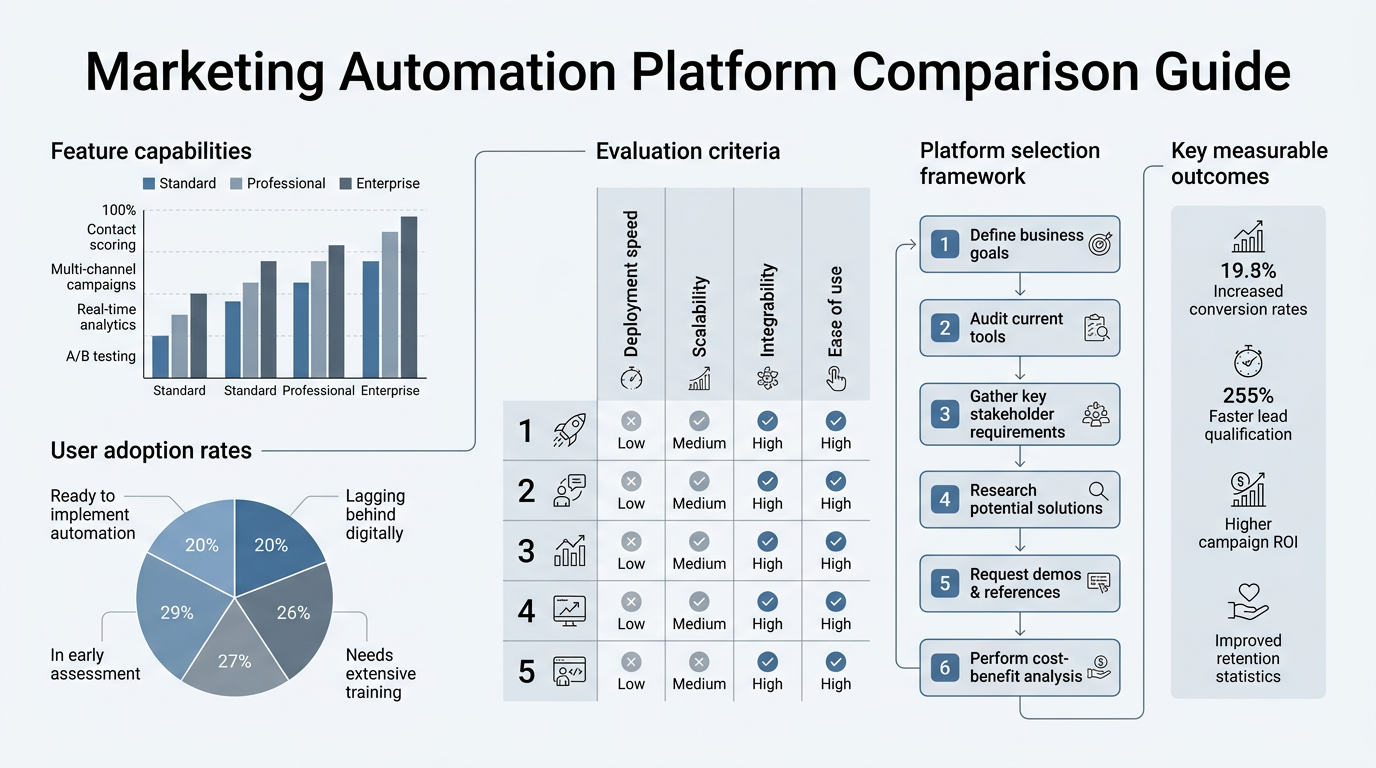
87% of marketers using AI-enhanced automation tools reported measurable increases in lead generation, and those businesses generated 2.3x more qualified leads per quarter compared to teams relying on manual processes. The multiplier effect comes from three factors: consistency (campaigns run on schedule, no gaps), speed (nurture sequences deliver in hours, not weeks), and personalization (dynamic content adapts to each prospect's behavior). For growing teams, this means smaller marketing departments can support 3-5x larger prospect bases without hiring proportionally.
That's why marketing automation is shifting from a "nice-to-have" efficiency tool to the core operating system for lead generation and customer lifecycle management. When done right, it's the difference between running a campaign and building a repeatable, scalable revenue machine. Research from HubSpot's 2026 marketing statistics confirms that adoption is accelerating, with AI-powered features now driving competitive advantage.
Key Selection Criteria for Marketing Automation Platforms

Not all platforms serve all use cases equally. Enterprise teams need different capabilities than SMBs, and B2B workflows differ from B2C eCommerce. Before evaluating specific vendors, define your non-negotiables across five dimensions: integration scope, ease of use, orchestration depth, data quality, and total cost of ownership.
1. CRM and Integration Ecosystem
Your automation platform lives between your CRM (the source of truth) and your other marketing tools (email, analytics, ads). A poor integration means manual data entry, sync delays, and lost lead context. Evaluate platforms on native CRM support (not just APIs), bi-directional sync speed, and compatibility with your existing stackSalesforce, HubSpot CRM, Pipedrive, Microsoft Dynamics, or others.
Red flag: platforms that require an API connector instead of a native integration, or charge extra for full bidirectional sync. Green flag: native integrations that sync in real-time or near-real-time and auto-map custom fields. Content marketing automation tools like Jottler layer on top of this ecosystem by automating the content research and creation that feeds your email and landing page workflowsfreeing your team from the friction of producing assets at the pace automation demands.
2. Email Deliverability and Sender Reputation Management
A platform with elegant workflows is useless if emails land in spam. Evaluate platforms on dedicated IP options, DKIM/SPF/DMARC support, bounce handling, and list hygiene tools. Many platforms include shared IP pools by defaultfine for small lists under 100k contacts, but a problem if you're sending over 1M emails monthly.
Ask references: "What's your average inbox placement rate?" Anything below 95% should trigger deeper investigation. Platforms like ActiveCampaign and HubSpot maintain strong sender reputations because they actively manage IP reputation and enforce list-cleaning practices automatically. Industry analysis from Affmaven shows leading platforms achieve 96%+ deliverability rates, so this is a measurable differentiator.
3. Journey Orchestration and Workflow Depth
This is where platforms diverge sharply. Basic platforms offer linear email sequences; mature platforms handle complex, branching multi-touch journeys with conditional logic, time delays, form-triggered sequences, and cross-channel coordination (email + SMS + push + web personalization). Evaluate whether the platform supports:
- Multi-step branching workflows with conditional logic (if X then Y, else Z)
- Relative and absolute time triggers (wait 3 days, wait until next Tuesday)
- Cross-channel journey mapping (email → SMS → in-app message → direct mail)
- Nested workflows and modular journey templates
- Dynamic content blocks that change based on contact attributes
Adobe Marketo and Oracle Eloqua excel herethey were built for complex B2B enterprise journeys. HubSpot and ActiveCampaign offer solid orchestration for mid-market teams. Smaller, newer platforms often cut corners on workflow depth to reduce UI complexity.
4. AI-Assisted Segmentation and Predictive Scoring
This is table stakes in 2026. 51% of marketers are piloting or scaling AI-powered automation. Evaluate platforms on:
- AI-generated segment discovery (auto-identifying high-value or at-risk cohorts)
- Predictive lead scoring (modeling likelihood-to-close without manual formula creation)
- AI content suggestions (dynamic subject lines, send-time optimization, next-best-action recommendations)
- Churn prediction (identifying customers likely to cancel before they're gone)
HubSpot and Adobe Marketo have invested heavily in AI prediction layers. Newer entrants like Jottler specialize in the content automation componentAI research, writing, and internal linkingthat feeds your campaign engine. The best growth stacks layer multiple AI systems together: one for predictive scoring/segmentation, one for content generation and optimization, and one for orchestration logic.
5. Ease of Use and Implementation Speed
Complexity creates training costs, support burden, and adoption friction. HubSpot is widely praised for its intuitive interface and minimal onboarding; Marketo is known for requiring weeks of implementation and ongoing admin overhead. For growing teams without a dedicated marketing operations hire, ease-of-use can be worth paying premium pricing.
Ask: How long from signup to first automated email campaign? Platforms promising "days" vs. "weeks" signal fundamentally different user experience philosophies. Test the platform yourself during the trialcan you build a 5-step lead nurture sequence without documentation?
Platform Comparison: HubSpot vs ActiveCampaign vs Adobe Marketo vs Klavioy
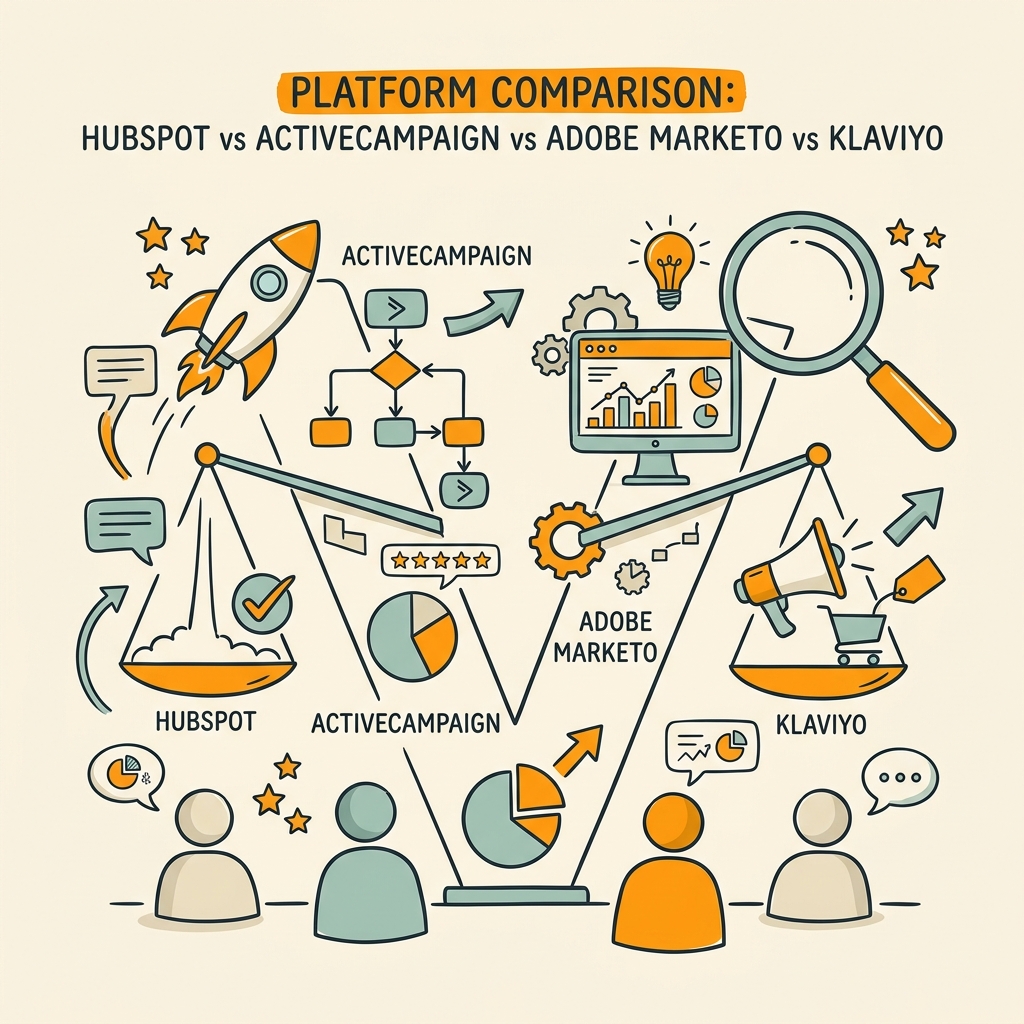
Here's where the category fractures into distinct playbooks. No single platform is universally "best"each dominates a specific buyer profile and use case. Understanding the positioning helps you match tool to team.
| Platform | Best For | Ease of Use | Journey Complexity | CRM Integration | Price Floor | Ideal Team Size |
|---|---|---|---|---|---|---|
| HubSpot Marketing Hub | Mid-market SaaS/B2B; integrated CRM needed | ★★★★★ (Excellent) | ★★★★☆ (Good) | Native HubSpot CRM (best-in-class) | $45–50/month starter | 3–15 marketers |
| ActiveCampaign | Agencies, SMBs, complex workflows; CRM flexibility | ★★★☆☆ (Moderate) | ★★★★★ (Excellent) | Integrates most CRMs via API + native connectors | $9–15/month email starter | 1–10 marketers + agencies |
| Adobe Marketo Engage | Enterprise B2B; Salesforce-centric; account-based marketing | ★★☆☆☆ (Complex) | ★★★★★ (Industry-leading) | Native Salesforce CRM (seamless) | $1,200/month+ (enterprise) | 10–50+ marketers |
| Klavioy | Ecommerce; SMS + email; D2C brands | ★★★★☆ (Good) | ★★★☆☆ (Basic-to-moderate) | App-based integrations; Shopify native | Free (limited); $30/month growth | 1–10 ecommerce marketers |
| Jottler | Busy founders; compounding content supply; organic growth | ★★★★★ (Connect and run) | N/A (Content layer, not campaign orchestration) | Publishes directly to any CMS; pairs with HubSpot/ActiveCampaign | $29/month baseline | 1–5 person teams + solopreneurs |
HubSpot: The Balanced Default
HubSpot dominates the mid-market because it solves the "all-in-one" problem acceptably. You get CRM, email, landing pages, forms, basic chat, analytics, and workflows in a single interface. Onboarding takes days, not weeks. The native CRM integration is seamlesscontacts sync in real-time, and deal stages trigger workflows automatically.
Strengths: Intuitive UI, excellent integrations, strong email deliverability, native CRM that many teams love, comprehensive reporting, and a huge partner ecosystem.
Limitations: Journey complexity caps out faster than Marketo or ActiveCampaign; you'll hit scaling limitations if you need deeply nested workflows or account-based orchestration; pricing climbs quickly ($320+/month for mid-tier).
Best for: Growing SaaS companies (10–30 people) who want a single vendor and can tolerate moderate workflow complexity. If you're looking to automate the content supply powering these workflows, AI content generation solutions like Jottler layer on top of HubSpot, handling daily research and writing that creates assets for your campaigns to distribute.
ActiveCampaign: The Flexibility Play
ActiveCampaign is the choice when your workflow doesn't fit the HubSpot mold. It excels at complex automation for agencies, small enterprises, and teams running non-standard CRM setups (Pipedrive, Zoho, custom). The platform's conditional logic and branching workflows rival Marketo.
Strengths: Flexible workflow engine; CRM-agnostic (integrates most platforms); strong automation and lead scoring; affordable entry point ($9/month email starter); excellent for agencies managing multiple client workflows.
Limitations: UI is more complex than HubSpotsteeper learning curve; no native CRM (you own the integration and data sync); lower email deliverability than HubSpot on shared IPs; AI features are newer and less polished.
Best for: Agencies, SMBs, and mid-market teams with non-standard stacks. If complexity is a concern, content marketing frameworks powered by automation simplify the demand-generation challenge by handling the content research and creation that feeds your campaignsreducing the content bottleneck that often forces teams to over-automate email sequences to compensate for lack of fresh assets.
Adobe Marketo: The Enterprise Standard
Marketo is the platform enterprises choose when they need to orchestrate complex, multi-touch account-based marketing (ABM) campaigns at scale. It integrates natively with Salesforce and handles workflows that would break most mid-market tools.
Strengths: Industry-leading orchestration depth; native Salesforce integration; strong ABM and account-based orchestration features; world-class for enterprise multi-channel campaigns; excellent scalability.
Limitations: High cost of entry ($1,200+/month); steep onboarding and ongoing admin overhead; UI is complex; not ideal if your CRM isn't Salesforce; ROI is realized only at scale.
Best for: Enterprise B2B teams with $5M+ ARR, complex buyer committees, and mature Salesforce deployments. If marketing automation is your bottleneck, cost-per-asset is your hidden problemMarketo implementers often tell us they'd move faster if they could pump more content through their workflows. Jottler solves that layer.
Klavioy: The Ecommerce Exception
Klavioy is purpose-built for D2C and ecommerce brands. While the other platforms excel at B2B lead generation, Klavioy dominates SMS + email for product-focused companies. Native Shopify integration, behavioral triggers based on purchase data, and strong SMS orchestration make it the obvious choice for ecommerce.
Strengths: Ecommerce-native features; SMS + email in one platform; Shopify integration is seamless; fast setup; affordable for SMBs.
Limitations: Limited for B2B workflows; no native CRM; journey complexity is moderate; AI features are lighter than competitors.
Best for: D2C brands, Shopify stores, and ecommerce-first teams.
Jottler: The Content Automation Layer
Jottler isn't a campaign orchestration platformit's the content machine that feeds your email, ads, and landing pages. Autonomous SEO agents research topics, write long-form articles, fact-check claims, and publish directly to your CMS daily. For teams overwhelmed by content production demands, Jottler removes the friction that prevents marketing automation from working at full capacity.
How it fits the stack: Connect Jottler to your website, set your desired publishing frequency (1–5 articles daily), and the AI agents automatically research keywords, write comprehensive 3,000+ word articles, validate facts across 14+ sources, and publish to your CMS with internal linking. The content it produces feeds your organic traffic funnela top-of-funnel motion that your HubSpot, ActiveCampaign, or Marketo workflows then nurture and convert.
Why this matters for marketing automation: Growing teams hit a content production ceiling. You can optimize email sequences perfectly, but if your lead volume is capped by organic traffic, no campaign platform fixes that. Jottler compounds growth by automating the research and writing layerfreeing your team from 40+ hours of weekly content work and allowing them to focus on what your platform actually does well: nurturing and converting leads through optimized workflows.
Best for: Busy founders and marketing teams at scaling companies who understand organic traffic's importance but lack resources for consistent content production. Starts at $29/month and publishes daily research-backed articles that build topical authority and funnel traffic into your campaigns.
How to Choose the Right Platform for Your Situation
The comparison above frames each platform's strengths, but vendor selection ultimately depends on your specific business model, team size, and workflow complexity. Use this decision framework to narrow the field.
Segment-Specific Recommendations
Your company size and business model should drive platform selection more than feature parity.
- Enterprise (100+ employees, $10M+ ARR): Adobe Marketo or Oracle Eloqua if Salesforce-centric; consider specialized ABM platforms (6sense, Terminus) layered on top. Complexity is table stakes; ROI is realized through scale.
- Mid-Market B2B (20–100 employees, $2–10M ARR): HubSpot or ActiveCampaign. Both offer sufficient orchestration, reasonable price, and manageable implementation. HubSpot if you want simplicity; ActiveCampaign if you need workflow flexibility or non-standard CRM stacks.
- SMB / Growing SaaS (5–20 employees, <$2M ARR): HubSpot starter tier or ActiveCampaign free/low-cost plans. Avoid Marketo unless you have a specific ABM playbook. Budget bandwidth for implementationexpect 2–4 weeks to full deployment.
- Ecommerce / D2C (any size): Klavioy. No alternative comes close for SMS + email orchestration in product-focused businesses.
- Agencies: ActiveCampaign (best workflow flexibility for multi-client setup) or HubSpot if clients are SMBs wanting a single vendor.
Evaluating Your Actual Use Case
Before signing a contract, ask yourself three critical questions:
- What's my lead volume today and projected in 12 months? If growing 3x, pick a platform that scales. Marketo and Eloqua scale; some cheaper platforms hit performance walls at 500k+ contacts.
- What's my workflow complexity? If you're running simple email nurture, HubSpot or Klavioy. If account-based marketing with 10+ conditional steps, you need Marketo or ActiveCampaign depth.
- How critical is my existing CRM? If you're Salesforce-first, Marketo is native and integration is seamless. If you're HubSpot CRM, stay with HubSpot. If you're anything else (Pipedrive, Zoho, custom), ActiveCampaign is safest.
The Hidden Cost of Content Scarcity
Most platform evaluations miss a critical variable: content supply. You can build perfect email sequences, but if your lead volume is throttled by organic traffic scarcity, no automation platform fixes that bottleneck. Growing teams often underspend on content production relative to campaign infrastructure.
That's where content automation tools like Jottler change the math. By automating daily long-form content research and writing, Jottler expands your organic funnelthe top of the funnel that feeds your marketing automation platform. For $29/month baseline, you get 3,000+ word articles published daily, fact-checked across sources, and optimized for SEO. The content compounds your organic traffic; the automation platform converts it.
For busy founders and small marketing teams, this dual automation (content + campaign) is far more effective than optimizing a single platform in isolation.
Conclusion
Marketing automation is now the default operating system for lead generation and customer lifecycle management. 78% of mid-market B2B organizations now use marketing automation, and organizations using AI-enhanced automation generate 2.3x more qualified leads per quarter than teams relying on manual processes. The question isn't whether to automateit's which platform maximizes ROI for your specific business model.
HubSpot wins on ease of use for mid-market teams; ActiveCampaign dominates for workflow flexibility; Adobe Marketo leads for enterprise complexity; Klavioy reigns in ecommerce. But platform selection is only half the battle. The other half is feeding your automation engine with enough high-quality content and leads to justify the investment.
That's why the most effective growth teams layer automation strategically: one system for campaign orchestration (HubSpot, ActiveCampaign, or Marketo), and one system for content automation (Jottler) that expands the funnel. Together, they compoundorganic traffic feeds campaigns; campaigns nurture leads; data from campaigns informs content strategy.
If you're ready to turn your marketing automation platform into a revenue multiplier, start with honest answers to three questions: What's my actual lead volume constraint? What's my workflow complexity? What's my team's bandwidth for implementation? Then match your answers to the platform strengths outlined above. And if your bottleneck is content supply, start your SEO agent to automate the research and writing layer that feeds your campaigns.
FAQs
What's the best marketing automation platform for a startup?
For early-stage startups (pre-Series A, <$2M ARR), HubSpot's starter plan or ActiveCampaign's free tier are the best entry points. HubSpot prioritizes ease of use and requires minimal setupyou'll be sending automated emails within days. ActiveCampaign costs less but requires more configuration work. Avoid Marketo and Oracle Eloqua at this stage; they're built for enterprise scale and ROI won't materialize until you're much larger. If your team is just 1–2 people, focus first on organic traffic automation to feed your early campaignscontent volume matters more than campaign sophistication when you're pre-PMF.
Should I use one marketing automation platform or multiple tools?
One consolidated platform is preferable for teams under 50 people. Managing multiple tools creates data sync headaches, duplicate work, and poor attribution. However, 34% of companies use multiple platforms because no single vendor excels at everything. If you're specialized (ecommerce, for example), you might run Klavioy for email + SMS and a separate CDP for segmentation. The key is having a clear data architecture and integration plan. Most growing teams land on one core platform (HubSpot or ActiveCampaign) plus point solutions for specialized needs (SMS, CDPs, webinar software). Avoid stacking 5+ tools without a data governance strategy.
How long does it take to implement a marketing automation platform?
HubSpot implementation typically takes 2–4 weeks for a growing team to move from signup to first automated campaigns and CRM sync. ActiveCampaign takes similar time if you're moving from a simple email tool but longer if you're migrating complex workflows. Marketo implementation is a 4–8 week project and requires dedicated resources or a consulting partner. The timeline depends on data cleanliness, existing integrations, and workflow complexity. Expect to spend 20–40 hours building out your initial automation architecture. Many teams underestimate migration frictionlegacy contact data, unclean email lists, and broken CRM syncs are common delays. Start with pilot workflows rather than trying to migrate everything at once.