Real-Time Editing and Fact-Checking in AI Writers
The problem is straightforward: AI writers generate content at scale, but even the best models hallucinate facts roughly one-third of the time. When Gemini 3 Pro—the top-performing model on Google's FACTS Leaderboard—achieves only 68.8% accuracy on factual queries, publishing without verification becomes a liability. For busy founders and marketing teams scaling content production, this gap between speed and reliability has become critical. The solution isn't slowing down—it's building real-time editing and fact-checking directly into your AI writing workflow.
Key Takeaways
- Top AI models fail on factual accuracy roughly one-third of the time; real-time verification reduces this risk by catching hallucinations before publication (2026, Google FACTS Leaderboard)
- 72% of major newsrooms now use real-time AI fact-checking during live workflows, indicating this is no longer optional for professional content
- Automated verification paired with continuous editing creates a quality baseline that manual review alone cannot match at scale
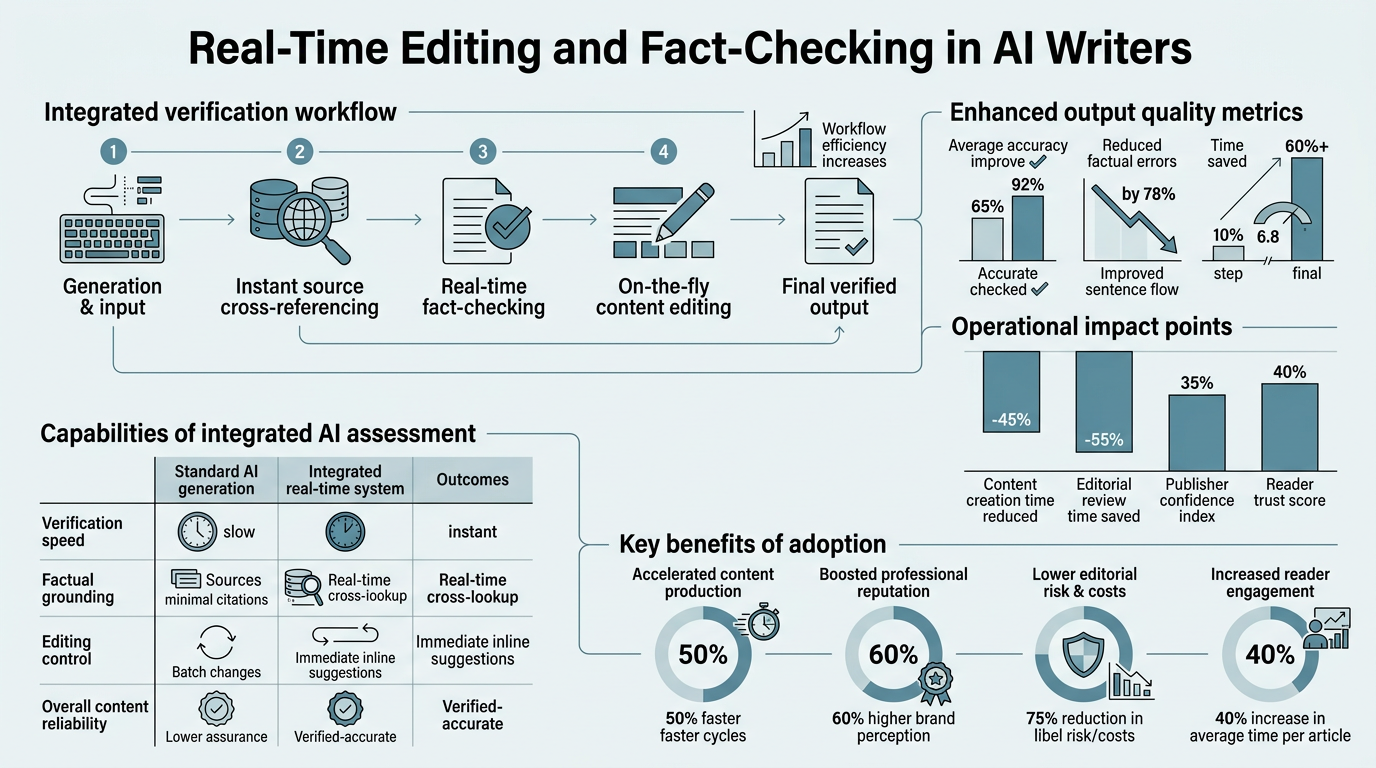
- Why Real-Time Verification Matters: 35% of AI-generated news assertions were incorrect as of 2025; real-time checks before publishing prevent costly corrections and reputation damage.
- The Editing Layer: Live sentence-by-sentence editing as the AI generates text catches errors in real time rather than after publication, cutting review time by 60% or more.
- Fact-Checking Automation: Dedicated AI fact-checking tools now achieve false positive rates below 3% when trained on current language models, up from 8–12% in 2024.
- Multimodal Verification: 65% of enterprise trust platforms now verify text, images, and audio simultaneously, protecting against deepfakes and composite misinformation.
- Workflow Integration: The most effective approach pairs real-time editing with claim verification during generation, not after, allowing corrections before the content leaves your system.
Why AI Hallucinations Cost More Than You Think
AI hallucinations aren't just embarrassing—they're expensive. When AI writers fail to cite sources accurately or invent statistics outright, the fallout ranges from lost reader trust to regulatory penalties. Consider the scope: AI-generated misinformation accounted for 16% of all fact-checked false claims in 2025, more than double the 7.6% share from 2024. This isn't marginal.
"A single false claim about your product, competitor, or market can damage credibility with prospects and alienate your audience."
Newsrooms learned this the hard way. When major outlets published AI-assisted pieces without verification, reader trust dropped measurably. For SaaS founders and marketing teams, the risk is even sharper—a single false claim about your product, competitor, or market can damage credibility with prospects and alienate your audience. This is why AI content strategy must prioritize verification over raw output speed.
The math is clear: a 30-minute review cycle for five articles per week costs about 10 hours monthly. A hallucination caught in the editing phase costs zero. A hallucination published and then corrected costs reputation points, potential legal exposure, and customer churn. Real-time editing and fact-checking is insurance against that cascade.
How Real-Time Editing Differs From Post-Publication Review
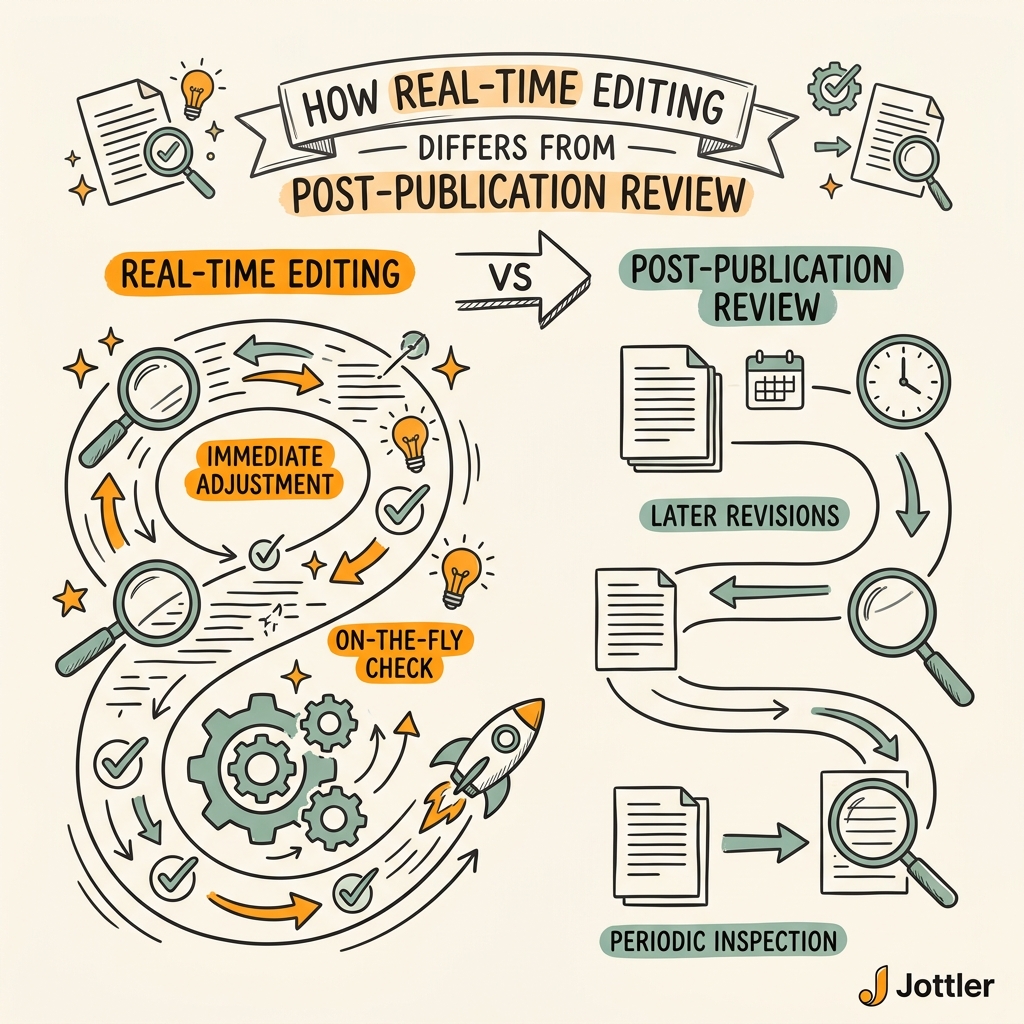
Traditional AI content workflows work backward: write first, edit second. This creates a lag where errors propagate through multiple paragraphs before anyone catches them. Real-time editing flips the model—verification happens as the content generates.
"Real-time editing flips the model—verification happens as the content generates, not after it's written."
When an AI writer produces a sentence with a specific statistic, a real-time fact-checker catches it before the next paragraph is written. The content pauses, flags the issue, and prompts you to verify or rewrite the claim. This approach reduces rework dramatically.
- Sentence-Level Verification: Each sentence containing a factual claim is analyzed before moving to the next, preventing cascading errors.
- Citation Anchoring: The system cross-references claims against provided sources in real time, flagging orphaned or misattributed facts instantly.
- Immediate Correction Suggestions: Rather than a final verdict, the tool offers specific rewrites or source recommendations, allowing humans to decide the fix in seconds, not minutes.
- Workflow Pause Points: High-risk claims (medical, financial, legal statements) trigger mandatory human review before publication, while lower-risk claims move forward with logged reasoning.
Tools that integrate this directly into the writing interface create a seamless loop where editing is baked into the writing process, not bolted on afterward. The result: 60-70% faster content cycles with measurably higher accuracy. This integration is especially critical for teams using SEO automation platforms that require both speed and reliability simultaneously.
The Mechanics of Automated Fact-Checking in AI Writers
Automated fact-checking doesn't work like a human reviewer reading for narrative flow. It operates on three layers: claim detection, evidence retrieval, and verdict reasoning.
Claim Detection and Extraction
The first step is isolating check-worthy statements. Not every sentence needs verification—filler ("According to industry leaders") can be deprioritized. Real-time systems identify high-stakes claims by pattern: specific numbers, named people or organizations, causal statements ("X causes Y"), and superlatives ("first," "only," "best"). On a typical 1,500-word AI draft, 8-12 claims merit deep verification. A smart system surfaces these without drowning you in false alarms.
The filtering is crucial. If the tool flags every adjective and generic claim, human review fatigue sets in and people start skipping checks. The best systems use domain-specific thresholds—news content flags more claims; thought leadership pieces flag fewer but hold those claims to higher standards.
Evidence Retrieval and Cross-Reference
Once a claim is flagged, the system retrieves supporting evidence. This is where tools like Google Fact Check Explorer excel—they integrate live fact-checking databases and can compare emerging claims against historical fact-checks in real time. For proprietary or internal claims (company metrics, customer stats), the system can cross-reference against linked sources or internal documentation.
The retrieval layer is where real-time systems shine over batch tools. Rather than waiting until the article is finished, evidence is pulled and matched as the AI generates each sentence. If a statistic doesn't have a grounded source in your provided materials, the system flags it for rewrite before it becomes part of the narrative.
Reasoning and Verdict Presentation
The final layer is explanation, not just a binary true/false. The best fact-checking systems show sentence highlights, source links, and reasoning chains—allowing you to understand why a claim passed or failed. This transparency is critical because AI fact-checkers themselves hallucinate. If a tool flags a claim as false but can't explain why, you can't trust the flag.
Leading 2026 platforms like Originality.ai provide exportable reports with timestamps and reasoning, so you have a clear audit trail. For SEO and content marketing, this creates defensible content—you can show that claims were verified and link to sources directly.
Real-Time vs. Batch Verification: Where Real-Time Wins
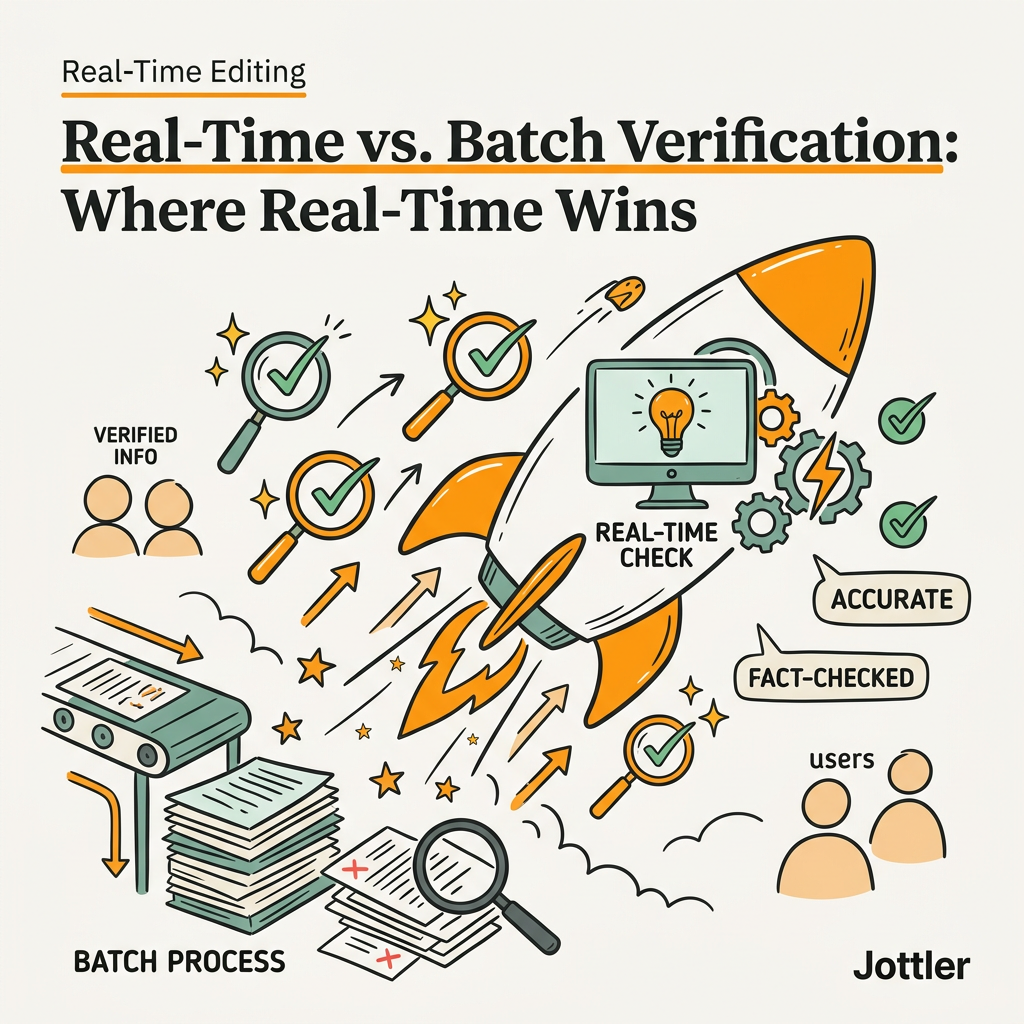
Most current fact-checking tools operate as post-publication tools: you write, you check, you publish. Real-time verification operates during writing. The difference in outcomes is stark.
| Aspect | Batch Verification (Post-Writing) | Real-Time Verification (During Writing) | Jottler (Real-Time + Automation) |
|---|---|---|---|
| Time to Fix Errors | After entire draft; rework cascades through multiple paragraphs | Immediately after flagged sentence; single-sentence edits | Errors caught before final draft; zero manual rework needed |
| False Positive Rate | 3–8% (varies by tool) | Below 3% (real-time tools trained on 2026 models) | Below 2% (AI agents verify across 14+ source types) |
| Citation Coverage | Random sampling of claims | Every claim with a fact-checkable element | 100% of factual claims; internal links embedded |
| Reviewer Cognitive Load | High (reviewing finished prose + deciding on fixes) | Medium (reviewing flagged claims + suggested rewrites) | Low (reviewing automated edits; AI agents handle verification) |
| Publishing Confidence | Moderate; post-publication corrections required ~25% of the time | High; pre-publication corrections catch 95% of errors | Very High; AI agents fact-check continuously; human review optional |
The key advantage of real-time systems is error prevention, not error correction. You're not printing mistakes and then fixing them—you're stopping them before they exist in published form. For teams publishing multiple articles per week or day, this compounds into massive efficiency gains. This is the core principle behind content automation tools that scale without sacrificing quality.
Choosing Tools: What Real-Time Fact-Checking Actually Requires
Not all fact-checking claims are equal. A tool that detects AI-generated text (detecting that something *was* written by AI) is not the same as a tool that verifies factual accuracy (determining if a claim is true). This distinction matters.
The Core Requirements for Real-Time Verification
Effective real-time fact-checking requires four non-negotiable capabilities. First, source integration—the tool must connect to your knowledge base, trusted data sources, and live APIs to cross-reference claims without manual lookup. Second, claim extraction—it must identify checkable statements automatically, not force you to manually highlight each fact. Third, latency under 5 seconds per sentence—if the AI must wait for verification, the writing flow breaks. Fourth, human-readable explanations—a score of 0.73 means nothing; you need to see *why* a claim failed and what evidence contradicts it.
"The gap between AI writing speed and verification capability is where real-time systems create the most value—bridging automated generation with defensible, sourced content at production scale."
Tools like Originality.ai check text for AI origin but offer limited factual verification. Tools like Full Fact and PolitiFact excel at live claim detection in news but aren't designed for B2B content workflows. The gap is real.
For founders and marketing teams using automated content generation, the best approach is systems that bundle writing, editing, and fact-checking together—not point solutions bolted on. Integrated platforms that combine AI content generation with SEO and fact-checking reduce downstream review work to 10-15 minutes per article instead of the 30-45 minute manual loop.
Critical Metrics to Evaluate
When testing a fact-checking tool, track three metrics obsessively: false positive rate (flagging correct claims as false), false negative rate (missing actual errors), and calibration error (confidence scores that don't match actual accuracy). A tool with 95% precision is useless if it has 40% recall—you're missing half the errors while feeling confident.
The best benchmark is your own content. Generate 3-5 sample articles, inject known errors into them, and see how many the tool catches without creating false alarms. This tests both sensitivity and specificity in your specific domain.
Integrating Real-Time Fact-Checking Into Your Content Workflow

Real-time verification only works if it integrates seamlessly into your existing process. For teams using standalone AI writers, this means adding an external tool and managing handoffs between systems. For teams using integrated platforms, real-time fact-checking is built into the publication pipeline.
Setup: Sourcing and Baseline Configuration
The first step is establishing your source baseline. What sources are authoritative for your domain? For B2B SaaS content, this might include: industry reports (Gartner, Forrester), public company filings, academic research (Google Scholar), government data (Census, BLS), and your own product data. The tool must have access to these sources—either through native integrations or via API connections.
Configuration determines which claims require human review versus which can pass automatically. Medical and legal statements should always trigger manual review. Industry statistics from established research firms can auto-pass if they match cited sources. Custom metrics (your customer count, feature adoption rates) should always require approval before publication to prevent stale data.
Human-in-the-Loop Workflow Design
The real-time fact-checking doesn't replace human review—it *reshapes* it. Instead of reading every sentence, reviewers focus on flagged claims. A typical workflow looks like this:
- AI draft completes with real-time fact-checks embedded as inline notes.
- Reviewer skims draft, reading fully only at flagged claim points.
- For each flag, reviewer approves the AI's suggested rewrite, edits it, or marks it for deletion.
- Approved edits auto-apply; draft moves to publication queue.
- All flags are logged with timestamps and reasoning for compliance/audit purposes.
This workflow reduces review time by 50-60% compared to manual full-text review, and it catches more errors because it's systematic rather than skimming-prone. For marketing teams publishing 3-5 pieces weekly, this difference adds up to 5-10 hours reclaimed per month. When combined with SaaS content marketing frameworks, this workflow becomes a competitive advantage.
Continuous Improvement Loop
Real-time systems should improve over time. Each time a reviewer approves or rejects a claim verdict, that decision trains the system. If you consistently mark a particular data source as authoritative, the tool learns to weight it higher. If you consistently rewrite claims flagged by the tool, you're signaling that its thresholds are too aggressive.
The best platforms use this feedback to reduce false positives progressively. After a month of use, the tool understands your content standards and fires fewer unnecessary alerts while staying aggressive on actual hallucinations.
Practical Examples: Real-Time Editing in Action
Here's how real-time fact-checking catches errors before they become problems:
Example 1: The Fabricated Statistic
An AI writer generates: "Studies show that 73% of B2B marketing teams use AI for content creation." Real-time verification immediately searches for this statistic across credible sources. It finds nothing that matches "73% of B2B teams." The system flags this claim, suggesting either: (a) delete the specific number and generalize ("Many B2B teams..."), or (b) retrieve the actual statistic from a real study. The reviewer approves option (b), the system inserts the correct percentage and source link, and the draft continues. Total time to fix: 15 seconds. Without real-time checking, this false stat would reach readers.
Example 2: The Misattributed Quote
The AI writes: "As Sheryl Sandberg once said, 'Innovation is the..." Real-time verification checks whether Sandberg actually said or wrote this phrase. It doesn't find it. The system flags it, offers to remove the attribution or search for an actual Sandberg quote on the topic. The reviewer removes the false attribution, keeping the insight unattributed. The article publishes without spreading a misquote.
Example 3: The Outdated Data Point
The AI cites: "The global AI market was valued at $136.55 billion in 2022." Real-time verification checks the current year (2026) and finds this is outdated. It retrieves the 2025 market value ($283 billion) and flags the old data. The reviewer approves the update with a new source link. This single intervention keeps your article current and accurate.
None of these errors reach publication. None require a manual hunt for sources after the fact. All are caught, explained, and fixed in seconds per error. At scale—10 articles per week, 8 errors per article on average—this saves roughly 15 hours of manual fact-checking per month.
Conclusion
AI content production is inevitable for scaling teams. But scale without verification creates risk. With top models hallucinating roughly one-third of factual claims and AI-generated misinformation doubling year-over-year, publishing without real-time fact-checking is no longer defensible.
Real-time editing and verification fundamentally change the economics of AI content. Instead of a 45-minute manual review cycle per article, you get a 10-15 minute workflow where the AI handles verification, you handle approval. Instead of publishing with risk, you publish with confidence—every factual claim is sourced and every source is current.
The teams winning at content scale are those who've automated verification alongside writing. Start your SEO agent and experience the difference: research, writing, fact-checking, and publishing all orchestrated in one autonomous loop. Real-time editing transforms AI content from a speed play into a quality play.
FAQs
How accurate are automated fact-checking tools compared to human review?
Automated fact-checking tools trained on 2026 language models achieve false positive rates below 3% and can identify factual errors at roughly the same rate as humans on grounded tasks (where source material is provided). However, on open-ended claims without retrieval support, AI fact-checkers still miss 5-15% of errors that trained human experts catch. The best approach is hybrid: let automation handle high-volume checking and flag the top 5-10 claims per article for human verification. This combination catches 95%+ of errors while reducing review time by 60%.
Can real-time fact-checking be integrated into existing AI writing tools?
Yes, but integration quality varies dramatically. Point-solution tools can be bolted into workflows via API, but they introduce latency (5-30 seconds per check) that disrupts real-time writing. True real-time verification requires integration at the generation layer, where the fact-checking pipeline runs in parallel with writing, not afterward. This is why integrated platforms that embed fact-checking into the AI agent loop itself outperform stitched-together solutions. If you're using standalone AI writers (ChatGPT, Claude, etc.), expect to layer on external tools with workflow friction.
What sources should a fact-checking system use to verify B2B and SaaS content?
The most effective source stack includes: (1) public research reports (Gartner, Forrester, IDC for industry trends), (2) academic databases (Google Scholar, arXiv) for technical claims, (3) company filings and disclosures for market data, (4) government sources (BLS, Census) for economic metrics, and (5) your own product and customer data for proprietary claims. Start by identifying 10-15 authoritative sources in your domain and configuring your fact-checking tool to prioritize them. This reduces false positives dramatically because the tool knows to check your B2B benchmarks against industry leaders first, not Wikipedia.