
Repurposing Customer Case Studies Into Winning Content
Most B2B companies pour weeks into a single customer case study—then lock it in a PDF vault and move on. 42% of marketers say repurposing existing content led to successful campaigns, yet most teams treat case studies as one-off assets. The math is brutal: you spend the same effort mining customer data, writing, editing, and validating, but extract only a fraction of the return.
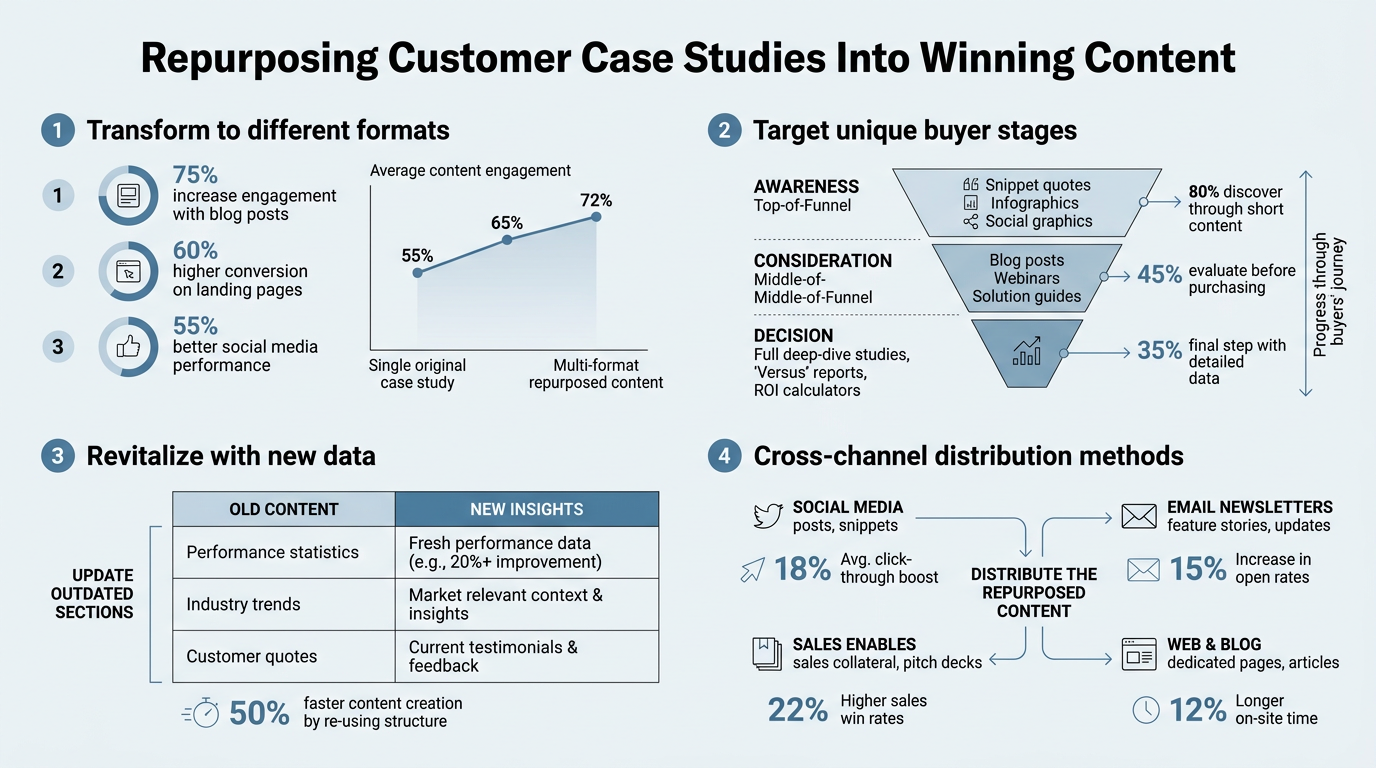
Case studies don't have a short shelf life. A single winning case study contains dozens of repurposable elements: customer stories, metrics, testimonials, proof points, and lessons learned. One piece of long-form content can generate 40+ assets—from social posts and emails to videos and infographics—without writing new primary content. The outcome? Exponential reach across channels, faster sales cycles, and compounding organic traffic from SEO.
Here's how to extract maximum value from every customer success story you document.
Key Takeaways
- 42% of marketers cite repurposing as the driver of successful campaigns, making it more efficient than new content from scratch (2026, Semrush)
- A single case study can yield 40+ distribution assets (social posts, videos, emails, infographics) across channels without additional primary creation
- Deep distribution across 3 channels with native-format adaptation outperforms shallow coverage of 10 channels by 35-60% in algorithmic reach
- Video Case Studies: Convert written narratives into full-length or short-form video content that drives engagement and conversion on LinkedIn and YouTube.
- Social Media Carousels: Extract key metrics and testimonials into platform-native carousel posts, achieving 35-60% higher reach than simple links.
- Blog Post Clusters: Break case studies into multiple topical blog posts—use-case articles, best-practice guides, and Q&A formats to rank for long-tail keywords.
- Sales Enablement Decks: Transform customer wins into slide decks and one-pagers for sales teams, cutting deal cycle time.
- Email Sequences: Build nurture campaigns around customer success stories, embedding testimonials and results into targeted messaging.
- Infographics and Visual Assets: Compress results into shareable graphics that stand out on Pinterest, LinkedIn, and in marketing collateral.
Why Case Studies Deserve Multi-Format Distribution
Case studies rank among the top 3 content types B2B marketers deploy for engagement and trust-building. The trap is treating them as isolated pieces. When a customer agrees to document their journey with your product, you hold a goldmine of proof, narrative, and context. Not maximizing it wastes months of effort.
The challenge: 45% of B2B marketers lack scalable case study production workflows. They either burn out producing case studies in isolation or abandon them after publication. But repurposing solves both problems. It multiplies impact from the same effort, maintains consistent messaging, and builds topical authority across multiple content formats—all critical for SEO in 2026.
"The data is clear: email marketing featuring case studies delivers $42 per $1 spent, while SEO-optimized case study content achieves 748% ROI from compounding organic traffic. Those numbers demand a distribution strategy that feeds both channels simultaneously."
How to Extract Repurposable Assets From Every Case Study

The first step is systematic extraction. Before you hit publish on a case study, identify the distinct atoms of information it contains. Each becomes a separate content piece.
Identify Core Narrative Angles
Every case study tells multiple stories. A customer's journey typically includes a before state (the problem), a during state (implementation), and an after state (results and lessons). Map these moments explicitly:
- Problem angle: What specific pain point did your customer face? This becomes a blog post targeting "how to solve X" or "why X is costing you revenue."
- Implementation story: How did the customer deploy your solution? This is perfect for a use-case article or a "day in the life" video.
- Results headline: What metrics improved? Extract the biggest wins as standalone social posts, testimonial graphics, and sales slides.
- Expert insight: Did the customer share forward-thinking advice? That's a future blog post or podcast episode waiting to happen.
Once mapped, each narrative angle becomes a distinct piece you can develop independently while staying grounded in your original case study's research.
Extract Quantifiable Proof Points
Numbers are the currency of case studies. They're memorable, shareable, and credible in a way prose alone never is. Parse your case study for every metric: revenue impact, time saved, cost reduction, efficiency gains, customer satisfaction scores, or adoption rates. List them separately.
Each data point becomes a separate asset. A 47% reduction in deployment time becomes a LinkedIn carousel post. A $2.3M revenue gain becomes a testimonial graphic. A 6-week faster sales cycle becomes an email subject line. Tools like Postiv AI can auto-generate multiple formats from a single metric in minutes.
Harvest Customer Quotes and Testimonials
A great case study pulls 3-5 strong customer quotes. Each quote is an asset in its own right. Pull them out, pair them with a compelling context sentence, and transform them into:
- LinkedIn testimonial posts (with a link to the full case study)
- Quote graphics (ideal for Instagram, Pinterest, and email headers)
- Social media carousel slides (one quote per slide with your branding)
- Email signature blocks or campaign headers
- Sales deck slides to reinforce credibility during pitches
A single 5-word testimonial can become 8-10 distinct social and email assets with different formatting, framing, and distribution timing.
Converting Case Studies Into SEO-Winning Blog Posts
One of the highest-ROI moves is converting a single case study into a cluster of SEO-optimized blog posts. This builds topical authority, ranks for multiple long-tail keywords, and keeps your content engine fed. A strategic approach to extraction and publication matters more than which specific tools you choose—though having them helps at scale.
Create Use-Case Blog Posts
A use-case article answers: "Here's how companies in [industry/situation] use this solution to solve X." These rank well for long-tail keywords like "how to reduce customer acquisition cost in SaaS" or "ways to automate billing workflows." Start with the implementation section of your case study—pull out the specific steps your customer took, generalize them slightly, and write a 1,500-2,000 word how-to.
This article links back to the full case study while targeting a different keyword than the case study itself. It also helps prospects earlier in the buying journey who aren't ready for a full customer story yet. When building this type of content cluster, an integrated approach that connects related pieces dramatically increases the authority they build together.
Build Best-Practice Posts From Lessons Learned
Every case study contains lessons. "Here are the 5 things we learned implementing this solution" becomes a standalone blog post targeting keywords like "best practices for X" or "how to implement X effectively." These posts establish thought leadership, rank for informational queries, and convert readers into newsletter subscribers.
The format is simple: extract 5 key takeaways from your case study's narrative or the customer's own reflections, expand each into 2-3 paragraphs with supporting context, and publish. This is where Digital Applied reports that updating evergreen content every six months can double traffic to existing posts, as Google prioritizes freshness.
"Updated evergreen content can double traffic compared to stale posts. Set a quarterly calendar reminder to refresh your top-performing case study assets with new data, refreshed designs, and updated CTAs."
Develop Q&A or Interview-Style Posts
Some case studies are interview-based. Take those interviews and restructure them as a Q&A blog post: "Why [Customer] Chose [Solution] Over Competitors" or "What [Customer] Learned From a 6-Month Implementation." These rank well for comparison keywords and build trust by letting customers speak directly to prospects.
A 2,000-word interview transcription becomes a 1,500-word Q&A post in 30 minutes of light editing. It targets different keywords than your main case study and appeals to prospects comparing solutions.
Turning Case Study Content Into Social Media Dominance

Social distribution is where repurposing compounds hardest. One case study can feed your LinkedIn, Twitter, Instagram, and TikTok feeds for weeks. The key is format adaptation—not copy-pasting the same post everywhere.
LinkedIn Carousels and Threads
LinkedIn carousels outperform link posts by a wide margin. Convert your case study into carousel decks: one slide per insight, with visuals and short copy. A typical case study generates 2-4 carousel posts:
- Results carousel: One metric per slide, building to the biggest win
- Lessons carousel: Key takeaways from the implementation
- Timeline carousel: Before → During → After snapshots
- Expert insight carousel: Forward-thinking advice from the customer
Native LinkedIn carousels see 35-60% higher algorithmic reach than cross-posted links. Systematic template libraries—documenting image dimensions, character limits, and hook structures—reduce production time by 40-60%, making this scalable even for lean teams. For busy founders managing multiple content pillars, automation platforms can streamline this even further by generating carousel copy variants automatically.
Quote Graphics and Testimonial Posts
Pull the strongest customer quote from your case study. Pair it with your brand's visual template (logo, color palette, design), make it shareable, and post it on LinkedIn, Instagram, and Twitter. A professional-looking testimonial graphic drives far more engagement than a text-only quote post.
Create 3-5 quote graphics from each case study and schedule them across platforms over 4-6 weeks. They require minimal production effort once your template exists and provide steady social proof in your audience's feed.
Short-Form Video and TikTok Content
The customer's biggest result deserves a 15-30 second video. Film a quick before/after montage, a graph animating the metric improvement, or a 20-second customer soundbite talking about their win. TikTok, Instagram Reels, and YouTube Shorts reward native short-form content with massive algorithmic reach.
One case study can yield 3-5 short videos without needing a production budget. Smartphone filming + simple editing tools (CapCut, Adobe Express) are enough.
Building Sales Enablement and Email Campaigns From Case Studies
Case studies aren't just marketing assets—they're sales weapons. Convert them into formats your sales team actually uses and into email sequences that nurture prospects through the buying journey.
Create One-Pagers and Sales Slides
Sales teams love one-pagers: a single page distilling a customer's problem, your solution, and the result. Extract the core narrative from your case study and design a clean, visually compelling one-pager that sales can drop into pitches or emails to qualified prospects.
These are fastest to produce and highest in immediate ROI—a sales rep closing a deal 1-2 weeks faster because they had a relevant one-pager is a direct revenue impact.
Build Email Sequences Around Customer Stories
Email is the highest-ROI channel for case study content: $42 return per $1 spent. Build a 3-5 email nurture sequence using your case study as the spine. When structured correctly, these sequences become part of a broader SaaS content marketing framework that compounds organic growth over time.
- Email 1: Introduce the customer and their initial challenge
- Email 2: Deep dive into their implementation approach
- Email 3: Reveal the results and quantify the impact
- Email 4: Share an actionable lesson from their journey
- Email 5: CTA to view the full case study or schedule a demo
Segment this sequence by buyer persona. A product manager reads it differently than a CFO. Most automation platforms allow persona-based customization with minimal effort once the narrative structure exists.
Measuring the Impact of Your Case Study Repurposing Strategy

Repurposing only compounds if you're measuring it. Track three key metrics across your distributed assets: reach, engagement, and pipeline impact.
Track Distribution Across Channels
For each case study, tag all derived content with a shared campaign identifier. A case study on "SaaS Company Reduced Churn 35%" becomes the campaign "churn-case-study-q2-2026." Every blog post, social post, email, and video derived from it carries that tag. This tells you which channels and formats drove traffic and engagement.
| Channel | Asset Format | Production Time | Expected ROI |
|---|---|---|---|
| 5-Email Sequence | 2-3 hours | $42 per $1 spent | |
| Blog | Use-case + Best-practice Posts | 4-6 hours | 748% ROI (organic) |
| 4 Carousel Posts | 1-2 hours | 35-60% higher reach vs. links | |
| Sales | One-pager + Slide Deck | 1-2 hours | 1-2 week faster deal cycle |
| Social | 3-5 Short-form Videos | 2-3 hours | Drives brand awareness |
Measure Contribution to Pipeline
Link each case study asset to your CRM. Did a LinkedIn carousel post drive a click-through to your website? Did an email campaign generate a demo request? Case studies are trust-builders—they rarely convert cold prospects directly, but they move people down the funnel. Track assisted conversions alongside direct ones. Understanding these pathways is crucial for validating your content marketing ROI strategy.
Update and Refresh Evergreen Assets
Your case studies should evolve. If a customer's results have compounded over time, update the case study with fresh metrics. Updated evergreen content can double traffic compared to stale posts. Set a quarterly calendar reminder to refresh your top-performing case study assets with new data, refreshed designs, and updated CTAs.
Scaling Case Study Repurposing With Automation and Templates
Repurposing at scale requires systems, not heroics. Build templates for every format you're producing—social media templates, email templates, blog post outlines, video formats. This turns case study extraction from a bespoke process into assembly-line work.
Implement a Repurposing Workflow
Establish a standard workflow: identify a new case study for publication → extract assets into a shared spreadsheet → batch-create content by format (all carousels in one session, all emails in another) → schedule across platforms using a content calendar. Many teams doing this at scale use tools that integrate directly with their CMS and publication platforms, automating fact-checking, internal linking, and distribution to eliminate friction.
Tools like Jottler are designed specifically to handle this at scale—they can intake a single case study, extract key claims and statistics, automatically research underlying facts for validation, generate multiple content formats optimized for SEO and each distribution channel, and publish directly to your website and social channels while building smart internal links that compound topical authority over time. For busy founders managing lean teams, this eliminates the overhead of manual repurposing entirely while ensuring every derived asset is fact-checked and SEO-optimized.
Build a Template Library
Document every format you produce: LinkedIn carousel dimensions, email header templates, blog post outline structure, video storyboard format. Share these templates with your team. Anyone can now repurpose a case study without starting from scratch.
Batch Extraction and Production
Don't repurpose one asset at a time. Once a case study is published, spend one focused session extracting all repurposable atoms and dumping them into a shared asset library. Then batch-produce by format: create all carousels together, all emails in another block, all blog posts in a third. This flow state approach reduces context switching and dramatically increases output.
Conclusion
Case studies are the most underlevered assets in B2B marketing. Most companies extract 10% of their potential value. By treating a single case study as the source material for 40+ derived assets across blogs, social, email, and sales, you unlock exponential returns from the same research effort.
The math is stark: 42% of successful marketing campaigns cite repurposing as the driver, while companies systematizing distribution across owned channels see 3x higher reach and 23% ROI uplift compared to one-off publishing. Every week you delay implementing a repurposing workflow is weeks of wasted customer proof points sitting in a vault.
Start small. Pick your strongest existing case study, extract 10 repurposable assets, and ship them across three channels. Track the results. Then systematize the process so the next case study generates 40 assets without manual overhead. Your pipeline will thank you. Start your SEO agent today to automate case study repurposing and compounding content distribution at scale.
FAQs
How long does it take to repurpose a case study into multiple formats?
With a template library and systematic workflow, extracting 10-15 assets from a single case study takes 2-4 hours of focused work. Most of that time is initial setup—designing social templates, mapping blog outlines, and building email structures. Once templates exist, the same case study generates assets in 1-2 hours. Automation tools that handle format adaptation and design can cut this to 30 minutes per case study, making repurposing truly scalable for lean teams.
Which formats deliver the highest ROI from case study repurposing?
Email campaigns and SEO-optimized blog posts are the two highest-ROI formats. Email featuring case study narratives delivers $42 per $1 spent, while blog posts targeting use-case and best-practice keywords achieve 748% ROI from compounding organic traffic. Sales enablement assets (one-pagers, slide decks) show the fastest direct impact on deal velocity, while social media excels at building brand awareness and driving traffic back to owned channels.
Do I need new customer interviews to repurpose a case study, or can I extract from existing ones?
You never need new interviews. A single well-researched case study contains enough material for 40+ distinct assets. The key is systematic extraction: break down the customer's story into its component parts—problem, solution, results, lessons learned—and develop each angle into separate content. Most teams under-extract because they treat case studies as finished pieces rather than content seed banks. Interview once, repurpose aggressively.