SaaS Link Building Through Developer Communities
Developer communities are where SaaS companies earn their most valuable backlinks. While traditional link building relies on outreach and paid placements, 48.6% of SEO experts rate digital PR as the most effective tactic, and much of that effectiveness flows from genuine engagement in developer spaces. Slack groups, Discord channels, GitHub discussions, and Hacker News aren't just channels for customer acquisition—they're ecosystems where word-of-mouth mentions become editorial backlinks, and shared tools become cited assets. The challenge: most SaaS founders treat developer communities as one-off marketing channels rather than strategic link-earning environments.
Key Takeaways
- 48.6% of SEO experts rate digital PR (including community-driven data) as the most effective link building tactic for SaaS (2026, BuzzStream)
- SaaS companies shipping one linkable asset per month and distributing it across developer communities earn sustainable backlinks without hired outreach.
- Integration partnerships (Zapier, Slack, HubSpot) are the highest-ROI link source for B2B SaaS—free, high-authority backlinks with zero outreach cost.
- Linkable Assets for Developers: Free tools, original data studies, and API documentation create passive backlinks when shared in developer communities.
- Integration-Driven Links: Setup guides and integration marketplace listings on platforms like Zapier generate high-authority backlinks automatically.
- Community Participation Strategy: Genuine engagement in Slack, Discord, and Reddit leads to word-of-mouth mentions in "best tools" roundups and editorial features.
- The "Honest Mention" Method: When developers ask for recommendations, a well-timed, authentic mention of your product triggers organic inclusion in curated link-earning content.
- Content Velocity: Releasing one linkable asset monthly and re-distributing it across 2–3 communities compounds backlink growth without scaling your team.
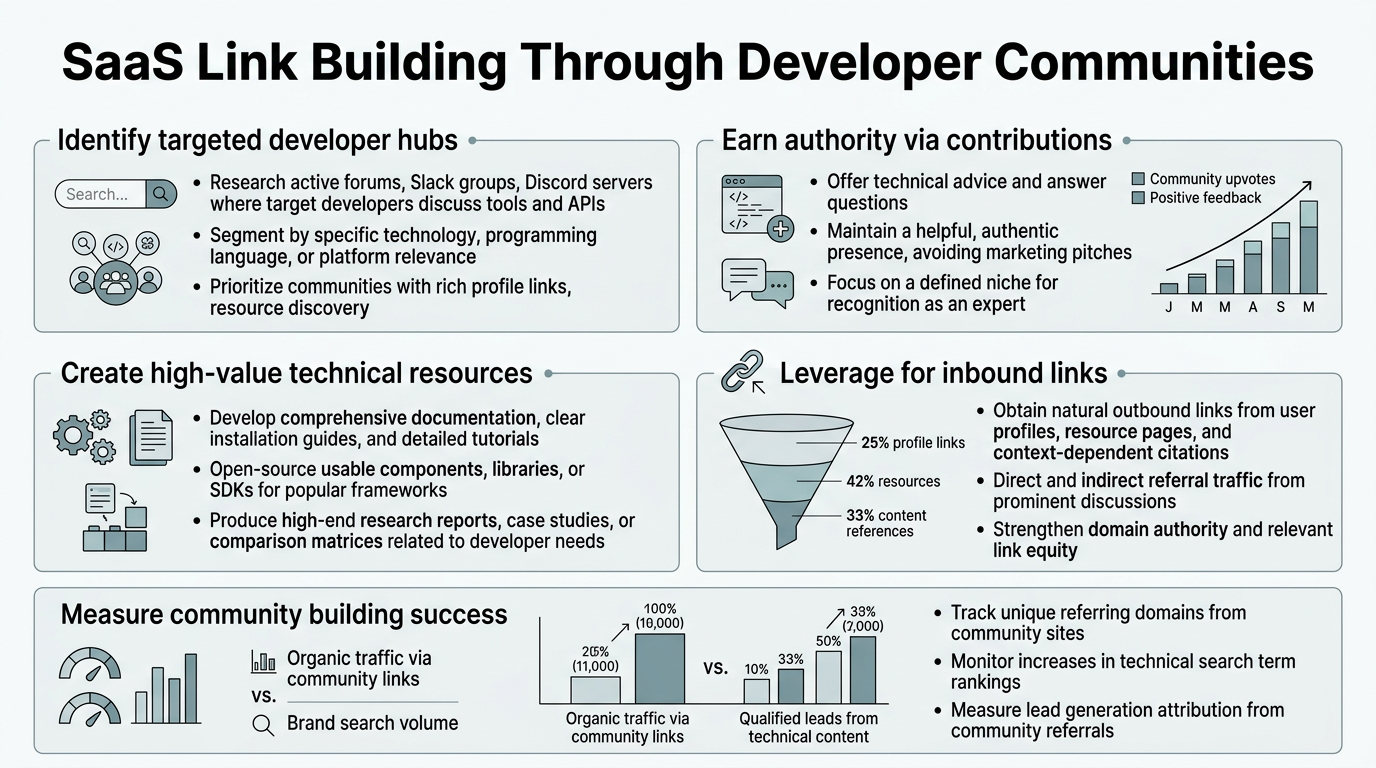
What Are Developer Communities and Why Do They Matter for Link Building?
Developer communities aren't just user forums—they're the primary discovery and decision-making channels for software buyers. BuzzStream's 2026 link building survey shows that backlinks from niche, community-vetted sources outrank traditional media mentions in link velocity and domain authority transfer. For SaaS, this means a single mention in a 10,000-member Slack community or a GitHub discussion thread can trigger more organic citations than a press release.
"Developers don't respond to sales pitches—they respond to tools that solve real problems and people who understand their pain points."
These communities operate on trust and authenticity. Developers don't respond to sales pitches—they respond to tools that solve real problems and people who understand their pain points. When a founder answers a technical question in a Discord channel or shares original data in a subreddit, it builds credibility that eventually translates into backlinks.
- Slack communities: Specialized groups focused on specific tech stacks, SaaS challenges, and link building strategies (e.g., "Backlink Masterminds," "SaaS Brigade").
- Reddit communities: Subreddits like r/SaaS, r/entrepreneur, and r/startups where tool recommendations drive "best tools" list creation.
- Discord servers: Real-time, informal channels where developers discuss tools and share discoveries.
- GitHub discussions: Conversations around frameworks and implementations that reference tools and integrations.
- Hacker News: The meta-discovery engine—a single top post links to thousands of downstream mentions.
The strategic advantage is clear: developer communities move fast, share organically, and create link opportunities without traditional outreach overhead. Industry data from 2026 shows that new SaaS sites that prioritize community engagement over paid link building close the domain authority gap with competitors 10–20% faster per quarter.
How to Create Linkable Assets That Developer Communities Will Actually Share
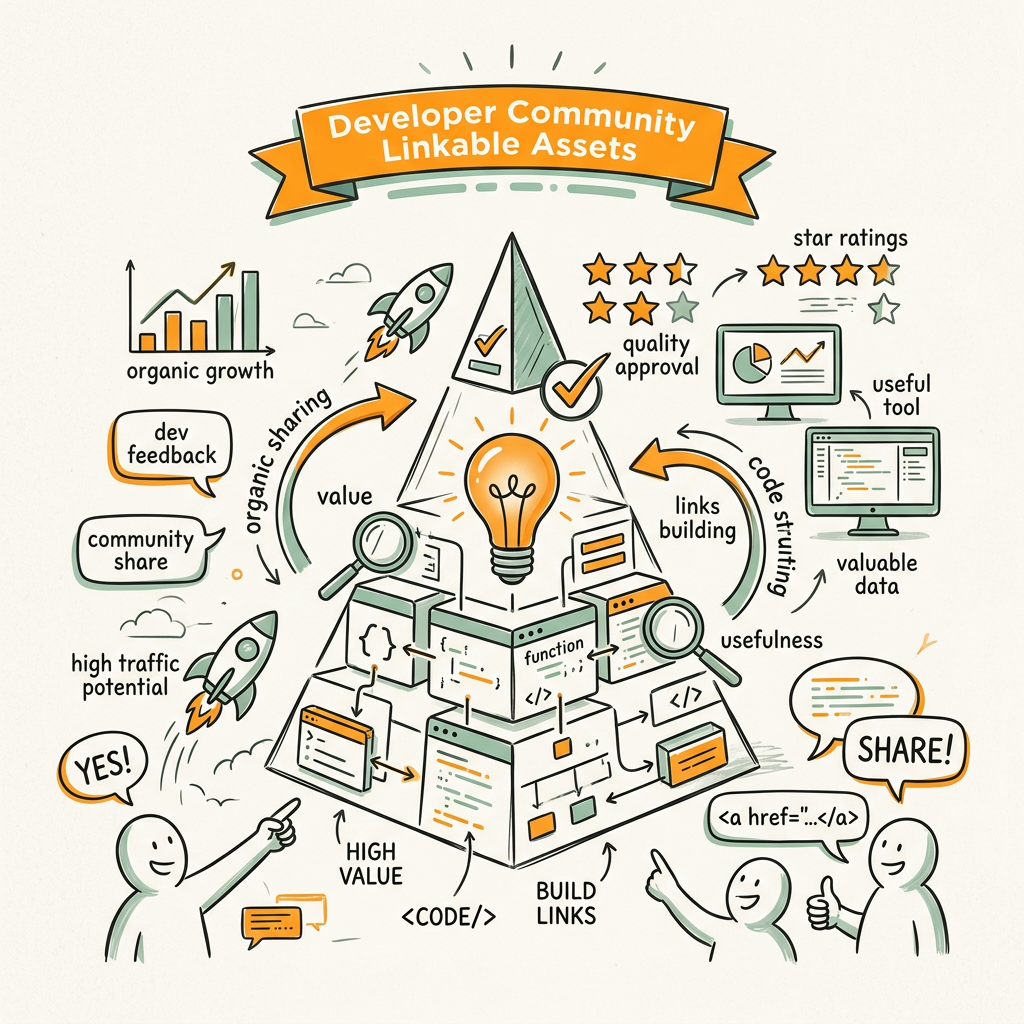
The foundation of developer community link building is creating assets that developers can't help but mention. This is where most SaaS teams fail—they build features but not frameworks, release updates but not data. Successful SaaS companies ship one linkable asset per month and then distribute it repeatedly across communities. The asset itself does 80% of the work; distribution does the remaining 20%.
Original Data Studies and Benchmarks
Data is the most shareable asset in developer communities. A benchmark showing how API response times correlate with user retention, or how onboarding complexity affects SaaS renewal rates, solves a real information gap. The advantage is that developers cite these studies in blog posts, documentation, and "best practices" guides for years after publication.
"A new SaaS site gained 87 backlinks by creating the first 'AI Agent Implementation Framework' before major competitors published theirs. The backlinks came from community members citing the framework in their own articles, documentation, and tool recommendations—none from traditional outreach." — DWI SEO Agency, 2026
Create data by surveying your user base, analyzing your own product anonymity, or aggregating public data sources. The key is speed and niche specificity. Instead of "The State of SaaS 2026" (10,000 competitors), create "Onboarding Workflows in Healthcare SaaS: A Data Study" (zero competitors). Developers searching for guidance in their specific industry will find and cite your data before anyone else's.
Free Developer Tools and Calculators
Free tools act as link magnets because they're referenced in documentation, tutorials, and problem-solving discussions. A calculator that shows "cost savings from automation vs. manual workflows," a code snippet library, or an API rate-limit calculator creates passive backlinks because it's genuinely useful.
The distinction: don't build free versions of your core product. Build tools that complement your product and solve specific, narrow problems. A CRM company building a free "email validation tool" will earn more links than a free CRM tier. Tools requiring zero domain authority (niche calculators, glossaries for emerging tech terms) rank and earn links faster.
Integration Documentation and Setup Guides
Integration marketplace listings (Zapier, HubSpot, Slack) are link-earning channels most SaaS teams underutilize. Each integration you publish on the partner's site creates a dedicated page—a high-authority backlink. More importantly, detailed setup guides within your own documentation link back to integration partners, creating bidirectional link networks that search engines reward.
Create a setup guide for each integration, not just a basic listing. Include code samples, use cases, and troubleshooting. When a developer searches "how to integrate [your SaaS] with Zapier," your setup guide outranks generic integration posts.
Which Developer Communities Generate the Most Valuable Backlinks?
Not all developer communities are equal for link earning. Some communities are highly moderated and link-hostile; others reward authentic participation with natural mentions and citations. The goal is to identify communities where your ICP (ideal customer profile) actively participates and where your assets solve real, discussed problems.
| Community | Member Count (Typical) | Backlink Potential | Engagement Type |
|---|---|---|---|
| Backlink Masterminds Slack | 2,500+ | Very High | Direct link swaps, roundups, tool features |
| SaaS Brigade (Slack) | 3,000+ | High | Product launches, beta testing, word-of-mouth |
| r/SaaS (Reddit) | 250,000+ | High | Tool recommendations, organic mentions, "best of" lists |
| r/entrepreneur (Reddit) | 500,000+ | Medium-High | Founder advice, case studies, resource links |
| Hacker News | Highly Curated | Very High | Launch discussions, top posts drive downstream links |
| GitHub Discussions & Issues | Varies by repo | Medium-High | Tool recommendations, integration references |
| Dev.to Community | 500,000+ | Medium-High | Article mentions, tutorial citations, community features |
High-Signal Communities for B2B SaaS
Slack communities focused on link building (Backlink Masterminds, Link Building HQ) attract professionals actively creating content and roundup lists. These communities have a direct "mention economy"—members share tools and ask for recommendations, creating immediate link opportunities. A single honest mention of your SaaS in a 2,500-member professional Slack can generate 3–5 backlinks within a week as members include your tool in their "tools I'm using" blog posts.
Reddit's r/SaaS and r/entrepreneur are high-volume channels where "what tools do you recommend" threads appear daily. Founders asking for solution recommendations often include 5–10 links in their follow-up research. When you're automating your SaaS content marketing strategy, this means you can afford to spend more time on strategic community engagement instead of writing response articles manually.
Niche Communities and Vertical-Specific Forums
Generic communities are crowded; niche ones are goldmines. If your SaaS targets healthcare, find healthcare-specific Slack groups, Discord servers, or forums. If you serve developers building AI applications, target AI-focused communities. Niche specificity dramatically increases link quality because links come from domain-relevant sources.
How to Execute the "Honest Mention" Strategy in Developer Communities
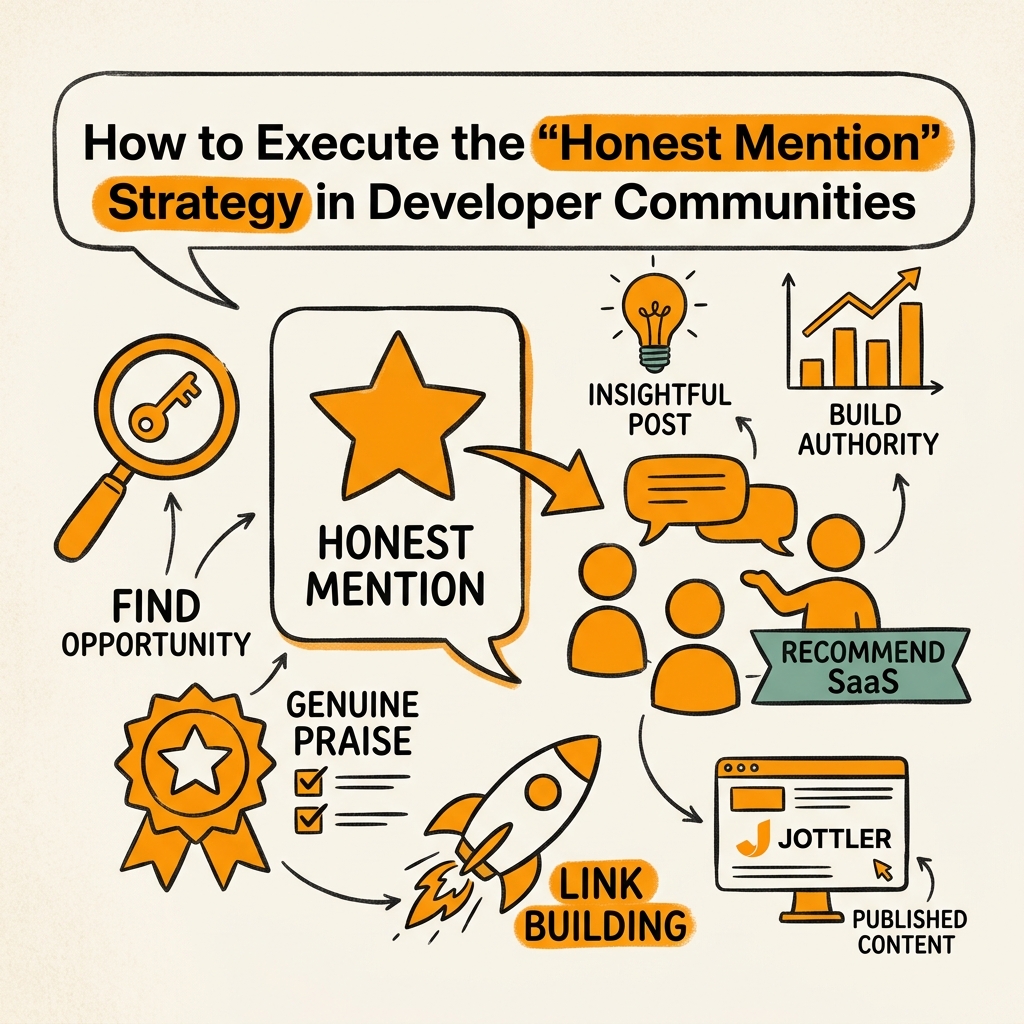
The most effective—and most overlooked—link building technique in developer communities is the honest mention. This isn't spam or self-promotion. It's authentic participation where you or your team answer a genuine question or recommendation request with your product as part of the solution.
"A developer in a Slack group asks, 'What tools do you use for [your problem]?' Instead of ignoring it or posting a weak answer, a team member responds with a thoughtful answer that includes your SaaS as one option, with context on why it fits their use case. That response is often screenshot and shared, included in blog posts, and cited in future roundup articles."
Here's how it works: When a genuine question arrives, respond with a thoughtful answer that includes your SaaS as one option, with context on why it fits their use case. That response is often screenshot and shared, included in blog posts, and cited in future roundup articles.
Timing and Community Selection
The timing of when you enter a community matters immensely. Don't join and immediately post about your product. Spend 2–3 weeks observing conversations, answering questions unrelated to your SaaS, and building credibility. When you do mention your tool, the context is established and the mention lands naturally.
Select the 5–10 communities where your ICP is most concentrated. Monitor conversation threads daily using tools like Slack's search or Reddit's saved filters. When someone asks a question your product directly solves, respond within the first hour with specificity: not "we solve that," but "we solve that by doing X, and here's a case study showing the result."
Building the Response Framework
Craft responses that follow a pattern. Start by acknowledging the problem with specificity tied to your domain. Then show authority through a relevant insight, stat, or framework. Mention your SaaS contextually within the discussion, not as a hard sell. Add value beyond the mention by linking to a free resource or guide. Finally, invite follow-up conversation rather than transactions.
This format creates two outcomes: First, the community member often cites your response in their own research. Second, DMs from genuinely interested prospects create case study opportunities and word-of-mouth links down the line.
Building Integration Partnerships as a Link Engine
Integration partnerships are often treated as feature work, not SEO strategy. That's a mistake. Building integrations with major platforms (Zapier, HubSpot, Slack, Salesforce) is the highest-ROI link building activity for B2B SaaS because the links are automatic, free, and perpetual.
The Marketplace Link Advantage
Every integration published on Zapier, HubSpot's App Marketplace, or Slack's App Directory creates a backlink from a domain with extreme authority (DA 90+). That single link is worth months of traditional outreach. Better: integration pages often rank for your brand name + integration keywords ("integrations with [your SaaS]"), driving qualified search traffic.
Marketplace optimization is where most SaaS teams drop the ball. They publish a basic integration listing and move on. The real opportunity is in the listing metadata and supporting documentation. Your SaaS link building strategy should treat integrations as one of the top three link sources, not an afterthought.
Integration Documentation and Setup Guides
For each major integration, create a dedicated setup guide in your knowledge base. Structure it with prerequisite setup and step-by-step account configuration, an installation walk-through with screenshots and API keys, use case scenarios showing when to use the integration with concrete examples, a troubleshooting section with FAQs for common installation questions, and links to the partner's documentation for bidirectional link value.
These setup guides are cited by developers writing tutorials, creating internal documentation, and answering questions in community forums. A single well-optimized integration guide can generate 5–20 backlinks organically as it becomes the canonical reference resource.
The Monthly Cadence: How to Distribute Linkable Assets Without Burning Out
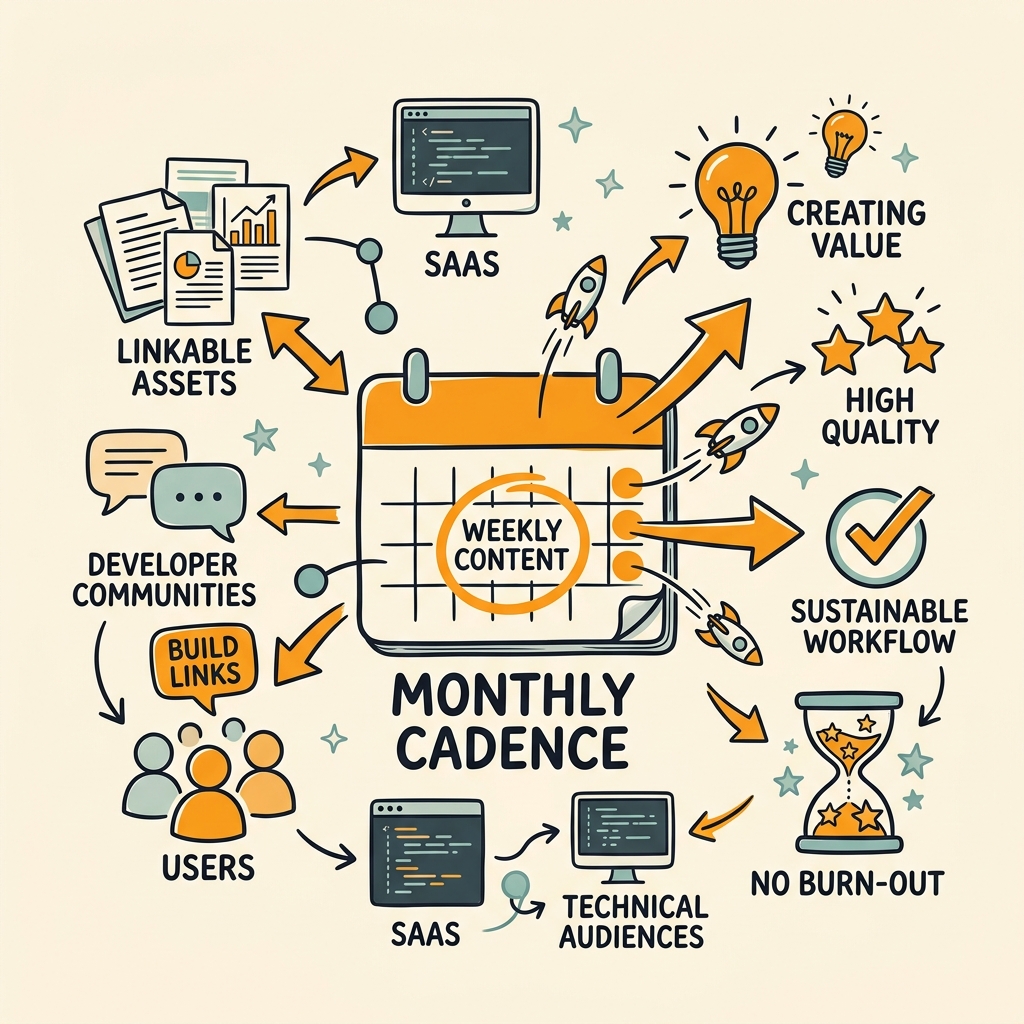
Consistency compounds in developer communities. The teams earning the most links aren't working harder; they're following a repeatable rhythm that distributes one asset across multiple channels without requiring weekly brainstorms. The cadence looks like this:
Week 1: Creation & Launch. Publish your linkable asset (data study, tool, guide) on your blog and send a short, personalized press note to 10–15 curated journalists, newsletter editors, and industry reporters. No mass emails. Personalized subject lines with a clear angle: "New data: [specific finding]" beats "Check out our research."
Week 2: Partner Co-Promotion. If your asset involves integrations, email the partner's developer relations or product team. Ask if they'll feature your setup guide on their blog or dev docs. This generates a backlink and co-marketing mention.
Week 3: Community Distribution. Post your asset in 2–3 relevant developer communities (not as an ad, but as a resource answering a gap). Slack communities: post a summary and link. Reddit: post in relevant subreddits with context. GitHub: if applicable, link from relevant issues or discussions.
Week 4: Repurposing & Updates. Re-run the asset with a new angle (segment by company size, vertical, use case). Repackage the data into customer stories. Create a PDF checklist version for email campaigns.
This cadence works because it's repeatable at scale. When you automate your SEO content pipeline, your team can publish a data-backed article every 3–5 days, giving you 6–10 assets per month to distribute strategically. That means more monthly assets to share, more community opportunities, and faster link compound growth.
Measuring Link Building Success Through Developer Communities
Most teams measure link building by raw link count. That's a vanity metric. The real measure is referring domain growth, domain authority of links, traffic quality from those links, and niche relevance. Are new links coming from DA 30+ sources or DA 10 junk? Are they generating search traffic that converts?
The benchmark: close 10–20% of the referring domain gap between your site and your top 3 competitors per quarter. If your top competitor has 500 referring domains and you have 300, aim to gain 40–100 new referring domains in the next quarter. This is achievable through consistent community engagement and linkable asset creation.
Track which communities generate the most links by monitoring backlinks in tools like SEMrush or Ahrefs and cross-referencing their referrer URLs. Slack domains rarely show up in backlink reports (links come downstream from individual members' blogs), so track this through traffic analytics and direct community mentions. Set up alerts for brand mentions across communities to capture unlinked mentions you can reach out to convert.
Common Mistakes When Link Building in Developer Communities
Smart link building through developer communities fails when teams make preventable mistakes:
- Treating communities as spam channels: Posting links and disappearing alienates communities. Participation precedes promotion.
- Creating assets no one asked for: A data study on "10 trends in SaaS" ranks poorly because it's generic. A study on "API performance in healthcare SaaS" ranks and earns links because it's specific and solves a real information gap.
- Inconsistent distribution: One campaign every 6 months doesn't compound. Monthly distribution does.
- Ignoring integration partnerships: The highest-ROI link source for SaaS is integration marketplaces. Neglecting them costs thousands of authority points.
- Not automating the content pipeline: If link building requires daily involvement from your founder or SEO lead, it won't scale. Content automation handles the research and writing overhead, freeing your team to focus on strategic distribution and community engagement.
Conclusion
Developer communities are no longer just customer acquisition channels—they're strategic link-earning environments where authentic participation compounds into authority. The data is clear: 48.6% of SEO experts rate digital PR (which includes community-sourced insights) as the most effective link building tactic, and teams shipping one linkable asset monthly and distributing across communities earn 10–20% of the competitive domain authority gap per quarter.
The playbook is simple: create specific, data-backed assets; build integrations that generate automatic backlinks; engage authentically in communities where your ICP participates; and repeat consistently. The bottleneck isn't strategy—it's execution capacity. Most SaaS teams have good ideas but lack the bandwidth to research topics, write SEO-optimized content, fact-check data, and publish consistently while maintaining quality.
This is where the compound value emerges. Start your SEO agent with Jottler to automate the content research and writing phase, freeing your team to focus on the part that matters most: strategic community engagement and asset distribution. Let AI handle the 3,000-word research articles; you handle the authentic moments where links are earned.
FAQs
Which developer communities should I prioritize for link building?
Prioritize communities where your ideal customers actively participate and ask questions your SaaS solves. For B2B SaaS, this typically means Slack communities focused on your industry (e.g., "Sales Stack," "Marketing Ops Collective"), r/SaaS and r/entrepreneur on Reddit where tool recommendations drive link creation, and Hacker News if you're shipping a product developers find novel. Start with 5–10 communities, not 50. Quality participation compounds faster than scattered surface-level engagement. Track which communities generate the most backlinks through traffic analysis and community monitoring, then double down on those quarterly.
How do I create a linkable asset that actually gets cited by developers?
Solve a specific information gap. Instead of "State of SaaS 2026," create "API Performance Benchmarks for Healthcare SaaS Companies" or "Onboarding Workflows That Drive 40%+ Retention." The most cited assets answer questions developers are actively discussing in communities but haven't found authoritative answers for. Survey community threads for recurring questions, then create data-backed or framework-based content that answers those questions comprehensively. Publish it, share it in 2–3 relevant communities, and let developers cite it naturally in their own work. Fresh, niche data sources earn links for years.
Can automation help with developer community link building?
Automation helps with the content pipeline, not community engagement. You cannot automate authentic participation in developer communities—that requires human judgment and real conversations. However, automating the research and writing of linkable assets (blog posts, data studies, guides) frees your team to focus on distribution and community engagement instead of spending 20 hours writing one article. Platforms that research topics deeply, write SEO-optimized long-form content, fact-check claims, and publish directly to your CMS daily give you the content ammunition to share in communities consistently without burning out your founder or marketer.